GIS Best Practices

Essays on Geography and GIS: Volume 2


                                  July 2009
Table of Contents

What Is GIS?                                                    1

GIS: Designing Our Future                                       3

Implementing Geographic Information Technologies Ethically     15

GIScience for Human Rights                                     29

Transport 2.0: Meeting Grand Challenges with GIScience         35

Geography Education and GIS Professional Development           47

Changing the Face of Geography: GIS and the IGU                51

Process Models and Next-Generation Geographic
Information Technology                                         63

Geographic Literacy in U.S. by 2025                            75

Geography, GIS, and Mental Health                              79

The National Geospatial Advisory Committee: An Action Agenda   83

Global Dialogues: GIScience and Sustainable
Development in Africa                                          93

Get Involved with Geo-Education Reform                         97


                                                i
What Is GIS?
                     Making decisions based on geography is basic to human thinking. Where shall we go, what will it be
                     like, and what shall we do when we get there are applied to the simple event of going to the store or
                     to the major event of launching a bathysphere into the ocean's depths. By understanding geography
                     and people's relationship to location, we can make informed decisions about the way we live on our
                     planet. A geographic information system (GIS) is a technological tool for comprehending geography
                     and making intelligent decisions.

                     GIS organizes geographic data so that a person reading a map can select data necessary for a
                     specific project or task. A thematic map has a table of contents that allows the reader to add layers
                     of information to a basemap of real-world locations. For example, a social analyst might use the
                     basemap of Eugene, Oregon, and select datasets from the U.S. Census Bureau to add data layers
                     to a map that shows residents' education levels, ages, and employment status. With an ability to
                     combine a variety of datasets in an infinite number of ways, GIS is a useful tool for nearly every field
                     of knowledge from archaeology to zoology.

                     A good GIS program is able to process geographic data from a variety of sources and integrate
                     it into a map project. Many countries have an abundance of geographic data for analysis, and
                     governments often make GIS datasets publicly available. Map file databases often come included
                     with GIS packages; others can be obtained from both commercial vendors and government
                     agencies. Some data is gathered in the field by global positioning units that attach a location
                     coordinate (latitude and longitude) to a feature such as a pump station.

                     GIS maps are interactive. On the computer screen, map users can scan a GIS map in any direction,
                     zoom in or out, and change the nature of the information contained in the map. They can choose
                     whether to see the roads, how many roads to see, and how roads should be depicted. Then
                     they can select what other items they wish to view alongside these roads such as storm drains,
                     gas lines, rare plants, or hospitals. Some GIS programs are designed to perform sophisticated
                     calculations for tracking storms or predicting erosion patterns. GIS applications can be embedded
                     into common activities such as verifying an address.

                     From routinely performing work-related tasks to scientifically exploring the complexities of our world,
                     GIS gives people the geographic advantage to become more productive, more aware, and more
                     responsive citizens of planet Earth.


GIS BEST PRACTICES                                    1                                                          WWW.ESRI.COM
GIS: Designing Our Future
                     By Jack Dangermond


                     "Man may perish by his own explosive and insidious inventions. For
                     an adjustment to them he leaves himself precious little time, and
                     progressively less as his technological wizardry runs wild and rushes on.
                     If he is to survive at all, it cannot be through slow adjustment. It will have
                     to be through design more subtly considered and circumspect, through
                     more cautious planning in advance."

                     With those words in 1954, influential architect Richard Neutra
                     opened his seminal book Survival through Design. Neutra was an
                     early environmentalist, taking an approach to architectural design
                     that applied elements of biological and behavioral science—what he called biorealism, or
                     the "inherent and inseparable relationship between man and nature." Fifteen years later, in
                     his groundbreaking book Design with Nature, landscape architect Ian McHarg advocated a
                     framework for design that helps humans achieve synergy with nature. Design and planning
                     that take into consideration both environmental and social issues help us ensure that our
                     resources are used appropriately and responsibly, to help us move toward a better future for all.
                     McHarg's pioneering work not only had a fundamental influence on the up-and-coming field of
                     environmental planning but simultaneously solidified the core concepts of the young field of GIS
                     as well.

                     In the 40 years since Design with Nature was written, a better world is the common goal all
                     of us—geographers, planners, scientists, and others—have been striving for. Discussing his
                     book during the Keynote Address at the 1997 ESRI International User Conference, McHarg laid
                     out a process by which "environmental data could be incorporated into the planning process."
                     Rejecting the view of a future modeled after some idyllic environmental past, he instead was
                     an early adopter of the view that we should be using our dominance of earth systems to help
                     evolve the natural world and make it better, rather than conquer it. Powerful anthropogenic
                     influence over earth systems represents not just a huge challenge but an equally huge
                     opportunity—not humans versus nature, but humans with nature. "While traditional ecological
                     research selected environments with a minimum human influence, I selected arenas of human
                     dominance," McHarg said. Today more than ever, it is important to recognize the overwhelming

GIS BEST PRACTICES                                    3                                                     WWW.ESRI.COM
impact of humans on the environment, that massive human impacts on the earth are a fact
                             that's not going away, and that we stand at the crossroads. Thus, our challenge is to provide
                             designers, engineers, planners, and others, with a set of tools and a framework for designing
                             and managing the anthropogenic earth.
            Design for the   I've recently become very interested in the relatively new field of earth systems engineering and
      Anthropogenic Earth    management (ESEM), which concerns itself with the design, engineering, analysis, and
                             management of complex earth systems. ESEM takes a holistic view of multiple issues affecting
                             our earth—not only taking environmental, social, and other considerations into account up front
                             in the design process but also looking at challenges from an adaptive systems approach, where
                             ongoing analysis feeds back into the continual management of the system.

                             Braden Allenby, professor
                             of civil and environmental
                             engineering at Arizona State
                             University and one of ESEM's
                             founders, often emphasizes
                             the undeniably dominant role
                             humans have in earth systems.
                             "We live in a world that is
                             fundamentally different from
                             anything that we have known
                             in the past," says Allenby in
                             his paper "The Metaphysics of
                             the Anthropogenic Earth Part I:
                             Integrative Cognitivism." "It is a
                             world dominated by one species,
                             its activities and technologies,
                             its cultures, and the integrated
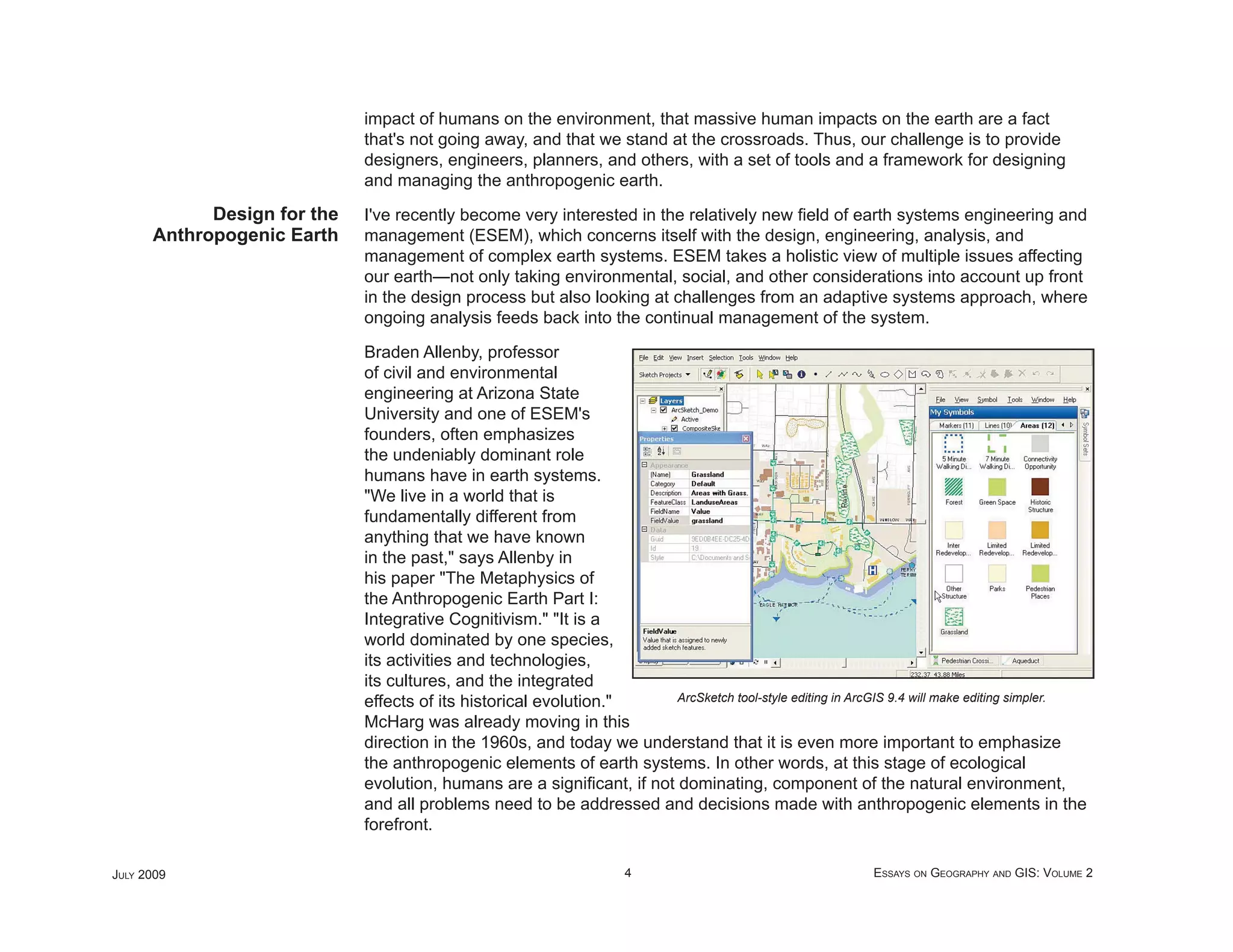
                             effects of its historical evolution."      ArcSketch tool-style editing in ArcGIS 9.4 will make editing simpler.

                             McHarg was already moving in this
                             direction in the 1960s, and today we understand that it is even more important to emphasize
                             the anthropogenic elements of earth systems. In other words, at this stage of ecological
                             evolution, humans are a significant, if not dominating, component of the natural environment,
                             and all problems need to be addressed and decisions made with anthropogenic elements in the
                             forefront.

JULY 2009                                                            4                                     ESSAYS ON GEOGRAPHY AND GIS: VOLUME 2
Allenby sees reasoned design and management in the age of the anthropogenic earth as our
                             moral imperative, but the biggest obstacle to our success is that we are not set up to work, or
                             even think, in this way. "We lack solid data and analytical frameworks to make assertions about
                             the costs, benefits, and normative assessments of different . . . practices," notes Allenby in
                             "Biomass Management Systems" in Reconstructing Earth. And this is why I believe that GIS and
                             the emerging field of GeoDesign are critical to the success of approaches such as ESEM and
                             other logical and rational models for dealing with the environmental and planning problems of
                             ours and future generations.

                             "We are being propelled into this new century with no plan, no control, no brakes." —Bill Joy,
                             Cofounder and Chief Scientist, Sun Microsystems
     Designing Alternative   The key to developing a true understanding of our complex and dynamic earth is creating a
                  Futures    framework to take many different pieces of past and future data from a variety of sources and
                             merge them in a single system. GIS is a sophisticated technological tool already in widespread
                             use by planners, engineers, and scientists to display and analyze all forms of location-
                             referenced data about the health, status, and history of our planet. GIS enables a GeoDesign
                             framework for analyzing and managing anthropogenic earth issues by allowing users to
                             inventory and display large, complex spatial datasets. They can also analyze the potential
                             interplay between various factors, getting us closer to a true understanding of how our dynamic
                             earth systems may change in the coming decades and centuries.

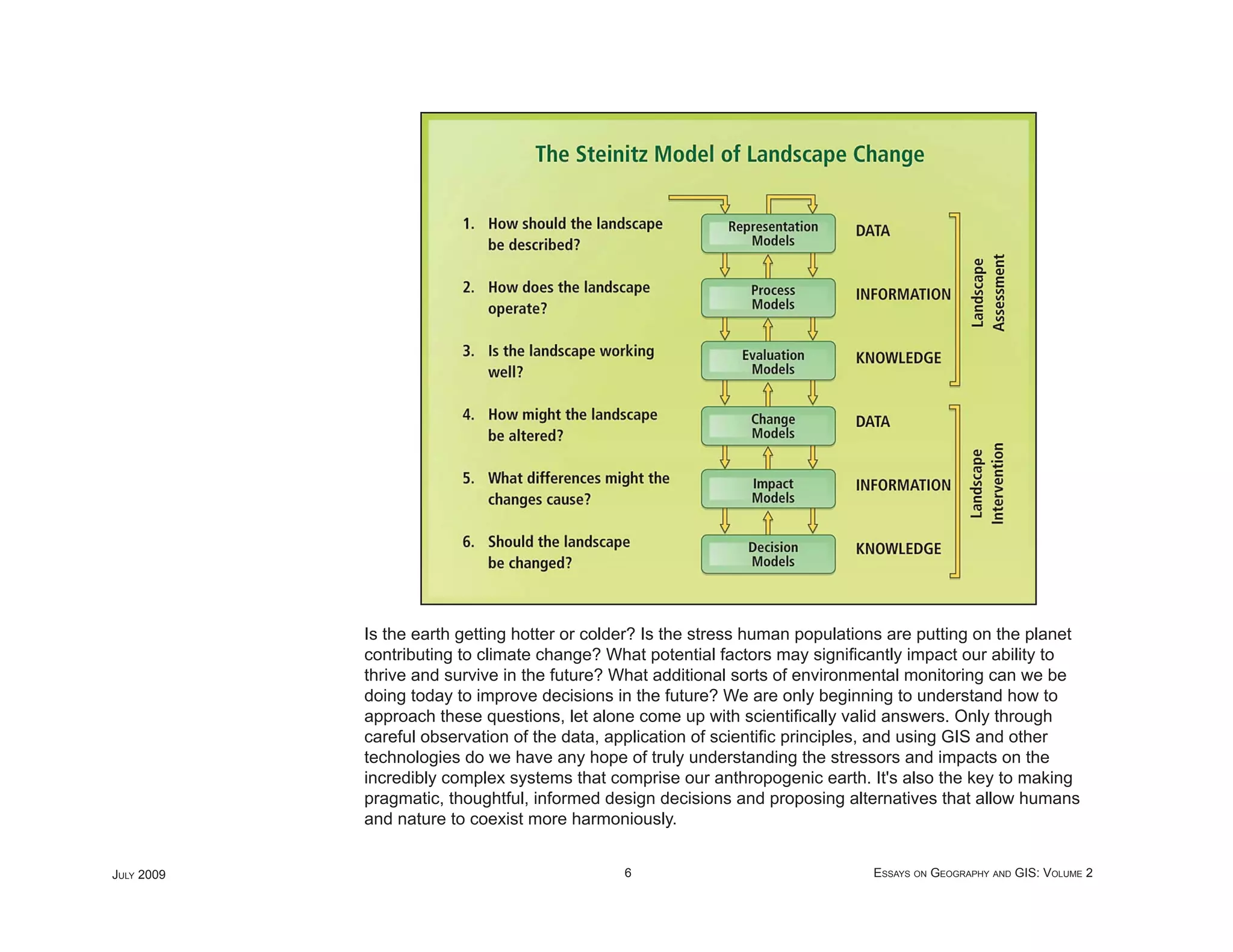
                             Carl Steinitz, an urban planner at Harvard University, originated many of the early ideas about
                             the application of GIS for landscape analysis and urban planning. Steinitz developed a model of
                             landscape change that enables design of alternative futures. Those alternative designs can then
                             be evaluated in terms of their impact on the natural environment as well as their utility to the
                             human population, and the alternative future that is projected to achieve the best balance can
                             then be selected for implementation. With a debt of gratitude to Steinitz ("A Framework for PLF,"
                             Landscape Future), the GeoDesign framework also lets us design and test various alternatives,
                             helping us make the most educated and informed decisions about the best possible future.


GIS BEST PRACTICES                                          5                                                        WWW.ESRI.COM
Is the earth getting hotter or colder? Is the stress human populations are putting on the planet
            contributing to climate change? What potential factors may significantly impact our ability to
            thrive and survive in the future? What additional sorts of environmental monitoring can we be
            doing today to improve decisions in the future? We are only beginning to understand how to
            approach these questions, let alone come up with scientifically valid answers. Only through
            careful observation of the data, application of scientific principles, and using GIS and other
            technologies do we have any hope of truly understanding the stressors and impacts on the
            incredibly complex systems that comprise our anthropogenic earth. It's also the key to making
            pragmatic, thoughtful, informed design decisions and proposing alternatives that allow humans
            and nature to coexist more harmoniously.


JULY 2009                                     6                                 ESSAYS ON GEOGRAPHY AND GIS: VOLUME 2
Design with Nature   Design with Nature—rarely has a three-word title so eloquently summed up an entire tome. The
                              most important word in that title is not design, nor is it nature. It's with. It sets the stage for
                              design and nature working together in concert to achieve something that is bigger than the sum
                              of the parts, a synergy of design and nature reaching toward the goal of the survival of the
                              human species in particular and the planet in general.

                              It's not a stretch to say that the development of GIS technology and the entire industry around it
                              was profoundly influenced by the work of McHarg. He popularized the overlay concept and laid
                              the groundwork for what was to become GIS, thus taking a number of budding young landscape
                              architects and geographers and changing their lives forever.

                              McHarg and I may have disagreed on some things, but we clearly shared the vision of using
                              geographic analysis techniques to design a better world. Although we've made much progress
                              in building the infrastructure to help us accomplish this monumental task, we're still not quite
                              there yet. In fact, 28 years after Design with Nature was published, McHarg issued a challenge
                              of sorts to attendees of the 1997 ESRI International User Conference in his Keynote Address:

                              "By and large, the ecological planning studies I did in the 1960s and 1970s have not been
                              equaled, far less surpassed. And I think there has got to be a challenge; that is, we've got to
                              be able to learn to do at least as well for regions and for the nation and, indeed, for the global
                              environment as we are doing at the moment."

                              Like McHarg's Design with Nature, ESRI is also celebrating its 40th anniversary this year. It's no
                              coincidence that both the concepts espoused within Design with Nature and the GIS work led by
                              ESRI launched almost simultaneously. When McHarg advocated this new methodology of taking
                              geographic considerations into the design process and workflow, I don't know if he could ever
                              have imagined how far we'd come with GIS by 2009. But the hard work we've been doing on
                              developing GIS technology for the last 40 years does not mean we are finished, or even close to
                              being finished. And I feel that all our hard work evolving GIS has led us to this pivotal point. The
                              next logical step in the evolution of this technology is GeoDesign.
 The Case for GeoDesign       GeoDesign borrows concepts from landscape architecture, environmental studies, geography,
                              planning, regenerative studies, and integrative studies. Much like GIS and environmental
                              planning before it, GeoDesign takes an interdisciplinary, synergistic approach to solving critical
                              problems and optimizing location, orientation, and features of projects both local and global in
                              scale.


GIS BEST PRACTICES                                            7                                                          WWW.ESRI.COM
Design is art within the framework of limitations—limitations that arise as a result of function,
                            world view, bias, and other factors, but also limitations that arise as a result of place. Design
                            considering place was at the core of McHarg's beliefs, and it is the basis for our research and
                            development efforts in the emerging field of GeoDesign.

                            ". . . design is always and necessarily an art as well as a problem-solving activity . . ." —David
                            Pye, The Nature of Design

                            To a certain extent, this is already done today by numerous GIS practitioners in fields like urban
                            and regional planning and environmental management. But GeoDesign makes this easier by
                            making it an integral part of the workflow, both shortening the cycle time of the design process
                            and improving the quality of the results.

                            Cycle time is shortened because GeoDesign moves analysis to an earlier stage in the design
                            process. Rather than analyzing the potential impacts and effects of a proposed project after
                            the design phase, critical factors are instead taken into consideration up front. The quality of
                            the results improves because the project is designed around, in concert with, and/or to fully
                            leverage certain geographic, environmental, and social features while simultaneously minimizing
                            undesirable impacts to those same features.
     Designing Our Future   "GIS: Designing Our Future" is the theme of the 2009 ESRI International User Conference.
                            When I talk of designing our future, I believe that combining the wealth of data available about
                            our world with sophisticated analysis and management tools is the prescription for
                            understanding and shaping the future of our planet—an anthropogenic future where advances
                            in human society, technology, etc., are designed in close collaboration with nature, resulting in
                            the best of possible future worlds. It's a huge task and a delicate balance, for sure, but with help
                            from GIS and GeoDesign tools, we readily accept that challenge. Because, frankly, we have no
                            other choice.
       What Is GeoDesign?   GeoDesign brings geographic analysis into the design process, where initial design sketches
                            are instantly vetted for suitability against a myriad of database layers describing a variety of
                            physical and social factors for the spatial extent of the project. This on-the-fly suitability analysis
                            provides a framework for design, giving land-use planners, engineers, transportation planners,
                            and others involved with design, the tools to leverage geographic information within their design
                            workflows. Fully leveraging geography during the design process results in designs that emulate
                            the best features and functions of natural systems, benefiting both humans and nature through
                            a more peaceful and synergistic coexistence.

JULY 2009                                                       8                                  ESSAYS ON GEOGRAPHY AND GIS: VOLUME 2
GeoDesign involves three activity spaces: the work environment (where designers do their
                                 work), the design tools (the tools designers use to do their work), and supportive workflows
                                 (how designers do their work). Having one of these out of sync can impede the design process.

                                    Work Environment—Today's work environment used by geo-based design professionals
                                    involves the field, the desktop, connection to enterprise servers and databases, the use of
                                    document management systems, collaborative environments (both inside and outside the
                                    enterprise), and interaction with outside agencies and organizations.

                                    Design Tools—Geo-based designers use a variety of tools to assist them as they create
                                    their designs. Probably the most frequently used tool, or type of tool, is the drawing tool. The
                                    particular type of drawing tool depends on the designer's domain and whether the designer
                                    is working in 2D or 3D space.

                                    Supportive Workflows—Most geo-based workflows, at least at a detailed level, are domain
                                    specific. Three workflows pertaining to the use of geographic information stand out,
                                    however, as being predominantly genetic: one related to land-use change; one related to
                                    the design, construction, and management of built facilities; and one related to the use of 2D
                                    CAD.
               Early Forays in   Although it might be easy to compare the two, GeoDesign should not be confused with
                   GeoDesign     computer-aided design (CAD). In fact, the first geographic design system was ArcCAD, ESRI's
                                 earliest attempt to build a dedicated GeoDesign tool. Released in the early 1990s, ArcCAD was
                                 the first fully functional GIS system within the AutoCAD environment. While traditional CAD is a
                                 useful tool in the architectural design of a building, GeoDesign is concerned with designing that
                                 same building in and around the environment. ArcCAD was an attempt to integrate geographic
                                 data and spatial modeling into the design process. ArcCAD provided powerful mapping, data
                                 management, spatial analysis, and display tools that worked directly with AutoCAD's design and
                                 drafting tools.

                                 ArcCAD was followed by other ESRI applications (including SDE CAD Client and ArcGIS for
                                 AutoCAD) that allowed designers and others within the CAD environment to leverage the full
                                 power of GIS functionality and GIS databases. ArcGIS for AutoCAD, a free downloadable tool
                                 that offers seamless interoperability between AutoCAD and the ArcGIS platform, is used widely
                                 today. ArcGIS for AutoCAD users are provided with quick and easy access, within the AutoCAD
                                 environment, to enterprise GIS data published by ArcGIS Server. This tool lets designers include


GIS BEST PRACTICES                                              9                                                         WWW.ESRI.COM
the results of GIS analysis in AutoCAD designs, as well as create, manipulate, and define how
                            CAD data is organized and attributed as GIS content.
   Design Tools in ArcGIS   Design professionals are creative and rely heavily on intuition, a gut feeling that something is
                            right. GIS professionals providing input to a creative process rely heavily on analysis and
                            science. With GeoDesign, GIS becomes a tool for designers; they can move rapidly through an
                            iterative design process while leveraging the full analytical power of the geodatabase. We
                            believe that bringing together the worlds of design and analysis under one common information
                            system framework will have huge implications.

                            In 2005, Bill Miller, ESRI's engineer/architect, led a small team to develop a free sample ArcGIS
                            extension that was the first step toward true GIS-based GeoDesign tools. Released in 2006, the
                            extension allows you to quickly create features in the ArcGIS Desktop ArcMap application with
                            easy-to-use sketch tools. You simply select a sketch tool and an associated symbol, then draw
                            the feature. This simple design tool automatically manages the drawing environment, allowing
                            you to conceptualize what to draw, as opposed to how to draw it. With ArcSketch, you can
                            sketch a set of alternative land-use concept plans, quickly lay out the spatial components of a
                            disaster response plan, sketch out the location of a highway, or lay out a site master plan.

                            As a geographic sketching tool that allows users to sketch initial designs on top of GIS-based
                            maps and imagery, ArcSketch was useful to many of our users, but it is only the beginning.
                            Functionality similar to ArcSketch will be further enhanced and integrated into the core software
                            system at the 9.4 release. And subsequent releases of ArcGIS promise even more support for
                            the use of GIS for design.

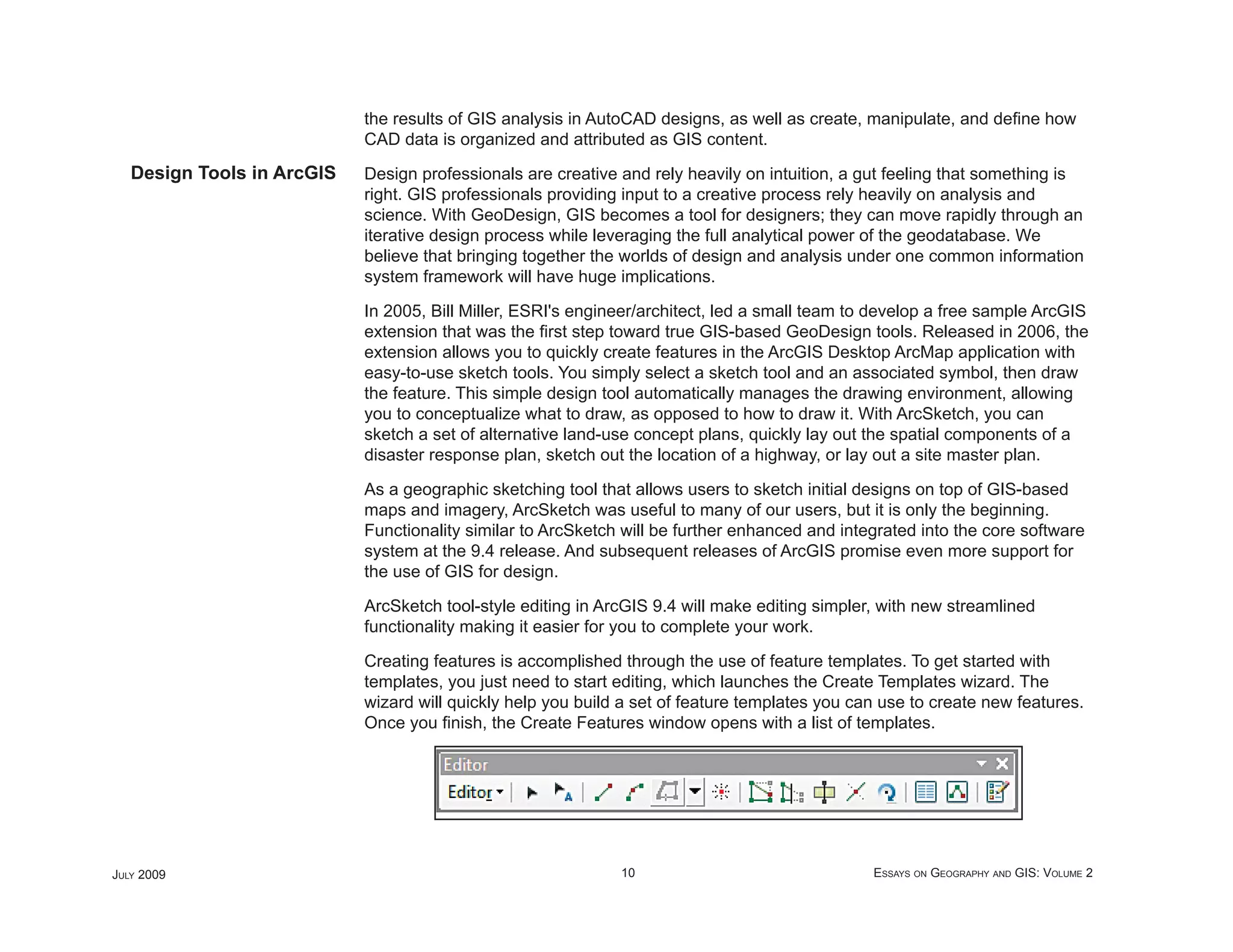
                            ArcSketch tool-style editing in ArcGIS 9.4 will make editing simpler, with new streamlined
                            functionality making it easier for you to complete your work.

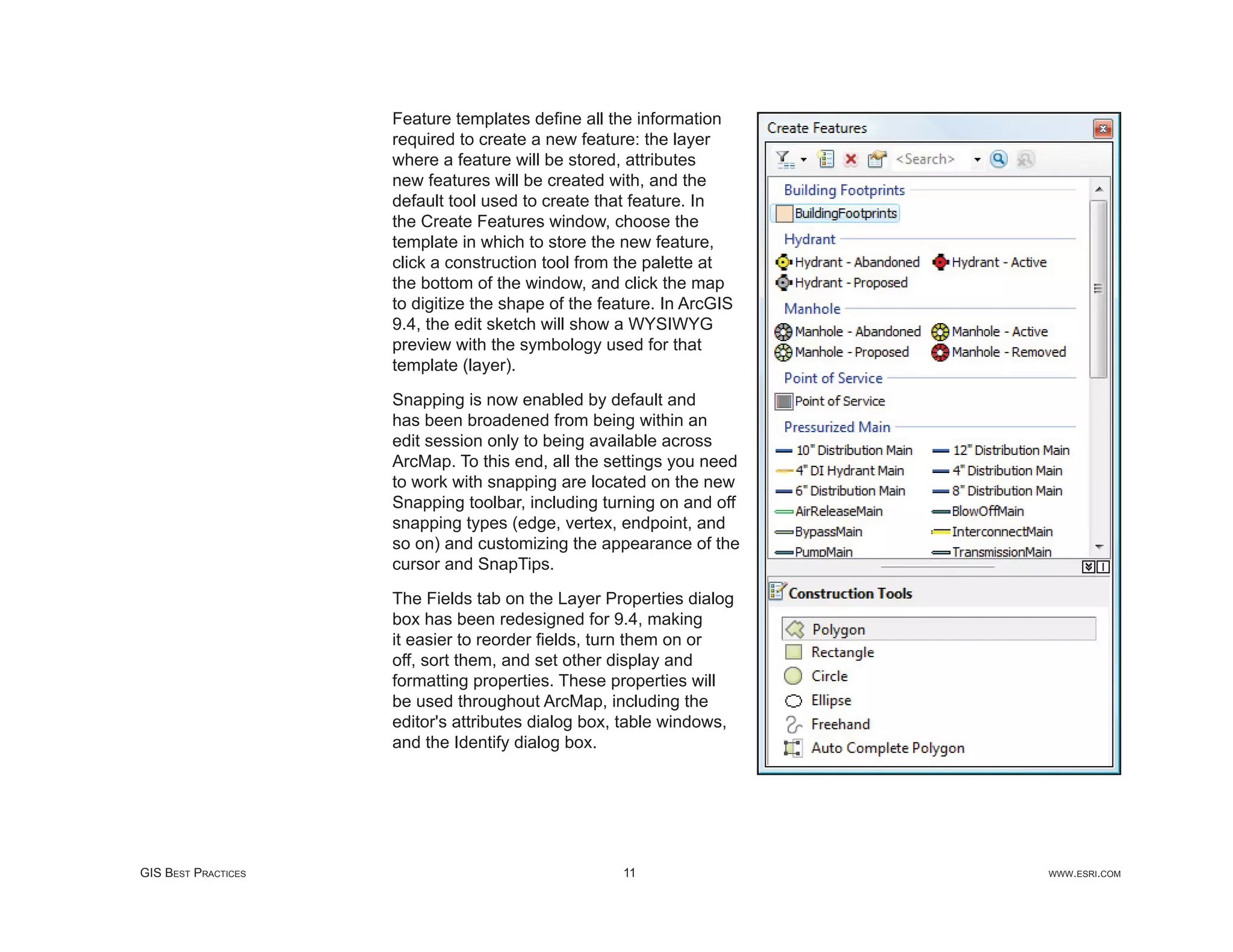
                            Creating features is accomplished through the use of feature templates. To get started with
                            templates, you just need to start editing, which launches the Create Templates wizard. The
                            wizard will quickly help you build a set of feature templates you can use to create new features.
                            Once you finish, the Create Features window opens with a list of templates.


JULY 2009                                                     10                                ESSAYS ON GEOGRAPHY AND GIS: VOLUME 2
Feature templates define all the information
                     required to create a new feature: the layer
                     where a feature will be stored, attributes
                     new features will be created with, and the
                     default tool used to create that feature. In
                     the Create Features window, choose the
                     template in which to store the new feature,
                     click a construction tool from the palette at
                     the bottom of the window, and click the map
                     to digitize the shape of the feature. In ArcGIS
                     9.4, the edit sketch will show a WYSIWYG
                     preview with the symbology used for that
                     template (layer).

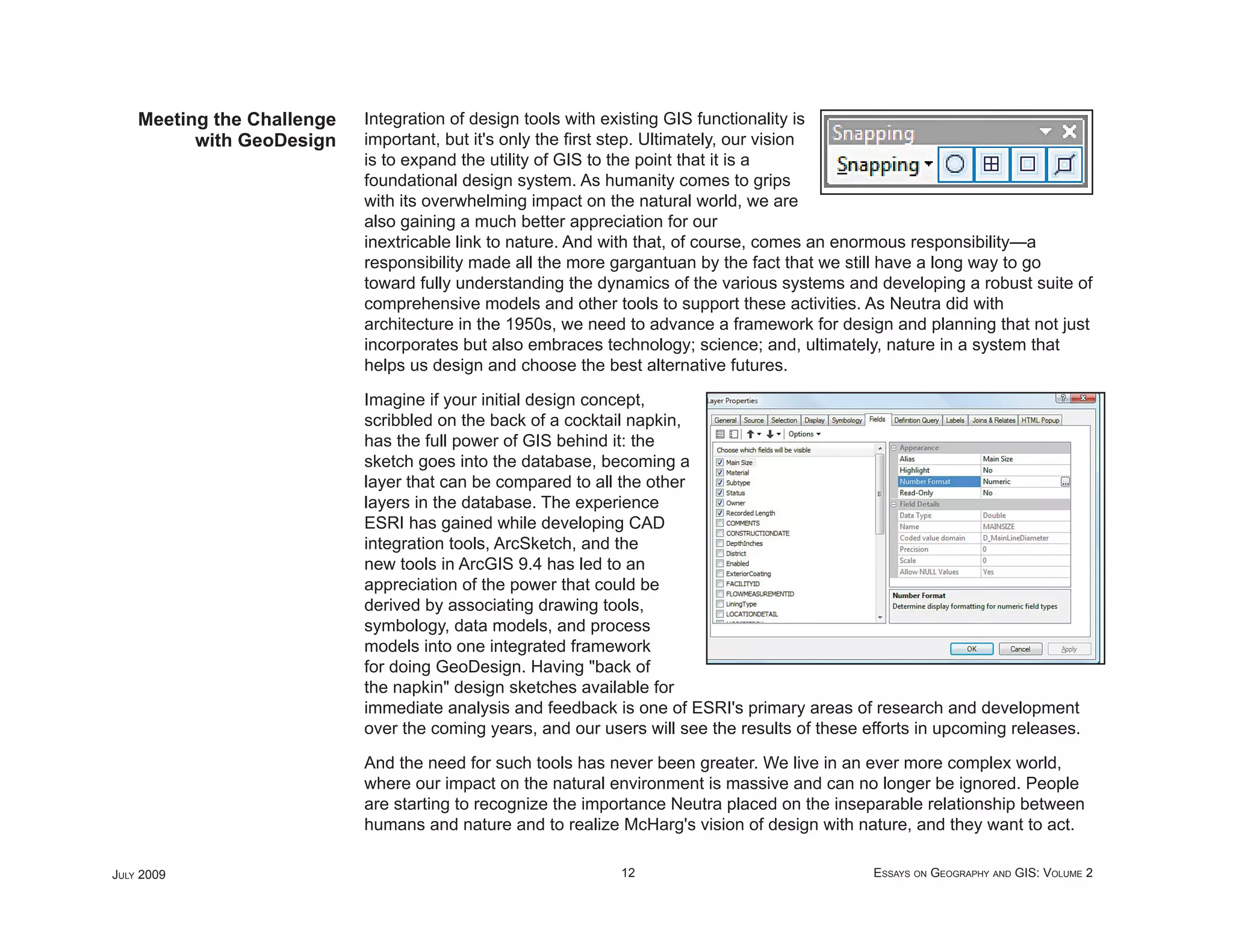
                     Snapping is now enabled by default and
                     has been broadened from being within an
                     edit session only to being available across
                     ArcMap. To this end, all the settings you need
                     to work with snapping are located on the new
                     Snapping toolbar, including turning on and off
                     snapping types (edge, vertex, endpoint, and
                     so on) and customizing the appearance of the
                     cursor and SnapTips.

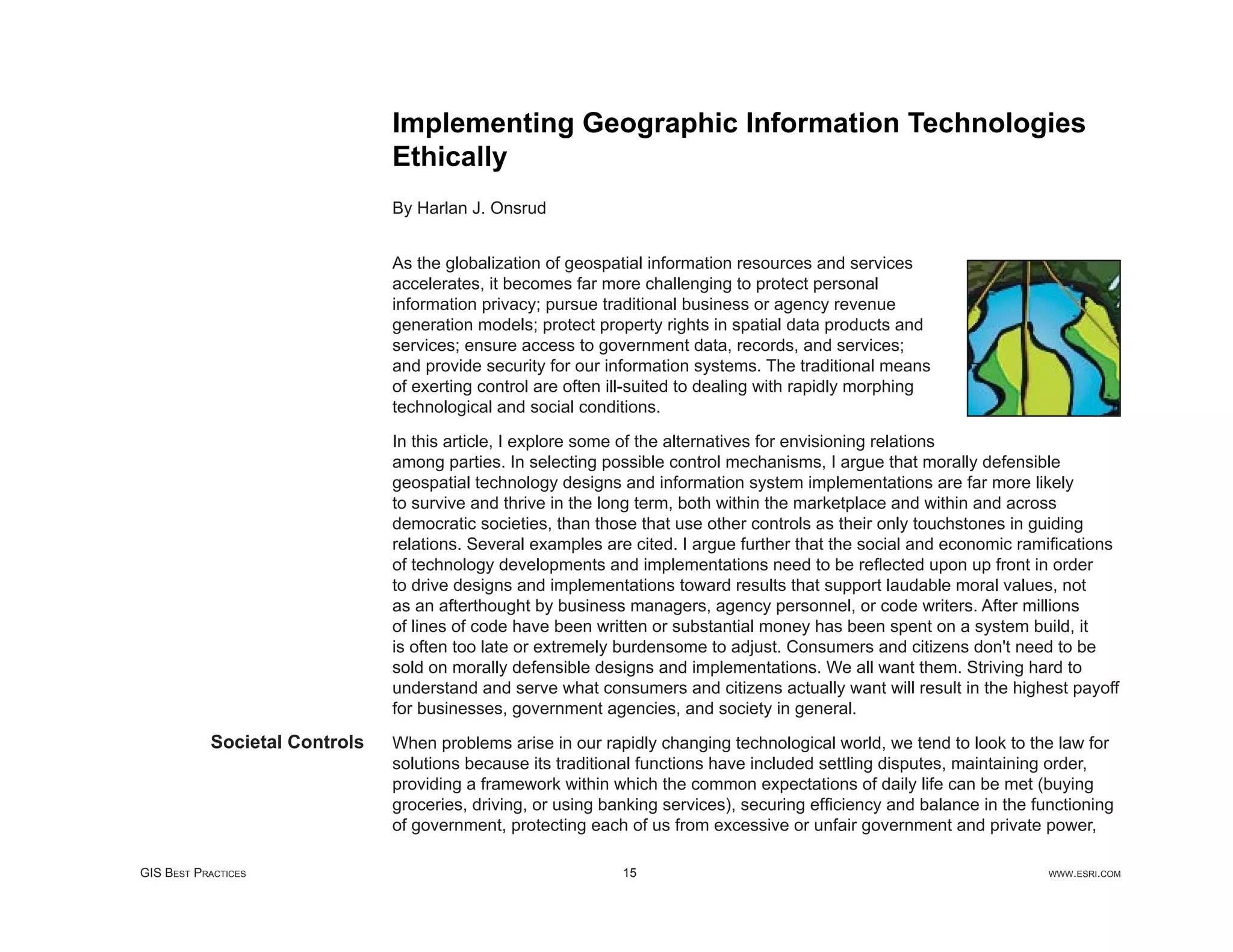
                     The Fields tab on the Layer Properties dialog
                     box has been redesigned for 9.4, making
                     it easier to reorder fields, turn them on or
                     off, sort them, and set other display and
                     formatting properties. These properties will
                     be used throughout ArcMap, including the
                     editor's attributes dialog box, table windows,
                     and the Identify dialog box.


GIS BEST PRACTICES                                  11                 WWW.ESRI.COM
Meeting the Challenge   Integration of design tools with existing GIS functionality is
          with GeoDesign    important, but it's only the first step. Ultimately, our vision
                            is to expand the utility of GIS to the point that it is a
                            foundational design system. As humanity comes to grips
                            with its overwhelming impact on the natural world, we are
                            also gaining a much better appreciation for our
                            inextricable link to nature. And with that, of course, comes an enormous responsibility—a
                            responsibility made all the more gargantuan by the fact that we still have a long way to go
                            toward fully understanding the dynamics of the various systems and developing a robust suite of
                            comprehensive models and other tools to support these activities. As Neutra did with
                            architecture in the 1950s, we need to advance a framework for design and planning that not just
                            incorporates but also embraces technology; science; and, ultimately, nature in a system that
                            helps us design and choose the best alternative futures.

                            Imagine if your initial design concept,
                            scribbled on the back of a cocktail napkin,
                            has the full power of GIS behind it: the
                            sketch goes into the database, becoming a
                            layer that can be compared to all the other
                            layers in the database. The experience
                            ESRI has gained while developing CAD
                            integration tools, ArcSketch, and the
                            new tools in ArcGIS 9.4 has led to an
                            appreciation of the power that could be
                            derived by associating drawing tools,
                            symbology, data models, and process
                            models into one integrated framework
                            for doing GeoDesign. Having "back of
                            the napkin" design sketches available for
                            immediate analysis and feedback is one of ESRI's primary areas of research and development
                            over the coming years, and our users will see the results of these efforts in upcoming releases.

                            And the need for such tools has never been greater. We live in an ever more complex world,
                            where our impact on the natural environment is massive and can no longer be ignored. People
                            are starting to recognize the importance Neutra placed on the inseparable relationship between
                            humans and nature and to realize McHarg's vision of design with nature, and they want to act.

JULY 2009                                                     12                                ESSAYS ON GEOGRAPHY AND GIS: VOLUME 2
"There is now a growing interest in combining design functionality with the broader geographical
                     context that geospatial tools offer in order to engage more deeply in land-use planning," notes
                     Matt Ball, editor at V1 Magazine. A GeoDesign framework will provide a robust set of tools for
                     design professionals and finally meet the challenge of Ian McHarg, letting us truly design with
                     nature.


                     (Reprinted from the Summer 2009 issue of ArcNews magazine)


GIS BEST PRACTICES                                 13                                                      WWW.ESRI.COM
Implementing Geographic Information Technologies
                               Ethically
                               By Harlan J. Onsrud


                               As the globalization of geospatial information resources and services
                               accelerates, it becomes far more challenging to protect personal
                               information privacy; pursue traditional business or agency revenue
                               generation models; protect property rights in spatial data products and
                               services; ensure access to government data, records, and services;
                               and provide security for our information systems. The traditional means
                               of exerting control are often ill-suited to dealing with rapidly morphing
                               technological and social conditions.

                               In this article, I explore some of the alternatives for envisioning relations
                               among parties. In selecting possible control mechanisms, I argue that morally defensible
                               geospatial technology designs and information system implementations are far more likely
                               to survive and thrive in the long term, both within the marketplace and within and across
                               democratic societies, than those that use other controls as their only touchstones in guiding
                               relations. Several examples are cited. I argue further that the social and economic ramifications
                               of technology developments and implementations need to be reflected upon up front in order
                               to drive designs and implementations toward results that support laudable moral values, not
                               as an afterthought by business managers, agency personnel, or code writers. After millions
                               of lines of code have been written or substantial money has been spent on a system build, it
                               is often too late or extremely burdensome to adjust. Consumers and citizens don't need to be
                               sold on morally defensible designs and implementations. We all want them. Striving hard to
                               understand and serve what consumers and citizens actually want will result in the highest payoff
                               for businesses, government agencies, and society in general.
           Societal Controls   When problems arise in our rapidly changing technological world, we tend to look to the law for
                               solutions because its traditional functions have included settling disputes, maintaining order,
                               providing a framework within which the common expectations of daily life can be met (buying
                               groceries, driving, or using banking services), securing efficiency and balance in the functioning
                               of government, protecting each of us from excessive or unfair government and private power,

GIS BEST PRACTICES                                            15                                                       WWW.ESRI.COM
and ensuring that all members of society have an opportunity to enjoy the minimum decencies
            of life. The roles of the law are myriad, and we naturally look to the legal system for guidance.
            Yet, resorting to the law is not the first or best mechanism for defining our relationships with
            others.

            The preferred priority of societal controls has often been listed in the legal literature as the
            marketplace, private arrangements, then the law. In this priority listing, price is viewed as
            a much better regulator of quality than laws, and support of the free will of parties, such as
            through agreements, is far more beneficial than having the law define what their relationships
            should be. In the context of the marketplace and private arrangements, the law serves a
            primarily supporting role in ensuring open competition and the enforcement of valid contracts.
            Looking to the law to define personal or resolve disputed relationships should be seen as a last
            resort.

            For resources, such as geospatial products, that can be conveyed through cyberspace, the
            inherent characteristics of data and information make enforcement of controls particularly
            problematic. The theory is that the "invisible hand" of everybody pursuing individual economic
            interests drives greater efficiency and lower prices throughout the market. However, for this
            invisible hand to function effectively, goods in the market should have the characteristics of
            being rivalrous (e.g., my consumption of an apple adversely affects your consumption of the
            same good) and excludable (e.g., I need to be able to bar your use of the good for free), and the
            market must be transparent.

            There are at least three major reasons provided in the literature as to why markets fail: public
            goods, externalities, and economies of scale.


JULY 2009                                      16                                ESSAYS ON GEOGRAPHY AND GIS: VOLUME 2
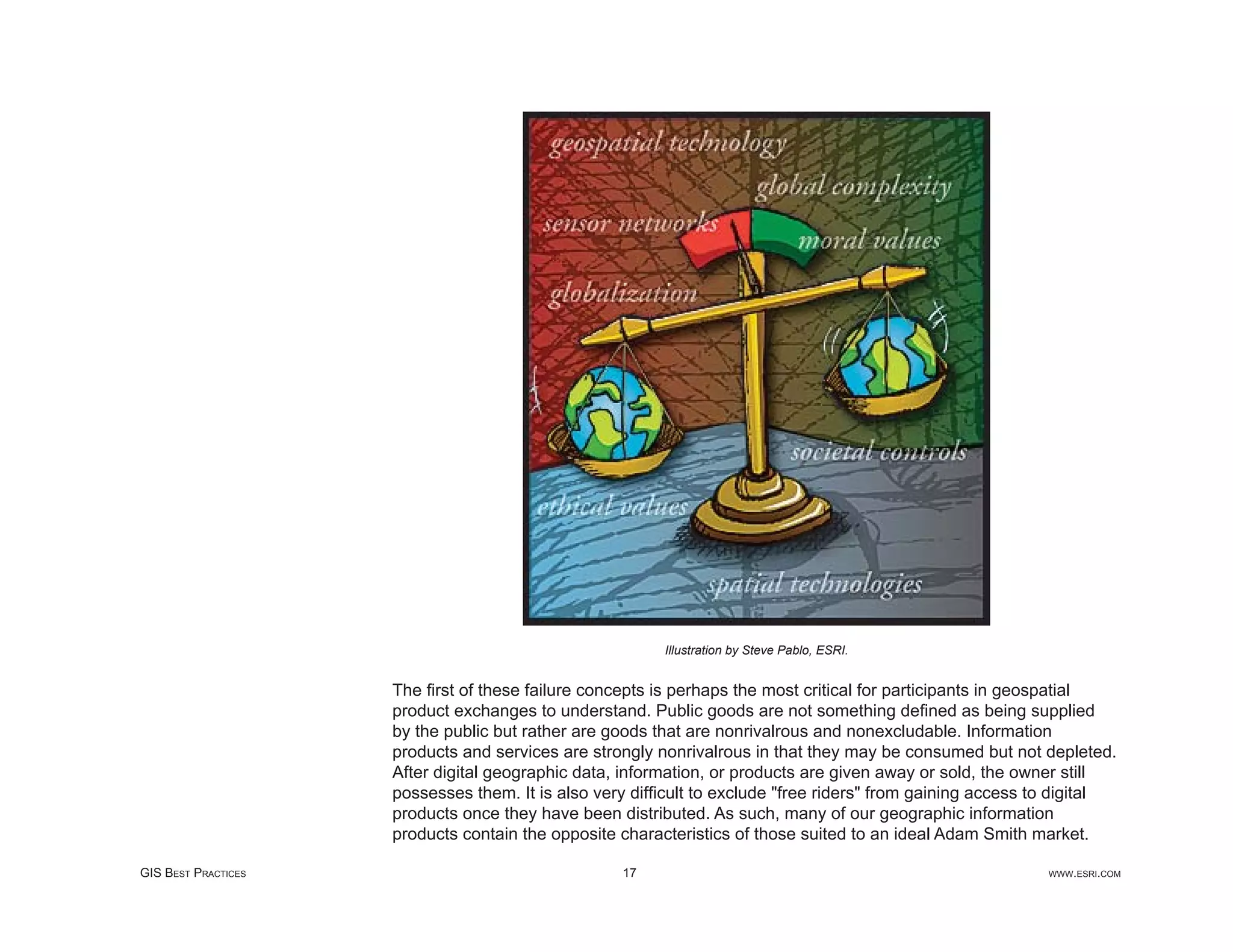
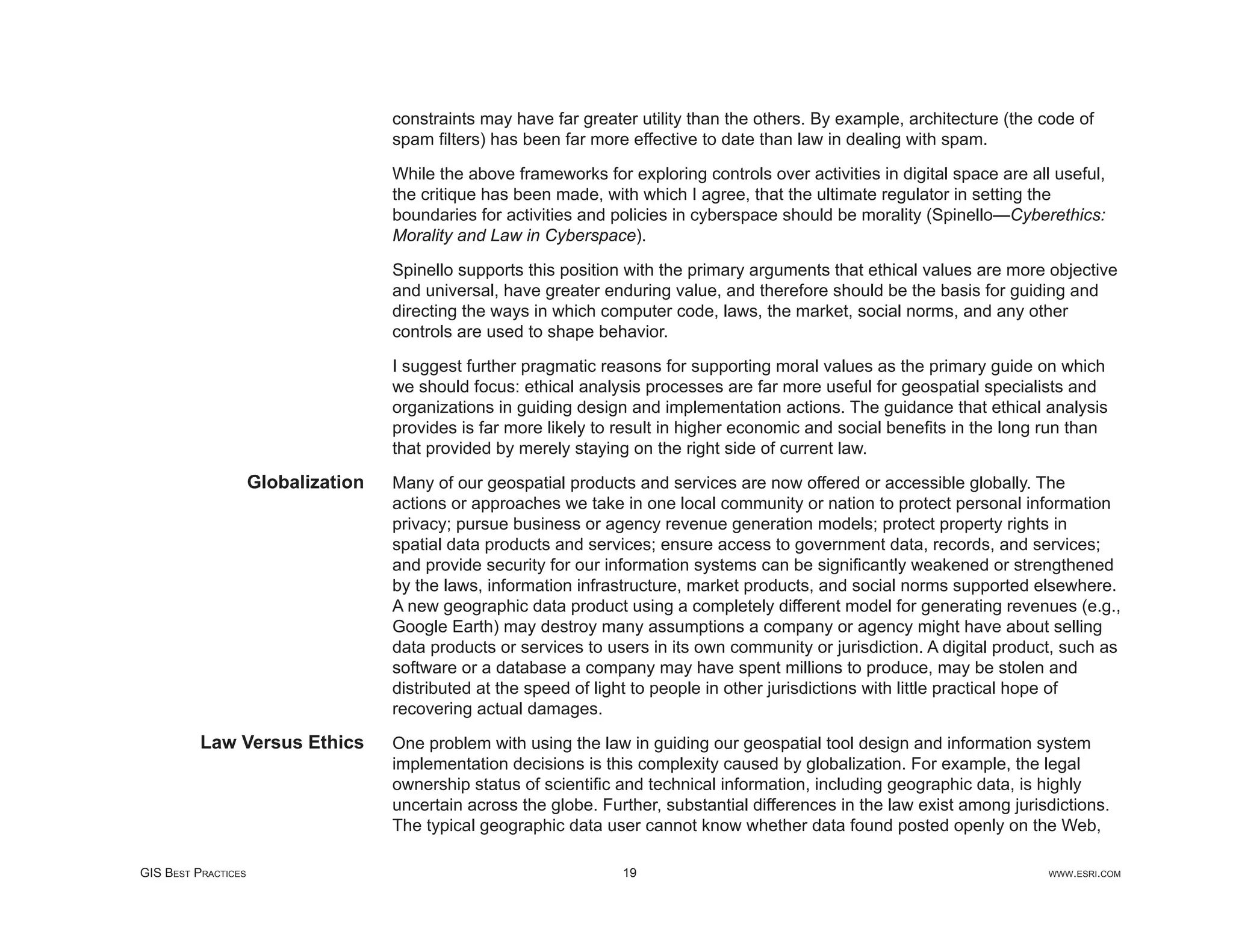
Illustration by Steve Pablo, ESRI.


                     The first of these failure concepts is perhaps the most critical for participants in geospatial
                     product exchanges to understand. Public goods are not something defined as being supplied
                     by the public but rather are goods that are nonrivalrous and nonexcludable. Information
                     products and services are strongly nonrivalrous in that they may be consumed but not depleted.
                     After digital geographic data, information, or products are given away or sold, the owner still
                     possesses them. It is also very difficult to exclude "free riders" from gaining access to digital
                     products once they have been distributed. As such, many of our geographic information
                     products contain the opposite characteristics of those suited to an ideal Adam Smith market.

GIS BEST PRACTICES                                 17                                                      WWW.ESRI.COM
There is not much we in the geospatial industry can do about the nonrivalrous nature of our
            information goods. To date, the information industry in general has used two major mechanisms
            in attempts to convert inherently nonexcludable information goods to excludable goods.

            The first is by action of law. In most nations, copyright and other intellectual property laws have
            been legislated that provide sanctions should copyrighted works be copied without permission.
            As we know from the widespread free rider sharing of music and movie files across the Web,
            enforcement through the laws of the world's nations has not been very effective to date in
            converting such nonexcludable goods to excludable goods across the globe.

            The second approach is to use technology to prevent unauthorized persons from using one's
            information products, such as through digital rights management tools. To date, however, those
            using such systems have often lost in global market competition when competing with products
            that have taken an open approach to intellectual property protection and have allowed users
            to play and experiment with information products before buying them, when competing with
            products that are given away for free in order to build a market for related services, or when
            competitors are using an alternative economic model than one relying on intellectual property
            rights to create excludability.

            A more useful framework for exploring controls that are and may be imposed among parties
            in both real space and cyberspace is the framework of law, norms, market, and architecture
            (Lessig—Code and Other Laws of Cyberspace). As we all know, laws are rules imposed by
            government, and sanctions are typically imposed after a breach occurs. Norms are standards
            of behavior, often within a specific community, and enforcement comes not from force of law but
            through violators being branded as antisocial or abnormal and stigmatized by the community.
            The market regulates through price and does so up front rather than after the fact. Finally,
            architecture constrains our behavior physically (e.g., I can't take your apples if they are locked in
            a room). Enforcement through architecture is immediate and does not require an intermediary,
            such as arrest of a lawbreaker or chastisement of a community member. The architecture of
            cyberspace is embedded in software code (i.e., I can't gain access unless I provide a user name
            and password).

            Lessig argues that all four categories of constraints are in continuous operation whether in
            physical space or cyberspace. They influence each other, and all should be explored in the
            context of their combined effects when looking for solutions in promoting good behavior and
            constraining bad behavior in cyberspace. When considering specific behaviors, one or more


JULY 2009                                      18                                 ESSAYS ON GEOGRAPHY AND GIS: VOLUME 2
constraints may have far greater utility than the others. By example, architecture (the code of
                                     spam filters) has been far more effective to date than law in dealing with spam.

                                     While the above frameworks for exploring controls over activities in digital space are all useful,
                                     the critique has been made, with which I agree, that the ultimate regulator in setting the
                                     boundaries for activities and policies in cyberspace should be morality (Spinello—Cyberethics:
                                     Morality and Law in Cyberspace).

                                     Spinello supports this position with the primary arguments that ethical values are more objective
                                     and universal, have greater enduring value, and therefore should be the basis for guiding and
                                     directing the ways in which computer code, laws, the market, social norms, and any other
                                     controls are used to shape behavior.

                                     I suggest further pragmatic reasons for supporting moral values as the primary guide on which
                                     we should focus: ethical analysis processes are far more useful for geospatial specialists and
                                     organizations in guiding design and implementation actions. The guidance that ethical analysis
                                     provides is far more likely to result in higher economic and social benefits in the long run than
                                     that provided by merely staying on the right side of current law.

                     Globalization   Many of our geospatial products and services are now offered or accessible globally. The
                                     actions or approaches we take in one local community or nation to protect personal information
                                     privacy; pursue business or agency revenue generation models; protect property rights in
                                     spatial data products and services; ensure access to government data, records, and services;
                                     and provide security for our information systems can be significantly weakened or strengthened
                                     by the laws, information infrastructure, market products, and social norms supported elsewhere.
                                     A new geographic data product using a completely different model for generating revenues (e.g.,
                                     Google Earth) may destroy many assumptions a company or agency might have about selling
                                     data products or services to users in its own community or jurisdiction. A digital product, such as
                                     software or a database a company may have spent millions to produce, may be stolen and
                                     distributed at the speed of light to people in other jurisdictions with little practical hope of
                                     recovering actual damages.
          Law Versus Ethics          One problem with using the law in guiding our geospatial tool design and information system
                                     implementation decisions is this complexity caused by globalization. For example, the legal
                                     ownership status of scientific and technical information, including geographic data, is highly
                                     uncertain across the globe. Further, substantial differences in the law exist among jurisdictions.
                                     The typical geographic data user cannot know whether data found posted openly on the Web,

GIS BEST PRACTICES                                                  19                                                         WWW.ESRI.COM
extracted from a table in a print article, or automatically extracted from a networked database
            and included as a portion of the visual results from an online Web map service is protected by
            copyright or some other legal right. Even in science, the tradition of reproducing the data of
            others in one's work, then citing the source is no longer sufficient. Although many in society tend
            to ignore legal rules when they fail to meet our day-to-day expectations or they appear patently
            unjust as applied to our circumstances, the law in many jurisdictions now assumes that if the
            compiled digital data of others is used without their permission, it's done at the user's own legal
            peril. Just as one may not assume that any music file found openly available on the Web is free
            to copy legally without permission, the same holds true for most of our geographic digital
            products.


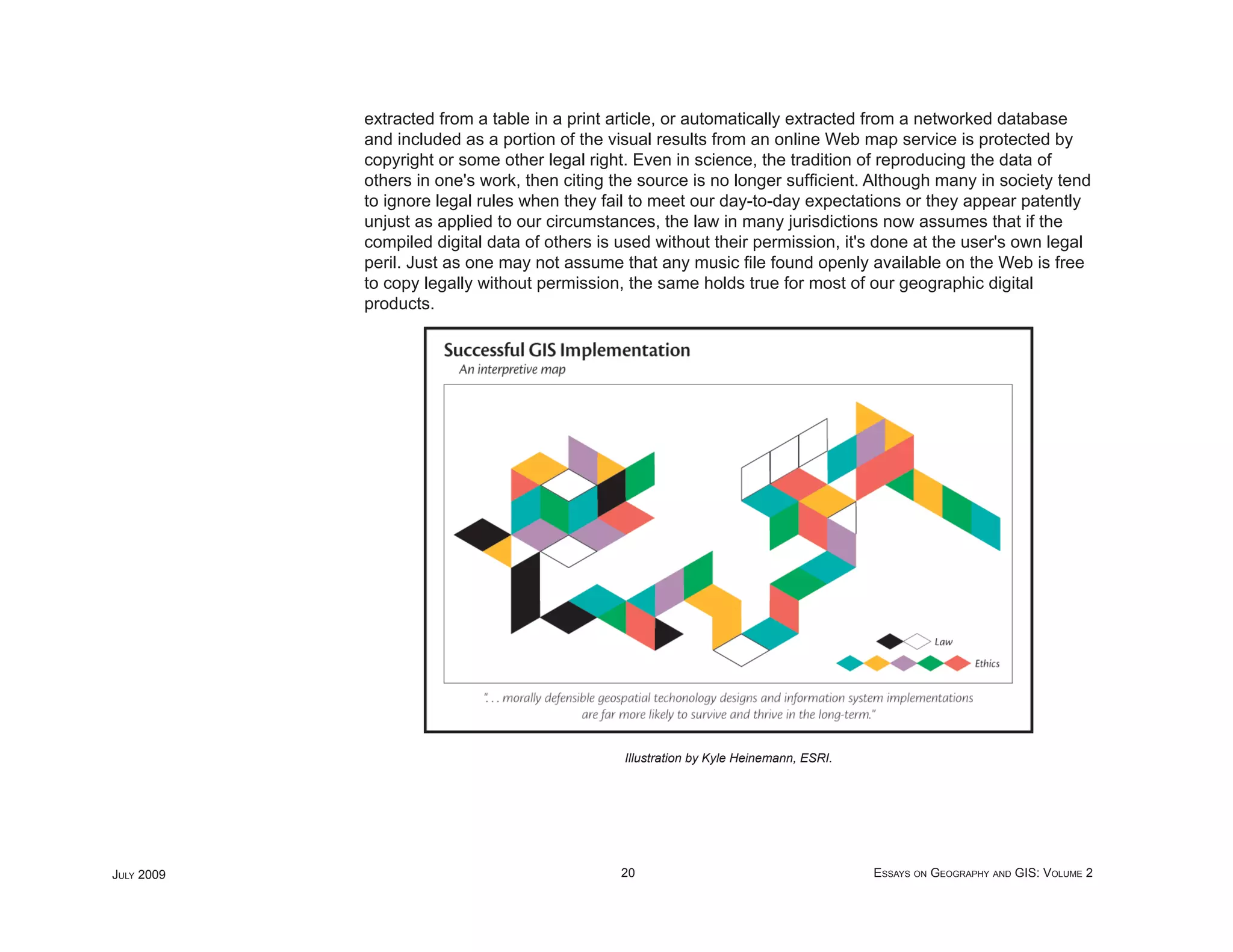
                                               Illustration by Kyle Heinemann, ESRI.


JULY 2009                                      20                                      ESSAYS ON GEOGRAPHY AND GIS: VOLUME 2
In addition to its complexity, another problem with using law as a primary guide for our
                              geospatial design and implementation decisions is that laws are passed on a majority-
                              rules basis (or representative majority-rules basis), at least in democratic societies. Even
                              in democratic societies, the concerns of minorities or disenfranchised parties may not
                              be adequately protected if we seek to meet only the letter of the law in our designs and
                              implementations.

                              A third problem with using the law as a primary guide is that legal rules tend to establish
                              minimum standards of conduct and are applied on a basis where one rule applies to all.
                              Minimally legal conduct often falls far short of morally defensible conduct. Examples abound
                              of database implementations and software designs meeting the minimum legal standards for
                              protecting the intellectual property or privacy rights of users but where the use of such data was
                              found by most of the data subjects to be highly objectionable, even though technically legal.

                              In contrast, core ethical values are much more universal. The core values themselves tend not
                              to change over time or with location. They are grounded in our common human nature across
                              societies. Ethical values also supply us with laudable as opposed to minimum goals for the
                              societal effects of our software designs and system implementations. Further, morally defensible
                              designs and implementations tend to embed adaptability to individual human conditions and
                              preferences. Thus, one-size-fits-all is not forced on users on a take-it-or-leave-it basis.

                              Simply following the law also typically provides little or no guidance in resolving a true ethical
                              dilemma. Resolving a right-versus-wrong conflict does not create an ethical dilemma. We
                              know what to do. Our duty is to choose the right action. An ethical dilemma occurs when
                              one contemplated action is arguably right but will cause harm to others while the competing,
                              alternative contemplated action or actions, including the alternative of doing nothing, are
                              similarly right and proper but will also cause harm to others. Thus, we truly are conflicted about
                              the right action to take.

        Core Ethical Values   The science of ethics helps us sort out which moral arguments have greater validity. The two
                              primary traditions in philosophy are deontological (concerning duty and obligations) and
                              teleological (concerning ends) theories. As a gross simplification, under deontological theories,
                              intent is everything. As long as you intended to do good or at least not do bad, your action is
                              morally defensible. Under teleological theories, intent or motive doesn't really matter as long as
                              the final result is good. Thus, although the marketplace might be vile, greedy, and focused on
                              maximizing self-interest, if everyone in society benefits by having a free and open marketplace,
                              perhaps the open marketplace has greater moral strength than alternative economic systems.

GIS BEST PRACTICES                                           21                                                         WWW.ESRI.COM
Over time, we have seen thousands of scholarly articles subcategorizing and attempting to
            reconcile these ethics traditions. Thus far, no single universal theory has emerged to provide us
            with a single clear-cut guide for our actions, yet the primary lines of ethical thought have many
            areas of agreement.

            In assessing the moral validity of a contemplated action, such as a system design or
            implementation approach, we could indeed assess the action in the light of the traditional lines
            of philosophical reasoning. However, a more straightforward and contemporary solution is to
            focus on intermediary principles comporting with the primary ethical theories. While several
            theoretical frameworks might be used, I'll choose to illustrate some later examples using the
            concept of principlism as advocated by Beauchamp and Childress (Beauchamp and Childress—
            Principles of Biomedical Ethics).

            Under this approach, certain prima facie duties are always in effect. They include autonomy of
            the person, nonmaleficence, beneficence, and justice. When assessing a planned action, all
            these duties always apply.

            Briefly, autonomy is the duty to support self-determination in defining, planning, and pursuing
            a good life; nonmaleficence is the duty to avoid harm to others; beneficence is the duty to
            advance the welfare of others when able to do so; and justice is the duty to treat all fairly and
            impartially. When the duties are in conflict or one duty cannot be achieved, it needs to be asked
            whether there are alternative actions that might satisfy them all. If not, one needs to analyze the
            alternative design or implementation actions to determine which alternative might best achieve
            the duty viewed as being most critical to honor in the specific instance and minimize the harmful
            effects of not fully supporting one or more other duties.

            For the long-term efficacy of software designs and system implementations involving the
            general public or consumers, moral issue consciousness and knowledge of ethical analysis
            processes for assessing contemplated actions by business managers, agency personnel, and
            code writers are extremely important.

            There are several guidelines offered by practical ethicists. Most of the good guidelines
            automatically incorporate consideration of controlling laws and relevant disciplinary codes of
            conduct. In a straightforward case, resorting to law or codes of conduct may provide an answer
            that the designer or implementer can live with and perhaps one need go no further. In the tough
            cases, however, a systematic and rational procedure for thoroughly evaluating the situation is
            recommended. One that I use with both practicing professionals and students is the process

JULY 2009                                      22                                ESSAYS ON GEOGRAPHY AND GIS: VOLUME 2
and list of checkpoints advocated by Rushworth Kidder (Rushworth Kidder—How Good People
                               Make Tough Choices: Resolving the Dilemmas of Ethical Living). The length of this article
                               precludes stepping through a thorough assessment of a typical geospatial ethical dilemma.
                               Rather, we jump to some examples to illustrate how moral values may have greater efficacy
                               than law and other controls in guiding us toward rational solutions.
             The Example of    The music industry initially used the law as its primary guide and control mechanism in
       Intellectual Property   regulating the behavior of music file sharers. It pursued a closed approach to intellectual
                               property protection in that only those purchasing full albums as defined and packaged by the
                               traditional record companies or those subscribing to specific music services would have a legal
                               right to possess or listen at will to the offerings of their artists.

                               Digital rights management systems were invoked to impose up-front control by locking out
                               those who had not first paid an entry fee. These models would be strictly enforced through the
                               application of law. However, this industry-wide model was viewed as unjust and illogical by large
                               numbers of both consumers and artists in the light of current and emerging technologies. Was
                               this position of the recording industry morally defensible? What alternatives might better support
                               autonomy of the person, nonmaleficence, beneficence, and justice?

                               The current model of iTunes and similar download services is one that appears to be far
                               more morally defensible in meeting societal needs. Focusing on the moral values of justice
                               and fairness, the current implementation of iTunes Plus comports much more with the long-
                               established legal bargain made between copyright holders and society in that, once a copy
                               of a work has been purchased, "fair use" of the work without further payment is supported
                               uninhibited by digital rights management constraints. This includes the right of the purchaser of
                               a copy to transfer that copy to a reasonable number of other mediums for personal use.

                               The copyright holder (e.g., artist, recording company) is protected by using technology not
                               to lock out access but by using technology to make purchasers accountable. It does so by
                               attaching personally identifiable information to purchased files so that those who blatantly abuse
                               the law by distributing their purchased copy to millions of others can be identified. ITunes and
                               similar music sites support autonomy of the individual and beneficence by allowing artists to
                               publicly publish their works in the manner in which they desire without controls imposed and
                               fees extracted by intermediaries. Further, consumers have the ability to purchase individual
                               tracks as opposed to collections packaged as albums. In terms of nonmaleficence, the harms


GIS BEST PRACTICES                                            23                                                       WWW.ESRI.COM
of the economic, technological, and legal model pursued appear to be imposed primarily on
                               competitors, and such harms, assuming a competitive marketplace, are typically viewed as a
                               societal benefit by bringing down costs to make goods available to larger segments of society.

                               While Steve Jobs and other executives at Apple probably were not thinking explicitly of moral
                               values in developing a workable solution for delivering music to consumers, their results remain
                               an example where following a morally defensible path, as opposed to a legal rights advocacy
                               path, has achieved far greater positive relations with consumers and profits for businesses.
                               How might suppliers of geographic data and services similarly supply location-based data and
                               services using approaches that are morally defensible while better achieving business and
                               government objectives?
             Ethics-Driven     For at least the past quarter century, the debate has continued as to whether, under what
       Implementations of      circumstances, and to what extent property restrictions should be imposed on citizens and
  Geographic Information       businesses in the use of geographic data that was gathered by domestic government agencies
      Systems and Spatial      to meet government mandates and funded through general tax revenues. Similar debates
   Data Infrastructure: An     surround the issue of whether data gathered for science through taxpayer-funded research
   Illustrative Intellectual   grants should be made available to other scientists, businesses, and government agencies with
       Property Challenge      no intellectual property restrictions imposed on the data. Much experience in pursuing various
                               approaches exists.

                               I encourage students to explore the various approaches that have been used for the distribution
                               of scientific and technical data, then have them articulate the moral values supported or
                               not supported by these various approaches. We then search for market, legal, architecture
                               (computer code), and social norm solutions that might better meet each and all of the moral
                               values while still meeting pragmatic business and government objectives.

                               Development of one such solution was initiated (but not completed) in a research project entitled
                               the Commons of Geographic Data (geodatacommons.umaine.edu). This particular system
                               was envisioned as supporting volunteer contributions from any sector. The moral value and
                               pragmatic assessment process concluded that the contribution of geographic data by geospatial
                               specialists and nonspecialists throughout the scientific, government, and commercial sectors,
                               as well as by the general public, often highly benefits all contributors and users. Not all actors
                               in all sectors will contribute, but many will. We believe that more in these communities would
                               be willing to share their geographic data files if an architecture provided a simple mechanism
                               for doing so, creators could reliably retain credit and recognition for their contributions, liability


JULY 2009                                                         24                                  ESSAYS ON GEOGRAPHY AND GIS: VOLUME 2
exposure would be minimized, and contributors would obtain substantial benefits (e.g.,
                     increased recognition, long-term archiving of their data, peer evaluation, and credibility).

                     To meet these operational requirements, the architecture proposed would provide

                        Open Access License Generation—With a few clicks, in less than a minute, users could
                        create ironclad open access license conditions for any of their contributed datasets and bind
                        that licensing information to the data.

                        Automated Metadata Generation—With a few clicks and typed responses, in less than
                        10 minutes, users who are not GIScience professionals would use a simple mechanism for
                        creating standards-based metadata.

                        File Provenance Tracking—The system would automatically convert any contributed file
                        to several standard interchange formats and track reuse of each of these files through
                        generations of digital copying, aggregation, and partial extraction, ensuring that the parent
                        lineage is always traceable.

                        Peer Review Recommender Systems—The system would enable users to not only access
                        data through standard search mechanisms but also evaluate data for its suitability to meet
                        their needs, as well as provide feedback to contributors.

                        Long-Term Archiving—Files would be archived and backed up at interconnected, long-term,
                        institutionally supported facilities (e.g., libraries and research centers) that would not depend
                        on the contributor's continual maintenance.

                     Notice that the architecture proposed for the geospatial community has several parallels with
                     the iTunes architecture discussed above and is morally defensible using some of the same
                     arguments. It uses an open approach to intellectual property management by allowing the
                     tracing of major abusers of license conditions but not hiding the geographic data. Because of
                     the public goods aspects of the proposed architecture, unlike iTunes, the architecture is unlikely
                     to be provided through the competitive marketplace. Public or philanthropic funding would
                     likely be required to resolve the research challenges and then develop and support such an
                     architecture.

                     Several economic studies have confirmed that less restrictive intellectual property regimes often
                     have far greater benefits for democratic societies and the world in general than more restrictive
                     systems (e.g., Maurer—Across Two Worlds: Database Protection in the US and Europe) or

GIS BEST PRACTICES                                  25                                                         WWW.ESRI.COM
approaches in which government competes with private companies (e.g., Weiss—Borders in
                              Cyberspace: Conflicting Government Information Policies and Their Economic Impacts). Hence,
                              the architecture suggested above incorporates open access licensing. However, a similar
                              architecture supporting a morally defensible commercial license environment for geographic
                              data and services is also certainly possible (National Research Council—Licensing Geographic
                              Data and Services). Notice that it is possible to develop these morally defensible solutions
                              entirely through architecture without the need to change any national laws or impose any other
                              new controls.
  Ethics-Driven Design of     The mobile technology industry, as well as the location privacy literature, assumes a future in
   Geospatial Technology      which government and corporate interests will have access and control over detailed information
          Development: An     on the location and movement of objects and physical assets identified with individuals.
      Illustrative Location   Individuals will be granted, through legislation, a one-size-fits-all level of personal information
         Privacy Challenge    privacy protection regardless of individual preferences and the changing nature of those
                              preferences as technology and society change. While recognizing the importance of baseline
                              personal information privacy that should be provided to all individuals through operation of the
                              legal system, what if, instead, the global mobile tracking industry was built on the assumption
                              that universal core moral values would be supported to the greatest extent possible? How
                              instead would the technology evolve, and what explicit capabilities might the technology
                              provide?

                              In assessing pervasive tracking systems that would support core moral values, imagine
                              development of a handheld universal personal communicator. This device serves as a
                              voice phone; receives and sends text messages, still images, and video; responds to voice
                              commands and can respond back by voice; allows users to make purchases on the fly; tracks
                              their location and provides directions or business information when asked; notifies them when
                              they are near something they desire to buy or someone they wish to meet; tracks and warns of
                              traffic problems and congestion; allows them to locate and track multiple friends on the fly; and
                              performs other similar location and communication functions. This device is no longer difficult to
                              imagine in economically developed nations. The corporate sector currently assumes ownership
                              of the records of the time, location, transactions, and use of such systems, constrained only by
                              one-size-fits-all legislative provisions and cumbersome opt-out possibilities.

                              A challenge I have frequently presented to engineering students is to conceptually design a
                              prototype user interface that demonstrates how individuals might be allowed greater autonomy
                              in deciding how, when, and at what detail their locations and movements may be tracked and


JULY 2009                                                       26                                ESSAYS ON GEOGRAPHY AND GIS: VOLUME 2
retained by others. The design should increase beneficial uses of this type of technology,
                     promote growth of the industry, and promote public security while granting individuals much
                     greater flexibility and ease in protecting their personal information privacy.

                     One suggested approach resulted in recommending an integrated technological and legal
                     solution that focused on an efficient interface for changing user privacy preferences on the
                     fly with selections enforced through a dynamic contract (Anuket Bhaduri—User Controlled
                     Privacy Protection in Location-Based Services, Master's Thesis, University of Maine, 2003).
                     The suggested interface allowed users to be notified of the location and personal information
                     exposure needed to take advantage of wireless services and allowed the user to set
                     preferences, such as controlling who might contact the device user and by what methods (e.g.,
                     voice, text, video), the precision of the position and the time of the location of the user that
                     might be exposed to businesses and to various user-defined categories of acquaintances, and
                     the detail of data and time limits for storage of data by the service provider. All these decisions
                     would be under the control and at the option of each user rather than under the control of the
                     service provider. This work demonstrated that a practical design alternative does exist that
                     would support autonomy of the individual by giving consumers the power to readily control
                     their own information exposure. This particular research did not pursue in depth the issue of
                     providing incentives or benefits for industry if companies redirected their approaches in this
                     direction.

                     Another approach addressed the protection of personal information privacy in pervasive
                     radio-frequency identification (RFID) tag environments (Eva Hedefine—Personal Privacy
                     Protection within Ubiquitous RFID Environments, Master's Thesis, University of Maine, 2006).
                     The assumption in this work is that we are rapidly entering a world where RFID readers
                     will be as pervasive as security cameras, and each of us is likely to be carrying numerous
                     publicly readable passive tags on our clothes and in our wallets as we travel in order to gain
                     the numerous business and social advantages that these tags will provide. Once again, the
                     recommended solution involved an integrated technological and legal solution as the best
                     means of imposing controls to ensure a morally defensible publicly deployed system. In this
                     instance, however, the recommendation is that legislation should be passed to drive technology
                     to achieve the desired results of protecting personal information privacy while simultaneously
                     allowing appropriate surveillance for security purposes. The legislation recommended takes the
                     constitutionally defensible approach of a "do-not-link-to-identity" centralized list with wireless
                     technologies developed to allow users to override their identity protection on the fly in instances
                     where they want to gain a service that requires identity verification. The code controls would

GIS BEST PRACTICES                                  27                                                         WWW.ESRI.COM
be imposed primarily within the RFID networked communication architecture rather than in the
                               handheld devices or active sensors carried by consumers. One conclusion of this research
                               was that the public goods aspect of generally deployed privacy protection for the public
                               would prevent an appropriate market solution. To achieve a morally defensible solution would
                               require an appropriate legislative mandate from the government to drive the development of
                               infrastructure technologies in the appropriate direction.

                               The point of the preceding examples is to illustrate that the technological solutions advocated
                               are ethically, legally, and marketplace situated.

                 Conclusion    All of our individual information resources ultimately will be part of a globally connected
                               communication and interchange network. It makes sense in this evolving technological reality to
                               think of ourselves as global citizens in addition to citizens of our local communities, nations, and
                               professions and members of our business or government organizations. Implementers of
                               geographic information systems, geospatial technology code writers, and builders of geographic
                               databases and spatial data infrastructure need to be responsible, prudent, and comprehensive
                               in incorporating basic moral values into the geospatial infrastructure we help create. Not only is
                               this the right thing to do, but geospatial technology designs and information system
                               implementations that are morally defensible are also far more likely to be mutually supported
                               internationally by governments and to survive and thrive in the long term within the global
                               marketplace.

            About the Author   Harlan J. Onsrud is professor of spatial information science and engineering at the University of
                               Maine. His research focuses on the analysis of legal, ethical, and institutional issues affecting
                               the creation and use of digital databases and the assessment of the social impacts of spatial
                               technologies. He is a licensed engineer, land surveyor and attorney and currently chairs the
                               Socioeconomic Data and Applications Center (SEDAC) User Working Group, a Distributed
                               Active Archive Center (DAAC) in the Earth Observing System Data and Information System
                               (EOSDIS) located at the Center for International Earth Science Information Network (CIESIN),
                               Columbia University. He is editor of Research and Theory in Advancing Spatial Data
                               Infrastructure Concepts (ESRI Press, June 2007).


                               (Reprinted from the Fall 2008 issue of ArcNews magazine)


JULY 2009                                                         28                                 ESSAYS ON GEOGRAPHY AND GIS: VOLUME 2
GIScience for Human Rights
                              "Crossing Borders"

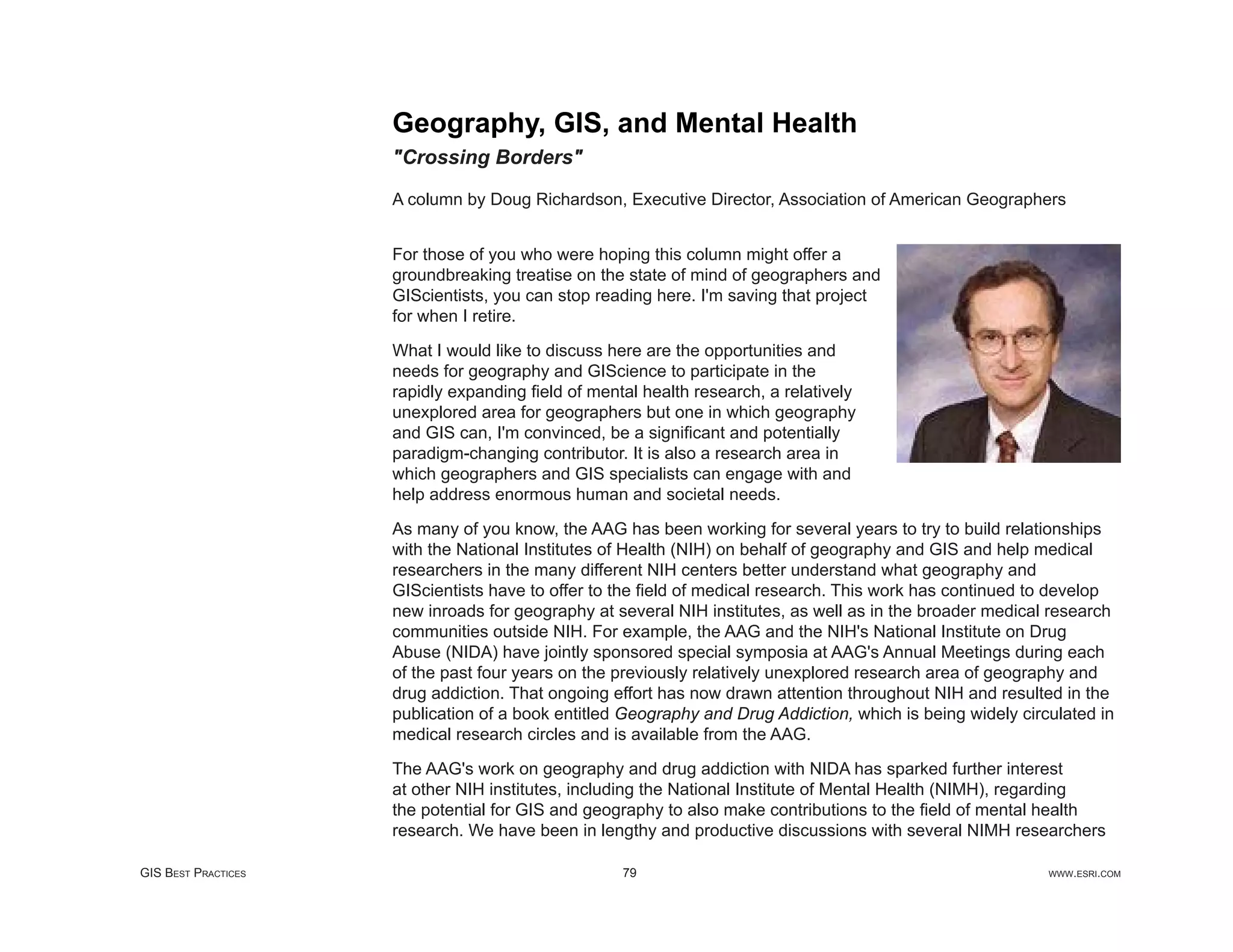
                              A column by Doug Richardson, Executive Director, Association of American Geographers


                              Nearly all geographers and GIS specialists are concerned about
                              human rights and in their personal and professional lives seek
                              meaningful ways to act on these concerns and values. For the
                              past two years, the AAG has been working together with the
                              American Association for the Advancement of Science (AAAS)
                              to explore an array of issues, projects, and programs that
                              engage GIScience, geography, and human rights.

                              This collaborative work has resulted in substantive
                              developments in three areas of human rights activity that
                              intersect geography and GIS:

                              1. The creation of a new Science and Human Rights Coalition,
                                 of which the AAG is a founding member and co-organizer

                              2. Cooperation around an AAAS project on Geospatial Technologies and Human Rights

                              3. The development of an AAG Geography and Human Rights Clearinghouse

                              I am pleased to report on progress to date on these new programs and invite the ideas, input,
                              and participation of the ESRI user community as we move forward.
       Science and Human      For the past two years, the AAG has worked closely with AAAS and a team of other scientific
           Rights Coalition   and professional associations to help develop the conceptual and organizational framework for
                              a proposed new Science and Human Rights Coalition, to be hosted by AAAS. The coalition is a
                              network of individuals and scientific organizations that recognize a role for science and
                              scientists in efforts to realize human rights. The working goals of the coalition are to promote
                              human rights awareness and programs within scientific associations, professional societies, and
                              science academies; facilitate collaborative partnerships between the scientific and human rights
                              communities to address human rights challenges; create opportunities for scientific associations
                              to explore and contribute their discipline-specific skills and knowledge to human rights; and

GIS BEST PRACTICES                                          29                                                      WWW.ESRI.COM
expand the knowledge base of human rights organizations regarding scientific methods, tools,
            and technologies that can be applied in human rights work. Scientific associations that share the
            goals of the coalition are invited to participate as members. Individual scholars and scientists
            are encouraged to participate through their scientific organizations but may also be involved as
            affiliated members.


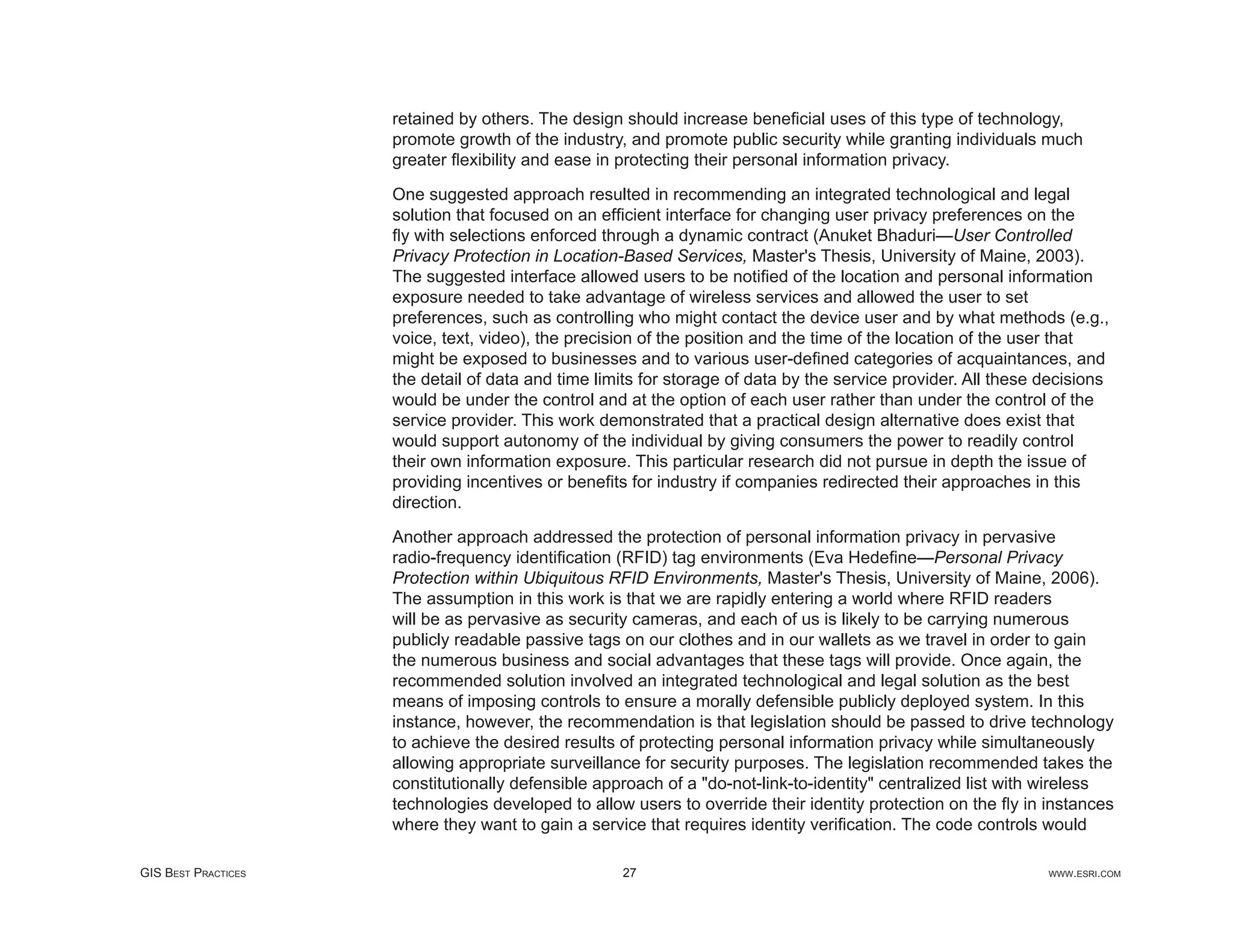
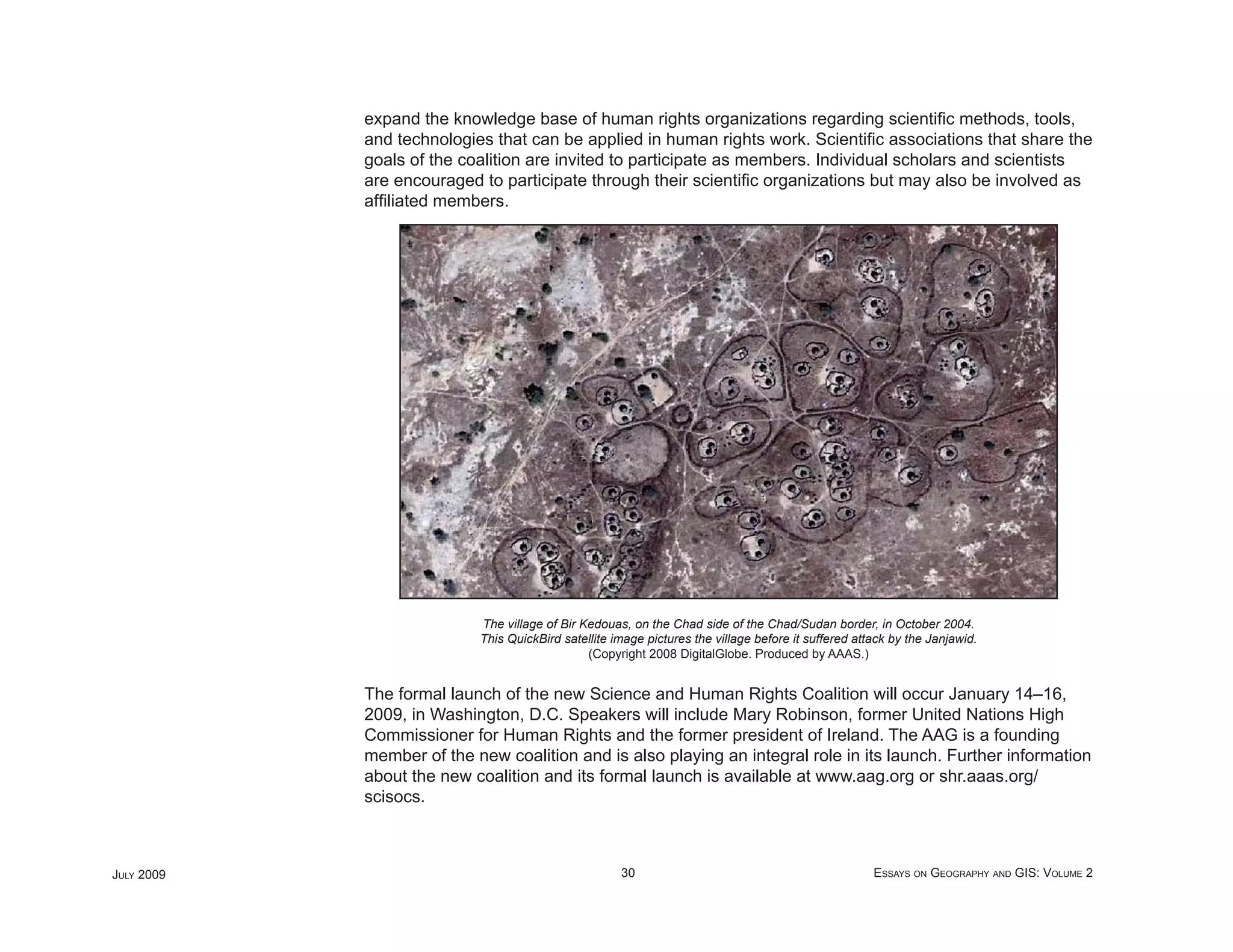
                           The village of Bir Kedouas, on the Chad side of the Chad/Sudan border, in October 2004.
                           This QuickBird satellite image pictures the village before it suffered attack by the Janjawid.
                                               (Copyright 2008 DigitalGlobe. Produced by AAAS.)


            The formal launch of the new Science and Human Rights Coalition will occur January 14–16,
            2009, in Washington, D.C. Speakers will include Mary Robinson, former United Nations High
            Commissioner for Human Rights and the former president of Ireland. The AAG is a founding
            member of the new coalition and is also playing an integral role in its launch. Further information
            about the new coalition and its formal launch is available at www.aag.org or shr.aaas.org/
            scisocs.


JULY 2009                                            30                                              ESSAYS ON GEOGRAPHY AND GIS: VOLUME 2
Geospatial    The AAG also
       Technologies and    supports and
    Human Rights Project   provides input to the
                           AAAS Geospatial
                           Technologies and
                           Human Rights
                           project, which is
                           part of the AAAS
                           Science and Human
                           Rights Coalition.
                           This project is
                           funded by the
                           MacArthur and Oak
                           Foundations to
                           develop
                           applications, as well
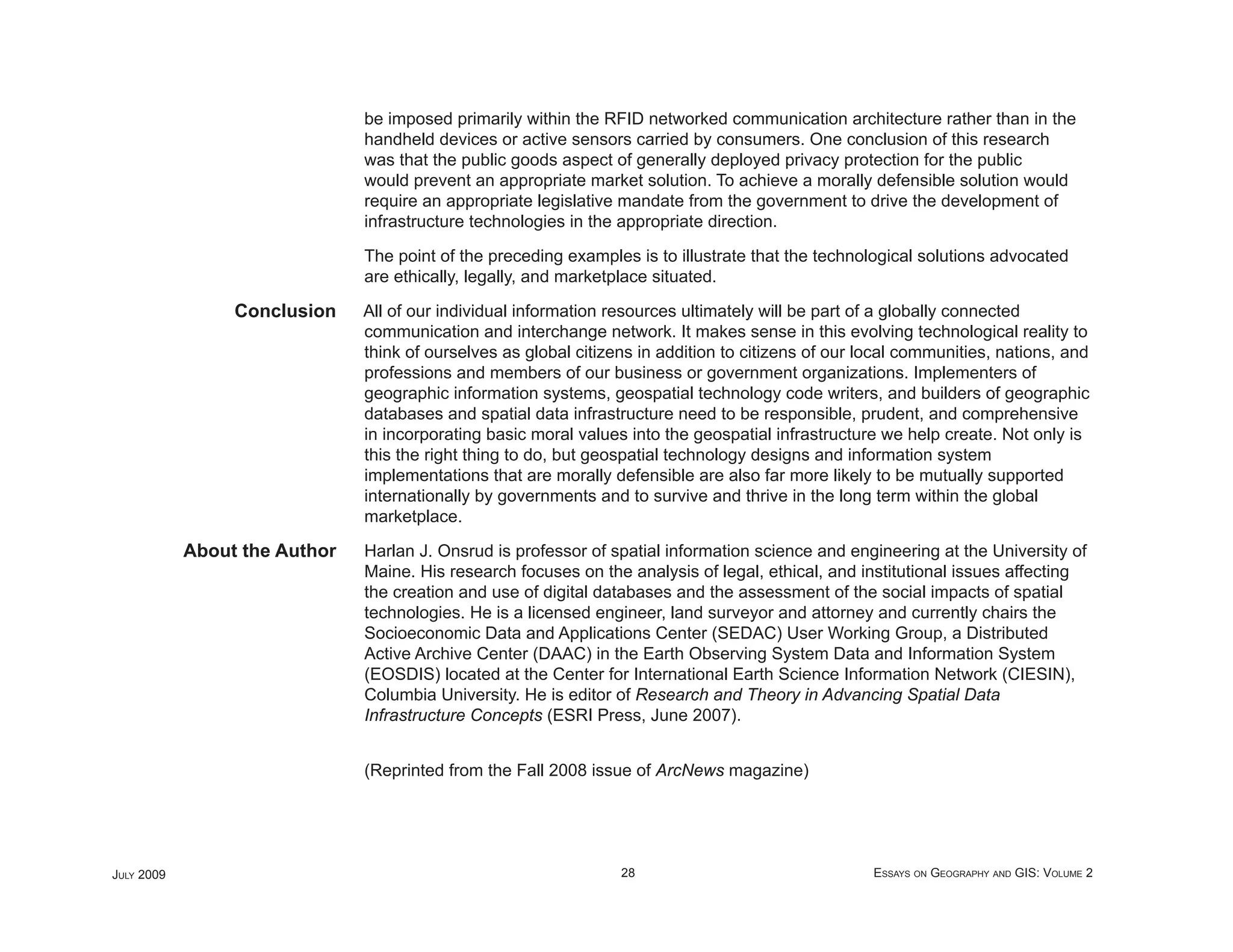
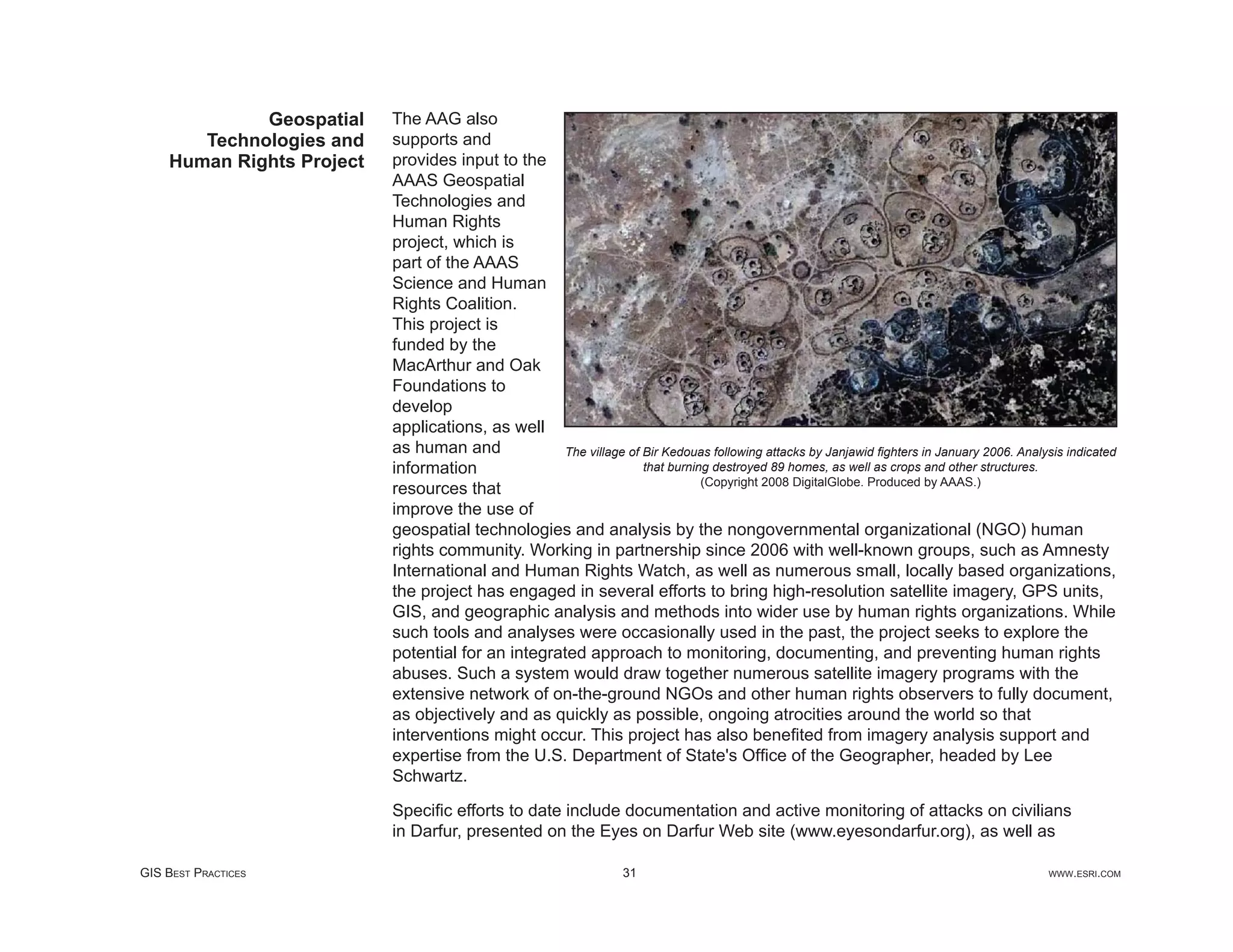
                           as human and            The village of Bir Kedouas following attacks by Janjawid fighters in January 2006. Analysis indicated
                           information                            that burning destroyed 89 homes, as well as crops and other structures.
                                                                             (Copyright 2008 DigitalGlobe. Produced by AAAS.)
                           resources that
                           improve the use of
                           geospatial technologies and analysis by the nongovernmental organizational (NGO) human
                           rights community. Working in partnership since 2006 with well-known groups, such as Amnesty
                           International and Human Rights Watch, as well as numerous small, locally based organizations,
                           the project has engaged in several efforts to bring high-resolution satellite imagery, GPS units,
                           GIS, and geographic analysis and methods into wider use by human rights organizations. While
                           such tools and analyses were occasionally used in the past, the project seeks to explore the
                           potential for an integrated approach to monitoring, documenting, and preventing human rights
                           abuses. Such a system would draw together numerous satellite imagery programs with the
                           extensive network of on-the-ground NGOs and other human rights observers to fully document,
                           as objectively and as quickly as possible, ongoing atrocities around the world so that
                           interventions might occur. This project has also benefited from imagery analysis support and
                           expertise from the U.S. Department of State's Office of the Geographer, headed by Lee
                           Schwartz.

                           Specific efforts to date include documentation and active monitoring of attacks on civilians
                           in Darfur, presented on the Eyes on Darfur Web site (www.eyesondarfur.org), as well as

GIS BEST PRACTICES                                                31                                                                       WWW.ESRI.COM
documentation efforts in Burma and the Ogaden region of Ethiopia. In such remote regions,
                               governments often are able to commit atrocities against their citizens with near impunity,
                               and satellite observations can often be the only method of authoritatively corroborating
                               witness reporting for international NGO and governmental human rights organizations. To
                               a more limited extent, such imagery can occasionally be effective as a proactive protection
                               and warning mechanism, allowing innocent people to escape from harm's way or deterring
                               attacks on monitored villages or sites. In addition, the project is currently engaged in efforts to
                               support indigenous land rights in Guatemala, document adverse impacts of aerial defoliation
                               in Colombia, and explore applications and needs of local human rights organizations in other
                               regions.
              AAG Geography    The AAG and the AAAS also recently
            and Human Rights   entered into an agreement, supported by
               Clearinghouse   funding from the MacArthur Foundation, to
                               develop an inventory of geographic
                               research and scholarship relating to human
                               rights. This inventory and resultant detailed
                               bibliography will form the foundation of a
                               new AAG Geography and Human Rights
                               Clearinghouse, which will be housed on the
                               AAG Web site. We invite all AAG members
                               and ESRI users, as well as others, to
                               contribute to this clearinghouse. Among
                               numerous applications and uses of this
                               body of research, the AAG and AAAS
                               particularly seek to identify research and
                               project work that is substantive enough to
                               be valuable as evidence or in support of
                               expert testimony in international tribunals
                               investigating human rights abuses. We
                               would very much appreciate it if you could
                               send citations of any geographic research
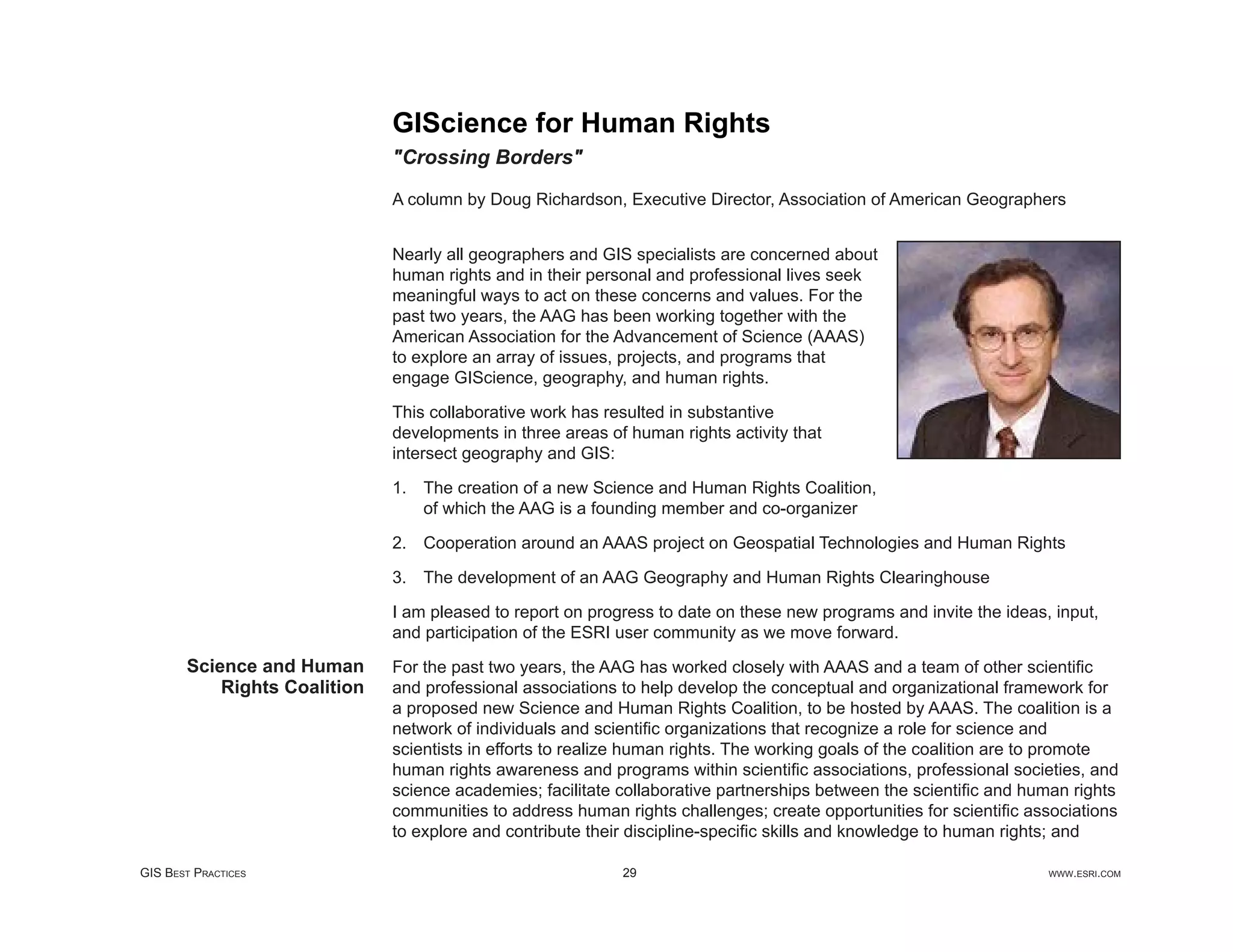
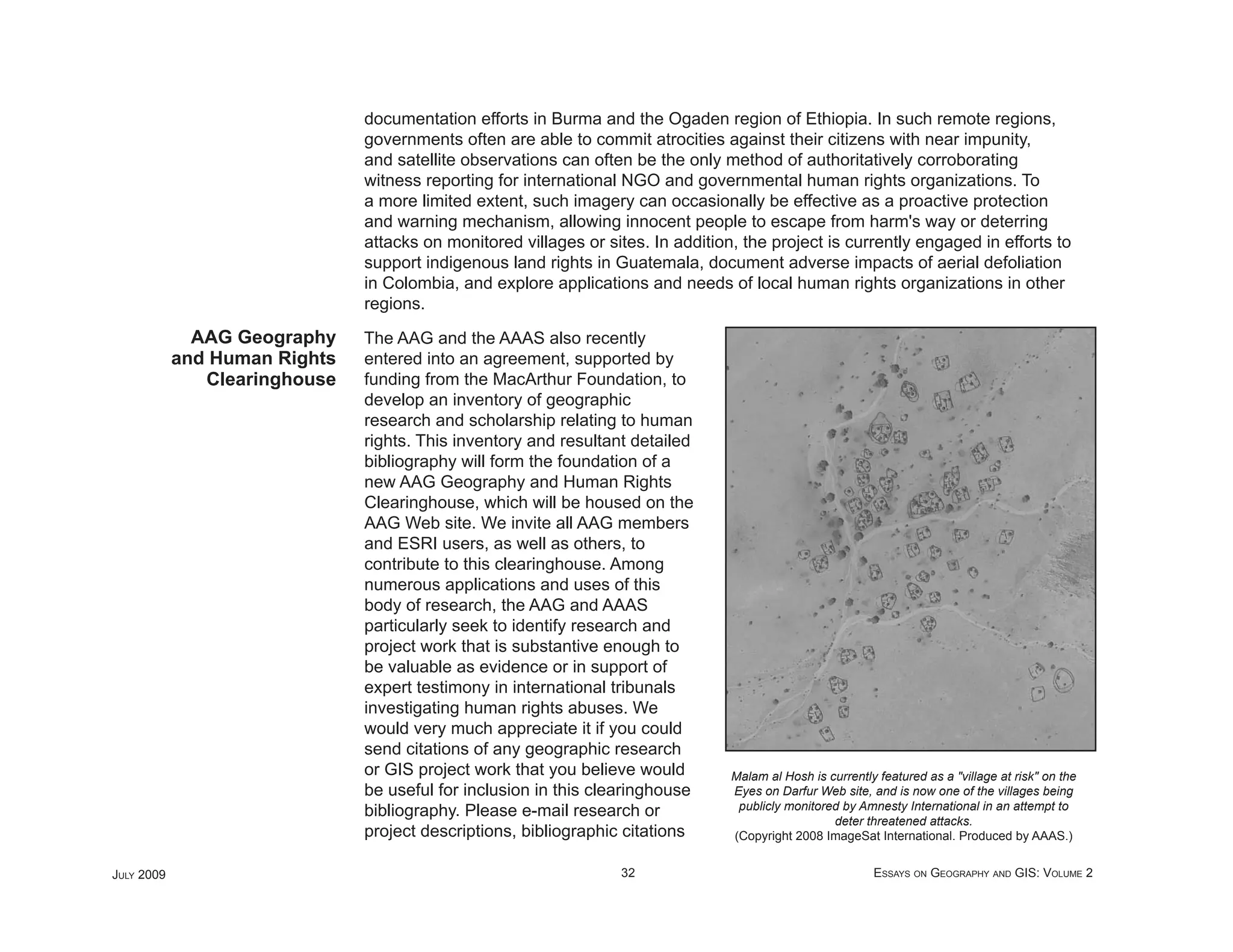
                               or GIS project work that you believe would         Malam al Hosh is currently featured as a "village at risk" on the
                               be useful for inclusion in this clearinghouse      Eyes on Darfur Web site, and is now one of the villages being
                               bibliography. Please e-mail research or             publicly monitored by Amnesty International in an attempt to
                                                                                                    deter threatened attacks.
                               project descriptions, bibliographic citations      (Copyright 2008 ImageSat International. Produced by AAAS.)


JULY 2009                                                         32                                        ESSAYS ON GEOGRAPHY AND GIS: VOLUME 2
(preferably annotated with an abstract or brief summary of the work), and other relevant material
                               to Megan Overbey (moverbey@aag.org) or Matthew Hamilton (mhamilton@aag.org) at the
                               AAG.

                               Geographer and AAAS Human Rights Project director Lars Bromley noted that "Geographers
                               and GIScientists obviously have critical and long-standing roles to play in human rights work.
                               As such, AAAS is delighted to collaborate with the AAG in an effort to concisely identify relevant
                               literature across a broad range of topics, which could inform future activities of interest to the
                               human rights community." In addition to bibliographic, informational, and research resources,
                               the AAG Clearinghouse will also provide links to other geography or GIS-related human rights
                               programs, such as those of Amnesty International, the United Nations, and the U.S. Holocaust
                               Memorial Museum's Genocide Prevention Mapping Initiative, among others.
            More Information   Regular updates on these AAG and AAAS human rights programs will be available at www.aag.
                               org and www.aaas.org.


                               (Reprinted from the Fall 2008 issue of ArcNews magazine)


GIS BEST PRACTICES                                            33                                                        WWW.ESRI.COM
Transport 2.0: Meeting Grand Challenges with
                             GIScience
                             By Harvey J. Miller


                             Transportation is vital to contemporary economies and lifestyles. But in
                             the 21st century, we are facing unprecedented challenges. Demand for
                             transportation has increased dramatically over the past decades. Both
                             transportation and communication technologies have made the world more
                             mobile and interdependent. International trade relationships have altered the
                             dynamics of manufacturing and consumption, heavily increasing the volume
                             of freight traffic. Personal travel demand continues to rise at all geographic
                             scales from local to global.

                             While in the past the strategy for managing transportation demand was
                             simply to build more infrastructure, we are facing severe financial, environmental, and social
                             constraints to expanding infrastructure. The convergence of ballooning demand and limited
                             expansion has created enormous pressures on transportation systems. Our only choice is
                             greater understanding of these complex systems and more informed decision making by
                             transportation professionals and the public who use these systems.

                             This article describes the major challenges facing transportation in the 21st century. It also
                             discusses the role of geographic information science (GIScience) and technology in helping
                             create new ways of exploring and understanding transportation systems with the goal of
                             improving decision making by both professionals and casual users. We also describe an effort
                             by the Transportation Research Board (TRB) of the U.S. National Academies to identify the
                             research and development required to achieve this vision over a decadal time frame.
       Grand Challenges in   The TRB periodically identifies critical transportation issues based on their potential impact on
            Transportation   the nation's economy and quality of life. Other critical issues, such as institutional challenges
                             and finance, are not mentioned here. Although these are also critical, they are less directly
                             relevant to GIS applications in transportation.

                             Infrastructure. The United States, along with many nations of the world, made massive
                             investments in transportation infrastructure during the 20th century. However, this infrastructure

GIS BEST PRACTICES                                          35                                                        WWW.ESRI.COM
is now old and used beyond its designed service life. This problem is not limited to highways;
            inland waterways and rail networks, as well as many sewer and water systems, have similar
            problems. The need to rehabilitate this infrastructure is occurring when higher demands are
            being placed on transportation systems and public investment is declining. How do we preserve
            and renovate saturated transportation systems without substantial increases in resources?

            Congestion. Traffic congestion is a daily fact of life for many of the nation's and world's
            commuters. Estimates of the costs in money and gasoline lost by U.S. commuters every year
            range in the billions of dollars and gallons, respectively. In most cities, congestion is no longer
            limited to rush hours in the morning and evening; it has spread to many locations and hours
            of the clock. The burden of congestion is not limited to people; freight bottlenecks at ports and
            shipment delays at the local and regional levels place enormous costs on businesses and
            consumers. The growing need for efficient and responsive transportation to support the global
            economy and mobile lifestyles is occurring in an era when the ability to expand networks is
            increasingly limited. Can we maintain current or achieve improved levels of performance without
            substantial physical expansion?

            Energy and the environment. The United States, as well
            as a burgeoning number of countries in the world, has
            an overwhelming reliance on the most energy-intensive
            transportation technologies, namely, automobiles and
            planes. The ability to continue reliance on petroleum-
            based transportation technologies is questionable in
            the short run but certainly impossible over the long
            run. Transportation systems have a direct and large
            environmental footprint, particularly with respect to air
            quality and contributions to global climate change. Over
            half the U.S. population lives in cities that do not meet
            federal clean air standards. Transportation also has
            an enormous indirect footprint through inducing other
            systems, such as cities, to manifest environmentally
            unsustainable forms, such as sprawl. Can we reduce
                                                                              Illustration by Pamela Razor, ESRI.
            the direct and indirect environmental footprints and
            achieve a sustainable transportation system despite
            increasing population and travel demands?


JULY 2009                                      36                                ESSAYS ON GEOGRAPHY AND GIS: VOLUME 2
Safety. The United States has been a world leader in transportation safety, and enormous
                             progress has been made over the past century. Nevertheless, transportation continues to
                             be the most dangerous activity experienced by a typical person. The United States is also
                             falling behind other nations, such as the United Kingdom (UK) and the Netherlands, with
                             respect to reducing fatalities and serious injuries caused by traffic accidents. While many of
                             the improvements over the past century have made drivers safer, pedestrians and cyclists
                             remain vulnerable. In the future, more people and vehicles within transportation systems with
                             minimal physical expansion imply higher incidence of crashes with potential for injury and loss
                             of life. Can we substantially reduce the number of transportation accidents without significantly
                             reducing the efficiency and responsiveness of transportation systems?

                             Security and emergencies. September 11, 2001; the London and Madrid train bombings; and
                             Hurricane Katrina illustrate the vulnerability of transportation systems to disruptions, both human
                             made and natural. Transportation systems are popular terrorism targets since they concentrate
                             large numbers of people into small spaces, increasing the likelihood of harm and enhancing
                             psychological impact. Disrupting transportation systems can also strangle contemporary
                             economies and lifestyles that depend on trade and mobility. Attempts to evacuate major U.S.
                             cities, such as New Orleans and Houston, were ineffective. Can we prevent the improper and
                             unauthorized use of transportation systems, and reduce our vulnerability to their disruption,
                             without seriously restricting mobility or violating individual rights? Is it possible to evacuate a
                             neighborhood, city, or region quickly and without additional injury or loss of life?

                             Equity. A transportation system that relies on personal vehicles creates significant
                             disadvantages for many people, especially the poor, minorities, the elderly, the young,
                             and others who cannot or choose not to drive. These problems will continue given current
                             demographic and social trends. For example, most of the elderly population in the United States
                             is aging in place, often in communities dominated by the automobile. Limited mobility can create
                             isolation and social exclusion, establishing barriers to participating in society and enjoying its
                             benefits. How do we meet the transportation needs of the growing numbers of diverse and
                             vulnerable people?
        Business as Usual?   Traditional design, planning, and investment methods, even those enhanced through GIS and
                             related technologies, are unable to meet the grand challenges facing transportation systems.
                             These methods view transportation problems as well defined and isolated. Transportation
                             modes, such as road, rail, water, and air, cannot be viewed in isolation; transportation solutions
                             are likely to be multimodal in nature. Transportation systems are tightly coupled with economic,


GIS BEST PRACTICES                                          37                                                        WWW.ESRI.COM
social, and land-use systems: transportation networks affect, and are affected by, the broader
                             systems in which they are embedded. There may be nontransportation solutions to problems
                             traditionally viewed in that manner.

                             It is also increasingly clear that human systems, such as transportation and cities, are complex
                             and difficult to manage, let alone control. We learn this lesson repeatedly as attempted changes
                             in these systems lead to disproportionate, unintended outcomes. Rather, human systems must
                             be nuanced: we can only set the framework for the evolution, not control its specific trajectory.
                             This framework is often context specific. This is not defeatist; it simply suggests that we must be
                             more clever and subtle than we have been in the past. We must achieve deeper understanding
                             of these systems.
    GIS for Transportation   GIS for Transportation (GIS-T) involves the application of GIScience and GIS for understanding
                             transportation systems and solving problems associated with their planning, construction,
                             operation, and maintenance. GIS-T has matured to the point that it is well positioned to provide
                             useful tools and strategies to meet the challenges facing transportation systems in the
                             21st century. Contemporary developments that can inform efforts to meet transportation
                             challenges include the following:

                                Development and deployment of high-resolution environmental monitoring systems, such as
                                satellite and airborne remote sensing

                                Development and deployment of location-aware technologies and geosensor networks that
                                allow fine-grained tracking of mobile objects

                                Increasing ability of GIS to maintain and display spatiotemporal and moving objects data

                                Improved science and tools for exploring and analyzing complex and massive
                                spatiotemporal data

                                Improved science and tools for simulating transportation, urban, and other human systems
                                from the bottom up—at the level of the individual person, vehicle, or object

                                Development and adoption of data standards and information infrastructures for integrating
                                and interoperating data

                             While these scientific and technological developments clearly have great potential, the question
                             remains—What do we do with all this new stuff? The challenges facing transportation systems


JULY 2009                                                      38                                ESSAYS ON GEOGRAPHY AND GIS: VOLUME 2
are great and require new modes of thinking and analysis for their solution. Indeed, the
                                 transportation challenges offer a type of "moon shot": vital problems whose solutions will require
                                 long-term vision, as well as major scientific and technological advances.
                 Mirror Worlds   In his 1993 book Mirror Worlds: Or the Day Software Puts the Universe in a Shoebox . . . How It
                                 Will Happen and What It Will Mean, computer scientist David Gelernter describes a future where
                                 you look at your computer and see reality—the real-time status of an entire company, hospital,
                                 transportation system, or city.


                                                                      Illustration by Fred Estrada, ESRI.


                                 You start with a broad, geographic overview, perhaps a digital globe. You zoom in to your
                                 city. As you get closer, you see patterns—colors, shapes, and flows—draped on the city,
                                 representing the real-time status of its systems and infrastructure. Some patterns are static,
                                 some change shape, color, or intensity as the city changes in real time. As you zoom in closer,
                                 the representations automatically change to reflect greater detail. At the largest scale, you
                                 see vehicles—automobiles, planes, trains, ships—moving through a photorealistic, three-
                                 dimensional model of the city's buildings, roads, tracks, and waterways. But it is not quite real.
                                 Although they reflect real conditions, most of the vehicles are synthetic, except for some of
                                 direct interest to you (your car, your fleet, a delivery truck with a package for you). Also, many of
                                 these objects are augmented with text, sound, and imagery, reflecting some status that requires
                                 your attention or may capture your interest. You can even enter some of the buildings, for
                                 example, to attend a public hearing at city hall.

                                 During your exploration, you meet other people who are visiting and participating in the mirror
                                 world. You also interact with virtual participants—software agents who act on your behalf,


GIS BEST PRACTICES                                              39                                                         WWW.ESRI.COM
finding, digesting, and reporting information of interest to you, perhaps making some choices for
            you but alerting you when crucial decisions are required.

            At any time you can navigate the scene and manipulate many of its objects; the flows and
            patterns change as they aggregate or disaggregate with the changing viewpoint. The displayed
            attributes may change as well, either automatically with the changing perspective or through
            your commands. You can also change the temporal scale: running the synthetic city backward
            or forward in time at varying rates, even exploring simulated futures. In addition to manipulating
            space and time, you can also explore for semantic similarity: find analogous states of the city or
            other cities that are similar to a real or imagined situation and see what happens.

            Perhaps you are a busy person who needs to manage a hectic schedule. You use the mirror
            world to check real-time conditions of the transportation system and work with a virtual
            transportation concierge to determine the best schedule, travel, and mode choices (including
            cooperating with other users through carpooling or ride sharing) that allow you to accomplish the
            activities that comprise your day in a timely and efficient manner. But you are also a concerned
            citizen, and the mirror world allows you to participate in community decision making, say, tour a
            realistic depiction of the proposed light-rail line through your neighborhood, see the simulated
            future with and without the line, and search for other places and times with similar projects.
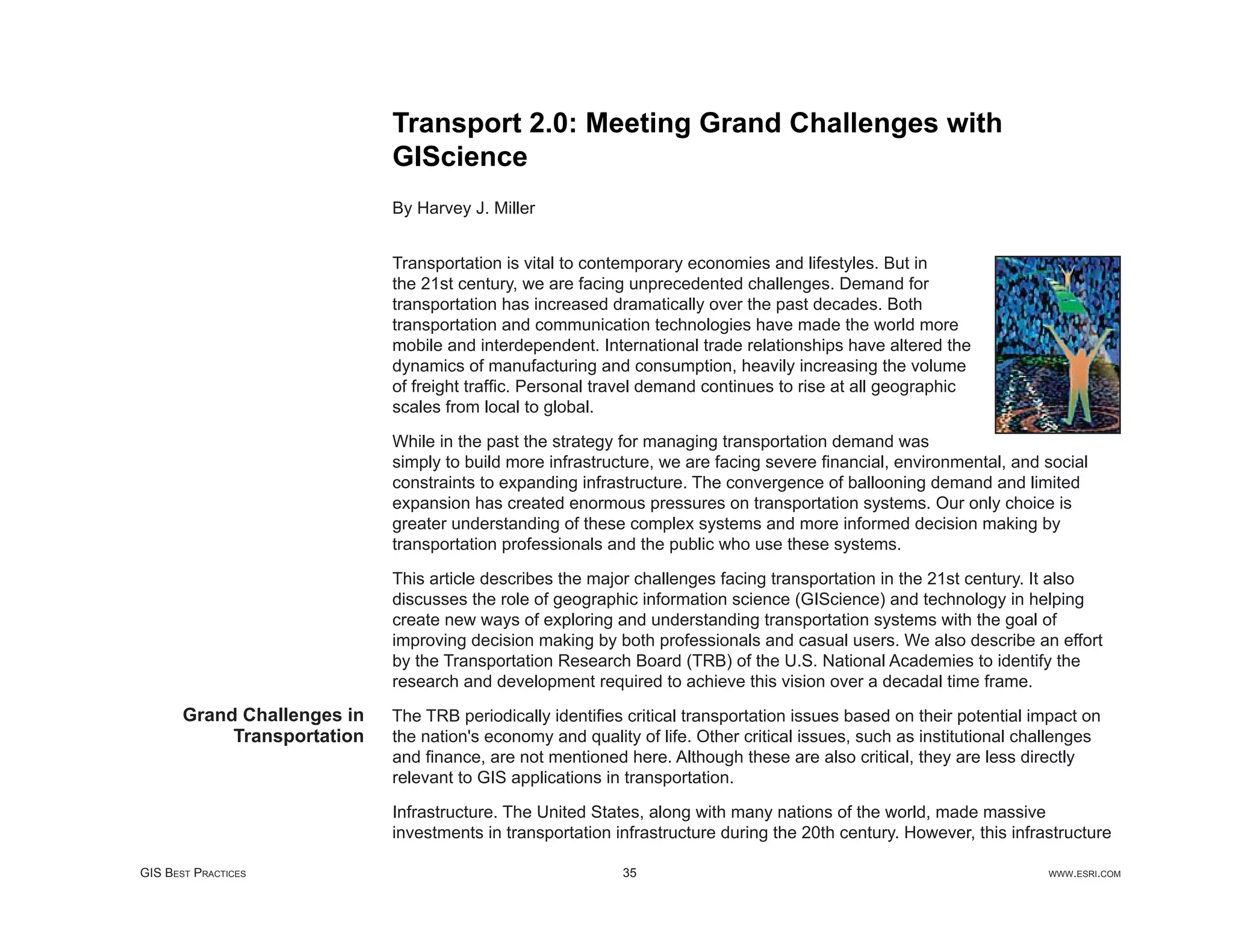
            Or perhaps you are a project manager, dealing with the difficulties of designing and
            implementing the new light-rail line. You issue a call for public input. You post the current
            design as a 3D digital model, allowing the public to walk through and even "ride" the proposed
            system. You also post a simulation that shows the expected effects on the city in 10 years if this
            project is completed. The public can comment on all aspects of the project design and planning
            process.

            Maybe you are a traffic manager, and you notice something strange: there is a local professional
            sports event, but traffic isn't streaming away from the stadium as expected. You check at the
            stadium and see that the game is going into overtime. You search for historical analogs and
            discover that overtime games during playoffs lead to an unusual amount of traffic on the Elm
            Street Bridge. Triggered by this query, a software agent informs you that the bridge on-ramp is
            undergoing unscheduled maintenance due to a water main break two days ago. You alert the
            local traffic police, as well as hospital emergency rooms, to let them know about the situation.
            The mirror world also propagates this to the general public, allowing them to change their
            schedules and trips in response to this event. An agent also sends a message to the local air


JULY 2009                                     40                                 ESSAYS ON GEOGRAPHY AND GIS: VOLUME 2
quality monitoring board, suggesting that the unusual event may lead to an abnormal amount of
                                vehicle emissions, perhaps requiring a voluntary "no-drive" day tomorrow.

                                A mirror world sounds like many of the Web-based tools we have available at present, such
                                as digital maps; real-time snapshots of traffic or weather; applets; customizable Web pages
                                based on your profile and browsing history; and virtual worlds, such as Second Life. Indeed,
                                we have made a great deal of progress along the path described by Gelernter in 1993. But we
                                are far from his vision. A mirror world goes beyond these current technologies to create a real-
                                time, comprehensive, detailed, interactive, and discoverable portrayal of a complex real-world
                                system. Unlike existing virtual worlds, the mirror world is not an alternative reality but a reflection
                                of reality that is tightly coupled to the real world. It is also an interpreted world: the databases
                                and data streams feeding the mirror world may be processed using knowledge discovery and
                                visualization tools to aid legibility, provide decision support, and protect sensitive data. Some of
                                the data may also be interpreted and presented by software or human agents.

                                Four key ingredients comprise a mirror world: One is a live picture, a comprehensive depiction
                                of the state of a complex system right now, in real time. Another is a deep picture, an integrated
                                representation that can be viewed at different levels of detail. Agents operate on our behalf
                                to help deal with the complexity of this world. Finally, a mirror world must have a sense of
                                experience, not simply an archival database one can query, but a way to search and retrieve
                                relevant information from these previous states, including states that may be different but are
                                good analogs for the current decision at hand. This should also include the ability to imagine
                                alternative futures in what-if scenario modeling.

                                Your level of immersion in a mirror world can vary. It could be as basic as current social
                                networking sites, such as Facebook, especially if you are accessing it through a mobile device,
                                such as your phone. Or it could be a virtual but artificial world on your screen, such as Second
                                Life. As virtual reality technologies improve, the mirror world could become a full sensory
                                experience. Also, as augmented reality technologies improve, you will be able to see the mirror
                                world superimposed on the real world through devices such as eyeglasses, windshields, and
                                data projectors.
                     So What?   Sounds cool. But so what? David Gelernter suggests several profound, perhaps even
                                transformative, benefits of mirror worlds.

                                Getting a grip. Contemporary organizations are fantastically complex. No one person can
                                understand and participate in all the myriad decisions and problem solving required to run a

GIS BEST PRACTICES                                              41                                                         WWW.ESRI.COM
hospital, transportation system, city, nation, or global community. The good news is that no one
            person needs to; we can share in this decision making, leaving some tasks to software and
            others to human experts. The mirror world can process the data you need, allow you to explore
            this information, and even alert you when a decision is required. In short, a mirror world helps
            you understand and deal with a complex reality by delegating mundane but overwhelming tasks
            and involving you when a real decision is required.

            The new public square. A mirror world is a type of place where you can meet and interact
            with others, whether they are friends, neighbors, coworkers, fellow citizens, public officials,
            or business leaders. You can participate in activities ranging from a simple chat to a major
            policy change. Although this is possible in the real world, most people do not participate fully
            in community decision making: the real world is too big, complex, and costly to navigate. A
            mirror world reduces these barriers by creating a multiscale virtual world that is more easily
            discovered, navigated, and engaged.

            The new conference room. A mirror world can also facilitate decision making that arises when
            diverse groups participate in a complex project, such as designing, building, and maintaining
            transportation infrastructure. A nascent example is the emerging field of building information
            modeling (BIM) for managing the construction life cycle through a three-dimensional, real-
            time, spatially referenced model of the building being constructed. BIM advocates claim better
            coordination, greater productivity, fewer errors, and savings in cost and time. Mirror worlds
            can scale this technology to large-scale transportation projects, including monitoring the
            infrastructure after installation to support management and maintenance. Combining this idea
            with the new public square, mirror worlds can allow public involvement at any stage of a facility's
            design, construction, use, and renovation.

            Seeing the whole. One of the profound benefits of a mirror world is that it facilitates what
            Gerlernter calls top-sight: seeing the big picture. Top-sight is more than just a bird's-eye view
            or a synoptic summary. It also means seeing interconnections of parts, as well as the links
            between oneself and the whole. Top-sight is a form of insight; one can pursue it avidly but
            only achieve it gradually. It is a quality of great leaders and participants in well-functioning
            communities. The increasing complexity of the world makes top-sight more difficult. Although a
            mirror world cannot teach people to have top-sight, it can facilitate that view by managing the
            complexity that inhibits this holistic perspective.

            Will mirror worlds solve the major problems facing transportation systems in the 21st century?
            Perhaps not. Some challenges may be too great, and others may require political will and

JULY 2009                                      42                                 ESSAYS ON GEOGRAPHY AND GIS: VOLUME 2
leadership that may not exist. But a mirror world can certainly facilitate a better perspective on
                            these problems, a view that is integrated, holistic, and multidimensional. It can also facilitate
                            community mindfulness and public involvement. And it can help empower citizens and
                            stakeholders to make better-informed transportation decisions at all spatial scales and time
                            frames.
   Transportation Worlds:   How do we create this new instrument, the combined telescope, microscope, and time machine
       What Do We Need?     that is a transportation world? Much of the requisite science and many of the technologies
                            currently exist, albeit in nascent form; these include GIS, geovisualization, agent-based
                            technologies, virtual reality, and Web 2.0 tools. However, these technologies and the underlying
                            science must achieve levels of maturity, sophistication, and interoperability that are beyond the
                            current state of the art. Several major research and development trajectories are relevant.

                            Pervasive transportation information. New location-aware technologies and geosensor
                            networks allow the collection of geospatial and temporal data at unprecedented scales and
                            scope. It is unclear how best to deploy and support these data collection networks and how
                            to deal with varying levels of data quality. There is also a need for new representation models
                            that can accommodate the increasingly diverse data. More private citizens are volunteering
                            geographic data through cell phones and other devices; how do we treat this data?

                            Transportation data must be integrated and shared across many applications and domains,
                            often in real time. How do we efficiently integrate and archive this data, as well as make the data
                            accessible to authorized individuals while preventing its misuse by unauthorized individuals?

                            Individuals will have unprecedented access to data and information about transportation
                            systems. How will this change their behavior?

                            New knowledge for better transportation decisions. The unprecedented scope, spectrum,
                            and detail of geospatial data collection technologies present a major challenge with respect
                            to making sense of this data. Required are new methods for exploring the data, confirming
                            discovered information, and communicating this information to transportation professionals and
                            the public at large for collaborative decision making about transportation futures. We also need
                            methods for automated detection of relevant information and unusual patterns for real-time
                            response to tactical problems, including those arising when using transportation systems in
                            one's daily life.


GIS BEST PRACTICES                                         43                                                         WWW.ESRI.COM
Imagined transportation worlds. Geospatial information and technologies can bring together
                          the real and imagined worlds. How do we interoperate models and representations that are
                          often designed for different purposes and at varying spatial and temporal scales? How do
                          we judge the validity and utility of imagined worlds? How do we facilitate understanding of
                          the scientific processes involved in simulating transportation futures to decision makers,
                          stakeholders, and the public at large?

                          Geospatial infrastructures for transportation. The hardware and software issues involved
                          in creating a real-time transportation world are enormous and will require advancements in
                          basic GIScience, including new spatial algorithms, spatial data structures and processing,
                          cyberinfrastructures to support spatial and temporal information, geovisualization techniques,
                          and user interfaces. These should be designed with transportation systems in mind but must
                          interoperate with methods and technologies in broader mirror worlds.

                          Also required are new processes to plan, budget, maintain, and upgrade geospatial
                          technologies within public- and private-sector organizations. These infrastructures will require
                          enterprise-wide investments and cannot be budgeted and built piecemeal.

                          Educating the transportation professional. New science, technologies, and data will
                          place unprecedented demands on the education of the transportation student, as well as
                          the continuing education and training of the transportation professional. Students will require
                          foundations in transportation science, as well as the science underlying new geospatial
                          technologies and data. It will be challenging to fit these demands within two- or four-year higher
                          education programs, particularly those with strict accreditation requirements. There will also be
                          a need to continue education and training throughout the career of a transportation professional
                          as the technologies and software evolve in response to continuing advances in computer
                          science, GIScience, and transportation science.
   How Do We Get There?   The Transportation Research Board Committee on Geographic Information Science and
    A Research Road Map   Applications (ABJ60) is involved in a multiyear effort to identify the research needed over a 10–
                          20 year time frame for developing new geospatial science and technologies to meet the grand
                          challenges facing transportation systems in the 21st century. The article you are reading is a
                          product of this effort, and it involved many individuals (several are listed in the
                          acknowledgments).


JULY 2009                                                   44                                 ESSAYS ON GEOGRAPHY AND GIS: VOLUME 2
These efforts will continue through 2010 and beyond. We are developing a research road map
                               that will identify the research trajectories and major milestones required to create the advanced
                               geospatial environment for transportation described in this article.

                               We invite you to get involved. We need input from a diverse range of individuals concerned with
                               transportation, either professionally or casually. Visit our Web site at abj60.org.
                      Notes    For discussion of critical issues in transportation, including some not mentioned in this article,
                               see TRB Executive Committee (2006), Critical Issues in Transportation, Transportation
                               Research Board, U.S. National Academies, Washington, D.C., available at trb.org.
          Acknowledgments      The goal of the ABJ60 committee is to advance GIScience, technology, and applications in the
                               field of transportation through research in communications and visualization; spatial data;
                               systems integration, organization, and spatial analysis; and modeling. The committee also
                               conducts outreach through TRB to communicate the effective use of GIS to the transportation
                               community.

                               Many members and friends of the committee are involved in the strategic research vision
                               described in this article as focus group leaders or participants; they are listed at the committee
                               Web site, abj60.org. Special thanks to Reginald Souleyrette (committee cochair), Val Noronha
                               (chair, research subcommittee), Cesar Quiroga (secretary), and Tom Palmerlee (TRB officer).
                               An extra thanks to Roger Petzold (Federal Highway Administration) for supporting this effort.
            About the Author   Harvey J. Miller is professor and chair of the Department of Geography at the University of Utah
                               in Salt Lake City, Utah. His research and teaching interests include the application of geographic
                               information science, spatial analysis, and geocomputational techniques for understanding how
                               transportation and communication technologies shape individual lives and urban morphology.
                               He has published more than 60 scientific papers on these topics. He is author (with Shih-Lung
                               Shaw) of Geographic Information Systems for Transportation: Principles and Applications
                               (Oxford University Press) and editor (with Jiawei Han) of Geographic Data Mining and
                               Knowledge Discovery, second edition (Taylor and Francis). Miller serves on the editorial boards
                               of several of the top scientific journals in GIScience, spatial analysis, and transportation and
                               was the North American editor of the International Journal of Geographical Information Science,
                               2000–2004. He is currently cochairing the Committee on Geographic Information Science and
                               Applications of the Transportation Research Board, U.S. National Academies.


                               (Reprinted from the Winter 2008/2009 issue of ArcNews magazine)
GIS BEST PRACTICES                                             45                                                         WWW.ESRI.COM
Geography Education and GIS Professional
                     Development
                     "Crossing Borders"

                     A column by Doug Richardson, Executive Director, Association of American Geographers


                     In economically turbulent times, many students and college
                     graduates will likely be wondering what options they have
                     at their disposal. Is it time to jump into the job market, or is
                     graduate school a better option? Indeed, many geography
                     departments are hearing from students who are curious about
                     advancing their career options and the value of an advanced
                     degree in geographic information science (GIScience) for
                     future employment. Fortunately, even in difficult times, GIS
                     and GIScience students still enjoy growing opportunities to
                     pursue geospatial work in business, government, and nonprofit
                     organizations where spatial, environmental, and interdisciplinary
                     skills are needed. Having strong academic preparation in
                     geography and GIScience will only expand the career opportunities available to students,
                     allowing graduates to enter the job market at a higher level and advance more rapidly through
                     the ranks after being hired.

                     Within the past few years, a number of studies in the United States and the United Kingdom
                     have addressed the issue of employability, a term describing the readiness of an individual to
                     obtain and then maintain employment (Mistry, White, and Berardi 2006; Donert 2007; Solem,
                     Cheung, and Schlemper 2008—see www.aag.org for full citations). All of these studies point
                     to some important findings. First, hundreds of employer organizations across a broad swath of
                     the business, government, and nonprofit (BGN) sectors seek individuals who are able to think
                     spatially and use geographic technologies to collect, integrate, and analyze data on social and
                     natural systems. And the good news for job seekers is that these same employers forecast an
                     increasing demand for these abilities in the coming years.

                     A second important finding is that employers view geography education as an essential
                     component of professional development in GIScience. This is because geography offers the

GIS BEST PRACTICES                                 47                                                       WWW.ESRI.COM
conceptual frameworks, spatial science foundations, interdisciplinary perspectives, and spatial
            thinking skills underpinning effective use of GIS and related mapping technologies. In the
            experience of the employers surveyed and interviewed in this research, geographic learning
            through field studies, internships, and academic coursework enhances the work of geospatial
            professionals and helps ensure that the analytical power of geographic technologies is tapped
            productively.

            Employers are also reporting broad and growing professional opportunities for GIScience
            graduates in areas as diverse as environmental management, transportation, public health, and
            international trade. Here, too, there are opportunities for GIS professionals to enhance their
            employability by taking advantage of new models of graduate education, such as professional
            master's degree programs, which integrate management training and internships with GIScience
            education. Among the many such programs are the new Professional Master's Program
            in geography at Temple University and similar master's degree and certificate programs in
            geographic information science offered by universities ranging from Arizona State University to
            Pennsylvania State University and dozens of others. The Guide to Geography Programs in the
            Americas provides a detailed overview of these educational opportunities (available at
            www.aag.org).

            Many employers still report difficulties finding qualified graduates possessing strong preparation
            in geography and spatial analysis. In recent years, the AAG has undertaken research projects
            aimed at improving geography education for careers in BGN organizations (as well as in K–12
            and higher education). One of the larger challenges identified in this work is the need to better
            align curricula with students' career aspirations and the needs of employer organizations. This
            is especially true in doctoral programs where Ph.D. students who once aspired primarily to
            careers in academia are now often attracted to equally rewarding and socially engaged careers
            in government, nonprofit organizations, and businesses. Departments in which the M.A./M.S.
            is the highest degree offered demonstrate clearer understanding of student goals and curricula
            that address BGN opportunities, but these programs still face challenges of implementation and
            helping students make transitions from traditional academic preparation.

            The greater attention now given to BGN career preparation in geography graduate programs
            also holds promise for recruiting and retaining more women and minority students in the
            GIScience fields. This is because many of the students surveyed, including women and minority
            students, are especially interested in BGN careers, yet often feel that many purely technical
            graduate programs do not adequately provide them with the career advising and broader


JULY 2009                                     48                               ESSAYS ON GEOGRAPHY AND GIS: VOLUME 2
educational foundation they see as important to success in the GIS fields. But throughout the
                     educational and career pipeline, students, parents, and teachers all need more information
                     about the wide variety of GIScience career options available and the preparation required for
                     success in these careers.

                     Given that context, the AAG has identified broad areas of critical data needs and actions for
                     future work so that future graduates have a clearer sense of the opportunities available to them:

                        Better data on the geographic and general skills that graduates employed in BGN positions
                        use in their daily work

                        Local, regional, and national estimates of employers' demand for geographic and geospatial
                        skills in different types of BGN organizations

                        Comparisons and assessments of undergraduate and graduate curricula in geography for
                        preparation in BGN careers

                        Continued development of disciplinary infrastructure to enhance graduate advising, career
                        preparation, and transition support for early career geography and GIS professionals in BGN
                        organizations, modeled after the success of recent National Science Foundation-funded
                        programs, such as the Geography Faculty Development Alliance, and the AAG's Enhancing
                        Departments and Graduate Education (EDGE) in Geography program

                     Geography graduate and undergraduate programs have undertaken a leading role nationally in
                     providing the broad-based GIScience and GIS educational and research programs needed by
                     students and employers across BGN sectors. Thanks to the hard work and goodwill of countless
                     individuals in the geography, GIS, and GIScience communities, including notably those of our
                     friends and colleagues within the ESRI education community, we are collectively developing the
                     capacity for meeting the educational needs of our next generation of students and employers.
                     For more information on educational programs available in geography, GIS, and GIScience, visit
                     www.aag.org/education.


                     (Reprinted from the Winter 2008/2009 issue of ArcNews magazine)


GIS BEST PRACTICES                                 49                                                       WWW.ESRI.COM
Changing the Face of Geography: GIS and the IGU
                     By Roger F. Tomlinson


                     Geographers—including those of the International Geographical Union
                     (IGU)—have as their task the description and explanation of the living
                     space of humans and the resulting spatial structure of society. The
                     development of formal views of these concerns forms the basis for
                     the modern science of geography. The extent and complexity of the
                     world we live in make this task hard. The volumes of data that result
                     from even cursory global investigation are a serious impediment to our
                     understanding. Fifty years ago, it was not possible to handle any large
                     set of the hard-copy maps and data that were being gathered, much less
                     analyze them in any efficient way. The resulting inability—indeed the
                     failure—to ask questions, let alone consider in depth the role of various
                     interacting influences shaping the individual and societal factors, left us
                     with a deep and generally unrecognized ignorance of space and time
                     behavior.

                     The advent of computers as information processing tools and the development of GIS have
                     measurably assisted geographers in their work. These new tools are being added to the
                     discipline. Just as the advent of the telescope by Galileo increased the knowledge of the
                     heavens and the concepts of space and the advent of the microscope revolutionized biology
                     with its ability to add resolution and depth to inquiry, so the advent of the tools of GIS has
                     impacted the discipline of geography. The quality of questions asked is rising, and the scope
                     and use of spatial analysis are becoming more sophisticated. We are digging deeper into the
                     spatial variables in considering factors that otherwise would not be explored. The trade-off
                     between effort and inquiry is shifting in favor of inquiry. Workers are able to exchange their
                     reasoning (decision models) very easily. This is contributing to the awareness of geography and
                     the growing number of people becoming involved in the field. There is an increasing exchange
                     of ideas and methods. As a result, the study of geography is changing significantly and
                     beneficially and, in particular, expanding outside academic confines. Geography as a discipline
                     is no longer encompassed by academic geography. It is not now principally reductionist and
                     curiosity driven, with a goal to produce general laws (a long-established scientific method with


GIS BEST PRACTICES                                  51                                                     WWW.ESRI.COM
great virtue). There is an urgent demand for the use of geographic science in government,
            relative to society, and to address the pressing issues facing the world. Geographers have
            major contributions to make to these issues.

            There is, for example, broad agreement in the scientific community that the earth's climate is
            changing and that it is partly human induced. Very little is known, however, about the societal
            impacts of climate change, and there are very important geographic questions that need to
            be answered about changes in biogeochemical cycles, ecosystems, water resources, and
            resource utilization; continued atmospheric pollution; and the overall economic, political,
            and social implications. Geographers can contribute to the body of knowledge about climate
            change by synthesizing, analyzing, and modeling possible impacts.


                              The process of prepositioning ambulances for better service is one way in which
                                                GIS is used to examine spatial situations.


JULY 2009                                          52                                           ESSAYS ON GEOGRAPHY AND GIS: VOLUME 2
Similarly, with respect to human health and well-being, understanding of a population's health,
                     the distribution of disease in an area, and the environment's effect on health and disease
                     is central to human existence and a quintessentially geographic problem. There are also
                     significant issues about the accessibility of health care and spatial distribution of health care
                     providers.

                     Globalization is about interaction and integration among people, companies, and governments
                     of different nations, a process driven by international trade and investment and aided by
                     information technology. It has effects on the environment, culture, political systems, economic
                     development and prosperity, and human physical well-being in societies around the world.
                     Again, the analysis of these conditions has a strong spatial component.

                     Societal security is an essential goal of all governments and one that has become increasingly
                     difficult to fulfill in recent years. In an area of asymmetric warfare, sociopolitical solutions have
                     become ever more complex, and their impacts affect different communities and socioeconomic
                     groups in different ways.

                     Sustainability entails meeting the needs of the present without compromising the ability of
                     future generations to meet their own needs, and it still remains a problem, especially in light of
                     accelerated environmental change and the current food crisis. Geographers have a great deal
                     to contribute to understanding and solving this complex, multidimensional, essentially spatial
                     problem.

                     Underpinning social diversity means understanding and generalizing the processes of spatial
                     heterogeneity: defining characteristics of patterns and processes on the surface of the earth.
                     Understanding these processes, which account for social diversity, difference, and inequality, is
                     key to good governance.

                     The following are illustrations of some of the ways in which GIS is being used to examine spatial
                     situations.

                     Climate—The Palmer Drought Severity Index is the basis for agricultural relief for farmers in
                     major distress. Of particular interest is the analysis of drought on nuclear power plants. They
                     require large volumes of water for cooling purposes, and sustained drought means that they
                     have to be closed down, removing their supply of electricity in the states concerned.


GIS BEST PRACTICES                                  53                                                         WWW.ESRI.COM
Human Impact—The first human impact map of population density in two hemispheres is that
            of CO2 emissions in the atmosphere, using real-time Jet Propulsion Laboratory satellite sensor
            information.

            Population Density—Population density is provided as an element in the calculations of human
            impact and the human footprint.

            Human Footprint—The human footprint aims to measure the extent of human interference
            on the earth's surface, using updated data on human population density, land transformation,
            human access, electrical power infrastructure, and settlements. This latest version was
            produced in 2008. The work was produced by the Humanitarian Information Unit of the Office of
            the Geographer and Global Issues (director, Dr. Lee Schwartz) of the Bureau of Intelligence and
            Research in the U.S. Department of State.

            Human Health—Human health examines the interaction of spatial variables, including the
            U.S. Department of Agriculture's work with animal influence on human health; the outbreaks of
            avian flu in China by location; the tracing of the acute respiratory syndrome outbreak in China
            and Hong Kong to identify its origins; the National Cancer Institute's analysis of environmental
            effects on cancer incidents; and the relationship between smoking and birth weight in part of
            Ontario, Canada.

            Avian Flu—Avian flu and bird migration routes illustrate the correlation between known
            outbreaks of avian flu and bird migration corridors to assist in the process of identifying the
            source and the diffusion of the disease. The same GIS application allows users to identify
            quarantine stations, flu shot clinics, and local public health departments.

            Ambulance Location—The process of prepositioning ambulances for better service is
            examined. Contours of actual demand (call density) and the existing position of ambulances to
            meet that demand are calculated to optimize response travel times, affecting the efficiency of
            ambulance organization and survival rate in the area.

            Flu Vaccine Distribution—Access to influenza vaccine distributions is compared to population
            distribution with access buffer zones of a one-mile and a two-mile radius around points of
            distribution of vaccines. Similar analysis is being used in preparation for avian flu epidemics.

            AIDS—The progress on the U.S. President's Emergency Plan for AIDS Relief in sub-Saharan
            Africa is illustrated as a basis for policy change. Also included are results in Vietnam and


JULY 2009                                      54                                ESSAYS ON GEOGRAPHY AND GIS: VOLUME 2
Guyana. Further analysis and understanding of the AIDS epidemic in Africa, particularly Kenya,
                     Uganda, Tanzania, Zambia, and Malawi, come from analyzing patient data by gender showing
                     the percentage of HIV-positive individuals in four categories (2–5 percent, 5–10 percent,
                     10–15 percent, and more than 15 percent of the population). Similarly, HIV prevalence among
                     youth by first-order administrative divisions in the countries concerned is examined, again as
                     a percentage of the general population and by gender. These studies underpin the effective
                     delivery of AIDS relief in sub-Saharan Africa and the monitoring and analysis of program
                     effectiveness.


                                                          Illustration by Elizabeth Davies, ESRI.


                     The analysis of life and death in Africa is one with broad scope. It includes infant mortality rates,
                     access to drinking water, overall AIDS infections, gross national income, and life expectancy by
                     country. Bringing these variables together over a continent allows workers to better understand
                     the measures necessary to improve the national condition.

                     Food Riots 2007–2008—The human condition of the world, particularly the food riots of 2007
                     and 2008, is tracked and illustrated. This is the first instance of a worldwide dimension.

                     Afghanistan Opium Cultivation—With Afghanistan supplying 80 percent of the world's heroin,
                     this is a global issue. This map compares population density in Afghanistan with areas of poppy
                     cultivation. The Taliban is operating extensively in the southern area of the country and has
                     recently started operations in the northeast.

                     Habitat Destruction—Brazil graphically illustrates the extent of harvesting, which is
                     systematically removing rain forest habitat.


GIS BEST PRACTICES                                   55                                                         WWW.ESRI.COM
Where to Plant a Billion Trees—The Green Belt Movement, spearheaded by Nobel Prize
            winner Wangari Maathai, is a political/environmental, and very successful, movement with the
            object of planting a billion trees in Africa. Peter Ndunda is the GIS coordinator for the project,
            actively working in East and West Africa to overlay soil types, climate, animal habitat, population
            density, and tribal lands to determine the most effective sites for planting. Without the GIS, trees
            would be planted in unfavorable sites. Their survival would be dubious, and popular political
            support would wither away.

            Plant Hardiness Zone Migration—The Nature Conservancy at the University of Washington
            has calculated plant hardiness zones for 1960, 2008, and 2099. The movement north of
            the boreal forest and the ameliorating of temperatures in the Arctic islands are particularly
            noticeable. Implications for habitat can be measured and better appreciated.

            Arctic Sea Ice—The Arctic sea ice conditions are put into perspective. National Aeronautics and
            Space Administration (NASA) data shows that Arctic perennial sea ice, which normally survives
            the summer melt season and remains year-round, shrank abruptly by 14 percent between
            2004 and 2005. The loss of perennial ice in the east Arctic Ocean was even higher, nearing
            50 percent during that time as some of the ice moved from the east Arctic to the west. The
            overall decrease in winter Arctic perennial sea ice totals 720,000 square kilometers (280,000
            square miles)—an area the size of Texas. Perennial ice can be 3 or more meters (10 or more
            feet) thick. It was replaced by new, seasonal ice only about 0.3 to 2 meters (1 to 7 feet) thick
            that is more vulnerable to summer melt. The decrease in the perennial ice raises the possibility
            that Arctic sea ice will retreat to another record low extent this year. This follows a series of very
            low ice-cover years observed over the past four summers from active and passive microwave
            satellite data.

            Travel History—By tracking the flights of one company over the course of a year and
            understanding environmental impact routes, the use of increasingly high-cost fuel and the
            distribution of future corporate locations/regional offices become understood.

            Hydro Watershed—The hydro watershed of the Neuse River in North Carolina is a
            sophisticated exercise in flood probability and control based on rainfall and evaporation over the
            course of a year.


JULY 2009                                      56                                  ESSAYS ON GEOGRAPHY AND GIS: VOLUME 2
Humanitarian Aid—For the purposes of humanitarian aid, the U.S. Agency for International
                           Development (USAID) determines the location of individuals affected by cyclone activity in
                           Bangladesh. This analysis was used as a basis for extensive aid being provided in the right
                           locations.

                           Another example of humanitarian aid produced by the Office of Foreign Disaster Assistance in
                           USAID concerns the Greek wildfires of 2007. The principal map used by the project is the result
                           of daily identification of five boundaries. In particular, the analysis concentrated on the degree
                           of soil burn severity in the Kladios Basin, which allowed the focus of aid to be directed to those
                           communities most affected by long-term damage and in the most desperate need of assistance.

                           Humanitarian aid provided by the U.S. Department of State in the Horn of Africa is concerned
                           with the potential interaction of drought, locusts, flooding, and earthquakes, providing measures
                           of the probability by hazard type to provide policy guidance for assistance in this area.

                           Humanitarian aid is the frequently minimized side of the U.S. Department of Defense, which
                           uses mobile GIS in identifying needs and building the facilities for water supply in Afghanistan.

                           The Press Response—The press takes note of geography in action. There has been a
                           series of newspaper headlines concerning GIS utilization in city operations, police department
                           activities, real estate transactions, riverine studies, and so on.

                           Commercial Applications—Commercial store locations show the increasing use of geography
                           in the business community, analyzing how specific retail outlets are located with respect to the
                           driving distance (in miles) from their nearest competitors and the subsequent analysis of areas
                           with access to more than one store to ensure that new store locations do not compete in the
                           trade area of existing stores.
 Summarizing the Spatial   GIS combines the ability to manage stores of geographic data and perform spatial analysis and
              Situations   modeling to visualize output and disseminate results and methods.

                           It is not surprising that GIS and geographic analysis are being widely used. But the diffusion
                           of geographic analysis methodology throughout the real world is quite remarkable. Based on
                           licensing records, there are few countries or government departments in the world that are not
                           using GIS. At least 5 million people in more than 300,000 institutions in more than 150 countries
                           are using geographic methods in their work daily. And the largest campuses investigating
                           geographic analysis are not in academia but in the private sector (e.g., ESRI has more than


GIS BEST PRACTICES                                        57                                                        WWW.ESRI.COM
2,700 U.S. employees, with 100 Ph.D. and 1,500 master's recipients, and adds numerous new
            graduates each year).

            Using the assumption that every $1 million of investment in data and GIS requires at least one
            trained person for the investment to be used effectively, there is a shortfall of at least 3,000
            trained people per year in North America alone, compared to the output from all universities
            and technical colleges in North America. Students are realizing that geography offers career
            opportunities and interesting jobs throughout the working world.


                  Avian flu and bird migration routes illustrate the correlation between known outbreaks of avian flu and bird migration
                              corridors to assist in the process of identifying the source and the diffusion of the disease.


JULY 2009                                               58                                            ESSAYS ON GEOGRAPHY AND GIS: VOLUME 2
Interest in the discipline is growing everywhere. Academic geography may be splintering into
                     quasi-named departments and subspecialties, but students who are trained in geographic
                     analysis and can use the modern tools of GIS are in high demand. The growth of this interest
                     is exemplified in the growth of the Association of American Geographers, which has increased
                     significantly in size in the past decade and whose yearly conferences are attended by more
                     people than ever (see table below). Similarly indicative is the reintroduction of geography at
                     Harvard after an absence of 60 years in the new Center for Geographical Analysis. At the
                     center's inauguration, the president of Harvard said,
                     "Geographic information systems will let us change the
                     nature of questions that are asked in a wide diversity of
                     sciences and humanities."

                     Indeed, a wide variety of problems has already been
                     illustrated and is being addressed, but many broad-
                     based issues still demand the attention of geographers.

                     There is a geography of security and terrorism that is
                     multifaceted and comparatively little researched and
                     understood, in spite of the fact that it could contribute
                     enormously to this pressing problem. There is great
                     scope in this area for the development of critical theories
                     to examine alternative geographies.

                     The extensive development of quantitative geography
                     in the 1960s and 1970s addressing the problems of
                     analyzing and modeling space needs to be integrated
                     with the GIS capabilities of today and brought together to
                     develop wider and more generally applicable models of
                     geographic space and time, focusing on interactions and
                     dynamics.

                     We still have no adequate models for major cities, much less for the world itself. I am convinced
                     that we—or at the very least, our grandchildren—will have them, but there are many research
                     questions that remain to be investigated on the way to creating Al Gore's "digital earth." There
                     are questions that touch on many aspects of geography, including representation, efficiency of
                     information management, appropriate scientific visualization of issues, applications, and policy


GIS BEST PRACTICES                                  59                                                       WWW.ESRI.COM
implications. I have no doubt that GIS will be at the core of this progress and that the future will
                             be rich and productive.
             International   The International Geographical Union's interest in GIS originated in the Commission on Remote
       Geographical Union    Sensing under the chairmanship of Dieter Steiner (1964–1968). The transition from
                     (IGU)   photointerpretation to the handling of satellite imagery in digital form heralded the renaming of
                             the commission in 1968 as the Commission on Geographical Data Sensing and Processing.
                             This commission stayed in existence for 12 years under my chairmanship in the critical early
                             stages of GIS. It held the first international GIS conferences in the world, published the first
                             texts, established international cooperation between workers in the field, established academic
                             and industry research teams, undertook inventory and description of all GIS software under
                             development, and carried out appraisal of in-house systems for government agencies.

                             To put this into perspective, in the 1950s and 1960s, the links between computers and maps
                             were tenuous at best. Workers were separated internationally and intellectually. Communication
                             varied from poor to nonexistent. Academics found that, in general, their departments did
                             not actively support their efforts; academic journals were not greatly interested, and their
                             publishing delays did not serve the needs of the rapidly developing field. The field was being
                             moved forward by people in institutions with a need for the capabilities, mainly in government
                             departments, and in the private sector by those who wished to provide goods and services to
                             government.

                             These needs were perceived to be those of agencies that produced paper maps and needed
                             to automate the cartographic process and agencies that needed to read and geographically
                             analyze maps (and related statistical data) and required geographic information systems
                             to provide information for decision-making purposes. These requirements led to the initially
                             separate development of automatic cartography systems and geographic information systems.

                             Clearly, there was a need for increased communication in the field and for providing support for
                             academic colleagues, as well as establishing an international base for research and publication
                             and a forum for discussion and networking. The IGU did that.

                             The first international conference on GIS was held in Ottawa, Canada, in 1970. Under the
                             auspices of the IGU and with the assistance of UNESCO (particularly the support and guidance
                             of Dr. Konstantin Lange) and the government of Canada, an invitation was sent to everyone
                             known to be active in the field. Forty people were contacted and attended the conference, and
                             by the end of the week, the first book on geographic information systems was created. It was

JULY 2009                                                       60                                  ESSAYS ON GEOGRAPHY AND GIS: VOLUME 2
entitled Environment Information Systems to take advantage of government's renewed interest
                     in environmental concerns at that time. The primary objectives were to establish communication
                     between workers in the field and to publish. Participants at the first meeting undertook to write
                     a further text on the state of development of the field entitled Geographical Data Handling. This
                     was published with the assistance of the United States Geological Survey (USGS) in 1972. It
                     was a two-volume, 1,300-page text that reviewed all known developments of geographic data
                     sensing, spatial data processing, spatial data manipulation and analysis, spatial data display,
                     current systems, and the economics of geographic data handling. These were the first key
                     texts in the field and were affectionately known as the "yellow and green telephone directories."
                     One thousand copies were printed. They were available free of charge at the Second IGU
                     Conference held in Ottawa that year. Three hundred people attended. Official delegations from
                     8 countries and workers from 15 countries were present. For the next few years, with the aid
                     of the government of Canada, the IGU published a yearly directory of the names and contact
                     information of the original participants and a description of their work. This list was subsequently
                     added to voluntarily by additional workers and was sent to everybody listed. The communication
                     process had begun.

                     In 1975, the commission also formed a critique group and carried out case studies on five
                     geographic information systems in North America—their successes and failures—with the
                     support of UNESCO, which published the work as a text in its Natural Resource Research
                     Series in 1975. The IGU was also invited to review the work of the USGS. This was a two-
                     year study and produced a seminal report in 1976 that alerted the major agency that it was
                     committed to the digital age but was woefully unprepared to undertake commitments that it
                     had already made. Also, for the first time, the IGU provided significant input to the work of the
                     Committee on Data for Science and Technology of the International Council of Scientific Unions.

                     In the late 1970s, the IGU undertook an inventory of all computer software for spatial data
                     handling, funded by the Resource and Land Inventory Program and the Geography Program of
                     the U.S. Department of the Interior and directed by the renowned Dr. Duane Marble. This work
                     represented the most comprehensive review of software for spatial data handling undertaken to
                     that date, describing more than 600 systems and software programs worldwide. The resulting
                     three-volume reference text was published by USGS in 1980 and made available at no cost to
                     scientists worldwide. The commission also held interdisciplinary meetings in 1977 and 1978 to
                     examine the methodological problems inherent in the future storage of large amounts of spatial
                     data. These were held in Ottawa and Toronto, Canada, and Buffalo, New York. The IGU also
                     contributed to the NASA meeting on Landsat data and geographic information systems in 1977.

GIS BEST PRACTICES                                  61                                                         WWW.ESRI.COM
Under the leadership of Dieter Steiner, it provided a three-week workshop in Nigeria on remote-
                                sensing methods for regional and national planning in July 1978, funded by the Canadian
                                International Development Agency and UNESCO. The working materials for this workshop
                                included a three-volume text on the recent applications of remote-sensing technology for use by
                                the commission.

                                From 1980 to 1988, the work of the Commission on Geographical Data Sensing and Processing
                                was led by Marble. The activity concentrated principally on specialist meetings addressing
                                major scientific concerns in the development of GIS. In 1988, the commission was renamed the
                                Commission on Geographic Information Systems under the chairmanship of professor Sachio
                                Kubo from Japan.

                                In all, the IGU carried out supervision of $1.5 million in grants and contracts between 1968 and
                                1980. The communication foundation had been laid, academic geographers were increasingly
                                receiving recognition for their work, regularly published journals were becoming available,
                                and GIS conferences worldwide provided a necessary continuation of the work begun by the
                                International Geographical Union. In short, the IGU was the organization that nourished the
                                growth of GIS and let it be a coherent part of geography for the benefit of the discipline as a
                                whole.
            Acknowledgments     Generous contributions to this paper were made by Dr. David Maguire and Dr. Duane Marble.
                                The author also wishes to thank John Calkins and Jay Loteria for graphic assistance.

             About the Author   Dr. Roger F. Tomlinson, CM, is president of Tomlinson Associates Ltd. Consulting Geographers,
                                17 Kippewa Drive, Ottawa, Ontario K1S 3G3 Canada. He was chairman of the International
                                Geographical Union GIS Commission for 12 years, and he is known as the "father of GIS" as a
                                result of his work in using computers to model land inventories for the Canadian government in
                                the early 1960s. He is the author of many works, including Thinking About GIS, Third Edition,
                                2007, ESRI Press, Redlands, California.


                                (Reprinted from the Spring 2009 issue of ArcNews magazine)


JULY 2009                                                         62                                ESSAYS ON GEOGRAPHY AND GIS: VOLUME 2
Process Models and Next-Generation Geographic
                     Information Technology
                     By Paul M. Torrens


                     Much of the inner workings of geographic information systems is
                     organized around data models: computational structures (rasters
                     and vectors are common variants) that determine how GIS stores,
                     organizes, and displays various types of information for different
                     purposes. Put simply, data models treat the world in terms of objects
                     that represent entities and their related attributes. In GIS, there is
                     usually no dedicated model of the processes that govern dynamics,
                     adaptation, and evolution of a system. For many years, GIS has
                     advanced the potential for unifying representations of entities and
                     processes, and recently, the long-standing promise of consociating
                     the two is beginning to be realized, enabling a burgeoning paradigm
                     shift to a new style of GIS.

                     The next generation of geographic information systems will be driven by process models. These
                     are usually composed of algorithms and heuristics that will act on users' requests for the GIS to
                     perform some service for them, connect to digital networks to contextualize those requests, and
                     interact seamlessly with other databases and processes to achieve users' goals. Alternatively,
                     process models may be used as a synthetic representation of system parts to build artificial
                     phenomena "in silico" that can be subjected to experimentation and what-if scenario building in
                     ways that are not possible "on the ground." Geoprocessing has been featured with increasing
                     priority in GIS for some time, and conventional GIS already relies on geoprocessing for spatial
                     analysis and data manipulation.

                     Process models represent an evolution from these existing technologies, catalyzed by
                     artificial intelligence that takes traditional GIS operations into the world of dynamic, proactive
                     computing on a semantic Web of interconnected data and intelligent software agents. Imagine,
                     for example, building a representation of the earth's boundary layer climate in GIS, but also
                     being able to run dynamic weather patterns, storms, and hurricanes over that data, using


GIS BEST PRACTICES                                  63                                                       WWW.ESRI.COM
climate models that sit in a supercomputing center on another continent. This article charts
                         the development of process models in the geographic information sciences and discusses the
                         technologies that have shaped them from the outside in. In addition, it explores their future
                         potential in allying next-generation GIS to the semantic Web, virtual worlds, computer gaming,
                         computational social science, business intelligence, cyberplaces, the emerging "Internet of
                         Things," and newly discovered nanospaces.
            Background   Much of the innovation for process models in the geographic sciences has come from within the
                         geographic information technology community. Geoprocessing featured prominently in the early
                         origins of online GIS, where server-based GIS delegated much of the work that a desktop client
                         would perform to the background, hidden from the user. Interest in geoprocessing has
                         resurfaced recently, largely because of increased enthusiasm for online cartography and
                         expanding interest in schemes for appropriating, parsing, and reconstituting diverse data
                         sources from around the Web into novel mashups that lean on application programming
                         interfaces—interfaces to centralized code bases—that have origins in search engine technology.

                         Concurrently, many scholars in the geographic information science community have been
                         developing innovative methods for fusing representations of space and time in GIS. This
                         has seen the infusion of schemes from time geography into spatial database and data
                         access structures to allow structured queries to be performed on data's temporal, as well as
                         spatial, attributes. Time geography has also been used in geovisualization, as a method for
                         representing temporal attributes of datasets spatially, thereby allowing them to be subjected to
                         standard spatial analysis. Much of this work has been based around a move toward creating
                         cyberinfrastructure for cross-disciplinary research teams, and significant advances have been
                         made in developing technologies to fuse GIS with real-time data from the diverse array of
                         interconnected sensors and broadcast devices that now permeate inventory systems, long-term
                         scientific observatories, transportation infrastructure, and even our personal communication
                         systems. In parallel, work in spatial simulation has edged ever closer toward a tight coupling
                         with GIS, particularly in high-resolution modeling and geocomputation using cellular and agent-
                         based automata as computational vehicles for animating objects through complex adaptive
                         systems. Automata are, essentially, empty data structures capable of processing information
                         and exchanging it with other automata. Simulation builders often turn to GIS routines in search
                         of algorithms for handling the information exchange between automata, and over time, a natural
                         affinity between the two has begun to develop into a mutually influential research field often
                         referred to as geosimulation.


JULY 2009                                                  64                               ESSAYS ON GEOGRAPHY AND GIS: VOLUME 2
The cloud of Wi-Fi signals that envelops central Salt Lake City, Utah, generated by approximately 1,700 access points.


                     Much of the work in developing process models is finding its way into GIS from outside
                     fields, however, and developments in information technology for the Web—and for handling
                     geographic data on the Web—have been particularly influential. A massive growth in the volume
                     and nature of data in which we find our lives and work enveloped has catalyzed a transition from
                     a previous model of the Web to a newer-generation phase. The Web remains fundamentally
                     the same in its architecture, but the number of applications and devices that contribute to it
                     has swelled appreciably, and with this shift, a phase change has taken place, instantiating


GIS BEST PRACTICES                                          65                                                                           WWW.ESRI.COM
what is now commonly referred to as Web 2.0. The previous iteration of Web development
            was centered on static, subscription-based content aggregated by dominant portals such as
            AltaVista, AOL, Excite, HotBot, Infoseek, Lycos, and Yahoo! By comparison, much of the current
            generation model for the Web is characterized by user-generated content (blogs, Twitter tweets,
            photographs, points of interest, even maps) and flexible transfers between diverse data sources.
            Moreover, these varied data streams interface seamlessly over new interoperable database and
            browser technologies and are often delivered in custom-controlled formats directly to browsers
            or handheld devices via channels such as Really Simple Syndication (RSS). This takes place
            dynamically, updating in near real time as the ecology of the Web ebbs and flows.

            Enveloping these developments has been a groundswell in the volume of geographic data fed
            to the Web. In many ways, Web 2.0 has been built on the back of the GeoWeb that has formed
            between growing volumes of location-enabled devices and data that either interface with the
            Web in standardized exchanges (uploading geotagged content to online data warehouses,
            for example) or rely on the Web for their functionality (as in the case of alternative positioning
            systems that triangulate their location based on wireless access points). The reduction in
            the cost of geographic positioning technologies led to the massive infusion of location-aware
            technology into cameras, phones, running shoes, and cars; atop bicycle handlebars; and in
            clothing, pets, handheld gaming devices, and asset-tracking devices on the products that we
            buy in supermarkets. Devices all over the world began to sense and communicate their absolute
            and relative positions, allowing, first, the devices to be location tagged; second, those tags to
            become a significant medium for organizing, browsing, searching, and retrieving data; and,
            third, their relative geography to become the semantic context that ascribes to those objects
            (and their users) information. Indeed, for many online activities, maps and GIS have become the
            main portal to the Web.

            Semantic intelligence is driving the next evolution of the Web, characterized by the use of
            process models (usually referred to as software agents or Web services) as artificial intelligence
            that can reason about the meaning of data that courses through Internet and communication
            networks. A slew of ontological schemes—methods for classifying data and its relationships—
            provides the scaffolding that supports semantic reasoning online. Geography and location
            ontology is an important component of online semantics, allowing processes to not only know
            where something is in both network space and the tangible geography of the real world but
            also to reason about where it might have been, where it might go and why, whether that is
            usual or unusual behavior, what might travel with it, what might be left behind, what activities it
            might engage in along the way or when it reaches its destination, and what services might be

JULY 2009                                      66                                ESSAYS ON GEOGRAPHY AND GIS: VOLUME 2
suggested to facilitate these activities. Often, these may be location-based services that make
                                 use of the geographic position of a device, its user, or the local network of related devices,
                                 or they may make use of the network to deliver "action at a distance" to enrich a user's local
                                 experience, by connecting the user to friends across the world, for example.

                                 Process models have also been developed in other information systems. Much of the potential
                                 for advancing geographic information technology stems from the ability of GIS to interface with
                                 other processes and related informatics through complementary process modeling schemes.
                                 The early precursors of this interoperability are already beginning to take shape through the
                                 fusion of GIS and building information models (BIMs). BIMs offer the ability of urban GIS to
                                 focus attention on a much finer resolution than ever, to the scale of buildings' structural parts
                                 and their mechanical systems. GIS allows BIMs to consider the role of the building in a larger
                                 urban, social, geological, and ecosystem context. When process models are added to the mix,
                                 the complementary functionality expands even farther. Consider, for example, the uses of a
                                 GIS that represents the building footprints of an entire city but can also connect to building
                                 information models to calculate the energy load of independent structures for hundreds of
                                 potential weather scenarios, or BIMs that can interact with an earthquake simulation to test
                                 building infrastructural response to subsurface deformation in the bedrock underneath, using
                                 cartography to visualize cascading envelopes of projected impact for potential aftershocks.
                Virtual Worlds   Many advocates of the semantic Web envision a massive dynamic system of digitally networked
                                 objects and people, continuously casting "data shadows" with enough resolution and fidelity to
                                 constitute a virtual representation of the tangible world. These virtual worlds are already being
                                 built, and many people and companies choose to immerse themselves in online virtual worlds
                                 and massively multiplayer online role-playing gaming (MMORPG) environments for socializing,
                                 conducting business, organizing remotely, collaborating on research projects, traveling
                                 vicariously, and so on.

                                 Here, process models are also driving advances in technology. Process models from computer
                                 gaming engines have been ported to virtual worlds, to populate them with automated digital
                                 assistants and synthetic people that behave and act realistically and can engage with users
                                 in the game world in much the same way that social interactions take place in the real world.
                                 Virtual worlds have been coupled with realistic, built and natural environment representations
                                 constructed using geometry familiar to GIS. The current generation of process models for
                                 MMORPG environments is relatively simple in its treatment of spatial behavior, but rapid
                                 advances are being made in infusing them with a range of behavioral geographies and spatial


GIS BEST PRACTICES                                             67                                                        WWW.ESRI.COM
cognitive abilities that will enable more sophisticated spatial reasoning to be included in their
            routines.

            Gaming is just one application of process models in virtual worlds. The actions and interactions
            of synthetic avatars representing real-world people can be traced with perfect accuracy in virtual
            worlds because they are digital by their very nature, and often, that data may be associated with
            the data shadows that users cast from their real-world telecommunications and transactional
            activities in the tangible world. Virtual worlds are seen by many as terra novae for new forms of
            retailing, marketing, research, and online collaboration in which avatar representations of real
            people mix with process models that study them, mimic missing components of their synthetic
            physical or social environments, mine data, perform calculations, and reason about their actions
            and interactions.


                                                Illustration by Suzanne Davis, ESRI.


JULY 2009                                      68                                      ESSAYS ON GEOGRAPHY AND GIS: VOLUME 2
Code Space   Aspects of the semantic Web may seep into the real world, from cyberspace to "meatspace." In
                                  many ways, the distinction between the two has long ago blurred, and for many of us, our lives
                                  are already fully immersed in cyberplaces that couple computer bits and tangible bricks, and we
                                  find much of our activity steeped in flows of information that react to our actions and often shape
                                  what we do. Geographers have begun to document the emergence of what we might term a
                                  "code space," a burgeoning software geography that identifies us and authenticates our
                                  credentials to access particular spaces at particular times and regulates the sets of permissions
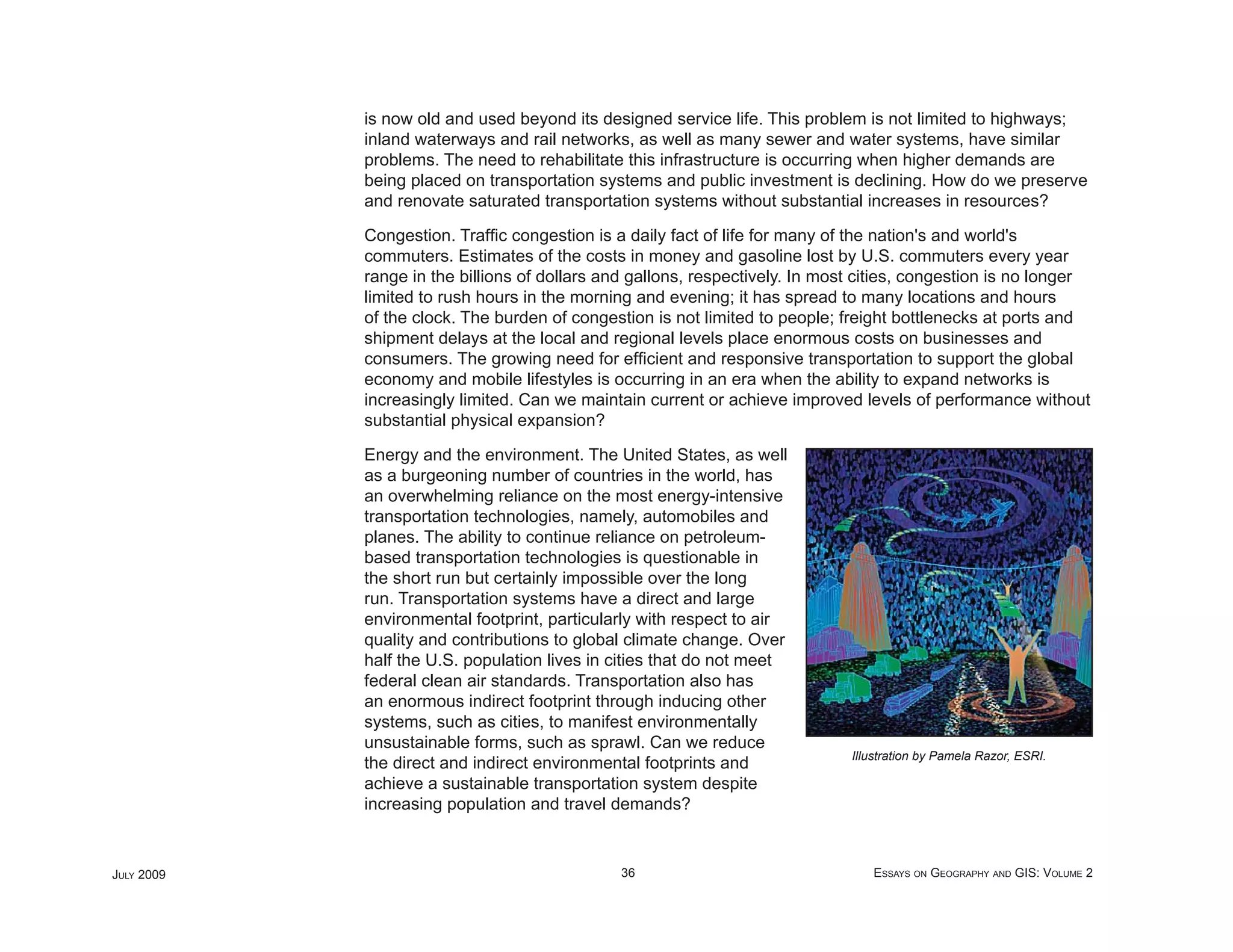
                                  that determine what we might do, and with whom, while we are there. Commercial vehicle traffic
                                  for interstate commerce, commuter transit systems, and airports are obvious examples of code
                                  space in operation in our everyday lives. Mail systems transitioned fully to coded space a long
                                  time ago: for parcel delivery services, almost every object and activity can be identified and
                                  traced as it progresses through the system, from collection to delivery on our doorstep. Other
                                  code spaces are rapidly moving to the foreground: patients, doctors, and supplies are being
                                  handled in a similar fashion in hospitals. Goods in supermarkets and shopping malls are
                                  interconnected through intricate webs of bar codes, radio-frequency identification (RFID) tags,
                                  and inventory management systems that reason about their position in a network of stores and
                                  even the supply geography of individual packets on a shelf. Similarly, transactions may be
                                  tagged at the point of sale and associated uniquely to customers using loyalty, debit, and credit
                                  cards that also link customers to their neighbors at home and similar demographic groupings in
                                  other cities, using sophisticated geodemographic analyses. The influence between location-
                                  aware technology and sociology is also beginning to reverse. Other code spaces facilitate the
                                  emergence of "smart mobs" or "flash mobs," social collectives organized and mediated by
                                  Internet and communications technologies: text messaging, instant messaging, and tweeting,
                                  for example, for the purposes of political organization; social networking; or, as is often the case,
                                  simple fun.
    The Internet of Things        In technology circles, objects in a code space are referred to as "spimes," artifacts that are
                                  "aware" of their position in space and time and their position relative to other things; spimes also
                                  maintain a history of this location data. The term spime has arisen in discussions about the
                                  emergence of an Internet of Things, a secondary Internet that parallels the World Wide Web of
                                  networked computers and human users. The Internet of Things is composed of (often
                                  computationally simple) devices that are usually interconnected using wireless communications
                                  technologies and may be self-organizing in formation. While limited individually, these mesh
                                  networks adopt a collective processing power that is often greater than the sum of its parts
                                  when their independent process models are networked as large "swarms" of devices. Moreover,
                                  swarm networks tend to be very resilient to disruption, and their collective computational and

GIS BEST PRACTICES                                                69                                                         WWW.ESRI.COM
communication power often grows as new devices are added to the swarm. Networks of early-
                              stage spimes (proto-spimes) of this kind have already been developed using, for example,
                              microelectromechanical systems (MEMS), which may be engineered as tiny devices that are
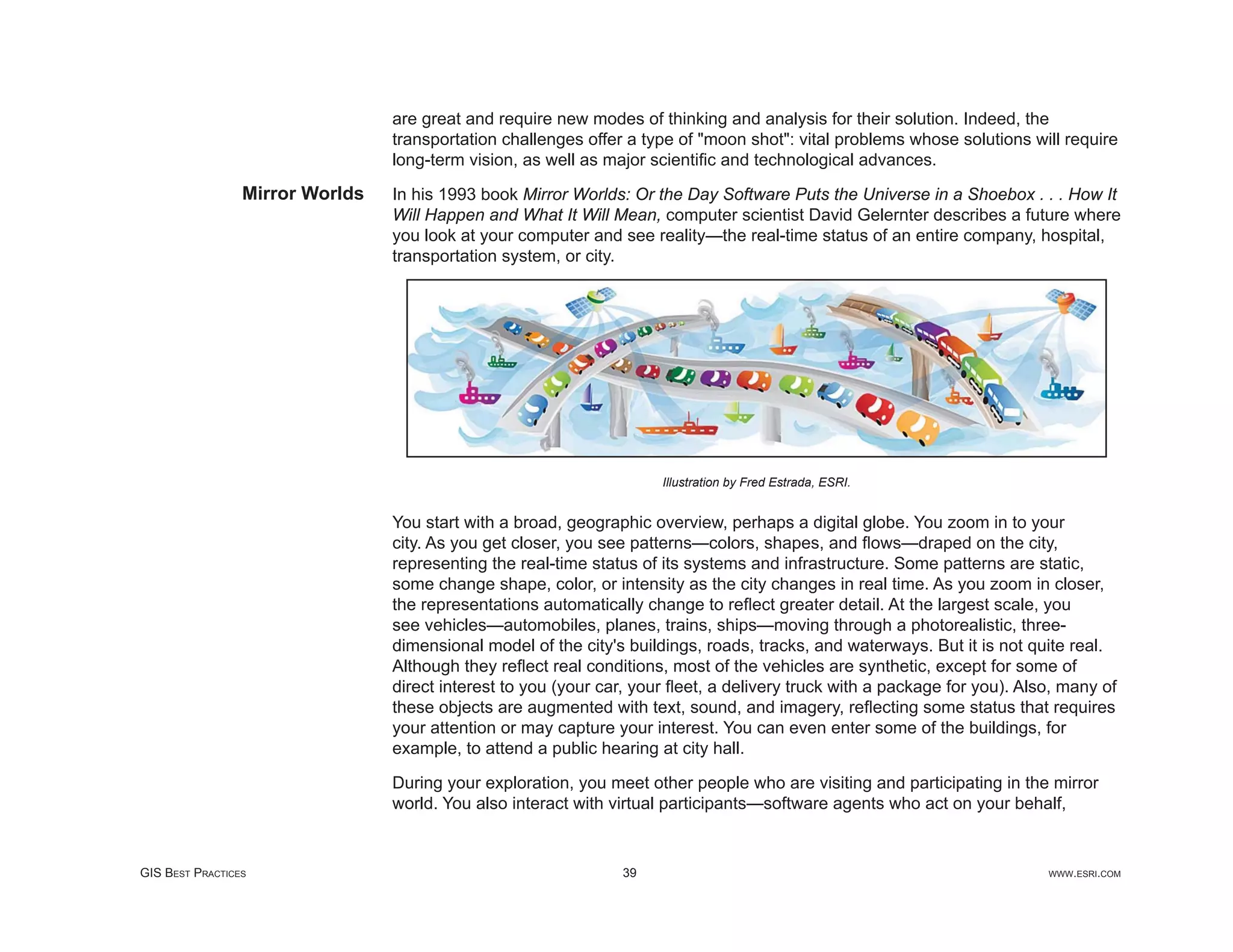
                              capable of sensing changes in electrical current, light, chemistry, water vapor, and so on, in their
                              immediate surroundings. When networked together in massive volumes, they can be used as
                              large-geography sensor grids for earthquakes, hurricanes, and security, for example. Sensor
                              readings can be conveyed in short hops between devices over large spaces, back to a human
                              observer or information system for analysis. MEMS often contain a conventional operating
                              system and storage medium and can thus also perform limited processing on the data that they
                              collect, deciding, for example, to take a photograph if particular conditions are triggered, and
                              geotagging that photograph with a GPS or based on triangulation with a base station.
        Geodemographics       The science and practice of geodemographics are concerned with analyzing people, groups,
     and Related Business     and populations based on tightly coupling who they are with where they live. The who in this
               Intelligence   small formula can provide information about potential debtors', customers', or voters' likely
                              economic profile, social status, or potential political affiliation on current issues, for example.
                              The where part of the equation is tasked with identifying what part of a city, postal code, or
                              neighborhood those people might reside in, for the purposes of allying them to their neighboring
                              property markets, crime statistics, and retail landscapes, for example. Together, this allows
                              populations and activities to be tagged with particular geodemographic labels or value platforms.
                              These tags are used to guide a host of activities, from drawing polling samples to targeting
                              mass mailing campaigns and siting roadside billboards. The dataware for geodemographics
                              traditionally relied on mashing up socioeconomic data collected by census bureaus and other
                              groups with market research and point-of-sale data gathered by businesses or conglomerates.
                              Traditionally, the science has been relatively imprecise and plagued with problems of ecological
                              fallacy in relying on assignment of group-level attributes to individual-level behavior. Because of
                              early reliance on data from census organizations, which aggregate returns to arbitrary
                              geographic zones, the spatial components of geodemographics have also suffered from
                              problems of modifiable areal units (i.e., there are an almost infinite number of ways to delineate
                              a geographic cluster). Data is often collected for single snapshots in time and is subject to
                              serious problems of data decay; households, for example, may frequently move beyond or
                              between lifestyles or trends, without adequate means in the geodemographic classification
                              system to capture that transition longitudinally.

                              Process models could change geodemographics. When users browse the Web, their
                              transactions and navigation patterns, the links they click, and even the amount of time that their

JULY 2009                                                        70                                 ESSAYS ON GEOGRAPHY AND GIS: VOLUME 2
mouse cursor hovers over a particular advertisement can be tracked and geocoded uniquely
                     to their machine. Users' computers can be referenced to an address in the Internet protocol
                     scheme, which can be associated to a tangible place in the real world using reverse geocoding.
                     Along retail high streets and in shopping malls, customers now routinely yield a plethora of
                     personal information in return for consumer loyalty cards, for example, or share their ZIP Codes
                     and phone numbers at the point of sale, in addition to passively sharing their names when
                     using credit or debit cards. By simply associating an e-mail address to this data, it is relatively
                     straightforward, in many cases, to cross-reference one's activity in the tangible world with one's
                     data shadow in cyberspace. Developments in related retail intelligence, business analytics,
                     inferential statistics, and geocomputing have increased the level of sophistication with which
                     data can be processed, analyzed, and mined for information. This allows the rapid assessment
                     of emerging trends and geodemographic categories. Process models are even coded into the
                     software at cash registers in some instances.

                     Much of this technology is allied to spimes and code spaces. Technologies based around RFID
                     and RFID tagging, initially designed for automated stock taking in warehouses and stores, are
                     now widely embedded in products, cards (and therefore wallets), and the environment with such
                     pervasiveness that they enable widespread activity and interaction tracking, particularly within
                     a closed environment such as a supermarket. Coupled to something like a customer loyalty
                     card, these systems allow for real-time feeds of who is interacting (or not) with (not just buying,
                     but handling, or even browsing) what products, where, when, with what frequency, and in
                     what sequences. The huge volumes of data generated by such systems provide fertile training
                     grounds for process models.

                     The increasing fusion of mobile telecommunication technologies with these systems opens up
                     a new environment for coupling process models to mobile geodemographics. This is a novel
                     development for two main reasons. First, it creates new avenues of inquiry and inference about
                     people and transactions on the go (and associated questions and speculations regarding where
                     they may have been, where they might be going, with whom, and to do what). Second, it allows
                     geodemographic analysis to be refined to within-activity resolutions. This has already been put
                     to use in the insurance industry, for example, to initiate pay-as-you-go vehicle coverage models,
                     using GPS devices that report location information to insurance underwriters. Mobile phone
                     providers have also experimented with business models based around location-based services
                     and location-targeted advertising predicated on users' locations within the cell-phone grid,
                     and groups have already begun to experiment with targeting billboard and radio advertising to


GIS BEST PRACTICES                                  71                                                        WWW.ESRI.COM
individual cars based on similar schemes. New GIS schemes based around space-time process
                            models and events are well positioned to interact with these technologies.
            Nanosystems     When spimelike devices are built at very small geographies, capable of sensing and even
                            manipulating objects at exceptionally fine scales, they become useful for nanoengineering. In
                            recent years, there has been a massive fueling of interest in nanoscale science and
                            development of motors, actuators, and manipulators at nanoscales. With these developments
                            have come a veritable land grab and gold rush for scientific inquiry at hitherto relatively
                            underexplored scales: within the earth, within the body, within objects, within anything to be
                            found between 1 and 100 nanometers. Geographers missed out on the last bonanza at fine
                            scales and were mostly absent from teams tasked with mapping the genome. The cartography
                            required to visually map the genome is trivial and the processes that govern genomic patterns
                            are completely alien to most geographers' skill sets, so their exclusion from these endeavors is
                            understandable. The science and engineering surrounding nanotechnology differ from this
                            situation, however, in that they are primarily concerned with spatiotemporal patterns and
                            processes and the scaling of systems to new dimensions. These areas of inquiry are part of the
                            geographer's craft and fall firmly within the domain of geographic information technologies.
                            Process models with spatial sensing and semantic intelligence could play a vital role in future
                            nanoscale exploration and engineering.
     Computational Social   Geographic process models also offer tremendous benefits in supporting research and inquiry
                Science     in the social sciences, where a new set of methods and models has been emerging under the
                            banner of computational social science. Computational social science, in essence, is concerned
                            with the use of computation—not just computers—to facilitate the assessment of ideas and
                            development of theories for social science systems that have proved to be relatively
                            impenetrable to academic inquiry by traditional means. Usually, the social systems are complex
                            and nonlinear and evolve through convoluted feedback mechanisms that render them difficult or
                            impossible to analyze using standard qualitative or quantitative analysis. Computational social
                            scientists have, alternatively, borrowed ideas from computational biology to develop a suite of
                            tools that will allow them to construct synthetic social systems within a computer, in silico, that
                            can be manipulated, adapted, accelerated, or cast on diverging evolutionary paths in ways that
                            would never be possible in the real world.


JULY 2009                                                      72                                ESSAYS ON GEOGRAPHY AND GIS: VOLUME 2
The success of these computational experiments relies on the ability of computational social
                                science to generate realistic models of social processes, however, and much of the innovation
                                in these fields has been contributed by geographers because of their skills in leveraging
                                space and spatial thinking as a glue to bind diverse cross-disciplinary social science. Much
                                of computational social science research involves simulation-building. To date, the artificial
                                intelligence driving geography in these simulations has been rather simplistic, and development
                                in process models offers a potential detour from this constraint. Moreover, computational social
                                science models are often developed at the resolution of individual people and scaled to treat
                                massive populations of connected "agents," with careful attention paid to the social mechanisms
                                that determine their connections. This often requires that large amounts of data be managed
                                and manipulated across scales, and it is no surprise that most model developers turn to GIS for
                                these tasks. Connections between agent-based models and GIS have been mostly formulated
                                as loose couplings in the past, but recent developments have seen functionality from geographic
                                information science built directly into agent software architectures, with the result that agents
                                begin to resemble geographic processors themselves, with realistic spatial cognition and
                                thinking. These developments are potentially of great value in social science, both in providing
                                new tools for advanced model building and in infusing spatial thinking into social science
                                generally. At the same time, developments in agent-based computing have the potential to feed
                                back into classic GIS as architectures for reasoning about and processing human environment
                                data.
                     Prologue   This is a wonderful time to be working with or developing geographic information technologies,
                                at the cusp of some very exciting future developments that will bring GIS farther into the
                                mainstream of information technology and will infuse geography and spatial thinking into a host
                                of applications. Of course, some potential sobering futures for these developments should be
                                mentioned. As process models are embedded in larger information, technical, or even
                                sociotechnical systems, issues of accuracy, error, and error propagation in GIS become even
                                more significant. Ethical issues surrounding the use of fine-grained positional data also become
                                more complex when allied with process models that reason about the significance or context of
                                that data. Moreover, the reliability of process models as appropriate representations of
                                phenomena or systems must come under greater scrutiny.


GIS BEST PRACTICES                                            73                                                       WWW.ESRI.COM
About the Author   Dr. Paul M. Torrens is an associate professor in the School of Geographical Sciences at Arizona
                               State University and director of its Geosimulation Research Laboratory. His work earned him a
                               Faculty Early Career Development Award from the U.S. National Science Foundation in 2007,
                               and he was awarded the Presidential Early Career Award for Scientists and Engineers by
                               President George W. Bush in 2008. The Presidential Early Career Award is the highest honor
                               that the U.S. government bestows on young scientists; Torrens is the first geographer to receive
                               the award.


                               (Reprinted from the Summer 2009 issue of ArcNews magazine)


JULY 2009                                                       74                               ESSAYS ON GEOGRAPHY AND GIS: VOLUME 2
Geographic Literacy in U.S. by 2025
                     "Geo Learning"

                     A column by Daniel C. Edelson, Vice President for Education, National Geographic Society


                     For more than a decade, the National Geographic Society and
                     ESRI have worked together to advance the cause of geographic
                     literacy in the United States.

                     This new ArcNews column represents the next step in that
                     collaboration. We are reaching out to the ESRI user community, the
                     largest organization of GIS professionals in the world, to engage
                     you in this important campaign.

                     In this inaugural column, I will address the questions of what
                     geographic literacy is and why GIS professionals have such an
                     important role to play in our campaign to increase the rate of
                     geographic literacy in the United States. In future "Geo Learning"
                     columns, I will describe specific ways that you can get involved in this effort.

                     It's no secret that Americans know next to nothing about geography. The most recent National
                     Geographic/Roper Poll (2006) found that half the 18–24-year-old Americans surveyed could not
                     locate New York on a map of the United States, and nearly 6 in 10 could not locate Ohio.

                     One-third of the young adults in the survey gave the wrong answer when asked to name the
                     continent where the Amazon rain forest is located. And, after being at war with Iraq for three
                     years, 63 percent of young Americans could not identify Iraq on a map of the Middle East.

                     If you're like me, you find it hard to believe those statistics because they are so discouraging,
                     but they are true. However, by paying too much attention to these statistics, we could easily
                     teach American schoolchildren a lot of disconnected geographic facts about the world that
                     distract us from what people really need.


GIS BEST PRACTICES                                  75                                                        WWW.ESRI.COM
Knowing geography facts does little good if you can't do something with those facts. People
            don't need to know geography, they need to be able to do geography. To me, doing geography
            is what geographic literacy is all about.

            The problem facing American society right now is that most people don't even know what it
            means to do geography. So who does know what it means to do geography and understand
            why it is so important? You do.

            GIS professionals know what it means to analyze and solve geospatial problems. GIS
            professionals routinely apply geographic analysis to complex situations, predict consequences,
            construct plans, and make decisions. Not only do GIS professionals know what it means
            to do geography, they also understand how valuable the ability to do geography is to them
            individually, to their employers, and to our society.

            To me, GIS professionals represent the standard against which we should measure geographic
            literacy. I do not mean that every individual should have the level of expertise that GIS
            professionals have. That's neither appropriate nor realistic.

            However, we should aspire to having all Americans be able to conduct basic geographic
            analysis in order to make sound personal, political, and professional decisions. This is not about
            technology, either; I'm not arguing that all Americans need to be able to use a GIS.

            My point is about analysis. I believe that every American should understand how the attributes
            of a location and its relationship to other locations affect that location. Every adult should
            understand that his or her actions have predictable effects elsewhere and that what happens
            elsewhere affects them. Today, most Americans go from kindergarten through college without
            ever being taught how to trace causes forward or backward across space or to analyze spatial
            relationships in order to predict or explain.

            Without this analytic ability, how would we ever expect them to make good decisions about
            where to live and work, how to transport themselves, what to buy and how to dispose of it, how
            to prepare for natural disasters, whether to go to war abroad, where to locate a store or factory,
            or how to market goods abroad? The list goes on and on.

            An even bigger problem than the low rate of geographic literacy in this country is that Americans
            don't even know enough to see the price that they are paying individually and as a society. Most
            Americans don't have any idea how much better their lives and our world could be if they could
            all do geography. Once again, the largest group that does understand the value of geographic

JULY 2009                                      76                                ESSAYS ON GEOGRAPHY AND GIS: VOLUME 2
literacy is the community of GIS professionals, and that is why the National Geographic Society
                     and ESRI want to enlist you in our long-term campaign to create a geographically literate
                     society.

                     So, what have we done historically, where are we now, and where do we hope to go with your
                     help?

                     Beginning more than 20 years ago, the National Geographic Society took up the cause of
                     geographic literacy and created an education foundation to fund geography education initiatives.
                     Since then, we established a national network of state "geography alliances," which are
                     university-based organizations that advocate for geography education and provide professional
                     development for teachers. Funded by a combination of proceeds from National Geographic
                     programs, state governments, and private philanthropies, these alliances were successful in
                     establishing K–12 standards for geographic literacy in all 50 U.S. states; Washington, D.C.; and
                     Puerto Rico.

                     The state geography alliances also created geography education materials and trained
                     thousands of K–12 teachers in their states. While teacher professional development is the
                     key to improving geographic literacy, it is also the biggest challenge. Most teachers who are
                     responsible for teaching geographic content, whether it's in the context of science or social
                     studies, have never received any training in geography themselves.

                     In 20 years, the National Geographic-funded Alliance Network has had an impressive impact in
                     raw numbers, but percentage-wise, it is just a drop in the bucket. That means, today, we face a
                     situation in which we have a powerful infrastructure for reforming education, but we do not have
                     the resources to bring about that reform.

                     For that reason, we are in the process of launching the second phase of our campaign for
                     geographic literacy. The goal of this campaign is to approach universal geographic literacy.
                     Specifically, we set a goal to achieve 80 percent rates of geographic literacy in all 50 states by
                     2025, where geographic literacy is defined as the ability of students to apply geographic skills
                     and understanding in their personal and civic lives. We set a second goal to achieve 50 percent
                     geographic fluency in all 50 states at the same time. Geographic fluency is a higher standard,
                     which we define as preparation sufficient for successful postsecondary study in subjects
                     that require geographic skills and understanding (e.g., international affairs or environmental
                     science).


GIS BEST PRACTICES                                  77                                                       WWW.ESRI.COM
The year 2025 seems far away, but because educational reform is a slow process, and we don't
            currently have the necessary resources, this reform is an ambitious goal. To achieve our goal,
            we are working with the Alliance Network and other like-minded organizations, such as the
            Association of American Geographers, National Council for Geographic Education, and ESRI,
            on three parallel tasks:

               Create a combination of top-down policy and bottom-up consumer demand for geographic
               literacy.

               Obtain sufficient resources in the form of federal, state, and philanthropic funding to mount a
               large-scale reform effort.

               Create and implement plans for large-scale educational reform at the state and local levels.

            There are important roles for GIS professionals and other applied geographers to play in all
            three of these strands, and in upcoming columns I will challenge you, the ESRI user community,
            to play your part.


            (Reprinted from the Spring 2009 issue of ArcNews magazine)


JULY 2009                                    78                                ESSAYS ON GEOGRAPHY AND GIS: VOLUME 2
Geography, GIS, and Mental Health
                     "Crossing Borders"

                     A column by Doug Richardson, Executive Director, Association of American Geographers


                     For those of you who were hoping this column might offer a
                     groundbreaking treatise on the state of mind of geographers and
                     GIScientists, you can stop reading here. I'm saving that project
                     for when I retire.

                     What I would like to discuss here are the opportunities and
                     needs for geography and GIScience to participate in the
                     rapidly expanding field of mental health research, a relatively
                     unexplored area for geographers but one in which geography
                     and GIS can, I'm convinced, be a significant and potentially
                     paradigm-changing contributor. It is also a research area in
                     which geographers and GIS specialists can engage with and
                     help address enormous human and societal needs.

                     As many of you know, the AAG has been working for several years to try to build relationships
                     with the National Institutes of Health (NIH) on behalf of geography and GIS and help medical
                     researchers in the many different NIH centers better understand what geography and
                     GIScientists have to offer to the field of medical research. This work has continued to develop
                     new inroads for geography at several NIH institutes, as well as in the broader medical research
                     communities outside NIH. For example, the AAG and the NIH's National Institute on Drug
                     Abuse (NIDA) have jointly sponsored special symposia at AAG's Annual Meetings during each
                     of the past four years on the previously relatively unexplored research area of geography and
                     drug addiction. That ongoing effort has now drawn attention throughout NIH and resulted in the
                     publication of a book entitled Geography and Drug Addiction, which is being widely circulated in
                     medical research circles and is available from the AAG.

                     The AAG's work on geography and drug addiction with NIDA has sparked further interest
                     at other NIH institutes, including the National Institute of Mental Health (NIMH), regarding
                     the potential for GIS and geography to also make contributions to the field of mental health
                     research. We have been in lengthy and productive discussions with several NIMH researchers

GIS BEST PRACTICES                                 79                                                       WWW.ESRI.COM
engaged in genomic studies that are attempting to identify genetic markers, the presence or
            absence of which, it is hypothesized, may correlate with various complex mental disorders, such
            as schizophrenia, depression, and so forth. The challenge here is that genetic factors are rarely
            determinant and are nearly always highly interactive with environmental risk factors.

            This new genetic research has revived old debates about nature versus nurture, or genes
            versus environment, but at a whole new scale and level of detail and sophistication. As mental
            health and other medical researchers are increasingly able to obtain highly detailed and
            sophisticated genetic information, there is now also developing a counter-demand for more
            highly detailed and sophisticated information about the environment in order to attempt to sort
            out complex gene-environment interactions. This is where geography, with its emphasis on
            place and related geographic methodologies for organizing and understanding environments,
            and GIS, with its ability to integrate and correlate vast amounts of different environmental data
            with observed conditions, such as mental health disorders or genetic risk factors, become
            central to this new research.

            Consequently, geography and GIS are now on the threshold of enabling substantial new
            breakthroughs in medical research involving complex gene-environmental interactions. We still
            have a long way to go in understanding genetic and environmental interactions, and our GIS
            systems and geographic methods are both challenged by the complexity of these systems.
            However, I have found that medical researchers everywhere, from NIH to universities to private
            companies, are highly receptive to the promise that geographic methodologies and GIScience
            and GIS systems hold for a better understanding of the etiology, treatment, and prevention of
            disease, addiction, and mental health disorders.

            These explorations with NIH have been both interesting and productive. An illustration of
            the unexpected pathways and intriguing outcomes of these creative interactions between
            geography and the medical and mental health researchers at NIH is an invitation I received
            last fall to help organize a special session, together with others from NIH, on the topic of
            Geography, Addiction, and Mental Health for a meeting of the International Federation of
            Psychiatric Epidemiologists, which was held in Vienna, Austria. While generally not at a loss
            for words, I must admit that at first I was not sure what I should say (or not say) to a room full
            of psychiatrists. However, the meetings went very well, and there was genuine excitement on
            the part of the many psychiatrists, geneticists, psychologists, and medical researchers present
            in learning more about GIS and about geography's potential contributions to research on
            understanding the role of place and the environment in mental disorders and their treatment.


JULY 2009                                      80                                ESSAYS ON GEOGRAPHY AND GIS: VOLUME 2
Examples of the dozens of research themes with geographic dimensions we discussed included
                                   genetic and environmental interactions in schizophrenia, research on the consequences
                                   of refugee displacement, psychiatric morbidity of homelessness, psychopathology among
                                   Holocaust survivors and their children, urbanicity and psychoses, the global economic burden
                                   of mental disorders, public policy and the measurement of happiness, and searching for genes
                                   with environmental interactions in complex disorders. Plans are under way to follow up both
                                   organizationally and individually to help link these research programs with geography and GIS.

                                   As one NIH scientist noted at our session, "To date, most mental health research has focused
                                   largely on biomedical pathways. Increasingly, however, researchers are considering how
                                   people's environments—the physical and cultural contexts in which they live—influence the
                                   prevalence and consequence of mental health disorders." The AAG will continue to engage
                                   these issues of geography's potential role in medical research at all institutes of NIH, and I
                                   encourage geographers, GIScientists, and GIS specialists to also consider how you might work
                                   together with researchers at NIH's National Institute of Mental Health to help address these
                                   complex but pressing mental health research and human needs.
                        For More   Contact www.aag.org or www.nimh.nih.gov.
                     Information
                                   (Reprinted from the Summer 2009 issue of ArcNews magazine)


GIS BEST PRACTICES                                               81                                                     WWW.ESRI.COM
The National Geospatial Advisory Committee: An
                     Action Agenda
                     By Anne Hale Miglarese, NGAC Chairperson


                     In January of 2008, U.S. Secretary of the Interior Dirk Kempthorne announced the formation and
                     membership of the National Geospatial Advisory Committee (NGAC). This announcement came
                     as no surprise to geospatial professionals following the activities of the Federal Geographic
                     Data Committee (FGDC) or spatial data development and coordination in the United States. In
                     fact, for years, many nonfederal organizations and individuals have called for a voice to officially
                     provide input into U.S. federal government activities related to geospatial programs.

                     For the most part, the federal government was quite willing to receive informal input and hold
                     forums to discuss its spatial activities, but listening was often an ad hoc and casual process. In
                     defense of the government staff, federal law restricts the influence of nonfederal individuals on
                     official federal programs and activities. Their informal approach was the only approach legally
                     possible without setting up what is known as a federal advisory committee under the authority of
                     the Federal Advisory Committee Act (FACA).


                                                         Illustration by Marina Murad, ESRI.


                     But, by formally establishing this FACA committee, i.e., the NGAC, the federal government can
                     now receive formal advice and recommendations from representatives of state, local, regional,
                     and tribal governments, as well as academia and the private sector.


GIS BEST PRACTICES                                  83                                                        WWW.ESRI.COM
The pending establishment of the NGAC was published in the Federal Register on
                            May 16, 2007, along with a request for applications for committee membership. Thus, on
                            January 29, 2008, the secretary officially named 28 individuals to serve on the NGAC (see
                            table at the bottom of this article). These members represent a very diverse and exceptionally
                            talented group of professionals who have spent many years devoted to promoting and
                            advancing the use of GIS technology to improve decision making across many disciplines.
             Governance     The charter for the committee was established by the office of the Secretary of the Interior and
                            establishes that the committee will report to the chair of the FGDC, which is the Secretary of the
                            Interior or his designee. Jim Cason, the Associate Deputy Secretary of the Interior, serves as
                            the chair of the FGDC. The scope and objectives of the committee are also laid out in the
                            charter:

                            "The committee will provide advice and recommendations related to management of federal
                            and national geospatial programs, the development of the National Spatial Data Infrastructure
                            [NSDI] and the implementation of Office of Management and Budget [OMB] Circular A-16 and
                            Executive Order 12906. The committee will review and comment on geospatial policy and
                            management issues and will provide a forum to convey views representative of nonfederal
                            stakeholders in the geospatial community."

                            The committee will meet three to four times per year, and all meetings of the committee will be
                            open to the public, with time devoted on the agenda for public comment. The chair of the NGAC,
                            in consultation with the designated federal official (Ivan Deloach, Staff Director of the FGDC),
                            will set the agenda and meeting dates. All meetings are announced in the Federal Register, and
                            all documents and minutes of the meeting are publicly available on the Web
                            (www.fgdc.gov/ngac).
  Direction and Guidance    The committee's first full public meeting occurred April 15–16, 2008, in Washington, D.C. At this
           from the FGDC    meeting, Cason formally requested that the committee provide advice on
              Chairperson
                               National Spatial Data Infrastructure: Recommendations on the future roles and
                               responsibilities of the key players in developing and sustaining the next generation of the
                               NSDI

                               Public-private partnerships and investment strategies: Recommendations on minimizing/
                               removing investment barriers that impede public-private partnerships in advancing the
                               collection, use, and dissemination of geospatial data, products, and technology


JULY 2009                                                     84                                ESSAYS ON GEOGRAPHY AND GIS: VOLUME 2
Management of federal geospatial resources: OMB Circular A-16—Comments/
                                  Recommendations on geospatial life cycle management strategies and revisions to OMB
                                  Circular A-16 data themes being developed and coordinated through the Geospatial Line of
                                  Business initiative

                                  Data initiatives: Reviews and recommendations, including recommendations on prioritization
                                  of specific programmatic or data initiatives, which include the following: Imagery for the
                                  Nation (IFTN), national land parcel data, and the National Map

                               At this meeting, the committee received briefings from federal staff on several general activities,
                               such as an overview of FGDC activities; a general introduction to the Geospatial Line of
                               Business activity and OMB Circular A-16; and an introduction to the National Map, Imagery for
                               the Nation, Elevation for the Nation, and Geospatial One-Stop.

                               Additionally, significant time was spent allowing each member of the committee to express
                               their views, concerns, and passions related to the work of the committee. From this three-hour
                               discussion, many similarities emerged, and the cohesion of the group began.
         Getting Started: An   The committee has been a long time in the making and hopes its efforts are not judged by the
             Action Agenda     impact it makes in the first few months but by the quality of the advice and guidance it provides
                               to the chair of the FGDC in the years to come. It is anticipated that the committee will focus on a
                               wide range of topics over the next two years. Many of these issues and subjects may be studied
                               and reported in short order. Many will take more time, and several should be viewed as long-
                               term projects requiring detailed analysis and discussion.

                               Agenda items raised as actions in the first meeting were assigned to subcommittees, then
                               brought back to the full committee for its endorsement in the June meeting. One such item was
                               the creation of a mission statement:


GIS BEST PRACTICES                                            85                                                        WWW.ESRI.COM
The National Geospatial Advisory Committee mission is to provide strategies regarding the
                              creation, management, and dissemination of cohesive geospatial data, information, and
                              knowledge to enable commercial, academic, and nonprofit organizations and all levels of
                              government to more effectively

                                  Empower and serve the public.

                                  Protect our homeland.

                                  Foster economic growth.

                                  Advance science.

                                  Manage our resources.

                                  Prepare for and respond to emergencies.

                                  Govern our nation.


   NGAC Endorsement of      With a mission statement complete, the committee was asked by Cason to evaluate and make
   Imagery for the Nation   recommendations on the Imagery for the Nation initiative. After hours of debate, the following
                            statement was endorsed by the NGAC:


                              Whereas seamless coverage orthophotography has been demonstrated to have crosscutting
                              utility; whereas all levels of government are currently investing in orthophotography, many
                              without coordination or leveraging the investment; and whereas IFTN

                                  Provides financial incentives for all levels of government to cooperate in creation and
                                  publication of public domain data

                                  Saves taxpayer money by achieving national economies of scale

                                  Sets minimal technical standards ensuring that cohesive national data is created, while
                                  allowing buy ups so that varying state, local, and regional requirements can be met


JULY 2009                                                     86                               ESSAYS ON GEOGRAPHY AND GIS: VOLUME 2
Establishes a regular schedule for delivery so customers and partners can plan

                        Is the model for the development of other critical national geospatial data layers

                     NGAC fully endorses the concept of Imagery for the Nation. However, before it is authorized
                     and implemented the following issues need to be resolved:

                        A procurement strategy that uses a best practices procurement process and delineates
                        the contracting agency(s), procurement methods, and vehicles must be detailed. This
                        procurement plan should cover small business participation. The federal community
                        should clearly speak to the intent of whether this information will be procured to create
                        information that will go into the public domain or will be licensed as data products.
                        Further, the government needs a funding and acquisition timeline that allows private
                        companies to engage in strategic planning for capital equipment acquisition and
                        staffing that allows the demand to be met in a timely fashion without creating undue risk
                        of oversupply in the marketplace due to the lack of a clear procurement strategy.

                        The committee requested a clear statement of policy from the federal government
                        on how it intends to ensure that funding associated with the IFTN initiative will be
                        monitored to make certain it is not used to underwrite projects that compete with
                        private-sector services offered in the geospatial community.

                        The development and publication of an integrated strategy for funding and
                        implementing the data development initiative of the NSDI are critical. While it is
                        acknowledged that the IFTN initiative is thoughtfully conceived and well vetted within
                        the geospatial community, largely due to the efforts of the National States Geographic
                        Information Council and the National Digital Orthophotography Program, it is important
                        that this program not be implemented without careful consideration of the other data
                        initiatives developing within the community. Specifically, the other programs that should
                        be analyzed and synchronized with IFTN include Elevation for the Nation, Parcels
                        for the Nation, and Transportation for the Nation. The geospatial community must
                        analyze these activities and develop a plan to present them as needed investments
                        in the development of information infrastructure in a thoughtful, complementary, and
                        nonduplicative process.


GIS BEST PRACTICES                              87                                                           WWW.ESRI.COM
The recently established National Land Imaging Program (NLIP) is designed to meet
                                  U.S. civilian moderate-resolution land imaging needs to monitor the changes in land
                                  surface, polar regions, and coastal zones due to the changes in population growth,
                                  development, and climate changes. A program office has been established in the
                                  Department of the Interior, reporting at the secretary and assistant secretary level, to
                                  provide focused leadership and management for the nation's land imaging efforts. NLIP
                                  will focus on maintaining a core, operational government commitment and capability
                                  to collect moderate-resolution land imagery through the procurement and launch of a
                                  series of U.S. owned satellites, thereby ensuring the continuity of U.S. collected and
                                  managed Landsat-like data well into future decades. It is important for FGDC and the
                                  Department of the Interior to ensure that the IFTN and NLIP programs are clear in their
                                  mission focus and work together to provide society with the spatial information required
                                  to support decision making, albeit at very different scales for different applications.

                                  With regard to the management of Imagery for the Nation, the committee requested
                                  that the federal government clearly articulate the management process that will govern
                                  Imagery for the Nation as an ongoing program. Specifically, how will it be managed
                                  and by what agencies and offices; how will the programmatic staff stay in touch with
                                  the needs of the nonfederal user community; how will the program minimize duplication
                                  of effort and ensure through a vigorous outreach program that others are aware of the
                                  availability of this information; and, finally, how will the staff continue to measure the
                                  return on investment and document cost savings on an ongoing basis?


                            The committee looks forward to a regular dialog with the organizations promoting Imagery for
                            the Nation, particularly FGDC. While there are still several issues as delineated above, the
                            committee is confident that by working together it can achieve its common goal.
    Transition Team White   In the first meeting, a significant amount of dialog revolved around the geospatial community's
                    Paper   need to engage in the political process by embracing a new administration in November and
                            working to influence this new leadership to embrace geospatial technology as an investment
                            that underpins the national governance structure and to positively influence hundreds of
                            administrative initiatives to follow. The goal of this project is for a geospatial white paper
                            to be developed for the transition team shortly after the November election. The design of


JULY 2009                                                     88                                ESSAYS ON GEOGRAPHY AND GIS: VOLUME 2
the geospatial white paper will be simple and focus on why geospatial technology matters
                               to the federal government, a few high-profile activities that could be embraced by the new
                               administration, and the location and title of presidentially appointed positions within the federal
                               agencies that have traditionally had significant influence on geospatial policy and technology.
                               The subcommittee will be working over the summer on fully developing the transition paper, and
                               the full committee anticipates finalizing the document at its October meeting.


                                                                   Illustration by Suzanne Davis, ESRI.


                The Changing   Also, during the committee's first meeting, there was significant discussion on how the
                  Landscape    geospatial world has changed dramatically over the past decade and how, as a community,
                               it must acknowledge that change and anticipate the future to make sound recommendations
                               for geospatial investments in the public sector. These changes have occurred at all levels in
                               government, academia, and the private sector. To lay a foundation and context for the NGAC
                               deliberations over the next few years, the committee is developing a changing landscape
                               white paper that describes this change from a technical level, a social level, and a governance
                               standpoint. There are many everyday examples; all one has to do is look at how geospatial
                               technology is being embedded in consumer applications on cell phones to see the change.

                               Perhaps the best example of this fundamental change occurring within the spatial community
                               is to look at the progression of where framework spatial data is generated. In years past, most
                               mapping data was generated at the federal level through federal programs, eventually making
                               its way to state and local governments. However, often, the data was out of date by the time
                               it was distributed to nonfederal governments or, even more typically, was not built to standard
                               scales necessary at the state and local levels. One could argue that about 10 years ago, the
                               hourglass began to turn and the flow of data began to move from state and local government,
                               where the higher-resolution data was procured, to the federal government (see hourglass
                               graphic on page 90). This transition alone has caused serious issues with governance
                               structures that the community grapples with to this day. However, perhaps the most radical

GIS BEST PRACTICES                                            89                                                        WWW.ESRI.COM
assertion of change has just begun. With the influence of Garmin, Google, Microsoft, NAVTEQ,
            Tele Atlas, Yahoo, and many other talented and financially enabled businesses moving into the
            local search arena on the backbone of geography, it is certain that this is only the beginning of
            this changing paradigm of where data is created and where partnerships are located.


                  In years past, most mapping data was generated at the federal level through federal programs and then eventually
                made its way to state and local governments. However, often the data was out of date by the time it reached nonfederal
                       governments or was not built to the scales needed by state and local governments. About 10 years ago,
                          the hourglass began to turn and the flow of high-resolution data began to move the other direction,
                                       from state and local governments to the federal government. Furthermore,
                                 perhaps a more radical change has just begun—the influence of private-sector data.


JULY 2009                                              90                                            ESSAYS ON GEOGRAPHY AND GIS: VOLUME 2
These fundamental changes and the influence and impact they will have on federal, state,
                               and local governments, as well as the flow of geospatial goods and services, cannot be
                               underestimated. The National Geospatial Advisory Committee will endeavor to describe and
                               analyze many of these phenomena in the white paper to be published later this year.
  The Long-Term Agenda         In light of the transition occurring within the geospatial industry, the committee spoke at
                               length on the need for a national strategy for building and sustaining the NSDI. There is
                               broad agreement on the need for such a strategy, which is certainly the long pole in the
                               geospatial tent. This effort will take substantial discussion, listening, learning, and debating
                               to be thoughtfully constructed. Deliberations will focus on topics such as the need for strong
                               leadership within federal, state, and local governments. It is ideal that all these entities are
                               represented on the NGAC. Sustainable funding and financing must be a major component of
                               the strategy, and within this topic, the analysis of business models that allow true public-private
                               partnerships will certainly be an interesting debate.

                               Finally, the geospatial community must work together to attract and educate the next generation
                               of this profession. This country's attention to the basic teachings of geography and the many
                               other disciplines that underpin geospatial technology is woefully inadequate. This basic
                               framework for a national strategy for the NSDI will evolve and include building the components
                               of the strategy in consultation with the community at large.
            Staying in Touch   FGDC encourages you to monitor its activities through its Web site (www.fgdc.gov/ngac). The
                               committee is in the process of developing an outreach strategy and hopes to release it on
                               its Web site in the near future. It looks forward to working with the geospatial community to
                               provide actionable recommendations and advice that promote better decision making through
                               geography.
            About the Author   Anne Hale Miglarese is a principal with the Booz Allen Hamilton consulting firm in Washington,
                               D.C. Miglarese has worked in state government with the South Carolina Department of
                               Natural Resources and in federal government with the National Oceanic and Atmospheric
                               Administration. Most recently, she was the president and managing director of Fugro EarthData.
                               Miglarese also serves on numerous boards, including the Management Association of Private
                               Photogrammetric Surveyors and TerraGo Technologies. Miglarese is the chairperson of the
                               National Geospatial Advisory Committee.


GIS BEST PRACTICES                                            91                                                         WWW.ESRI.COM
Academic and Private-Sector                    Public-Sector Representatives
            Representatives
            Sean Ahearn, Hunter College, City University   Timothy M. Bennett, NativeView
            of New York
            Allen Carroll, National Geographic Society     Michael Byrne, State of California
            David Cowen, University of South Carolina      Donald Dittmar, Waukesha County, Wisconsin
            Jack Dangermond, ESRI                          Dennis Goreham, State of Utah
            Kass Green, The Alta Vista Company             Randall L. Johnson, Metropolitan Council,
                                                           St. Paul, Minnesota
            David Maune, Dewberry                          Randy Johnson, Hennepin County, Minnesota
            Anne Hale Miglarese, Booz Allen Hamilton       Jerry Johnston, U.S. Environmental
            (Chairperson)                                  Protection Agency
            Charles Mondello, Pictometry International     Barney Krucoff, District of Columbia
            Kim Nelson, Microsoft Corporation              Timothy Loewenstein, Buffalo County,
                                                           Nebraska
            Matthew O'Connell, GeoEye                      Zsolt Nagy, State of North Carolina
            John Palatiello, Management Association for    Jay Parrish, State of Pennsylvania
            Private Photogrammetric Surveyors
            G. Michael Ritchie, Photo Science              Gene Schiller, Southwest Florida Water
                                                           Management District
            David Schell, Open Geospatial Consortium       Steven Wallach, U.S. National Geospatial-
                                                           Intelligence Agency (Vice Chairperson)
            Christopher Tucker, ERDAS, Inc.


            (Reprinted from the Summer 2008 issue of ArcNews magazine)


JULY 2009                                   92                               ESSAYS ON GEOGRAPHY AND GIS: VOLUME 2
Global Dialogues: GIScience and Sustainable
                     Development in Africa
                     "Crossing Borders"

                     A column by Doug Richardson,Executive Director, Association of American Geographers


                     The Association of American Geographers recently had the opportunity to participate with hundreds
                     of African geographers, GIScientists, and environmental scientists
                     in a new dialogue around the theme of Geospatial Science and
                     Sustainable Development in Africa. These discussions, which
                     were initiated in March 2008 and have already generated several
                     promising new areas of research and educational collaboration,
                     were sponsored by the U.S. Department of State's Global Dialogues
                     on Emerging Science and Technology (GDEST) program. Follow-on
                     activities and continuing interactions resulting from these dialogues
                     have the potential to generate considerable ongoing and long-
                     term cooperation among African and U.S. scientists in geographic
                     research, geographic information science (GIScience) education
                     and GIS applications, sustainability science, and many related
                     fields.

                     Five other GDEST programs also have been undertaken, including dialogues in Japan (focusing
                     on nanotechnologies), China (biotechnology), and Germany (quantum computing). However,
                     the recent Africa GDEST program is the first to be initiated on a continental scale and the first to
                     address geography-related research fields, such as geospatial science and sustainability.

                     The Global Dialogues on Emerging Science and Technology program focusing on Geospatial
                     Science and Sustainable Development in Africa began in March 2008 with site visits to universities,
                     governmental ministries, and nongovernmental organizations in nine African countries, followed by
                     a conference on the same theme in Cape Town, South Africa.

                     The U.S. delegation was divided into two teams, East Africa and West Africa, and included
                     members from the U.S. Department of State Humanitarian Information Unit and its Bureau of
                     Oceans and International Environmental and Scientific Affairs, as well as representatives from other

GIS BEST PRACTICES                                    93                                                         WWW.ESRI.COM
U.S. governmental agencies, several U.S. universities, the American Geographical Society,
            the Association of American Geographers, and the United States Agency for International
            Development (USAID) regional offices. The teams conducted more than 50 site visits and met
            with hundreds of African experts in the fields of environmental remote-sensing interpretation
            and modeling, GIS cartography and analysis, agriculture, education, health, surveying, mining,
            climate, hydrology, population, urban systems, and information and communication technology.

            Care was taken to listen to and learn from our African colleagues, to identify needs rather
            than prescribe solutions, to build upon existing regional capacity in geospatial science and
            technology rather than duplicate or displace it, and to explore opportunities for collaboration
            between U.S. and African scientists and institutions, as well as among African organizations and
            networks, in ways identified as useful to scientists, educators, and governmental agencies from
            the region.

            It was clear from both the country visits and the conference that significant progress has been
            achieved since the 2002 World Summit on Sustainable Development in terms of the diffusion
            and sophistication of geospatial technologies, applications, and coordination, both regionally
            and in individual countries, and their use in sustainable development planning and program
            implementation. Despite progress, however, optimal use of geographic information science and
            associated technologies is often constrained by a lack of resources, a lack of access to suitable
            data, and a lack of coordination among users and data producers.

            Among other topics, GDEST participants particularly sought to promote future dialogues that
            would identify partners for collaboration on specific projects or programs; make better use
            of collaboration among U.S. and African scientists and practitioners to create a sustainable
            critical mass of African expertise; support regional and indigenous educational and institutional
            infrastructures; and develop educational and research collaborative mechanisms, including
            faculty and student exchange programs, online interactions, and better access to research and
            curricular information.

            The AAG currently is implementing some of the above resource sharing and online interactive
            coordinative mechanisms through its new subsidized Developing Regions Membership Program
            and through the existing AAG Center for Global Geography Education programs.

            Also important to sustaining collaboration is supporting existing African networks of excellence
            and platforms for dialogue, information sharing, and communication. For example, African
            networks of excellence, such as the African Association of Remote Sensing of the Environment

JULY 2009                                     94                                 ESSAYS ON GEOGRAPHY AND GIS: VOLUME 2
(AARSE), African Geo Information Research Network (AGIRN), African Reference Frame
                     (AFREF), Environmental Information Systems Africa (EIS-AFRICA), Mapping Africa for
                     Africa, and university networks (e.g., University Network for Disaster Risk Reduction in
                     Africa [UNEDRA]), are vital infrastructures of communication and coordination for research,
                     education, and applications collaboration. Descriptions of and linkages to these and many other
                     existing African networks can be accessed directly through the AAG Web site at www.aag.org/
                     developing.

                     The U.S. GDEST delegation representatives, both individually and in coordination with U.S.
                     embassies in the countries visited, are currently following up on contacts and acquaintances
                     made during the site visits and will be continuing discussions on specific projects for which
                     opportunities for partnerships and collaboration were identified. A report on the African GDEST
                     program's progress and findings is under development and will be made available in the near
                     future.

                     I would like to thank Lee Schwartz, director of the Office of the Geographer and Global Issues
                     at the U.S. Department of State, together with Nina Fedoroff and Andrew Reynolds of the Office
                     of the Science and Technology Adviser to the Secretary of State, for providing key leadership
                     and logistical support essential to the success of the African GDEST program. Most importantly,
                     on behalf of all of the participants, I would like to express our deep appreciation to our African
                     colleagues for the opportunity to learn from them during these dialogues and for their insight
                     and guidance on how to sustain ongoing interactions and useful collaborative activities in the
                     years ahead.

                     More information on African geography and GIS research, education, and sustainable
                     development activities, as well as collaborative needs and opportunities, is available and
                     updated regularly on the AAG Web site (www.aag.org).


                     (Reprinted from the Spring 2008 issue of ArcNews magazine)


GIS BEST PRACTICES                                  95                                                       WWW.ESRI.COM
Get Involved with Geo-Education Reform
                     "Geo Learning"

                     A column by Daniel C. Edelson, Vice President for Education, National Geographic Society


                     We've got a problem in our country. The rate of geographic
                     literacy—meaning the number of people who can synthesize
                     geographic information from a variety of sources and draw a sound
                     conclusion—is abysmally low. On the other hand, ArcNews goes to
                     almost a million individuals who earn their living by doing that kind
                     of geographic reasoning every day.

                     So, what we have is an enormous geographic literacy gap. We
                     have a solid core of geographic experts, including the readers of
                     ArcNews, but once we get outside that group, there is a dramatic
                     drop-off in the level of geographic understanding and skills. As the
                     companies and agencies that are struggling to fill openings for GIS
                     professionals can attest, we can certainly use more geographic
                     experts in our country. However, from a societal perspective, I believe the gap in expertise
                     between experts and the rest of the population is a much bigger problem.

                     For our society to function effectively in the modern world, we need the vast majority of our
                     population to be either geographically competent or geographically proficient. These are terms
                     I use to describe nonexpert levels of geographic literacy. Geographically competent describes
                     individuals who are prepared for everyday geographic reasoning, such as choosing where
                     to live or evaluating a ballot initiative that would affect land use. In a well-functioning school
                     system, most students would achieve geographic competence by the end of middle school.

                     Geographically proficient describes college readiness in geographic skills and understanding. A
                     geographically fluent individual is prepared for college-level coursework in subjects that require
                     geographic skills and understanding, such as international relations or environmental science.
                     At the National Geographic Society, we have set the goal of achieving a 50 percent rate of
                     geographic fluency among 18-year-olds by 2025.


GIS BEST PRACTICES                                  97                                                         WWW.ESRI.COM
A rough estimate of the distribution of geographic literacy among 18-year-olds in the U.S. today (left) and
                                 the distribution that National Geographic is committed to achieving by 2025 (right).


            While there are no statistics on the distribution among different levels of geographic literacy
            in the United States, there is pretty good evidence that a majority of Americans are not
            geographically competent. Our goal is to flip this distribution over the next couple of decades.
            Furthermore, our goal is to have the geographically proficient population be the largest, followed
            by the geographically competent and geographically expert populations.

            One reason that increasing the rate of geographic literacy is more important than increasing
            the number of geographic experts is that the public is the audience for the work of geographic

JULY 2009                                              98                                             ESSAYS ON GEOGRAPHY AND GIS: VOLUME 2
experts at the end of the day. We can no longer afford for corporate executives, policy makers,
                     politicians, and even the general public to be uneducated about geographic planning and
                     decision making. If they are, then the work of geographic experts is largely wasted. Of course,
                     the other reason is that if we increase the supply of individuals at the other levels of geographic
                     literacy, then the pool for geographic experts gets larger.

                     If we are serious about reducing this geoliteracy gap, then the question we have to ask
                     ourselves is, Where is the solution to this geoliteracy gap going to come from? It is not going to
                     be solved by the majority. The majority are not even in a position to understand what they are
                     missing. The solution is going to come from the people who can see the price that our society is
                     paying on a daily basis for the lack of geographic literacy among its citizens. It is going to come
                     from the relatively small minority of geographically literate individuals, especially the geographic
                     experts.

                     So, what actions can individual GIS professionals and other applied geographers take to help
                     move along the incipient campaign to boost geographic literacy?

                     The first action is personal. It is important that we start building public awareness of why
                     geographic literacy is so important and what a good geographic education would teach our
                     children. Those of us who "do geography" on a daily basis need to start talking to the people
                     in our families and communities about what we do, so they start to understand that geographic
                     literacy is not about knowing where things are but about knowing how to plan and make
                     decisions.

                     By talking to our family and friends about the kind of geographic problem solving we do, we can
                     start to help them see what their children are missing in their educations. It is possible to talk to
                     people about the kinds of work that GIS professionals do without using terms like symbology,
                     constraint satisfaction, buffer, and model. It can be good practice for us and eye opening for
                     them.

                     The second action is political. At both the state and federal levels, it is important that people who
                     understand the importance of geographic literacy advocate for improved geographic education
                     in our schools. As a result of hard work by a large number of "geoevangelists," all 50 states, the
                     District of Columbia, and Puerto Rico have social studies, science, and technology standards
                     that call for geographic literacy. However, these state standards are revised every few years,
                     and if we don't stay vigilant, they can be changed. If you are interested in finding out about the


GIS BEST PRACTICES                                   99                                                         WWW.ESRI.COM
current policy situation in your state, you can contact your state geographic alliance (find yours
            at www.ngsednet.org/communities).

            At the federal level, there is legislation pending in Congress right now to establish a fund for
            the improvement of geography teaching. Geography is the only subject listed in No Child Left
            Behind as a core academic subject that has no federal funding program. The bill in Congress,
            called the Teaching Geography is Fundamental Act, has strong bipartisan support, but it will not
            pass unless legislators know that there are constituents who care. All it takes is a few minutes to
            make a phone call or write a letter, and it can make a huge difference. National Geographic has
            information about the bill and how to contact your legislators at www.nationalgeographic.com/
            foundation/policy_initiative.html.

            The third action is educational. There are valuable roles for geography professionals to play
            in their local educational system. Many GIS professionals teach at community colleges and
            in professional seminars. This is very important for filling the pipeline for geographic experts,
            but there are things we can do in the K–12 system that will start to boost the numbers
            of geographically competent and proficient individuals. However, finding and developing
            opportunities to work in schools can be tricky. So, National Geographic and ESRI are teaming
            up on a GeoMentoring program to pair geography professionals with K–12 teachers to bring
            their expertise into the classroom.

            At the ESRI International User Conference this summer, we will be introducing this new program
            that will provide geography professionals with guidelines for working with schools and materials
            for activities they can do with teachers in their local schools. These activities will range from
            "pre-GIS" activities using paper maps, crayons, and cutouts for lower grades and schools with
            limited technology access to real GIS activities using ESRI software in schools.

            The fourth action is financial. In most of the scientific disciplines, a substantial stream of funding
            for educational improvement comes from scientists and the companies that employ them. Over
            time, the cause of geographic literacy is going to require that same level of support. In a future
            column, I will describe some giving opportunities for individuals and organizations to support the
            improvement of geographic education at local, state, and national levels.

            In closing, I have two points to make. One is that the problem is urgent. The second is that the
            solution we are seeking will, at best, come slowly and only through serious and prolonged effort.
            There are things that we, as geographic experts, can and should do today, and I encourage you
            to begin right away. I must also caution you, though, that improving education is more about

JULY 2009                                     100                                 ESSAYS ON GEOGRAPHY AND GIS: VOLUME 2
tortoises than it is about hares. So, if you do talk to a neighbor, call your senator, or become a
                     GeoMentor, don't do it as a quick fix. Be prepared to stick with it for a while. If we all do, we will
                     be able to make a change.


                     (Reprinted from the Summer 2009 issue of ArcNews magazine)


GIS BEST PRACTICES                                   101                                                         WWW.ESRI.COM
Copyright © 2009 ESRI
All rights reserved.
Printed in the United States of America.

The information contained in this document is the exclusive property of ESRI. This work is protected under United States copyright law and other international copyright treaties and conventions. No part of this work may be reproduced or transmitted in any form or by any means, electronic or mechani-
cal, including photocopying and recording, or by any information storage or retrieval system, except as expressly permitted in writing by ESRI. All requests should be sent to Attention: Contracts and Legal Services Manager, ESRI, 380 New York Street, Redlands, CA 92373-8100, USA.

The information contained in this document is subject to change without notice.

U.S. GOVERNMENT RESTRICTED/LIMITED RIGHTS
Any software, documentation, and/or data delivered hereunder is subject to the terms of the License Agreement. In no event shall the U.S. Government acquire greater than RESTRICTED/LIMITED RIGHTS. At a minimum, use, duplication, or disclosure by the U.S. Government is subject to restric-
tions as set forth in FAR §52.227-14 Alternates I, II, and III (JUN 1987); FAR §52.227-19 (JUN 1987) and/or FAR §12.211/12.212 (Commercial Technical Data/Computer Software); and DFARS §252.227-7015 (NOV 1995) (Technical Data) and/or DFARS §227.7202 (Computer Software), as applicable.
Contractor/Manufacturer is ESRI, 380 New York Street, Redlands, CA 92373-8100, USA.

@esri.com, 3D Analyst, ACORN, ADF, AML, ArcAtlas, ArcCAD, ArcCatalog, ArcCOGO, ArcData, ArcDoc, ArcEdit, ArcEditor, ArcEurope, ArcExplorer, ArcExpress, ArcGIS, ArcGlobe, ArcGrid, ArcIMS, ARC/INFO, ArcInfo, ArcInfo Librarian, ArcInfo—Professional GIS, ArcInfo—The World’s GIS, ArcLocation,
ArcLogistics, ArcMap, ArcNetwork, ArcNews, ArcObjects, ArcOpen, ArcPad, ArcPlot, ArcPress, ArcQuest, ArcReader, ArcScan, ArcScene, ArcSchool, ArcSDE, ArcSdl, ArcSketch, ArcStorm, ArcSurvey, ArcTIN, ArcToolbox, ArcTools, ArcUSA, ArcUser, ArcView, ArcVoyager, ArcWatch, ArcWeb, ArcWorld,
ArcXML, Atlas GIS, AtlasWare, Avenue, Business Analyst Online, BusinessMAP, Community, CommunityInfo, Data Automation Kit, Database Integrator, DBI Kit, EDN, ESRI, ESRI—Team GIS, ESRI—The GIS Company, ESRI—The GIS People, ESRI—The GIS Software Leader, FormEdit, Geographic Design
System, ESRI BIS, Geography Matters, Geography Network, GIS by ESRI, GIS Day, GIS for Everyone, GISData Server, JTX, MapBeans, MapCafé, MapData, MapObjects, Maplex, MapStudio, ModelBuilder, MOLE, NetEngine, PC ARC/INFO, PC ARCPLOT, PC ARCSHELL, PC DATA CONVERSION, PC
STARTER KIT, PC TABLES, PC ARCEDIT, PC NETWORK, PC OVERLAY, PLTS, Rent-a-Tech, RouteMAP, SDE, Site·Reporter, SML, Sourcebook·America, Spatial Database Engine, StreetEditor, StreetMap, Tapestry, the ARC/INFO logo, the ArcAtlas logo, the ArcCAD logo, the ArcCAD WorkBench logo, the
ArcCOGO logo, the ArcData logo, the ArcData Online logo, the ArcEdit logo, the ArcEurope logo, the ArcExplorer logo, the ArcExpress logo, the ArcGIS logo, the ArcGIS Explorer logo, the ArcGrid logo, the ArcIMS logo, the ArcInfo logo, the ArcLogistics Route logo, the ArcNetwork logo, the ArcPad
logo, the ArcPlot logo, the ArcPress for ArcView logo, the ArcPress logo, the ArcScan logo, the ArcScene logo, the ArcSDE CAD Client logo, the ArcSDE logo, the ArcStorm logo, the ArcTIN logo, the ArcTools logo, the ArcUSA logo, the ArcView 3D Analyst logo, the ArcView Business Analyst logo,
the ArcView Data Publisher logo, the ArcView GIS logo, the ArcView Image Analysis logo, the ArcView Internet Map Server logo, the ArcView logo, the ArcView Network Analyst logo, the ArcView Spatial Analyst logo, the ArcView StreetMap 2000 logo, the ArcView StreetMap logo, the ArcView
Tracking Analyst logo, the ArcWorld logo, the Atlas GIS logo, the Avenue logo, the BusinessMAP logo, the Community logo, the Data Automation Kit logo, the Digital Chart of the World logo, the ESRI Data logo, the ESRI globe logo, the ESRI Press logo, the Geography Network logo, the MapCafé
logo, the MapObjects Internet Map Server logo, the MapObjects logo, the MOLE logo, the NetEngine logo, the PC ARC/INFO logo, the Production Line Tool Set logo, the RouteMAP IMS logo, the RouteMAP logo, the SDE logo, The World’s Leading Desktop GIS, Water Writes, www.esri.com, www.
esribis.com, www.geographynetwork.com, www.gis.com, www.gisday.com, and Your Personal Geographic Information System are trademarks, registered trademarks, or service marks of ESRI in the United States, the European Community, or certain other jurisdictions.

Other companies and products mentioned herein may be trademarks or registered trademarks of their respective trademark owners.
Since 1969, ESRI has been giving customers around
                            the world the power to think and plan geographically.
                            The market leader in geographic information system
                            (GIS) solutions, ESRI software is used in more than
                            300,000 organizations worldwide including each
                            of the 200 largest cities in the United States, most
                            national governments, more than two-thirds of Fortune
                            500 companies, and more than 5,000 colleges and
                            universities. ESRI applications, running on more than one
                            million desktops and thousands of Web and enterprise
                            servers, provide the backbone for the world’s mapping
                            and spatial analysis. ESRI is the only vendor that provides
                            complete technical solutions for desktop, mobile, server,
                            and Internet platforms. Visit us at www.esri.com.


                                                                                                        G37018
ESRI • 380 New York Street • Redlands, CA 92373-8100 • 909-793-2853 • FAX 909-793-5953 • www.esri.com   ESRI6/09sp

Essays on Geography and GIS, Vol. 2

  • 1.
    GIS Best Practices Essayson Geography and GIS: Volume 2 July 2009
  • 2.
    Table of Contents WhatIs GIS? 1 GIS: Designing Our Future 3 Implementing Geographic Information Technologies Ethically 15 GIScience for Human Rights 29 Transport 2.0: Meeting Grand Challenges with GIScience 35 Geography Education and GIS Professional Development 47 Changing the Face of Geography: GIS and the IGU 51 Process Models and Next-Generation Geographic Information Technology 63 Geographic Literacy in U.S. by 2025 75 Geography, GIS, and Mental Health 79 The National Geospatial Advisory Committee: An Action Agenda 83 Global Dialogues: GIScience and Sustainable Development in Africa 93 Get Involved with Geo-Education Reform 97 i
  • 3.
    What Is GIS? Making decisions based on geography is basic to human thinking. Where shall we go, what will it be like, and what shall we do when we get there are applied to the simple event of going to the store or to the major event of launching a bathysphere into the ocean's depths. By understanding geography and people's relationship to location, we can make informed decisions about the way we live on our planet. A geographic information system (GIS) is a technological tool for comprehending geography and making intelligent decisions. GIS organizes geographic data so that a person reading a map can select data necessary for a specific project or task. A thematic map has a table of contents that allows the reader to add layers of information to a basemap of real-world locations. For example, a social analyst might use the basemap of Eugene, Oregon, and select datasets from the U.S. Census Bureau to add data layers to a map that shows residents' education levels, ages, and employment status. With an ability to combine a variety of datasets in an infinite number of ways, GIS is a useful tool for nearly every field of knowledge from archaeology to zoology. A good GIS program is able to process geographic data from a variety of sources and integrate it into a map project. Many countries have an abundance of geographic data for analysis, and governments often make GIS datasets publicly available. Map file databases often come included with GIS packages; others can be obtained from both commercial vendors and government agencies. Some data is gathered in the field by global positioning units that attach a location coordinate (latitude and longitude) to a feature such as a pump station. GIS maps are interactive. On the computer screen, map users can scan a GIS map in any direction, zoom in or out, and change the nature of the information contained in the map. They can choose whether to see the roads, how many roads to see, and how roads should be depicted. Then they can select what other items they wish to view alongside these roads such as storm drains, gas lines, rare plants, or hospitals. Some GIS programs are designed to perform sophisticated calculations for tracking storms or predicting erosion patterns. GIS applications can be embedded into common activities such as verifying an address. From routinely performing work-related tasks to scientifically exploring the complexities of our world, GIS gives people the geographic advantage to become more productive, more aware, and more responsive citizens of planet Earth. GIS BEST PRACTICES 1 WWW.ESRI.COM
  • 4.
    GIS: Designing OurFuture By Jack Dangermond "Man may perish by his own explosive and insidious inventions. For an adjustment to them he leaves himself precious little time, and progressively less as his technological wizardry runs wild and rushes on. If he is to survive at all, it cannot be through slow adjustment. It will have to be through design more subtly considered and circumspect, through more cautious planning in advance." With those words in 1954, influential architect Richard Neutra opened his seminal book Survival through Design. Neutra was an early environmentalist, taking an approach to architectural design that applied elements of biological and behavioral science—what he called biorealism, or the "inherent and inseparable relationship between man and nature." Fifteen years later, in his groundbreaking book Design with Nature, landscape architect Ian McHarg advocated a framework for design that helps humans achieve synergy with nature. Design and planning that take into consideration both environmental and social issues help us ensure that our resources are used appropriately and responsibly, to help us move toward a better future for all. McHarg's pioneering work not only had a fundamental influence on the up-and-coming field of environmental planning but simultaneously solidified the core concepts of the young field of GIS as well. In the 40 years since Design with Nature was written, a better world is the common goal all of us—geographers, planners, scientists, and others—have been striving for. Discussing his book during the Keynote Address at the 1997 ESRI International User Conference, McHarg laid out a process by which "environmental data could be incorporated into the planning process." Rejecting the view of a future modeled after some idyllic environmental past, he instead was an early adopter of the view that we should be using our dominance of earth systems to help evolve the natural world and make it better, rather than conquer it. Powerful anthropogenic influence over earth systems represents not just a huge challenge but an equally huge opportunity—not humans versus nature, but humans with nature. "While traditional ecological research selected environments with a minimum human influence, I selected arenas of human dominance," McHarg said. Today more than ever, it is important to recognize the overwhelming GIS BEST PRACTICES 3 WWW.ESRI.COM
  • 5.
    impact of humanson the environment, that massive human impacts on the earth are a fact that's not going away, and that we stand at the crossroads. Thus, our challenge is to provide designers, engineers, planners, and others, with a set of tools and a framework for designing and managing the anthropogenic earth. Design for the I've recently become very interested in the relatively new field of earth systems engineering and Anthropogenic Earth management (ESEM), which concerns itself with the design, engineering, analysis, and management of complex earth systems. ESEM takes a holistic view of multiple issues affecting our earth—not only taking environmental, social, and other considerations into account up front in the design process but also looking at challenges from an adaptive systems approach, where ongoing analysis feeds back into the continual management of the system. Braden Allenby, professor of civil and environmental engineering at Arizona State University and one of ESEM's founders, often emphasizes the undeniably dominant role humans have in earth systems. "We live in a world that is fundamentally different from anything that we have known in the past," says Allenby in his paper "The Metaphysics of the Anthropogenic Earth Part I: Integrative Cognitivism." "It is a world dominated by one species, its activities and technologies, its cultures, and the integrated effects of its historical evolution." ArcSketch tool-style editing in ArcGIS 9.4 will make editing simpler. McHarg was already moving in this direction in the 1960s, and today we understand that it is even more important to emphasize the anthropogenic elements of earth systems. In other words, at this stage of ecological evolution, humans are a significant, if not dominating, component of the natural environment, and all problems need to be addressed and decisions made with anthropogenic elements in the forefront. JULY 2009 4 ESSAYS ON GEOGRAPHY AND GIS: VOLUME 2
  • 6.
    Allenby sees reasoneddesign and management in the age of the anthropogenic earth as our moral imperative, but the biggest obstacle to our success is that we are not set up to work, or even think, in this way. "We lack solid data and analytical frameworks to make assertions about the costs, benefits, and normative assessments of different . . . practices," notes Allenby in "Biomass Management Systems" in Reconstructing Earth. And this is why I believe that GIS and the emerging field of GeoDesign are critical to the success of approaches such as ESEM and other logical and rational models for dealing with the environmental and planning problems of ours and future generations. "We are being propelled into this new century with no plan, no control, no brakes." —Bill Joy, Cofounder and Chief Scientist, Sun Microsystems Designing Alternative The key to developing a true understanding of our complex and dynamic earth is creating a Futures framework to take many different pieces of past and future data from a variety of sources and merge them in a single system. GIS is a sophisticated technological tool already in widespread use by planners, engineers, and scientists to display and analyze all forms of location- referenced data about the health, status, and history of our planet. GIS enables a GeoDesign framework for analyzing and managing anthropogenic earth issues by allowing users to inventory and display large, complex spatial datasets. They can also analyze the potential interplay between various factors, getting us closer to a true understanding of how our dynamic earth systems may change in the coming decades and centuries. Carl Steinitz, an urban planner at Harvard University, originated many of the early ideas about the application of GIS for landscape analysis and urban planning. Steinitz developed a model of landscape change that enables design of alternative futures. Those alternative designs can then be evaluated in terms of their impact on the natural environment as well as their utility to the human population, and the alternative future that is projected to achieve the best balance can then be selected for implementation. With a debt of gratitude to Steinitz ("A Framework for PLF," Landscape Future), the GeoDesign framework also lets us design and test various alternatives, helping us make the most educated and informed decisions about the best possible future. GIS BEST PRACTICES 5 WWW.ESRI.COM
  • 7.
    Is the earthgetting hotter or colder? Is the stress human populations are putting on the planet contributing to climate change? What potential factors may significantly impact our ability to thrive and survive in the future? What additional sorts of environmental monitoring can we be doing today to improve decisions in the future? We are only beginning to understand how to approach these questions, let alone come up with scientifically valid answers. Only through careful observation of the data, application of scientific principles, and using GIS and other technologies do we have any hope of truly understanding the stressors and impacts on the incredibly complex systems that comprise our anthropogenic earth. It's also the key to making pragmatic, thoughtful, informed design decisions and proposing alternatives that allow humans and nature to coexist more harmoniously. JULY 2009 6 ESSAYS ON GEOGRAPHY AND GIS: VOLUME 2
  • 8.
    Design with Nature Design with Nature—rarely has a three-word title so eloquently summed up an entire tome. The most important word in that title is not design, nor is it nature. It's with. It sets the stage for design and nature working together in concert to achieve something that is bigger than the sum of the parts, a synergy of design and nature reaching toward the goal of the survival of the human species in particular and the planet in general. It's not a stretch to say that the development of GIS technology and the entire industry around it was profoundly influenced by the work of McHarg. He popularized the overlay concept and laid the groundwork for what was to become GIS, thus taking a number of budding young landscape architects and geographers and changing their lives forever. McHarg and I may have disagreed on some things, but we clearly shared the vision of using geographic analysis techniques to design a better world. Although we've made much progress in building the infrastructure to help us accomplish this monumental task, we're still not quite there yet. In fact, 28 years after Design with Nature was published, McHarg issued a challenge of sorts to attendees of the 1997 ESRI International User Conference in his Keynote Address: "By and large, the ecological planning studies I did in the 1960s and 1970s have not been equaled, far less surpassed. And I think there has got to be a challenge; that is, we've got to be able to learn to do at least as well for regions and for the nation and, indeed, for the global environment as we are doing at the moment." Like McHarg's Design with Nature, ESRI is also celebrating its 40th anniversary this year. It's no coincidence that both the concepts espoused within Design with Nature and the GIS work led by ESRI launched almost simultaneously. When McHarg advocated this new methodology of taking geographic considerations into the design process and workflow, I don't know if he could ever have imagined how far we'd come with GIS by 2009. But the hard work we've been doing on developing GIS technology for the last 40 years does not mean we are finished, or even close to being finished. And I feel that all our hard work evolving GIS has led us to this pivotal point. The next logical step in the evolution of this technology is GeoDesign. The Case for GeoDesign GeoDesign borrows concepts from landscape architecture, environmental studies, geography, planning, regenerative studies, and integrative studies. Much like GIS and environmental planning before it, GeoDesign takes an interdisciplinary, synergistic approach to solving critical problems and optimizing location, orientation, and features of projects both local and global in scale. GIS BEST PRACTICES 7 WWW.ESRI.COM
  • 9.
    Design is artwithin the framework of limitations—limitations that arise as a result of function, world view, bias, and other factors, but also limitations that arise as a result of place. Design considering place was at the core of McHarg's beliefs, and it is the basis for our research and development efforts in the emerging field of GeoDesign. ". . . design is always and necessarily an art as well as a problem-solving activity . . ." —David Pye, The Nature of Design To a certain extent, this is already done today by numerous GIS practitioners in fields like urban and regional planning and environmental management. But GeoDesign makes this easier by making it an integral part of the workflow, both shortening the cycle time of the design process and improving the quality of the results. Cycle time is shortened because GeoDesign moves analysis to an earlier stage in the design process. Rather than analyzing the potential impacts and effects of a proposed project after the design phase, critical factors are instead taken into consideration up front. The quality of the results improves because the project is designed around, in concert with, and/or to fully leverage certain geographic, environmental, and social features while simultaneously minimizing undesirable impacts to those same features. Designing Our Future "GIS: Designing Our Future" is the theme of the 2009 ESRI International User Conference. When I talk of designing our future, I believe that combining the wealth of data available about our world with sophisticated analysis and management tools is the prescription for understanding and shaping the future of our planet—an anthropogenic future where advances in human society, technology, etc., are designed in close collaboration with nature, resulting in the best of possible future worlds. It's a huge task and a delicate balance, for sure, but with help from GIS and GeoDesign tools, we readily accept that challenge. Because, frankly, we have no other choice. What Is GeoDesign? GeoDesign brings geographic analysis into the design process, where initial design sketches are instantly vetted for suitability against a myriad of database layers describing a variety of physical and social factors for the spatial extent of the project. This on-the-fly suitability analysis provides a framework for design, giving land-use planners, engineers, transportation planners, and others involved with design, the tools to leverage geographic information within their design workflows. Fully leveraging geography during the design process results in designs that emulate the best features and functions of natural systems, benefiting both humans and nature through a more peaceful and synergistic coexistence. JULY 2009 8 ESSAYS ON GEOGRAPHY AND GIS: VOLUME 2
  • 10.
    GeoDesign involves threeactivity spaces: the work environment (where designers do their work), the design tools (the tools designers use to do their work), and supportive workflows (how designers do their work). Having one of these out of sync can impede the design process. Work Environment—Today's work environment used by geo-based design professionals involves the field, the desktop, connection to enterprise servers and databases, the use of document management systems, collaborative environments (both inside and outside the enterprise), and interaction with outside agencies and organizations. Design Tools—Geo-based designers use a variety of tools to assist them as they create their designs. Probably the most frequently used tool, or type of tool, is the drawing tool. The particular type of drawing tool depends on the designer's domain and whether the designer is working in 2D or 3D space. Supportive Workflows—Most geo-based workflows, at least at a detailed level, are domain specific. Three workflows pertaining to the use of geographic information stand out, however, as being predominantly genetic: one related to land-use change; one related to the design, construction, and management of built facilities; and one related to the use of 2D CAD. Early Forays in Although it might be easy to compare the two, GeoDesign should not be confused with GeoDesign computer-aided design (CAD). In fact, the first geographic design system was ArcCAD, ESRI's earliest attempt to build a dedicated GeoDesign tool. Released in the early 1990s, ArcCAD was the first fully functional GIS system within the AutoCAD environment. While traditional CAD is a useful tool in the architectural design of a building, GeoDesign is concerned with designing that same building in and around the environment. ArcCAD was an attempt to integrate geographic data and spatial modeling into the design process. ArcCAD provided powerful mapping, data management, spatial analysis, and display tools that worked directly with AutoCAD's design and drafting tools. ArcCAD was followed by other ESRI applications (including SDE CAD Client and ArcGIS for AutoCAD) that allowed designers and others within the CAD environment to leverage the full power of GIS functionality and GIS databases. ArcGIS for AutoCAD, a free downloadable tool that offers seamless interoperability between AutoCAD and the ArcGIS platform, is used widely today. ArcGIS for AutoCAD users are provided with quick and easy access, within the AutoCAD environment, to enterprise GIS data published by ArcGIS Server. This tool lets designers include GIS BEST PRACTICES 9 WWW.ESRI.COM
  • 11.
    the results ofGIS analysis in AutoCAD designs, as well as create, manipulate, and define how CAD data is organized and attributed as GIS content. Design Tools in ArcGIS Design professionals are creative and rely heavily on intuition, a gut feeling that something is right. GIS professionals providing input to a creative process rely heavily on analysis and science. With GeoDesign, GIS becomes a tool for designers; they can move rapidly through an iterative design process while leveraging the full analytical power of the geodatabase. We believe that bringing together the worlds of design and analysis under one common information system framework will have huge implications. In 2005, Bill Miller, ESRI's engineer/architect, led a small team to develop a free sample ArcGIS extension that was the first step toward true GIS-based GeoDesign tools. Released in 2006, the extension allows you to quickly create features in the ArcGIS Desktop ArcMap application with easy-to-use sketch tools. You simply select a sketch tool and an associated symbol, then draw the feature. This simple design tool automatically manages the drawing environment, allowing you to conceptualize what to draw, as opposed to how to draw it. With ArcSketch, you can sketch a set of alternative land-use concept plans, quickly lay out the spatial components of a disaster response plan, sketch out the location of a highway, or lay out a site master plan. As a geographic sketching tool that allows users to sketch initial designs on top of GIS-based maps and imagery, ArcSketch was useful to many of our users, but it is only the beginning. Functionality similar to ArcSketch will be further enhanced and integrated into the core software system at the 9.4 release. And subsequent releases of ArcGIS promise even more support for the use of GIS for design. ArcSketch tool-style editing in ArcGIS 9.4 will make editing simpler, with new streamlined functionality making it easier for you to complete your work. Creating features is accomplished through the use of feature templates. To get started with templates, you just need to start editing, which launches the Create Templates wizard. The wizard will quickly help you build a set of feature templates you can use to create new features. Once you finish, the Create Features window opens with a list of templates. JULY 2009 10 ESSAYS ON GEOGRAPHY AND GIS: VOLUME 2
  • 12.
    Feature templates defineall the information required to create a new feature: the layer where a feature will be stored, attributes new features will be created with, and the default tool used to create that feature. In the Create Features window, choose the template in which to store the new feature, click a construction tool from the palette at the bottom of the window, and click the map to digitize the shape of the feature. In ArcGIS 9.4, the edit sketch will show a WYSIWYG preview with the symbology used for that template (layer). Snapping is now enabled by default and has been broadened from being within an edit session only to being available across ArcMap. To this end, all the settings you need to work with snapping are located on the new Snapping toolbar, including turning on and off snapping types (edge, vertex, endpoint, and so on) and customizing the appearance of the cursor and SnapTips. The Fields tab on the Layer Properties dialog box has been redesigned for 9.4, making it easier to reorder fields, turn them on or off, sort them, and set other display and formatting properties. These properties will be used throughout ArcMap, including the editor's attributes dialog box, table windows, and the Identify dialog box. GIS BEST PRACTICES 11 WWW.ESRI.COM
  • 13.
    Meeting the Challenge Integration of design tools with existing GIS functionality is with GeoDesign important, but it's only the first step. Ultimately, our vision is to expand the utility of GIS to the point that it is a foundational design system. As humanity comes to grips with its overwhelming impact on the natural world, we are also gaining a much better appreciation for our inextricable link to nature. And with that, of course, comes an enormous responsibility—a responsibility made all the more gargantuan by the fact that we still have a long way to go toward fully understanding the dynamics of the various systems and developing a robust suite of comprehensive models and other tools to support these activities. As Neutra did with architecture in the 1950s, we need to advance a framework for design and planning that not just incorporates but also embraces technology; science; and, ultimately, nature in a system that helps us design and choose the best alternative futures. Imagine if your initial design concept, scribbled on the back of a cocktail napkin, has the full power of GIS behind it: the sketch goes into the database, becoming a layer that can be compared to all the other layers in the database. The experience ESRI has gained while developing CAD integration tools, ArcSketch, and the new tools in ArcGIS 9.4 has led to an appreciation of the power that could be derived by associating drawing tools, symbology, data models, and process models into one integrated framework for doing GeoDesign. Having "back of the napkin" design sketches available for immediate analysis and feedback is one of ESRI's primary areas of research and development over the coming years, and our users will see the results of these efforts in upcoming releases. And the need for such tools has never been greater. We live in an ever more complex world, where our impact on the natural environment is massive and can no longer be ignored. People are starting to recognize the importance Neutra placed on the inseparable relationship between humans and nature and to realize McHarg's vision of design with nature, and they want to act. JULY 2009 12 ESSAYS ON GEOGRAPHY AND GIS: VOLUME 2
  • 14.
    "There is nowa growing interest in combining design functionality with the broader geographical context that geospatial tools offer in order to engage more deeply in land-use planning," notes Matt Ball, editor at V1 Magazine. A GeoDesign framework will provide a robust set of tools for design professionals and finally meet the challenge of Ian McHarg, letting us truly design with nature. (Reprinted from the Summer 2009 issue of ArcNews magazine) GIS BEST PRACTICES 13 WWW.ESRI.COM
  • 15.
    Implementing Geographic InformationTechnologies Ethically By Harlan J. Onsrud As the globalization of geospatial information resources and services accelerates, it becomes far more challenging to protect personal information privacy; pursue traditional business or agency revenue generation models; protect property rights in spatial data products and services; ensure access to government data, records, and services; and provide security for our information systems. The traditional means of exerting control are often ill-suited to dealing with rapidly morphing technological and social conditions. In this article, I explore some of the alternatives for envisioning relations among parties. In selecting possible control mechanisms, I argue that morally defensible geospatial technology designs and information system implementations are far more likely to survive and thrive in the long term, both within the marketplace and within and across democratic societies, than those that use other controls as their only touchstones in guiding relations. Several examples are cited. I argue further that the social and economic ramifications of technology developments and implementations need to be reflected upon up front in order to drive designs and implementations toward results that support laudable moral values, not as an afterthought by business managers, agency personnel, or code writers. After millions of lines of code have been written or substantial money has been spent on a system build, it is often too late or extremely burdensome to adjust. Consumers and citizens don't need to be sold on morally defensible designs and implementations. We all want them. Striving hard to understand and serve what consumers and citizens actually want will result in the highest payoff for businesses, government agencies, and society in general. Societal Controls When problems arise in our rapidly changing technological world, we tend to look to the law for solutions because its traditional functions have included settling disputes, maintaining order, providing a framework within which the common expectations of daily life can be met (buying groceries, driving, or using banking services), securing efficiency and balance in the functioning of government, protecting each of us from excessive or unfair government and private power, GIS BEST PRACTICES 15 WWW.ESRI.COM
  • 16.
    and ensuring thatall members of society have an opportunity to enjoy the minimum decencies of life. The roles of the law are myriad, and we naturally look to the legal system for guidance. Yet, resorting to the law is not the first or best mechanism for defining our relationships with others. The preferred priority of societal controls has often been listed in the legal literature as the marketplace, private arrangements, then the law. In this priority listing, price is viewed as a much better regulator of quality than laws, and support of the free will of parties, such as through agreements, is far more beneficial than having the law define what their relationships should be. In the context of the marketplace and private arrangements, the law serves a primarily supporting role in ensuring open competition and the enforcement of valid contracts. Looking to the law to define personal or resolve disputed relationships should be seen as a last resort. For resources, such as geospatial products, that can be conveyed through cyberspace, the inherent characteristics of data and information make enforcement of controls particularly problematic. The theory is that the "invisible hand" of everybody pursuing individual economic interests drives greater efficiency and lower prices throughout the market. However, for this invisible hand to function effectively, goods in the market should have the characteristics of being rivalrous (e.g., my consumption of an apple adversely affects your consumption of the same good) and excludable (e.g., I need to be able to bar your use of the good for free), and the market must be transparent. There are at least three major reasons provided in the literature as to why markets fail: public goods, externalities, and economies of scale. JULY 2009 16 ESSAYS ON GEOGRAPHY AND GIS: VOLUME 2
  • 17.
    Illustration by StevePablo, ESRI. The first of these failure concepts is perhaps the most critical for participants in geospatial product exchanges to understand. Public goods are not something defined as being supplied by the public but rather are goods that are nonrivalrous and nonexcludable. Information products and services are strongly nonrivalrous in that they may be consumed but not depleted. After digital geographic data, information, or products are given away or sold, the owner still possesses them. It is also very difficult to exclude "free riders" from gaining access to digital products once they have been distributed. As such, many of our geographic information products contain the opposite characteristics of those suited to an ideal Adam Smith market. GIS BEST PRACTICES 17 WWW.ESRI.COM
  • 18.
    There is notmuch we in the geospatial industry can do about the nonrivalrous nature of our information goods. To date, the information industry in general has used two major mechanisms in attempts to convert inherently nonexcludable information goods to excludable goods. The first is by action of law. In most nations, copyright and other intellectual property laws have been legislated that provide sanctions should copyrighted works be copied without permission. As we know from the widespread free rider sharing of music and movie files across the Web, enforcement through the laws of the world's nations has not been very effective to date in converting such nonexcludable goods to excludable goods across the globe. The second approach is to use technology to prevent unauthorized persons from using one's information products, such as through digital rights management tools. To date, however, those using such systems have often lost in global market competition when competing with products that have taken an open approach to intellectual property protection and have allowed users to play and experiment with information products before buying them, when competing with products that are given away for free in order to build a market for related services, or when competitors are using an alternative economic model than one relying on intellectual property rights to create excludability. A more useful framework for exploring controls that are and may be imposed among parties in both real space and cyberspace is the framework of law, norms, market, and architecture (Lessig—Code and Other Laws of Cyberspace). As we all know, laws are rules imposed by government, and sanctions are typically imposed after a breach occurs. Norms are standards of behavior, often within a specific community, and enforcement comes not from force of law but through violators being branded as antisocial or abnormal and stigmatized by the community. The market regulates through price and does so up front rather than after the fact. Finally, architecture constrains our behavior physically (e.g., I can't take your apples if they are locked in a room). Enforcement through architecture is immediate and does not require an intermediary, such as arrest of a lawbreaker or chastisement of a community member. The architecture of cyberspace is embedded in software code (i.e., I can't gain access unless I provide a user name and password). Lessig argues that all four categories of constraints are in continuous operation whether in physical space or cyberspace. They influence each other, and all should be explored in the context of their combined effects when looking for solutions in promoting good behavior and constraining bad behavior in cyberspace. When considering specific behaviors, one or more JULY 2009 18 ESSAYS ON GEOGRAPHY AND GIS: VOLUME 2
  • 19.
    constraints may havefar greater utility than the others. By example, architecture (the code of spam filters) has been far more effective to date than law in dealing with spam. While the above frameworks for exploring controls over activities in digital space are all useful, the critique has been made, with which I agree, that the ultimate regulator in setting the boundaries for activities and policies in cyberspace should be morality (Spinello—Cyberethics: Morality and Law in Cyberspace). Spinello supports this position with the primary arguments that ethical values are more objective and universal, have greater enduring value, and therefore should be the basis for guiding and directing the ways in which computer code, laws, the market, social norms, and any other controls are used to shape behavior. I suggest further pragmatic reasons for supporting moral values as the primary guide on which we should focus: ethical analysis processes are far more useful for geospatial specialists and organizations in guiding design and implementation actions. The guidance that ethical analysis provides is far more likely to result in higher economic and social benefits in the long run than that provided by merely staying on the right side of current law. Globalization Many of our geospatial products and services are now offered or accessible globally. The actions or approaches we take in one local community or nation to protect personal information privacy; pursue business or agency revenue generation models; protect property rights in spatial data products and services; ensure access to government data, records, and services; and provide security for our information systems can be significantly weakened or strengthened by the laws, information infrastructure, market products, and social norms supported elsewhere. A new geographic data product using a completely different model for generating revenues (e.g., Google Earth) may destroy many assumptions a company or agency might have about selling data products or services to users in its own community or jurisdiction. A digital product, such as software or a database a company may have spent millions to produce, may be stolen and distributed at the speed of light to people in other jurisdictions with little practical hope of recovering actual damages. Law Versus Ethics One problem with using the law in guiding our geospatial tool design and information system implementation decisions is this complexity caused by globalization. For example, the legal ownership status of scientific and technical information, including geographic data, is highly uncertain across the globe. Further, substantial differences in the law exist among jurisdictions. The typical geographic data user cannot know whether data found posted openly on the Web, GIS BEST PRACTICES 19 WWW.ESRI.COM
  • 20.
    extracted from atable in a print article, or automatically extracted from a networked database and included as a portion of the visual results from an online Web map service is protected by copyright or some other legal right. Even in science, the tradition of reproducing the data of others in one's work, then citing the source is no longer sufficient. Although many in society tend to ignore legal rules when they fail to meet our day-to-day expectations or they appear patently unjust as applied to our circumstances, the law in many jurisdictions now assumes that if the compiled digital data of others is used without their permission, it's done at the user's own legal peril. Just as one may not assume that any music file found openly available on the Web is free to copy legally without permission, the same holds true for most of our geographic digital products. Illustration by Kyle Heinemann, ESRI. JULY 2009 20 ESSAYS ON GEOGRAPHY AND GIS: VOLUME 2
  • 21.
    In addition toits complexity, another problem with using law as a primary guide for our geospatial design and implementation decisions is that laws are passed on a majority- rules basis (or representative majority-rules basis), at least in democratic societies. Even in democratic societies, the concerns of minorities or disenfranchised parties may not be adequately protected if we seek to meet only the letter of the law in our designs and implementations. A third problem with using the law as a primary guide is that legal rules tend to establish minimum standards of conduct and are applied on a basis where one rule applies to all. Minimally legal conduct often falls far short of morally defensible conduct. Examples abound of database implementations and software designs meeting the minimum legal standards for protecting the intellectual property or privacy rights of users but where the use of such data was found by most of the data subjects to be highly objectionable, even though technically legal. In contrast, core ethical values are much more universal. The core values themselves tend not to change over time or with location. They are grounded in our common human nature across societies. Ethical values also supply us with laudable as opposed to minimum goals for the societal effects of our software designs and system implementations. Further, morally defensible designs and implementations tend to embed adaptability to individual human conditions and preferences. Thus, one-size-fits-all is not forced on users on a take-it-or-leave-it basis. Simply following the law also typically provides little or no guidance in resolving a true ethical dilemma. Resolving a right-versus-wrong conflict does not create an ethical dilemma. We know what to do. Our duty is to choose the right action. An ethical dilemma occurs when one contemplated action is arguably right but will cause harm to others while the competing, alternative contemplated action or actions, including the alternative of doing nothing, are similarly right and proper but will also cause harm to others. Thus, we truly are conflicted about the right action to take. Core Ethical Values The science of ethics helps us sort out which moral arguments have greater validity. The two primary traditions in philosophy are deontological (concerning duty and obligations) and teleological (concerning ends) theories. As a gross simplification, under deontological theories, intent is everything. As long as you intended to do good or at least not do bad, your action is morally defensible. Under teleological theories, intent or motive doesn't really matter as long as the final result is good. Thus, although the marketplace might be vile, greedy, and focused on maximizing self-interest, if everyone in society benefits by having a free and open marketplace, perhaps the open marketplace has greater moral strength than alternative economic systems. GIS BEST PRACTICES 21 WWW.ESRI.COM
  • 22.
    Over time, wehave seen thousands of scholarly articles subcategorizing and attempting to reconcile these ethics traditions. Thus far, no single universal theory has emerged to provide us with a single clear-cut guide for our actions, yet the primary lines of ethical thought have many areas of agreement. In assessing the moral validity of a contemplated action, such as a system design or implementation approach, we could indeed assess the action in the light of the traditional lines of philosophical reasoning. However, a more straightforward and contemporary solution is to focus on intermediary principles comporting with the primary ethical theories. While several theoretical frameworks might be used, I'll choose to illustrate some later examples using the concept of principlism as advocated by Beauchamp and Childress (Beauchamp and Childress— Principles of Biomedical Ethics). Under this approach, certain prima facie duties are always in effect. They include autonomy of the person, nonmaleficence, beneficence, and justice. When assessing a planned action, all these duties always apply. Briefly, autonomy is the duty to support self-determination in defining, planning, and pursuing a good life; nonmaleficence is the duty to avoid harm to others; beneficence is the duty to advance the welfare of others when able to do so; and justice is the duty to treat all fairly and impartially. When the duties are in conflict or one duty cannot be achieved, it needs to be asked whether there are alternative actions that might satisfy them all. If not, one needs to analyze the alternative design or implementation actions to determine which alternative might best achieve the duty viewed as being most critical to honor in the specific instance and minimize the harmful effects of not fully supporting one or more other duties. For the long-term efficacy of software designs and system implementations involving the general public or consumers, moral issue consciousness and knowledge of ethical analysis processes for assessing contemplated actions by business managers, agency personnel, and code writers are extremely important. There are several guidelines offered by practical ethicists. Most of the good guidelines automatically incorporate consideration of controlling laws and relevant disciplinary codes of conduct. In a straightforward case, resorting to law or codes of conduct may provide an answer that the designer or implementer can live with and perhaps one need go no further. In the tough cases, however, a systematic and rational procedure for thoroughly evaluating the situation is recommended. One that I use with both practicing professionals and students is the process JULY 2009 22 ESSAYS ON GEOGRAPHY AND GIS: VOLUME 2
  • 23.
    and list ofcheckpoints advocated by Rushworth Kidder (Rushworth Kidder—How Good People Make Tough Choices: Resolving the Dilemmas of Ethical Living). The length of this article precludes stepping through a thorough assessment of a typical geospatial ethical dilemma. Rather, we jump to some examples to illustrate how moral values may have greater efficacy than law and other controls in guiding us toward rational solutions. The Example of The music industry initially used the law as its primary guide and control mechanism in Intellectual Property regulating the behavior of music file sharers. It pursued a closed approach to intellectual property protection in that only those purchasing full albums as defined and packaged by the traditional record companies or those subscribing to specific music services would have a legal right to possess or listen at will to the offerings of their artists. Digital rights management systems were invoked to impose up-front control by locking out those who had not first paid an entry fee. These models would be strictly enforced through the application of law. However, this industry-wide model was viewed as unjust and illogical by large numbers of both consumers and artists in the light of current and emerging technologies. Was this position of the recording industry morally defensible? What alternatives might better support autonomy of the person, nonmaleficence, beneficence, and justice? The current model of iTunes and similar download services is one that appears to be far more morally defensible in meeting societal needs. Focusing on the moral values of justice and fairness, the current implementation of iTunes Plus comports much more with the long- established legal bargain made between copyright holders and society in that, once a copy of a work has been purchased, "fair use" of the work without further payment is supported uninhibited by digital rights management constraints. This includes the right of the purchaser of a copy to transfer that copy to a reasonable number of other mediums for personal use. The copyright holder (e.g., artist, recording company) is protected by using technology not to lock out access but by using technology to make purchasers accountable. It does so by attaching personally identifiable information to purchased files so that those who blatantly abuse the law by distributing their purchased copy to millions of others can be identified. ITunes and similar music sites support autonomy of the individual and beneficence by allowing artists to publicly publish their works in the manner in which they desire without controls imposed and fees extracted by intermediaries. Further, consumers have the ability to purchase individual tracks as opposed to collections packaged as albums. In terms of nonmaleficence, the harms GIS BEST PRACTICES 23 WWW.ESRI.COM
  • 24.
    of the economic,technological, and legal model pursued appear to be imposed primarily on competitors, and such harms, assuming a competitive marketplace, are typically viewed as a societal benefit by bringing down costs to make goods available to larger segments of society. While Steve Jobs and other executives at Apple probably were not thinking explicitly of moral values in developing a workable solution for delivering music to consumers, their results remain an example where following a morally defensible path, as opposed to a legal rights advocacy path, has achieved far greater positive relations with consumers and profits for businesses. How might suppliers of geographic data and services similarly supply location-based data and services using approaches that are morally defensible while better achieving business and government objectives? Ethics-Driven For at least the past quarter century, the debate has continued as to whether, under what Implementations of circumstances, and to what extent property restrictions should be imposed on citizens and Geographic Information businesses in the use of geographic data that was gathered by domestic government agencies Systems and Spatial to meet government mandates and funded through general tax revenues. Similar debates Data Infrastructure: An surround the issue of whether data gathered for science through taxpayer-funded research Illustrative Intellectual grants should be made available to other scientists, businesses, and government agencies with Property Challenge no intellectual property restrictions imposed on the data. Much experience in pursuing various approaches exists. I encourage students to explore the various approaches that have been used for the distribution of scientific and technical data, then have them articulate the moral values supported or not supported by these various approaches. We then search for market, legal, architecture (computer code), and social norm solutions that might better meet each and all of the moral values while still meeting pragmatic business and government objectives. Development of one such solution was initiated (but not completed) in a research project entitled the Commons of Geographic Data (geodatacommons.umaine.edu). This particular system was envisioned as supporting volunteer contributions from any sector. The moral value and pragmatic assessment process concluded that the contribution of geographic data by geospatial specialists and nonspecialists throughout the scientific, government, and commercial sectors, as well as by the general public, often highly benefits all contributors and users. Not all actors in all sectors will contribute, but many will. We believe that more in these communities would be willing to share their geographic data files if an architecture provided a simple mechanism for doing so, creators could reliably retain credit and recognition for their contributions, liability JULY 2009 24 ESSAYS ON GEOGRAPHY AND GIS: VOLUME 2
  • 25.
    exposure would beminimized, and contributors would obtain substantial benefits (e.g., increased recognition, long-term archiving of their data, peer evaluation, and credibility). To meet these operational requirements, the architecture proposed would provide Open Access License Generation—With a few clicks, in less than a minute, users could create ironclad open access license conditions for any of their contributed datasets and bind that licensing information to the data. Automated Metadata Generation—With a few clicks and typed responses, in less than 10 minutes, users who are not GIScience professionals would use a simple mechanism for creating standards-based metadata. File Provenance Tracking—The system would automatically convert any contributed file to several standard interchange formats and track reuse of each of these files through generations of digital copying, aggregation, and partial extraction, ensuring that the parent lineage is always traceable. Peer Review Recommender Systems—The system would enable users to not only access data through standard search mechanisms but also evaluate data for its suitability to meet their needs, as well as provide feedback to contributors. Long-Term Archiving—Files would be archived and backed up at interconnected, long-term, institutionally supported facilities (e.g., libraries and research centers) that would not depend on the contributor's continual maintenance. Notice that the architecture proposed for the geospatial community has several parallels with the iTunes architecture discussed above and is morally defensible using some of the same arguments. It uses an open approach to intellectual property management by allowing the tracing of major abusers of license conditions but not hiding the geographic data. Because of the public goods aspects of the proposed architecture, unlike iTunes, the architecture is unlikely to be provided through the competitive marketplace. Public or philanthropic funding would likely be required to resolve the research challenges and then develop and support such an architecture. Several economic studies have confirmed that less restrictive intellectual property regimes often have far greater benefits for democratic societies and the world in general than more restrictive systems (e.g., Maurer—Across Two Worlds: Database Protection in the US and Europe) or GIS BEST PRACTICES 25 WWW.ESRI.COM
  • 26.
    approaches in whichgovernment competes with private companies (e.g., Weiss—Borders in Cyberspace: Conflicting Government Information Policies and Their Economic Impacts). Hence, the architecture suggested above incorporates open access licensing. However, a similar architecture supporting a morally defensible commercial license environment for geographic data and services is also certainly possible (National Research Council—Licensing Geographic Data and Services). Notice that it is possible to develop these morally defensible solutions entirely through architecture without the need to change any national laws or impose any other new controls. Ethics-Driven Design of The mobile technology industry, as well as the location privacy literature, assumes a future in Geospatial Technology which government and corporate interests will have access and control over detailed information Development: An on the location and movement of objects and physical assets identified with individuals. Illustrative Location Individuals will be granted, through legislation, a one-size-fits-all level of personal information Privacy Challenge privacy protection regardless of individual preferences and the changing nature of those preferences as technology and society change. While recognizing the importance of baseline personal information privacy that should be provided to all individuals through operation of the legal system, what if, instead, the global mobile tracking industry was built on the assumption that universal core moral values would be supported to the greatest extent possible? How instead would the technology evolve, and what explicit capabilities might the technology provide? In assessing pervasive tracking systems that would support core moral values, imagine development of a handheld universal personal communicator. This device serves as a voice phone; receives and sends text messages, still images, and video; responds to voice commands and can respond back by voice; allows users to make purchases on the fly; tracks their location and provides directions or business information when asked; notifies them when they are near something they desire to buy or someone they wish to meet; tracks and warns of traffic problems and congestion; allows them to locate and track multiple friends on the fly; and performs other similar location and communication functions. This device is no longer difficult to imagine in economically developed nations. The corporate sector currently assumes ownership of the records of the time, location, transactions, and use of such systems, constrained only by one-size-fits-all legislative provisions and cumbersome opt-out possibilities. A challenge I have frequently presented to engineering students is to conceptually design a prototype user interface that demonstrates how individuals might be allowed greater autonomy in deciding how, when, and at what detail their locations and movements may be tracked and JULY 2009 26 ESSAYS ON GEOGRAPHY AND GIS: VOLUME 2
  • 27.
    retained by others.The design should increase beneficial uses of this type of technology, promote growth of the industry, and promote public security while granting individuals much greater flexibility and ease in protecting their personal information privacy. One suggested approach resulted in recommending an integrated technological and legal solution that focused on an efficient interface for changing user privacy preferences on the fly with selections enforced through a dynamic contract (Anuket Bhaduri—User Controlled Privacy Protection in Location-Based Services, Master's Thesis, University of Maine, 2003). The suggested interface allowed users to be notified of the location and personal information exposure needed to take advantage of wireless services and allowed the user to set preferences, such as controlling who might contact the device user and by what methods (e.g., voice, text, video), the precision of the position and the time of the location of the user that might be exposed to businesses and to various user-defined categories of acquaintances, and the detail of data and time limits for storage of data by the service provider. All these decisions would be under the control and at the option of each user rather than under the control of the service provider. This work demonstrated that a practical design alternative does exist that would support autonomy of the individual by giving consumers the power to readily control their own information exposure. This particular research did not pursue in depth the issue of providing incentives or benefits for industry if companies redirected their approaches in this direction. Another approach addressed the protection of personal information privacy in pervasive radio-frequency identification (RFID) tag environments (Eva Hedefine—Personal Privacy Protection within Ubiquitous RFID Environments, Master's Thesis, University of Maine, 2006). The assumption in this work is that we are rapidly entering a world where RFID readers will be as pervasive as security cameras, and each of us is likely to be carrying numerous publicly readable passive tags on our clothes and in our wallets as we travel in order to gain the numerous business and social advantages that these tags will provide. Once again, the recommended solution involved an integrated technological and legal solution as the best means of imposing controls to ensure a morally defensible publicly deployed system. In this instance, however, the recommendation is that legislation should be passed to drive technology to achieve the desired results of protecting personal information privacy while simultaneously allowing appropriate surveillance for security purposes. The legislation recommended takes the constitutionally defensible approach of a "do-not-link-to-identity" centralized list with wireless technologies developed to allow users to override their identity protection on the fly in instances where they want to gain a service that requires identity verification. The code controls would GIS BEST PRACTICES 27 WWW.ESRI.COM
  • 28.
    be imposed primarilywithin the RFID networked communication architecture rather than in the handheld devices or active sensors carried by consumers. One conclusion of this research was that the public goods aspect of generally deployed privacy protection for the public would prevent an appropriate market solution. To achieve a morally defensible solution would require an appropriate legislative mandate from the government to drive the development of infrastructure technologies in the appropriate direction. The point of the preceding examples is to illustrate that the technological solutions advocated are ethically, legally, and marketplace situated. Conclusion All of our individual information resources ultimately will be part of a globally connected communication and interchange network. It makes sense in this evolving technological reality to think of ourselves as global citizens in addition to citizens of our local communities, nations, and professions and members of our business or government organizations. Implementers of geographic information systems, geospatial technology code writers, and builders of geographic databases and spatial data infrastructure need to be responsible, prudent, and comprehensive in incorporating basic moral values into the geospatial infrastructure we help create. Not only is this the right thing to do, but geospatial technology designs and information system implementations that are morally defensible are also far more likely to be mutually supported internationally by governments and to survive and thrive in the long term within the global marketplace. About the Author Harlan J. Onsrud is professor of spatial information science and engineering at the University of Maine. His research focuses on the analysis of legal, ethical, and institutional issues affecting the creation and use of digital databases and the assessment of the social impacts of spatial technologies. He is a licensed engineer, land surveyor and attorney and currently chairs the Socioeconomic Data and Applications Center (SEDAC) User Working Group, a Distributed Active Archive Center (DAAC) in the Earth Observing System Data and Information System (EOSDIS) located at the Center for International Earth Science Information Network (CIESIN), Columbia University. He is editor of Research and Theory in Advancing Spatial Data Infrastructure Concepts (ESRI Press, June 2007). (Reprinted from the Fall 2008 issue of ArcNews magazine) JULY 2009 28 ESSAYS ON GEOGRAPHY AND GIS: VOLUME 2
  • 29.
    GIScience for HumanRights "Crossing Borders" A column by Doug Richardson, Executive Director, Association of American Geographers Nearly all geographers and GIS specialists are concerned about human rights and in their personal and professional lives seek meaningful ways to act on these concerns and values. For the past two years, the AAG has been working together with the American Association for the Advancement of Science (AAAS) to explore an array of issues, projects, and programs that engage GIScience, geography, and human rights. This collaborative work has resulted in substantive developments in three areas of human rights activity that intersect geography and GIS: 1. The creation of a new Science and Human Rights Coalition, of which the AAG is a founding member and co-organizer 2. Cooperation around an AAAS project on Geospatial Technologies and Human Rights 3. The development of an AAG Geography and Human Rights Clearinghouse I am pleased to report on progress to date on these new programs and invite the ideas, input, and participation of the ESRI user community as we move forward. Science and Human For the past two years, the AAG has worked closely with AAAS and a team of other scientific Rights Coalition and professional associations to help develop the conceptual and organizational framework for a proposed new Science and Human Rights Coalition, to be hosted by AAAS. The coalition is a network of individuals and scientific organizations that recognize a role for science and scientists in efforts to realize human rights. The working goals of the coalition are to promote human rights awareness and programs within scientific associations, professional societies, and science academies; facilitate collaborative partnerships between the scientific and human rights communities to address human rights challenges; create opportunities for scientific associations to explore and contribute their discipline-specific skills and knowledge to human rights; and GIS BEST PRACTICES 29 WWW.ESRI.COM
  • 30.
    expand the knowledgebase of human rights organizations regarding scientific methods, tools, and technologies that can be applied in human rights work. Scientific associations that share the goals of the coalition are invited to participate as members. Individual scholars and scientists are encouraged to participate through their scientific organizations but may also be involved as affiliated members. The village of Bir Kedouas, on the Chad side of the Chad/Sudan border, in October 2004. This QuickBird satellite image pictures the village before it suffered attack by the Janjawid. (Copyright 2008 DigitalGlobe. Produced by AAAS.) The formal launch of the new Science and Human Rights Coalition will occur January 14–16, 2009, in Washington, D.C. Speakers will include Mary Robinson, former United Nations High Commissioner for Human Rights and the former president of Ireland. The AAG is a founding member of the new coalition and is also playing an integral role in its launch. Further information about the new coalition and its formal launch is available at www.aag.org or shr.aaas.org/ scisocs. JULY 2009 30 ESSAYS ON GEOGRAPHY AND GIS: VOLUME 2
  • 31.
    Geospatial The AAG also Technologies and supports and Human Rights Project provides input to the AAAS Geospatial Technologies and Human Rights project, which is part of the AAAS Science and Human Rights Coalition. This project is funded by the MacArthur and Oak Foundations to develop applications, as well as human and The village of Bir Kedouas following attacks by Janjawid fighters in January 2006. Analysis indicated information that burning destroyed 89 homes, as well as crops and other structures. (Copyright 2008 DigitalGlobe. Produced by AAAS.) resources that improve the use of geospatial technologies and analysis by the nongovernmental organizational (NGO) human rights community. Working in partnership since 2006 with well-known groups, such as Amnesty International and Human Rights Watch, as well as numerous small, locally based organizations, the project has engaged in several efforts to bring high-resolution satellite imagery, GPS units, GIS, and geographic analysis and methods into wider use by human rights organizations. While such tools and analyses were occasionally used in the past, the project seeks to explore the potential for an integrated approach to monitoring, documenting, and preventing human rights abuses. Such a system would draw together numerous satellite imagery programs with the extensive network of on-the-ground NGOs and other human rights observers to fully document, as objectively and as quickly as possible, ongoing atrocities around the world so that interventions might occur. This project has also benefited from imagery analysis support and expertise from the U.S. Department of State's Office of the Geographer, headed by Lee Schwartz. Specific efforts to date include documentation and active monitoring of attacks on civilians in Darfur, presented on the Eyes on Darfur Web site (www.eyesondarfur.org), as well as GIS BEST PRACTICES 31 WWW.ESRI.COM
  • 32.
    documentation efforts inBurma and the Ogaden region of Ethiopia. In such remote regions, governments often are able to commit atrocities against their citizens with near impunity, and satellite observations can often be the only method of authoritatively corroborating witness reporting for international NGO and governmental human rights organizations. To a more limited extent, such imagery can occasionally be effective as a proactive protection and warning mechanism, allowing innocent people to escape from harm's way or deterring attacks on monitored villages or sites. In addition, the project is currently engaged in efforts to support indigenous land rights in Guatemala, document adverse impacts of aerial defoliation in Colombia, and explore applications and needs of local human rights organizations in other regions. AAG Geography The AAG and the AAAS also recently and Human Rights entered into an agreement, supported by Clearinghouse funding from the MacArthur Foundation, to develop an inventory of geographic research and scholarship relating to human rights. This inventory and resultant detailed bibliography will form the foundation of a new AAG Geography and Human Rights Clearinghouse, which will be housed on the AAG Web site. We invite all AAG members and ESRI users, as well as others, to contribute to this clearinghouse. Among numerous applications and uses of this body of research, the AAG and AAAS particularly seek to identify research and project work that is substantive enough to be valuable as evidence or in support of expert testimony in international tribunals investigating human rights abuses. We would very much appreciate it if you could send citations of any geographic research or GIS project work that you believe would Malam al Hosh is currently featured as a "village at risk" on the be useful for inclusion in this clearinghouse Eyes on Darfur Web site, and is now one of the villages being bibliography. Please e-mail research or publicly monitored by Amnesty International in an attempt to deter threatened attacks. project descriptions, bibliographic citations (Copyright 2008 ImageSat International. Produced by AAAS.) JULY 2009 32 ESSAYS ON GEOGRAPHY AND GIS: VOLUME 2
  • 33.
    (preferably annotated withan abstract or brief summary of the work), and other relevant material to Megan Overbey (moverbey@aag.org) or Matthew Hamilton (mhamilton@aag.org) at the AAG. Geographer and AAAS Human Rights Project director Lars Bromley noted that "Geographers and GIScientists obviously have critical and long-standing roles to play in human rights work. As such, AAAS is delighted to collaborate with the AAG in an effort to concisely identify relevant literature across a broad range of topics, which could inform future activities of interest to the human rights community." In addition to bibliographic, informational, and research resources, the AAG Clearinghouse will also provide links to other geography or GIS-related human rights programs, such as those of Amnesty International, the United Nations, and the U.S. Holocaust Memorial Museum's Genocide Prevention Mapping Initiative, among others. More Information Regular updates on these AAG and AAAS human rights programs will be available at www.aag. org and www.aaas.org. (Reprinted from the Fall 2008 issue of ArcNews magazine) GIS BEST PRACTICES 33 WWW.ESRI.COM
  • 34.
    Transport 2.0: MeetingGrand Challenges with GIScience By Harvey J. Miller Transportation is vital to contemporary economies and lifestyles. But in the 21st century, we are facing unprecedented challenges. Demand for transportation has increased dramatically over the past decades. Both transportation and communication technologies have made the world more mobile and interdependent. International trade relationships have altered the dynamics of manufacturing and consumption, heavily increasing the volume of freight traffic. Personal travel demand continues to rise at all geographic scales from local to global. While in the past the strategy for managing transportation demand was simply to build more infrastructure, we are facing severe financial, environmental, and social constraints to expanding infrastructure. The convergence of ballooning demand and limited expansion has created enormous pressures on transportation systems. Our only choice is greater understanding of these complex systems and more informed decision making by transportation professionals and the public who use these systems. This article describes the major challenges facing transportation in the 21st century. It also discusses the role of geographic information science (GIScience) and technology in helping create new ways of exploring and understanding transportation systems with the goal of improving decision making by both professionals and casual users. We also describe an effort by the Transportation Research Board (TRB) of the U.S. National Academies to identify the research and development required to achieve this vision over a decadal time frame. Grand Challenges in The TRB periodically identifies critical transportation issues based on their potential impact on Transportation the nation's economy and quality of life. Other critical issues, such as institutional challenges and finance, are not mentioned here. Although these are also critical, they are less directly relevant to GIS applications in transportation. Infrastructure. The United States, along with many nations of the world, made massive investments in transportation infrastructure during the 20th century. However, this infrastructure GIS BEST PRACTICES 35 WWW.ESRI.COM
  • 35.
    is now oldand used beyond its designed service life. This problem is not limited to highways; inland waterways and rail networks, as well as many sewer and water systems, have similar problems. The need to rehabilitate this infrastructure is occurring when higher demands are being placed on transportation systems and public investment is declining. How do we preserve and renovate saturated transportation systems without substantial increases in resources? Congestion. Traffic congestion is a daily fact of life for many of the nation's and world's commuters. Estimates of the costs in money and gasoline lost by U.S. commuters every year range in the billions of dollars and gallons, respectively. In most cities, congestion is no longer limited to rush hours in the morning and evening; it has spread to many locations and hours of the clock. The burden of congestion is not limited to people; freight bottlenecks at ports and shipment delays at the local and regional levels place enormous costs on businesses and consumers. The growing need for efficient and responsive transportation to support the global economy and mobile lifestyles is occurring in an era when the ability to expand networks is increasingly limited. Can we maintain current or achieve improved levels of performance without substantial physical expansion? Energy and the environment. The United States, as well as a burgeoning number of countries in the world, has an overwhelming reliance on the most energy-intensive transportation technologies, namely, automobiles and planes. The ability to continue reliance on petroleum- based transportation technologies is questionable in the short run but certainly impossible over the long run. Transportation systems have a direct and large environmental footprint, particularly with respect to air quality and contributions to global climate change. Over half the U.S. population lives in cities that do not meet federal clean air standards. Transportation also has an enormous indirect footprint through inducing other systems, such as cities, to manifest environmentally unsustainable forms, such as sprawl. Can we reduce Illustration by Pamela Razor, ESRI. the direct and indirect environmental footprints and achieve a sustainable transportation system despite increasing population and travel demands? JULY 2009 36 ESSAYS ON GEOGRAPHY AND GIS: VOLUME 2
  • 36.
    Safety. The UnitedStates has been a world leader in transportation safety, and enormous progress has been made over the past century. Nevertheless, transportation continues to be the most dangerous activity experienced by a typical person. The United States is also falling behind other nations, such as the United Kingdom (UK) and the Netherlands, with respect to reducing fatalities and serious injuries caused by traffic accidents. While many of the improvements over the past century have made drivers safer, pedestrians and cyclists remain vulnerable. In the future, more people and vehicles within transportation systems with minimal physical expansion imply higher incidence of crashes with potential for injury and loss of life. Can we substantially reduce the number of transportation accidents without significantly reducing the efficiency and responsiveness of transportation systems? Security and emergencies. September 11, 2001; the London and Madrid train bombings; and Hurricane Katrina illustrate the vulnerability of transportation systems to disruptions, both human made and natural. Transportation systems are popular terrorism targets since they concentrate large numbers of people into small spaces, increasing the likelihood of harm and enhancing psychological impact. Disrupting transportation systems can also strangle contemporary economies and lifestyles that depend on trade and mobility. Attempts to evacuate major U.S. cities, such as New Orleans and Houston, were ineffective. Can we prevent the improper and unauthorized use of transportation systems, and reduce our vulnerability to their disruption, without seriously restricting mobility or violating individual rights? Is it possible to evacuate a neighborhood, city, or region quickly and without additional injury or loss of life? Equity. A transportation system that relies on personal vehicles creates significant disadvantages for many people, especially the poor, minorities, the elderly, the young, and others who cannot or choose not to drive. These problems will continue given current demographic and social trends. For example, most of the elderly population in the United States is aging in place, often in communities dominated by the automobile. Limited mobility can create isolation and social exclusion, establishing barriers to participating in society and enjoying its benefits. How do we meet the transportation needs of the growing numbers of diverse and vulnerable people? Business as Usual? Traditional design, planning, and investment methods, even those enhanced through GIS and related technologies, are unable to meet the grand challenges facing transportation systems. These methods view transportation problems as well defined and isolated. Transportation modes, such as road, rail, water, and air, cannot be viewed in isolation; transportation solutions are likely to be multimodal in nature. Transportation systems are tightly coupled with economic, GIS BEST PRACTICES 37 WWW.ESRI.COM
  • 37.
    social, and land-usesystems: transportation networks affect, and are affected by, the broader systems in which they are embedded. There may be nontransportation solutions to problems traditionally viewed in that manner. It is also increasingly clear that human systems, such as transportation and cities, are complex and difficult to manage, let alone control. We learn this lesson repeatedly as attempted changes in these systems lead to disproportionate, unintended outcomes. Rather, human systems must be nuanced: we can only set the framework for the evolution, not control its specific trajectory. This framework is often context specific. This is not defeatist; it simply suggests that we must be more clever and subtle than we have been in the past. We must achieve deeper understanding of these systems. GIS for Transportation GIS for Transportation (GIS-T) involves the application of GIScience and GIS for understanding transportation systems and solving problems associated with their planning, construction, operation, and maintenance. GIS-T has matured to the point that it is well positioned to provide useful tools and strategies to meet the challenges facing transportation systems in the 21st century. Contemporary developments that can inform efforts to meet transportation challenges include the following: Development and deployment of high-resolution environmental monitoring systems, such as satellite and airborne remote sensing Development and deployment of location-aware technologies and geosensor networks that allow fine-grained tracking of mobile objects Increasing ability of GIS to maintain and display spatiotemporal and moving objects data Improved science and tools for exploring and analyzing complex and massive spatiotemporal data Improved science and tools for simulating transportation, urban, and other human systems from the bottom up—at the level of the individual person, vehicle, or object Development and adoption of data standards and information infrastructures for integrating and interoperating data While these scientific and technological developments clearly have great potential, the question remains—What do we do with all this new stuff? The challenges facing transportation systems JULY 2009 38 ESSAYS ON GEOGRAPHY AND GIS: VOLUME 2
  • 38.
    are great andrequire new modes of thinking and analysis for their solution. Indeed, the transportation challenges offer a type of "moon shot": vital problems whose solutions will require long-term vision, as well as major scientific and technological advances. Mirror Worlds In his 1993 book Mirror Worlds: Or the Day Software Puts the Universe in a Shoebox . . . How It Will Happen and What It Will Mean, computer scientist David Gelernter describes a future where you look at your computer and see reality—the real-time status of an entire company, hospital, transportation system, or city. Illustration by Fred Estrada, ESRI. You start with a broad, geographic overview, perhaps a digital globe. You zoom in to your city. As you get closer, you see patterns—colors, shapes, and flows—draped on the city, representing the real-time status of its systems and infrastructure. Some patterns are static, some change shape, color, or intensity as the city changes in real time. As you zoom in closer, the representations automatically change to reflect greater detail. At the largest scale, you see vehicles—automobiles, planes, trains, ships—moving through a photorealistic, three- dimensional model of the city's buildings, roads, tracks, and waterways. But it is not quite real. Although they reflect real conditions, most of the vehicles are synthetic, except for some of direct interest to you (your car, your fleet, a delivery truck with a package for you). Also, many of these objects are augmented with text, sound, and imagery, reflecting some status that requires your attention or may capture your interest. You can even enter some of the buildings, for example, to attend a public hearing at city hall. During your exploration, you meet other people who are visiting and participating in the mirror world. You also interact with virtual participants—software agents who act on your behalf, GIS BEST PRACTICES 39 WWW.ESRI.COM
  • 39.
    finding, digesting, andreporting information of interest to you, perhaps making some choices for you but alerting you when crucial decisions are required. At any time you can navigate the scene and manipulate many of its objects; the flows and patterns change as they aggregate or disaggregate with the changing viewpoint. The displayed attributes may change as well, either automatically with the changing perspective or through your commands. You can also change the temporal scale: running the synthetic city backward or forward in time at varying rates, even exploring simulated futures. In addition to manipulating space and time, you can also explore for semantic similarity: find analogous states of the city or other cities that are similar to a real or imagined situation and see what happens. Perhaps you are a busy person who needs to manage a hectic schedule. You use the mirror world to check real-time conditions of the transportation system and work with a virtual transportation concierge to determine the best schedule, travel, and mode choices (including cooperating with other users through carpooling or ride sharing) that allow you to accomplish the activities that comprise your day in a timely and efficient manner. But you are also a concerned citizen, and the mirror world allows you to participate in community decision making, say, tour a realistic depiction of the proposed light-rail line through your neighborhood, see the simulated future with and without the line, and search for other places and times with similar projects. Or perhaps you are a project manager, dealing with the difficulties of designing and implementing the new light-rail line. You issue a call for public input. You post the current design as a 3D digital model, allowing the public to walk through and even "ride" the proposed system. You also post a simulation that shows the expected effects on the city in 10 years if this project is completed. The public can comment on all aspects of the project design and planning process. Maybe you are a traffic manager, and you notice something strange: there is a local professional sports event, but traffic isn't streaming away from the stadium as expected. You check at the stadium and see that the game is going into overtime. You search for historical analogs and discover that overtime games during playoffs lead to an unusual amount of traffic on the Elm Street Bridge. Triggered by this query, a software agent informs you that the bridge on-ramp is undergoing unscheduled maintenance due to a water main break two days ago. You alert the local traffic police, as well as hospital emergency rooms, to let them know about the situation. The mirror world also propagates this to the general public, allowing them to change their schedules and trips in response to this event. An agent also sends a message to the local air JULY 2009 40 ESSAYS ON GEOGRAPHY AND GIS: VOLUME 2
  • 40.
    quality monitoring board,suggesting that the unusual event may lead to an abnormal amount of vehicle emissions, perhaps requiring a voluntary "no-drive" day tomorrow. A mirror world sounds like many of the Web-based tools we have available at present, such as digital maps; real-time snapshots of traffic or weather; applets; customizable Web pages based on your profile and browsing history; and virtual worlds, such as Second Life. Indeed, we have made a great deal of progress along the path described by Gelernter in 1993. But we are far from his vision. A mirror world goes beyond these current technologies to create a real- time, comprehensive, detailed, interactive, and discoverable portrayal of a complex real-world system. Unlike existing virtual worlds, the mirror world is not an alternative reality but a reflection of reality that is tightly coupled to the real world. It is also an interpreted world: the databases and data streams feeding the mirror world may be processed using knowledge discovery and visualization tools to aid legibility, provide decision support, and protect sensitive data. Some of the data may also be interpreted and presented by software or human agents. Four key ingredients comprise a mirror world: One is a live picture, a comprehensive depiction of the state of a complex system right now, in real time. Another is a deep picture, an integrated representation that can be viewed at different levels of detail. Agents operate on our behalf to help deal with the complexity of this world. Finally, a mirror world must have a sense of experience, not simply an archival database one can query, but a way to search and retrieve relevant information from these previous states, including states that may be different but are good analogs for the current decision at hand. This should also include the ability to imagine alternative futures in what-if scenario modeling. Your level of immersion in a mirror world can vary. It could be as basic as current social networking sites, such as Facebook, especially if you are accessing it through a mobile device, such as your phone. Or it could be a virtual but artificial world on your screen, such as Second Life. As virtual reality technologies improve, the mirror world could become a full sensory experience. Also, as augmented reality technologies improve, you will be able to see the mirror world superimposed on the real world through devices such as eyeglasses, windshields, and data projectors. So What? Sounds cool. But so what? David Gelernter suggests several profound, perhaps even transformative, benefits of mirror worlds. Getting a grip. Contemporary organizations are fantastically complex. No one person can understand and participate in all the myriad decisions and problem solving required to run a GIS BEST PRACTICES 41 WWW.ESRI.COM
  • 41.
    hospital, transportation system,city, nation, or global community. The good news is that no one person needs to; we can share in this decision making, leaving some tasks to software and others to human experts. The mirror world can process the data you need, allow you to explore this information, and even alert you when a decision is required. In short, a mirror world helps you understand and deal with a complex reality by delegating mundane but overwhelming tasks and involving you when a real decision is required. The new public square. A mirror world is a type of place where you can meet and interact with others, whether they are friends, neighbors, coworkers, fellow citizens, public officials, or business leaders. You can participate in activities ranging from a simple chat to a major policy change. Although this is possible in the real world, most people do not participate fully in community decision making: the real world is too big, complex, and costly to navigate. A mirror world reduces these barriers by creating a multiscale virtual world that is more easily discovered, navigated, and engaged. The new conference room. A mirror world can also facilitate decision making that arises when diverse groups participate in a complex project, such as designing, building, and maintaining transportation infrastructure. A nascent example is the emerging field of building information modeling (BIM) for managing the construction life cycle through a three-dimensional, real- time, spatially referenced model of the building being constructed. BIM advocates claim better coordination, greater productivity, fewer errors, and savings in cost and time. Mirror worlds can scale this technology to large-scale transportation projects, including monitoring the infrastructure after installation to support management and maintenance. Combining this idea with the new public square, mirror worlds can allow public involvement at any stage of a facility's design, construction, use, and renovation. Seeing the whole. One of the profound benefits of a mirror world is that it facilitates what Gerlernter calls top-sight: seeing the big picture. Top-sight is more than just a bird's-eye view or a synoptic summary. It also means seeing interconnections of parts, as well as the links between oneself and the whole. Top-sight is a form of insight; one can pursue it avidly but only achieve it gradually. It is a quality of great leaders and participants in well-functioning communities. The increasing complexity of the world makes top-sight more difficult. Although a mirror world cannot teach people to have top-sight, it can facilitate that view by managing the complexity that inhibits this holistic perspective. Will mirror worlds solve the major problems facing transportation systems in the 21st century? Perhaps not. Some challenges may be too great, and others may require political will and JULY 2009 42 ESSAYS ON GEOGRAPHY AND GIS: VOLUME 2
  • 42.
    leadership that maynot exist. But a mirror world can certainly facilitate a better perspective on these problems, a view that is integrated, holistic, and multidimensional. It can also facilitate community mindfulness and public involvement. And it can help empower citizens and stakeholders to make better-informed transportation decisions at all spatial scales and time frames. Transportation Worlds: How do we create this new instrument, the combined telescope, microscope, and time machine What Do We Need? that is a transportation world? Much of the requisite science and many of the technologies currently exist, albeit in nascent form; these include GIS, geovisualization, agent-based technologies, virtual reality, and Web 2.0 tools. However, these technologies and the underlying science must achieve levels of maturity, sophistication, and interoperability that are beyond the current state of the art. Several major research and development trajectories are relevant. Pervasive transportation information. New location-aware technologies and geosensor networks allow the collection of geospatial and temporal data at unprecedented scales and scope. It is unclear how best to deploy and support these data collection networks and how to deal with varying levels of data quality. There is also a need for new representation models that can accommodate the increasingly diverse data. More private citizens are volunteering geographic data through cell phones and other devices; how do we treat this data? Transportation data must be integrated and shared across many applications and domains, often in real time. How do we efficiently integrate and archive this data, as well as make the data accessible to authorized individuals while preventing its misuse by unauthorized individuals? Individuals will have unprecedented access to data and information about transportation systems. How will this change their behavior? New knowledge for better transportation decisions. The unprecedented scope, spectrum, and detail of geospatial data collection technologies present a major challenge with respect to making sense of this data. Required are new methods for exploring the data, confirming discovered information, and communicating this information to transportation professionals and the public at large for collaborative decision making about transportation futures. We also need methods for automated detection of relevant information and unusual patterns for real-time response to tactical problems, including those arising when using transportation systems in one's daily life. GIS BEST PRACTICES 43 WWW.ESRI.COM
  • 43.
    Imagined transportation worlds.Geospatial information and technologies can bring together the real and imagined worlds. How do we interoperate models and representations that are often designed for different purposes and at varying spatial and temporal scales? How do we judge the validity and utility of imagined worlds? How do we facilitate understanding of the scientific processes involved in simulating transportation futures to decision makers, stakeholders, and the public at large? Geospatial infrastructures for transportation. The hardware and software issues involved in creating a real-time transportation world are enormous and will require advancements in basic GIScience, including new spatial algorithms, spatial data structures and processing, cyberinfrastructures to support spatial and temporal information, geovisualization techniques, and user interfaces. These should be designed with transportation systems in mind but must interoperate with methods and technologies in broader mirror worlds. Also required are new processes to plan, budget, maintain, and upgrade geospatial technologies within public- and private-sector organizations. These infrastructures will require enterprise-wide investments and cannot be budgeted and built piecemeal. Educating the transportation professional. New science, technologies, and data will place unprecedented demands on the education of the transportation student, as well as the continuing education and training of the transportation professional. Students will require foundations in transportation science, as well as the science underlying new geospatial technologies and data. It will be challenging to fit these demands within two- or four-year higher education programs, particularly those with strict accreditation requirements. There will also be a need to continue education and training throughout the career of a transportation professional as the technologies and software evolve in response to continuing advances in computer science, GIScience, and transportation science. How Do We Get There? The Transportation Research Board Committee on Geographic Information Science and A Research Road Map Applications (ABJ60) is involved in a multiyear effort to identify the research needed over a 10– 20 year time frame for developing new geospatial science and technologies to meet the grand challenges facing transportation systems in the 21st century. The article you are reading is a product of this effort, and it involved many individuals (several are listed in the acknowledgments). JULY 2009 44 ESSAYS ON GEOGRAPHY AND GIS: VOLUME 2
  • 44.
    These efforts willcontinue through 2010 and beyond. We are developing a research road map that will identify the research trajectories and major milestones required to create the advanced geospatial environment for transportation described in this article. We invite you to get involved. We need input from a diverse range of individuals concerned with transportation, either professionally or casually. Visit our Web site at abj60.org. Notes For discussion of critical issues in transportation, including some not mentioned in this article, see TRB Executive Committee (2006), Critical Issues in Transportation, Transportation Research Board, U.S. National Academies, Washington, D.C., available at trb.org. Acknowledgments The goal of the ABJ60 committee is to advance GIScience, technology, and applications in the field of transportation through research in communications and visualization; spatial data; systems integration, organization, and spatial analysis; and modeling. The committee also conducts outreach through TRB to communicate the effective use of GIS to the transportation community. Many members and friends of the committee are involved in the strategic research vision described in this article as focus group leaders or participants; they are listed at the committee Web site, abj60.org. Special thanks to Reginald Souleyrette (committee cochair), Val Noronha (chair, research subcommittee), Cesar Quiroga (secretary), and Tom Palmerlee (TRB officer). An extra thanks to Roger Petzold (Federal Highway Administration) for supporting this effort. About the Author Harvey J. Miller is professor and chair of the Department of Geography at the University of Utah in Salt Lake City, Utah. His research and teaching interests include the application of geographic information science, spatial analysis, and geocomputational techniques for understanding how transportation and communication technologies shape individual lives and urban morphology. He has published more than 60 scientific papers on these topics. He is author (with Shih-Lung Shaw) of Geographic Information Systems for Transportation: Principles and Applications (Oxford University Press) and editor (with Jiawei Han) of Geographic Data Mining and Knowledge Discovery, second edition (Taylor and Francis). Miller serves on the editorial boards of several of the top scientific journals in GIScience, spatial analysis, and transportation and was the North American editor of the International Journal of Geographical Information Science, 2000–2004. He is currently cochairing the Committee on Geographic Information Science and Applications of the Transportation Research Board, U.S. National Academies. (Reprinted from the Winter 2008/2009 issue of ArcNews magazine) GIS BEST PRACTICES 45 WWW.ESRI.COM
  • 45.
    Geography Education andGIS Professional Development "Crossing Borders" A column by Doug Richardson, Executive Director, Association of American Geographers In economically turbulent times, many students and college graduates will likely be wondering what options they have at their disposal. Is it time to jump into the job market, or is graduate school a better option? Indeed, many geography departments are hearing from students who are curious about advancing their career options and the value of an advanced degree in geographic information science (GIScience) for future employment. Fortunately, even in difficult times, GIS and GIScience students still enjoy growing opportunities to pursue geospatial work in business, government, and nonprofit organizations where spatial, environmental, and interdisciplinary skills are needed. Having strong academic preparation in geography and GIScience will only expand the career opportunities available to students, allowing graduates to enter the job market at a higher level and advance more rapidly through the ranks after being hired. Within the past few years, a number of studies in the United States and the United Kingdom have addressed the issue of employability, a term describing the readiness of an individual to obtain and then maintain employment (Mistry, White, and Berardi 2006; Donert 2007; Solem, Cheung, and Schlemper 2008—see www.aag.org for full citations). All of these studies point to some important findings. First, hundreds of employer organizations across a broad swath of the business, government, and nonprofit (BGN) sectors seek individuals who are able to think spatially and use geographic technologies to collect, integrate, and analyze data on social and natural systems. And the good news for job seekers is that these same employers forecast an increasing demand for these abilities in the coming years. A second important finding is that employers view geography education as an essential component of professional development in GIScience. This is because geography offers the GIS BEST PRACTICES 47 WWW.ESRI.COM
  • 46.
    conceptual frameworks, spatialscience foundations, interdisciplinary perspectives, and spatial thinking skills underpinning effective use of GIS and related mapping technologies. In the experience of the employers surveyed and interviewed in this research, geographic learning through field studies, internships, and academic coursework enhances the work of geospatial professionals and helps ensure that the analytical power of geographic technologies is tapped productively. Employers are also reporting broad and growing professional opportunities for GIScience graduates in areas as diverse as environmental management, transportation, public health, and international trade. Here, too, there are opportunities for GIS professionals to enhance their employability by taking advantage of new models of graduate education, such as professional master's degree programs, which integrate management training and internships with GIScience education. Among the many such programs are the new Professional Master's Program in geography at Temple University and similar master's degree and certificate programs in geographic information science offered by universities ranging from Arizona State University to Pennsylvania State University and dozens of others. The Guide to Geography Programs in the Americas provides a detailed overview of these educational opportunities (available at www.aag.org). Many employers still report difficulties finding qualified graduates possessing strong preparation in geography and spatial analysis. In recent years, the AAG has undertaken research projects aimed at improving geography education for careers in BGN organizations (as well as in K–12 and higher education). One of the larger challenges identified in this work is the need to better align curricula with students' career aspirations and the needs of employer organizations. This is especially true in doctoral programs where Ph.D. students who once aspired primarily to careers in academia are now often attracted to equally rewarding and socially engaged careers in government, nonprofit organizations, and businesses. Departments in which the M.A./M.S. is the highest degree offered demonstrate clearer understanding of student goals and curricula that address BGN opportunities, but these programs still face challenges of implementation and helping students make transitions from traditional academic preparation. The greater attention now given to BGN career preparation in geography graduate programs also holds promise for recruiting and retaining more women and minority students in the GIScience fields. This is because many of the students surveyed, including women and minority students, are especially interested in BGN careers, yet often feel that many purely technical graduate programs do not adequately provide them with the career advising and broader JULY 2009 48 ESSAYS ON GEOGRAPHY AND GIS: VOLUME 2
  • 47.
    educational foundation theysee as important to success in the GIS fields. But throughout the educational and career pipeline, students, parents, and teachers all need more information about the wide variety of GIScience career options available and the preparation required for success in these careers. Given that context, the AAG has identified broad areas of critical data needs and actions for future work so that future graduates have a clearer sense of the opportunities available to them: Better data on the geographic and general skills that graduates employed in BGN positions use in their daily work Local, regional, and national estimates of employers' demand for geographic and geospatial skills in different types of BGN organizations Comparisons and assessments of undergraduate and graduate curricula in geography for preparation in BGN careers Continued development of disciplinary infrastructure to enhance graduate advising, career preparation, and transition support for early career geography and GIS professionals in BGN organizations, modeled after the success of recent National Science Foundation-funded programs, such as the Geography Faculty Development Alliance, and the AAG's Enhancing Departments and Graduate Education (EDGE) in Geography program Geography graduate and undergraduate programs have undertaken a leading role nationally in providing the broad-based GIScience and GIS educational and research programs needed by students and employers across BGN sectors. Thanks to the hard work and goodwill of countless individuals in the geography, GIS, and GIScience communities, including notably those of our friends and colleagues within the ESRI education community, we are collectively developing the capacity for meeting the educational needs of our next generation of students and employers. For more information on educational programs available in geography, GIS, and GIScience, visit www.aag.org/education. (Reprinted from the Winter 2008/2009 issue of ArcNews magazine) GIS BEST PRACTICES 49 WWW.ESRI.COM
  • 48.
    Changing the Faceof Geography: GIS and the IGU By Roger F. Tomlinson Geographers—including those of the International Geographical Union (IGU)—have as their task the description and explanation of the living space of humans and the resulting spatial structure of society. The development of formal views of these concerns forms the basis for the modern science of geography. The extent and complexity of the world we live in make this task hard. The volumes of data that result from even cursory global investigation are a serious impediment to our understanding. Fifty years ago, it was not possible to handle any large set of the hard-copy maps and data that were being gathered, much less analyze them in any efficient way. The resulting inability—indeed the failure—to ask questions, let alone consider in depth the role of various interacting influences shaping the individual and societal factors, left us with a deep and generally unrecognized ignorance of space and time behavior. The advent of computers as information processing tools and the development of GIS have measurably assisted geographers in their work. These new tools are being added to the discipline. Just as the advent of the telescope by Galileo increased the knowledge of the heavens and the concepts of space and the advent of the microscope revolutionized biology with its ability to add resolution and depth to inquiry, so the advent of the tools of GIS has impacted the discipline of geography. The quality of questions asked is rising, and the scope and use of spatial analysis are becoming more sophisticated. We are digging deeper into the spatial variables in considering factors that otherwise would not be explored. The trade-off between effort and inquiry is shifting in favor of inquiry. Workers are able to exchange their reasoning (decision models) very easily. This is contributing to the awareness of geography and the growing number of people becoming involved in the field. There is an increasing exchange of ideas and methods. As a result, the study of geography is changing significantly and beneficially and, in particular, expanding outside academic confines. Geography as a discipline is no longer encompassed by academic geography. It is not now principally reductionist and curiosity driven, with a goal to produce general laws (a long-established scientific method with GIS BEST PRACTICES 51 WWW.ESRI.COM
  • 49.
    great virtue). Thereis an urgent demand for the use of geographic science in government, relative to society, and to address the pressing issues facing the world. Geographers have major contributions to make to these issues. There is, for example, broad agreement in the scientific community that the earth's climate is changing and that it is partly human induced. Very little is known, however, about the societal impacts of climate change, and there are very important geographic questions that need to be answered about changes in biogeochemical cycles, ecosystems, water resources, and resource utilization; continued atmospheric pollution; and the overall economic, political, and social implications. Geographers can contribute to the body of knowledge about climate change by synthesizing, analyzing, and modeling possible impacts. The process of prepositioning ambulances for better service is one way in which GIS is used to examine spatial situations. JULY 2009 52 ESSAYS ON GEOGRAPHY AND GIS: VOLUME 2
  • 50.
    Similarly, with respectto human health and well-being, understanding of a population's health, the distribution of disease in an area, and the environment's effect on health and disease is central to human existence and a quintessentially geographic problem. There are also significant issues about the accessibility of health care and spatial distribution of health care providers. Globalization is about interaction and integration among people, companies, and governments of different nations, a process driven by international trade and investment and aided by information technology. It has effects on the environment, culture, political systems, economic development and prosperity, and human physical well-being in societies around the world. Again, the analysis of these conditions has a strong spatial component. Societal security is an essential goal of all governments and one that has become increasingly difficult to fulfill in recent years. In an area of asymmetric warfare, sociopolitical solutions have become ever more complex, and their impacts affect different communities and socioeconomic groups in different ways. Sustainability entails meeting the needs of the present without compromising the ability of future generations to meet their own needs, and it still remains a problem, especially in light of accelerated environmental change and the current food crisis. Geographers have a great deal to contribute to understanding and solving this complex, multidimensional, essentially spatial problem. Underpinning social diversity means understanding and generalizing the processes of spatial heterogeneity: defining characteristics of patterns and processes on the surface of the earth. Understanding these processes, which account for social diversity, difference, and inequality, is key to good governance. The following are illustrations of some of the ways in which GIS is being used to examine spatial situations. Climate—The Palmer Drought Severity Index is the basis for agricultural relief for farmers in major distress. Of particular interest is the analysis of drought on nuclear power plants. They require large volumes of water for cooling purposes, and sustained drought means that they have to be closed down, removing their supply of electricity in the states concerned. GIS BEST PRACTICES 53 WWW.ESRI.COM
  • 51.
    Human Impact—The firsthuman impact map of population density in two hemispheres is that of CO2 emissions in the atmosphere, using real-time Jet Propulsion Laboratory satellite sensor information. Population Density—Population density is provided as an element in the calculations of human impact and the human footprint. Human Footprint—The human footprint aims to measure the extent of human interference on the earth's surface, using updated data on human population density, land transformation, human access, electrical power infrastructure, and settlements. This latest version was produced in 2008. The work was produced by the Humanitarian Information Unit of the Office of the Geographer and Global Issues (director, Dr. Lee Schwartz) of the Bureau of Intelligence and Research in the U.S. Department of State. Human Health—Human health examines the interaction of spatial variables, including the U.S. Department of Agriculture's work with animal influence on human health; the outbreaks of avian flu in China by location; the tracing of the acute respiratory syndrome outbreak in China and Hong Kong to identify its origins; the National Cancer Institute's analysis of environmental effects on cancer incidents; and the relationship between smoking and birth weight in part of Ontario, Canada. Avian Flu—Avian flu and bird migration routes illustrate the correlation between known outbreaks of avian flu and bird migration corridors to assist in the process of identifying the source and the diffusion of the disease. The same GIS application allows users to identify quarantine stations, flu shot clinics, and local public health departments. Ambulance Location—The process of prepositioning ambulances for better service is examined. Contours of actual demand (call density) and the existing position of ambulances to meet that demand are calculated to optimize response travel times, affecting the efficiency of ambulance organization and survival rate in the area. Flu Vaccine Distribution—Access to influenza vaccine distributions is compared to population distribution with access buffer zones of a one-mile and a two-mile radius around points of distribution of vaccines. Similar analysis is being used in preparation for avian flu epidemics. AIDS—The progress on the U.S. President's Emergency Plan for AIDS Relief in sub-Saharan Africa is illustrated as a basis for policy change. Also included are results in Vietnam and JULY 2009 54 ESSAYS ON GEOGRAPHY AND GIS: VOLUME 2
  • 52.
    Guyana. Further analysisand understanding of the AIDS epidemic in Africa, particularly Kenya, Uganda, Tanzania, Zambia, and Malawi, come from analyzing patient data by gender showing the percentage of HIV-positive individuals in four categories (2–5 percent, 5–10 percent, 10–15 percent, and more than 15 percent of the population). Similarly, HIV prevalence among youth by first-order administrative divisions in the countries concerned is examined, again as a percentage of the general population and by gender. These studies underpin the effective delivery of AIDS relief in sub-Saharan Africa and the monitoring and analysis of program effectiveness. Illustration by Elizabeth Davies, ESRI. The analysis of life and death in Africa is one with broad scope. It includes infant mortality rates, access to drinking water, overall AIDS infections, gross national income, and life expectancy by country. Bringing these variables together over a continent allows workers to better understand the measures necessary to improve the national condition. Food Riots 2007–2008—The human condition of the world, particularly the food riots of 2007 and 2008, is tracked and illustrated. This is the first instance of a worldwide dimension. Afghanistan Opium Cultivation—With Afghanistan supplying 80 percent of the world's heroin, this is a global issue. This map compares population density in Afghanistan with areas of poppy cultivation. The Taliban is operating extensively in the southern area of the country and has recently started operations in the northeast. Habitat Destruction—Brazil graphically illustrates the extent of harvesting, which is systematically removing rain forest habitat. GIS BEST PRACTICES 55 WWW.ESRI.COM
  • 53.
    Where to Planta Billion Trees—The Green Belt Movement, spearheaded by Nobel Prize winner Wangari Maathai, is a political/environmental, and very successful, movement with the object of planting a billion trees in Africa. Peter Ndunda is the GIS coordinator for the project, actively working in East and West Africa to overlay soil types, climate, animal habitat, population density, and tribal lands to determine the most effective sites for planting. Without the GIS, trees would be planted in unfavorable sites. Their survival would be dubious, and popular political support would wither away. Plant Hardiness Zone Migration—The Nature Conservancy at the University of Washington has calculated plant hardiness zones for 1960, 2008, and 2099. The movement north of the boreal forest and the ameliorating of temperatures in the Arctic islands are particularly noticeable. Implications for habitat can be measured and better appreciated. Arctic Sea Ice—The Arctic sea ice conditions are put into perspective. National Aeronautics and Space Administration (NASA) data shows that Arctic perennial sea ice, which normally survives the summer melt season and remains year-round, shrank abruptly by 14 percent between 2004 and 2005. The loss of perennial ice in the east Arctic Ocean was even higher, nearing 50 percent during that time as some of the ice moved from the east Arctic to the west. The overall decrease in winter Arctic perennial sea ice totals 720,000 square kilometers (280,000 square miles)—an area the size of Texas. Perennial ice can be 3 or more meters (10 or more feet) thick. It was replaced by new, seasonal ice only about 0.3 to 2 meters (1 to 7 feet) thick that is more vulnerable to summer melt. The decrease in the perennial ice raises the possibility that Arctic sea ice will retreat to another record low extent this year. This follows a series of very low ice-cover years observed over the past four summers from active and passive microwave satellite data. Travel History—By tracking the flights of one company over the course of a year and understanding environmental impact routes, the use of increasingly high-cost fuel and the distribution of future corporate locations/regional offices become understood. Hydro Watershed—The hydro watershed of the Neuse River in North Carolina is a sophisticated exercise in flood probability and control based on rainfall and evaporation over the course of a year. JULY 2009 56 ESSAYS ON GEOGRAPHY AND GIS: VOLUME 2
  • 54.
    Humanitarian Aid—For thepurposes of humanitarian aid, the U.S. Agency for International Development (USAID) determines the location of individuals affected by cyclone activity in Bangladesh. This analysis was used as a basis for extensive aid being provided in the right locations. Another example of humanitarian aid produced by the Office of Foreign Disaster Assistance in USAID concerns the Greek wildfires of 2007. The principal map used by the project is the result of daily identification of five boundaries. In particular, the analysis concentrated on the degree of soil burn severity in the Kladios Basin, which allowed the focus of aid to be directed to those communities most affected by long-term damage and in the most desperate need of assistance. Humanitarian aid provided by the U.S. Department of State in the Horn of Africa is concerned with the potential interaction of drought, locusts, flooding, and earthquakes, providing measures of the probability by hazard type to provide policy guidance for assistance in this area. Humanitarian aid is the frequently minimized side of the U.S. Department of Defense, which uses mobile GIS in identifying needs and building the facilities for water supply in Afghanistan. The Press Response—The press takes note of geography in action. There has been a series of newspaper headlines concerning GIS utilization in city operations, police department activities, real estate transactions, riverine studies, and so on. Commercial Applications—Commercial store locations show the increasing use of geography in the business community, analyzing how specific retail outlets are located with respect to the driving distance (in miles) from their nearest competitors and the subsequent analysis of areas with access to more than one store to ensure that new store locations do not compete in the trade area of existing stores. Summarizing the Spatial GIS combines the ability to manage stores of geographic data and perform spatial analysis and Situations modeling to visualize output and disseminate results and methods. It is not surprising that GIS and geographic analysis are being widely used. But the diffusion of geographic analysis methodology throughout the real world is quite remarkable. Based on licensing records, there are few countries or government departments in the world that are not using GIS. At least 5 million people in more than 300,000 institutions in more than 150 countries are using geographic methods in their work daily. And the largest campuses investigating geographic analysis are not in academia but in the private sector (e.g., ESRI has more than GIS BEST PRACTICES 57 WWW.ESRI.COM
  • 55.
    2,700 U.S. employees,with 100 Ph.D. and 1,500 master's recipients, and adds numerous new graduates each year). Using the assumption that every $1 million of investment in data and GIS requires at least one trained person for the investment to be used effectively, there is a shortfall of at least 3,000 trained people per year in North America alone, compared to the output from all universities and technical colleges in North America. Students are realizing that geography offers career opportunities and interesting jobs throughout the working world. Avian flu and bird migration routes illustrate the correlation between known outbreaks of avian flu and bird migration corridors to assist in the process of identifying the source and the diffusion of the disease. JULY 2009 58 ESSAYS ON GEOGRAPHY AND GIS: VOLUME 2
  • 56.
    Interest in thediscipline is growing everywhere. Academic geography may be splintering into quasi-named departments and subspecialties, but students who are trained in geographic analysis and can use the modern tools of GIS are in high demand. The growth of this interest is exemplified in the growth of the Association of American Geographers, which has increased significantly in size in the past decade and whose yearly conferences are attended by more people than ever (see table below). Similarly indicative is the reintroduction of geography at Harvard after an absence of 60 years in the new Center for Geographical Analysis. At the center's inauguration, the president of Harvard said, "Geographic information systems will let us change the nature of questions that are asked in a wide diversity of sciences and humanities." Indeed, a wide variety of problems has already been illustrated and is being addressed, but many broad- based issues still demand the attention of geographers. There is a geography of security and terrorism that is multifaceted and comparatively little researched and understood, in spite of the fact that it could contribute enormously to this pressing problem. There is great scope in this area for the development of critical theories to examine alternative geographies. The extensive development of quantitative geography in the 1960s and 1970s addressing the problems of analyzing and modeling space needs to be integrated with the GIS capabilities of today and brought together to develop wider and more generally applicable models of geographic space and time, focusing on interactions and dynamics. We still have no adequate models for major cities, much less for the world itself. I am convinced that we—or at the very least, our grandchildren—will have them, but there are many research questions that remain to be investigated on the way to creating Al Gore's "digital earth." There are questions that touch on many aspects of geography, including representation, efficiency of information management, appropriate scientific visualization of issues, applications, and policy GIS BEST PRACTICES 59 WWW.ESRI.COM
  • 57.
    implications. I haveno doubt that GIS will be at the core of this progress and that the future will be rich and productive. International The International Geographical Union's interest in GIS originated in the Commission on Remote Geographical Union Sensing under the chairmanship of Dieter Steiner (1964–1968). The transition from (IGU) photointerpretation to the handling of satellite imagery in digital form heralded the renaming of the commission in 1968 as the Commission on Geographical Data Sensing and Processing. This commission stayed in existence for 12 years under my chairmanship in the critical early stages of GIS. It held the first international GIS conferences in the world, published the first texts, established international cooperation between workers in the field, established academic and industry research teams, undertook inventory and description of all GIS software under development, and carried out appraisal of in-house systems for government agencies. To put this into perspective, in the 1950s and 1960s, the links between computers and maps were tenuous at best. Workers were separated internationally and intellectually. Communication varied from poor to nonexistent. Academics found that, in general, their departments did not actively support their efforts; academic journals were not greatly interested, and their publishing delays did not serve the needs of the rapidly developing field. The field was being moved forward by people in institutions with a need for the capabilities, mainly in government departments, and in the private sector by those who wished to provide goods and services to government. These needs were perceived to be those of agencies that produced paper maps and needed to automate the cartographic process and agencies that needed to read and geographically analyze maps (and related statistical data) and required geographic information systems to provide information for decision-making purposes. These requirements led to the initially separate development of automatic cartography systems and geographic information systems. Clearly, there was a need for increased communication in the field and for providing support for academic colleagues, as well as establishing an international base for research and publication and a forum for discussion and networking. The IGU did that. The first international conference on GIS was held in Ottawa, Canada, in 1970. Under the auspices of the IGU and with the assistance of UNESCO (particularly the support and guidance of Dr. Konstantin Lange) and the government of Canada, an invitation was sent to everyone known to be active in the field. Forty people were contacted and attended the conference, and by the end of the week, the first book on geographic information systems was created. It was JULY 2009 60 ESSAYS ON GEOGRAPHY AND GIS: VOLUME 2
  • 58.
    entitled Environment InformationSystems to take advantage of government's renewed interest in environmental concerns at that time. The primary objectives were to establish communication between workers in the field and to publish. Participants at the first meeting undertook to write a further text on the state of development of the field entitled Geographical Data Handling. This was published with the assistance of the United States Geological Survey (USGS) in 1972. It was a two-volume, 1,300-page text that reviewed all known developments of geographic data sensing, spatial data processing, spatial data manipulation and analysis, spatial data display, current systems, and the economics of geographic data handling. These were the first key texts in the field and were affectionately known as the "yellow and green telephone directories." One thousand copies were printed. They were available free of charge at the Second IGU Conference held in Ottawa that year. Three hundred people attended. Official delegations from 8 countries and workers from 15 countries were present. For the next few years, with the aid of the government of Canada, the IGU published a yearly directory of the names and contact information of the original participants and a description of their work. This list was subsequently added to voluntarily by additional workers and was sent to everybody listed. The communication process had begun. In 1975, the commission also formed a critique group and carried out case studies on five geographic information systems in North America—their successes and failures—with the support of UNESCO, which published the work as a text in its Natural Resource Research Series in 1975. The IGU was also invited to review the work of the USGS. This was a two- year study and produced a seminal report in 1976 that alerted the major agency that it was committed to the digital age but was woefully unprepared to undertake commitments that it had already made. Also, for the first time, the IGU provided significant input to the work of the Committee on Data for Science and Technology of the International Council of Scientific Unions. In the late 1970s, the IGU undertook an inventory of all computer software for spatial data handling, funded by the Resource and Land Inventory Program and the Geography Program of the U.S. Department of the Interior and directed by the renowned Dr. Duane Marble. This work represented the most comprehensive review of software for spatial data handling undertaken to that date, describing more than 600 systems and software programs worldwide. The resulting three-volume reference text was published by USGS in 1980 and made available at no cost to scientists worldwide. The commission also held interdisciplinary meetings in 1977 and 1978 to examine the methodological problems inherent in the future storage of large amounts of spatial data. These were held in Ottawa and Toronto, Canada, and Buffalo, New York. The IGU also contributed to the NASA meeting on Landsat data and geographic information systems in 1977. GIS BEST PRACTICES 61 WWW.ESRI.COM
  • 59.
    Under the leadershipof Dieter Steiner, it provided a three-week workshop in Nigeria on remote- sensing methods for regional and national planning in July 1978, funded by the Canadian International Development Agency and UNESCO. The working materials for this workshop included a three-volume text on the recent applications of remote-sensing technology for use by the commission. From 1980 to 1988, the work of the Commission on Geographical Data Sensing and Processing was led by Marble. The activity concentrated principally on specialist meetings addressing major scientific concerns in the development of GIS. In 1988, the commission was renamed the Commission on Geographic Information Systems under the chairmanship of professor Sachio Kubo from Japan. In all, the IGU carried out supervision of $1.5 million in grants and contracts between 1968 and 1980. The communication foundation had been laid, academic geographers were increasingly receiving recognition for their work, regularly published journals were becoming available, and GIS conferences worldwide provided a necessary continuation of the work begun by the International Geographical Union. In short, the IGU was the organization that nourished the growth of GIS and let it be a coherent part of geography for the benefit of the discipline as a whole. Acknowledgments Generous contributions to this paper were made by Dr. David Maguire and Dr. Duane Marble. The author also wishes to thank John Calkins and Jay Loteria for graphic assistance. About the Author Dr. Roger F. Tomlinson, CM, is president of Tomlinson Associates Ltd. Consulting Geographers, 17 Kippewa Drive, Ottawa, Ontario K1S 3G3 Canada. He was chairman of the International Geographical Union GIS Commission for 12 years, and he is known as the "father of GIS" as a result of his work in using computers to model land inventories for the Canadian government in the early 1960s. He is the author of many works, including Thinking About GIS, Third Edition, 2007, ESRI Press, Redlands, California. (Reprinted from the Spring 2009 issue of ArcNews magazine) JULY 2009 62 ESSAYS ON GEOGRAPHY AND GIS: VOLUME 2
  • 60.
    Process Models andNext-Generation Geographic Information Technology By Paul M. Torrens Much of the inner workings of geographic information systems is organized around data models: computational structures (rasters and vectors are common variants) that determine how GIS stores, organizes, and displays various types of information for different purposes. Put simply, data models treat the world in terms of objects that represent entities and their related attributes. In GIS, there is usually no dedicated model of the processes that govern dynamics, adaptation, and evolution of a system. For many years, GIS has advanced the potential for unifying representations of entities and processes, and recently, the long-standing promise of consociating the two is beginning to be realized, enabling a burgeoning paradigm shift to a new style of GIS. The next generation of geographic information systems will be driven by process models. These are usually composed of algorithms and heuristics that will act on users' requests for the GIS to perform some service for them, connect to digital networks to contextualize those requests, and interact seamlessly with other databases and processes to achieve users' goals. Alternatively, process models may be used as a synthetic representation of system parts to build artificial phenomena "in silico" that can be subjected to experimentation and what-if scenario building in ways that are not possible "on the ground." Geoprocessing has been featured with increasing priority in GIS for some time, and conventional GIS already relies on geoprocessing for spatial analysis and data manipulation. Process models represent an evolution from these existing technologies, catalyzed by artificial intelligence that takes traditional GIS operations into the world of dynamic, proactive computing on a semantic Web of interconnected data and intelligent software agents. Imagine, for example, building a representation of the earth's boundary layer climate in GIS, but also being able to run dynamic weather patterns, storms, and hurricanes over that data, using GIS BEST PRACTICES 63 WWW.ESRI.COM
  • 61.
    climate models thatsit in a supercomputing center on another continent. This article charts the development of process models in the geographic information sciences and discusses the technologies that have shaped them from the outside in. In addition, it explores their future potential in allying next-generation GIS to the semantic Web, virtual worlds, computer gaming, computational social science, business intelligence, cyberplaces, the emerging "Internet of Things," and newly discovered nanospaces. Background Much of the innovation for process models in the geographic sciences has come from within the geographic information technology community. Geoprocessing featured prominently in the early origins of online GIS, where server-based GIS delegated much of the work that a desktop client would perform to the background, hidden from the user. Interest in geoprocessing has resurfaced recently, largely because of increased enthusiasm for online cartography and expanding interest in schemes for appropriating, parsing, and reconstituting diverse data sources from around the Web into novel mashups that lean on application programming interfaces—interfaces to centralized code bases—that have origins in search engine technology. Concurrently, many scholars in the geographic information science community have been developing innovative methods for fusing representations of space and time in GIS. This has seen the infusion of schemes from time geography into spatial database and data access structures to allow structured queries to be performed on data's temporal, as well as spatial, attributes. Time geography has also been used in geovisualization, as a method for representing temporal attributes of datasets spatially, thereby allowing them to be subjected to standard spatial analysis. Much of this work has been based around a move toward creating cyberinfrastructure for cross-disciplinary research teams, and significant advances have been made in developing technologies to fuse GIS with real-time data from the diverse array of interconnected sensors and broadcast devices that now permeate inventory systems, long-term scientific observatories, transportation infrastructure, and even our personal communication systems. In parallel, work in spatial simulation has edged ever closer toward a tight coupling with GIS, particularly in high-resolution modeling and geocomputation using cellular and agent- based automata as computational vehicles for animating objects through complex adaptive systems. Automata are, essentially, empty data structures capable of processing information and exchanging it with other automata. Simulation builders often turn to GIS routines in search of algorithms for handling the information exchange between automata, and over time, a natural affinity between the two has begun to develop into a mutually influential research field often referred to as geosimulation. JULY 2009 64 ESSAYS ON GEOGRAPHY AND GIS: VOLUME 2
  • 62.
    The cloud ofWi-Fi signals that envelops central Salt Lake City, Utah, generated by approximately 1,700 access points. Much of the work in developing process models is finding its way into GIS from outside fields, however, and developments in information technology for the Web—and for handling geographic data on the Web—have been particularly influential. A massive growth in the volume and nature of data in which we find our lives and work enveloped has catalyzed a transition from a previous model of the Web to a newer-generation phase. The Web remains fundamentally the same in its architecture, but the number of applications and devices that contribute to it has swelled appreciably, and with this shift, a phase change has taken place, instantiating GIS BEST PRACTICES 65 WWW.ESRI.COM
  • 63.
    what is nowcommonly referred to as Web 2.0. The previous iteration of Web development was centered on static, subscription-based content aggregated by dominant portals such as AltaVista, AOL, Excite, HotBot, Infoseek, Lycos, and Yahoo! By comparison, much of the current generation model for the Web is characterized by user-generated content (blogs, Twitter tweets, photographs, points of interest, even maps) and flexible transfers between diverse data sources. Moreover, these varied data streams interface seamlessly over new interoperable database and browser technologies and are often delivered in custom-controlled formats directly to browsers or handheld devices via channels such as Really Simple Syndication (RSS). This takes place dynamically, updating in near real time as the ecology of the Web ebbs and flows. Enveloping these developments has been a groundswell in the volume of geographic data fed to the Web. In many ways, Web 2.0 has been built on the back of the GeoWeb that has formed between growing volumes of location-enabled devices and data that either interface with the Web in standardized exchanges (uploading geotagged content to online data warehouses, for example) or rely on the Web for their functionality (as in the case of alternative positioning systems that triangulate their location based on wireless access points). The reduction in the cost of geographic positioning technologies led to the massive infusion of location-aware technology into cameras, phones, running shoes, and cars; atop bicycle handlebars; and in clothing, pets, handheld gaming devices, and asset-tracking devices on the products that we buy in supermarkets. Devices all over the world began to sense and communicate their absolute and relative positions, allowing, first, the devices to be location tagged; second, those tags to become a significant medium for organizing, browsing, searching, and retrieving data; and, third, their relative geography to become the semantic context that ascribes to those objects (and their users) information. Indeed, for many online activities, maps and GIS have become the main portal to the Web. Semantic intelligence is driving the next evolution of the Web, characterized by the use of process models (usually referred to as software agents or Web services) as artificial intelligence that can reason about the meaning of data that courses through Internet and communication networks. A slew of ontological schemes—methods for classifying data and its relationships— provides the scaffolding that supports semantic reasoning online. Geography and location ontology is an important component of online semantics, allowing processes to not only know where something is in both network space and the tangible geography of the real world but also to reason about where it might have been, where it might go and why, whether that is usual or unusual behavior, what might travel with it, what might be left behind, what activities it might engage in along the way or when it reaches its destination, and what services might be JULY 2009 66 ESSAYS ON GEOGRAPHY AND GIS: VOLUME 2
  • 64.
    suggested to facilitatethese activities. Often, these may be location-based services that make use of the geographic position of a device, its user, or the local network of related devices, or they may make use of the network to deliver "action at a distance" to enrich a user's local experience, by connecting the user to friends across the world, for example. Process models have also been developed in other information systems. Much of the potential for advancing geographic information technology stems from the ability of GIS to interface with other processes and related informatics through complementary process modeling schemes. The early precursors of this interoperability are already beginning to take shape through the fusion of GIS and building information models (BIMs). BIMs offer the ability of urban GIS to focus attention on a much finer resolution than ever, to the scale of buildings' structural parts and their mechanical systems. GIS allows BIMs to consider the role of the building in a larger urban, social, geological, and ecosystem context. When process models are added to the mix, the complementary functionality expands even farther. Consider, for example, the uses of a GIS that represents the building footprints of an entire city but can also connect to building information models to calculate the energy load of independent structures for hundreds of potential weather scenarios, or BIMs that can interact with an earthquake simulation to test building infrastructural response to subsurface deformation in the bedrock underneath, using cartography to visualize cascading envelopes of projected impact for potential aftershocks. Virtual Worlds Many advocates of the semantic Web envision a massive dynamic system of digitally networked objects and people, continuously casting "data shadows" with enough resolution and fidelity to constitute a virtual representation of the tangible world. These virtual worlds are already being built, and many people and companies choose to immerse themselves in online virtual worlds and massively multiplayer online role-playing gaming (MMORPG) environments for socializing, conducting business, organizing remotely, collaborating on research projects, traveling vicariously, and so on. Here, process models are also driving advances in technology. Process models from computer gaming engines have been ported to virtual worlds, to populate them with automated digital assistants and synthetic people that behave and act realistically and can engage with users in the game world in much the same way that social interactions take place in the real world. Virtual worlds have been coupled with realistic, built and natural environment representations constructed using geometry familiar to GIS. The current generation of process models for MMORPG environments is relatively simple in its treatment of spatial behavior, but rapid advances are being made in infusing them with a range of behavioral geographies and spatial GIS BEST PRACTICES 67 WWW.ESRI.COM
  • 65.
    cognitive abilities thatwill enable more sophisticated spatial reasoning to be included in their routines. Gaming is just one application of process models in virtual worlds. The actions and interactions of synthetic avatars representing real-world people can be traced with perfect accuracy in virtual worlds because they are digital by their very nature, and often, that data may be associated with the data shadows that users cast from their real-world telecommunications and transactional activities in the tangible world. Virtual worlds are seen by many as terra novae for new forms of retailing, marketing, research, and online collaboration in which avatar representations of real people mix with process models that study them, mimic missing components of their synthetic physical or social environments, mine data, perform calculations, and reason about their actions and interactions. Illustration by Suzanne Davis, ESRI. JULY 2009 68 ESSAYS ON GEOGRAPHY AND GIS: VOLUME 2
  • 66.
    Code Space Aspects of the semantic Web may seep into the real world, from cyberspace to "meatspace." In many ways, the distinction between the two has long ago blurred, and for many of us, our lives are already fully immersed in cyberplaces that couple computer bits and tangible bricks, and we find much of our activity steeped in flows of information that react to our actions and often shape what we do. Geographers have begun to document the emergence of what we might term a "code space," a burgeoning software geography that identifies us and authenticates our credentials to access particular spaces at particular times and regulates the sets of permissions that determine what we might do, and with whom, while we are there. Commercial vehicle traffic for interstate commerce, commuter transit systems, and airports are obvious examples of code space in operation in our everyday lives. Mail systems transitioned fully to coded space a long time ago: for parcel delivery services, almost every object and activity can be identified and traced as it progresses through the system, from collection to delivery on our doorstep. Other code spaces are rapidly moving to the foreground: patients, doctors, and supplies are being handled in a similar fashion in hospitals. Goods in supermarkets and shopping malls are interconnected through intricate webs of bar codes, radio-frequency identification (RFID) tags, and inventory management systems that reason about their position in a network of stores and even the supply geography of individual packets on a shelf. Similarly, transactions may be tagged at the point of sale and associated uniquely to customers using loyalty, debit, and credit cards that also link customers to their neighbors at home and similar demographic groupings in other cities, using sophisticated geodemographic analyses. The influence between location- aware technology and sociology is also beginning to reverse. Other code spaces facilitate the emergence of "smart mobs" or "flash mobs," social collectives organized and mediated by Internet and communications technologies: text messaging, instant messaging, and tweeting, for example, for the purposes of political organization; social networking; or, as is often the case, simple fun. The Internet of Things In technology circles, objects in a code space are referred to as "spimes," artifacts that are "aware" of their position in space and time and their position relative to other things; spimes also maintain a history of this location data. The term spime has arisen in discussions about the emergence of an Internet of Things, a secondary Internet that parallels the World Wide Web of networked computers and human users. The Internet of Things is composed of (often computationally simple) devices that are usually interconnected using wireless communications technologies and may be self-organizing in formation. While limited individually, these mesh networks adopt a collective processing power that is often greater than the sum of its parts when their independent process models are networked as large "swarms" of devices. Moreover, swarm networks tend to be very resilient to disruption, and their collective computational and GIS BEST PRACTICES 69 WWW.ESRI.COM
  • 67.
    communication power oftengrows as new devices are added to the swarm. Networks of early- stage spimes (proto-spimes) of this kind have already been developed using, for example, microelectromechanical systems (MEMS), which may be engineered as tiny devices that are capable of sensing changes in electrical current, light, chemistry, water vapor, and so on, in their immediate surroundings. When networked together in massive volumes, they can be used as large-geography sensor grids for earthquakes, hurricanes, and security, for example. Sensor readings can be conveyed in short hops between devices over large spaces, back to a human observer or information system for analysis. MEMS often contain a conventional operating system and storage medium and can thus also perform limited processing on the data that they collect, deciding, for example, to take a photograph if particular conditions are triggered, and geotagging that photograph with a GPS or based on triangulation with a base station. Geodemographics The science and practice of geodemographics are concerned with analyzing people, groups, and Related Business and populations based on tightly coupling who they are with where they live. The who in this Intelligence small formula can provide information about potential debtors', customers', or voters' likely economic profile, social status, or potential political affiliation on current issues, for example. The where part of the equation is tasked with identifying what part of a city, postal code, or neighborhood those people might reside in, for the purposes of allying them to their neighboring property markets, crime statistics, and retail landscapes, for example. Together, this allows populations and activities to be tagged with particular geodemographic labels or value platforms. These tags are used to guide a host of activities, from drawing polling samples to targeting mass mailing campaigns and siting roadside billboards. The dataware for geodemographics traditionally relied on mashing up socioeconomic data collected by census bureaus and other groups with market research and point-of-sale data gathered by businesses or conglomerates. Traditionally, the science has been relatively imprecise and plagued with problems of ecological fallacy in relying on assignment of group-level attributes to individual-level behavior. Because of early reliance on data from census organizations, which aggregate returns to arbitrary geographic zones, the spatial components of geodemographics have also suffered from problems of modifiable areal units (i.e., there are an almost infinite number of ways to delineate a geographic cluster). Data is often collected for single snapshots in time and is subject to serious problems of data decay; households, for example, may frequently move beyond or between lifestyles or trends, without adequate means in the geodemographic classification system to capture that transition longitudinally. Process models could change geodemographics. When users browse the Web, their transactions and navigation patterns, the links they click, and even the amount of time that their JULY 2009 70 ESSAYS ON GEOGRAPHY AND GIS: VOLUME 2
  • 68.
    mouse cursor hoversover a particular advertisement can be tracked and geocoded uniquely to their machine. Users' computers can be referenced to an address in the Internet protocol scheme, which can be associated to a tangible place in the real world using reverse geocoding. Along retail high streets and in shopping malls, customers now routinely yield a plethora of personal information in return for consumer loyalty cards, for example, or share their ZIP Codes and phone numbers at the point of sale, in addition to passively sharing their names when using credit or debit cards. By simply associating an e-mail address to this data, it is relatively straightforward, in many cases, to cross-reference one's activity in the tangible world with one's data shadow in cyberspace. Developments in related retail intelligence, business analytics, inferential statistics, and geocomputing have increased the level of sophistication with which data can be processed, analyzed, and mined for information. This allows the rapid assessment of emerging trends and geodemographic categories. Process models are even coded into the software at cash registers in some instances. Much of this technology is allied to spimes and code spaces. Technologies based around RFID and RFID tagging, initially designed for automated stock taking in warehouses and stores, are now widely embedded in products, cards (and therefore wallets), and the environment with such pervasiveness that they enable widespread activity and interaction tracking, particularly within a closed environment such as a supermarket. Coupled to something like a customer loyalty card, these systems allow for real-time feeds of who is interacting (or not) with (not just buying, but handling, or even browsing) what products, where, when, with what frequency, and in what sequences. The huge volumes of data generated by such systems provide fertile training grounds for process models. The increasing fusion of mobile telecommunication technologies with these systems opens up a new environment for coupling process models to mobile geodemographics. This is a novel development for two main reasons. First, it creates new avenues of inquiry and inference about people and transactions on the go (and associated questions and speculations regarding where they may have been, where they might be going, with whom, and to do what). Second, it allows geodemographic analysis to be refined to within-activity resolutions. This has already been put to use in the insurance industry, for example, to initiate pay-as-you-go vehicle coverage models, using GPS devices that report location information to insurance underwriters. Mobile phone providers have also experimented with business models based around location-based services and location-targeted advertising predicated on users' locations within the cell-phone grid, and groups have already begun to experiment with targeting billboard and radio advertising to GIS BEST PRACTICES 71 WWW.ESRI.COM
  • 69.
    individual cars basedon similar schemes. New GIS schemes based around space-time process models and events are well positioned to interact with these technologies. Nanosystems When spimelike devices are built at very small geographies, capable of sensing and even manipulating objects at exceptionally fine scales, they become useful for nanoengineering. In recent years, there has been a massive fueling of interest in nanoscale science and development of motors, actuators, and manipulators at nanoscales. With these developments have come a veritable land grab and gold rush for scientific inquiry at hitherto relatively underexplored scales: within the earth, within the body, within objects, within anything to be found between 1 and 100 nanometers. Geographers missed out on the last bonanza at fine scales and were mostly absent from teams tasked with mapping the genome. The cartography required to visually map the genome is trivial and the processes that govern genomic patterns are completely alien to most geographers' skill sets, so their exclusion from these endeavors is understandable. The science and engineering surrounding nanotechnology differ from this situation, however, in that they are primarily concerned with spatiotemporal patterns and processes and the scaling of systems to new dimensions. These areas of inquiry are part of the geographer's craft and fall firmly within the domain of geographic information technologies. Process models with spatial sensing and semantic intelligence could play a vital role in future nanoscale exploration and engineering. Computational Social Geographic process models also offer tremendous benefits in supporting research and inquiry Science in the social sciences, where a new set of methods and models has been emerging under the banner of computational social science. Computational social science, in essence, is concerned with the use of computation—not just computers—to facilitate the assessment of ideas and development of theories for social science systems that have proved to be relatively impenetrable to academic inquiry by traditional means. Usually, the social systems are complex and nonlinear and evolve through convoluted feedback mechanisms that render them difficult or impossible to analyze using standard qualitative or quantitative analysis. Computational social scientists have, alternatively, borrowed ideas from computational biology to develop a suite of tools that will allow them to construct synthetic social systems within a computer, in silico, that can be manipulated, adapted, accelerated, or cast on diverging evolutionary paths in ways that would never be possible in the real world. JULY 2009 72 ESSAYS ON GEOGRAPHY AND GIS: VOLUME 2
  • 70.
    The success ofthese computational experiments relies on the ability of computational social science to generate realistic models of social processes, however, and much of the innovation in these fields has been contributed by geographers because of their skills in leveraging space and spatial thinking as a glue to bind diverse cross-disciplinary social science. Much of computational social science research involves simulation-building. To date, the artificial intelligence driving geography in these simulations has been rather simplistic, and development in process models offers a potential detour from this constraint. Moreover, computational social science models are often developed at the resolution of individual people and scaled to treat massive populations of connected "agents," with careful attention paid to the social mechanisms that determine their connections. This often requires that large amounts of data be managed and manipulated across scales, and it is no surprise that most model developers turn to GIS for these tasks. Connections between agent-based models and GIS have been mostly formulated as loose couplings in the past, but recent developments have seen functionality from geographic information science built directly into agent software architectures, with the result that agents begin to resemble geographic processors themselves, with realistic spatial cognition and thinking. These developments are potentially of great value in social science, both in providing new tools for advanced model building and in infusing spatial thinking into social science generally. At the same time, developments in agent-based computing have the potential to feed back into classic GIS as architectures for reasoning about and processing human environment data. Prologue This is a wonderful time to be working with or developing geographic information technologies, at the cusp of some very exciting future developments that will bring GIS farther into the mainstream of information technology and will infuse geography and spatial thinking into a host of applications. Of course, some potential sobering futures for these developments should be mentioned. As process models are embedded in larger information, technical, or even sociotechnical systems, issues of accuracy, error, and error propagation in GIS become even more significant. Ethical issues surrounding the use of fine-grained positional data also become more complex when allied with process models that reason about the significance or context of that data. Moreover, the reliability of process models as appropriate representations of phenomena or systems must come under greater scrutiny. GIS BEST PRACTICES 73 WWW.ESRI.COM
  • 71.
    About the Author Dr. Paul M. Torrens is an associate professor in the School of Geographical Sciences at Arizona State University and director of its Geosimulation Research Laboratory. His work earned him a Faculty Early Career Development Award from the U.S. National Science Foundation in 2007, and he was awarded the Presidential Early Career Award for Scientists and Engineers by President George W. Bush in 2008. The Presidential Early Career Award is the highest honor that the U.S. government bestows on young scientists; Torrens is the first geographer to receive the award. (Reprinted from the Summer 2009 issue of ArcNews magazine) JULY 2009 74 ESSAYS ON GEOGRAPHY AND GIS: VOLUME 2
  • 72.
    Geographic Literacy inU.S. by 2025 "Geo Learning" A column by Daniel C. Edelson, Vice President for Education, National Geographic Society For more than a decade, the National Geographic Society and ESRI have worked together to advance the cause of geographic literacy in the United States. This new ArcNews column represents the next step in that collaboration. We are reaching out to the ESRI user community, the largest organization of GIS professionals in the world, to engage you in this important campaign. In this inaugural column, I will address the questions of what geographic literacy is and why GIS professionals have such an important role to play in our campaign to increase the rate of geographic literacy in the United States. In future "Geo Learning" columns, I will describe specific ways that you can get involved in this effort. It's no secret that Americans know next to nothing about geography. The most recent National Geographic/Roper Poll (2006) found that half the 18–24-year-old Americans surveyed could not locate New York on a map of the United States, and nearly 6 in 10 could not locate Ohio. One-third of the young adults in the survey gave the wrong answer when asked to name the continent where the Amazon rain forest is located. And, after being at war with Iraq for three years, 63 percent of young Americans could not identify Iraq on a map of the Middle East. If you're like me, you find it hard to believe those statistics because they are so discouraging, but they are true. However, by paying too much attention to these statistics, we could easily teach American schoolchildren a lot of disconnected geographic facts about the world that distract us from what people really need. GIS BEST PRACTICES 75 WWW.ESRI.COM
  • 73.
    Knowing geography factsdoes little good if you can't do something with those facts. People don't need to know geography, they need to be able to do geography. To me, doing geography is what geographic literacy is all about. The problem facing American society right now is that most people don't even know what it means to do geography. So who does know what it means to do geography and understand why it is so important? You do. GIS professionals know what it means to analyze and solve geospatial problems. GIS professionals routinely apply geographic analysis to complex situations, predict consequences, construct plans, and make decisions. Not only do GIS professionals know what it means to do geography, they also understand how valuable the ability to do geography is to them individually, to their employers, and to our society. To me, GIS professionals represent the standard against which we should measure geographic literacy. I do not mean that every individual should have the level of expertise that GIS professionals have. That's neither appropriate nor realistic. However, we should aspire to having all Americans be able to conduct basic geographic analysis in order to make sound personal, political, and professional decisions. This is not about technology, either; I'm not arguing that all Americans need to be able to use a GIS. My point is about analysis. I believe that every American should understand how the attributes of a location and its relationship to other locations affect that location. Every adult should understand that his or her actions have predictable effects elsewhere and that what happens elsewhere affects them. Today, most Americans go from kindergarten through college without ever being taught how to trace causes forward or backward across space or to analyze spatial relationships in order to predict or explain. Without this analytic ability, how would we ever expect them to make good decisions about where to live and work, how to transport themselves, what to buy and how to dispose of it, how to prepare for natural disasters, whether to go to war abroad, where to locate a store or factory, or how to market goods abroad? The list goes on and on. An even bigger problem than the low rate of geographic literacy in this country is that Americans don't even know enough to see the price that they are paying individually and as a society. Most Americans don't have any idea how much better their lives and our world could be if they could all do geography. Once again, the largest group that does understand the value of geographic JULY 2009 76 ESSAYS ON GEOGRAPHY AND GIS: VOLUME 2
  • 74.
    literacy is thecommunity of GIS professionals, and that is why the National Geographic Society and ESRI want to enlist you in our long-term campaign to create a geographically literate society. So, what have we done historically, where are we now, and where do we hope to go with your help? Beginning more than 20 years ago, the National Geographic Society took up the cause of geographic literacy and created an education foundation to fund geography education initiatives. Since then, we established a national network of state "geography alliances," which are university-based organizations that advocate for geography education and provide professional development for teachers. Funded by a combination of proceeds from National Geographic programs, state governments, and private philanthropies, these alliances were successful in establishing K–12 standards for geographic literacy in all 50 U.S. states; Washington, D.C.; and Puerto Rico. The state geography alliances also created geography education materials and trained thousands of K–12 teachers in their states. While teacher professional development is the key to improving geographic literacy, it is also the biggest challenge. Most teachers who are responsible for teaching geographic content, whether it's in the context of science or social studies, have never received any training in geography themselves. In 20 years, the National Geographic-funded Alliance Network has had an impressive impact in raw numbers, but percentage-wise, it is just a drop in the bucket. That means, today, we face a situation in which we have a powerful infrastructure for reforming education, but we do not have the resources to bring about that reform. For that reason, we are in the process of launching the second phase of our campaign for geographic literacy. The goal of this campaign is to approach universal geographic literacy. Specifically, we set a goal to achieve 80 percent rates of geographic literacy in all 50 states by 2025, where geographic literacy is defined as the ability of students to apply geographic skills and understanding in their personal and civic lives. We set a second goal to achieve 50 percent geographic fluency in all 50 states at the same time. Geographic fluency is a higher standard, which we define as preparation sufficient for successful postsecondary study in subjects that require geographic skills and understanding (e.g., international affairs or environmental science). GIS BEST PRACTICES 77 WWW.ESRI.COM
  • 75.
    The year 2025seems far away, but because educational reform is a slow process, and we don't currently have the necessary resources, this reform is an ambitious goal. To achieve our goal, we are working with the Alliance Network and other like-minded organizations, such as the Association of American Geographers, National Council for Geographic Education, and ESRI, on three parallel tasks: Create a combination of top-down policy and bottom-up consumer demand for geographic literacy. Obtain sufficient resources in the form of federal, state, and philanthropic funding to mount a large-scale reform effort. Create and implement plans for large-scale educational reform at the state and local levels. There are important roles for GIS professionals and other applied geographers to play in all three of these strands, and in upcoming columns I will challenge you, the ESRI user community, to play your part. (Reprinted from the Spring 2009 issue of ArcNews magazine) JULY 2009 78 ESSAYS ON GEOGRAPHY AND GIS: VOLUME 2
  • 76.
    Geography, GIS, andMental Health "Crossing Borders" A column by Doug Richardson, Executive Director, Association of American Geographers For those of you who were hoping this column might offer a groundbreaking treatise on the state of mind of geographers and GIScientists, you can stop reading here. I'm saving that project for when I retire. What I would like to discuss here are the opportunities and needs for geography and GIScience to participate in the rapidly expanding field of mental health research, a relatively unexplored area for geographers but one in which geography and GIS can, I'm convinced, be a significant and potentially paradigm-changing contributor. It is also a research area in which geographers and GIS specialists can engage with and help address enormous human and societal needs. As many of you know, the AAG has been working for several years to try to build relationships with the National Institutes of Health (NIH) on behalf of geography and GIS and help medical researchers in the many different NIH centers better understand what geography and GIScientists have to offer to the field of medical research. This work has continued to develop new inroads for geography at several NIH institutes, as well as in the broader medical research communities outside NIH. For example, the AAG and the NIH's National Institute on Drug Abuse (NIDA) have jointly sponsored special symposia at AAG's Annual Meetings during each of the past four years on the previously relatively unexplored research area of geography and drug addiction. That ongoing effort has now drawn attention throughout NIH and resulted in the publication of a book entitled Geography and Drug Addiction, which is being widely circulated in medical research circles and is available from the AAG. The AAG's work on geography and drug addiction with NIDA has sparked further interest at other NIH institutes, including the National Institute of Mental Health (NIMH), regarding the potential for GIS and geography to also make contributions to the field of mental health research. We have been in lengthy and productive discussions with several NIMH researchers GIS BEST PRACTICES 79 WWW.ESRI.COM
  • 77.
    engaged in genomicstudies that are attempting to identify genetic markers, the presence or absence of which, it is hypothesized, may correlate with various complex mental disorders, such as schizophrenia, depression, and so forth. The challenge here is that genetic factors are rarely determinant and are nearly always highly interactive with environmental risk factors. This new genetic research has revived old debates about nature versus nurture, or genes versus environment, but at a whole new scale and level of detail and sophistication. As mental health and other medical researchers are increasingly able to obtain highly detailed and sophisticated genetic information, there is now also developing a counter-demand for more highly detailed and sophisticated information about the environment in order to attempt to sort out complex gene-environment interactions. This is where geography, with its emphasis on place and related geographic methodologies for organizing and understanding environments, and GIS, with its ability to integrate and correlate vast amounts of different environmental data with observed conditions, such as mental health disorders or genetic risk factors, become central to this new research. Consequently, geography and GIS are now on the threshold of enabling substantial new breakthroughs in medical research involving complex gene-environmental interactions. We still have a long way to go in understanding genetic and environmental interactions, and our GIS systems and geographic methods are both challenged by the complexity of these systems. However, I have found that medical researchers everywhere, from NIH to universities to private companies, are highly receptive to the promise that geographic methodologies and GIScience and GIS systems hold for a better understanding of the etiology, treatment, and prevention of disease, addiction, and mental health disorders. These explorations with NIH have been both interesting and productive. An illustration of the unexpected pathways and intriguing outcomes of these creative interactions between geography and the medical and mental health researchers at NIH is an invitation I received last fall to help organize a special session, together with others from NIH, on the topic of Geography, Addiction, and Mental Health for a meeting of the International Federation of Psychiatric Epidemiologists, which was held in Vienna, Austria. While generally not at a loss for words, I must admit that at first I was not sure what I should say (or not say) to a room full of psychiatrists. However, the meetings went very well, and there was genuine excitement on the part of the many psychiatrists, geneticists, psychologists, and medical researchers present in learning more about GIS and about geography's potential contributions to research on understanding the role of place and the environment in mental disorders and their treatment. JULY 2009 80 ESSAYS ON GEOGRAPHY AND GIS: VOLUME 2
  • 78.
    Examples of thedozens of research themes with geographic dimensions we discussed included genetic and environmental interactions in schizophrenia, research on the consequences of refugee displacement, psychiatric morbidity of homelessness, psychopathology among Holocaust survivors and their children, urbanicity and psychoses, the global economic burden of mental disorders, public policy and the measurement of happiness, and searching for genes with environmental interactions in complex disorders. Plans are under way to follow up both organizationally and individually to help link these research programs with geography and GIS. As one NIH scientist noted at our session, "To date, most mental health research has focused largely on biomedical pathways. Increasingly, however, researchers are considering how people's environments—the physical and cultural contexts in which they live—influence the prevalence and consequence of mental health disorders." The AAG will continue to engage these issues of geography's potential role in medical research at all institutes of NIH, and I encourage geographers, GIScientists, and GIS specialists to also consider how you might work together with researchers at NIH's National Institute of Mental Health to help address these complex but pressing mental health research and human needs. For More Contact www.aag.org or www.nimh.nih.gov. Information (Reprinted from the Summer 2009 issue of ArcNews magazine) GIS BEST PRACTICES 81 WWW.ESRI.COM
  • 79.
    The National GeospatialAdvisory Committee: An Action Agenda By Anne Hale Miglarese, NGAC Chairperson In January of 2008, U.S. Secretary of the Interior Dirk Kempthorne announced the formation and membership of the National Geospatial Advisory Committee (NGAC). This announcement came as no surprise to geospatial professionals following the activities of the Federal Geographic Data Committee (FGDC) or spatial data development and coordination in the United States. In fact, for years, many nonfederal organizations and individuals have called for a voice to officially provide input into U.S. federal government activities related to geospatial programs. For the most part, the federal government was quite willing to receive informal input and hold forums to discuss its spatial activities, but listening was often an ad hoc and casual process. In defense of the government staff, federal law restricts the influence of nonfederal individuals on official federal programs and activities. Their informal approach was the only approach legally possible without setting up what is known as a federal advisory committee under the authority of the Federal Advisory Committee Act (FACA). Illustration by Marina Murad, ESRI. But, by formally establishing this FACA committee, i.e., the NGAC, the federal government can now receive formal advice and recommendations from representatives of state, local, regional, and tribal governments, as well as academia and the private sector. GIS BEST PRACTICES 83 WWW.ESRI.COM
  • 80.
    The pending establishmentof the NGAC was published in the Federal Register on May 16, 2007, along with a request for applications for committee membership. Thus, on January 29, 2008, the secretary officially named 28 individuals to serve on the NGAC (see table at the bottom of this article). These members represent a very diverse and exceptionally talented group of professionals who have spent many years devoted to promoting and advancing the use of GIS technology to improve decision making across many disciplines. Governance The charter for the committee was established by the office of the Secretary of the Interior and establishes that the committee will report to the chair of the FGDC, which is the Secretary of the Interior or his designee. Jim Cason, the Associate Deputy Secretary of the Interior, serves as the chair of the FGDC. The scope and objectives of the committee are also laid out in the charter: "The committee will provide advice and recommendations related to management of federal and national geospatial programs, the development of the National Spatial Data Infrastructure [NSDI] and the implementation of Office of Management and Budget [OMB] Circular A-16 and Executive Order 12906. The committee will review and comment on geospatial policy and management issues and will provide a forum to convey views representative of nonfederal stakeholders in the geospatial community." The committee will meet three to four times per year, and all meetings of the committee will be open to the public, with time devoted on the agenda for public comment. The chair of the NGAC, in consultation with the designated federal official (Ivan Deloach, Staff Director of the FGDC), will set the agenda and meeting dates. All meetings are announced in the Federal Register, and all documents and minutes of the meeting are publicly available on the Web (www.fgdc.gov/ngac). Direction and Guidance The committee's first full public meeting occurred April 15–16, 2008, in Washington, D.C. At this from the FGDC meeting, Cason formally requested that the committee provide advice on Chairperson National Spatial Data Infrastructure: Recommendations on the future roles and responsibilities of the key players in developing and sustaining the next generation of the NSDI Public-private partnerships and investment strategies: Recommendations on minimizing/ removing investment barriers that impede public-private partnerships in advancing the collection, use, and dissemination of geospatial data, products, and technology JULY 2009 84 ESSAYS ON GEOGRAPHY AND GIS: VOLUME 2
  • 81.
    Management of federalgeospatial resources: OMB Circular A-16—Comments/ Recommendations on geospatial life cycle management strategies and revisions to OMB Circular A-16 data themes being developed and coordinated through the Geospatial Line of Business initiative Data initiatives: Reviews and recommendations, including recommendations on prioritization of specific programmatic or data initiatives, which include the following: Imagery for the Nation (IFTN), national land parcel data, and the National Map At this meeting, the committee received briefings from federal staff on several general activities, such as an overview of FGDC activities; a general introduction to the Geospatial Line of Business activity and OMB Circular A-16; and an introduction to the National Map, Imagery for the Nation, Elevation for the Nation, and Geospatial One-Stop. Additionally, significant time was spent allowing each member of the committee to express their views, concerns, and passions related to the work of the committee. From this three-hour discussion, many similarities emerged, and the cohesion of the group began. Getting Started: An The committee has been a long time in the making and hopes its efforts are not judged by the Action Agenda impact it makes in the first few months but by the quality of the advice and guidance it provides to the chair of the FGDC in the years to come. It is anticipated that the committee will focus on a wide range of topics over the next two years. Many of these issues and subjects may be studied and reported in short order. Many will take more time, and several should be viewed as long- term projects requiring detailed analysis and discussion. Agenda items raised as actions in the first meeting were assigned to subcommittees, then brought back to the full committee for its endorsement in the June meeting. One such item was the creation of a mission statement: GIS BEST PRACTICES 85 WWW.ESRI.COM
  • 82.
    The National GeospatialAdvisory Committee mission is to provide strategies regarding the creation, management, and dissemination of cohesive geospatial data, information, and knowledge to enable commercial, academic, and nonprofit organizations and all levels of government to more effectively Empower and serve the public. Protect our homeland. Foster economic growth. Advance science. Manage our resources. Prepare for and respond to emergencies. Govern our nation. NGAC Endorsement of With a mission statement complete, the committee was asked by Cason to evaluate and make Imagery for the Nation recommendations on the Imagery for the Nation initiative. After hours of debate, the following statement was endorsed by the NGAC: Whereas seamless coverage orthophotography has been demonstrated to have crosscutting utility; whereas all levels of government are currently investing in orthophotography, many without coordination or leveraging the investment; and whereas IFTN Provides financial incentives for all levels of government to cooperate in creation and publication of public domain data Saves taxpayer money by achieving national economies of scale Sets minimal technical standards ensuring that cohesive national data is created, while allowing buy ups so that varying state, local, and regional requirements can be met JULY 2009 86 ESSAYS ON GEOGRAPHY AND GIS: VOLUME 2
  • 83.
    Establishes a regularschedule for delivery so customers and partners can plan Is the model for the development of other critical national geospatial data layers NGAC fully endorses the concept of Imagery for the Nation. However, before it is authorized and implemented the following issues need to be resolved: A procurement strategy that uses a best practices procurement process and delineates the contracting agency(s), procurement methods, and vehicles must be detailed. This procurement plan should cover small business participation. The federal community should clearly speak to the intent of whether this information will be procured to create information that will go into the public domain or will be licensed as data products. Further, the government needs a funding and acquisition timeline that allows private companies to engage in strategic planning for capital equipment acquisition and staffing that allows the demand to be met in a timely fashion without creating undue risk of oversupply in the marketplace due to the lack of a clear procurement strategy. The committee requested a clear statement of policy from the federal government on how it intends to ensure that funding associated with the IFTN initiative will be monitored to make certain it is not used to underwrite projects that compete with private-sector services offered in the geospatial community. The development and publication of an integrated strategy for funding and implementing the data development initiative of the NSDI are critical. While it is acknowledged that the IFTN initiative is thoughtfully conceived and well vetted within the geospatial community, largely due to the efforts of the National States Geographic Information Council and the National Digital Orthophotography Program, it is important that this program not be implemented without careful consideration of the other data initiatives developing within the community. Specifically, the other programs that should be analyzed and synchronized with IFTN include Elevation for the Nation, Parcels for the Nation, and Transportation for the Nation. The geospatial community must analyze these activities and develop a plan to present them as needed investments in the development of information infrastructure in a thoughtful, complementary, and nonduplicative process. GIS BEST PRACTICES 87 WWW.ESRI.COM
  • 84.
    The recently establishedNational Land Imaging Program (NLIP) is designed to meet U.S. civilian moderate-resolution land imaging needs to monitor the changes in land surface, polar regions, and coastal zones due to the changes in population growth, development, and climate changes. A program office has been established in the Department of the Interior, reporting at the secretary and assistant secretary level, to provide focused leadership and management for the nation's land imaging efforts. NLIP will focus on maintaining a core, operational government commitment and capability to collect moderate-resolution land imagery through the procurement and launch of a series of U.S. owned satellites, thereby ensuring the continuity of U.S. collected and managed Landsat-like data well into future decades. It is important for FGDC and the Department of the Interior to ensure that the IFTN and NLIP programs are clear in their mission focus and work together to provide society with the spatial information required to support decision making, albeit at very different scales for different applications. With regard to the management of Imagery for the Nation, the committee requested that the federal government clearly articulate the management process that will govern Imagery for the Nation as an ongoing program. Specifically, how will it be managed and by what agencies and offices; how will the programmatic staff stay in touch with the needs of the nonfederal user community; how will the program minimize duplication of effort and ensure through a vigorous outreach program that others are aware of the availability of this information; and, finally, how will the staff continue to measure the return on investment and document cost savings on an ongoing basis? The committee looks forward to a regular dialog with the organizations promoting Imagery for the Nation, particularly FGDC. While there are still several issues as delineated above, the committee is confident that by working together it can achieve its common goal. Transition Team White In the first meeting, a significant amount of dialog revolved around the geospatial community's Paper need to engage in the political process by embracing a new administration in November and working to influence this new leadership to embrace geospatial technology as an investment that underpins the national governance structure and to positively influence hundreds of administrative initiatives to follow. The goal of this project is for a geospatial white paper to be developed for the transition team shortly after the November election. The design of JULY 2009 88 ESSAYS ON GEOGRAPHY AND GIS: VOLUME 2
  • 85.
    the geospatial whitepaper will be simple and focus on why geospatial technology matters to the federal government, a few high-profile activities that could be embraced by the new administration, and the location and title of presidentially appointed positions within the federal agencies that have traditionally had significant influence on geospatial policy and technology. The subcommittee will be working over the summer on fully developing the transition paper, and the full committee anticipates finalizing the document at its October meeting. Illustration by Suzanne Davis, ESRI. The Changing Also, during the committee's first meeting, there was significant discussion on how the Landscape geospatial world has changed dramatically over the past decade and how, as a community, it must acknowledge that change and anticipate the future to make sound recommendations for geospatial investments in the public sector. These changes have occurred at all levels in government, academia, and the private sector. To lay a foundation and context for the NGAC deliberations over the next few years, the committee is developing a changing landscape white paper that describes this change from a technical level, a social level, and a governance standpoint. There are many everyday examples; all one has to do is look at how geospatial technology is being embedded in consumer applications on cell phones to see the change. Perhaps the best example of this fundamental change occurring within the spatial community is to look at the progression of where framework spatial data is generated. In years past, most mapping data was generated at the federal level through federal programs, eventually making its way to state and local governments. However, often, the data was out of date by the time it was distributed to nonfederal governments or, even more typically, was not built to standard scales necessary at the state and local levels. One could argue that about 10 years ago, the hourglass began to turn and the flow of data began to move from state and local government, where the higher-resolution data was procured, to the federal government (see hourglass graphic on page 90). This transition alone has caused serious issues with governance structures that the community grapples with to this day. However, perhaps the most radical GIS BEST PRACTICES 89 WWW.ESRI.COM
  • 86.
    assertion of changehas just begun. With the influence of Garmin, Google, Microsoft, NAVTEQ, Tele Atlas, Yahoo, and many other talented and financially enabled businesses moving into the local search arena on the backbone of geography, it is certain that this is only the beginning of this changing paradigm of where data is created and where partnerships are located. In years past, most mapping data was generated at the federal level through federal programs and then eventually made its way to state and local governments. However, often the data was out of date by the time it reached nonfederal governments or was not built to the scales needed by state and local governments. About 10 years ago, the hourglass began to turn and the flow of high-resolution data began to move the other direction, from state and local governments to the federal government. Furthermore, perhaps a more radical change has just begun—the influence of private-sector data. JULY 2009 90 ESSAYS ON GEOGRAPHY AND GIS: VOLUME 2
  • 87.
    These fundamental changesand the influence and impact they will have on federal, state, and local governments, as well as the flow of geospatial goods and services, cannot be underestimated. The National Geospatial Advisory Committee will endeavor to describe and analyze many of these phenomena in the white paper to be published later this year. The Long-Term Agenda In light of the transition occurring within the geospatial industry, the committee spoke at length on the need for a national strategy for building and sustaining the NSDI. There is broad agreement on the need for such a strategy, which is certainly the long pole in the geospatial tent. This effort will take substantial discussion, listening, learning, and debating to be thoughtfully constructed. Deliberations will focus on topics such as the need for strong leadership within federal, state, and local governments. It is ideal that all these entities are represented on the NGAC. Sustainable funding and financing must be a major component of the strategy, and within this topic, the analysis of business models that allow true public-private partnerships will certainly be an interesting debate. Finally, the geospatial community must work together to attract and educate the next generation of this profession. This country's attention to the basic teachings of geography and the many other disciplines that underpin geospatial technology is woefully inadequate. This basic framework for a national strategy for the NSDI will evolve and include building the components of the strategy in consultation with the community at large. Staying in Touch FGDC encourages you to monitor its activities through its Web site (www.fgdc.gov/ngac). The committee is in the process of developing an outreach strategy and hopes to release it on its Web site in the near future. It looks forward to working with the geospatial community to provide actionable recommendations and advice that promote better decision making through geography. About the Author Anne Hale Miglarese is a principal with the Booz Allen Hamilton consulting firm in Washington, D.C. Miglarese has worked in state government with the South Carolina Department of Natural Resources and in federal government with the National Oceanic and Atmospheric Administration. Most recently, she was the president and managing director of Fugro EarthData. Miglarese also serves on numerous boards, including the Management Association of Private Photogrammetric Surveyors and TerraGo Technologies. Miglarese is the chairperson of the National Geospatial Advisory Committee. GIS BEST PRACTICES 91 WWW.ESRI.COM
  • 88.
    Academic and Private-Sector Public-Sector Representatives Representatives Sean Ahearn, Hunter College, City University Timothy M. Bennett, NativeView of New York Allen Carroll, National Geographic Society Michael Byrne, State of California David Cowen, University of South Carolina Donald Dittmar, Waukesha County, Wisconsin Jack Dangermond, ESRI Dennis Goreham, State of Utah Kass Green, The Alta Vista Company Randall L. Johnson, Metropolitan Council, St. Paul, Minnesota David Maune, Dewberry Randy Johnson, Hennepin County, Minnesota Anne Hale Miglarese, Booz Allen Hamilton Jerry Johnston, U.S. Environmental (Chairperson) Protection Agency Charles Mondello, Pictometry International Barney Krucoff, District of Columbia Kim Nelson, Microsoft Corporation Timothy Loewenstein, Buffalo County, Nebraska Matthew O'Connell, GeoEye Zsolt Nagy, State of North Carolina John Palatiello, Management Association for Jay Parrish, State of Pennsylvania Private Photogrammetric Surveyors G. Michael Ritchie, Photo Science Gene Schiller, Southwest Florida Water Management District David Schell, Open Geospatial Consortium Steven Wallach, U.S. National Geospatial- Intelligence Agency (Vice Chairperson) Christopher Tucker, ERDAS, Inc. (Reprinted from the Summer 2008 issue of ArcNews magazine) JULY 2009 92 ESSAYS ON GEOGRAPHY AND GIS: VOLUME 2
  • 89.
    Global Dialogues: GIScienceand Sustainable Development in Africa "Crossing Borders" A column by Doug Richardson,Executive Director, Association of American Geographers The Association of American Geographers recently had the opportunity to participate with hundreds of African geographers, GIScientists, and environmental scientists in a new dialogue around the theme of Geospatial Science and Sustainable Development in Africa. These discussions, which were initiated in March 2008 and have already generated several promising new areas of research and educational collaboration, were sponsored by the U.S. Department of State's Global Dialogues on Emerging Science and Technology (GDEST) program. Follow-on activities and continuing interactions resulting from these dialogues have the potential to generate considerable ongoing and long- term cooperation among African and U.S. scientists in geographic research, geographic information science (GIScience) education and GIS applications, sustainability science, and many related fields. Five other GDEST programs also have been undertaken, including dialogues in Japan (focusing on nanotechnologies), China (biotechnology), and Germany (quantum computing). However, the recent Africa GDEST program is the first to be initiated on a continental scale and the first to address geography-related research fields, such as geospatial science and sustainability. The Global Dialogues on Emerging Science and Technology program focusing on Geospatial Science and Sustainable Development in Africa began in March 2008 with site visits to universities, governmental ministries, and nongovernmental organizations in nine African countries, followed by a conference on the same theme in Cape Town, South Africa. The U.S. delegation was divided into two teams, East Africa and West Africa, and included members from the U.S. Department of State Humanitarian Information Unit and its Bureau of Oceans and International Environmental and Scientific Affairs, as well as representatives from other GIS BEST PRACTICES 93 WWW.ESRI.COM
  • 90.
    U.S. governmental agencies,several U.S. universities, the American Geographical Society, the Association of American Geographers, and the United States Agency for International Development (USAID) regional offices. The teams conducted more than 50 site visits and met with hundreds of African experts in the fields of environmental remote-sensing interpretation and modeling, GIS cartography and analysis, agriculture, education, health, surveying, mining, climate, hydrology, population, urban systems, and information and communication technology. Care was taken to listen to and learn from our African colleagues, to identify needs rather than prescribe solutions, to build upon existing regional capacity in geospatial science and technology rather than duplicate or displace it, and to explore opportunities for collaboration between U.S. and African scientists and institutions, as well as among African organizations and networks, in ways identified as useful to scientists, educators, and governmental agencies from the region. It was clear from both the country visits and the conference that significant progress has been achieved since the 2002 World Summit on Sustainable Development in terms of the diffusion and sophistication of geospatial technologies, applications, and coordination, both regionally and in individual countries, and their use in sustainable development planning and program implementation. Despite progress, however, optimal use of geographic information science and associated technologies is often constrained by a lack of resources, a lack of access to suitable data, and a lack of coordination among users and data producers. Among other topics, GDEST participants particularly sought to promote future dialogues that would identify partners for collaboration on specific projects or programs; make better use of collaboration among U.S. and African scientists and practitioners to create a sustainable critical mass of African expertise; support regional and indigenous educational and institutional infrastructures; and develop educational and research collaborative mechanisms, including faculty and student exchange programs, online interactions, and better access to research and curricular information. The AAG currently is implementing some of the above resource sharing and online interactive coordinative mechanisms through its new subsidized Developing Regions Membership Program and through the existing AAG Center for Global Geography Education programs. Also important to sustaining collaboration is supporting existing African networks of excellence and platforms for dialogue, information sharing, and communication. For example, African networks of excellence, such as the African Association of Remote Sensing of the Environment JULY 2009 94 ESSAYS ON GEOGRAPHY AND GIS: VOLUME 2
  • 91.
    (AARSE), African GeoInformation Research Network (AGIRN), African Reference Frame (AFREF), Environmental Information Systems Africa (EIS-AFRICA), Mapping Africa for Africa, and university networks (e.g., University Network for Disaster Risk Reduction in Africa [UNEDRA]), are vital infrastructures of communication and coordination for research, education, and applications collaboration. Descriptions of and linkages to these and many other existing African networks can be accessed directly through the AAG Web site at www.aag.org/ developing. The U.S. GDEST delegation representatives, both individually and in coordination with U.S. embassies in the countries visited, are currently following up on contacts and acquaintances made during the site visits and will be continuing discussions on specific projects for which opportunities for partnerships and collaboration were identified. A report on the African GDEST program's progress and findings is under development and will be made available in the near future. I would like to thank Lee Schwartz, director of the Office of the Geographer and Global Issues at the U.S. Department of State, together with Nina Fedoroff and Andrew Reynolds of the Office of the Science and Technology Adviser to the Secretary of State, for providing key leadership and logistical support essential to the success of the African GDEST program. Most importantly, on behalf of all of the participants, I would like to express our deep appreciation to our African colleagues for the opportunity to learn from them during these dialogues and for their insight and guidance on how to sustain ongoing interactions and useful collaborative activities in the years ahead. More information on African geography and GIS research, education, and sustainable development activities, as well as collaborative needs and opportunities, is available and updated regularly on the AAG Web site (www.aag.org). (Reprinted from the Spring 2008 issue of ArcNews magazine) GIS BEST PRACTICES 95 WWW.ESRI.COM
  • 92.
    Get Involved withGeo-Education Reform "Geo Learning" A column by Daniel C. Edelson, Vice President for Education, National Geographic Society We've got a problem in our country. The rate of geographic literacy—meaning the number of people who can synthesize geographic information from a variety of sources and draw a sound conclusion—is abysmally low. On the other hand, ArcNews goes to almost a million individuals who earn their living by doing that kind of geographic reasoning every day. So, what we have is an enormous geographic literacy gap. We have a solid core of geographic experts, including the readers of ArcNews, but once we get outside that group, there is a dramatic drop-off in the level of geographic understanding and skills. As the companies and agencies that are struggling to fill openings for GIS professionals can attest, we can certainly use more geographic experts in our country. However, from a societal perspective, I believe the gap in expertise between experts and the rest of the population is a much bigger problem. For our society to function effectively in the modern world, we need the vast majority of our population to be either geographically competent or geographically proficient. These are terms I use to describe nonexpert levels of geographic literacy. Geographically competent describes individuals who are prepared for everyday geographic reasoning, such as choosing where to live or evaluating a ballot initiative that would affect land use. In a well-functioning school system, most students would achieve geographic competence by the end of middle school. Geographically proficient describes college readiness in geographic skills and understanding. A geographically fluent individual is prepared for college-level coursework in subjects that require geographic skills and understanding, such as international relations or environmental science. At the National Geographic Society, we have set the goal of achieving a 50 percent rate of geographic fluency among 18-year-olds by 2025. GIS BEST PRACTICES 97 WWW.ESRI.COM
  • 93.
    A rough estimateof the distribution of geographic literacy among 18-year-olds in the U.S. today (left) and the distribution that National Geographic is committed to achieving by 2025 (right). While there are no statistics on the distribution among different levels of geographic literacy in the United States, there is pretty good evidence that a majority of Americans are not geographically competent. Our goal is to flip this distribution over the next couple of decades. Furthermore, our goal is to have the geographically proficient population be the largest, followed by the geographically competent and geographically expert populations. One reason that increasing the rate of geographic literacy is more important than increasing the number of geographic experts is that the public is the audience for the work of geographic JULY 2009 98 ESSAYS ON GEOGRAPHY AND GIS: VOLUME 2
  • 94.
    experts at theend of the day. We can no longer afford for corporate executives, policy makers, politicians, and even the general public to be uneducated about geographic planning and decision making. If they are, then the work of geographic experts is largely wasted. Of course, the other reason is that if we increase the supply of individuals at the other levels of geographic literacy, then the pool for geographic experts gets larger. If we are serious about reducing this geoliteracy gap, then the question we have to ask ourselves is, Where is the solution to this geoliteracy gap going to come from? It is not going to be solved by the majority. The majority are not even in a position to understand what they are missing. The solution is going to come from the people who can see the price that our society is paying on a daily basis for the lack of geographic literacy among its citizens. It is going to come from the relatively small minority of geographically literate individuals, especially the geographic experts. So, what actions can individual GIS professionals and other applied geographers take to help move along the incipient campaign to boost geographic literacy? The first action is personal. It is important that we start building public awareness of why geographic literacy is so important and what a good geographic education would teach our children. Those of us who "do geography" on a daily basis need to start talking to the people in our families and communities about what we do, so they start to understand that geographic literacy is not about knowing where things are but about knowing how to plan and make decisions. By talking to our family and friends about the kind of geographic problem solving we do, we can start to help them see what their children are missing in their educations. It is possible to talk to people about the kinds of work that GIS professionals do without using terms like symbology, constraint satisfaction, buffer, and model. It can be good practice for us and eye opening for them. The second action is political. At both the state and federal levels, it is important that people who understand the importance of geographic literacy advocate for improved geographic education in our schools. As a result of hard work by a large number of "geoevangelists," all 50 states, the District of Columbia, and Puerto Rico have social studies, science, and technology standards that call for geographic literacy. However, these state standards are revised every few years, and if we don't stay vigilant, they can be changed. If you are interested in finding out about the GIS BEST PRACTICES 99 WWW.ESRI.COM
  • 95.
    current policy situationin your state, you can contact your state geographic alliance (find yours at www.ngsednet.org/communities). At the federal level, there is legislation pending in Congress right now to establish a fund for the improvement of geography teaching. Geography is the only subject listed in No Child Left Behind as a core academic subject that has no federal funding program. The bill in Congress, called the Teaching Geography is Fundamental Act, has strong bipartisan support, but it will not pass unless legislators know that there are constituents who care. All it takes is a few minutes to make a phone call or write a letter, and it can make a huge difference. National Geographic has information about the bill and how to contact your legislators at www.nationalgeographic.com/ foundation/policy_initiative.html. The third action is educational. There are valuable roles for geography professionals to play in their local educational system. Many GIS professionals teach at community colleges and in professional seminars. This is very important for filling the pipeline for geographic experts, but there are things we can do in the K–12 system that will start to boost the numbers of geographically competent and proficient individuals. However, finding and developing opportunities to work in schools can be tricky. So, National Geographic and ESRI are teaming up on a GeoMentoring program to pair geography professionals with K–12 teachers to bring their expertise into the classroom. At the ESRI International User Conference this summer, we will be introducing this new program that will provide geography professionals with guidelines for working with schools and materials for activities they can do with teachers in their local schools. These activities will range from "pre-GIS" activities using paper maps, crayons, and cutouts for lower grades and schools with limited technology access to real GIS activities using ESRI software in schools. The fourth action is financial. In most of the scientific disciplines, a substantial stream of funding for educational improvement comes from scientists and the companies that employ them. Over time, the cause of geographic literacy is going to require that same level of support. In a future column, I will describe some giving opportunities for individuals and organizations to support the improvement of geographic education at local, state, and national levels. In closing, I have two points to make. One is that the problem is urgent. The second is that the solution we are seeking will, at best, come slowly and only through serious and prolonged effort. There are things that we, as geographic experts, can and should do today, and I encourage you to begin right away. I must also caution you, though, that improving education is more about JULY 2009 100 ESSAYS ON GEOGRAPHY AND GIS: VOLUME 2
  • 96.
    tortoises than itis about hares. So, if you do talk to a neighbor, call your senator, or become a GeoMentor, don't do it as a quick fix. Be prepared to stick with it for a while. If we all do, we will be able to make a change. (Reprinted from the Summer 2009 issue of ArcNews magazine) GIS BEST PRACTICES 101 WWW.ESRI.COM
  • 97.
    Copyright © 2009ESRI All rights reserved. Printed in the United States of America. The information contained in this document is the exclusive property of ESRI. This work is protected under United States copyright law and other international copyright treaties and conventions. No part of this work may be reproduced or transmitted in any form or by any means, electronic or mechani- cal, including photocopying and recording, or by any information storage or retrieval system, except as expressly permitted in writing by ESRI. All requests should be sent to Attention: Contracts and Legal Services Manager, ESRI, 380 New York Street, Redlands, CA 92373-8100, USA. The information contained in this document is subject to change without notice. U.S. GOVERNMENT RESTRICTED/LIMITED RIGHTS Any software, documentation, and/or data delivered hereunder is subject to the terms of the License Agreement. In no event shall the U.S. Government acquire greater than RESTRICTED/LIMITED RIGHTS. At a minimum, use, duplication, or disclosure by the U.S. Government is subject to restric- tions as set forth in FAR §52.227-14 Alternates I, II, and III (JUN 1987); FAR §52.227-19 (JUN 1987) and/or FAR §12.211/12.212 (Commercial Technical Data/Computer Software); and DFARS §252.227-7015 (NOV 1995) (Technical Data) and/or DFARS §227.7202 (Computer Software), as applicable. Contractor/Manufacturer is ESRI, 380 New York Street, Redlands, CA 92373-8100, USA. @esri.com, 3D Analyst, ACORN, ADF, AML, ArcAtlas, ArcCAD, ArcCatalog, ArcCOGO, ArcData, ArcDoc, ArcEdit, ArcEditor, ArcEurope, ArcExplorer, ArcExpress, ArcGIS, ArcGlobe, ArcGrid, ArcIMS, ARC/INFO, ArcInfo, ArcInfo Librarian, ArcInfo—Professional GIS, ArcInfo—The World’s GIS, ArcLocation, ArcLogistics, ArcMap, ArcNetwork, ArcNews, ArcObjects, ArcOpen, ArcPad, ArcPlot, ArcPress, ArcQuest, ArcReader, ArcScan, ArcScene, ArcSchool, ArcSDE, ArcSdl, ArcSketch, ArcStorm, ArcSurvey, ArcTIN, ArcToolbox, ArcTools, ArcUSA, ArcUser, ArcView, ArcVoyager, ArcWatch, ArcWeb, ArcWorld, ArcXML, Atlas GIS, AtlasWare, Avenue, Business Analyst Online, BusinessMAP, Community, CommunityInfo, Data Automation Kit, Database Integrator, DBI Kit, EDN, ESRI, ESRI—Team GIS, ESRI—The GIS Company, ESRI—The GIS People, ESRI—The GIS Software Leader, FormEdit, Geographic Design System, ESRI BIS, Geography Matters, Geography Network, GIS by ESRI, GIS Day, GIS for Everyone, GISData Server, JTX, MapBeans, MapCafé, MapData, MapObjects, Maplex, MapStudio, ModelBuilder, MOLE, NetEngine, PC ARC/INFO, PC ARCPLOT, PC ARCSHELL, PC DATA CONVERSION, PC STARTER KIT, PC TABLES, PC ARCEDIT, PC NETWORK, PC OVERLAY, PLTS, Rent-a-Tech, RouteMAP, SDE, Site·Reporter, SML, Sourcebook·America, Spatial Database Engine, StreetEditor, StreetMap, Tapestry, the ARC/INFO logo, the ArcAtlas logo, the ArcCAD logo, the ArcCAD WorkBench logo, the ArcCOGO logo, the ArcData logo, the ArcData Online logo, the ArcEdit logo, the ArcEurope logo, the ArcExplorer logo, the ArcExpress logo, the ArcGIS logo, the ArcGIS Explorer logo, the ArcGrid logo, the ArcIMS logo, the ArcInfo logo, the ArcLogistics Route logo, the ArcNetwork logo, the ArcPad logo, the ArcPlot logo, the ArcPress for ArcView logo, the ArcPress logo, the ArcScan logo, the ArcScene logo, the ArcSDE CAD Client logo, the ArcSDE logo, the ArcStorm logo, the ArcTIN logo, the ArcTools logo, the ArcUSA logo, the ArcView 3D Analyst logo, the ArcView Business Analyst logo, the ArcView Data Publisher logo, the ArcView GIS logo, the ArcView Image Analysis logo, the ArcView Internet Map Server logo, the ArcView logo, the ArcView Network Analyst logo, the ArcView Spatial Analyst logo, the ArcView StreetMap 2000 logo, the ArcView StreetMap logo, the ArcView Tracking Analyst logo, the ArcWorld logo, the Atlas GIS logo, the Avenue logo, the BusinessMAP logo, the Community logo, the Data Automation Kit logo, the Digital Chart of the World logo, the ESRI Data logo, the ESRI globe logo, the ESRI Press logo, the Geography Network logo, the MapCafé logo, the MapObjects Internet Map Server logo, the MapObjects logo, the MOLE logo, the NetEngine logo, the PC ARC/INFO logo, the Production Line Tool Set logo, the RouteMAP IMS logo, the RouteMAP logo, the SDE logo, The World’s Leading Desktop GIS, Water Writes, www.esri.com, www. esribis.com, www.geographynetwork.com, www.gis.com, www.gisday.com, and Your Personal Geographic Information System are trademarks, registered trademarks, or service marks of ESRI in the United States, the European Community, or certain other jurisdictions. Other companies and products mentioned herein may be trademarks or registered trademarks of their respective trademark owners.
  • 98.
    Since 1969, ESRIhas been giving customers around the world the power to think and plan geographically. The market leader in geographic information system (GIS) solutions, ESRI software is used in more than 300,000 organizations worldwide including each of the 200 largest cities in the United States, most national governments, more than two-thirds of Fortune 500 companies, and more than 5,000 colleges and universities. ESRI applications, running on more than one million desktops and thousands of Web and enterprise servers, provide the backbone for the world’s mapping and spatial analysis. ESRI is the only vendor that provides complete technical solutions for desktop, mobile, server, and Internet platforms. Visit us at www.esri.com. G37018 ESRI • 380 New York Street • Redlands, CA 92373-8100 • 909-793-2853 • FAX 909-793-5953 • www.esri.com ESRI6/09sp