

GENRE IN ACADEMIC WRITING
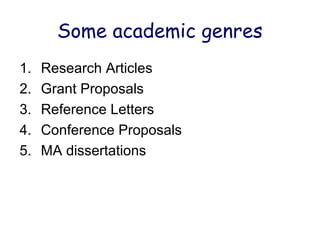
Some academic genres
1.
2.
3.
4.
5.

Research Articles
Grant Proposals
Reference Letters
Conference Proposals
MA dissertations
Sample Format of Research Article
Sections

Rhetorical Function

Introduction

Establish research topic and justify need for more research

Literature
Review

Demonstrate current knowledge of research and develop
research questions

Methods

Describe approach to answering research questions

Results

Describe data gathered via approach

Discussion

Provide answers to research questions based on data gathered

Conclusions

Evaluate research and make deductions for the future
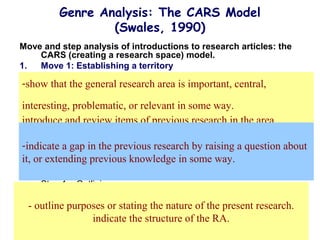
Genre Analysis: The CARS Model
(Swales, 1990)
Move and step analysis of introductions to research articles: the
CARS (creating a research space) model.
1.
Move 1: Establishing a territory
•
Step 1: Claiming centrality and/or
•-show that the general research area is and/or
Step 2: Making topic generalizations important, central,
•
Step 3: Reviewing items of previous research
interesting, problematic, or niche in some way.
2.
Move 2: Establishing a relevant
•introduce1a: Counter claiming orprevious research in the area.
Step and review items of
•
Step 1b: Indicating a gap or
•
Step
-indicate 1c: Question-raising or research by raising a question about
a gap in the previous
•
Step 1d: Continuing a tradition
extending previous knowledge in some way.
•it, orStep 2: Presenting positive justification
3.
Move 3: Occupying the niche
•
Step 1a: Outlining purposes or
•
Step 1b: Announcing present research
• - outline purposes or stating the nature of the present research.
Step 2: Announcing principle findings
•
Step 3: Indicating Research article structureRA.
indicate the structure of the
•
Step 4: Evaluating findings
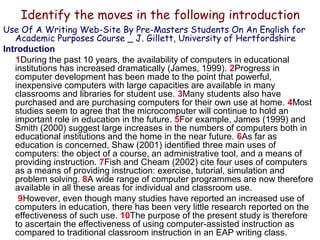
Identify the moves in the following introduction
Use Of A Writing Web-Site By Pre-Masters Students On An English for
Academic Purposes Course _ J. Gillett, University of Hertfordshire
Introduction
1During the past 10 years, the availability of computers in educational
institutions has increased dramatically (James, 1999). 2Progress in
computer development has been made to the point that powerful,
inexpensive computers with large capacities are available in many
classrooms and libraries for student use. 3Many students also have
purchased and are purchasing computers for their own use at home. 4Most
studies seem to agree that the microcomputer will continue to hold an
important role in education in the future. 5For example, James (1999) and
Smith (2000) suggest large increases in the numbers of computers both in
educational institutions and the home in the near future. 6As far as
education is concerned, Shaw (2001) identified three main uses of
computers: the object of a course, an administrative tool, and a means of
providing instruction. 7Fish and Cheam (2002) cite four uses of computers
as a means of providing instruction: exercise, tutorial, simulation and
problem solving. 8A wide range of computer programmes are now therefore
available in all these areas for individual and classroom use.
9However, even though many studies have reported an increased use of
computers in education, there has been very little research reported on the
effectiveness of such use. 10The purpose of the present study is therefore
to ascertain the effectiveness of using computer-assisted instruction as
compared to traditional classroom instruction in an EAP writing class.
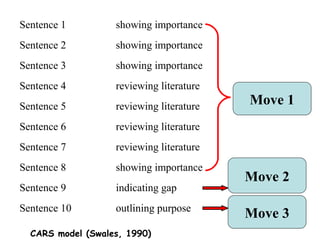
Sentence 1

showing importance

Sentence 2

showing importance

Sentence 3

showing importance

Sentence 4

reviewing literature

Sentence 5

reviewing literature

Sentence 6

reviewing literature

Sentence 7

reviewing literature

Sentence 8

showing importance

Sentence 9

indicating gap

Sentence 10

outlining purpose

CARS model (Swales, 1990)

Move 1

Move 2
Move 3
REFERENCES
http://www.uefap.com/writing/genre/introd.htm

Genre in academic writing

  • 1.
  • 2.
    Some academic genres 1. 2. 3. 4. 5. ResearchArticles Grant Proposals Reference Letters Conference Proposals MA dissertations
  • 3.
    Sample Format ofResearch Article Sections Rhetorical Function Introduction Establish research topic and justify need for more research Literature Review Demonstrate current knowledge of research and develop research questions Methods Describe approach to answering research questions Results Describe data gathered via approach Discussion Provide answers to research questions based on data gathered Conclusions Evaluate research and make deductions for the future
  • 4.
    Genre Analysis: TheCARS Model (Swales, 1990) Move and step analysis of introductions to research articles: the CARS (creating a research space) model. 1. Move 1: Establishing a territory • Step 1: Claiming centrality and/or •-show that the general research area is and/or Step 2: Making topic generalizations important, central, • Step 3: Reviewing items of previous research interesting, problematic, or niche in some way. 2. Move 2: Establishing a relevant •introduce1a: Counter claiming orprevious research in the area. Step and review items of • Step 1b: Indicating a gap or • Step -indicate 1c: Question-raising or research by raising a question about a gap in the previous • Step 1d: Continuing a tradition extending previous knowledge in some way. •it, orStep 2: Presenting positive justification 3. Move 3: Occupying the niche • Step 1a: Outlining purposes or • Step 1b: Announcing present research • - outline purposes or stating the nature of the present research. Step 2: Announcing principle findings • Step 3: Indicating Research article structureRA. indicate the structure of the • Step 4: Evaluating findings
  • 5.
    Identify the movesin the following introduction Use Of A Writing Web-Site By Pre-Masters Students On An English for Academic Purposes Course _ J. Gillett, University of Hertfordshire Introduction 1During the past 10 years, the availability of computers in educational institutions has increased dramatically (James, 1999). 2Progress in computer development has been made to the point that powerful, inexpensive computers with large capacities are available in many classrooms and libraries for student use. 3Many students also have purchased and are purchasing computers for their own use at home. 4Most studies seem to agree that the microcomputer will continue to hold an important role in education in the future. 5For example, James (1999) and Smith (2000) suggest large increases in the numbers of computers both in educational institutions and the home in the near future. 6As far as education is concerned, Shaw (2001) identified three main uses of computers: the object of a course, an administrative tool, and a means of providing instruction. 7Fish and Cheam (2002) cite four uses of computers as a means of providing instruction: exercise, tutorial, simulation and problem solving. 8A wide range of computer programmes are now therefore available in all these areas for individual and classroom use. 9However, even though many studies have reported an increased use of computers in education, there has been very little research reported on the effectiveness of such use. 10The purpose of the present study is therefore to ascertain the effectiveness of using computer-assisted instruction as compared to traditional classroom instruction in an EAP writing class.
  • 6.
    Sentence 1 showing importance Sentence2 showing importance Sentence 3 showing importance Sentence 4 reviewing literature Sentence 5 reviewing literature Sentence 6 reviewing literature Sentence 7 reviewing literature Sentence 8 showing importance Sentence 9 indicating gap Sentence 10 outlining purpose CARS model (Swales, 1990) Move 1 Move 2 Move 3
  • 7.