Style Guide for History Essays
Formatting
• 12 point font

• Double or one-and-a-half spaced
When to Use Quotations
There are two main reasons to use a quote.

1) Provide a quote to supply a really important
piece of evidence (generally from a primary
source) that you will then explain and draw
conclusions from.

2) Provide a quote to show your argument is
drawing on the work of an expert authority (and
therefore has credibility).
How to Quote

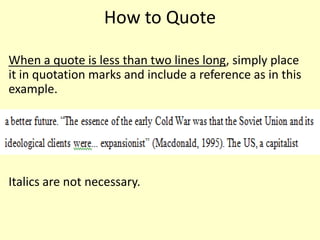
When a quote is less than two lines long, simply place
it in quotation marks and include a reference as in this
example.


Italics are not necessary.
How to Quote
When quotes are more than two lines long:

* leave a line

* indent on left and right

* make the quote a smaller font than the rest of the
paragraph

* leave a line before continuing

When you have done this, quotation marks are
unnecessary.
How to Quote
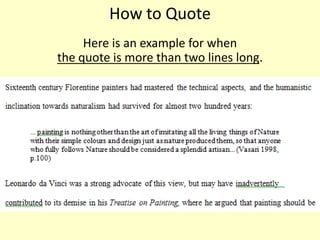
     Here is an example for when
the quote is more than two lines long.
When to Provide an In-Text Reference
You need to provide a reference 1) whenever you quote
another author or 2) whenever you use another author's
idea (where that idea is specific and/or debatable).
If you simply state, for example, that the French Revolution
was in 1789, you don't need to reference the claim.
Everybody knows this, nobody in particular authored this
idea and nobody contests it.
However, if you stated that 40,000 people died in the
Terror, you would need to provide a reference. This claim is
sufficiently specific that there could be different
perspectives and debate about it.
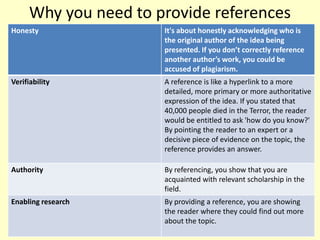
Why you need to provide references
Honesty                It's about honestly acknowledging who is
                       the original author of the idea being
                       presented. If you don’t correctly reference
                       another author’s work, you could be
                       accused of plagiarism.
Verifiability          A reference is like a hyperlink to a more
                       detailed, more primary or more authoritative
                       expression of the idea. If you stated that
                       40,000 people died in the Terror, the reader
                       would be entitled to ask 'how do you know?'
                       By pointing the reader to an expert or a
                       decisive piece of evidence on the topic, the
                       reference provides an answer.

Authority              By referencing, you show that you are
                       acquainted with relevant scholarship in the
                       field.
Enabling research      By providing a reference, you are showing
                       the reader where they could find out more
                       about the topic.
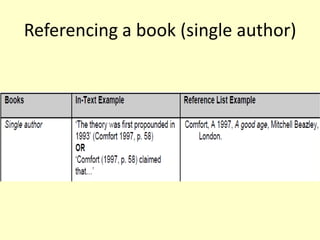
Referencing a book (single author)
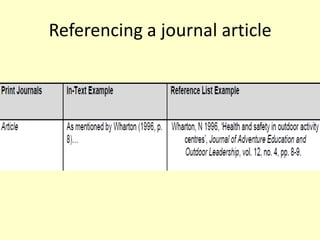
Referencing a journal article
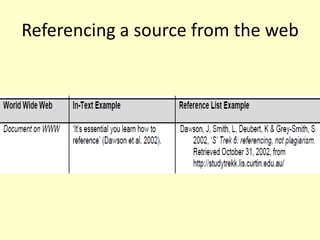
Referencing a source from the web
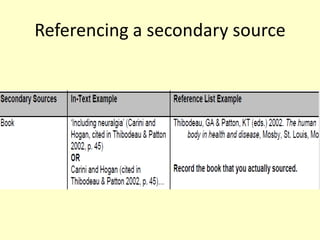
Referencing a secondary source
Referencing other items
Please use the Harvard Referencing Guide at
our Essay Resources page to find out how to
appropriately reference other items.
Citing Ancient Sources
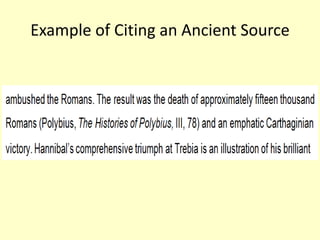
Citing ancient sources: Because of the nature of classical texts, as works that
were composed long before printed editions (and even "pages"), they have a
specialised format.
[Author], [Title] [Book/Section.(Poem, if applicable)].[Line #s cited]
For example:
Cicero, First Catilinarian 14.2.
Plato, Symposium 215a3-218b7.
If an author wrote only one work, you may omit the name of the work; for
example: Herodotus 9.1; rather than Herodotus, Histories 9.1. If you are
generically citing a specific book in a work, capitalize both elements (Book
Eighteen or Book 18 or Book XVIII); generic references, such as “several books in
the Iliad,” should not be capitalized. If you are including a parenthetical citation
at the end of a sentence – e.g. (Homer, Odyssey 1.1-3) – the full-stop should
always follows the citation.
Example of Citing an Ancient Source
Using ‘ibid’
Ibid. is an abbreviation of the Latin word ibidem
which means "in the same place".

If your reference is from the same page of the same
source as the reference immediately before this
one, simply put ibid. in brackets; (ibid.). If you're
referencing the same source as you have just done
but a different page put, for example, (ibid. p. 73).
Bibliographies (a.k.a Reference Lists)
A bibliography is an alphabetical list of the sources - books,
magazines, newspapers, CD-ROMs, Internet, interviews, etc. - that
you have used to prepare a piece of work.

The purpose of bibliographies is to: acknowledge sources; give
readers information to identify and consult sources; make sure our
information is accurate.

Create different sections for different source types, ie. literary
sources and electronic sources.

For an annotated bibliography, annotate each of the items in your
bibliography. In a sentence (or two, at most), explain 1) how the
source was useful in researching your essay and 2) provide an
evaluation of its reliability.
Example Essays
These essays all employ referencing conventions
well and have correctly formatted annotated
bibliographies.

The Appeal of Hamas, Ursula Cliff

The Genius of Hannibal, Jack Herring

The Birth of the Roman Navy, Pat Quinn Quirke

Essay style guide

  • 1.
    Style Guide forHistory Essays
  • 2.
    Formatting • 12 pointfont • Double or one-and-a-half spaced
  • 3.
    When to UseQuotations There are two main reasons to use a quote. 1) Provide a quote to supply a really important piece of evidence (generally from a primary source) that you will then explain and draw conclusions from. 2) Provide a quote to show your argument is drawing on the work of an expert authority (and therefore has credibility).
  • 4.
    How to Quote Whena quote is less than two lines long, simply place it in quotation marks and include a reference as in this example. Italics are not necessary.
  • 5.
    How to Quote Whenquotes are more than two lines long: * leave a line * indent on left and right * make the quote a smaller font than the rest of the paragraph * leave a line before continuing When you have done this, quotation marks are unnecessary.
  • 6.
    How to Quote Here is an example for when the quote is more than two lines long.
  • 7.
    When to Providean In-Text Reference You need to provide a reference 1) whenever you quote another author or 2) whenever you use another author's idea (where that idea is specific and/or debatable). If you simply state, for example, that the French Revolution was in 1789, you don't need to reference the claim. Everybody knows this, nobody in particular authored this idea and nobody contests it. However, if you stated that 40,000 people died in the Terror, you would need to provide a reference. This claim is sufficiently specific that there could be different perspectives and debate about it.
  • 8.
    Why you needto provide references Honesty It's about honestly acknowledging who is the original author of the idea being presented. If you don’t correctly reference another author’s work, you could be accused of plagiarism. Verifiability A reference is like a hyperlink to a more detailed, more primary or more authoritative expression of the idea. If you stated that 40,000 people died in the Terror, the reader would be entitled to ask 'how do you know?' By pointing the reader to an expert or a decisive piece of evidence on the topic, the reference provides an answer. Authority By referencing, you show that you are acquainted with relevant scholarship in the field. Enabling research By providing a reference, you are showing the reader where they could find out more about the topic.
  • 9.
    Referencing a book(single author)
  • 10.
  • 11.
  • 12.
  • 13.
    Referencing other items Pleaseuse the Harvard Referencing Guide at our Essay Resources page to find out how to appropriately reference other items.
  • 14.
    Citing Ancient Sources Citingancient sources: Because of the nature of classical texts, as works that were composed long before printed editions (and even "pages"), they have a specialised format. [Author], [Title] [Book/Section.(Poem, if applicable)].[Line #s cited] For example: Cicero, First Catilinarian 14.2. Plato, Symposium 215a3-218b7. If an author wrote only one work, you may omit the name of the work; for example: Herodotus 9.1; rather than Herodotus, Histories 9.1. If you are generically citing a specific book in a work, capitalize both elements (Book Eighteen or Book 18 or Book XVIII); generic references, such as “several books in the Iliad,” should not be capitalized. If you are including a parenthetical citation at the end of a sentence – e.g. (Homer, Odyssey 1.1-3) – the full-stop should always follows the citation.
  • 15.
    Example of Citingan Ancient Source
  • 16.
    Using ‘ibid’ Ibid. isan abbreviation of the Latin word ibidem which means "in the same place". If your reference is from the same page of the same source as the reference immediately before this one, simply put ibid. in brackets; (ibid.). If you're referencing the same source as you have just done but a different page put, for example, (ibid. p. 73).
  • 17.
    Bibliographies (a.k.a ReferenceLists) A bibliography is an alphabetical list of the sources - books, magazines, newspapers, CD-ROMs, Internet, interviews, etc. - that you have used to prepare a piece of work. The purpose of bibliographies is to: acknowledge sources; give readers information to identify and consult sources; make sure our information is accurate. Create different sections for different source types, ie. literary sources and electronic sources. For an annotated bibliography, annotate each of the items in your bibliography. In a sentence (or two, at most), explain 1) how the source was useful in researching your essay and 2) provide an evaluation of its reliability.
  • 18.
    Example Essays These essaysall employ referencing conventions well and have correctly formatted annotated bibliographies. The Appeal of Hamas, Ursula Cliff The Genius of Hannibal, Jack Herring The Birth of the Roman Navy, Pat Quinn Quirke