Argumentative Essay
Teacher FRED RYAN C. DEAÑO
Objectives
At the end of this session, you are expected to:
Identify parts and features of an
argumentative essay; and
Compose an argumentative essay.
Let’s Play!
Find words that you
considered related to
Argumentative essay.
What is an Argumentative Essay?
What is an Argument?
Argument is defined as “a reason or
reasons why you support or oppose an
idea or suggestion, or the process of
explaining these reasons” in Cambridge
dictionary.
What is an Argumentative Essay?
is a kind of text in which an author supports his own view and
try to refute counterview about an issue. The author aims to
lead readers to think just like himself in this kind of texts. It is
not easy to change readers’ view or make them question. The
author is expected to explain why he supports these views
and why counterview is invalid so as to achieve his goal. The
author is supposed not only to have a strong idea about the
issue discussed but also to be wise for a successful
argumentative essay (Knudson, 1992).
ARGUMENTATIVE WRITING
⚫ An argumentative essay uses
evidence and facts to prove whether
or not a thesis is true.
⚫It presents two sides of a single issue
and covers the most important
arguments for and against.
Argumentative Writing
 Makes claims based on factual evidence
(research)
 Makes counterclaims – the author
neutralizes or “defeats” opposing ideas
 Logic-based - convinces audience through
the merit and rationality of the claim and
evidence offered
A Brief Guide to Writing Argumentative Essays
The hook is an introduction that catches the reader’s attention.
Argumentation essays can start with facts, statistics, quotes, or anecdotes
that reference the topic of the essay. Make sure the introduction is
interesting enough to “hook” your readers’ into wanting to read more.
Once you have written the first sentence, you want to connect the
information to what you ultimately try to prove by leading into your thesis
statement.
A. Parts
A. Hook
I. Introduction
A Brief Guide to Writing Argumentative Essays
Example:
According to the Centers for Disease Control and
Prevention, over 2, 700 teen drivers between the ages of
16 and 19 died in 2010 and over 282,000 were injured.
Despite their desire to want to get behind the wheel, teen
drivers simply aren’t ready to take on the responsibilities
of driving yet.
A Brief Guide to Writing Argumentative Essays
A thesis statement is a sentence that explains what you are
trying to prove and provides an overview of the arguments you
will make in your body paragraphs. The thesis acts as a
roadmap for the rest of your paper. Do not worry about going
into too much detail about what your arguments will be:
instead, focus on writing a clear, concise statement that hints
at the topics you plan to discuss.
B. Thesis
A Brief Guide to Writing Argumentative Essays
Example:
The legal driving age should be changed to 20 because
teen drivers are more likely to cause accident and they
are not mature enough to understand the repercussions
of their actions.
A Brief Guide to Writing Argumentative Essays
Though not always required in an argumentative essay, a
background paragraph may be vital to your paper if there is
information that your audience needs to be aware of to
understand your topic. This might include important historical
dates, an explanation of who the subject affects, or current
laws. This paragraph is not trying to prove a point. It is simply
providing information to help the audience understand the
topic.
C. Background Information
A Brief Guide to Writing Argumentative Essays
Example:
Driver’s license requirements are set by government of every
country. Therefore, the legal driving age varies from country to
country. All countries allow drivers to have unrestricted
licenses at the age of 18. Most countries allow teenagers as
young as 16 to have restricted license, meaning they can drive
as long as they are with a parent or guardian.
A Brief Guide to Writing Argumentative Essays
The body paragraphs are where you will explain the evidence
you have to support your thesis statement. Your body
paragraph should start with a topic sentence written in your
own words. You should then include some form of rhetoric
(such as a fact or statistics, an emotional anecdote, or a law)
that provides support for your topic sentence.
Finally, the body paragraphs should contain a sentence that
explains how the evidence you have provided proves your
overall point.
II. Body Paragraphs
A Brief Guide to Writing Argumentative Essays
The writer acknowledges the opposition to not do so, me be considered
cowardice, dishonesty, or weakness. However, acknowledgement does not
imply agreement. In this portion of the essay, the writer needs to “refute”
or disagree intelligently with the opposition.
- A Gentle Reminder from Lester Faigley and Jack Selzers’ Good Reasons:
1. “Try to think of yourself as engaged not so much in winning over your
audience as in courting your audience’s cooperation.”
2. “Show that you understand and genuinely respect your listener’s or
reader’s position even if you think the position is ultimately wrong.”
III. Refutation
A Brief Guide to Writing Argumentative Essays
- The writer restates, in general terms, the major
arguments he has marshaled in defense of his thesis.
- The writer may summarize key points, restate his thesis,
reinforce the weakness of his opposition, underscore
the logic of his presentation, re-emphasize this debate is
important, suggest a course of action, or challenge the
reader to apply the paper’s argument to his own life.
IV. Conclusion
A Brief Guide to Writing Argumentative Essays
- Purpose of Argumentative Essays - An argument follows when two
groups disagree about something.
- An argumentative essay is also one that attempts/tries to change the
reader’s mind, to convince the reader to agree with the point of view of
the writer.
- Argumentative essays attempt to be highly persuasive and logical.
- When writing an argumentative essay, assume that your reader
disagrees with you, but remember your reader is no less intelligent than
you.
- Write objectively, logically, and respectfully.
B. Purpose
Key Concepts of Argumentative Essay
The School Uniform Question
Individualism is a fundamental part of society in many
countries. Most people believe in the right to express their own
opinion without fear of punishment. This value, however, is
coming under fire in an unlikely place – the public-school
classroom. The issue is school uniforms. Should public school
students be allowed to make individual decisions about
clothing, or should all students be required to wear a uniform?
School uniforms are the better choice for three reasons.
INTRODUCTION
Paragraph 1
- Hook
- Connecting/
Background
Information
-Thesis
Statement
Key Concepts of Argumentative Essay
First, wearing school uniforms would help make students’ lives simpler. They
would no longer have to decide what to wear every morning, sometimes trying on
outfit after outfit in an effort to choose. Uniforms would not only save time but
also would eliminate the stress often associated with this chore.
Second, school uniforms influence students to act responsibly in groups and as
individuals. In addition, uniforms create a feeling of unity among students. For
example, when students do something as a group, such as attend meetings in the
auditorium or eat lunch in the cafeteria, the fact that they all wear the same
uniform gives them a sense of community. Even more important, statistics show
the positive effects that school uniforms have on violence and truancy. According
to a recent survey, incidents of school violence dropped by 50 percent, attendance
and test scores improved, and student suspensions declined approximately 30
percent after school uniforms were introduced.
BODY
Paragraph 2
-Support 1 (first
reason)
• Explanation,
detail, example
Paragraph 3
-Support 2
(second reason)
• Explanation,
detail, example
Key Concepts of Argumentative Essay
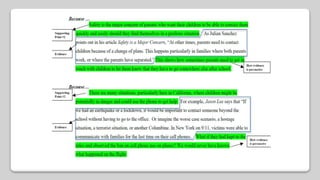
Finally, school uniforms would help make all the students feel equal.
Students’ standards of living differ greatly from family to family, and some
people are well-off while others are not. People sometimes forget that
school is a place to get an education, not to promote a “fashion show”.
School uniforms would promote pride and help to raise the self-esteem of
students who cannot afford to wear expensive clothing.
Opponents of mandatory uniforms say that students who wear school
uniforms cannot express their individuality. This point has some merit on
the surface. However, as stated previously, school is a place to learn, not to
flaunt wealth and fashion. Society must decide if individual expression
through clothing is more valuable than improved educational performance.
It is important to remember that school uniforms would be worn only
during school hours. Students can express their individuality in the way
that they dress outside of the classroom.
Paragraph 4
-Support 3 (third
reason)
• Explanation,
detail, example
Paragraph 5
-Opposite Side
-Counterargument
1
-Rebuttal (attack)
-Counterargument
2
• Rebuttal (attack)
Finally, school uniforms would help make all the students feel equal.
Students’ standards of living differ greatly from family to family, and some
people are well-off while others are not. People sometimes forget that
school is a place to get an education, not to promote a “fashion show”.
School uniforms would promote pride and help to raise the self-esteem of
students who cannot afford to wear expensive clothing.
Opponents of mandatory uniforms say that students who wear school
uniforms cannot express their individuality. This point has some merit on
the surface. However, as stated previously, school is a place to learn, not to
flaunt wealth and fashion. Society must decide if individual expression
through clothing is more valuable than improved educational performance.
It is important to remember that school uniforms would be worn only
during school hours. Students can express their individuality in the way
that they dress outside of the classroom.
Key Concepts of Argumentative Essay
In conclusion, there are many well-documented
benefits of implementing mandatory school
uniforms for students. Studies show that students
learn better and act more responsibly when they
wear uniforms. Public schools should require
uniforms in order to benefit both the students
and society as a whole.
CONCLUSION
Paragraph 6
-Repeat thesis
statement in
different words.
-
Suggestion/Opini
on.
Elements of
Argumentation
Elements of Argumentation
2
8
Argument/Claim
An argument states a claim
and supports it with reasons
and evidence from sources.
Arguing your side makes you
the proponent.
Counterargument/Counterclaim
An argument that stands in opposition
to your argument/claim. The
counterargument is your opponent’s
(the other side’s) argument that tries
to explains why you are wrong.
Elements of Argumentation
2
9
Refutation
Simply disproving an opposing
argument. It is an important skill
because it is how a writer
successfully convinces the
audience of the validity of his/her
own argument. 3
0
Elements of Argumentation
Everyday Life Example
When we argue:
Bob: That was a lame movie!
Suzy: Why?
Bob: The special effects were bad. The
monsters were obviously fake.
Suzy: I thought the movie was good because the
acting was believable.
Bob: Yes the acting was good but the horrible
special effects were too distracting and caused
some awkward moments.
Claim
Evidence
Counterclaim
Refutation
3
1
10
Key Terms to Learn
1.a person who disagrees with
something and speaks against it
2. the act or process of forming
reasons, drawing conclusions,
and applying them to a case in
discussion
3.point or statement that
supports one’s ideas and/or
thesis
4.point or statement in
opposition to the argument being
made in a written document or
speech
5.the process of discrediting the
arguments that oppose your
thesis statement
6. someone who argues in favor
of something; advocate
Argumentation
Refutation
Proponent
Opponent
Counter Argument
Pro Argument
Transitional
Device
Let’s Practice!
- In your learning module, page 10-11
- DIRECTIONS: Think about the following thesis
statements and decide whether you agree or disagree.
Prepare one reason and write it on their respective
column. Provide evidence to your answer.
Activity 2: Agree or Disagree
Example:
Let’s Practice!
In your learning module, page 11-12
DIRECTIONS: Complete the steps below to develop
ideas for an argumentative essay. Choose a topic and

write your thesis statement, think about several
supporting ideas for your opinion, and think about the
counterargument. Follow the steps below to develop
ideas for an argumentative essay
Activity 3: Planning Your Essay
Let’s Us Remember!
DIRECTIONS: Enumerate 5 important details
that one should remember in writing an
argumentative essay.
To Sum It Up!
 Argumentative essay requires you to investigate a topic; collect, generate, and
evaluate evidence; and establish a position on the topic in a concise manner.
 It has Four (4) parts namely; INTRODUCTION, BODY, REFUTATION, and
CONCLUSION.
 In the INTRODUCTION, contains the HOOK (an introduction that catches
reader’s attention), THESIS (a statement that you’re trying to prove), and
BACKGROUND INFORMATION (historical dates/ explanation).
 In the body, this is where you explain evidences to support your thesis
statement.
To Sum It Up!
 In the Refutation, it is an acknowledgement
of the writer but does not imply agreement.
 In the Conclusion, it is the restatement and
summarization of key points.
Let Us Assess!
Set A.
In your learning module, answer Activity # 6 on page 14-15.
Set B.
DIRECTIONS: Develop a 4-paragraph argumentative essay on a topic
of your choice by following the structure. Write it on a short-size
construction paper. It can be submitted either encoded or hand-
written.
Argumentative Essay.pptx

Argumentative Essay.pptx

  • 1.
  • 2.
    Objectives At the endof this session, you are expected to: Identify parts and features of an argumentative essay; and Compose an argumentative essay.
  • 3.
    Let’s Play! Find wordsthat you considered related to Argumentative essay.
  • 4.
    What is anArgumentative Essay? What is an Argument?
  • 5.
    What is anArgument? Argument is defined as “a reason or reasons why you support or oppose an idea or suggestion, or the process of explaining these reasons” in Cambridge dictionary.
  • 6.
    What is anArgumentative Essay? is a kind of text in which an author supports his own view and try to refute counterview about an issue. The author aims to lead readers to think just like himself in this kind of texts. It is not easy to change readers’ view or make them question. The author is expected to explain why he supports these views and why counterview is invalid so as to achieve his goal. The author is supposed not only to have a strong idea about the issue discussed but also to be wise for a successful argumentative essay (Knudson, 1992).
  • 7.
    ARGUMENTATIVE WRITING ⚫ Anargumentative essay uses evidence and facts to prove whether or not a thesis is true. ⚫It presents two sides of a single issue and covers the most important arguments for and against.
  • 8.
    Argumentative Writing  Makesclaims based on factual evidence (research)  Makes counterclaims – the author neutralizes or “defeats” opposing ideas  Logic-based - convinces audience through the merit and rationality of the claim and evidence offered
  • 9.
    A Brief Guideto Writing Argumentative Essays The hook is an introduction that catches the reader’s attention. Argumentation essays can start with facts, statistics, quotes, or anecdotes that reference the topic of the essay. Make sure the introduction is interesting enough to “hook” your readers’ into wanting to read more. Once you have written the first sentence, you want to connect the information to what you ultimately try to prove by leading into your thesis statement. A. Parts A. Hook I. Introduction
  • 10.
    A Brief Guideto Writing Argumentative Essays Example: According to the Centers for Disease Control and Prevention, over 2, 700 teen drivers between the ages of 16 and 19 died in 2010 and over 282,000 were injured. Despite their desire to want to get behind the wheel, teen drivers simply aren’t ready to take on the responsibilities of driving yet.
  • 11.
    A Brief Guideto Writing Argumentative Essays A thesis statement is a sentence that explains what you are trying to prove and provides an overview of the arguments you will make in your body paragraphs. The thesis acts as a roadmap for the rest of your paper. Do not worry about going into too much detail about what your arguments will be: instead, focus on writing a clear, concise statement that hints at the topics you plan to discuss. B. Thesis
  • 12.
    A Brief Guideto Writing Argumentative Essays Example: The legal driving age should be changed to 20 because teen drivers are more likely to cause accident and they are not mature enough to understand the repercussions of their actions.
  • 13.
    A Brief Guideto Writing Argumentative Essays Though not always required in an argumentative essay, a background paragraph may be vital to your paper if there is information that your audience needs to be aware of to understand your topic. This might include important historical dates, an explanation of who the subject affects, or current laws. This paragraph is not trying to prove a point. It is simply providing information to help the audience understand the topic. C. Background Information
  • 14.
    A Brief Guideto Writing Argumentative Essays Example: Driver’s license requirements are set by government of every country. Therefore, the legal driving age varies from country to country. All countries allow drivers to have unrestricted licenses at the age of 18. Most countries allow teenagers as young as 16 to have restricted license, meaning they can drive as long as they are with a parent or guardian.
  • 15.
    A Brief Guideto Writing Argumentative Essays The body paragraphs are where you will explain the evidence you have to support your thesis statement. Your body paragraph should start with a topic sentence written in your own words. You should then include some form of rhetoric (such as a fact or statistics, an emotional anecdote, or a law) that provides support for your topic sentence. Finally, the body paragraphs should contain a sentence that explains how the evidence you have provided proves your overall point. II. Body Paragraphs
  • 16.
    A Brief Guideto Writing Argumentative Essays The writer acknowledges the opposition to not do so, me be considered cowardice, dishonesty, or weakness. However, acknowledgement does not imply agreement. In this portion of the essay, the writer needs to “refute” or disagree intelligently with the opposition. - A Gentle Reminder from Lester Faigley and Jack Selzers’ Good Reasons: 1. “Try to think of yourself as engaged not so much in winning over your audience as in courting your audience’s cooperation.” 2. “Show that you understand and genuinely respect your listener’s or reader’s position even if you think the position is ultimately wrong.” III. Refutation
  • 17.
    A Brief Guideto Writing Argumentative Essays - The writer restates, in general terms, the major arguments he has marshaled in defense of his thesis. - The writer may summarize key points, restate his thesis, reinforce the weakness of his opposition, underscore the logic of his presentation, re-emphasize this debate is important, suggest a course of action, or challenge the reader to apply the paper’s argument to his own life. IV. Conclusion
  • 18.
    A Brief Guideto Writing Argumentative Essays - Purpose of Argumentative Essays - An argument follows when two groups disagree about something. - An argumentative essay is also one that attempts/tries to change the reader’s mind, to convince the reader to agree with the point of view of the writer. - Argumentative essays attempt to be highly persuasive and logical. - When writing an argumentative essay, assume that your reader disagrees with you, but remember your reader is no less intelligent than you. - Write objectively, logically, and respectfully. B. Purpose
  • 19.
    Key Concepts ofArgumentative Essay The School Uniform Question Individualism is a fundamental part of society in many countries. Most people believe in the right to express their own opinion without fear of punishment. This value, however, is coming under fire in an unlikely place – the public-school classroom. The issue is school uniforms. Should public school students be allowed to make individual decisions about clothing, or should all students be required to wear a uniform? School uniforms are the better choice for three reasons. INTRODUCTION Paragraph 1 - Hook - Connecting/ Background Information -Thesis Statement
  • 20.
    Key Concepts ofArgumentative Essay First, wearing school uniforms would help make students’ lives simpler. They would no longer have to decide what to wear every morning, sometimes trying on outfit after outfit in an effort to choose. Uniforms would not only save time but also would eliminate the stress often associated with this chore. Second, school uniforms influence students to act responsibly in groups and as individuals. In addition, uniforms create a feeling of unity among students. For example, when students do something as a group, such as attend meetings in the auditorium or eat lunch in the cafeteria, the fact that they all wear the same uniform gives them a sense of community. Even more important, statistics show the positive effects that school uniforms have on violence and truancy. According to a recent survey, incidents of school violence dropped by 50 percent, attendance and test scores improved, and student suspensions declined approximately 30 percent after school uniforms were introduced. BODY Paragraph 2 -Support 1 (first reason) • Explanation, detail, example Paragraph 3 -Support 2 (second reason) • Explanation, detail, example
  • 21.
    Key Concepts ofArgumentative Essay Finally, school uniforms would help make all the students feel equal. Students’ standards of living differ greatly from family to family, and some people are well-off while others are not. People sometimes forget that school is a place to get an education, not to promote a “fashion show”. School uniforms would promote pride and help to raise the self-esteem of students who cannot afford to wear expensive clothing. Opponents of mandatory uniforms say that students who wear school uniforms cannot express their individuality. This point has some merit on the surface. However, as stated previously, school is a place to learn, not to flaunt wealth and fashion. Society must decide if individual expression through clothing is more valuable than improved educational performance. It is important to remember that school uniforms would be worn only during school hours. Students can express their individuality in the way that they dress outside of the classroom. Paragraph 4 -Support 3 (third reason) • Explanation, detail, example Paragraph 5 -Opposite Side -Counterargument 1 -Rebuttal (attack) -Counterargument 2 • Rebuttal (attack) Finally, school uniforms would help make all the students feel equal. Students’ standards of living differ greatly from family to family, and some people are well-off while others are not. People sometimes forget that school is a place to get an education, not to promote a “fashion show”. School uniforms would promote pride and help to raise the self-esteem of students who cannot afford to wear expensive clothing. Opponents of mandatory uniforms say that students who wear school uniforms cannot express their individuality. This point has some merit on the surface. However, as stated previously, school is a place to learn, not to flaunt wealth and fashion. Society must decide if individual expression through clothing is more valuable than improved educational performance. It is important to remember that school uniforms would be worn only during school hours. Students can express their individuality in the way that they dress outside of the classroom.
  • 22.
    Key Concepts ofArgumentative Essay In conclusion, there are many well-documented benefits of implementing mandatory school uniforms for students. Studies show that students learn better and act more responsibly when they wear uniforms. Public schools should require uniforms in order to benefit both the students and society as a whole. CONCLUSION Paragraph 6 -Repeat thesis statement in different words. - Suggestion/Opini on.
  • 27.
  • 28.
    Elements of Argumentation 2 8 Argument/Claim Anargument states a claim and supports it with reasons and evidence from sources. Arguing your side makes you the proponent.
  • 29.
    Counterargument/Counterclaim An argument thatstands in opposition to your argument/claim. The counterargument is your opponent’s (the other side’s) argument that tries to explains why you are wrong. Elements of Argumentation 2 9
  • 30.
    Refutation Simply disproving anopposing argument. It is an important skill because it is how a writer successfully convinces the audience of the validity of his/her own argument. 3 0 Elements of Argumentation
  • 31.
    Everyday Life Example Whenwe argue: Bob: That was a lame movie! Suzy: Why? Bob: The special effects were bad. The monsters were obviously fake. Suzy: I thought the movie was good because the acting was believable. Bob: Yes the acting was good but the horrible special effects were too distracting and caused some awkward moments. Claim Evidence Counterclaim Refutation 3 1
  • 32.
    10 Key Terms toLearn 1.a person who disagrees with something and speaks against it 2. the act or process of forming reasons, drawing conclusions, and applying them to a case in discussion 3.point or statement that supports one’s ideas and/or thesis 4.point or statement in opposition to the argument being made in a written document or speech 5.the process of discrediting the arguments that oppose your thesis statement 6. someone who argues in favor of something; advocate Argumentation Refutation Proponent Opponent Counter Argument Pro Argument
  • 33.
  • 34.
    Let’s Practice! - Inyour learning module, page 10-11 - DIRECTIONS: Think about the following thesis statements and decide whether you agree or disagree. Prepare one reason and write it on their respective column. Provide evidence to your answer. Activity 2: Agree or Disagree
  • 35.
  • 36.
    Let’s Practice! In yourlearning module, page 11-12 DIRECTIONS: Complete the steps below to develop ideas for an argumentative essay. Choose a topic and write your thesis statement, think about several supporting ideas for your opinion, and think about the counterargument. Follow the steps below to develop ideas for an argumentative essay Activity 3: Planning Your Essay
  • 37.
    Let’s Us Remember! DIRECTIONS:Enumerate 5 important details that one should remember in writing an argumentative essay.
  • 38.
    To Sum ItUp!  Argumentative essay requires you to investigate a topic; collect, generate, and evaluate evidence; and establish a position on the topic in a concise manner.  It has Four (4) parts namely; INTRODUCTION, BODY, REFUTATION, and CONCLUSION.  In the INTRODUCTION, contains the HOOK (an introduction that catches reader’s attention), THESIS (a statement that you’re trying to prove), and BACKGROUND INFORMATION (historical dates/ explanation).  In the body, this is where you explain evidences to support your thesis statement.
  • 39.
    To Sum ItUp!  In the Refutation, it is an acknowledgement of the writer but does not imply agreement.  In the Conclusion, it is the restatement and summarization of key points.
  • 40.
    Let Us Assess! SetA. In your learning module, answer Activity # 6 on page 14-15. Set B. DIRECTIONS: Develop a 4-paragraph argumentative essay on a topic of your choice by following the structure. Write it on a short-size construction paper. It can be submitted either encoded or hand- written.