ESD Material Handling
Safety/Electrostatic Discharge (ESD)
 What Is Electrostatic Discharge (ESD)?
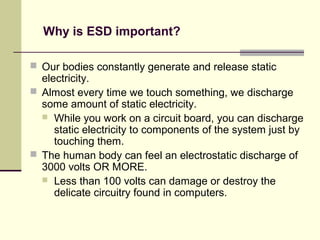
 Why is ESD important?
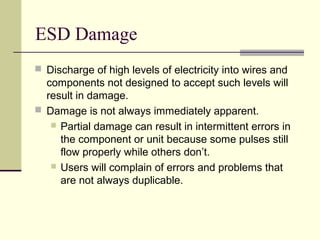
 ESD Damage
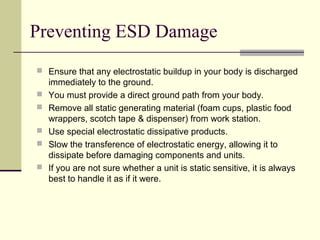
 Preventing ESD Damage
 ESD Workstation Components
 ESD Wrist Strap or Foot/Heel Strap
 ESD Floor or Table Mat
 Increasing Humidity
 Anti-static Bags
ESD Training Objectives:
What Is Electrostatic Discharge (ESD)?
 When two objects rub together, they create friction.
 A by-product of friction is heat.
 Result of the increased molecular activity brought about by
electrons moving back and forth between the two surfaces.
 Our bodies are constantly in motion. When we move
against another material, like carpet, we create friction.
 Results in rapid movement of electrons, some of which
remain in our bodies.
 This exchange of electrons builds up a charge within our
bodies
What Is Electrostatic Discharge (ESD)?
 Built-up electrons inside us are seeking an outlet:
 A way to flow through us to another electrically conductive
material that isn’t quite as charged up as we are.
 Such as a doorknob
 When we make contact with another electrically
conductive material, the electrons jump from our body
to the other material.
 So static electricity is the buildup of an electrical charge
within an object, such as a person, the discharge of
which is in the form of electricity.
 Our bodies constantly generate and release static
electricity.
 Almost every time we touch something, we discharge
some amount of static electricity.
 While you work on a circuit board, you can discharge
static electricity to components of the system just by
touching them.
 The human body can feel an electrostatic discharge of
3000 volts OR MORE.
 Less than 100 volts can damage or destroy the
delicate circuitry found in computers.
Why is ESD important?
 Discharge of high levels of electricity into wires and
components not designed to accept such levels will
result in damage.
 Damage is not always immediately apparent.
 Partial damage can result in intermittent errors in
the component or unit because some pulses still
flow properly while others don’t.
 Users will complain of errors and problems that
are not always duplicable.
ESD Damage
 Ensure that any electrostatic buildup in your body is discharged
immediately to the ground.
 You must provide a direct ground path from your body.
 Remove all static generating material (foam cups, plastic food
wrappers, scotch tape & dispenser) from work station.
 Use special electrostatic dissipative products.
 Slow the transference of electrostatic energy, allowing it to
dissipate before damaging components and units.
 If you are not sure whether a unit is static sensitive, it is always
best to handle it as if it were.
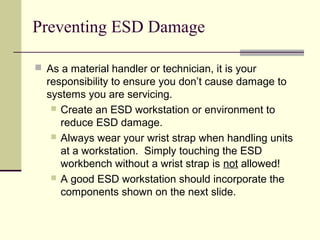
Preventing ESD Damage
 As a material handler or technician, it is your
responsibility to ensure you don’t cause damage to
systems you are servicing.
 Create an ESD workstation or environment to
reduce ESD damage.
 Always wear your wrist strap when handling units
at a workstation. Simply touching the ESD
workbench without a wrist strap is not allowed!
 A good ESD workstation should incorporate the
components shown on the next slide.
Preventing ESD Damage
 ESD wrist strap or foot/heel strap
 ESD floor mat/wax or table mats
 Increased humidity (this is an increasing concern
from our customers).
 Presence of moisture allows electrons to better
discharge safely into the air
 Anti-static bags
ESD Workstation Components
 ESD wrist strap or foot/heel straps (clean frequently)
 Attached to wrist with wire leading to designated plug-in
which is attached to grounded object
 Can be grounded to various items:
 ESD mat
 ESD floor mat
 Metal table or chair leg provided the table or chair leg is
grounded.
ESD Wrist Strap or Foot/Heel Straps
 ESD Floor or Table Mat
 Floor mat/wax placed where you stand
 The Table Mat is connected to the a ground and
provides a path for heel straps. Clean frequently to
ensure ground.
 Floor and underneath mat (where applicable)
should be kept free of dirt and debris. Clean
frequently to ensure ground.
 Table mat is placed on your work surface
 Provide route to ground through:
Grounding strap that runs from mat to a grounding
point
ESD Floor or Table Mat
 ESD buildup is greatly reduced in a humid
environment.
 As the presence of moisture in the air is increased,
electrons are better able to discharge safely into the
air instead of another object.
 Using a humidifier/air ionizer to increase the air
moisture in your work area can greatly reduce ESD
buildup.
 Too much humidity can cause condensation that
can damage components.
Increasing Humidity
(This is an increasing concern among customers)
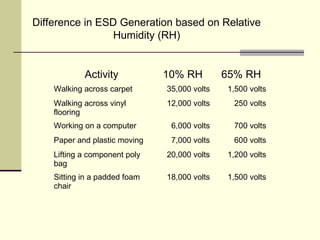
Activity 10% RH 65% RH
Walking across carpet 35,000 volts 1,500 volts
Walking across vinyl
flooring
12,000 volts 250 volts
Working on a computer 6,000 volts 700 volts
Paper and plastic moving 7,000 volts 600 volts
Lifting a component poly
bag
20,000 volts 1,200 volts
Sitting in a padded foam
chair
18,000 volts 1,500 volts
Difference in ESD Generation based on Relative
Humidity (RH)
 Electronic components are shipped in special ESD bags.
 These bags protect the components inside from ESD
 They should be saved and used to store components that you
work with
 Storing components in these bags will reduce the risk of ESD
damage to the component
 Static sensitive units cannot be handled outside of an ESD bag
without wrist/heel straps, not even by the unit’s edges
 Never place any paperwork or tags inside the ESD bag with the
unit. Paperwork generates static electricity
Anti-static Bags
 Electrically conductive bags
 Usually black or gray, coated with a metallic or carbon layer,
or with a metallic weave.
 Metal helps conduct ESD across surface of bag to
ground very quickly
 Carbon slows ESD transference, routing the charge to
the ground
 Bags can be used over long periods of time without losing
effectiveness
Types Of Anti-static Bags
 Electrically Low-Charging Bags
 Usually pink, coated with a substance that
prevents static build-up.
 Very little protection might actually be afforded to
the components inside.
 Anti-static properties of the bag degrade over
time.
Types of Anti-Static Bags

ESD

  • 1.
  • 2.
     What IsElectrostatic Discharge (ESD)?  Why is ESD important?  ESD Damage  Preventing ESD Damage  ESD Workstation Components  ESD Wrist Strap or Foot/Heel Strap  ESD Floor or Table Mat  Increasing Humidity  Anti-static Bags ESD Training Objectives:
  • 3.
    What Is ElectrostaticDischarge (ESD)?  When two objects rub together, they create friction.  A by-product of friction is heat.  Result of the increased molecular activity brought about by electrons moving back and forth between the two surfaces.  Our bodies are constantly in motion. When we move against another material, like carpet, we create friction.  Results in rapid movement of electrons, some of which remain in our bodies.  This exchange of electrons builds up a charge within our bodies
  • 4.
    What Is ElectrostaticDischarge (ESD)?  Built-up electrons inside us are seeking an outlet:  A way to flow through us to another electrically conductive material that isn’t quite as charged up as we are.  Such as a doorknob  When we make contact with another electrically conductive material, the electrons jump from our body to the other material.  So static electricity is the buildup of an electrical charge within an object, such as a person, the discharge of which is in the form of electricity.
  • 5.
     Our bodiesconstantly generate and release static electricity.  Almost every time we touch something, we discharge some amount of static electricity.  While you work on a circuit board, you can discharge static electricity to components of the system just by touching them.  The human body can feel an electrostatic discharge of 3000 volts OR MORE.  Less than 100 volts can damage or destroy the delicate circuitry found in computers. Why is ESD important?
  • 6.
     Discharge ofhigh levels of electricity into wires and components not designed to accept such levels will result in damage.  Damage is not always immediately apparent.  Partial damage can result in intermittent errors in the component or unit because some pulses still flow properly while others don’t.  Users will complain of errors and problems that are not always duplicable. ESD Damage
  • 7.
     Ensure thatany electrostatic buildup in your body is discharged immediately to the ground.  You must provide a direct ground path from your body.  Remove all static generating material (foam cups, plastic food wrappers, scotch tape & dispenser) from work station.  Use special electrostatic dissipative products.  Slow the transference of electrostatic energy, allowing it to dissipate before damaging components and units.  If you are not sure whether a unit is static sensitive, it is always best to handle it as if it were. Preventing ESD Damage
  • 8.
     As amaterial handler or technician, it is your responsibility to ensure you don’t cause damage to systems you are servicing.  Create an ESD workstation or environment to reduce ESD damage.  Always wear your wrist strap when handling units at a workstation. Simply touching the ESD workbench without a wrist strap is not allowed!  A good ESD workstation should incorporate the components shown on the next slide. Preventing ESD Damage
  • 9.
     ESD wriststrap or foot/heel strap  ESD floor mat/wax or table mats  Increased humidity (this is an increasing concern from our customers).  Presence of moisture allows electrons to better discharge safely into the air  Anti-static bags ESD Workstation Components
  • 10.
     ESD wriststrap or foot/heel straps (clean frequently)  Attached to wrist with wire leading to designated plug-in which is attached to grounded object  Can be grounded to various items:  ESD mat  ESD floor mat  Metal table or chair leg provided the table or chair leg is grounded. ESD Wrist Strap or Foot/Heel Straps
  • 11.
     ESD Flooror Table Mat  Floor mat/wax placed where you stand  The Table Mat is connected to the a ground and provides a path for heel straps. Clean frequently to ensure ground.  Floor and underneath mat (where applicable) should be kept free of dirt and debris. Clean frequently to ensure ground.  Table mat is placed on your work surface  Provide route to ground through: Grounding strap that runs from mat to a grounding point ESD Floor or Table Mat
  • 12.
     ESD buildupis greatly reduced in a humid environment.  As the presence of moisture in the air is increased, electrons are better able to discharge safely into the air instead of another object.  Using a humidifier/air ionizer to increase the air moisture in your work area can greatly reduce ESD buildup.  Too much humidity can cause condensation that can damage components. Increasing Humidity (This is an increasing concern among customers)
  • 13.
    Activity 10% RH65% RH Walking across carpet 35,000 volts 1,500 volts Walking across vinyl flooring 12,000 volts 250 volts Working on a computer 6,000 volts 700 volts Paper and plastic moving 7,000 volts 600 volts Lifting a component poly bag 20,000 volts 1,200 volts Sitting in a padded foam chair 18,000 volts 1,500 volts Difference in ESD Generation based on Relative Humidity (RH)
  • 14.
     Electronic componentsare shipped in special ESD bags.  These bags protect the components inside from ESD  They should be saved and used to store components that you work with  Storing components in these bags will reduce the risk of ESD damage to the component  Static sensitive units cannot be handled outside of an ESD bag without wrist/heel straps, not even by the unit’s edges  Never place any paperwork or tags inside the ESD bag with the unit. Paperwork generates static electricity Anti-static Bags
  • 15.
     Electrically conductivebags  Usually black or gray, coated with a metallic or carbon layer, or with a metallic weave.  Metal helps conduct ESD across surface of bag to ground very quickly  Carbon slows ESD transference, routing the charge to the ground  Bags can be used over long periods of time without losing effectiveness Types Of Anti-static Bags
  • 16.
     Electrically Low-ChargingBags  Usually pink, coated with a substance that prevents static build-up.  Very little protection might actually be afforded to the components inside.  Anti-static properties of the bag degrade over time. Types of Anti-Static Bags