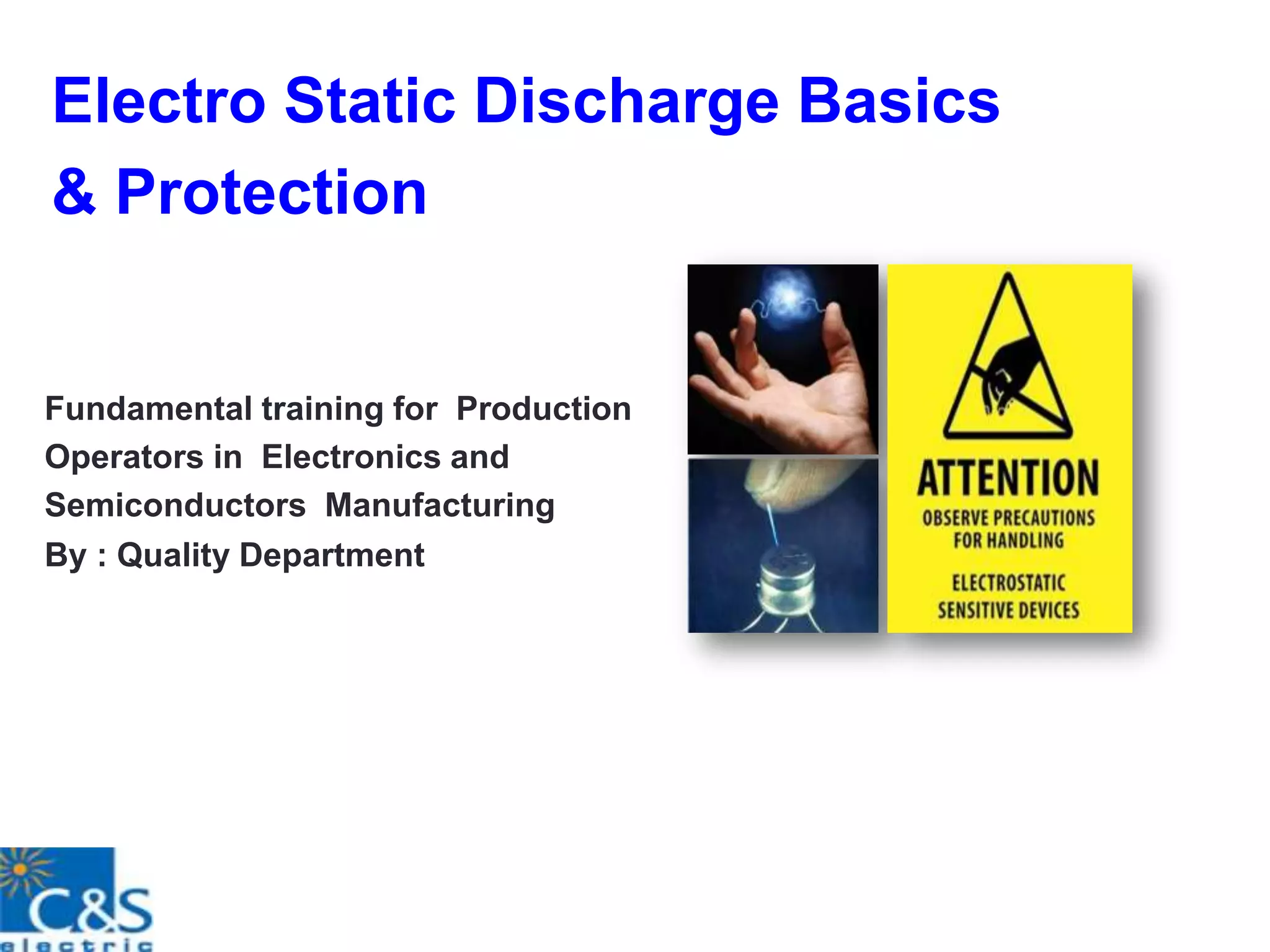

Electro Static Discharge Basics
& Protection
Fundamental training for Production
Operators in Electronics and
Semiconductors Manufacturing
By : Quality Department
Scope of Discussion
 ESD definition
 Common causes of ESD
 Sources of ESD
 Types of ESD damage
 ESD Control Programs
What is ESD?
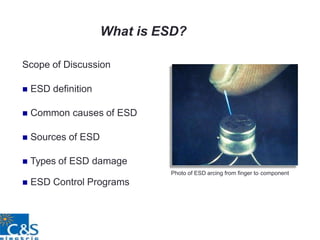
Photo of ESD arcing from finger to component
ESD Definition
•ESD – Electrostatic Discharge: The transfer of an
electrostatic charge between bodies at different
electrical pote.
ntials.
• Also referred to as static electricity
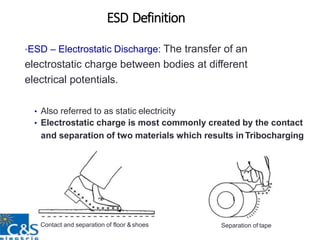
• Electrostatic charge is most commonly created by the contact
and separation of two materials which results in Tribocharging
Contact and separation of floor &shoes Separation of tape
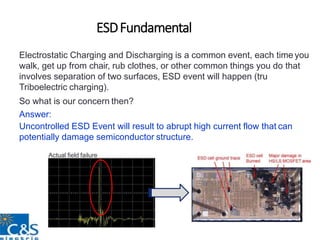
Electrostatic Charging and Discharging is a common event, each time you
walk, get up from chair, rub clothes, or other common things you do that
involves separation of two surfaces, ESD event will happen (tru
Triboelectric charging).
So what is our concern then?
Answer:
Uncontrolled ESD Event will result to abrupt high current flow that can
potentially damage semiconductor structure.
Actual field failure
ESDFundamental
ESDistheHiddenEnemy
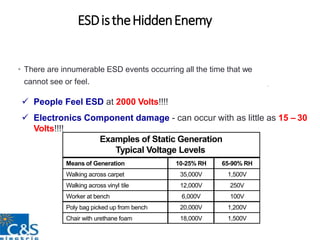
• There are innumerable ESD events occurring all the time that we
cannot see or feel. .
Examples of Static Generation
Typical Voltage Levels
Means of Generation 10-25% RH 65-90% RH
Walking across carpet 35,000V 1,500V
Walking across vinyl tile 12,000V 250V
Worker at bench 6,000V 100V
Poly bag picked up from bench 20,000V 1,200V
Chair with urethane foam 18,000V 1,500V
 People Feel ESD at 2000 Volts!!!!
 Electronics Component damage - can occur with as little as 15 – 30
Volts!!!!
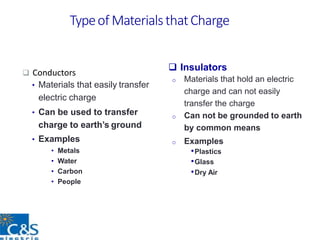
Typeof MaterialsthatCharge
 Conductors
• Materials that easily transfer
electric charge
• Can be used to transfer
charge to earth’s ground
• Examples
• Metals
• Water
• Carbon
• People
..
 Insulators
o Materials that hold an electric
charge and can not easily
transfer the charge
o Can not be grounded to earth
by common means
o Examples
•Plastics
•Glass
•Dry Air
Sources ofESD
TM
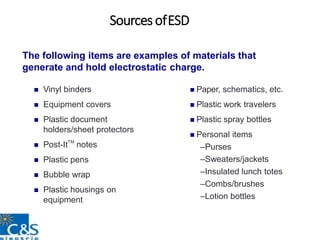
 Vinyl binders
 Equipment covers
 Plastic document
holders/sheet protectors
 Post-It notes
 Plastic pens
 Bubble wrap
 Plastic housings on
equipment
 Paper, schematics, etc.
 Plastic work travelers
 Plastic spray bottles
 Personal items
–Purses
–Sweaters/jackets
–Insulated lunch totes
–Combs/brushes
–Lotion bottles
The following items are examples of materials that
generate and hold electrostatic charge.
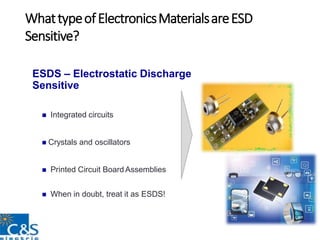
WhattypeofElectronicsMaterialsareESD
Sensitive?
ESDS – Electrostatic Discharge
Sensitive
 Integrated circuits
 Crystals and oscillators
 Printed Circuit Board Assemblies
 When in doubt, treat it as ESDS!
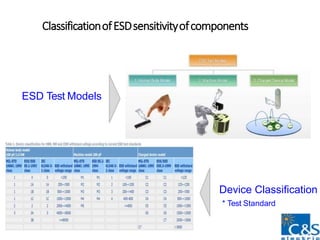
ClassificationofESDsensitivityofcomponents
ESD Test Models
Device Classification
* Test Standard
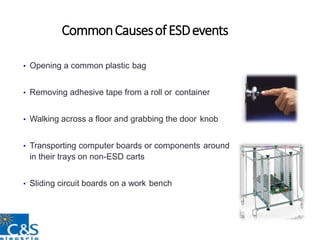
CommonCausesofESDevents
• Opening a common plastic bag
• Removing adhesive tape from a roll or container
• Walking across a floor and grabbing the door knob
• Transporting computer boards or components around
in their trays on non-ESD carts
• Sliding circuit boards on a work bench
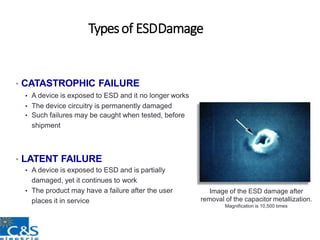
Typesof ESDDamage
• CATASTROPHIC FAILURE
• A device is exposed to ESD and it no longer works
• The device circuitry is permanently damaged
• Such failures may be caught when tested, before
shipment
• LATENT FAILURE
• A device is exposed to ESD and is partially
damaged, yet it continues to work
• The product may have a failure after the user
places it in service
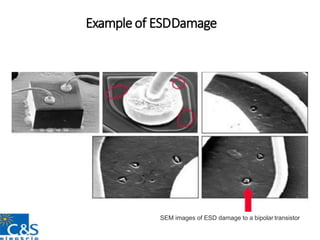
Image of the ESD damage after
removal of the capacitor metallization.
Magnification is 10,500 times
Exampleof ESDDamage
SEM images of ESD damage to a bipolar transistor
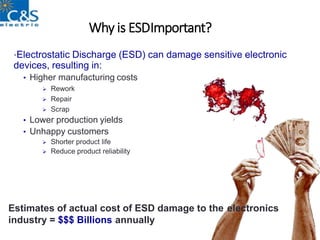
Why is ESDImportant?
•Electrostatic Discharge (ESD) can damage sensitive electronic
devices, resulting in:
• Higher manufacturing costs
 Rework
 Repair
 Scrap
• Lower production yields
• Unhappy customers
 Shorter product life
 Reduce product reliability
Estimates of actual cost of ESD damage to the electronics
industry = $$$ Billions annually
How to controlESD?
ESD Control Program
• ESD Training
• ESD Control Areas
• Ground Conductors
• Ionization
• ESDS Component Handling and Storage
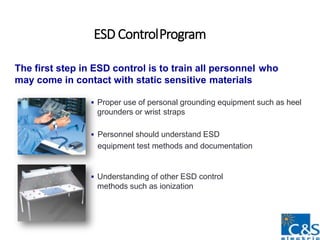
ESD ControlProgram
The first step in ESD control is to train all personnel who
may come in contact with static sensitive materials
 Proper use of personal grounding equipment such as heel
grounders or wrist straps
 Personnel should understand ESD
equipment test methods and documentation
 Understanding of other ESD control
methods such as ionization
ESD ControlProgram
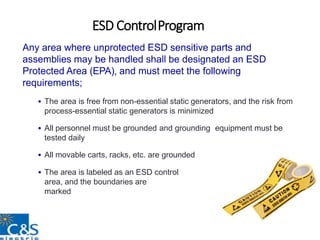
Any area where unprotected ESD sensitive parts and
assemblies may be handled shall be designated an ESD
Protected Area (EPA), and must meet the following
requirements;
 The area is free from non-essential static generators, and the risk from
process-essential static generators is minimized
 All personnel must be grounded and grounding equipment must be
tested daily
 All movable carts, racks, etc. are grounded
 The area is labeled as an ESD control
area, and the boundaries are
marked
clearly
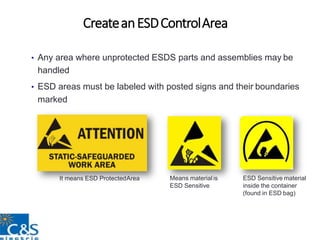
CreateanESDControlArea
• Any area where unprotected ESDS parts and assemblies may be
handled
• ESD areas must be labeled with posted signs and their boundaries
marked
It means ESD ProtectedArea ESD Sensitive material
inside the container
(found in ESD bag)
Means material is
ESD Sensitive
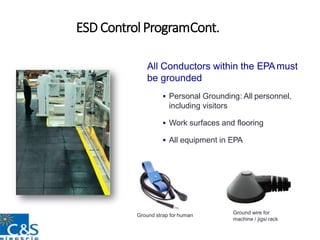
ESD Control ProgramCont.
All Conductors within the EPAmust
be grounded
 Personal Grounding: All personnel,
including visitors
 Work surfaces and flooring
 All equipment in EPA
Ground strap for human Ground wire for
machine / jigs/ rack
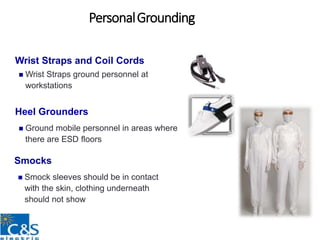
PersonalGrounding
Wrist Straps and Coil Cords
 Wrist Straps ground personnel at
workstations
Heel Grounders
 Ground mobile personnel in areas where
there are ESD floors
Smocks
 Smock sleeves should be in contact
with the skin, clothing underneath
should not show
PersonalGrounding
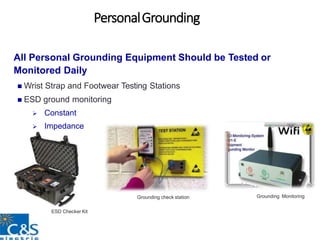
All Personal Grounding Equipment Should be Tested or
Monitored Daily
 Wrist Strap and Footwear Testing Stations
 ESD ground monitoring
 Constant
 Impedance
Grounding check station Grounding Monitoring
ESD Checker Kit
EquipmentGrounding
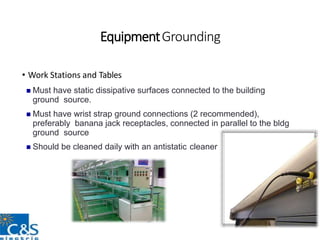
• Work Stations and Tables
 Must have static dissipative surfaces connected to the building
ground source.
 Must have wrist strap ground connections (2 recommended),
preferably banana jack receptacles, connected in parallel to the bldg
ground source
 Should be cleaned daily with an antistatic cleaner
EquipmentGrounding
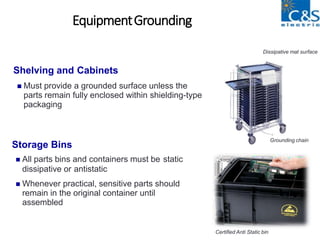
Shelving and Cabinets
 Must provide a grounded surface unless the
parts remain fully enclosed within shielding-type
packaging
Storage Bins
 All parts bins and containers must be static
dissipative or antistatic
 Whenever practical, sensitive parts should
remain in the original container until
assembled
Grounding chain
Dissipative mat surface
Certified Anti Static bin
Ionization
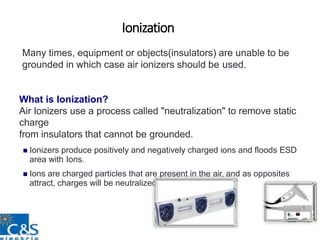
Many times, equipment or objects(insulators) are unable to be
grounded in which case air ionizers should be used.
What is Ionization?
Air Ionizers use a process called "neutralization" to remove static
charge
from insulators that cannot be grounded.
 Ionizers produce positively and negatively charged ions and floods ESD
area with Ions.
 Ions are charged particles that are present in the air, and as opposites
attract, charges will be neutralized over time.
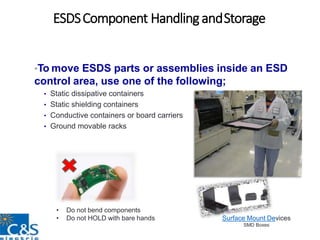
ESDSComponent HandlingandStorage
•To move ESDS parts or assemblies inside an ESD
control area, use one of the following;
• Static dissipative containers
• Static shielding containers
• Conductive containers or board carriers
• Ground movable racks
Surface Mount Devices
SMD Boxes
• Do not bend components
• Do not HOLD with bare hands
ESD BasicsReview
• Things to remember about an ESD protection plan.
 Only allow trained or escorted people in EPA
 Ground all conductors including people at ESD workstation
 Test wrist straps at least daily, or use continuous monitors
 Test ESD footwear at least daily, if used
 Visually check all grounding cords
 Keep wristband snug, foot grounder grounding tab in shoe, and ESD smocks buttoned
 Ionizers are maintained and air flow directed at ESDS items
 Use shielded packaging for shipping or storing ESD sensitive items outside the ESD
Protected Area
 Handle unpacked ESDS items only when grounded
Thank you.

Esd training By Manish Dwivedi

  • 1.
    Electro Static DischargeBasics & Protection Fundamental training for Production Operators in Electronics and Semiconductors Manufacturing By : Quality Department
  • 2.
    Scope of Discussion ESD definition  Common causes of ESD  Sources of ESD  Types of ESD damage  ESD Control Programs What is ESD? Photo of ESD arcing from finger to component
  • 3.
    ESD Definition •ESD –Electrostatic Discharge: The transfer of an electrostatic charge between bodies at different electrical pote. ntials. • Also referred to as static electricity • Electrostatic charge is most commonly created by the contact and separation of two materials which results in Tribocharging Contact and separation of floor &shoes Separation of tape
  • 4.
    Electrostatic Charging andDischarging is a common event, each time you walk, get up from chair, rub clothes, or other common things you do that involves separation of two surfaces, ESD event will happen (tru Triboelectric charging). So what is our concern then? Answer: Uncontrolled ESD Event will result to abrupt high current flow that can potentially damage semiconductor structure. Actual field failure ESDFundamental
  • 5.
    ESDistheHiddenEnemy • There areinnumerable ESD events occurring all the time that we cannot see or feel. . Examples of Static Generation Typical Voltage Levels Means of Generation 10-25% RH 65-90% RH Walking across carpet 35,000V 1,500V Walking across vinyl tile 12,000V 250V Worker at bench 6,000V 100V Poly bag picked up from bench 20,000V 1,200V Chair with urethane foam 18,000V 1,500V  People Feel ESD at 2000 Volts!!!!  Electronics Component damage - can occur with as little as 15 – 30 Volts!!!!
  • 6.
    Typeof MaterialsthatCharge  Conductors •Materials that easily transfer electric charge • Can be used to transfer charge to earth’s ground • Examples • Metals • Water • Carbon • People ..  Insulators o Materials that hold an electric charge and can not easily transfer the charge o Can not be grounded to earth by common means o Examples •Plastics •Glass •Dry Air
  • 7.
    Sources ofESD TM  Vinylbinders  Equipment covers  Plastic document holders/sheet protectors  Post-It notes  Plastic pens  Bubble wrap  Plastic housings on equipment  Paper, schematics, etc.  Plastic work travelers  Plastic spray bottles  Personal items –Purses –Sweaters/jackets –Insulated lunch totes –Combs/brushes –Lotion bottles The following items are examples of materials that generate and hold electrostatic charge.
  • 8.
    WhattypeofElectronicsMaterialsareESD Sensitive? ESDS – ElectrostaticDischarge Sensitive  Integrated circuits  Crystals and oscillators  Printed Circuit Board Assemblies  When in doubt, treat it as ESDS!
  • 9.
  • 10.
    CommonCausesofESDevents • Opening acommon plastic bag • Removing adhesive tape from a roll or container • Walking across a floor and grabbing the door knob • Transporting computer boards or components around in their trays on non-ESD carts • Sliding circuit boards on a work bench
  • 11.
    Typesof ESDDamage • CATASTROPHICFAILURE • A device is exposed to ESD and it no longer works • The device circuitry is permanently damaged • Such failures may be caught when tested, before shipment • LATENT FAILURE • A device is exposed to ESD and is partially damaged, yet it continues to work • The product may have a failure after the user places it in service Image of the ESD damage after removal of the capacitor metallization. Magnification is 10,500 times
  • 12.
    Exampleof ESDDamage SEM imagesof ESD damage to a bipolar transistor
  • 13.
    Why is ESDImportant? •ElectrostaticDischarge (ESD) can damage sensitive electronic devices, resulting in: • Higher manufacturing costs  Rework  Repair  Scrap • Lower production yields • Unhappy customers  Shorter product life  Reduce product reliability Estimates of actual cost of ESD damage to the electronics industry = $$$ Billions annually
  • 14.
    How to controlESD? ESDControl Program • ESD Training • ESD Control Areas • Ground Conductors • Ionization • ESDS Component Handling and Storage
  • 15.
    ESD ControlProgram The firststep in ESD control is to train all personnel who may come in contact with static sensitive materials  Proper use of personal grounding equipment such as heel grounders or wrist straps  Personnel should understand ESD equipment test methods and documentation  Understanding of other ESD control methods such as ionization
  • 16.
    ESD ControlProgram Any areawhere unprotected ESD sensitive parts and assemblies may be handled shall be designated an ESD Protected Area (EPA), and must meet the following requirements;  The area is free from non-essential static generators, and the risk from process-essential static generators is minimized  All personnel must be grounded and grounding equipment must be tested daily  All movable carts, racks, etc. are grounded  The area is labeled as an ESD control area, and the boundaries are marked clearly
  • 17.
    CreateanESDControlArea • Any areawhere unprotected ESDS parts and assemblies may be handled • ESD areas must be labeled with posted signs and their boundaries marked It means ESD ProtectedArea ESD Sensitive material inside the container (found in ESD bag) Means material is ESD Sensitive
  • 18.
    ESD Control ProgramCont. AllConductors within the EPAmust be grounded  Personal Grounding: All personnel, including visitors  Work surfaces and flooring  All equipment in EPA Ground strap for human Ground wire for machine / jigs/ rack
  • 19.
    PersonalGrounding Wrist Straps andCoil Cords  Wrist Straps ground personnel at workstations Heel Grounders  Ground mobile personnel in areas where there are ESD floors Smocks  Smock sleeves should be in contact with the skin, clothing underneath should not show
  • 20.
    PersonalGrounding All Personal GroundingEquipment Should be Tested or Monitored Daily  Wrist Strap and Footwear Testing Stations  ESD ground monitoring  Constant  Impedance Grounding check station Grounding Monitoring ESD Checker Kit
  • 21.
    EquipmentGrounding • Work Stationsand Tables  Must have static dissipative surfaces connected to the building ground source.  Must have wrist strap ground connections (2 recommended), preferably banana jack receptacles, connected in parallel to the bldg ground source  Should be cleaned daily with an antistatic cleaner
  • 22.
    EquipmentGrounding Shelving and Cabinets Must provide a grounded surface unless the parts remain fully enclosed within shielding-type packaging Storage Bins  All parts bins and containers must be static dissipative or antistatic  Whenever practical, sensitive parts should remain in the original container until assembled Grounding chain Dissipative mat surface Certified Anti Static bin
  • 23.
    Ionization Many times, equipmentor objects(insulators) are unable to be grounded in which case air ionizers should be used. What is Ionization? Air Ionizers use a process called "neutralization" to remove static charge from insulators that cannot be grounded.  Ionizers produce positively and negatively charged ions and floods ESD area with Ions.  Ions are charged particles that are present in the air, and as opposites attract, charges will be neutralized over time.
  • 24.
    ESDSComponent HandlingandStorage •To moveESDS parts or assemblies inside an ESD control area, use one of the following; • Static dissipative containers • Static shielding containers • Conductive containers or board carriers • Ground movable racks Surface Mount Devices SMD Boxes • Do not bend components • Do not HOLD with bare hands
  • 25.
    ESD BasicsReview • Thingsto remember about an ESD protection plan.  Only allow trained or escorted people in EPA  Ground all conductors including people at ESD workstation  Test wrist straps at least daily, or use continuous monitors  Test ESD footwear at least daily, if used  Visually check all grounding cords  Keep wristband snug, foot grounder grounding tab in shoe, and ESD smocks buttoned  Ionizers are maintained and air flow directed at ESDS items  Use shielded packaging for shipping or storing ESD sensitive items outside the ESD Protected Area  Handle unpacked ESDS items only when grounded
  • 26.