ESD
1
E
Electro
lectroS
Static
tatic D
Discharge Training
ischarge Training
ESD
2
Course Objectives
To make Employees aware of . . .
 what ESD is
 why an ESD program is important
 -’s minimum requirements for ESD control
 their roles and responsibilities in the ESD program
ESD
3
Presentation Outline
 What is ESD?
 Why is ESD Important?
 ESD Prevention Program
 ESD Roles and Responsibilities
 Hands-on Demonstration
 Q&A
 Assessment
ESD
4
 ESD Definition
 Common Causes of ESD
 Sources of ESD
 Types of ESD Damage
What is ESD?
ESD
5
ESD Definition
ESD – Electrostatic Discharge
 The transfer of electrostatic charge between bodies at
different electrical potentials
 Also referred to as static electricity
 Electrostatic charge is most commonly created by the
contact and separation of two materials
.
.
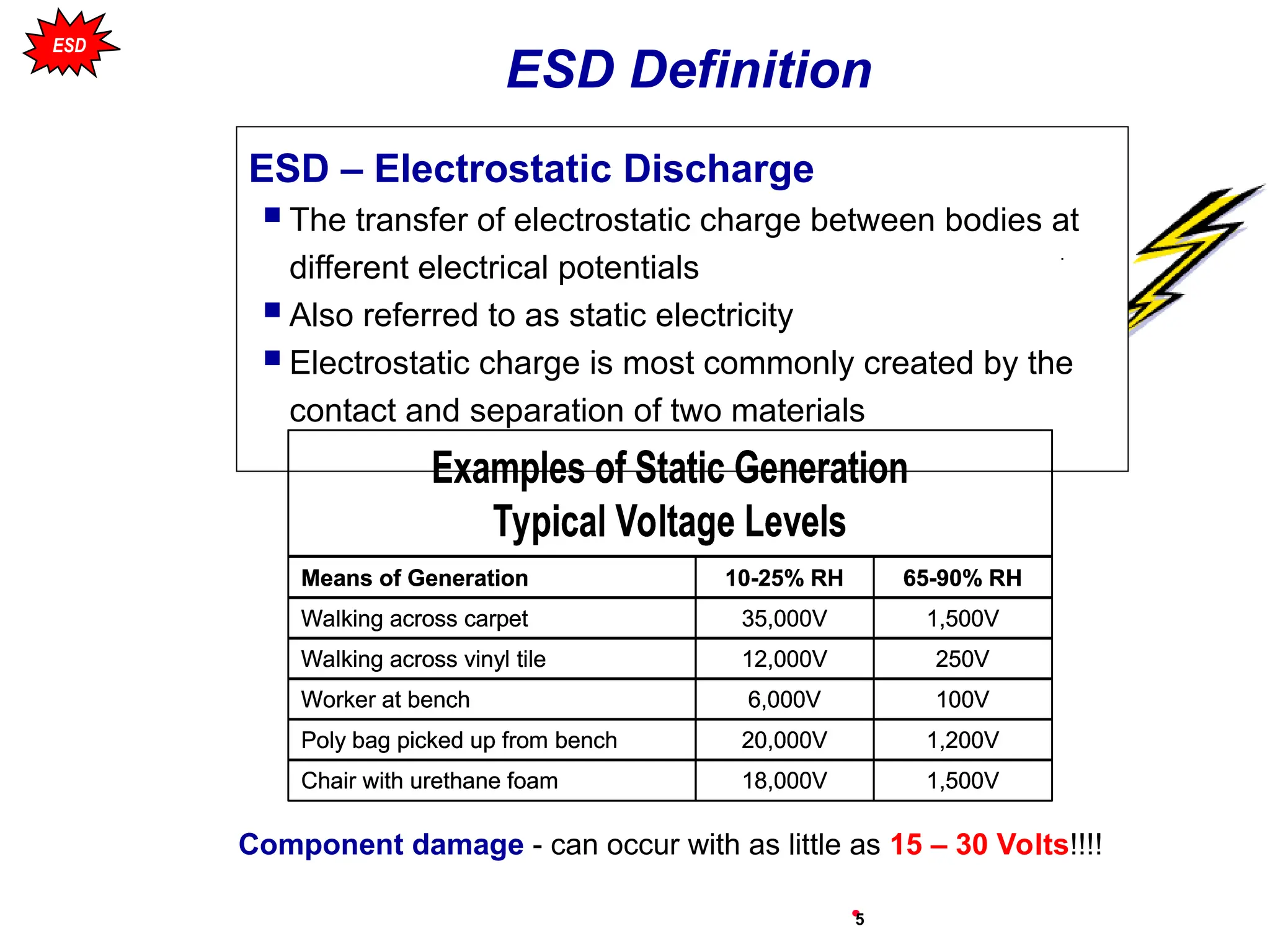
Component damage - can occur with as little as 15 – 30 Volts!!!!
Examples of Static Generation
Typical Voltage Levels
Means of Generation 10-25% RH 65-90% RH
Walking across carpet 35,000V 1,500V
Walking across vinyl tile 12,000V 250V
Worker at bench 6,000V 100V
Poly bag picked up from bench 20,000V 1,200V
Chair with urethane foam 18,000V 1,500V
Examples of Static Generation
Typical Voltage Levels
Means of Generation 10-25% RH 65-90% RH
Walking across carpet 35,000V 1,500V
Walking across vinyl tile 12,000V 250V
Worker at bench 6,000V 100V
Poly bag picked up from bench 20,000V 1,200V
Chair with urethane foam 18,000V 1,500V
Examples of Static Generation
Typical Voltage Levels
Examples of Static Generation
Typical Voltage Levels
Examples of Static Generation
Typical Voltage Levels
Means of Generation
Means of Generation 10-25% RH
10-25% RH 65-90% RH
65-90% RH
Walking across carpet
Walking across carpet 35,000V
35,000V 1,500V
1,500V
Walking across vinyl tile
Walking across vinyl tile 12,000V
12,000V 250V
250V
Worker at bench
Worker at bench 6,000V
6,000V 100V
100V
Poly bag picked up from bench
Poly bag picked up from bench 20,000V
20,000V 1,200V
1,200V
Chair with urethane foam
Chair with urethane foam 18,000V
18,000V 1,500V
1,500V
Examples of Static Generation
Typical Voltage Levels
Means of Generation 10-25% RH 65-90% RH
Walking across carpet 35,000V 1,500V
Walking across vinyl tile 12,000V 250V
Worker at bench 6,000V 100V
Poly bag picked up from bench 20,000V 1,200V
Examples of Static Generation
Typical Voltage Levels
Means of Generation 10-25% RH 65-90% RH
Walking across carpet 35,000V 1,500V
Walking across vinyl tile 12,000V 250V
Worker at bench 6,000V 100V
Poly bag picked up from bench 20,000V 1,200V
Examples of Static Generation
Typical Voltage Levels
Examples of Static Generation
Typical Voltage Levels
Examples of Static Generation
Typical Voltage Levels
Means of Generation
Means of Generation 10-25% RH
10-25% RH 65-90% RH
65-90% RH
Walking across carpet
Walking across carpet 35,000V
35,000V 1,500V
1,500V
Walking across vinyl tile
Walking across vinyl tile 12,000V
12,000V 250V
250V
Worker at bench
Worker at bench 6,000V
6,000V 100V
100V
Poly bag picked up from bench
Poly bag picked up from bench 20,000V
20,000V 1,200V
1,200V
ESD
6
ESDS – Electrostatic Discharge Sensitive
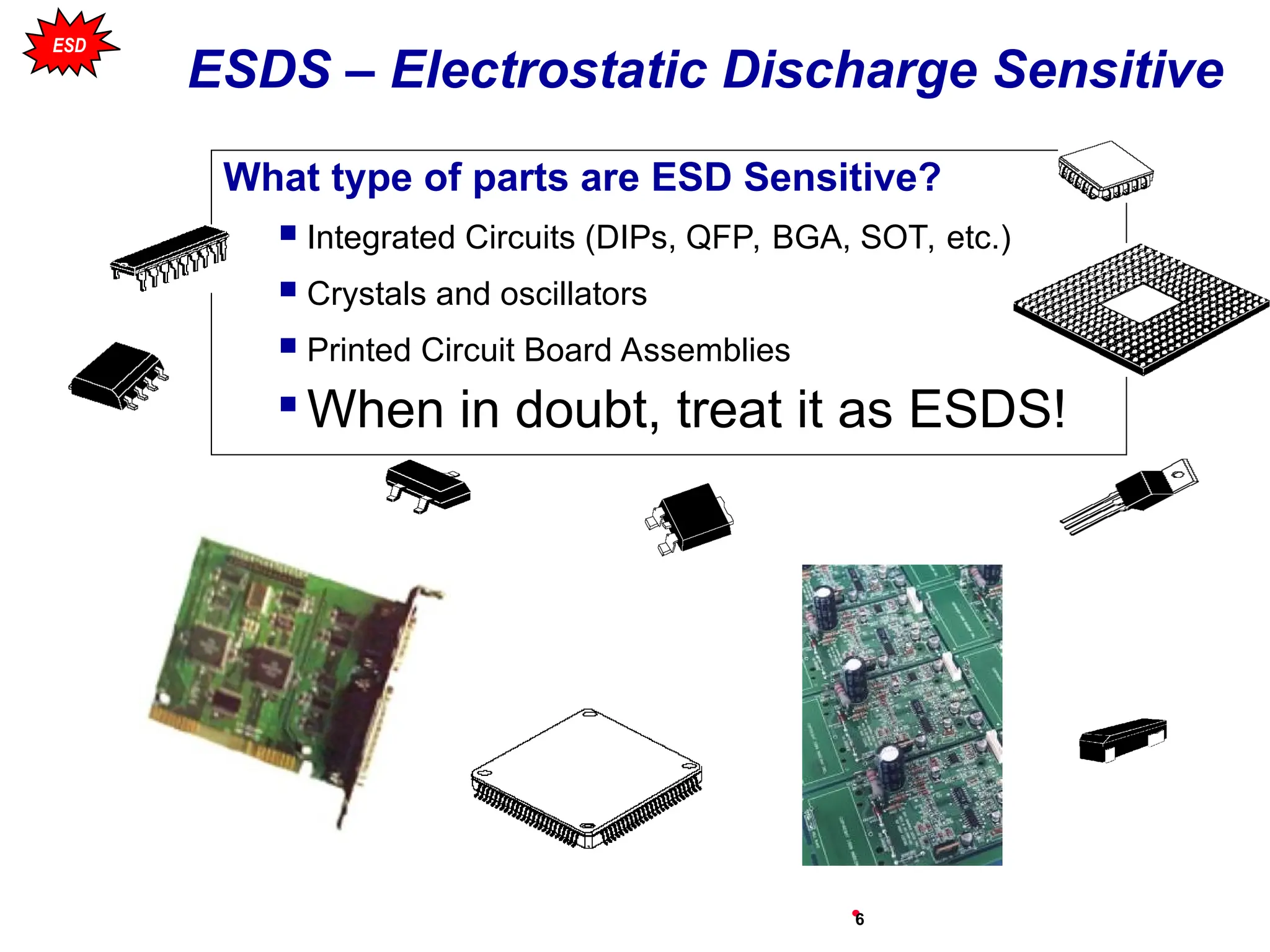
What type of parts are ESD Sensitive?
 Integrated Circuits (DIPs, QFP, BGA, SOT, etc.)
 Crystals and oscillators
 Printed Circuit Board Assemblies

When in doubt, treat it as ESDS!
ESD
7
Common Causes of ESD
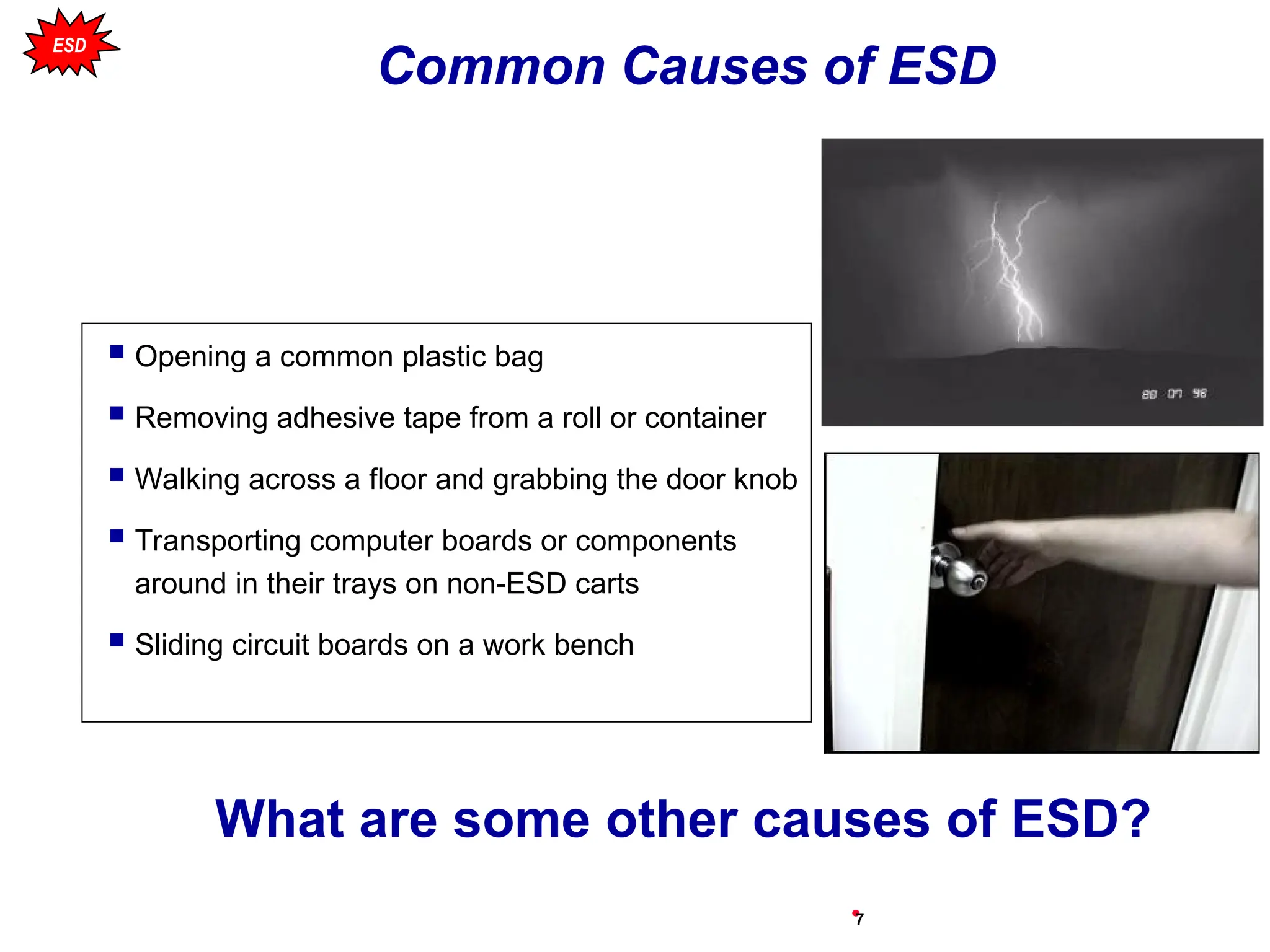
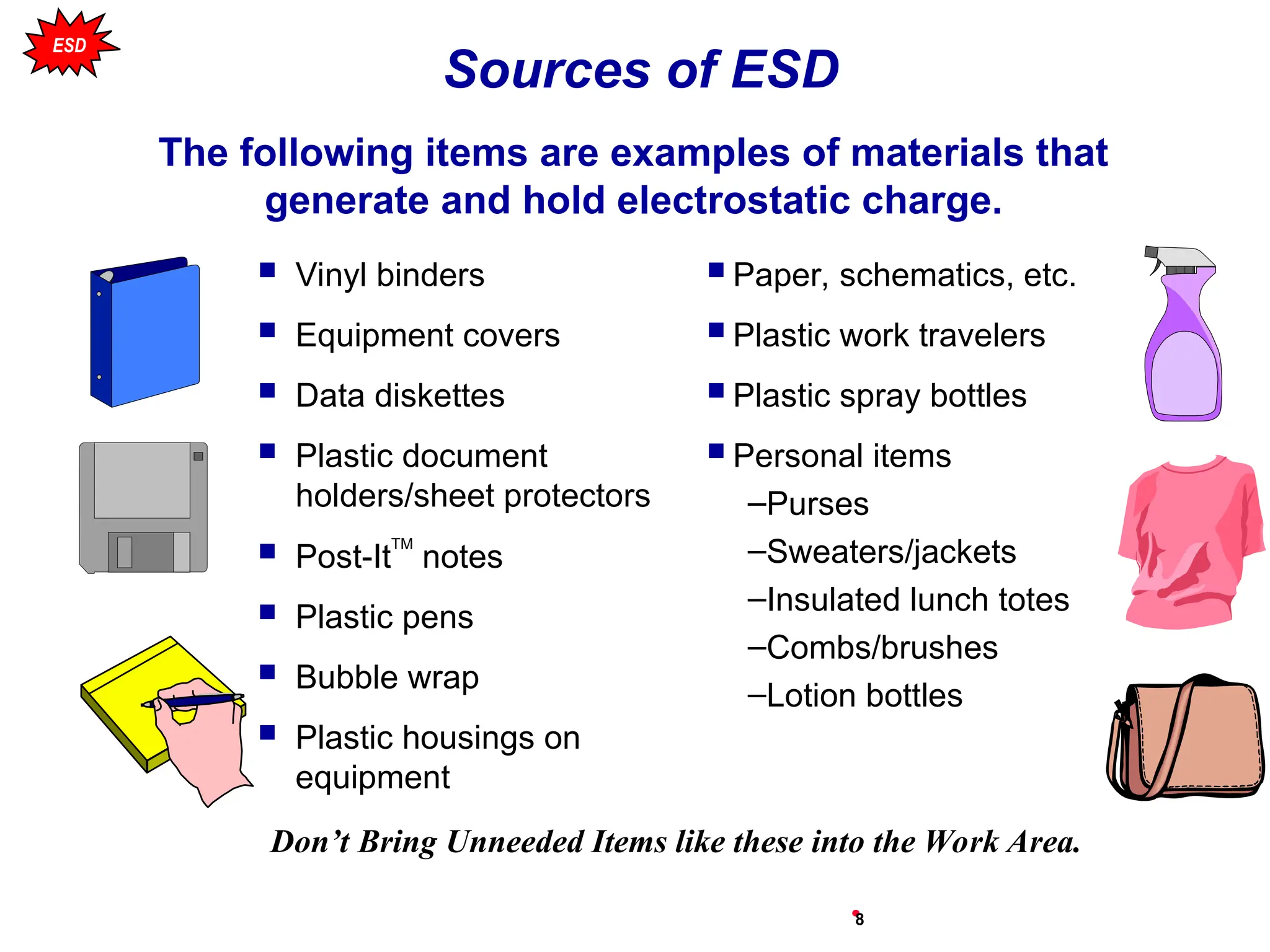
 Opening a common plastic bag
 Removing adhesive tape from a roll or container
 Walking across a floor and grabbing the door knob
 Transporting computer boards or components
around in their trays on non-ESD carts
 Sliding circuit boards on a work bench
What are some other causes of ESD?
ESD
8
Sources of ESD
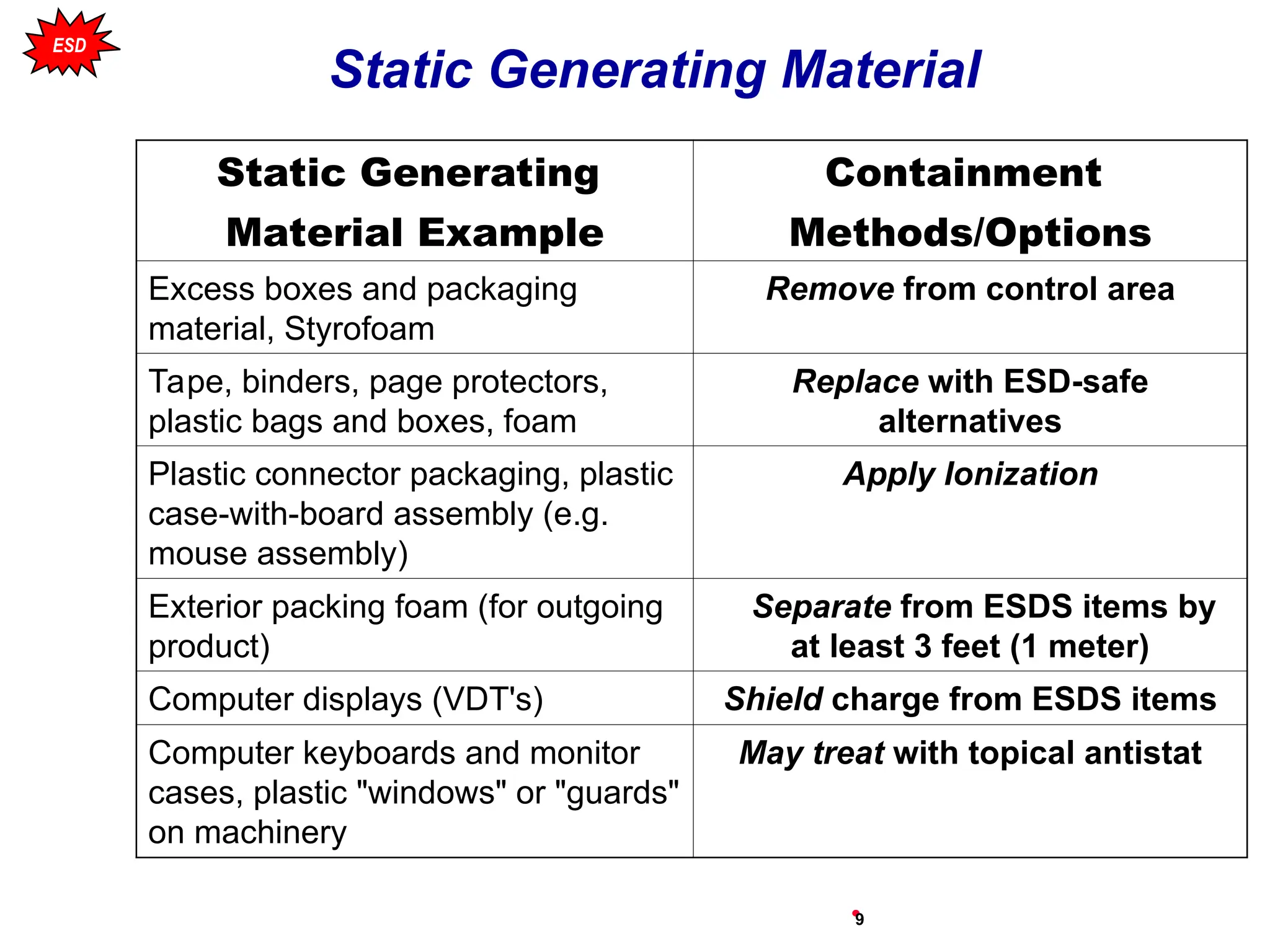
 Vinyl binders
 Equipment covers
 Data diskettes
 Plastic document
holders/sheet protectors
 Post-It
TM
notes
 Plastic pens
 Bubble wrap
 Plastic housings on
equipment
 Paper, schematics, etc.
 Plastic work travelers
 Plastic spray bottles
 Personal items
–Purses
–Sweaters/jackets
–Insulated lunch totes
–Combs/brushes
–Lotion bottles
Don’t Bring Unneeded Items like these into the Work Area.
The following items are examples of materials that
generate and hold electrostatic charge.
ESD
9
Static Generating Material
Static Generating
Material Example
Containment
Methods/Options
Excess boxes and packaging
material, Styrofoam
Remove from control area
Tape, binders, page protectors,
plastic bags and boxes, foam
Replace with ESD-safe
alternatives
Plastic connector packaging, plastic
case-with-board assembly (e.g.
mouse assembly)
Apply Ionization
Exterior packing foam (for outgoing
product)
Separate from ESDS items by
at least 3 feet (1 meter)
Computer displays (VDT's) Shield charge from ESDS items
Computer keyboards and monitor
cases, plastic "windows" or "guards"
on machinery
May treat with topical antistat
ESD
10
Types of ESD Damage
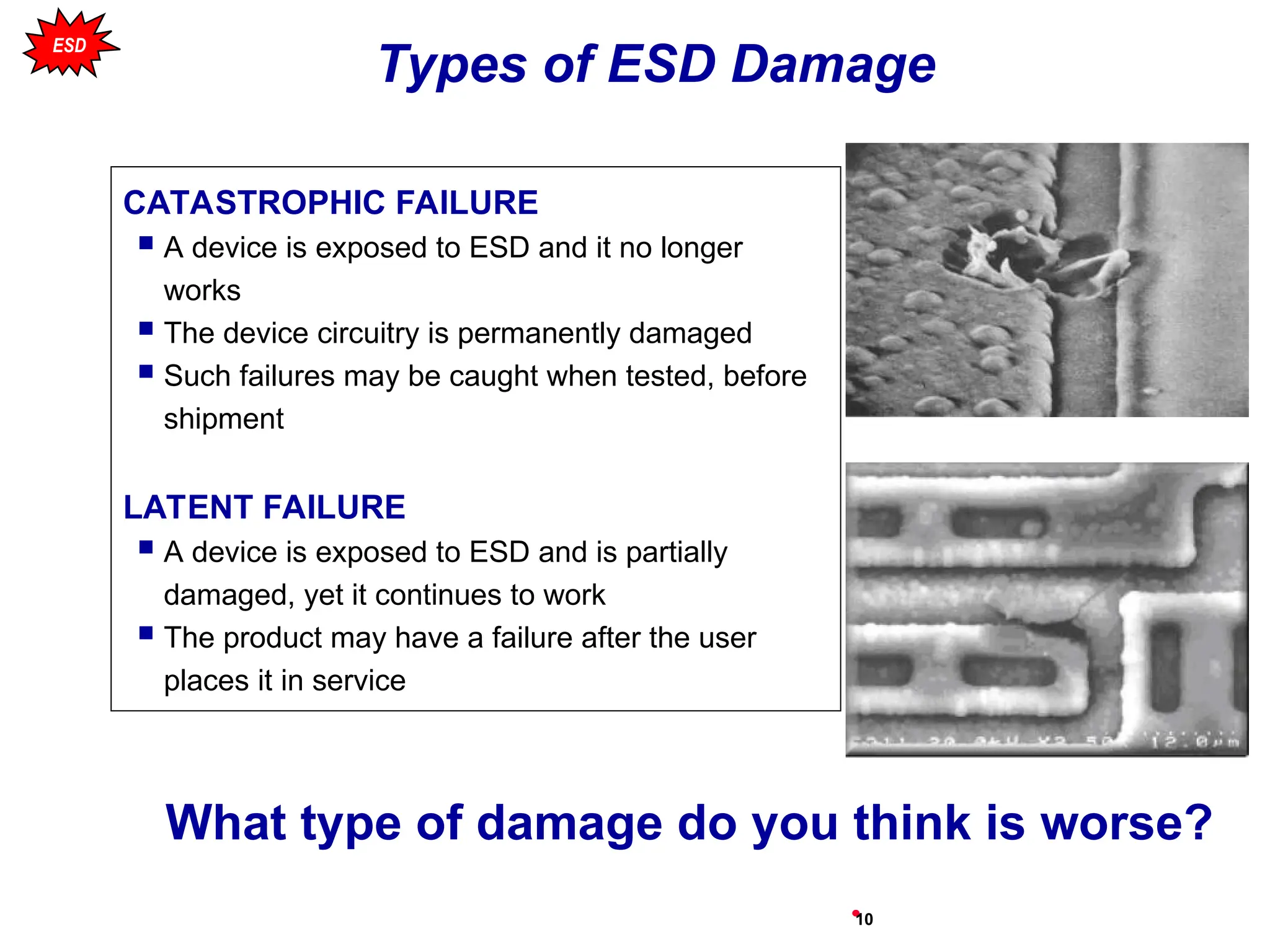
CATASTROPHIC FAILURE
 A device is exposed to ESD and it no longer
works
 The device circuitry is permanently damaged
 Such failures may be caught when tested, before
shipment
LATENT FAILURE
 A device is exposed to ESD and is partially
damaged, yet it continues to work
 The product may have a failure after the user
places it in service
What type of damage do you think is worse?
ESD
11
Why is ESD Important?
ESD
12
Why is ESD Important?
Electrostatic Discharge (ESD) can damage sensitive
electronic devices, resulting in:
 Higher manufacturing costs
 Rework
 Repair
 Scrap
 Lower production yields
 Unhappy customers
 Shorter product life
 Reduce product reliability
Estimates of actual cost of ESD damage to the electronics
industry = $$$ Billions annually
ESD
13
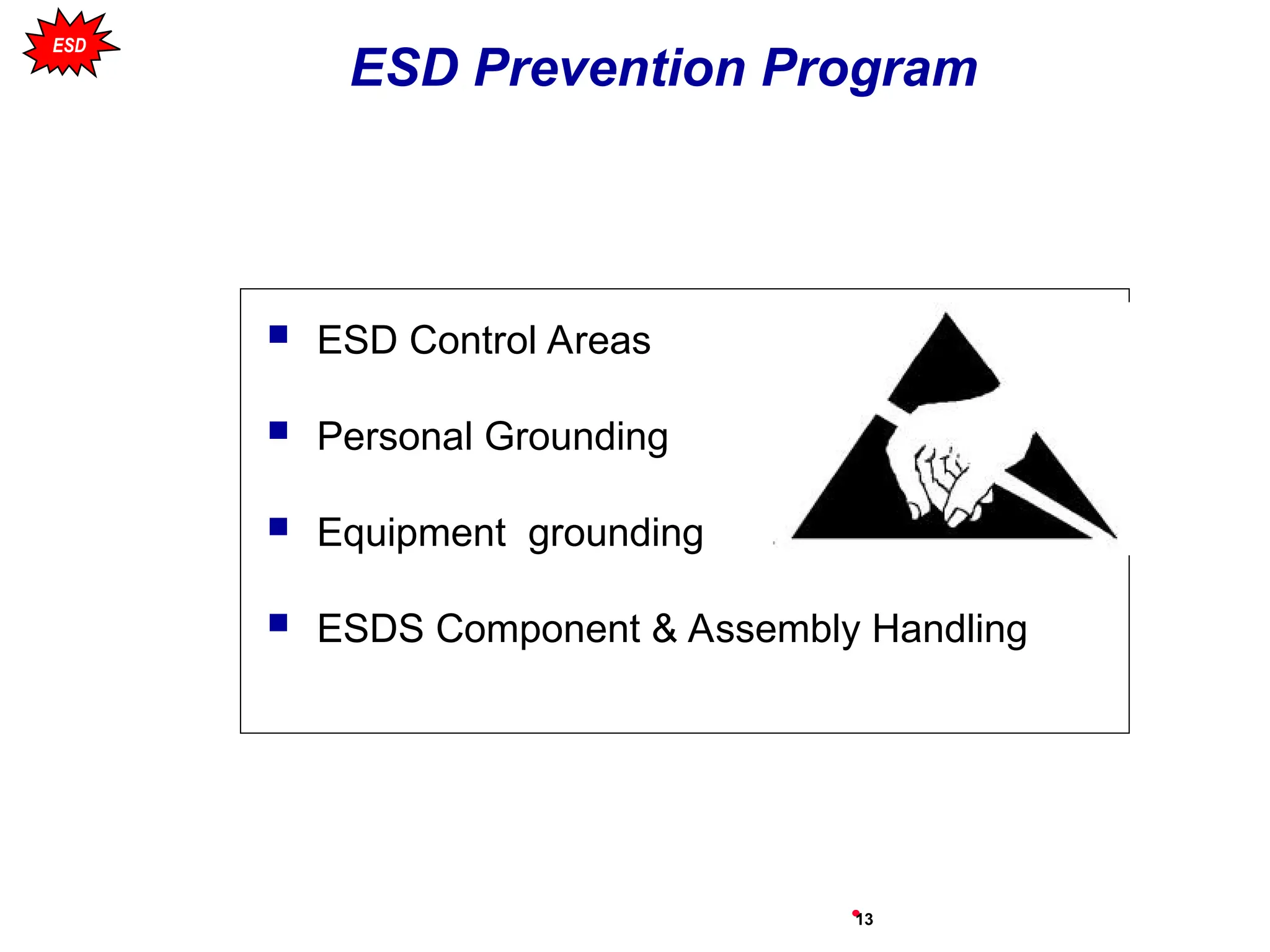
 ESD Control Areas
 Personal Grounding
 Equipment grounding
 ESDS Component & Assembly Handling
ESD Prevention Program
ESD
14
ESD Control Areas
 Any area where unprotected ESDS parts and assemblies may be handled
 ESD areas must be labeled with posted signs and their boundaries marked
ESD
15
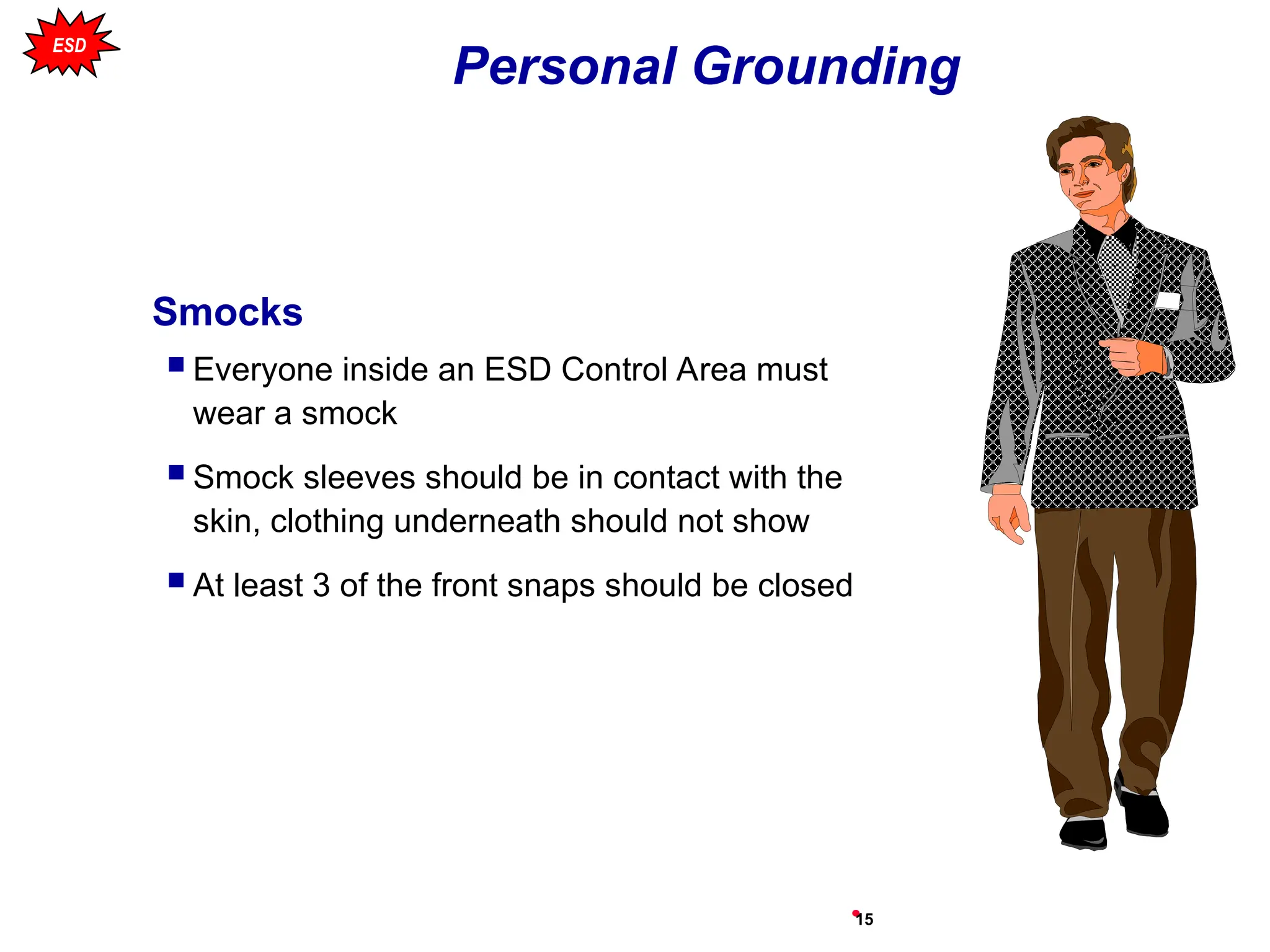
Personal Grounding
Smocks
 Everyone inside an ESD Control Area must
wear a smock
 Smock sleeves should be in contact with the
skin, clothing underneath should not show
 At least 3 of the front snaps should be closed
-
ESD
16
Personal Grounding
Shoes and Heel Straps –
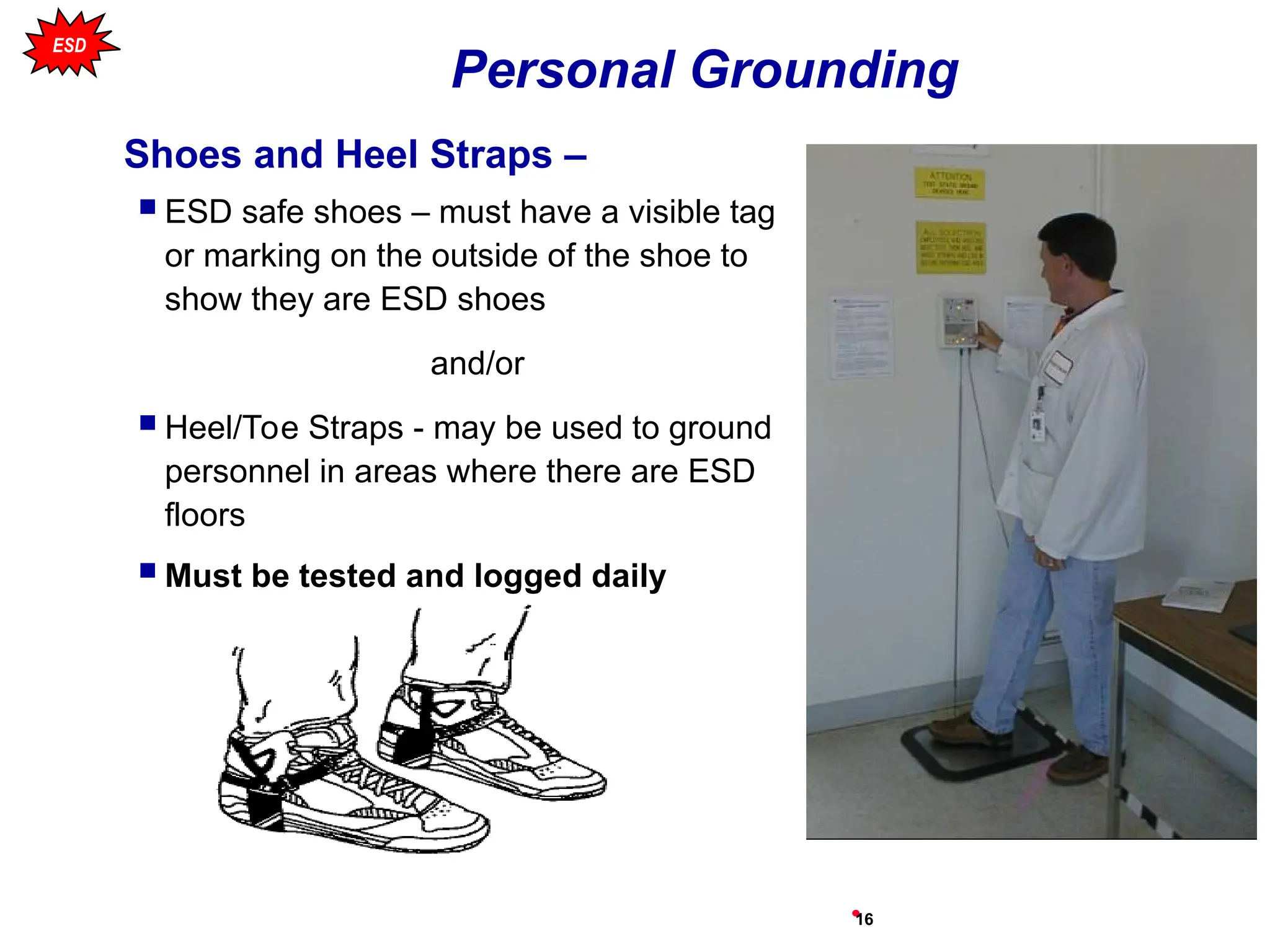
 ESD safe shoes – must have a visible tag
or marking on the outside of the shoe to
show they are ESD shoes
and/or
 Heel/Toe Straps - may be used to ground
personnel in areas where there are ESD
floors
 Must be tested and logged daily
ESD
17
Personal Grounding
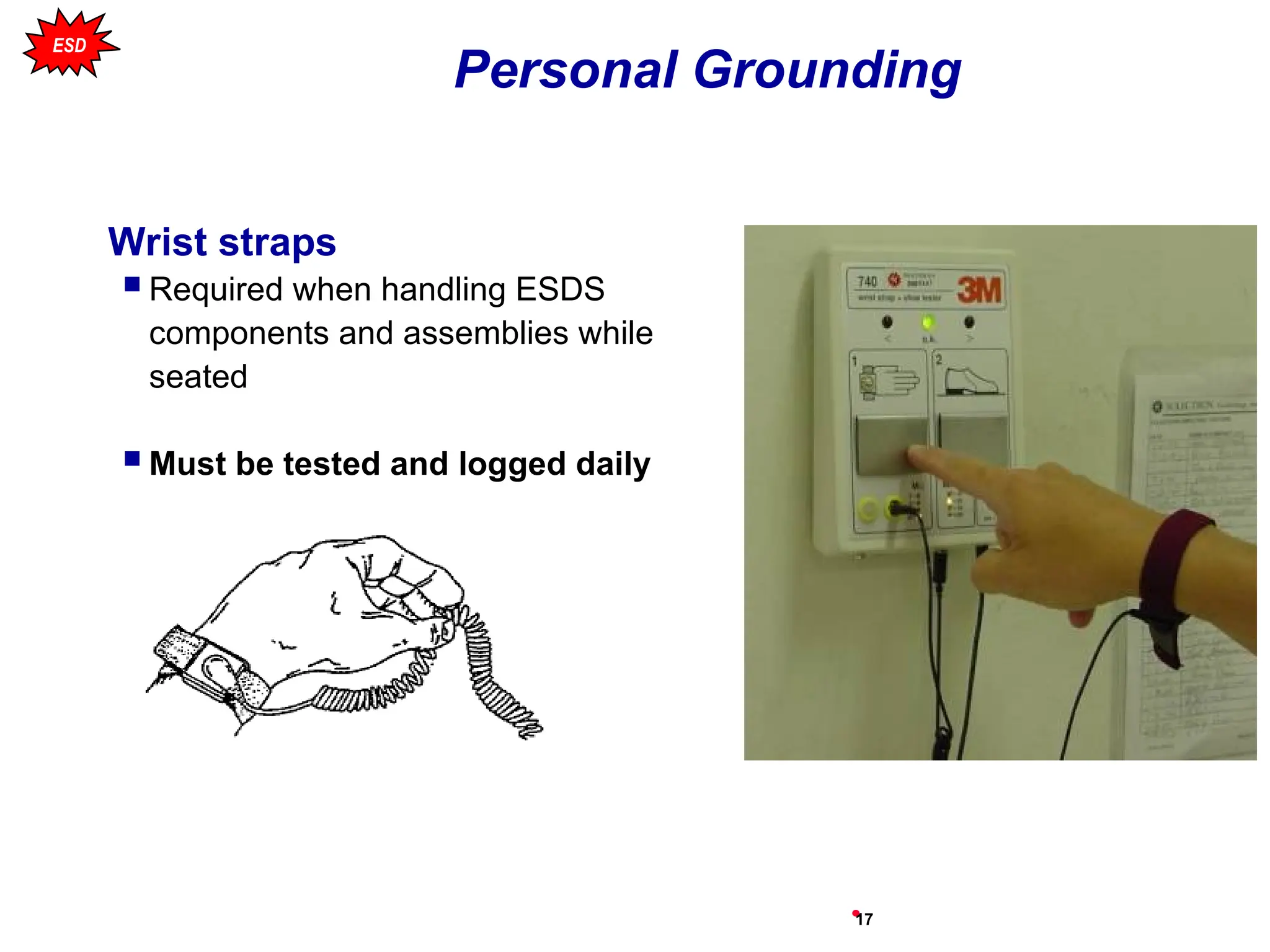
Wrist straps
 Required when handling ESDS
components and assemblies while
seated
 Must be tested and logged daily
ESD
18
Equipment Grounding
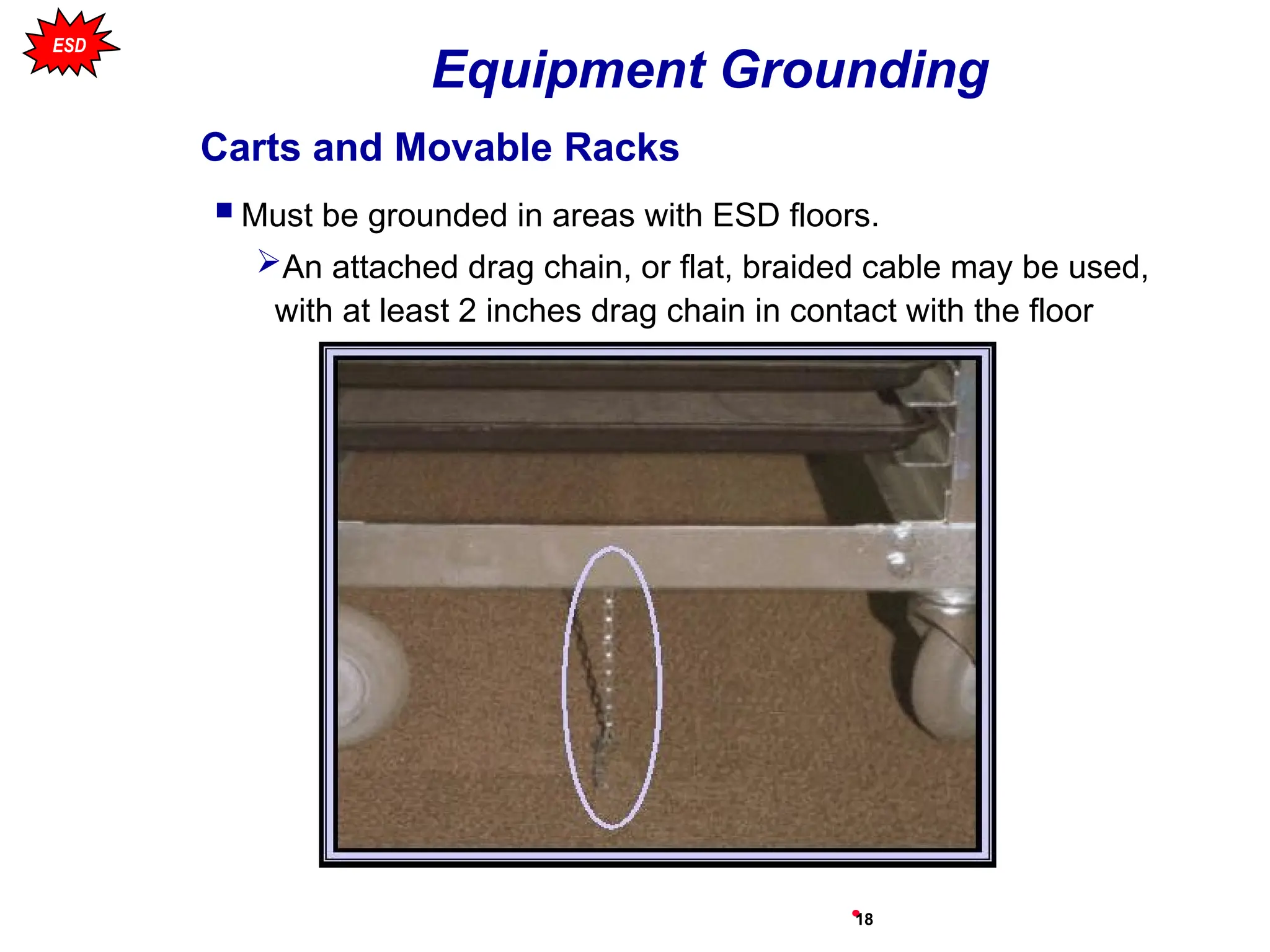
Carts and Movable Racks
 Must be grounded in areas with ESD floors.
An attached drag chain, or flat, braided cable may be used,
with at least 2 inches drag chain in contact with the floor
ESD
19
Equipment Grounding
Work Stations and Tables
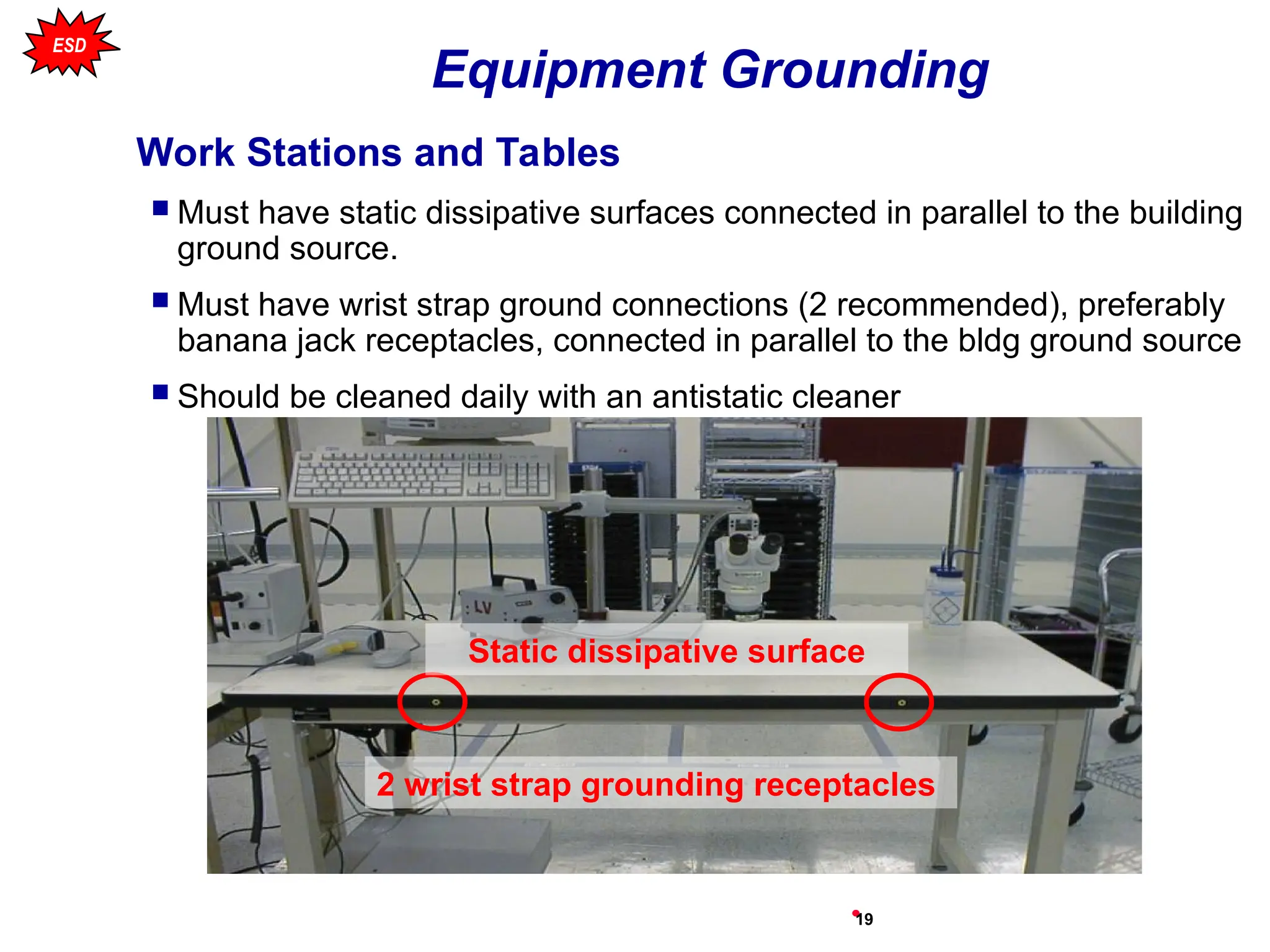
 Must have static dissipative surfaces connected in parallel to the building
ground source.
 Must have wrist strap ground connections (2 recommended), preferably
banana jack receptacles, connected in parallel to the bldg ground source
 Should be cleaned daily with an antistatic cleaner
2 wrist strap grounding receptacles
Static dissipative surface
ESD
20
Equipment Grounding
Power Tools
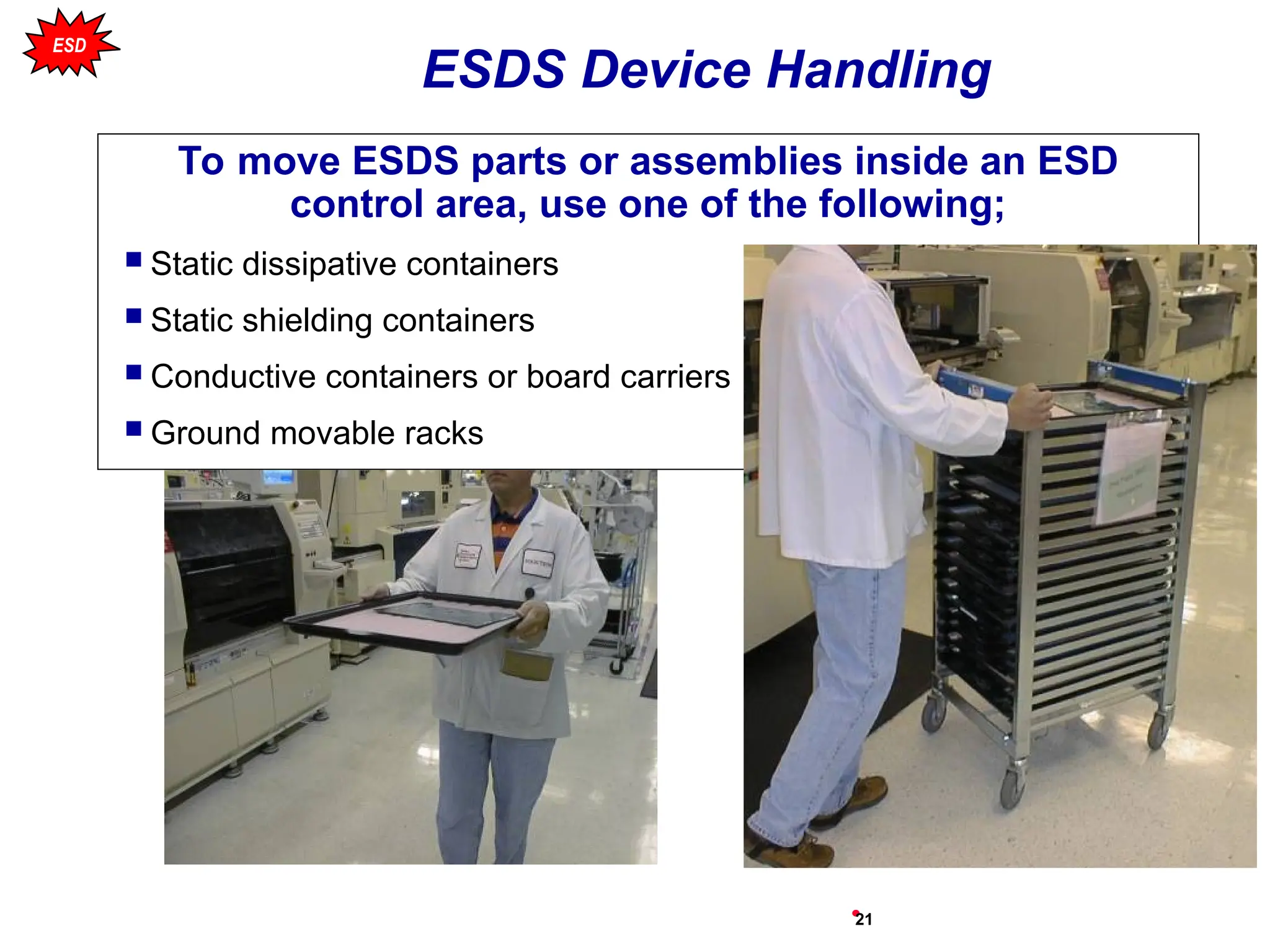
 Need to be grounded. Grounding to the local
utility is usually sufficient, but should be
determined by the site Engineering dept.
Shelving and Cabinets
 Must provide a grounded surface unless the parts
remain fully enclosed within shielding-type
packaging
Storage Bins
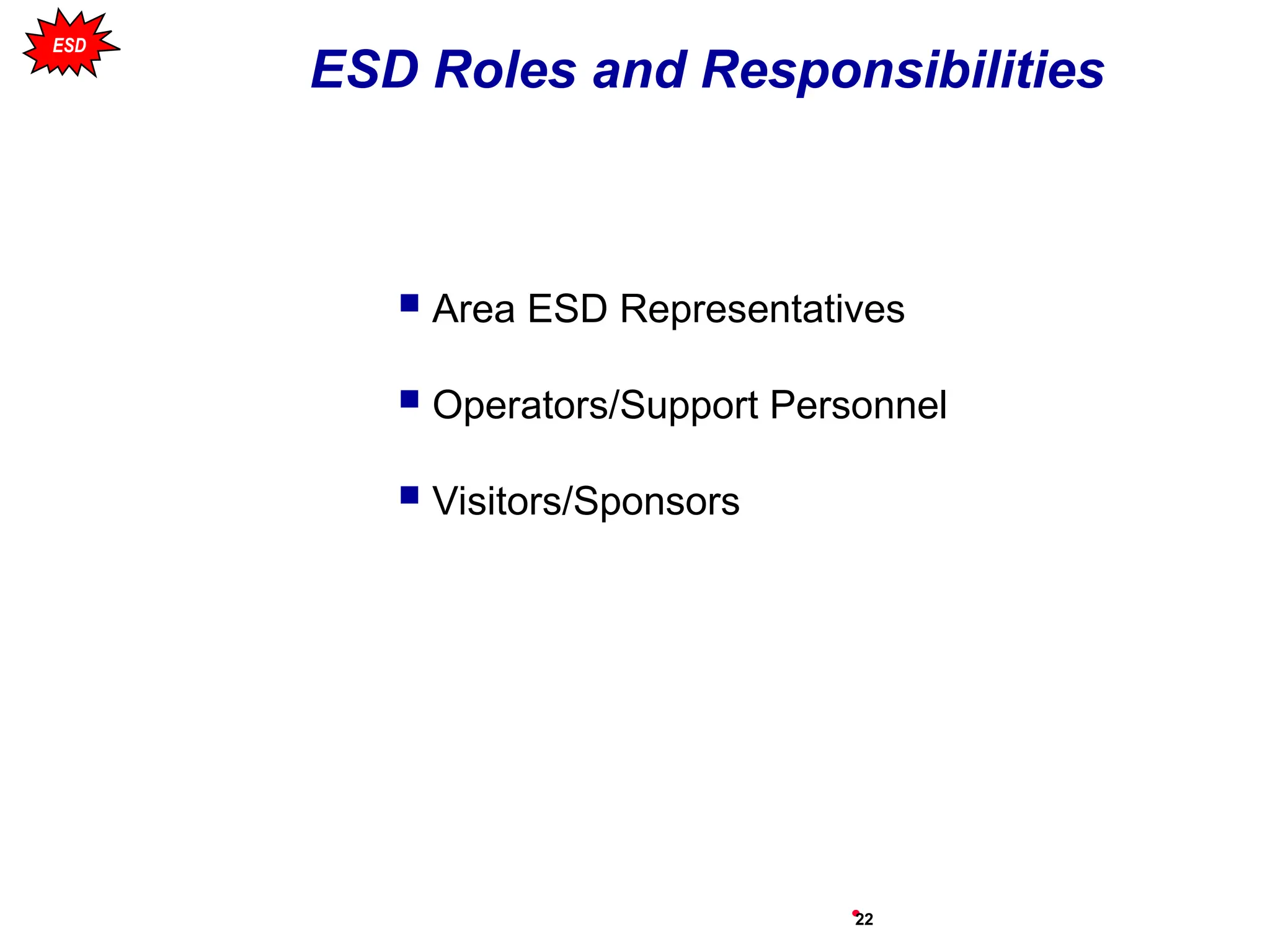
 All parts bins and containers must be static
dissipative or antistatic
 Whenever practical, sensitive parts should
remain in the original container until
assembled
ESD
21
ESDS Device Handling
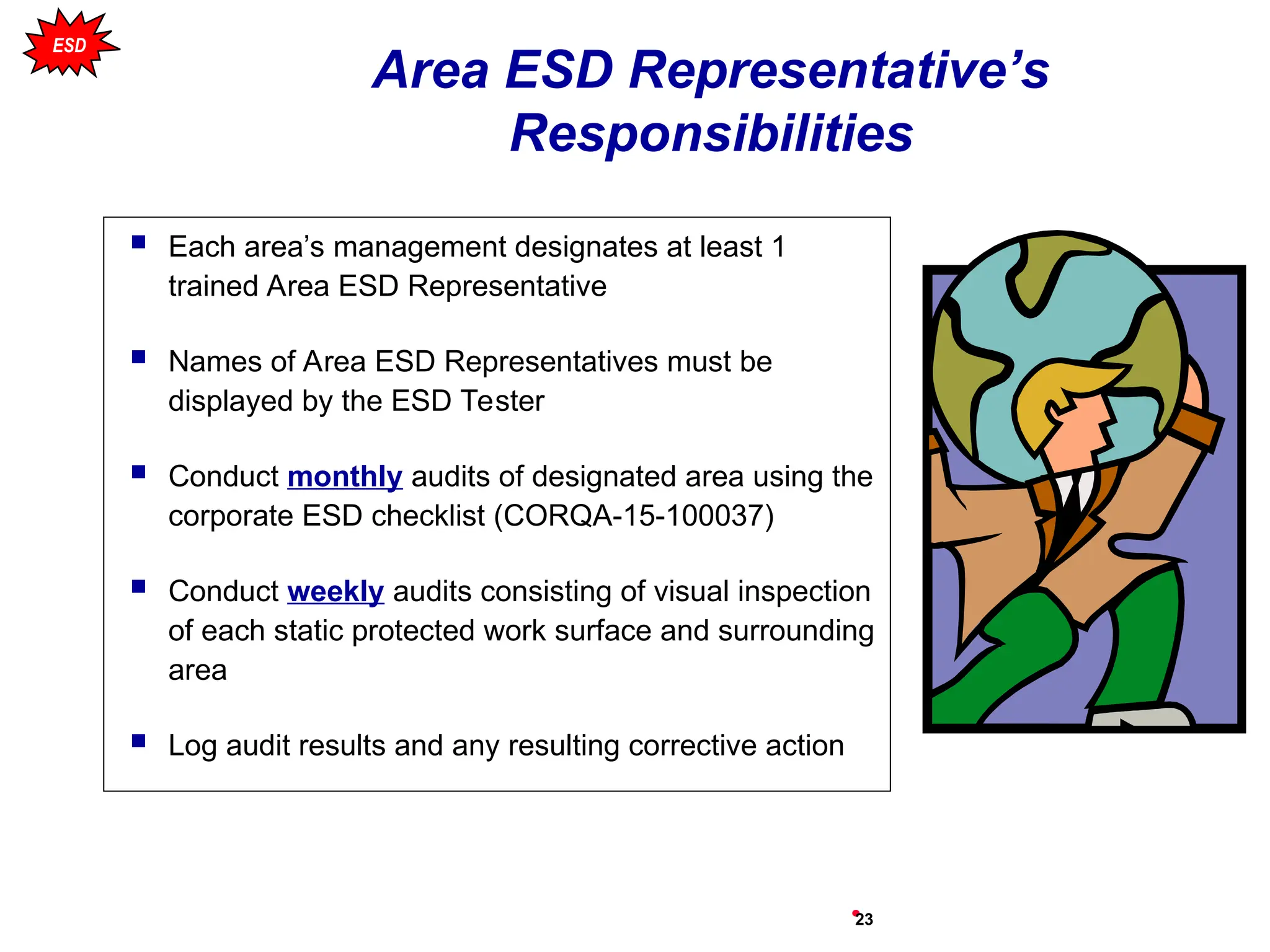
To move ESDS parts or assemblies inside an ESD
control area, use one of the following;
 Static dissipative containers
 Static shielding containers
 Conductive containers or board carriers
 Ground movable racks
ESD
22
 Area ESD Representatives
 Operators/Support Personnel
 Visitors/Sponsors
ESD Roles and Responsibilities
ESD
23
Area ESD Representative’s
Responsibilities
 Each area’s management designates at least 1
trained Area ESD Representative
 Names of Area ESD Representatives must be
displayed by the ESD Tester
 Conduct monthly audits of designated area using the
corporate ESD checklist (CORQA-15-100037)
 Conduct weekly audits consisting of visual inspection
of each static protected work surface and surrounding
area
 Log audit results and any resulting corrective action
ESD
24
Operator’s/Support Personnel’s
Responsibilities
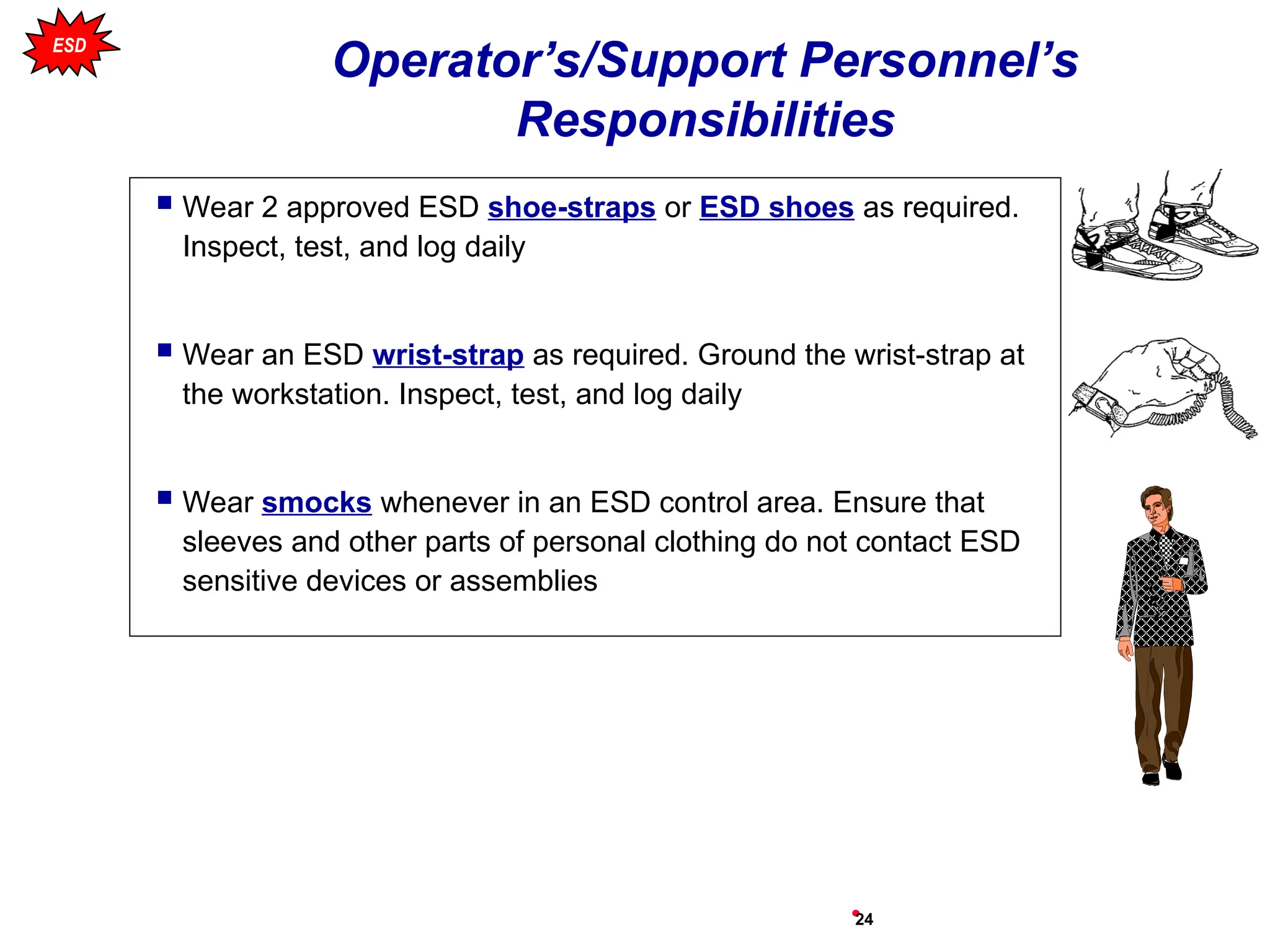
 Wear 2 approved ESD shoe-straps or ESD shoes as required.
Inspect, test, and log daily
 Wear an ESD wrist-strap as required. Ground the wrist-strap at
the workstation. Inspect, test, and log daily
 Wear smocks whenever in an ESD control area. Ensure that
sleeves and other parts of personal clothing do not contact ESD
sensitive devices or assemblies
-
ESD
25
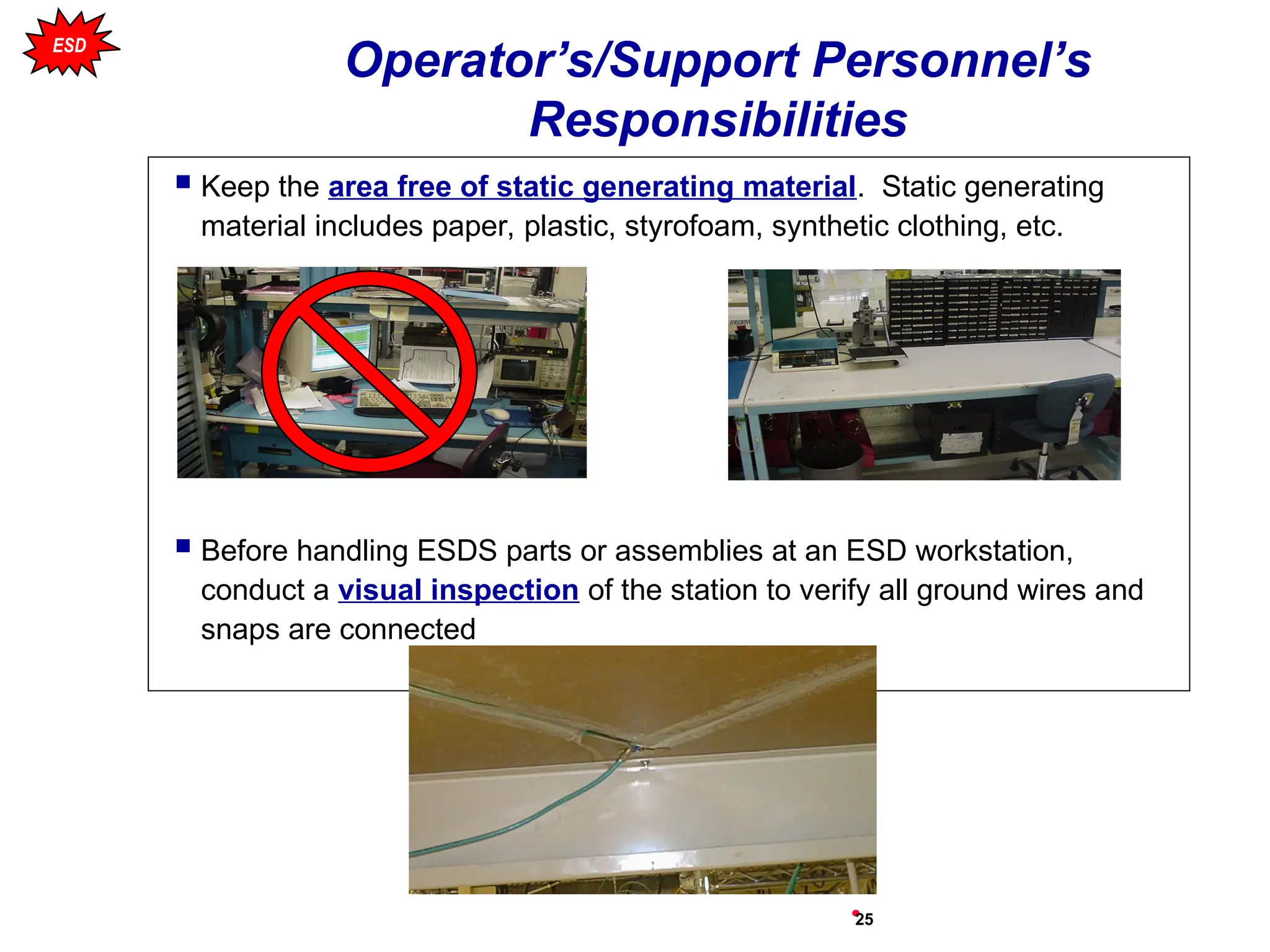
 Keep the area free of static generating material. Static generating
material includes paper, plastic, styrofoam, synthetic clothing, etc.
 Before handling ESDS parts or assemblies at an ESD workstation,
conduct a visual inspection of the station to verify all ground wires and
snaps are connected
Operator’s/Support Personnel’s
Responsibilities
ESD
26
Visitor’s/Sponsor’s Responsibilities
 The Sponsor ensures that visitors are provided with all required
ESD protective equipment when accessing ESD control areas
 The Sponsor ensures that the ESD protective equipment is worn
properly and tested
 The Sponsor ensures that visitors comply with current ESD
practices and procedures when in an ESD-sensitive area
 At the conclusion of the visit, the sponsor collects the reusable
ESD protective equipment that was issued
ESD
27
BREAK
ESD
28
Practical Training – Part 1
Hands-on Demonstration
 Put on Heel Straps
 Put on Wrist Strap
 Test Heel and Wrist Straps
 Completing Heel/Wrist Strap Tester log
ESD
29
Hands-on Demonstration
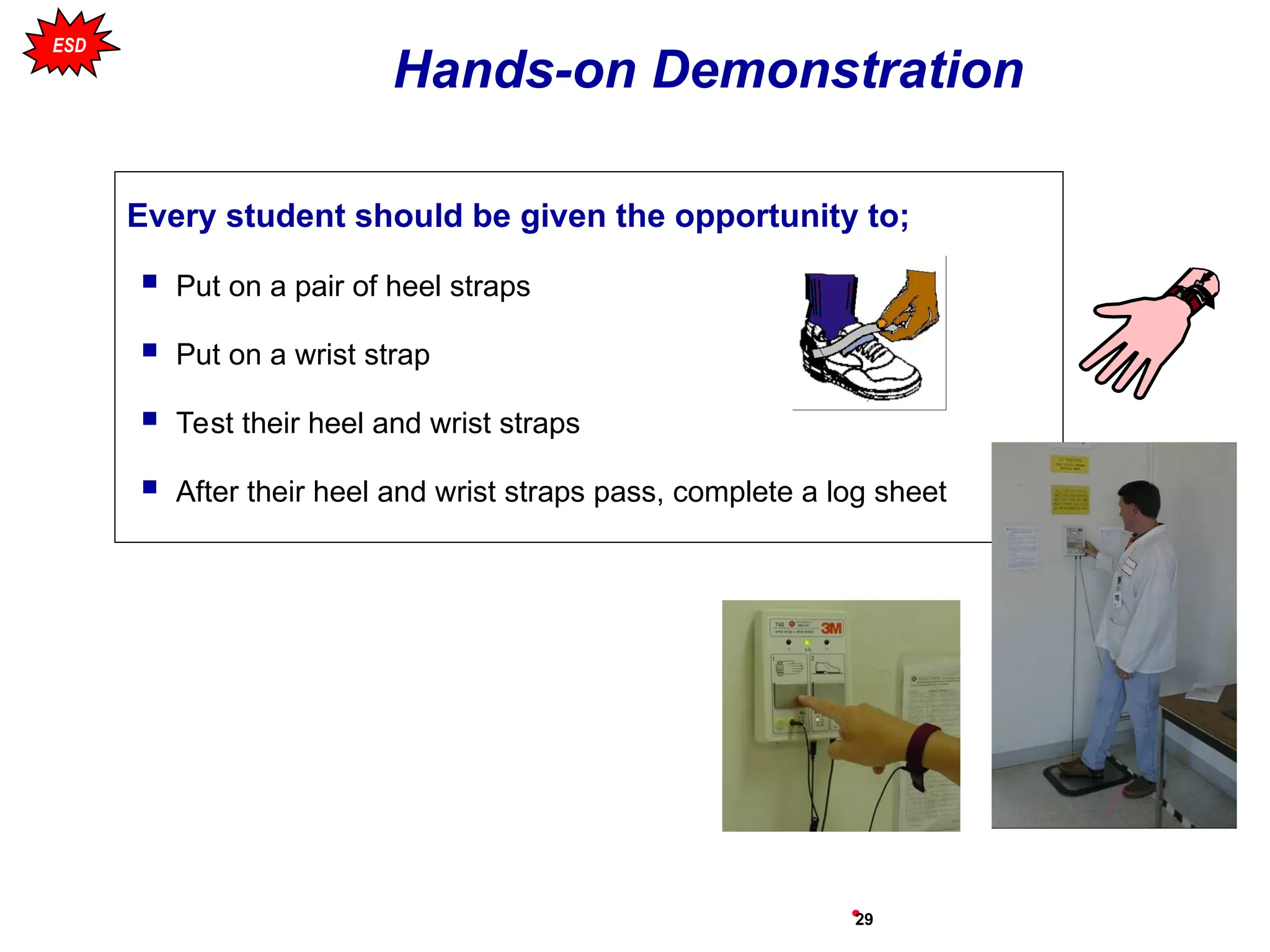
Every student should be given the opportunity to;
 Put on a pair of heel straps
 Put on a wrist strap
 Test their heel and wrist straps
 After their heel and wrist straps pass, complete a log sheet
ESD
30
Put on Heel Straps
(1)Place the heel strap on
the shoe so that the inside
lining is making contact
with the shoe.
(3)Fasten Velcro straps together,
securing heel strap firmly on shoe.
(2)Insert the contact strip inside
the shoe and under the foot.
Make sure that solid contact is
made between the stocking foot
and contact strip.
ESD
31
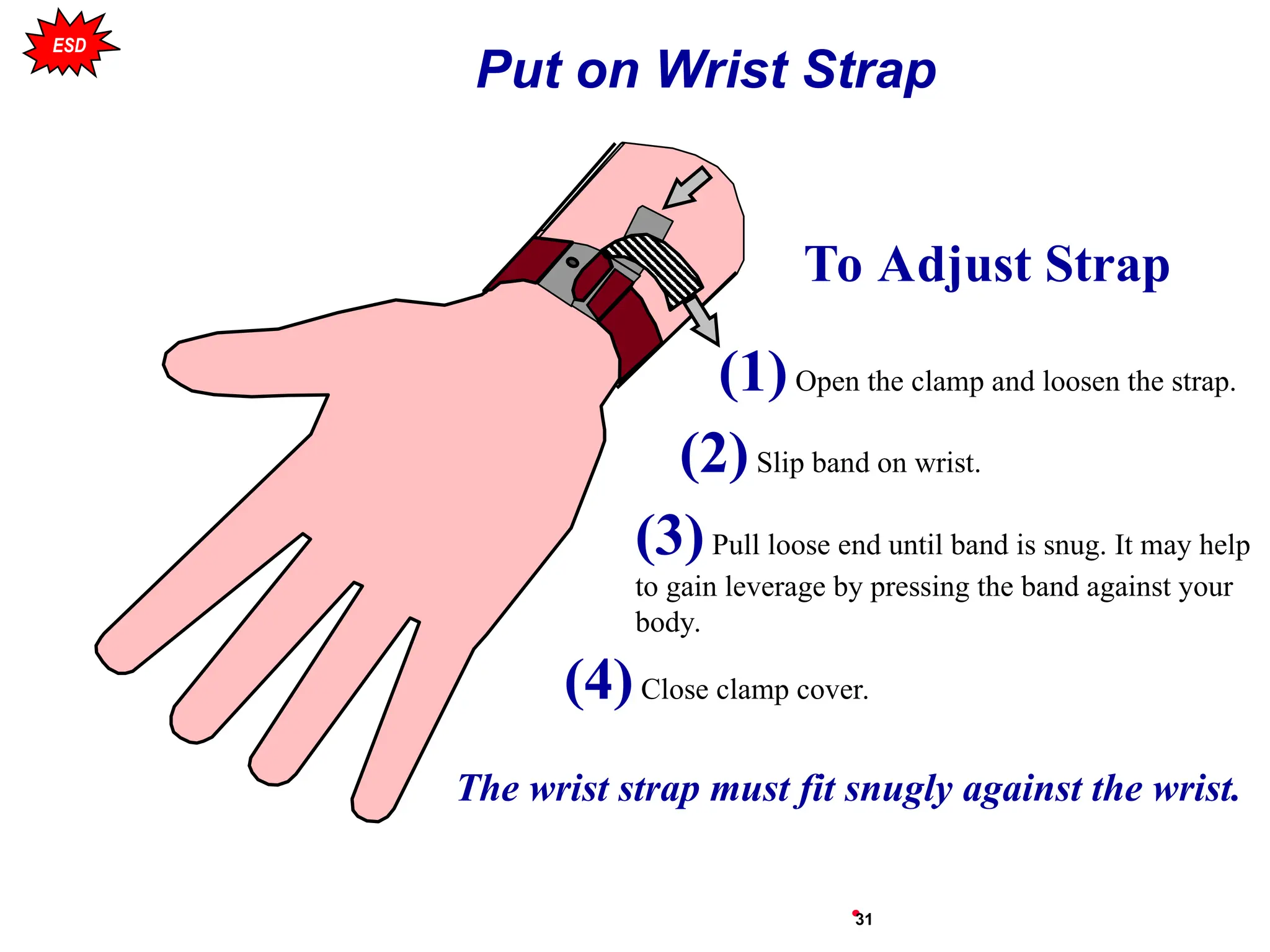
Put on Wrist Strap
(1)Open the clamp and loosen the strap.
To Adjust Strap
(2)Slip band on wrist.
(3)Pull loose end until band is snug. It may help
to gain leverage by pressing the band against your
body.
(4)Close clamp cover.
The wrist strap must fit snugly against the wrist.
ESD
32
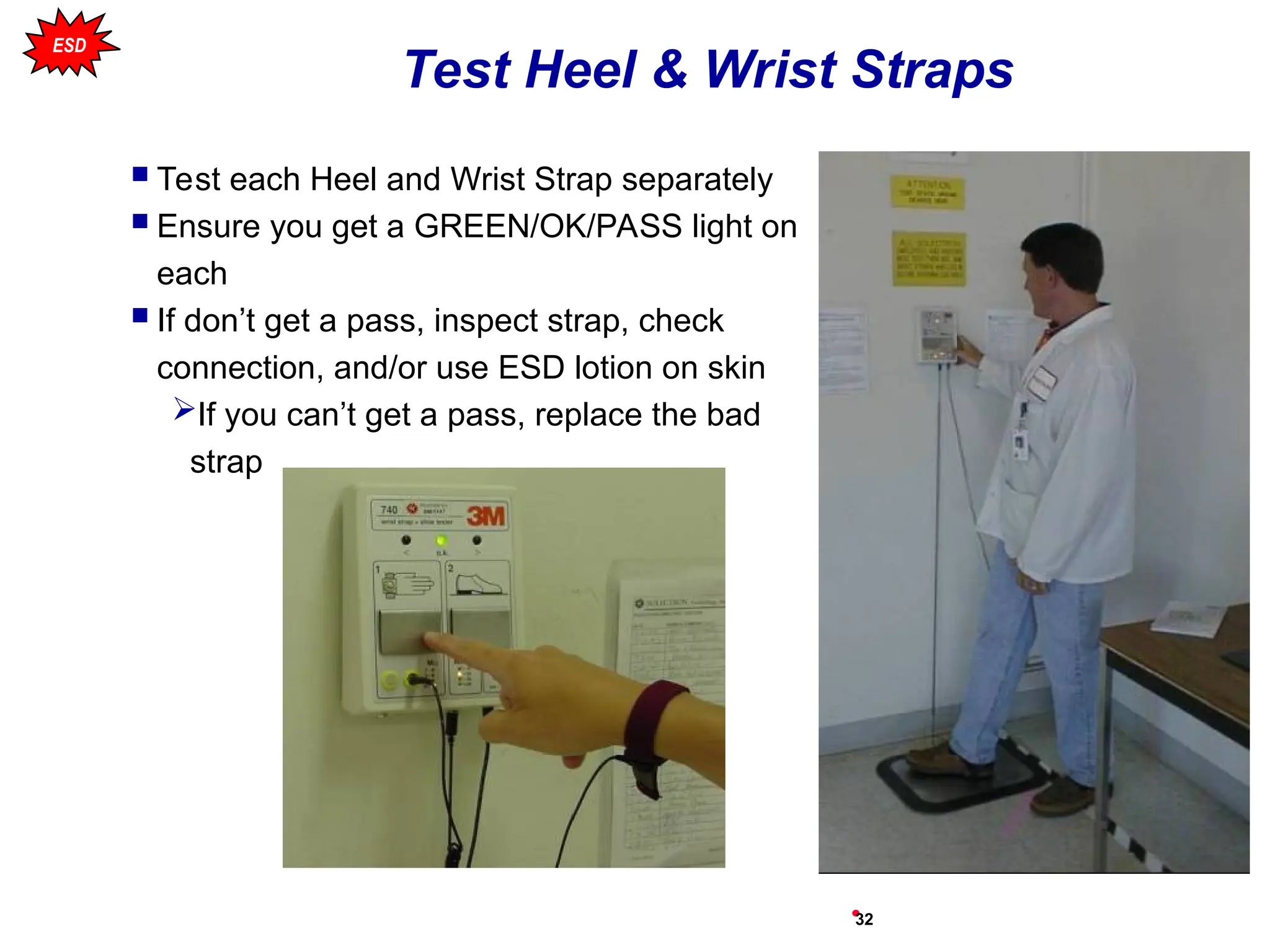
Test Heel & Wrist Straps
 Test each Heel and Wrist Strap separately
 Ensure you get a GREEN/OK/PASS light on
each
 If don’t get a pass, inspect strap, check
connection, and/or use ESD lotion on skin
If you can’t get a pass, replace the bad
strap
ESD
33
Complete the log sheet
 Must be tested and logged daily
 Mark day(s) not worked, don’t leave blank
 Example: Use ‘NW’ for Not Work on
days out, do NOT check it off as pass
ESD
34
Practical Training – Part 2
Perform an Audit
 Each Student is given an abbreviated ESD audit checklist
 Depending on the class size, individually, or in small groups,
take about 10 minutes to audit an ESD Control Area
 When you return to the classroom, each student or group will
share their results with the class.
ESD
35
Questions and Answers
How can ESD negatively affect our business?
What are some of your responsibilities to ensure that we
have good ESD controls?
What questions do you have about ESD or our ESD
program?
ESD
36
Assessment
Please take a few minutes to
answer some questions about
ESD and our ESD program.
ESD
37
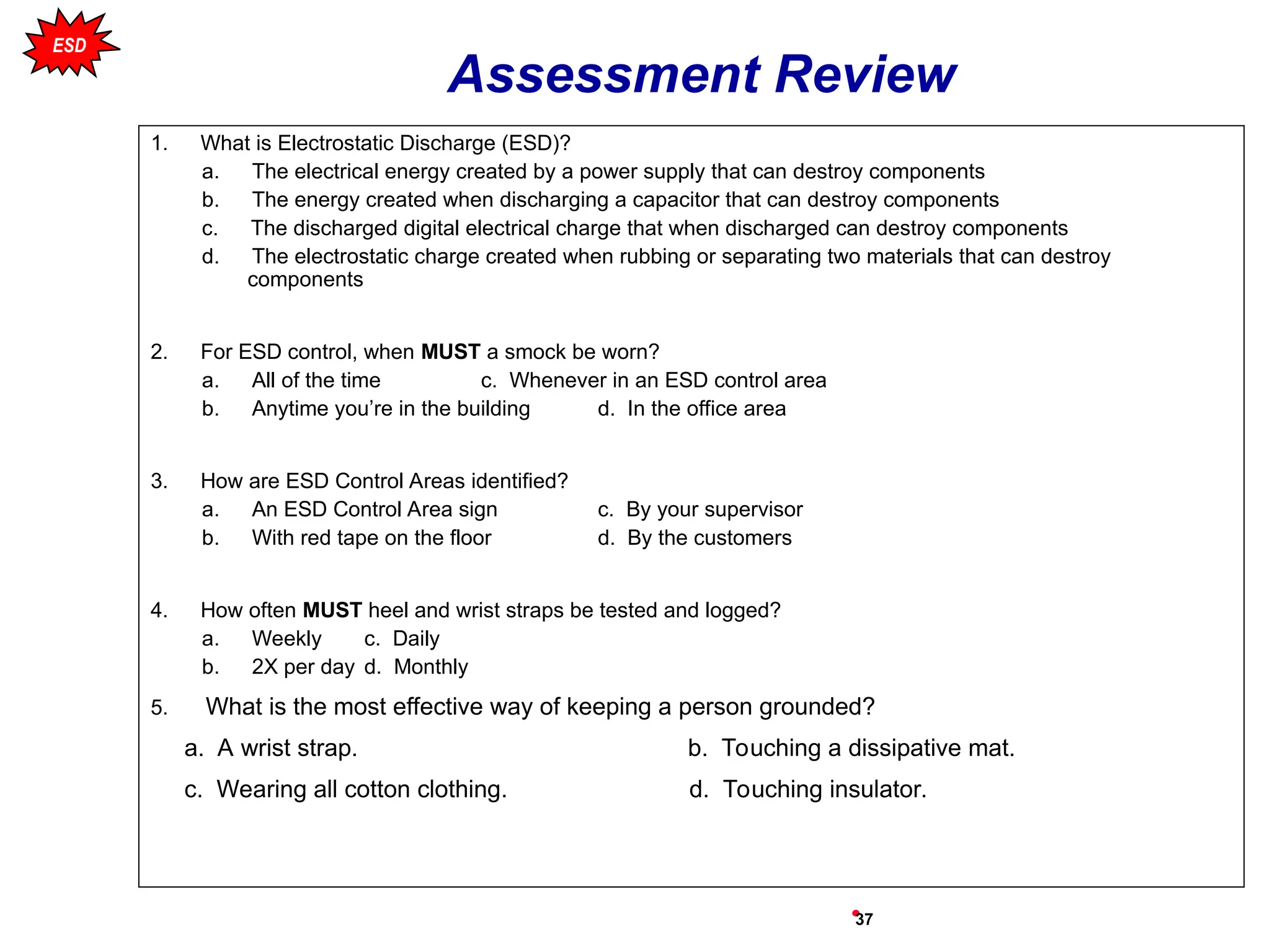
Assessment Review
1. What is Electrostatic Discharge (ESD)?
a. The electrical energy created by a power supply that can destroy components
b. The energy created when discharging a capacitor that can destroy components
c. The discharged digital electrical charge that when discharged can destroy components
d. The electrostatic charge created when rubbing or separating two materials that can destroy
components
2. For ESD control, when MUST a smock be worn?
a. All of the time c. Whenever in an ESD control area
b. Anytime you’re in the building d. In the office area
3. How are ESD Control Areas identified?
a. An ESD Control Area sign c. By your supervisor
b. With red tape on the floor d. By the customers
4. How often MUST heel and wrist straps be tested and logged?
a. Weekly c. Daily
b. 2X per day d. Monthly
5. What is the most effective way of keeping a person grounded?
a. A wrist strap. b. Touching a dissipative mat.
c. Wearing all cotton clothing. d. Touching insulator.
ESD
38
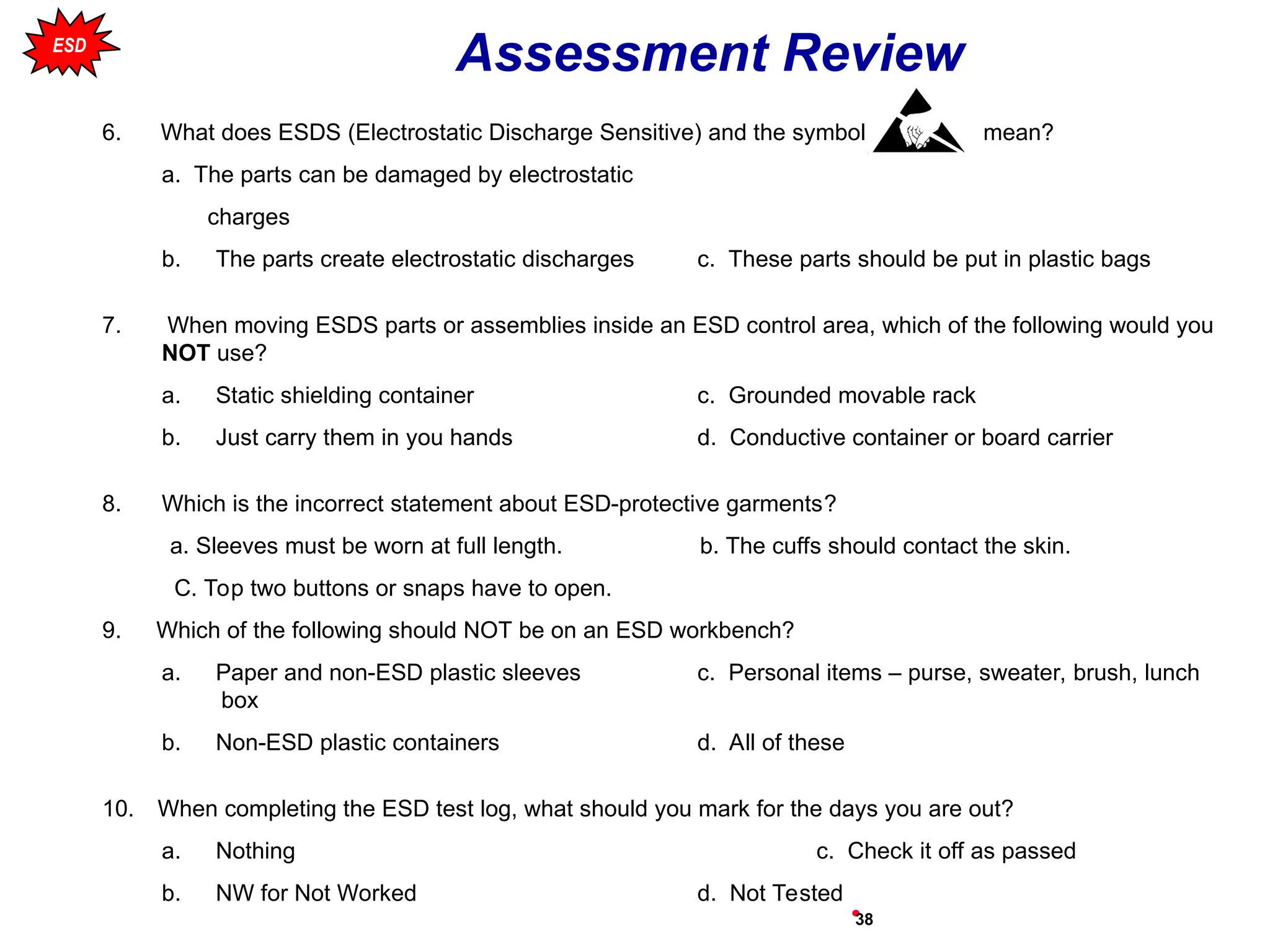
6. What does ESDS (Electrostatic Discharge Sensitive) and the symbol mean?
a. The parts can be damaged by electrostatic
charges
b. The parts create electrostatic discharges c. These parts should be put in plastic bags
7. When moving ESDS parts or assemblies inside an ESD control area, which of the following would you
NOT use?
a. Static shielding container c. Grounded movable rack
b. Just carry them in you hands d. Conductive container or board carrier
8. Which is the incorrect statement about ESD-protective garments?
a. Sleeves must be worn at full length. b. The cuffs should contact the skin.
C. Top two buttons or snaps have to open.
9. Which of the following should NOT be on an ESD workbench?
a. Paper and non-ESD plastic sleeves c. Personal items – purse, sweater, brush, lunch
box
b. Non-ESD plastic containers d. All of these
10. When completing the ESD test log, what should you mark for the days you are out?
a. Nothing c. Check it off as passed
b. NW for Not Worked d. Not Tested
Assessment Review
ESD
39
Assessment Review
BONUS QUESTION
Which of the following should you do to help the ESD controls at our site?
a. Test and log your heel and wrist strap daily
b. Check your work bench for proper grounding when beginning work
c. Always look for ESD violations, everyone be an auditor
d. Move ESDS components and assemblies in the proper containers
e. All of the above
ESD
40
 ESD Roles and Responsibilities
 ESD Control Program Plan
 ESD Audit Plan
 ESD Training Requirements
 ESD Record Retention
ESD for Management
ESD
41
Site ESD Coordinator’s Responsibilities
 Responsible for ESD problem resolution, ESD compliance audits
and consultancy
 Recommended quarterly audits or ensures that the ESD system is
included as part of the ISO/QS audits
 Log audit results and any resulting corrective action
 Train and verify competency of those who deliver ESD training.
 Maintain a list of Area ESD Representatives
ESD
42
Supervisor’s Responsibilities
Ensure that Operators are issued the required ESD
protective equipment
Replace worn or damaged equipment promptly
Verify that Operators are performing the daily checks
and follow all ESD practices specified
Establish and maintain the ESD log book and approve
the weekly log sheets
Perform Area ESD audits
Repeat offenders of the ESD control system should be
subject to disciplinary action
ESD
43
Management’s Responsibilities
Appoint an ESD Coordinator who is competent in ESD
theory and practice
Implement a DISCIPLINED ESD program
Read and understand CORQA-10-021954 and the site’s ESD
procedure
Walk-the-talk
Follow ALL ESD rules when in ESD Control Areas
Set the expectation for all of your employees
Zero tolerance for ESD violations
ESD
44
Management’s Responsibilities
Ensure ESD Audit schedules and Training requirements are
followed
Review ESD audit results on a monthly and quarterly basis
Ensure effective corrective actions are being taken
Take ESD VERY SERIOUS, our customers do!
It affects our Customer Satisfaction Index (CSI)
It affects the profitability of our business in hidden ways
ESD
45
ESD Control Program Plan
Any area where unprotected ESD sensitive parts and
assemblies may be handled shall be designated an ESD
Control Area, and must meet the following requirements;
The area is free from non-essential static generators, and the risk
from process-essential static generators is minimized
There is a system in place to ensure that all personnel may be
effectively grounded, & there is a tester nearby to verify that the
grounding equipment is working properly
Everyone (including visitors) inside the area wears a smock
All movable carts, racks, etc. are grounded
The area is labeled as an ESD control area, and the boundaries are
clearly marked
ESD
46
ESD Control Program Plan (continued)
Shelves are grounded
A static dissipative floor is present if heel straps, conductive shoes,
or carts are grounded to the floor
The area is subjected to monthly audits against the ESD procedure
All work surfaces are grounded and static dissipative, and their
grounding is verified monthly
Food, beverages and lunch boxes – examples of all ESD
generating material – are not allowed in ESD control areas
When possible, relative humidity shall be maintained to a minimum
of 40% and temperature between 18ºC and 27ºC, for ESD control
areas
ESD
47
Content
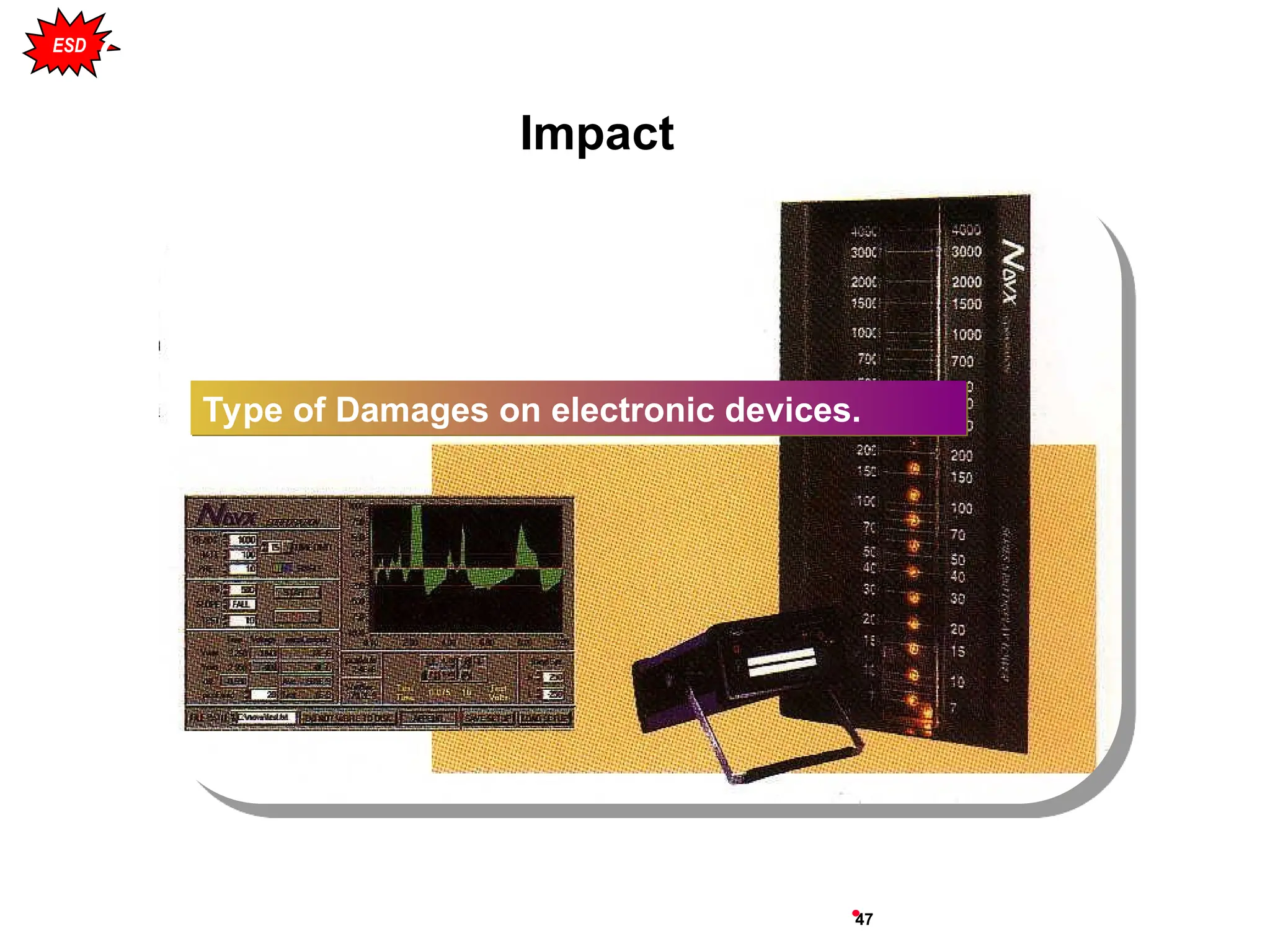
Impact
Type of Damages on electronic devices.
ESD
48
ESD - Cause on Electronics Damages
Latent Defect
 Failure normally couldn’t be detected at assembly
process
 But the quality of the device may be partially degraded
 The life span of the component is reduce dramatically
 Example : VCR stop recording after a minute.
Catastrophic Failures
 Failure could be detected at manufacturing
process
 Component of such are badly destroy and have
caused a metal melt,junction breakdown or oxide
failure
 Example : VCR can’t perform recording.
ESD - Cause on Electronics Damages
ESD
49
Content
Preventing and controlling
Basic prevent techniques
Grounding
Ionizer
Shielding
Packaging
Smock
Humidity
ESD
50
Prevention & Controlling
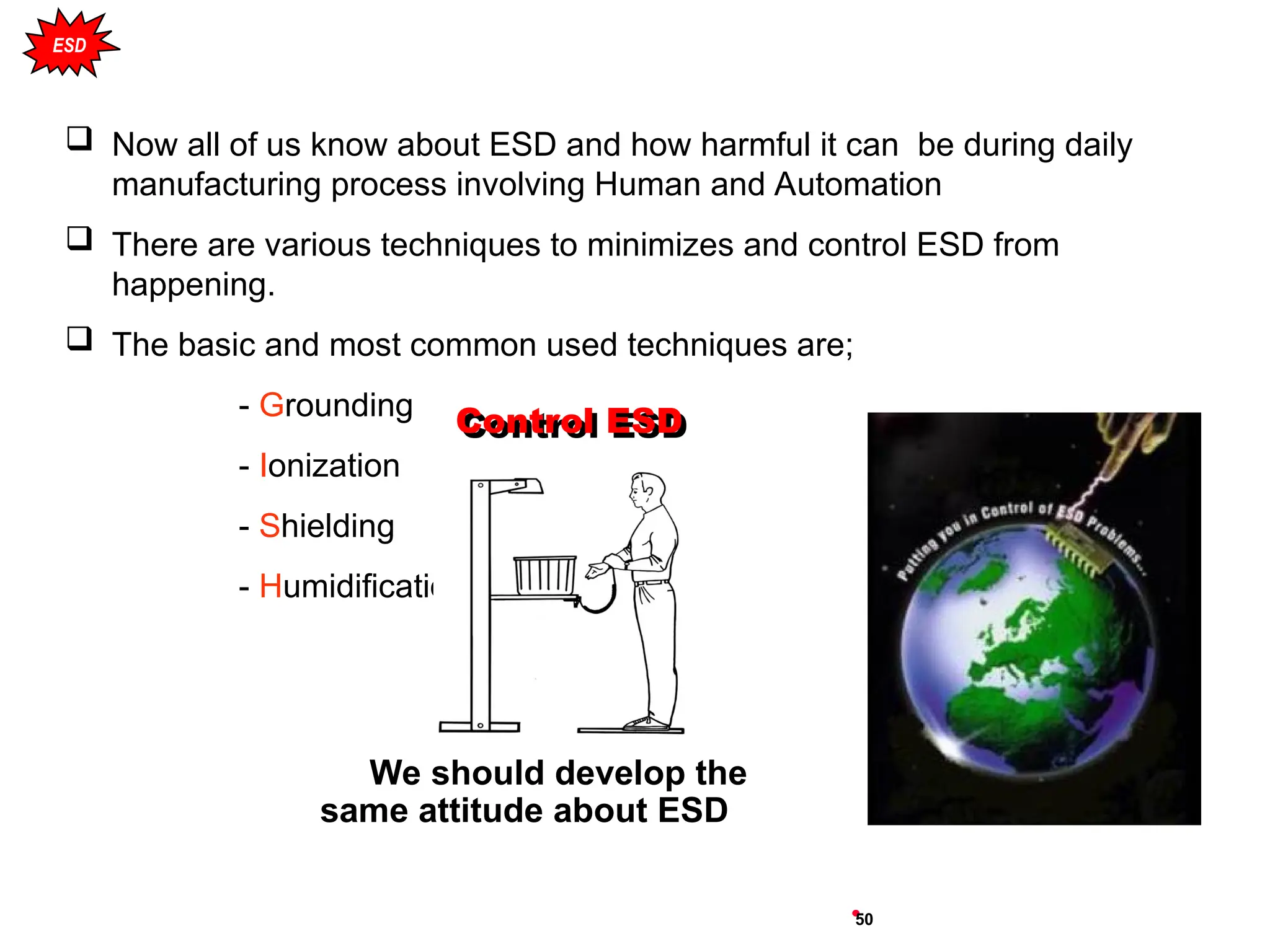
 Now all of us know about ESD and how harmful it can be during daily
manufacturing process involving Human and Automation
 There are various techniques to minimizes and control ESD from
happening.
 The basic and most common used techniques are;
- Grounding
- Ionization
- Shielding
- Humidification
We should develop the
same attitude about ESD
Control ESD
ESD
51
Prevention & Controlling
Grounding
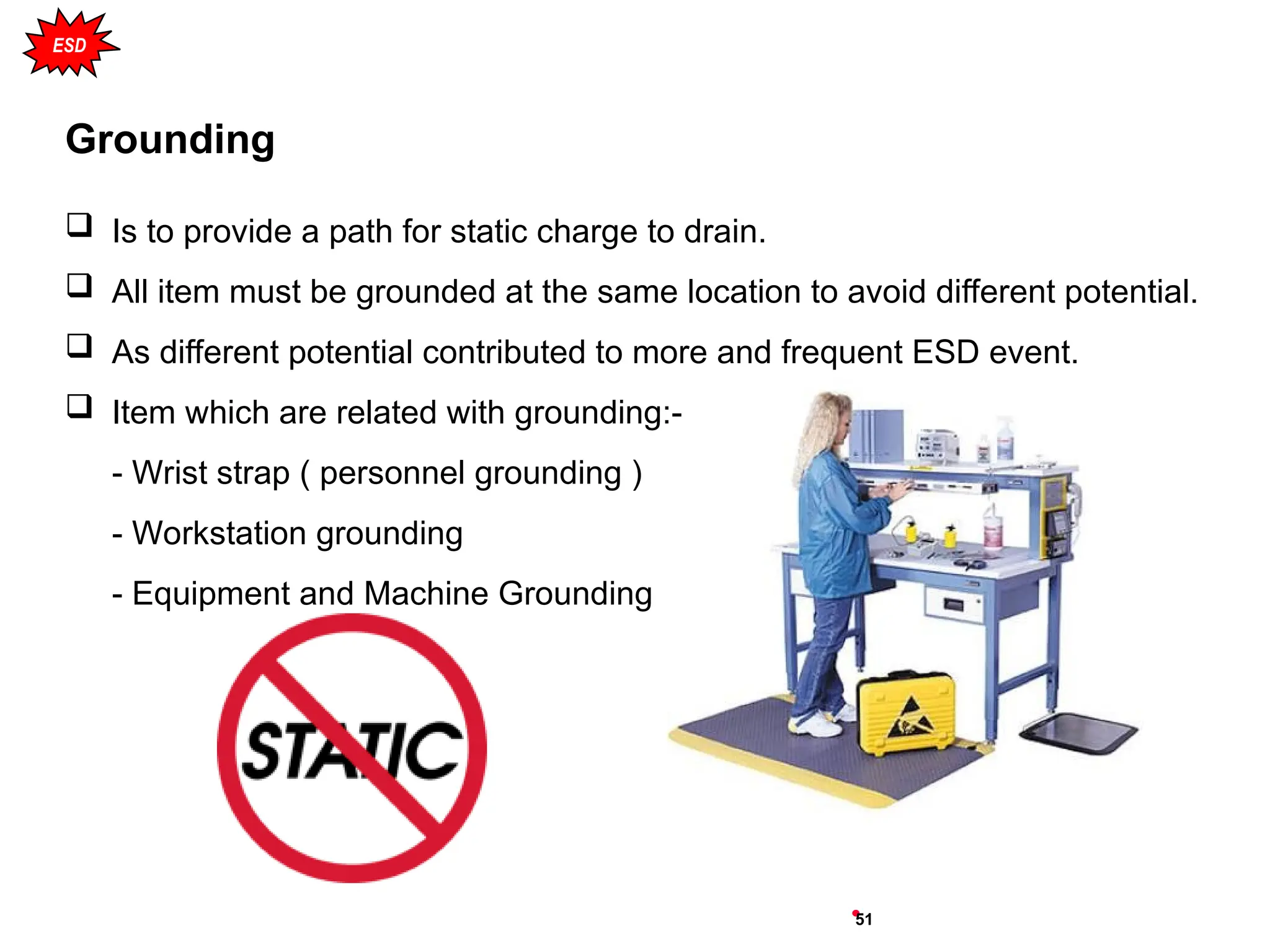
 Is to provide a path for static charge to drain.
 All item must be grounded at the same location to avoid different potential.
 As different potential contributed to more and frequent ESD event.
 Item which are related with grounding:-
- Wrist strap ( personnel grounding )
- Workstation grounding
- Equipment and Machine Grounding
ESD
52
Prevention & Controlling
Wrist strap / Heel strap
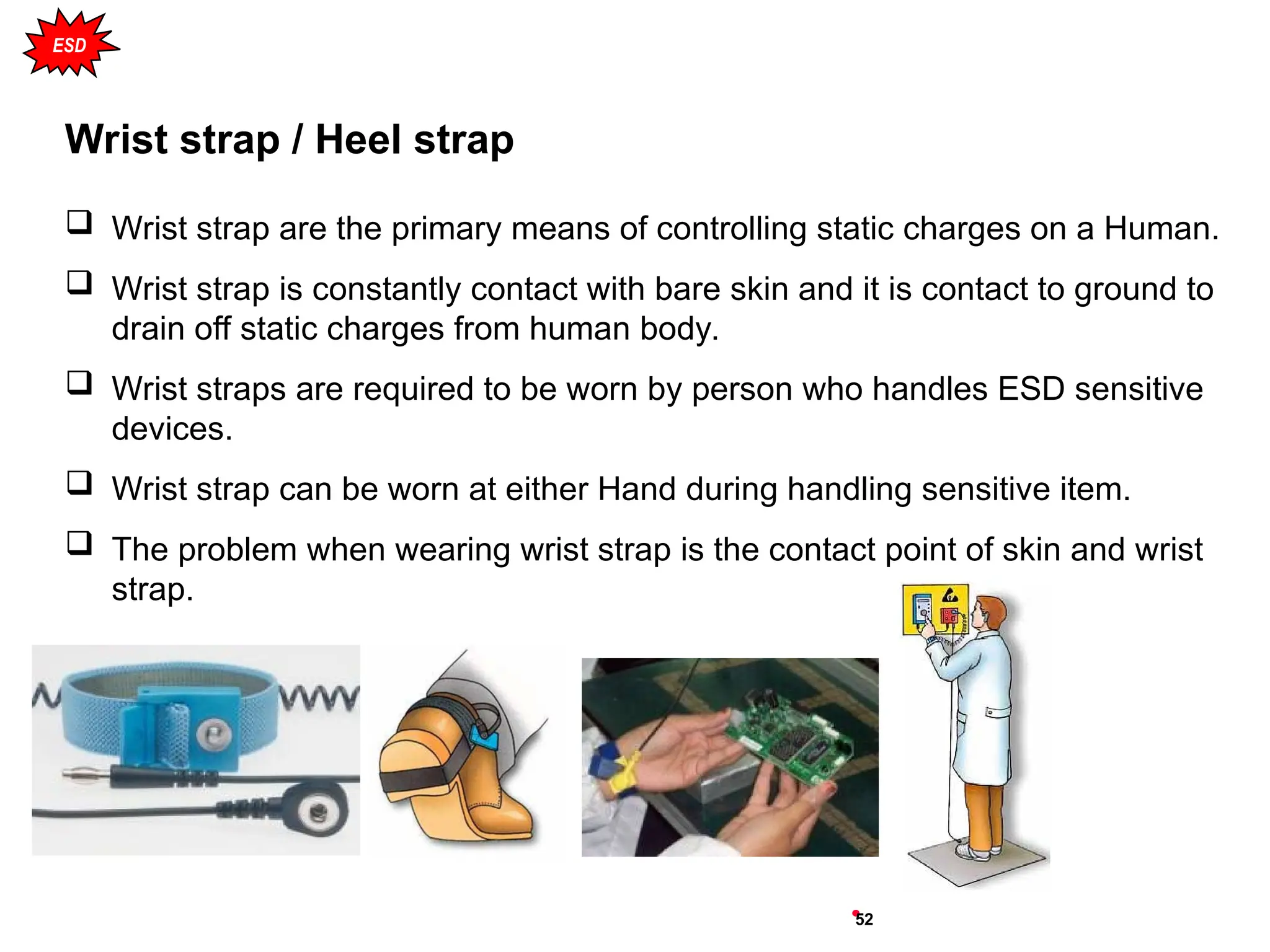
 Wrist strap are the primary means of controlling static charges on a Human.
 Wrist strap is constantly contact with bare skin and it is contact to ground to
drain off static charges from human body.
 Wrist straps are required to be worn by person who handles ESD sensitive
devices.
 Wrist strap can be worn at either Hand during handling sensitive item.
 The problem when wearing wrist strap is the contact point of skin and wrist
strap.
ESD
53
Prevention & Controlling
Workstation grounding
 Work surface where Electrostatic sensitive device is being handled must be
properly grounded to the common grounding point.
 Each work station must have a separate grounding point. [ connecting one
work surface ground to another is not recommended ]
 The use of a 1M ohm resister in series during grounding is recommended
due to safety reason . [ Some standard do not require this ]
Static dissipative
tabletop
Grounding
Point
Resistance
1 Mohm
Wrist strap
grounding point
ESD
54
Prevention & Controlling
Equipment and Machine Grounding
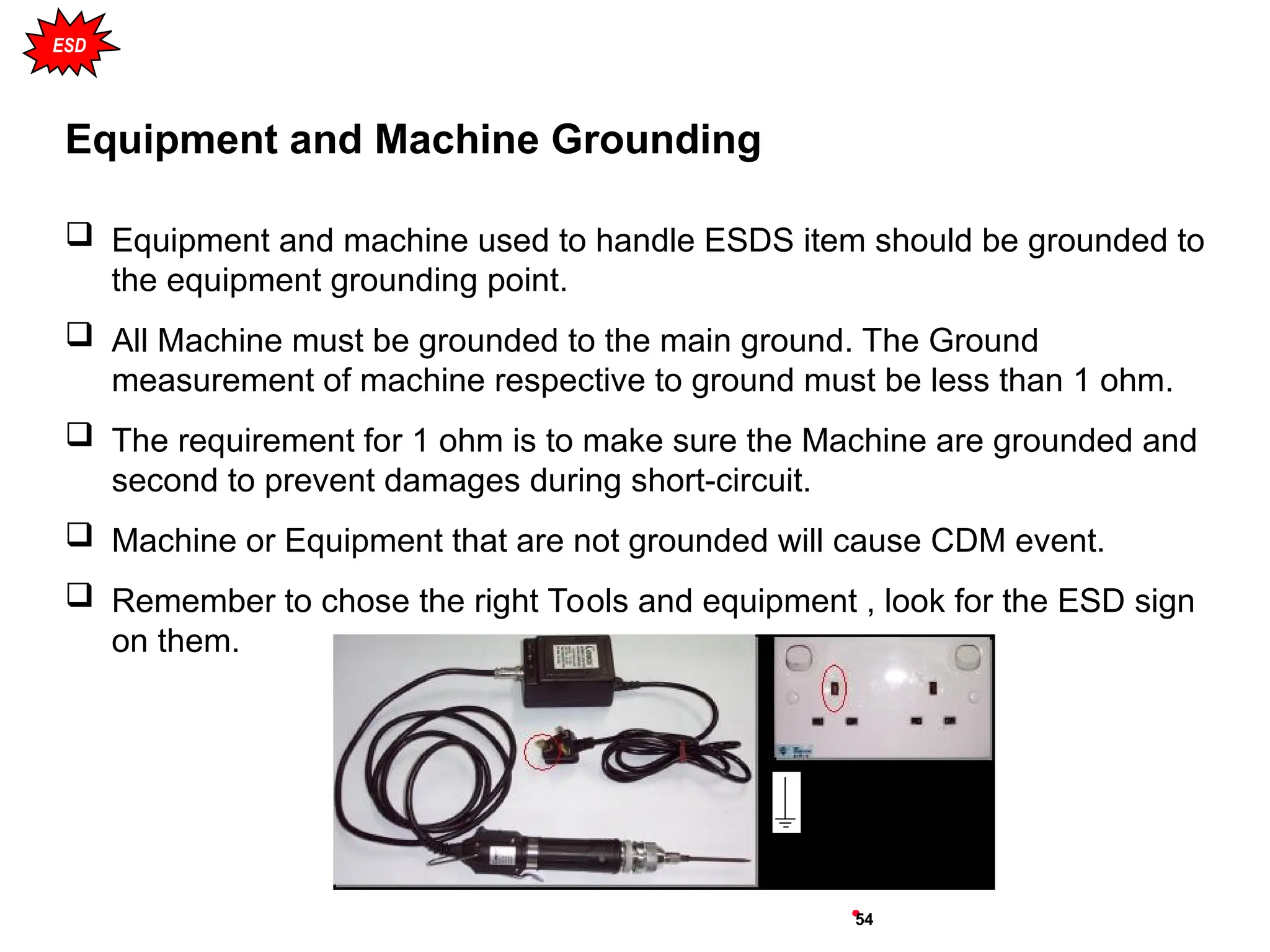
 Equipment and machine used to handle ESDS item should be grounded to
the equipment grounding point.
 All Machine must be grounded to the main ground. The Ground
measurement of machine respective to ground must be less than 1 ohm.
 The requirement for 1 ohm is to make sure the Machine are grounded and
second to prevent damages during short-circuit.
 Machine or Equipment that are not grounded will cause CDM event.
 Remember to chose the right Tools and equipment , look for the ESD sign
on them.
ESD
55
Prevention & Controlling
Ionization
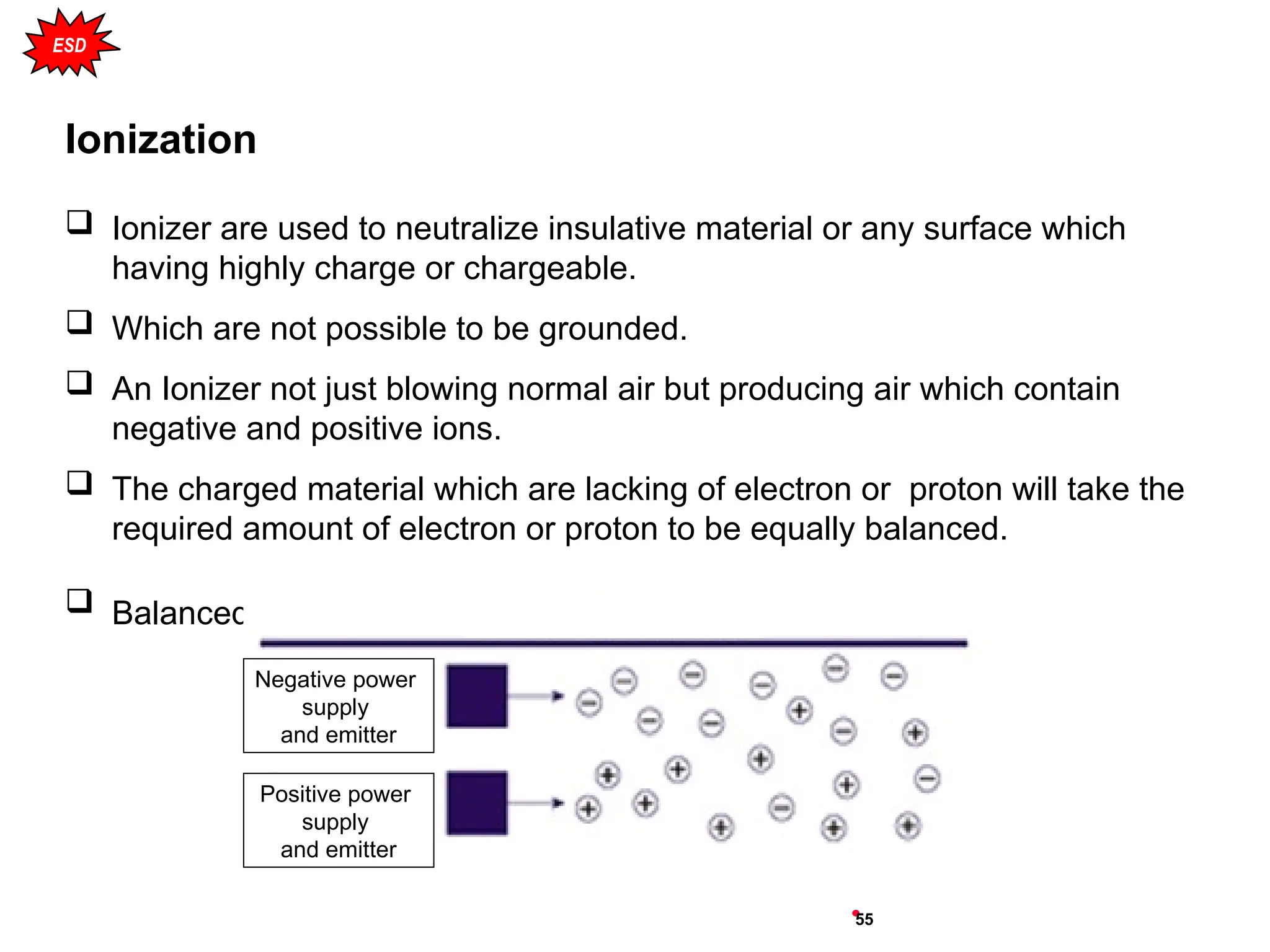
 Ionizer are used to neutralize insulative material or any surface which
having highly charge or chargeable.
 Which are not possible to be grounded.
 An Ionizer not just blowing normal air but producing air which contain
negative and positive ions.
 The charged material which are lacking of electron or proton will take the
required amount of electron or proton to be equally balanced.
 Balanced body will be neutralized as zero potential.
Negative power
supply
and emitter
Positive power
supply
and emitter
ESD
56
Prevention & Controlling
Shielding
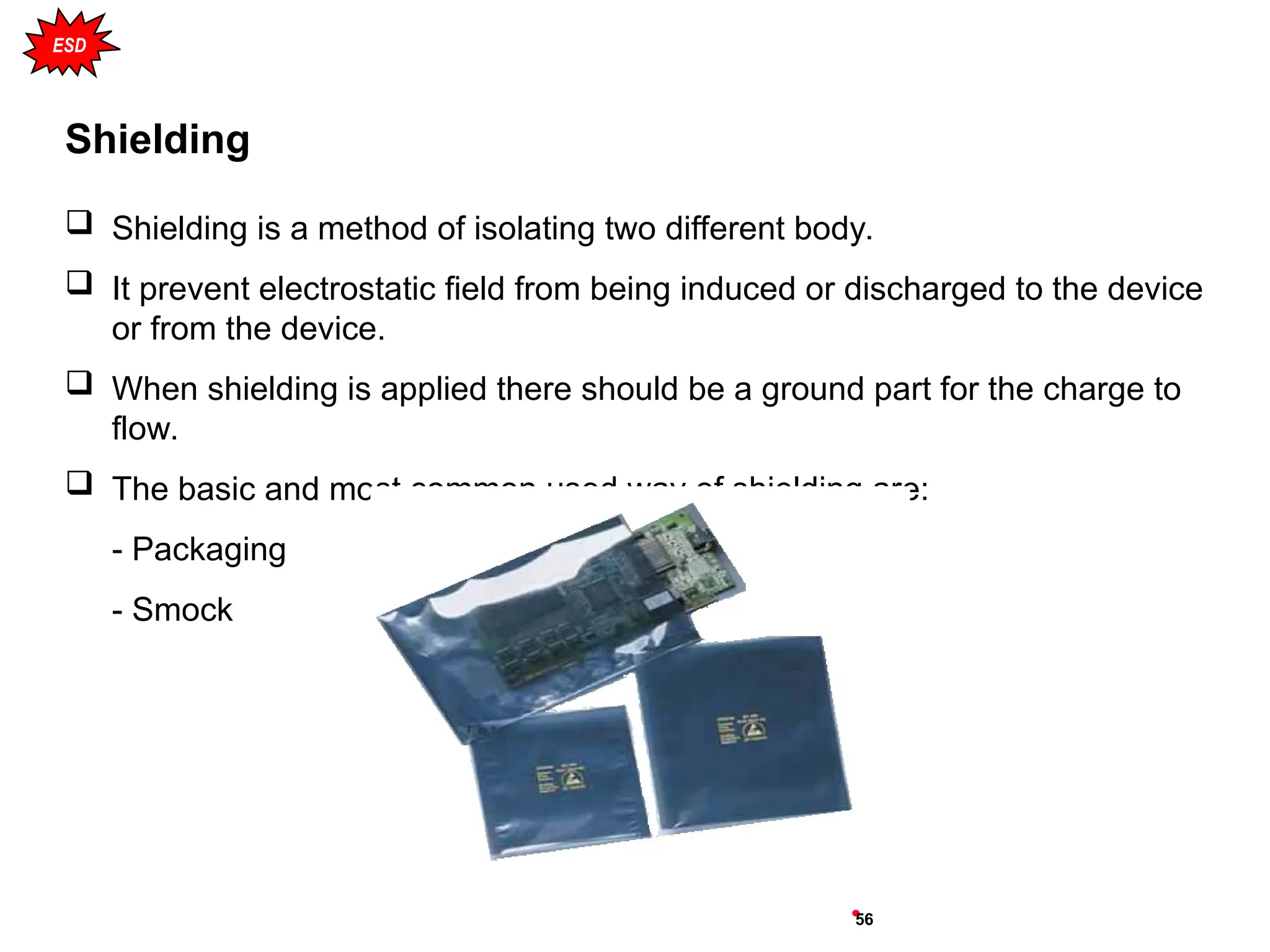
 Shielding is a method of isolating two different body.
 It prevent electrostatic field from being induced or discharged to the device
or from the device.
 When shielding is applied there should be a ground part for the charge to
flow.
 The basic and most common used way of shielding are:
- Packaging
- Smock
ESD
57
Prevention & Controlling
Packaging
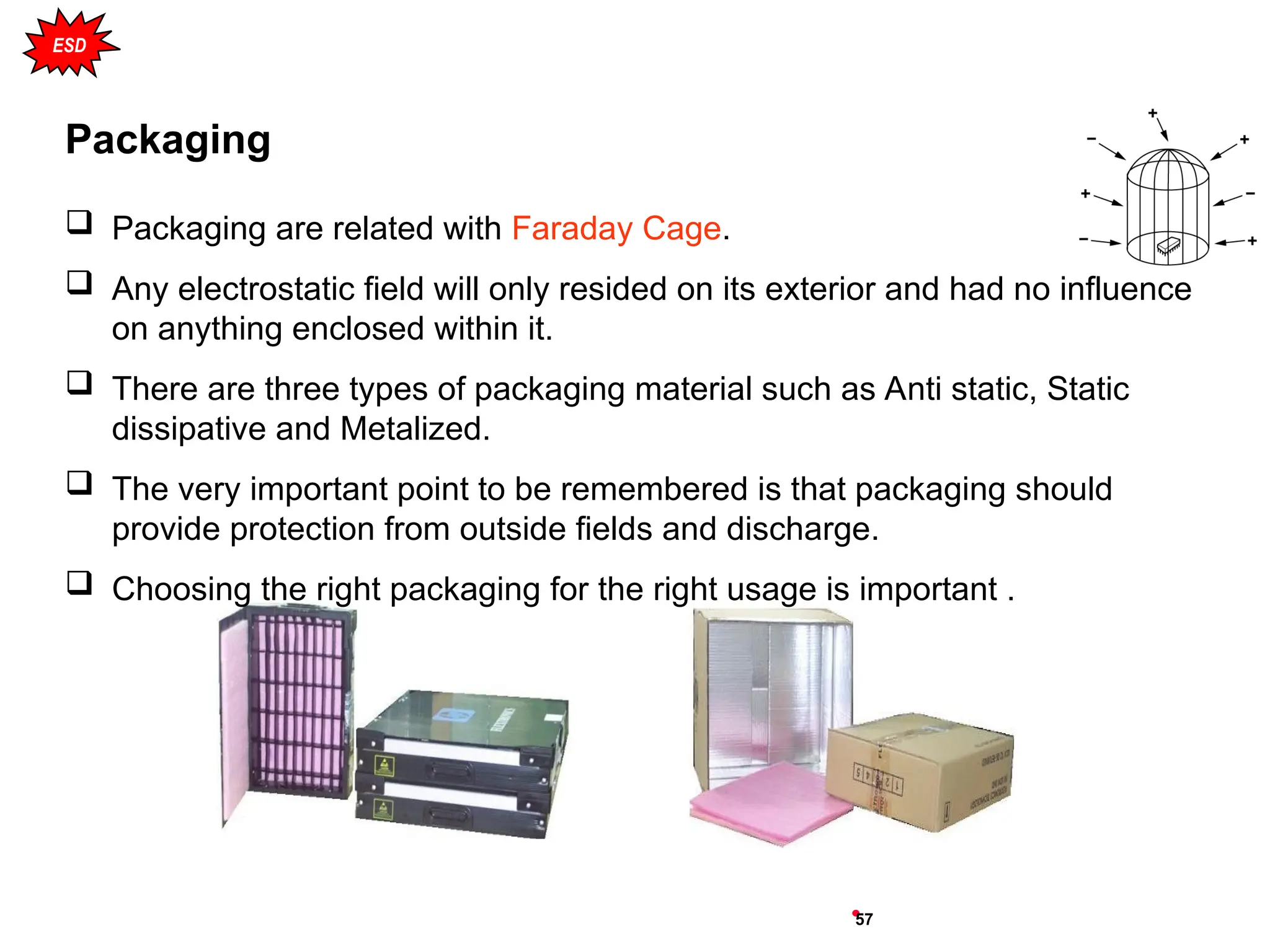
 Packaging are related with Faraday Cage.
 Any electrostatic field will only resided on its exterior and had no influence
on anything enclosed within it.
 There are three types of packaging material such as Anti static, Static
dissipative and Metalized.
 The very important point to be remembered is that packaging should
provide protection from outside fields and discharge.
 Choosing the right packaging for the right usage is important .
ESD
58
Prevention & Controlling
Smock
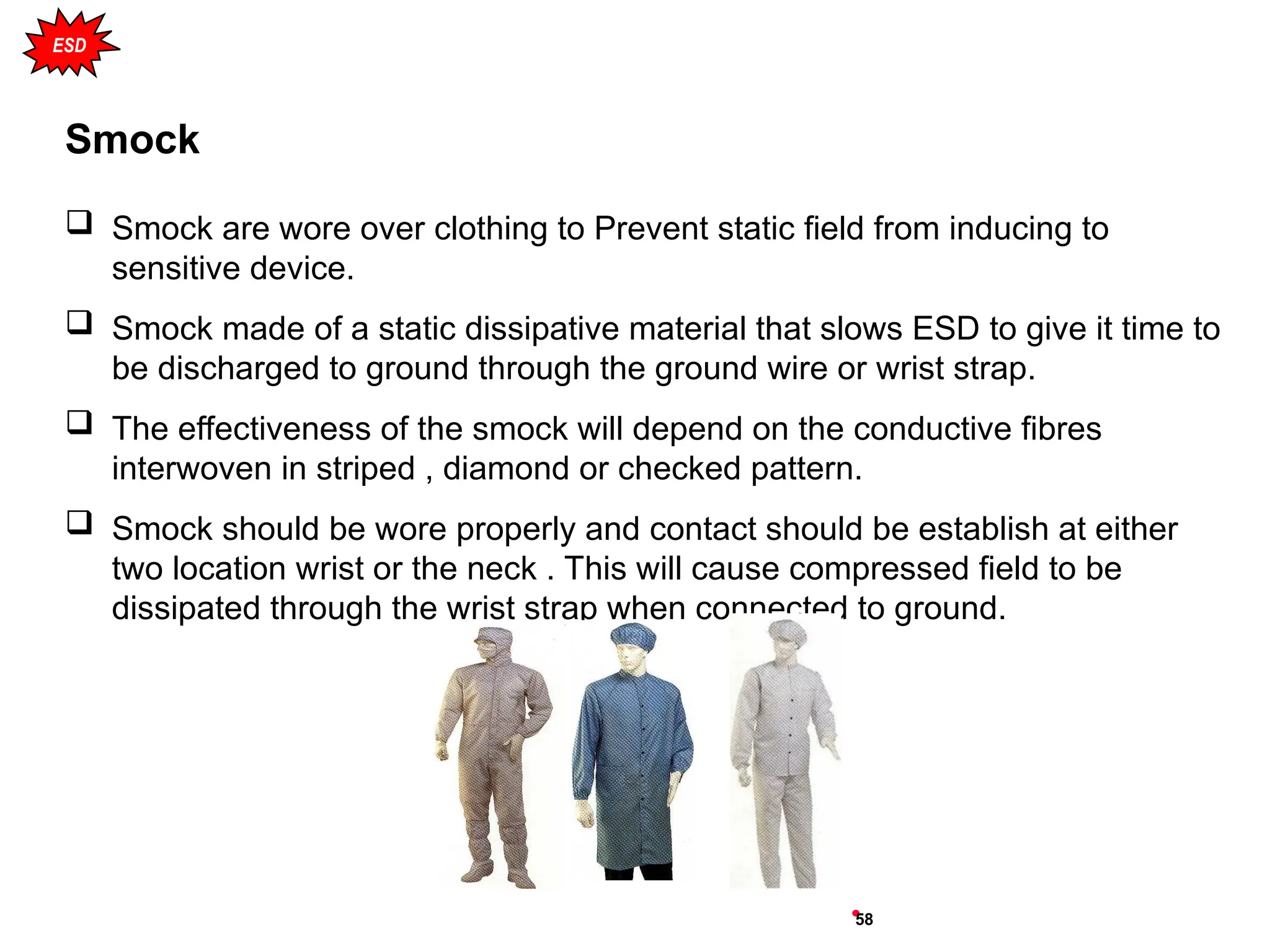
 Smock are wore over clothing to Prevent static field from inducing to
sensitive device.
 Smock made of a static dissipative material that slows ESD to give it time to
be discharged to ground through the ground wire or wrist strap.
 The effectiveness of the smock will depend on the conductive fibres
interwoven in striped , diamond or checked pattern.
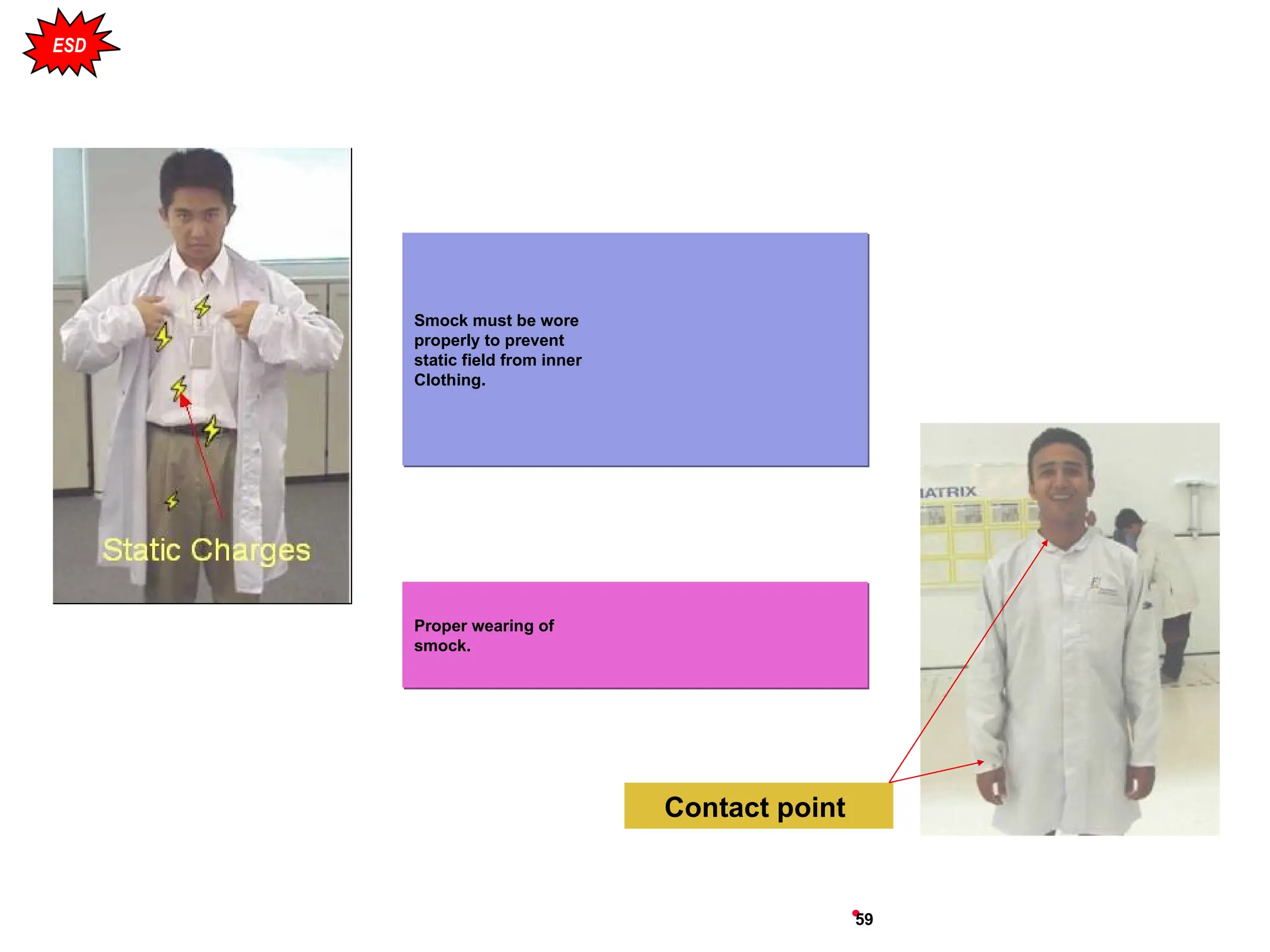
 Smock should be wore properly and contact should be establish at either
two location wrist or the neck . This will cause compressed field to be
dissipated through the wrist strap when connected to ground.
ESD
59
Prevention & Controlling
Smock must be wore
properly to prevent
static field from inner
Clothing.
Proper wearing of
smock.
Contact point
ESD
60
Prevention & Controlling
Humidity
 Humidity contains water vapor in the air which reduce the charge
generation.
 As the presence of moisture in the air is increased, electrons are better able
to discharge safely into the air instead of another object.
 It also makes some surface to be become conductive due to moisture
observation [exp : cold countries have higher concern on paper charging
compare to Hot countries]
 As humidity goes higher lower the charge and as lower the humidity higher
the charge .
 The recommended humidity range by ANSI is 40% to 60% RH .
ESD
61
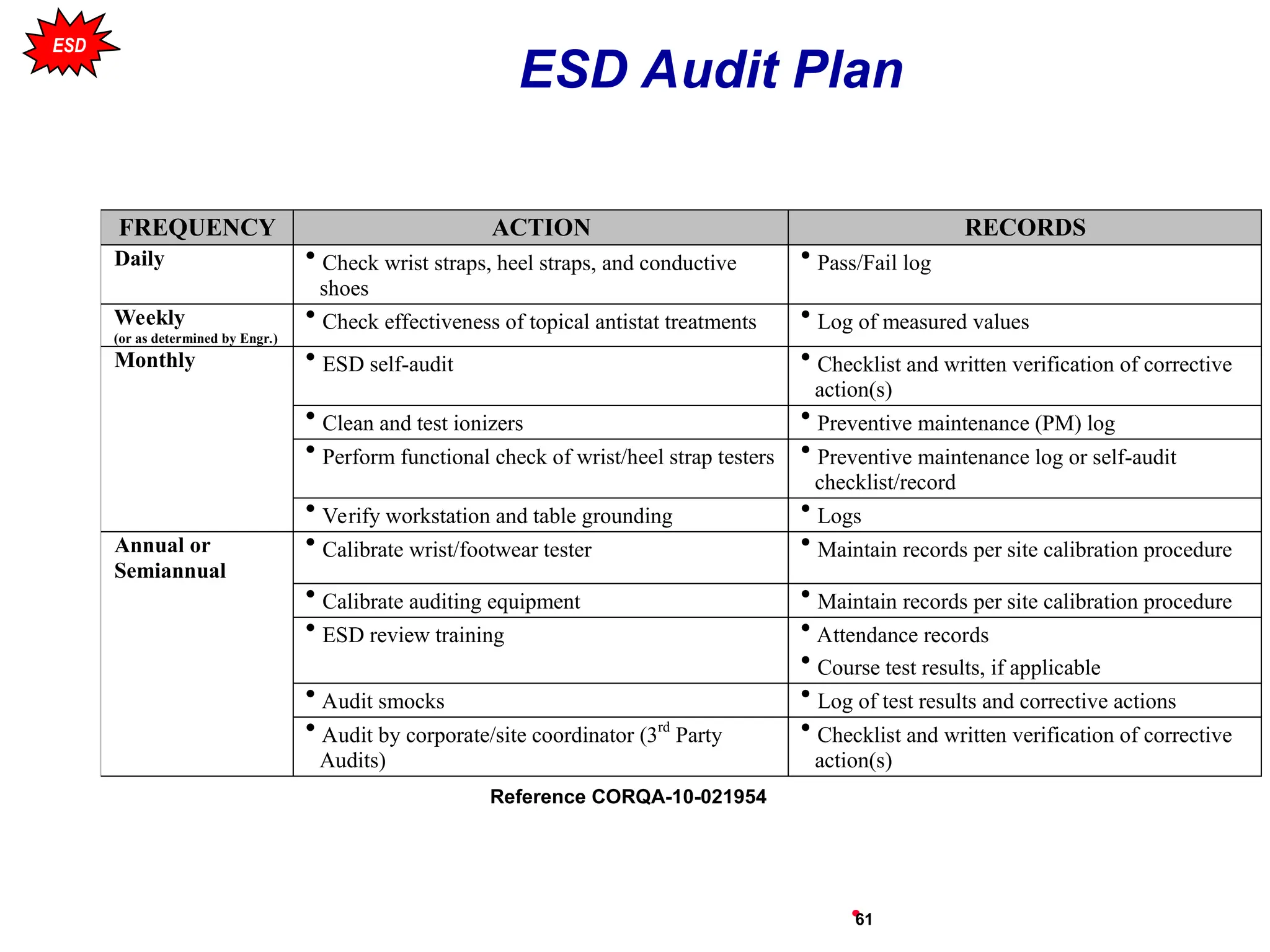
ESD Audit Plan
FREQUENCY ACTION RECORDS
Daily  Check wrist straps, heel straps, and conductive
shoes
 Pass/Fail log
Weekly
(or as determined by Engr.)
 Check effectiveness of topical antistat treatments  Log of measured values
Monthly  ESD self-audit  Checklist and written verification of corrective
action(s)
 Clean and test ionizers  Preventive maintenance (PM) log
 Perform functional check of wrist/heel strap testers  Preventive maintenance log or self-audit
checklist/record
 Verify workstation and table grounding  Logs
Annual or
Semiannual
 Calibrate wrist/footwear tester  Maintain records per site calibration procedure
 Calibrate auditing equipment  Maintain records per site calibration procedure
 ESD review training  Attendance records
 Course test results, if applicable
 Audit smocks  Log of test results and corrective actions
 Audit by corporate/site coordinator (3rd
Party
Audits)
 Checklist and written verification of corrective
action(s)
Reference CORQA-10-021954
ESD
62
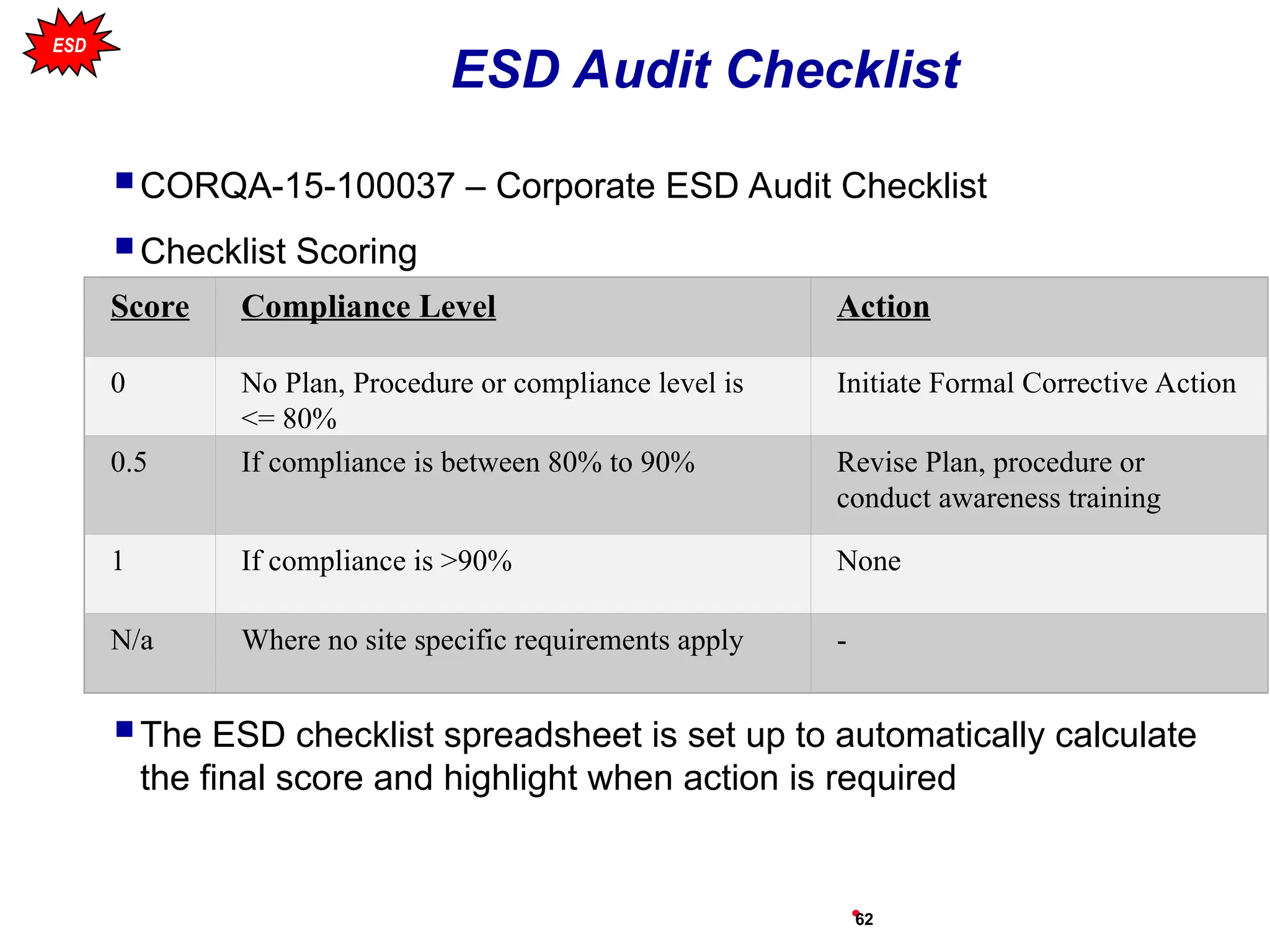
ESD Audit Checklist
 CORQA-15-100037 – Corporate ESD Audit Checklist
 Checklist Scoring
 The ESD checklist spreadsheet is set up to automatically calculate
the final score and highlight when action is required
Score Compliance Level Action
0 No Plan, Procedure or compliance level is
<= 80%
Initiate Formal Corrective Action
0.5 If compliance is between 80% to 90% Revise Plan, procedure or
conduct awareness training
1 If compliance is >90% None
N/a Where no site specific requirements apply -
ESD
63
ESD Training Requirements
In facilities that have an ESD Control Area
All employees are required to complete ESD training BEFORE allowed
access to ESD Control Areas
All Management responsible for an ESD Control area
Must receive the initial training, including the management section
All employees and managers who handle ESDS parts/
assemblies or who work in ESD Control Areas
Yearly ESD refresher training is recommended
If an Audit falls below 80%
Employees in the area with the violations must receive ESD refresher
training
The ESD non-compliances identified should be part of the training
process
ESD
64
ESD Record Retention
 Training Records
 Initial training and, if annual refresher training is required, records must be
retained and readily accessible for audit purposes
 Audit Records
 Must be retained and readily accessible for audit purposes
 All corrective actions must be documented, retained and readily
accessible for audit purposes
ESD
65
Management Assessment
Please take a few minutes to
answer some questions about
ESD and our ESD program.
ESD
66
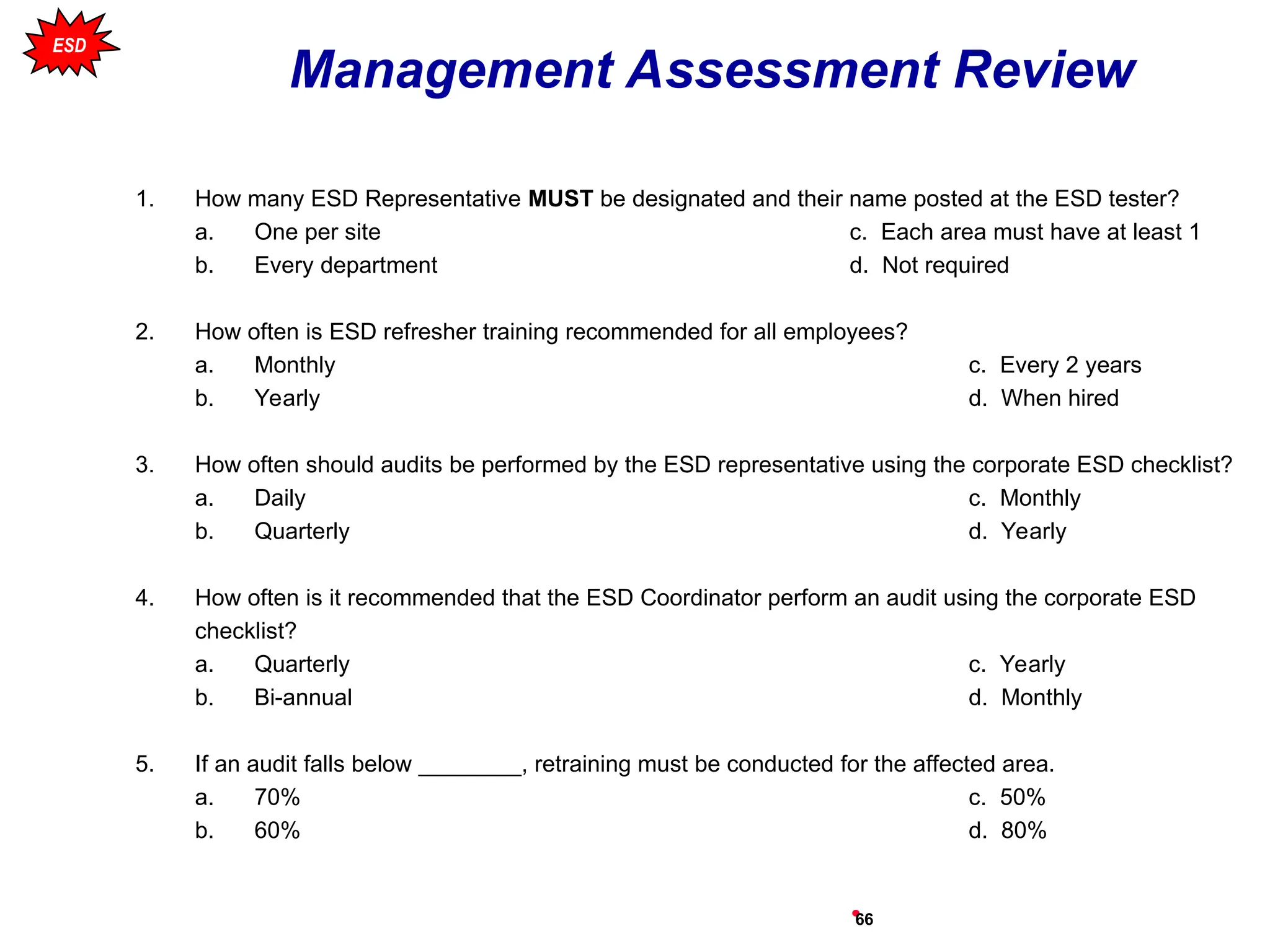
Management Assessment Review
1. How many ESD Representative MUST be designated and their name posted at the ESD tester?
a. One per site c. Each area must have at least 1
b. Every department d. Not required
2. How often is ESD refresher training recommended for all employees?
a. Monthly c. Every 2 years
b. Yearly d. When hired
3. How often should audits be performed by the ESD representative using the corporate ESD checklist?
a. Daily c. Monthly
b. Quarterly d. Yearly
4. How often is it recommended that the ESD Coordinator perform an audit using the corporate ESD
checklist?
a. Quarterly c. Yearly
b. Bi-annual d. Monthly
5. If an audit falls below ________, retraining must be conducted for the affected area.
a. 70% c. 50%
b. 60% d. 80%
ESD
67
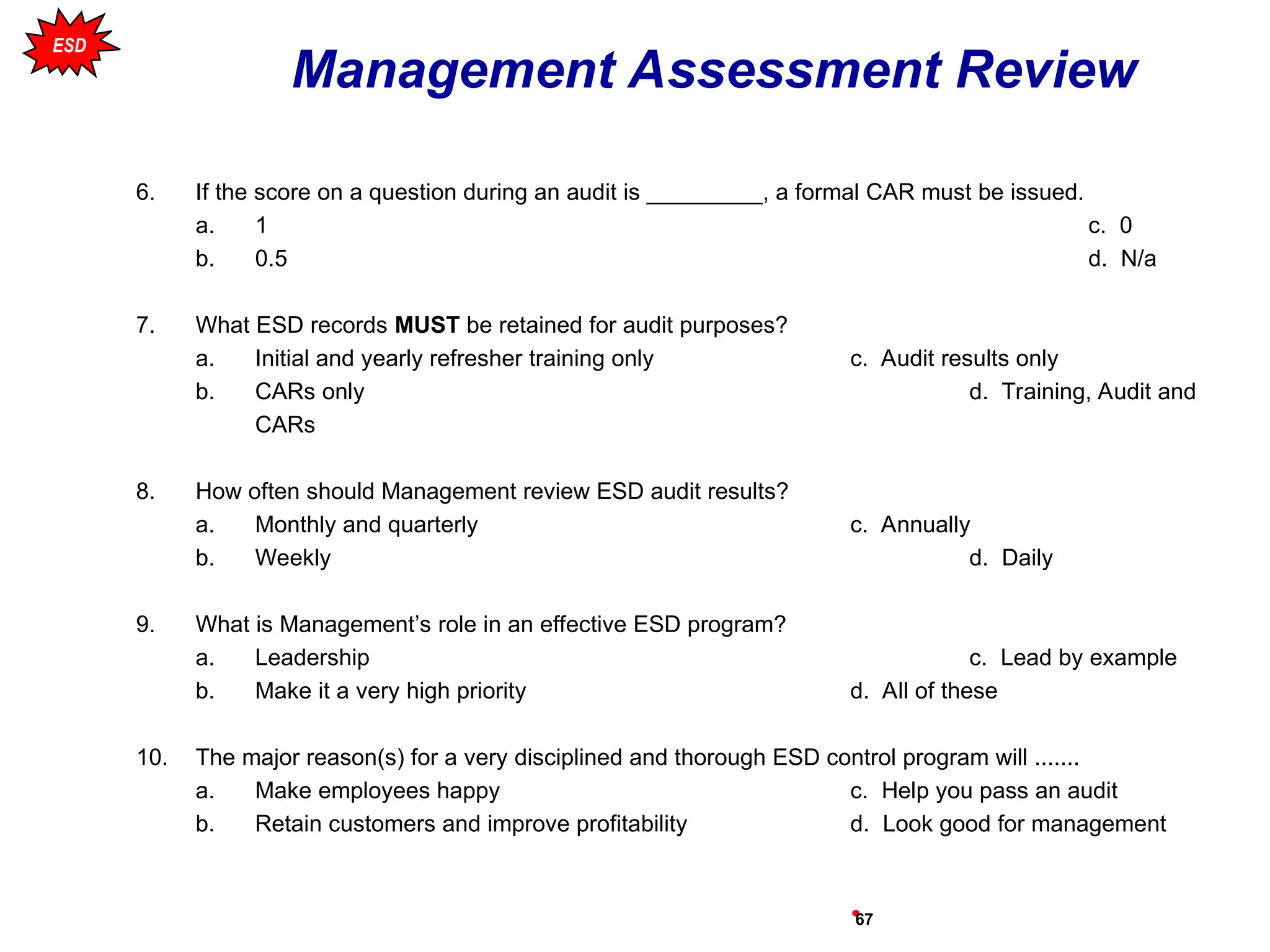
Management Assessment Review
6. If the score on a question during an audit is _________, a formal CAR must be issued.
a. 1 c. 0
b. 0.5 d. N/a
7. What ESD records MUST be retained for audit purposes?
a. Initial and yearly refresher training only c. Audit results only
b. CARs only d. Training, Audit and
CARs
8. How often should Management review ESD audit results?
a. Monthly and quarterly c. Annually
b. Weekly d. Daily
9. What is Management’s role in an effective ESD program?
a. Leadership c. Lead by example
b. Make it a very high priority d. All of these
10. The major reason(s) for a very disciplined and thorough ESD control program will .......
a. Make employees happy c. Help you pass an audit
b. Retain customers and improve profitability d. Look good for management
ESD
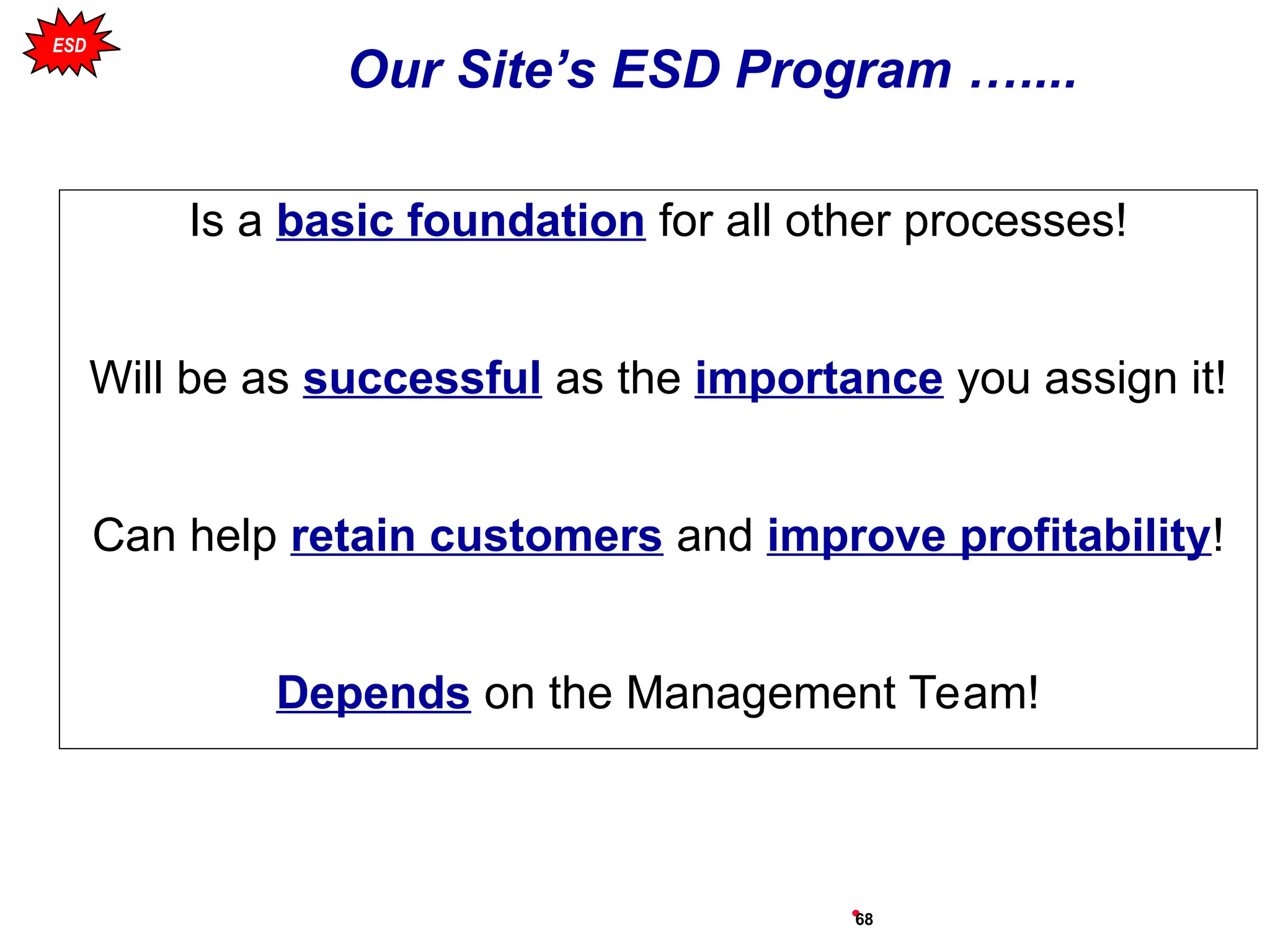
68
Our Site’s ESD Program …....
Is a basic foundation for all other processes!
Will be as successful as the importance you assign it!
Can help retain customers and improve profitability!
Depends on the Management Team!

Electro static discharge (ESD) Safety & awareness training

  • 1.
  • 2.
    ESD 2 Course Objectives To makeEmployees aware of . . .  what ESD is  why an ESD program is important  -’s minimum requirements for ESD control  their roles and responsibilities in the ESD program
  • 3.
    ESD 3 Presentation Outline  Whatis ESD?  Why is ESD Important?  ESD Prevention Program  ESD Roles and Responsibilities  Hands-on Demonstration  Q&A  Assessment
  • 4.
    ESD 4  ESD Definition Common Causes of ESD  Sources of ESD  Types of ESD Damage What is ESD?
  • 5.
    ESD 5 ESD Definition ESD –Electrostatic Discharge  The transfer of electrostatic charge between bodies at different electrical potentials  Also referred to as static electricity  Electrostatic charge is most commonly created by the contact and separation of two materials . . Component damage - can occur with as little as 15 – 30 Volts!!!! Examples of Static Generation Typical Voltage Levels Means of Generation 10-25% RH 65-90% RH Walking across carpet 35,000V 1,500V Walking across vinyl tile 12,000V 250V Worker at bench 6,000V 100V Poly bag picked up from bench 20,000V 1,200V Chair with urethane foam 18,000V 1,500V Examples of Static Generation Typical Voltage Levels Means of Generation 10-25% RH 65-90% RH Walking across carpet 35,000V 1,500V Walking across vinyl tile 12,000V 250V Worker at bench 6,000V 100V Poly bag picked up from bench 20,000V 1,200V Chair with urethane foam 18,000V 1,500V Examples of Static Generation Typical Voltage Levels Examples of Static Generation Typical Voltage Levels Examples of Static Generation Typical Voltage Levels Means of Generation Means of Generation 10-25% RH 10-25% RH 65-90% RH 65-90% RH Walking across carpet Walking across carpet 35,000V 35,000V 1,500V 1,500V Walking across vinyl tile Walking across vinyl tile 12,000V 12,000V 250V 250V Worker at bench Worker at bench 6,000V 6,000V 100V 100V Poly bag picked up from bench Poly bag picked up from bench 20,000V 20,000V 1,200V 1,200V Chair with urethane foam Chair with urethane foam 18,000V 18,000V 1,500V 1,500V Examples of Static Generation Typical Voltage Levels Means of Generation 10-25% RH 65-90% RH Walking across carpet 35,000V 1,500V Walking across vinyl tile 12,000V 250V Worker at bench 6,000V 100V Poly bag picked up from bench 20,000V 1,200V Examples of Static Generation Typical Voltage Levels Means of Generation 10-25% RH 65-90% RH Walking across carpet 35,000V 1,500V Walking across vinyl tile 12,000V 250V Worker at bench 6,000V 100V Poly bag picked up from bench 20,000V 1,200V Examples of Static Generation Typical Voltage Levels Examples of Static Generation Typical Voltage Levels Examples of Static Generation Typical Voltage Levels Means of Generation Means of Generation 10-25% RH 10-25% RH 65-90% RH 65-90% RH Walking across carpet Walking across carpet 35,000V 35,000V 1,500V 1,500V Walking across vinyl tile Walking across vinyl tile 12,000V 12,000V 250V 250V Worker at bench Worker at bench 6,000V 6,000V 100V 100V Poly bag picked up from bench Poly bag picked up from bench 20,000V 20,000V 1,200V 1,200V
  • 6.
    ESD 6 ESDS – ElectrostaticDischarge Sensitive What type of parts are ESD Sensitive?  Integrated Circuits (DIPs, QFP, BGA, SOT, etc.)  Crystals and oscillators  Printed Circuit Board Assemblies  When in doubt, treat it as ESDS!
  • 7.
    ESD 7 Common Causes ofESD  Opening a common plastic bag  Removing adhesive tape from a roll or container  Walking across a floor and grabbing the door knob  Transporting computer boards or components around in their trays on non-ESD carts  Sliding circuit boards on a work bench What are some other causes of ESD?
  • 8.
    ESD 8 Sources of ESD Vinyl binders  Equipment covers  Data diskettes  Plastic document holders/sheet protectors  Post-It TM notes  Plastic pens  Bubble wrap  Plastic housings on equipment  Paper, schematics, etc.  Plastic work travelers  Plastic spray bottles  Personal items –Purses –Sweaters/jackets –Insulated lunch totes –Combs/brushes –Lotion bottles Don’t Bring Unneeded Items like these into the Work Area. The following items are examples of materials that generate and hold electrostatic charge.
  • 9.
    ESD 9 Static Generating Material StaticGenerating Material Example Containment Methods/Options Excess boxes and packaging material, Styrofoam Remove from control area Tape, binders, page protectors, plastic bags and boxes, foam Replace with ESD-safe alternatives Plastic connector packaging, plastic case-with-board assembly (e.g. mouse assembly) Apply Ionization Exterior packing foam (for outgoing product) Separate from ESDS items by at least 3 feet (1 meter) Computer displays (VDT's) Shield charge from ESDS items Computer keyboards and monitor cases, plastic "windows" or "guards" on machinery May treat with topical antistat
  • 10.
    ESD 10 Types of ESDDamage CATASTROPHIC FAILURE  A device is exposed to ESD and it no longer works  The device circuitry is permanently damaged  Such failures may be caught when tested, before shipment LATENT FAILURE  A device is exposed to ESD and is partially damaged, yet it continues to work  The product may have a failure after the user places it in service What type of damage do you think is worse?
  • 11.
  • 12.
    ESD 12 Why is ESDImportant? Electrostatic Discharge (ESD) can damage sensitive electronic devices, resulting in:  Higher manufacturing costs  Rework  Repair  Scrap  Lower production yields  Unhappy customers  Shorter product life  Reduce product reliability Estimates of actual cost of ESD damage to the electronics industry = $$$ Billions annually
  • 13.
    ESD 13  ESD ControlAreas  Personal Grounding  Equipment grounding  ESDS Component & Assembly Handling ESD Prevention Program
  • 14.
    ESD 14 ESD Control Areas Any area where unprotected ESDS parts and assemblies may be handled  ESD areas must be labeled with posted signs and their boundaries marked
  • 15.
    ESD 15 Personal Grounding Smocks  Everyoneinside an ESD Control Area must wear a smock  Smock sleeves should be in contact with the skin, clothing underneath should not show  At least 3 of the front snaps should be closed -
  • 16.
    ESD 16 Personal Grounding Shoes andHeel Straps –  ESD safe shoes – must have a visible tag or marking on the outside of the shoe to show they are ESD shoes and/or  Heel/Toe Straps - may be used to ground personnel in areas where there are ESD floors  Must be tested and logged daily
  • 17.
    ESD 17 Personal Grounding Wrist straps Required when handling ESDS components and assemblies while seated  Must be tested and logged daily
  • 18.
    ESD 18 Equipment Grounding Carts andMovable Racks  Must be grounded in areas with ESD floors. An attached drag chain, or flat, braided cable may be used, with at least 2 inches drag chain in contact with the floor
  • 19.
    ESD 19 Equipment Grounding Work Stationsand Tables  Must have static dissipative surfaces connected in parallel to the building ground source.  Must have wrist strap ground connections (2 recommended), preferably banana jack receptacles, connected in parallel to the bldg ground source  Should be cleaned daily with an antistatic cleaner 2 wrist strap grounding receptacles Static dissipative surface
  • 20.
    ESD 20 Equipment Grounding Power Tools Need to be grounded. Grounding to the local utility is usually sufficient, but should be determined by the site Engineering dept. Shelving and Cabinets  Must provide a grounded surface unless the parts remain fully enclosed within shielding-type packaging Storage Bins  All parts bins and containers must be static dissipative or antistatic  Whenever practical, sensitive parts should remain in the original container until assembled
  • 21.
    ESD 21 ESDS Device Handling Tomove ESDS parts or assemblies inside an ESD control area, use one of the following;  Static dissipative containers  Static shielding containers  Conductive containers or board carriers  Ground movable racks
  • 22.
    ESD 22  Area ESDRepresentatives  Operators/Support Personnel  Visitors/Sponsors ESD Roles and Responsibilities
  • 23.
    ESD 23 Area ESD Representative’s Responsibilities Each area’s management designates at least 1 trained Area ESD Representative  Names of Area ESD Representatives must be displayed by the ESD Tester  Conduct monthly audits of designated area using the corporate ESD checklist (CORQA-15-100037)  Conduct weekly audits consisting of visual inspection of each static protected work surface and surrounding area  Log audit results and any resulting corrective action
  • 24.
    ESD 24 Operator’s/Support Personnel’s Responsibilities  Wear2 approved ESD shoe-straps or ESD shoes as required. Inspect, test, and log daily  Wear an ESD wrist-strap as required. Ground the wrist-strap at the workstation. Inspect, test, and log daily  Wear smocks whenever in an ESD control area. Ensure that sleeves and other parts of personal clothing do not contact ESD sensitive devices or assemblies -
  • 25.
    ESD 25  Keep thearea free of static generating material. Static generating material includes paper, plastic, styrofoam, synthetic clothing, etc.  Before handling ESDS parts or assemblies at an ESD workstation, conduct a visual inspection of the station to verify all ground wires and snaps are connected Operator’s/Support Personnel’s Responsibilities
  • 26.
    ESD 26 Visitor’s/Sponsor’s Responsibilities  TheSponsor ensures that visitors are provided with all required ESD protective equipment when accessing ESD control areas  The Sponsor ensures that the ESD protective equipment is worn properly and tested  The Sponsor ensures that visitors comply with current ESD practices and procedures when in an ESD-sensitive area  At the conclusion of the visit, the sponsor collects the reusable ESD protective equipment that was issued
  • 27.
  • 28.
    ESD 28 Practical Training –Part 1 Hands-on Demonstration  Put on Heel Straps  Put on Wrist Strap  Test Heel and Wrist Straps  Completing Heel/Wrist Strap Tester log
  • 29.
    ESD 29 Hands-on Demonstration Every studentshould be given the opportunity to;  Put on a pair of heel straps  Put on a wrist strap  Test their heel and wrist straps  After their heel and wrist straps pass, complete a log sheet
  • 30.
    ESD 30 Put on HeelStraps (1)Place the heel strap on the shoe so that the inside lining is making contact with the shoe. (3)Fasten Velcro straps together, securing heel strap firmly on shoe. (2)Insert the contact strip inside the shoe and under the foot. Make sure that solid contact is made between the stocking foot and contact strip.
  • 31.
    ESD 31 Put on WristStrap (1)Open the clamp and loosen the strap. To Adjust Strap (2)Slip band on wrist. (3)Pull loose end until band is snug. It may help to gain leverage by pressing the band against your body. (4)Close clamp cover. The wrist strap must fit snugly against the wrist.
  • 32.
    ESD 32 Test Heel &Wrist Straps  Test each Heel and Wrist Strap separately  Ensure you get a GREEN/OK/PASS light on each  If don’t get a pass, inspect strap, check connection, and/or use ESD lotion on skin If you can’t get a pass, replace the bad strap
  • 33.
    ESD 33 Complete the logsheet  Must be tested and logged daily  Mark day(s) not worked, don’t leave blank  Example: Use ‘NW’ for Not Work on days out, do NOT check it off as pass
  • 34.
    ESD 34 Practical Training –Part 2 Perform an Audit  Each Student is given an abbreviated ESD audit checklist  Depending on the class size, individually, or in small groups, take about 10 minutes to audit an ESD Control Area  When you return to the classroom, each student or group will share their results with the class.
  • 35.
    ESD 35 Questions and Answers Howcan ESD negatively affect our business? What are some of your responsibilities to ensure that we have good ESD controls? What questions do you have about ESD or our ESD program?
  • 36.
    ESD 36 Assessment Please take afew minutes to answer some questions about ESD and our ESD program.
  • 37.
    ESD 37 Assessment Review 1. Whatis Electrostatic Discharge (ESD)? a. The electrical energy created by a power supply that can destroy components b. The energy created when discharging a capacitor that can destroy components c. The discharged digital electrical charge that when discharged can destroy components d. The electrostatic charge created when rubbing or separating two materials that can destroy components 2. For ESD control, when MUST a smock be worn? a. All of the time c. Whenever in an ESD control area b. Anytime you’re in the building d. In the office area 3. How are ESD Control Areas identified? a. An ESD Control Area sign c. By your supervisor b. With red tape on the floor d. By the customers 4. How often MUST heel and wrist straps be tested and logged? a. Weekly c. Daily b. 2X per day d. Monthly 5. What is the most effective way of keeping a person grounded? a. A wrist strap. b. Touching a dissipative mat. c. Wearing all cotton clothing. d. Touching insulator.
  • 38.
    ESD 38 6. What doesESDS (Electrostatic Discharge Sensitive) and the symbol mean? a. The parts can be damaged by electrostatic charges b. The parts create electrostatic discharges c. These parts should be put in plastic bags 7. When moving ESDS parts or assemblies inside an ESD control area, which of the following would you NOT use? a. Static shielding container c. Grounded movable rack b. Just carry them in you hands d. Conductive container or board carrier 8. Which is the incorrect statement about ESD-protective garments? a. Sleeves must be worn at full length. b. The cuffs should contact the skin. C. Top two buttons or snaps have to open. 9. Which of the following should NOT be on an ESD workbench? a. Paper and non-ESD plastic sleeves c. Personal items – purse, sweater, brush, lunch box b. Non-ESD plastic containers d. All of these 10. When completing the ESD test log, what should you mark for the days you are out? a. Nothing c. Check it off as passed b. NW for Not Worked d. Not Tested Assessment Review
  • 39.
    ESD 39 Assessment Review BONUS QUESTION Whichof the following should you do to help the ESD controls at our site? a. Test and log your heel and wrist strap daily b. Check your work bench for proper grounding when beginning work c. Always look for ESD violations, everyone be an auditor d. Move ESDS components and assemblies in the proper containers e. All of the above
  • 40.
    ESD 40  ESD Rolesand Responsibilities  ESD Control Program Plan  ESD Audit Plan  ESD Training Requirements  ESD Record Retention ESD for Management
  • 41.
    ESD 41 Site ESD Coordinator’sResponsibilities  Responsible for ESD problem resolution, ESD compliance audits and consultancy  Recommended quarterly audits or ensures that the ESD system is included as part of the ISO/QS audits  Log audit results and any resulting corrective action  Train and verify competency of those who deliver ESD training.  Maintain a list of Area ESD Representatives
  • 42.
    ESD 42 Supervisor’s Responsibilities Ensure thatOperators are issued the required ESD protective equipment Replace worn or damaged equipment promptly Verify that Operators are performing the daily checks and follow all ESD practices specified Establish and maintain the ESD log book and approve the weekly log sheets Perform Area ESD audits Repeat offenders of the ESD control system should be subject to disciplinary action
  • 43.
    ESD 43 Management’s Responsibilities Appoint anESD Coordinator who is competent in ESD theory and practice Implement a DISCIPLINED ESD program Read and understand CORQA-10-021954 and the site’s ESD procedure Walk-the-talk Follow ALL ESD rules when in ESD Control Areas Set the expectation for all of your employees Zero tolerance for ESD violations
  • 44.
    ESD 44 Management’s Responsibilities Ensure ESDAudit schedules and Training requirements are followed Review ESD audit results on a monthly and quarterly basis Ensure effective corrective actions are being taken Take ESD VERY SERIOUS, our customers do! It affects our Customer Satisfaction Index (CSI) It affects the profitability of our business in hidden ways
  • 45.
    ESD 45 ESD Control ProgramPlan Any area where unprotected ESD sensitive parts and assemblies may be handled shall be designated an ESD Control Area, and must meet the following requirements; The area is free from non-essential static generators, and the risk from process-essential static generators is minimized There is a system in place to ensure that all personnel may be effectively grounded, & there is a tester nearby to verify that the grounding equipment is working properly Everyone (including visitors) inside the area wears a smock All movable carts, racks, etc. are grounded The area is labeled as an ESD control area, and the boundaries are clearly marked
  • 46.
    ESD 46 ESD Control ProgramPlan (continued) Shelves are grounded A static dissipative floor is present if heel straps, conductive shoes, or carts are grounded to the floor The area is subjected to monthly audits against the ESD procedure All work surfaces are grounded and static dissipative, and their grounding is verified monthly Food, beverages and lunch boxes – examples of all ESD generating material – are not allowed in ESD control areas When possible, relative humidity shall be maintained to a minimum of 40% and temperature between 18ºC and 27ºC, for ESD control areas
  • 47.
  • 48.
    ESD 48 ESD - Causeon Electronics Damages Latent Defect  Failure normally couldn’t be detected at assembly process  But the quality of the device may be partially degraded  The life span of the component is reduce dramatically  Example : VCR stop recording after a minute. Catastrophic Failures  Failure could be detected at manufacturing process  Component of such are badly destroy and have caused a metal melt,junction breakdown or oxide failure  Example : VCR can’t perform recording. ESD - Cause on Electronics Damages
  • 49.
    ESD 49 Content Preventing and controlling Basicprevent techniques Grounding Ionizer Shielding Packaging Smock Humidity
  • 50.
    ESD 50 Prevention & Controlling Now all of us know about ESD and how harmful it can be during daily manufacturing process involving Human and Automation  There are various techniques to minimizes and control ESD from happening.  The basic and most common used techniques are; - Grounding - Ionization - Shielding - Humidification We should develop the same attitude about ESD Control ESD
  • 51.
    ESD 51 Prevention & Controlling Grounding Is to provide a path for static charge to drain.  All item must be grounded at the same location to avoid different potential.  As different potential contributed to more and frequent ESD event.  Item which are related with grounding:- - Wrist strap ( personnel grounding ) - Workstation grounding - Equipment and Machine Grounding
  • 52.
    ESD 52 Prevention & Controlling Wriststrap / Heel strap  Wrist strap are the primary means of controlling static charges on a Human.  Wrist strap is constantly contact with bare skin and it is contact to ground to drain off static charges from human body.  Wrist straps are required to be worn by person who handles ESD sensitive devices.  Wrist strap can be worn at either Hand during handling sensitive item.  The problem when wearing wrist strap is the contact point of skin and wrist strap.
  • 53.
    ESD 53 Prevention & Controlling Workstationgrounding  Work surface where Electrostatic sensitive device is being handled must be properly grounded to the common grounding point.  Each work station must have a separate grounding point. [ connecting one work surface ground to another is not recommended ]  The use of a 1M ohm resister in series during grounding is recommended due to safety reason . [ Some standard do not require this ] Static dissipative tabletop Grounding Point Resistance 1 Mohm Wrist strap grounding point
  • 54.
    ESD 54 Prevention & Controlling Equipmentand Machine Grounding  Equipment and machine used to handle ESDS item should be grounded to the equipment grounding point.  All Machine must be grounded to the main ground. The Ground measurement of machine respective to ground must be less than 1 ohm.  The requirement for 1 ohm is to make sure the Machine are grounded and second to prevent damages during short-circuit.  Machine or Equipment that are not grounded will cause CDM event.  Remember to chose the right Tools and equipment , look for the ESD sign on them.
  • 55.
    ESD 55 Prevention & Controlling Ionization Ionizer are used to neutralize insulative material or any surface which having highly charge or chargeable.  Which are not possible to be grounded.  An Ionizer not just blowing normal air but producing air which contain negative and positive ions.  The charged material which are lacking of electron or proton will take the required amount of electron or proton to be equally balanced.  Balanced body will be neutralized as zero potential. Negative power supply and emitter Positive power supply and emitter
  • 56.
    ESD 56 Prevention & Controlling Shielding Shielding is a method of isolating two different body.  It prevent electrostatic field from being induced or discharged to the device or from the device.  When shielding is applied there should be a ground part for the charge to flow.  The basic and most common used way of shielding are: - Packaging - Smock
  • 57.
    ESD 57 Prevention & Controlling Packaging Packaging are related with Faraday Cage.  Any electrostatic field will only resided on its exterior and had no influence on anything enclosed within it.  There are three types of packaging material such as Anti static, Static dissipative and Metalized.  The very important point to be remembered is that packaging should provide protection from outside fields and discharge.  Choosing the right packaging for the right usage is important .
  • 58.
    ESD 58 Prevention & Controlling Smock Smock are wore over clothing to Prevent static field from inducing to sensitive device.  Smock made of a static dissipative material that slows ESD to give it time to be discharged to ground through the ground wire or wrist strap.  The effectiveness of the smock will depend on the conductive fibres interwoven in striped , diamond or checked pattern.  Smock should be wore properly and contact should be establish at either two location wrist or the neck . This will cause compressed field to be dissipated through the wrist strap when connected to ground.
  • 59.
    ESD 59 Prevention & Controlling Smockmust be wore properly to prevent static field from inner Clothing. Proper wearing of smock. Contact point
  • 60.
    ESD 60 Prevention & Controlling Humidity Humidity contains water vapor in the air which reduce the charge generation.  As the presence of moisture in the air is increased, electrons are better able to discharge safely into the air instead of another object.  It also makes some surface to be become conductive due to moisture observation [exp : cold countries have higher concern on paper charging compare to Hot countries]  As humidity goes higher lower the charge and as lower the humidity higher the charge .  The recommended humidity range by ANSI is 40% to 60% RH .
  • 61.
    ESD 61 ESD Audit Plan FREQUENCYACTION RECORDS Daily  Check wrist straps, heel straps, and conductive shoes  Pass/Fail log Weekly (or as determined by Engr.)  Check effectiveness of topical antistat treatments  Log of measured values Monthly  ESD self-audit  Checklist and written verification of corrective action(s)  Clean and test ionizers  Preventive maintenance (PM) log  Perform functional check of wrist/heel strap testers  Preventive maintenance log or self-audit checklist/record  Verify workstation and table grounding  Logs Annual or Semiannual  Calibrate wrist/footwear tester  Maintain records per site calibration procedure  Calibrate auditing equipment  Maintain records per site calibration procedure  ESD review training  Attendance records  Course test results, if applicable  Audit smocks  Log of test results and corrective actions  Audit by corporate/site coordinator (3rd Party Audits)  Checklist and written verification of corrective action(s) Reference CORQA-10-021954
  • 62.
    ESD 62 ESD Audit Checklist CORQA-15-100037 – Corporate ESD Audit Checklist  Checklist Scoring  The ESD checklist spreadsheet is set up to automatically calculate the final score and highlight when action is required Score Compliance Level Action 0 No Plan, Procedure or compliance level is <= 80% Initiate Formal Corrective Action 0.5 If compliance is between 80% to 90% Revise Plan, procedure or conduct awareness training 1 If compliance is >90% None N/a Where no site specific requirements apply -
  • 63.
    ESD 63 ESD Training Requirements Infacilities that have an ESD Control Area All employees are required to complete ESD training BEFORE allowed access to ESD Control Areas All Management responsible for an ESD Control area Must receive the initial training, including the management section All employees and managers who handle ESDS parts/ assemblies or who work in ESD Control Areas Yearly ESD refresher training is recommended If an Audit falls below 80% Employees in the area with the violations must receive ESD refresher training The ESD non-compliances identified should be part of the training process
  • 64.
    ESD 64 ESD Record Retention Training Records  Initial training and, if annual refresher training is required, records must be retained and readily accessible for audit purposes  Audit Records  Must be retained and readily accessible for audit purposes  All corrective actions must be documented, retained and readily accessible for audit purposes
  • 65.
    ESD 65 Management Assessment Please takea few minutes to answer some questions about ESD and our ESD program.
  • 66.
    ESD 66 Management Assessment Review 1.How many ESD Representative MUST be designated and their name posted at the ESD tester? a. One per site c. Each area must have at least 1 b. Every department d. Not required 2. How often is ESD refresher training recommended for all employees? a. Monthly c. Every 2 years b. Yearly d. When hired 3. How often should audits be performed by the ESD representative using the corporate ESD checklist? a. Daily c. Monthly b. Quarterly d. Yearly 4. How often is it recommended that the ESD Coordinator perform an audit using the corporate ESD checklist? a. Quarterly c. Yearly b. Bi-annual d. Monthly 5. If an audit falls below ________, retraining must be conducted for the affected area. a. 70% c. 50% b. 60% d. 80%
  • 67.
    ESD 67 Management Assessment Review 6.If the score on a question during an audit is _________, a formal CAR must be issued. a. 1 c. 0 b. 0.5 d. N/a 7. What ESD records MUST be retained for audit purposes? a. Initial and yearly refresher training only c. Audit results only b. CARs only d. Training, Audit and CARs 8. How often should Management review ESD audit results? a. Monthly and quarterly c. Annually b. Weekly d. Daily 9. What is Management’s role in an effective ESD program? a. Leadership c. Lead by example b. Make it a very high priority d. All of these 10. The major reason(s) for a very disciplined and thorough ESD control program will ....... a. Make employees happy c. Help you pass an audit b. Retain customers and improve profitability d. Look good for management
  • 68.
    ESD 68 Our Site’s ESDProgram ….... Is a basic foundation for all other processes! Will be as successful as the importance you assign it! Can help retain customers and improve profitability! Depends on the Management Team!

Editor's Notes

  • #1 Class recommended length; Classroom presentation – 45 minutes (make it interactive, ask questions, don’t read from the slides) Practical exercises – 30 minutes (depends on the # of students) Assessment, including review – 15 minutes Management presentation – 20 minutes Required materials; ESD Training presentation on PC with a digital projector or overhead slides of the ESD Training presentation Student handout, 1 per student created by printing this presentation using the File - Print function, Print What: Handouts, Slides per Page = 3 Copy of the assessment sheet for each student Copy of the abbreviated ESD Checklist for each student Pair of heel straps and wrist strap for each student (or a few they can share) ESD log sheet ESD heel strap and wrist strap tester REFRESHER TRAINING SHOULD INCLUDE THE PRESENTATION ONLY – PRACTICAL EXERCISES ARE NOT REQUIRED
  • #2 Stress how important is that they understand how ESD effects our business and how they can minimize those effects.
  • #4 Before you go to the next slide, ask the students what ESD is. You may want to write their answers on the whiteboard or a flipchart.
  • #5 Briefly talk about the amount of static charges created by the different means. Ask them if they’ve felt the shock of walking across the carpet and touching the door knob. Did it hurt? What do you think it would do to a component? RH = Relative Humidity, as the amount of humidity decreases, as it gets drier, the static charges increase. It does not take a lot of energy to destroy a circuit in a module that is made with has line widths of 0.2 micrometer (.0000002 meters – a hundred time smaller than a human hair)
  • #6 Bring examples of ESD Sensitive devices if possible. Stress the point that parts should be treated as ESDS unless they are absolutely sure they are not. Dual In-Line Package quad flat package ball grid array Small out-line Transfer
  • #7 As the students for other examples that create static electricity.
  • #8 Review the above examples of materials that create ESD. Ask for additional examples of things that create ESD.
  • #9 Briefly review the types of static generating examples and how they should be taken care of.
  • #10 Ask the students to discuss what type of failure is worst and why. Latent failures are worst because they can happen in our customer’s facility or in the ultimate Customer’s facility, causing they to be frustrated. Ask them how they felt when they got something home and it failed after a short time. Ask them to give examples from their personal life.
  • #11 Before you go to the next slide, ask the students why ESD is important. You may want to write their ideas on the whiteboard or a flipchart.
  • #12 Make sure to point out the negative affects that ESD has on our business and our customers, especially, the unhappy customers when our products fail on them! Ask the students if they’ve ever bought a product and it failed soon after they started using it. How did it make them fail? How do you think our customers feel when products we built for them fail?
  • #13 This is a review of our ESD Control Program, the steps we take to reduce and/or eliminate ESD
  • #14 Ask the students to name areas that are ESD Control areas. How do they know? Is there a sign? Is the boundaries clearly marked? How?
  • #15 Stress the importance of the long sleeves of their personal clothing not extend past the smock sleeve, roll up their sleeves if needed. It is important that the smock sleeves touch your skin so that if there are any static charges on your clothing, it goes through the smock to the skin to ground through the wrist or heel straps. Why are smocks worn? Many of the fabrics we wear are very high static generators. The smock is conductive and covers the clothing that may create static charges. Through the smock sleeves the charges are give a path to ground through your skin and heel or wrist straps.
  • #16 ESD shoes are acceptable as long as the ESD tag is visible. Stress that Heel straps should not be worn outside because it’ll wear them out and cause them to fail. Heel straps must be tested and pass on a daily basis.
  • #17 Stress the requirement that a wrist strap MUST be worn and plugged in whenever seated and handling ESDS components or assemblies. Even if you have 2 heel straps and your feet are on the floor, the wrist strap must be worn. If the wrist strap fails, sometimes it help if ESD lotion is used to moisten the skin around the strap.
  • #18 As the students to always look to see that the cart has a grounding drag chain whenever moving a cart. If it doesn’t, bring it to their supervisors attention and have it fixed or removed from the floor.
  • #19 Ask the students to always make a quick check whenever sitting at a workstation to ensure the table and wrist strap receptacles are connected to ground. Ask the students what should they do if the ESD workstation is not grounded? Suggested actions; They should not work at an ungrounded workstation with ESDS parts and assemblies. They should inform their supervisor and the Area ESD Representative immediately If the problem is not corrected quickly, they should notify the ESD Coordinator and the next level management.
  • #20 If a power tool does not have a 3 prong plug, bring it to your Supervisor’s attention. Stress the importance of leaving ESDS parts in their original protective container until assembles.
  • #21 Stress the importance of not carrying ESDS parts and assemblies around without the proper carriers. The should NOT carry assemblies across the floor just in their hands, without an ESD safe container.
  • #22 It is important that everyone understands their role and responsibility in our ESD program.
  • #23 Ask them who their Area ESD Rep is. If they don’t know, ask them to find out when they go on their audit (part of the practical exercise).
  • #24 Stress the importance of 2 heel straps, wrist strap, smock, testing, and logging for audit purposes.
  • #25 Mention that they need to help keep the area free and clear of Static Generating Material. Reemphasize the importance of checking your workstation before starting work at it. Make sure the ground wire is connected to the bench and the wrist strap connector wires are connected.
  • #26 Stress the importance of taking responsibility for their visitors. The visitors probably are not aware of -’s ESD requirements so it is your responsibility to ensure they are. If someone new comes into their area, they should check to make sure they have the proper ESD protection.
  • #27 Give the students a brief break before the practical piece of the training.
  • #28 This is the demonstration section of the training to let them apply what they’ve learned.
  • #29 Give each student heel and wrist strap or they will have to take turns if you don’t have sufficient. Every student MUST be given an opportunity to wear, test and log heel and wrist straps. Have each student test their heel and wrist strap until they get a pass. Have each student complete the actual ESD Log sheet that they’ll be using at the ESD tester, not just a sheet of paper.
  • #30 Sometimes people put the strap inside their sock. Putting the strap inside the shoe may work better because of the moisture between the shoe and sock.
  • #31 Stress the importance of the strap being snug so that it works effectively.
  • #32 Demonstrate how to properly test heel and wrist straps before letting the student do it.
  • #33 Have the students log their pass results on an actual ESD log sheet. Stress the importance of marking all days not worked because an auditor does not know that you weren’t here. They may just think you didn’t complete the test the days you were out.
  • #34 Have each student perform an ESD audit. We want everyone to be an casual auditor whenever they’re on the floor. Make sure that if they identify an ESD violation, they bring it to the person’s attention immediately, in a very friendly and professional manner. Give the students an opportunity to share their audit results with the group.
  • #35 Ask the students if they have any questions before the take a brief assessment to determine what they’ve learned.
  • #36 Give each student an assessment sheet and about 10 minutes to complete it. They should work on this individually. Have them swap papers with their neighbor for scoring. Go through the answers with the class as a group. Collect the graded assessments at the end.
  • #37 When reviewing the answers, ask for a volunteer or select a student to give the correct answer. Correct Answers; 1. D . 2. C 3. A 4. C 5. B
  • #38 Correct Answers; 6. C . 7. B 8. C 9. D 10. B
  • #39 Correct Answers; E
  • #40 Management MUST be aware of our entire ESD program. Each manager and supervisor should be given a copy of the corporate and site ESD procedure and checklist.
  • #41 Let all managers and supervisors know who the site ESD Coordinator is.
  • #63 Stress the yearly refresher training is recommended for everyone and retraining requirement if an audit fall below 80%.
  • #65 Give each student an assessment sheet and about 10 minutes to complete it. They should work on this individually. Have them swap papers with their neighbor for scoring. Go through the answers with the class as a group. Collect the graded assessments at the end.
  • #66 When reviewing the answers, ask for a volunteer or select a student to give the correct answer. Correct Answers; 1. C . 2. B 3. C 4. A 5. D
  • #67 Correct Answers; 6. C 7. D 8. A 9. D 10. B