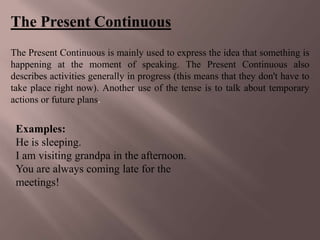
The Present Continuous
The Present Continuous is mainly used to express the idea that something is
happening at the moment of speaking. The Present Continuous also
describes activities generally in progress (this means that they don't have to
take place right now). Another use of the tense is to talk about temporary
actions or future plans.


 Examples:
 He is sleeping.
 I am visiting grandpa in the afternoon.
 You are always coming late for the
 meetings!
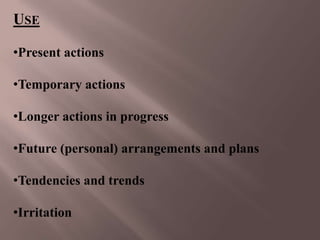
USE

•Present actions

•Temporary actions

•Longer actions in progress

•Future (personal) arrangements and plans

•Tendencies and trends

•Irritation
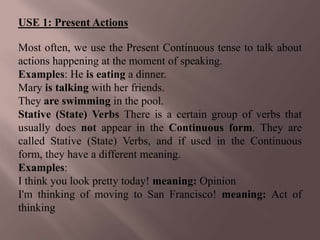
USE 1: Present Actions

Most often, we use the Present Continuous tense to talk about
actions happening at the moment of speaking.
Examples: He is eating a dinner.
Mary is talking with her friends.
They are swimming in the pool.
Stative (State) Verbs There is a certain group of verbs that
usually does not appear in the Continuous form. They are
called Stative (State) Verbs, and if used in the Continuous
form, they have a different meaning.
Examples:
I think you look pretty today! meaning: Opinion
I'm thinking of moving to San Francisco! meaning: Act of
thinking
USE 2: Temporary Actions

This tense is also used for activities continuing only for a
limited period of time.
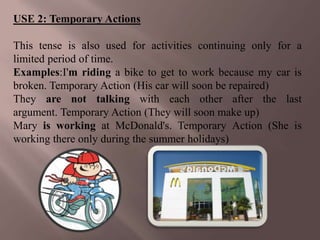
Examples:I'm riding a bike to get to work because my car is
broken. Temporary Action (His car will soon be repaired)
They are not talking with each other after the last
argument. Temporary Action (They will soon make up)
Mary is working at McDonald's. Temporary Action (She is
working there only during the summer holidays)
USE 3: Longer Actions in Progress

We also use the Present Continuous when we are in
the middle of doing something time-consuming (i.e.
something that takes time to complete). An example
of such an activity is writing a book, saving money
or studying for an exam.
Examples: They are working hard to earn money.
I am training to become a professional footballer.
Mike is studying hard to become a doctor.
Elizabeth is currently writing a children's book
titled I am the World.
USE 4: Future (Personal) Arrangements and Plans

Sometimes we use the Present Continuous to show
that something is planned and will be done in the near
future.
Examples: I'm meeting Katie in the evening.
He's flying to Rome in September.
We're not going anywhere tomorrow.
USE 5: Tendencies and Trends

This tense is also used for expressing
tendencies or trends.
Examples: Our country is
getting richer.
The Internet is becoming less of a
novelty.
The Universe is expanding .
USE 6: Irritation or Anger

And the last use of this tense is to express
irritation or anger over somebody or
something in the present with adverbs such
as: always, continually or contantly.
Examples:
She is continually complaining about
everything!
Johny is always asking stupid questions!
My boss is contantly critising me!

escuela de idiomas present continuous santana suarez

  • 4.
    The Present Continuous ThePresent Continuous is mainly used to express the idea that something is happening at the moment of speaking. The Present Continuous also describes activities generally in progress (this means that they don't have to take place right now). Another use of the tense is to talk about temporary actions or future plans. Examples: He is sleeping. I am visiting grandpa in the afternoon. You are always coming late for the meetings!
  • 5.
    USE •Present actions •Temporary actions •Longeractions in progress •Future (personal) arrangements and plans •Tendencies and trends •Irritation
  • 6.
    USE 1: PresentActions Most often, we use the Present Continuous tense to talk about actions happening at the moment of speaking. Examples: He is eating a dinner. Mary is talking with her friends. They are swimming in the pool. Stative (State) Verbs There is a certain group of verbs that usually does not appear in the Continuous form. They are called Stative (State) Verbs, and if used in the Continuous form, they have a different meaning. Examples: I think you look pretty today! meaning: Opinion I'm thinking of moving to San Francisco! meaning: Act of thinking
  • 7.
    USE 2: TemporaryActions This tense is also used for activities continuing only for a limited period of time. Examples:I'm riding a bike to get to work because my car is broken. Temporary Action (His car will soon be repaired) They are not talking with each other after the last argument. Temporary Action (They will soon make up) Mary is working at McDonald's. Temporary Action (She is working there only during the summer holidays)
  • 8.
    USE 3: LongerActions in Progress We also use the Present Continuous when we are in the middle of doing something time-consuming (i.e. something that takes time to complete). An example of such an activity is writing a book, saving money or studying for an exam. Examples: They are working hard to earn money. I am training to become a professional footballer. Mike is studying hard to become a doctor. Elizabeth is currently writing a children's book titled I am the World.
  • 9.
    USE 4: Future(Personal) Arrangements and Plans Sometimes we use the Present Continuous to show that something is planned and will be done in the near future. Examples: I'm meeting Katie in the evening. He's flying to Rome in September. We're not going anywhere tomorrow.
  • 10.
    USE 5: Tendenciesand Trends This tense is also used for expressing tendencies or trends. Examples: Our country is getting richer. The Internet is becoming less of a novelty. The Universe is expanding .
  • 11.
    USE 6: Irritationor Anger And the last use of this tense is to express irritation or anger over somebody or something in the present with adverbs such as: always, continually or contantly. Examples: She is continually complaining about everything! Johny is always asking stupid questions! My boss is contantly critising me!