Yelka Paredes
Villalobos
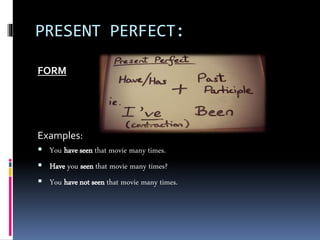
PRESENT PERFECT:
FORM
Examples:
 You have seen that movie many times.
 Have you seen that movie many times?
 You have not seen that movie many times.
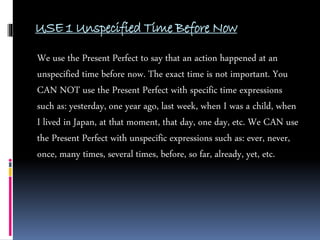
USE 1 Unspecified Time Before Now
We use the Present Perfect to say that an action happened at an
unspecified time before now. The exact time is not important. You
CAN NOT use the Present Perfect with specific time expressions
such as: yesterday, one year ago, last week, when I was a child, when
I lived in Japan, at that moment, that day, one day, etc. We CAN use
the Present Perfect with unspecific expressions such as: ever, never,
once, many times, several times, before, so far, already, yet, etc.
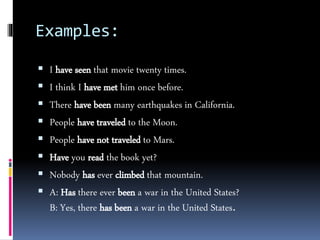
Examples:
 I have seen that movie twenty times.
 I think I have met him once before.
 There have been many earthquakes in California.
 People have traveled to the Moon.
 People have not traveled to Mars.
 Have you read the book yet?
 Nobody has ever climbed that mountain.
 A: Has there ever been a war in the United States?
B: Yes, there has been a war in the United States.
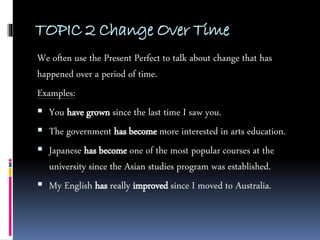
TOPIC 2 Change Over Time
We often use the Present Perfect to talk about change that has
happened over a period of time.
Examples:
 You have grown since the last time I saw you.
 The government has become more interested in arts education.
 Japanese has become one of the most popular courses at the
university since the Asian studies program was established.
 My English has really improved since I moved to Australia.
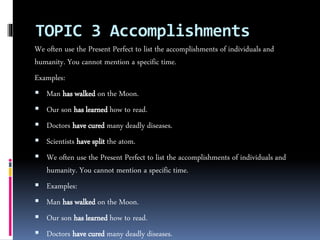
TOPIC 3 Accomplishments
We often use the Present Perfect to list the accomplishments of individuals and
humanity. You cannot mention a specific time.
Examples:
 Man has walked on the Moon.
 Our son has learned how to read.
 Doctors have cured many deadly diseases.
 Scientists have split the atom.
 We often use the Present Perfect to list the accomplishments of individuals and
humanity. You cannot mention a specific time.
 Examples:
 Man has walked on the Moon.
 Our son has learned how to read.
 Doctors have cured many deadly diseases.
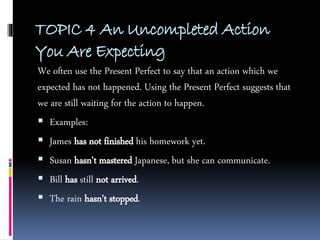
TOPIC 4 An Uncompleted Action
You Are Expecting
We often use the Present Perfect to say that an action which we
expected has not happened. Using the Present Perfect suggests that
we are still waiting for the action to happen.
 Examples:
 James has not finished his homework yet.
 Susan hasn't mastered Japanese, but she can communicate.
 Bill has still not arrived.
 The rain hasn't stopped.
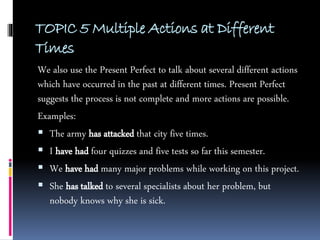
TOPIC 5 Multiple Actions at Different
Times
We also use the Present Perfect to talk about several different actions
which have occurred in the past at different times. Present Perfect
suggests the process is not complete and more actions are possible.
Examples:
 The army has attacked that city five times.
 I have had four quizzes and five tests so far this semester.
 We have had many major problems while working on this project.
 She has talked to several specialists about her problem, but
nobody knows why she is sick.
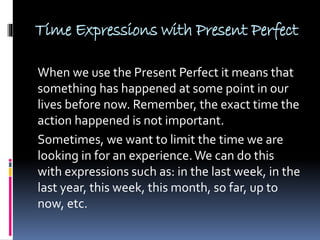
Time Expressions with Present Perfect
When we use the Present Perfect it means that
something has happened at some point in our
lives before now. Remember, the exact time the
action happened is not important.
Sometimes, we want to limit the time we are
looking in for an experience.We can do this
with expressions such as: in the last week, in the
last year, this week, this month, so far, up to
now, etc.
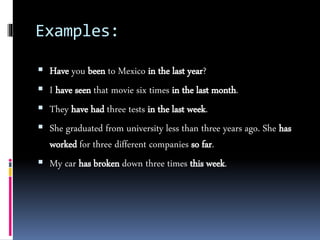
Examples:
 Have you been to Mexico in the last year?
 I have seen that movie six times in the last month.
 They have had three tests in the last week.
 She graduated from university less than three years ago. She has
worked for three different companies so far.
 My car has broken down three times this week.

Present perfect

  • 1.
  • 2.
    PRESENT PERFECT: FORM Examples:  Youhave seen that movie many times.  Have you seen that movie many times?  You have not seen that movie many times.
  • 3.
    USE 1 UnspecifiedTime Before Now We use the Present Perfect to say that an action happened at an unspecified time before now. The exact time is not important. You CAN NOT use the Present Perfect with specific time expressions such as: yesterday, one year ago, last week, when I was a child, when I lived in Japan, at that moment, that day, one day, etc. We CAN use the Present Perfect with unspecific expressions such as: ever, never, once, many times, several times, before, so far, already, yet, etc.
  • 4.
    Examples:  I haveseen that movie twenty times.  I think I have met him once before.  There have been many earthquakes in California.  People have traveled to the Moon.  People have not traveled to Mars.  Have you read the book yet?  Nobody has ever climbed that mountain.  A: Has there ever been a war in the United States? B: Yes, there has been a war in the United States.
  • 5.
    TOPIC 2 ChangeOver Time We often use the Present Perfect to talk about change that has happened over a period of time. Examples:  You have grown since the last time I saw you.  The government has become more interested in arts education.  Japanese has become one of the most popular courses at the university since the Asian studies program was established.  My English has really improved since I moved to Australia.
  • 6.
    TOPIC 3 Accomplishments Weoften use the Present Perfect to list the accomplishments of individuals and humanity. You cannot mention a specific time. Examples:  Man has walked on the Moon.  Our son has learned how to read.  Doctors have cured many deadly diseases.  Scientists have split the atom.  We often use the Present Perfect to list the accomplishments of individuals and humanity. You cannot mention a specific time.  Examples:  Man has walked on the Moon.  Our son has learned how to read.  Doctors have cured many deadly diseases.
  • 7.
    TOPIC 4 AnUncompleted Action You Are Expecting We often use the Present Perfect to say that an action which we expected has not happened. Using the Present Perfect suggests that we are still waiting for the action to happen.  Examples:  James has not finished his homework yet.  Susan hasn't mastered Japanese, but she can communicate.  Bill has still not arrived.  The rain hasn't stopped.
  • 8.
    TOPIC 5 MultipleActions at Different Times We also use the Present Perfect to talk about several different actions which have occurred in the past at different times. Present Perfect suggests the process is not complete and more actions are possible. Examples:  The army has attacked that city five times.  I have had four quizzes and five tests so far this semester.  We have had many major problems while working on this project.  She has talked to several specialists about her problem, but nobody knows why she is sick.
  • 9.
    Time Expressions withPresent Perfect When we use the Present Perfect it means that something has happened at some point in our lives before now. Remember, the exact time the action happened is not important. Sometimes, we want to limit the time we are looking in for an experience.We can do this with expressions such as: in the last week, in the last year, this week, this month, so far, up to now, etc.
  • 10.
    Examples:  Have youbeen to Mexico in the last year?  I have seen that movie six times in the last month.  They have had three tests in the last week.  She graduated from university less than three years ago. She has worked for three different companies so far.  My car has broken down three times this week.