Welcome to Journal presentation
Presenter
Dr. kazi Md. Rubayet Anwar
MBBS, FCPS( Medicine)
MD cardiology thesis part student
NICVD, Dhaka.
Nobel oral anticoagulant in patient with
acute coronary syndrome
Introduction
• Worldwide acute coronary syndrome (ACS) is a burning health issue and
having significant morbidity and mortality.
• Effective reperfusion strategies and novel antithrombotic therapies,
associated with subsequent remarkable improvements in patients’ prognoses.
• Despite these advances, patients with ACS remain at high risk of experiencing
recurrent ischemic events.
Introduction contd…
• Thrombosis prevention with antithrombotic agents plays a pivotal role in the
treatment of patients with ACS.
• Oral anticoagulants in addition to APT are an attractive option after ACS.
• Recently, direct oral anticoagulants (DOAC) in addition to APT have been shown
to reduce the risk of ischemic events at the cost of a higher risk of bleeding.
Pathophysiology of ACS
• Currently in-hospital treatment of ACS includes both antiplatelet and
anticoagulant medications long-term care focuses primarily on antiplatelet
therapy.
• Despite dual-antiplatelet therapy, patients with stabilized ACS have an ≈9%
to 11% risk of suffering a recurrent adverse cardiovascular event within 1
year.[*]
Platelet adhere to collagen
and vWF
Tissue factor
activation & Factor Xa
Thrombin
activation
Thrombus formation,
expansion, platelet activation
* Wallentin L, Becker RC, Budaj A, et al.; PLATO Investigators. Ticagrelor versus clopidogrel in patients with acute coronary syndromes. N Engl JMed. 2009;361:1045–1057.
Rationale of anticoagulants use in ACS
• Thrombin levels stay elevated for months after an ACS event[*].
Persistently elevated thrombin levels elevate risk of adverse events despite
antiplatelet therapy. Addition of anticoagulation to the long-term care of
patients with stabilized ACS to lower thrombin levels and improve
outcomes.
• Warfarin, when added to aspirin for long-term therapy after ACS reduced
recurrent MI but Novel oral anticoagulants (NOACs) are more promising
than warfarin.
*Christersson C, Oldgren J, Bylock A, Wallentin L, Siegbahn A. Long-term treatment with ximelagatran, an oral direct thrombin inhibitor, persistently reduces the
coagulation activity after a myocardial infarction. J ThrombHaemost. 2005;3:2245–2253.
• Patients with elevated cardiac biomarkers experience benefit from oral
anticoagulation after stabilized ACS.
• Persistently elevated thrombin levels increase the risk of recurrent adverse
cardiovascular events, so oral anticoagulants are a potential option for the long-
term management of ACS.
• Rivaroxaban 2.5 mg twice daily demonstrated an overall mortality benefit without
excess bleeding. Rivaroxaban reduce stent thrombosis after PCI as compared with
placebo.
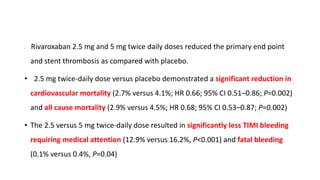
• Rivaroxaban 2.5 mg and 5 mg twice daily doses reduced the primary end point
and stent thrombosis as compared with placebo.
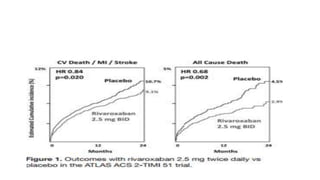
• 2.5 mg twice-daily dose versus placebo demonstrated a significant reduction in
cardiovascular mortality (2.7% versus 4.1%; HR 0.66; 95% CI 0.51–0.86; P=0.002)
and all cause mortality (2.9% versus 4.5%; HR 0.68; 95% CI 0.53–0.87; P=0.002)
• The 2.5 versus 5 mg twice-daily dose resulted in significantly less TIMI bleeding
requiring medical attention (12.9% versus 16.2%, P<0.001) and fatal bleeding
(0.1% versus 0.4%, P=0.04)
Phase 3 ATLAS ACS 2-TIMI 51 trial (n=15526)
• This is a phase III,
• multicenter, randomized,
• double-blind, placebo controlled clinical trial.
Phase 3 ATLAS ACS 2-TIMI 51 trial (n=15526)
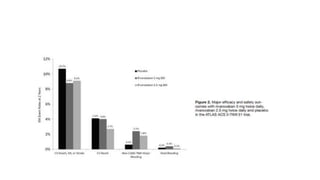
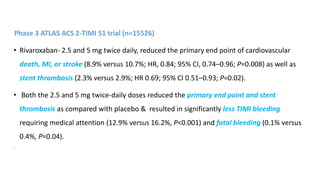
• Rivaroxaban- 2.5 and 5 mg twice daily, reduced the primary end point of cardiovascular
death, MI, or stroke (8.9% versus 10.7%; HR, 0.84; 95% CI, 0.74–0.96; P=0.008) as well as
stent thrombosis (2.3% versus 2.9%; HR 0.69; 95% CI 0.51–0.93; P=0.02).
• Both the 2.5 and 5 mg twice-daily doses reduced the primary end point and stent
thrombosis as compared with placebo & resulted in significantly less TIMI bleeding
requiring medical attention (12.9% versus 16.2%, P<0.001) and fatal bleeding (0.1% versus
0.4%, P=0.04).
•
Phase 3 ATLAS ACS 2-TIMI 51 trial (n=15526)
The results suggested that the 2.5 mg twice-daily dose offered the better
balance of efficacy and safety for patients with recent ACS with elevated
markers of cardiac necrosis.
APPRAISE-2 trial (n=7392)
(APixavan for PRevention of Acute ISchemic Events,2010)
• Randomized
• Double blind
• Phase III study
APPRAISE-2 trial (n=7392)
(APixavan for PRevention of Acute ISchemic Events,2010)
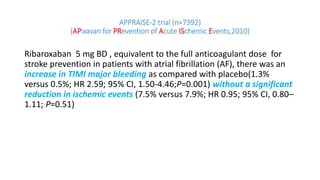
Ribaroxaban 5 mg BD , equivalent to the full anticoagulant dose for
stroke prevention in patients with atrial fibrillation (AF), there was an
increase in TIMI major bleeding as compared with placebo(1.3%
versus 0.5%; HR 2.59; 95% CI, 1.50-4.46;P=0.001) without a significant
reduction in ischemic events (7.5% versus 7.9%; HR 0.95; 95% CI, 0.80–
1.11; P=0.51)
ATLAS ACS-TIMI 46 trial (n=3491)
• double blind
• Dose escalated
• Phase II study
ATLAS ACS-TIMI 46 trial (n=3491)
Rivaroxavan was associated with a dose-dependent increase in
clinically significant bleeding and an overall significant reduction in
cardiovascular death, MI, or stroke with the numerically lowest HRs
seen with the lowest twice-daily doses.
Review Article
Received: 8 December 2014 / Accepted: 19 June 2015 / Published online: 17 July 2015 Neth Heart J (2015) 23:407–414
Management of the patient with an acute coronary syndrome using oral anticoagulation.
G.J.A. Vos · N. Bennaghmouch · K. Qaderdan · J.M. ten Berg
• Triple therapy is associated with an increased risk of major bleeding. Depending
of bleeding risk and indication (stable coronary artery disease or ACS), it should
be given for a short duration (1–6 months) followed by dual therapy (clopidogrel
75 mg/day (or alternatively, aspirin 75–100 mg/day). (Level of Evidence: B)
• Novel P2Y12 receptor inhibitors (prasugrel and ticagrelor) should not routinely be
part of a triple therapy regimen (only in select cases such as stent thrombosis).
(Level of Evidence: C)
Direct Oral Anticoagulants in Addition to Antiplatelet Therapy
for Secondary Prevention After Acute Coronary Syndromes
A Systematic Review and Meta-analysis
Mauro Chiarito, MD; Davide Cao, MD; Francesco Cannata, MD; Cosmo Godino, MD;
Corrado Lodigiani, MD;
Giuseppe Ferrante, MD, PhD; Renato D. Lopes, MD, PhD; John H. Alexander, MD; Bernhard
Reimers, MD;
Gianluigi Condorelli, MD, PhD; Giulio G. Stefanini, MD, PhD
JAMA CARDIOLOGY/ ORIGINAL INVESTIGAION
JAMA Cardiol. doi:10.1001/jamacardio.2017.5306
Published online February 7, 2018
Rationale
The rationale for using DOAC in patients with ACS without an indication for
oral anticoagulation, especially for those with STEMI, is linked to the pivotal
role of thrombin in this clinical setting. After an acute MI, high thrombin
levels are traceable for at least 6 months. Overall, our results suggest a
favorable net clinical benefit (defined as NNT minus NNH) when adding
DOAC to APT after ACS, particularly in patients presenting with STEMI.
IMPORTANCE: ACS remain at high risk for experiencing recurrent
ischemic events. Direct oral anticoagulants (DOAC) have been proposed
for secondary prevention after ACS.
OBJECTIVE: safety and efficacy of DOAC in addition to antiplatelet
therapy (APT) after ACS, focusing on treatment effects stratified by
baseline clinical presentation: [NSTE-ACS] vs [STEMI-ACS]
DATA SOURCES: PubMed, Embase, BioMedCentral, Google Scholar, and the
Cochrane Central Register of Controlled Trials, from inception to March 1, 2017.
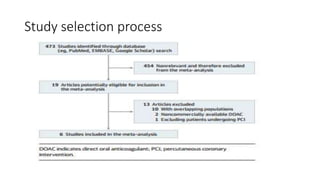
STUDY SELECTION: Randomized clinical trials (RCT) Overall, 473 studies were
screened, 19 clinical trials were assessed as potentially eligible, and 6 were
included in the meta-analysis.
DATA EXTRACTION AND SYNTHESIS: Preferred Reporting Items for Systematic
Reviews and Meta-analyses guidelines were used to abstract data and assess
quality and validity.
Study selection process
Main Outome and Measure:
• primary efficacy end points risk:
Cardiovascular death(CVD), Myocardial infarction(MI), and Stroke.
• primary safety end point:
Major bleeding.
(Bleeding events were assessed by the International Society of
Thrombosis and Hemostasis definition & Thrombolysis in
Myocardial Infarction (TIMI) definition.)
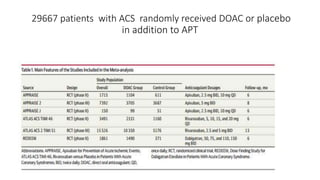
29667 patients with ACS randomly received DOAC or placebo
in addition to APT
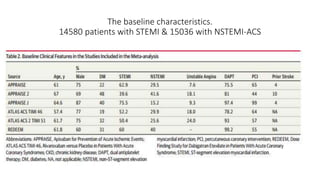
The baseline characteristics.
14580 patients with STEMI & 15036 with NSTEMI-ACS
Clinical outcome
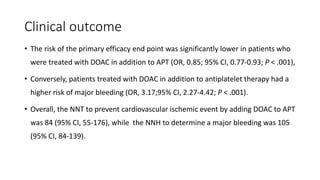
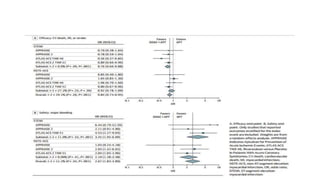
• The risk of the primary efficacy end point was significantly lower in patients who
were treated with DOAC in addition to APT (OR, 0.85; 95% CI, 0.77-0.93; P < .001),
• Conversely, patients treated with DOAC in addition to antiplatelet therapy had a
higher risk of major bleeding (OR, 3.17;95% CI, 2.27-4.42; P < .001).
• Overall, the NNT to prevent cardiovascular ischemic event by adding DOAC to APT
was 84 (95% CI, 55-176), while the NNH to determine a major bleeding was 105
(95% CI, 84-139).
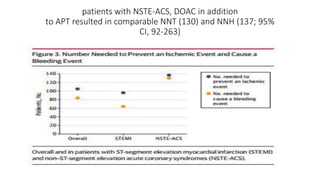
patients with NSTE-ACS, DOAC in addition
to APT resulted in comparable NNT (130) and NNH (137; 95%
CI, 92-263)
Results of Six trials that included 29 667 patients (14 580 patients [49.1%]
with STEMI and 15 036 [50.7%] with NSTE-ACS).
• This benefit was pronounced with STEMI (OR, 0.76; 95% CI, 0.66-0.88;
P < .001), while no significant treatment effect with NSTE-ACS (OR,
0.92; 95% CI, 0.78-1.09; P = .36; P for interaction = .09).
• DOACs were associated with a higher risk of major bleeding as
compared with APT alone (OR, 3.17; 95% CI, 2.27-4.42; P < .001)
Key findings of this meta-analysis can be summarized as follows:
DOAC plus APT after ACS is associated with a reduction in the risk of ischemic
events counterbalanced by a higher risk of major bleedings.
(1) with STEMI, the risk-benefit profile of DOAC plus APT appears to be more
favorable, with a significantly lower risk of ischemic events only partially
counterbalanced by a higher risk of major bleeding.
(2) with NSTE-ACS, DOAC in addition to APT are associated with a no significant
marginal reduction in the risk of ischemic events and with a significant
increase in bleeding, with an overall neutral net clinical benefit.
DOACs, especially rivaroxaban, seem to have a potential role in increasing the
antithrombotic protection among patients with ACS but they are associated with
an important increase in the risk of bleeding events.
A ATLAS ACS 2 TIMI 51 trial, Specifically rivaroxaban, 2.5 mg twice daily, in addition
to dual APT was associated with a significant reduction in cardiovascular and all
cause mortality as compared with a standard dual APT regimen, with a 2-fold
increase in the risk of major bleeding.
Study limitation
This is a study-level meta-analysis and the findings provide mean treatment
effects and lack of patient-level data prevents us from assessing the effect of
baseline clinical characteristics and treatment.
Moreover, DOAC in addition to last-generation P2Y12 inhibitors ( prasugrel or
ticagrelor) have not been investigated. This combination could expose patients
to a further increase in bleeding risk, with limitation in the reduction of ischemic
events.
Conclusion
Clinical benefits of DOAC in addition to APT for secondary prevention after
ACS might depend on the type of ACS.
• In patients with NSTE-ACS, the risk-benefit profile of DOAC in addition to
APT appears to be unfavorable.
• In patients with STEMI, DOAC in addition to APT appears to improve
outcomes in terms of ischemic events at the cost of a marginally
increased risk of major bleeding.
Take home message
• The risk-benefit profile of direct oral anticoagulants in addition to APT
appears to differ by ACS type.
• Direct oral anticoagulants might represent an attractive strategy in
patients with ST-segment elevation myocardial infarction.
• Specifically Rivaroxaban, 2.5 mg twice daily, in addition to dual APT
was associated with a significant reduction in cardiovascular and all
cause mortality.
Still more studies and follow up needed
Thank you

Welcome to journal presentation

  • 1.
    Welcome to Journalpresentation Presenter Dr. kazi Md. Rubayet Anwar MBBS, FCPS( Medicine) MD cardiology thesis part student NICVD, Dhaka.
  • 2.
    Nobel oral anticoagulantin patient with acute coronary syndrome
  • 3.
    Introduction • Worldwide acutecoronary syndrome (ACS) is a burning health issue and having significant morbidity and mortality. • Effective reperfusion strategies and novel antithrombotic therapies, associated with subsequent remarkable improvements in patients’ prognoses. • Despite these advances, patients with ACS remain at high risk of experiencing recurrent ischemic events.
  • 4.
    Introduction contd… • Thrombosisprevention with antithrombotic agents plays a pivotal role in the treatment of patients with ACS. • Oral anticoagulants in addition to APT are an attractive option after ACS. • Recently, direct oral anticoagulants (DOAC) in addition to APT have been shown to reduce the risk of ischemic events at the cost of a higher risk of bleeding.
  • 7.
    Pathophysiology of ACS •Currently in-hospital treatment of ACS includes both antiplatelet and anticoagulant medications long-term care focuses primarily on antiplatelet therapy. • Despite dual-antiplatelet therapy, patients with stabilized ACS have an ≈9% to 11% risk of suffering a recurrent adverse cardiovascular event within 1 year.[*] Platelet adhere to collagen and vWF Tissue factor activation & Factor Xa Thrombin activation Thrombus formation, expansion, platelet activation * Wallentin L, Becker RC, Budaj A, et al.; PLATO Investigators. Ticagrelor versus clopidogrel in patients with acute coronary syndromes. N Engl JMed. 2009;361:1045–1057.
  • 8.
    Rationale of anticoagulantsuse in ACS • Thrombin levels stay elevated for months after an ACS event[*]. Persistently elevated thrombin levels elevate risk of adverse events despite antiplatelet therapy. Addition of anticoagulation to the long-term care of patients with stabilized ACS to lower thrombin levels and improve outcomes. • Warfarin, when added to aspirin for long-term therapy after ACS reduced recurrent MI but Novel oral anticoagulants (NOACs) are more promising than warfarin. *Christersson C, Oldgren J, Bylock A, Wallentin L, Siegbahn A. Long-term treatment with ximelagatran, an oral direct thrombin inhibitor, persistently reduces the coagulation activity after a myocardial infarction. J ThrombHaemost. 2005;3:2245–2253.
  • 9.
    • Patients withelevated cardiac biomarkers experience benefit from oral anticoagulation after stabilized ACS. • Persistently elevated thrombin levels increase the risk of recurrent adverse cardiovascular events, so oral anticoagulants are a potential option for the long- term management of ACS. • Rivaroxaban 2.5 mg twice daily demonstrated an overall mortality benefit without excess bleeding. Rivaroxaban reduce stent thrombosis after PCI as compared with placebo.
  • 10.
    • Rivaroxaban 2.5mg and 5 mg twice daily doses reduced the primary end point and stent thrombosis as compared with placebo. • 2.5 mg twice-daily dose versus placebo demonstrated a significant reduction in cardiovascular mortality (2.7% versus 4.1%; HR 0.66; 95% CI 0.51–0.86; P=0.002) and all cause mortality (2.9% versus 4.5%; HR 0.68; 95% CI 0.53–0.87; P=0.002) • The 2.5 versus 5 mg twice-daily dose resulted in significantly less TIMI bleeding requiring medical attention (12.9% versus 16.2%, P<0.001) and fatal bleeding (0.1% versus 0.4%, P=0.04)
  • 13.
    Phase 3 ATLASACS 2-TIMI 51 trial (n=15526) • This is a phase III, • multicenter, randomized, • double-blind, placebo controlled clinical trial.
  • 14.
    Phase 3 ATLASACS 2-TIMI 51 trial (n=15526) • Rivaroxaban- 2.5 and 5 mg twice daily, reduced the primary end point of cardiovascular death, MI, or stroke (8.9% versus 10.7%; HR, 0.84; 95% CI, 0.74–0.96; P=0.008) as well as stent thrombosis (2.3% versus 2.9%; HR 0.69; 95% CI 0.51–0.93; P=0.02). • Both the 2.5 and 5 mg twice-daily doses reduced the primary end point and stent thrombosis as compared with placebo & resulted in significantly less TIMI bleeding requiring medical attention (12.9% versus 16.2%, P<0.001) and fatal bleeding (0.1% versus 0.4%, P=0.04). •
  • 15.
    Phase 3 ATLASACS 2-TIMI 51 trial (n=15526) The results suggested that the 2.5 mg twice-daily dose offered the better balance of efficacy and safety for patients with recent ACS with elevated markers of cardiac necrosis.
  • 16.
    APPRAISE-2 trial (n=7392) (APixavanfor PRevention of Acute ISchemic Events,2010) • Randomized • Double blind • Phase III study
  • 17.
    APPRAISE-2 trial (n=7392) (APixavanfor PRevention of Acute ISchemic Events,2010) Ribaroxaban 5 mg BD , equivalent to the full anticoagulant dose for stroke prevention in patients with atrial fibrillation (AF), there was an increase in TIMI major bleeding as compared with placebo(1.3% versus 0.5%; HR 2.59; 95% CI, 1.50-4.46;P=0.001) without a significant reduction in ischemic events (7.5% versus 7.9%; HR 0.95; 95% CI, 0.80– 1.11; P=0.51)
  • 18.
    ATLAS ACS-TIMI 46trial (n=3491) • double blind • Dose escalated • Phase II study
  • 19.
    ATLAS ACS-TIMI 46trial (n=3491) Rivaroxavan was associated with a dose-dependent increase in clinically significant bleeding and an overall significant reduction in cardiovascular death, MI, or stroke with the numerically lowest HRs seen with the lowest twice-daily doses.
  • 20.
    Review Article Received: 8December 2014 / Accepted: 19 June 2015 / Published online: 17 July 2015 Neth Heart J (2015) 23:407–414 Management of the patient with an acute coronary syndrome using oral anticoagulation. G.J.A. Vos · N. Bennaghmouch · K. Qaderdan · J.M. ten Berg • Triple therapy is associated with an increased risk of major bleeding. Depending of bleeding risk and indication (stable coronary artery disease or ACS), it should be given for a short duration (1–6 months) followed by dual therapy (clopidogrel 75 mg/day (or alternatively, aspirin 75–100 mg/day). (Level of Evidence: B) • Novel P2Y12 receptor inhibitors (prasugrel and ticagrelor) should not routinely be part of a triple therapy regimen (only in select cases such as stent thrombosis). (Level of Evidence: C)
  • 21.
    Direct Oral Anticoagulantsin Addition to Antiplatelet Therapy for Secondary Prevention After Acute Coronary Syndromes A Systematic Review and Meta-analysis Mauro Chiarito, MD; Davide Cao, MD; Francesco Cannata, MD; Cosmo Godino, MD; Corrado Lodigiani, MD; Giuseppe Ferrante, MD, PhD; Renato D. Lopes, MD, PhD; John H. Alexander, MD; Bernhard Reimers, MD; Gianluigi Condorelli, MD, PhD; Giulio G. Stefanini, MD, PhD JAMA CARDIOLOGY/ ORIGINAL INVESTIGAION JAMA Cardiol. doi:10.1001/jamacardio.2017.5306 Published online February 7, 2018
  • 22.
    Rationale The rationale forusing DOAC in patients with ACS without an indication for oral anticoagulation, especially for those with STEMI, is linked to the pivotal role of thrombin in this clinical setting. After an acute MI, high thrombin levels are traceable for at least 6 months. Overall, our results suggest a favorable net clinical benefit (defined as NNT minus NNH) when adding DOAC to APT after ACS, particularly in patients presenting with STEMI.
  • 23.
    IMPORTANCE: ACS remainat high risk for experiencing recurrent ischemic events. Direct oral anticoagulants (DOAC) have been proposed for secondary prevention after ACS. OBJECTIVE: safety and efficacy of DOAC in addition to antiplatelet therapy (APT) after ACS, focusing on treatment effects stratified by baseline clinical presentation: [NSTE-ACS] vs [STEMI-ACS]
  • 24.
    DATA SOURCES: PubMed,Embase, BioMedCentral, Google Scholar, and the Cochrane Central Register of Controlled Trials, from inception to March 1, 2017. STUDY SELECTION: Randomized clinical trials (RCT) Overall, 473 studies were screened, 19 clinical trials were assessed as potentially eligible, and 6 were included in the meta-analysis. DATA EXTRACTION AND SYNTHESIS: Preferred Reporting Items for Systematic Reviews and Meta-analyses guidelines were used to abstract data and assess quality and validity.
  • 25.
  • 26.
    Main Outome andMeasure: • primary efficacy end points risk: Cardiovascular death(CVD), Myocardial infarction(MI), and Stroke. • primary safety end point: Major bleeding. (Bleeding events were assessed by the International Society of Thrombosis and Hemostasis definition & Thrombolysis in Myocardial Infarction (TIMI) definition.)
  • 27.
    29667 patients withACS randomly received DOAC or placebo in addition to APT
  • 28.
    The baseline characteristics. 14580patients with STEMI & 15036 with NSTEMI-ACS
  • 29.
    Clinical outcome • Therisk of the primary efficacy end point was significantly lower in patients who were treated with DOAC in addition to APT (OR, 0.85; 95% CI, 0.77-0.93; P < .001), • Conversely, patients treated with DOAC in addition to antiplatelet therapy had a higher risk of major bleeding (OR, 3.17;95% CI, 2.27-4.42; P < .001). • Overall, the NNT to prevent cardiovascular ischemic event by adding DOAC to APT was 84 (95% CI, 55-176), while the NNH to determine a major bleeding was 105 (95% CI, 84-139).
  • 30.
    patients with NSTE-ACS,DOAC in addition to APT resulted in comparable NNT (130) and NNH (137; 95% CI, 92-263)
  • 31.
    Results of Sixtrials that included 29 667 patients (14 580 patients [49.1%] with STEMI and 15 036 [50.7%] with NSTE-ACS). • This benefit was pronounced with STEMI (OR, 0.76; 95% CI, 0.66-0.88; P < .001), while no significant treatment effect with NSTE-ACS (OR, 0.92; 95% CI, 0.78-1.09; P = .36; P for interaction = .09). • DOACs were associated with a higher risk of major bleeding as compared with APT alone (OR, 3.17; 95% CI, 2.27-4.42; P < .001)
  • 33.
    Key findings ofthis meta-analysis can be summarized as follows: DOAC plus APT after ACS is associated with a reduction in the risk of ischemic events counterbalanced by a higher risk of major bleedings. (1) with STEMI, the risk-benefit profile of DOAC plus APT appears to be more favorable, with a significantly lower risk of ischemic events only partially counterbalanced by a higher risk of major bleeding. (2) with NSTE-ACS, DOAC in addition to APT are associated with a no significant marginal reduction in the risk of ischemic events and with a significant increase in bleeding, with an overall neutral net clinical benefit.
  • 34.
    DOACs, especially rivaroxaban,seem to have a potential role in increasing the antithrombotic protection among patients with ACS but they are associated with an important increase in the risk of bleeding events. A ATLAS ACS 2 TIMI 51 trial, Specifically rivaroxaban, 2.5 mg twice daily, in addition to dual APT was associated with a significant reduction in cardiovascular and all cause mortality as compared with a standard dual APT regimen, with a 2-fold increase in the risk of major bleeding.
  • 35.
    Study limitation This isa study-level meta-analysis and the findings provide mean treatment effects and lack of patient-level data prevents us from assessing the effect of baseline clinical characteristics and treatment. Moreover, DOAC in addition to last-generation P2Y12 inhibitors ( prasugrel or ticagrelor) have not been investigated. This combination could expose patients to a further increase in bleeding risk, with limitation in the reduction of ischemic events.
  • 36.
    Conclusion Clinical benefits ofDOAC in addition to APT for secondary prevention after ACS might depend on the type of ACS. • In patients with NSTE-ACS, the risk-benefit profile of DOAC in addition to APT appears to be unfavorable. • In patients with STEMI, DOAC in addition to APT appears to improve outcomes in terms of ischemic events at the cost of a marginally increased risk of major bleeding.
  • 37.
    Take home message •The risk-benefit profile of direct oral anticoagulants in addition to APT appears to differ by ACS type. • Direct oral anticoagulants might represent an attractive strategy in patients with ST-segment elevation myocardial infarction. • Specifically Rivaroxaban, 2.5 mg twice daily, in addition to dual APT was associated with a significant reduction in cardiovascular and all cause mortality. Still more studies and follow up needed
  • 38.