Microgrids and their destructuring effects on
the electrical industry
Prof. Damien Ernst
University of Li`ege
May 2014
1
Microgrid: what is it?
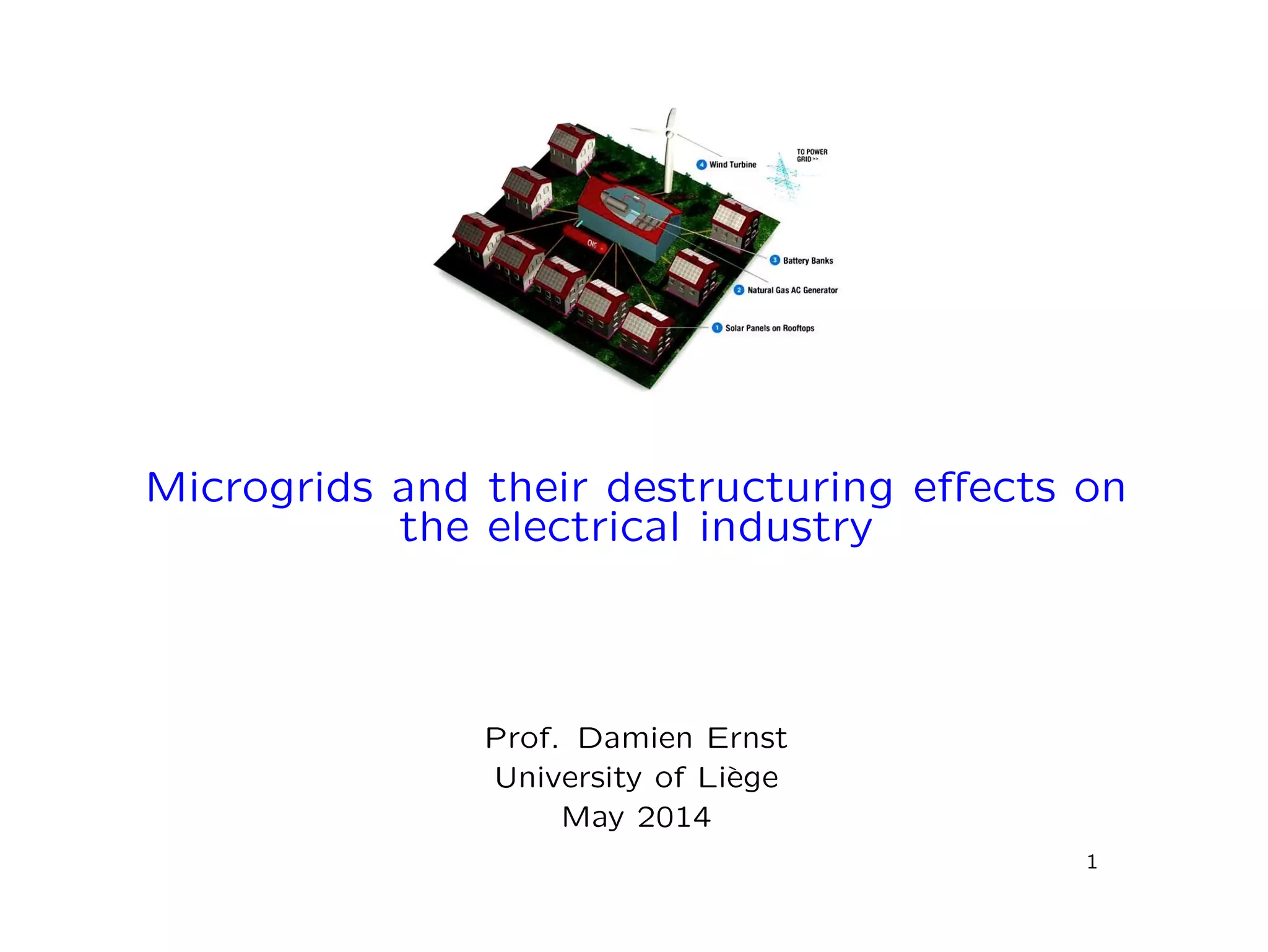
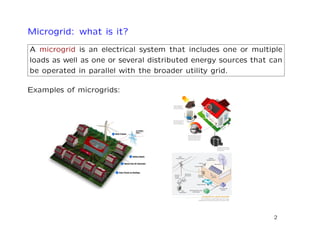
A microgrid is an electrical system that includes one or multiple
loads as well as one or several distributed energy sources that can
be operated in parallel with the broader utility grid.
Examples of microgrids:
2
The first power system, built in 1881, would be
considered today as a neighborhood size fully in-
dependent micro-grid.
Power systems have progressively moved through the years towards a
structure where most of the electricity is produced in large facilities,
such as fossil fuel (coal, gas powered), nuclear, or hydropower plants
and transmitted to loads through a transmission and a distribution
network. This is the Generation-Transmission-Distribution (GTD)
model. This progressive move has been caused by economies of
scale in generation.
3
These last few years, microgrids have been strongly developing and
the GTD model seems to be loosing its (almost) absolute
predominance. In this talk, we answer three main questions:
Question 1: What are the main factors that have set off the
development of microgrids?
Question 2: Are microgrids an epiphenomenon? If no, to what
extend will they develop?
Question 3: What advice to give to (a) power production
companies, (b) distribution companies (c) transmission companies,
(d) governments to deal with microgrids?
4
Question 1: What are the main factors driving the
development of microgrids?
The force behind microgrids development: the price of producing
electricity next to the load(s) is cheaper than the retail price of
electricity.
Six factors fostering this force:
Factor VI: Deregulation of power system industry has failed to make
the GTD model more cost-efficient. The opposite has even
happened due to the creation of new activities related to
deregulation (trading activities, increased regulation, etc) and
increased difficulties in optimizing/operating the GTD model in a
deregulated environment.
5
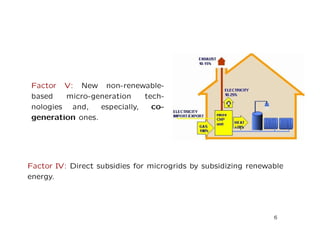
Factor V: New non-renewable-
based micro-generation tech-
nologies and, especially, co-
generation ones.
Factor IV: Direct subsidies for microgrids by subsidizing renewable
energy.
6
Factor III: Financing subsidies for renewable energy by increasing the
retail price of electricity.
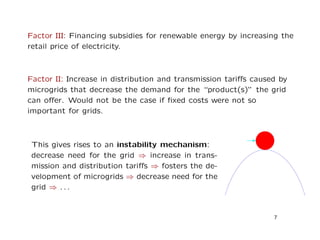
Factor II: Increase in distribution and transmission tariffs caused by
microgrids that decrease the demand for the “product(s)” the grid
can offer. Would not be the case if fixed costs were not so
important for grids.
This gives rises to an instability mechanism:
decrease need for the grid ⇒ increase in trans-
mission and distribution tariffs ⇒ fosters the de-
velopment of microgrids ⇒ decrease need for the
grid ⇒ . . .
7
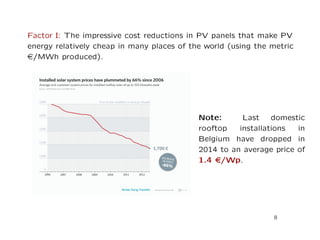
Factor I: The impressive cost reductions in PV panels that make PV
energy relatively cheap in many places of the world (using the metric
e/MWh produced).
Note: Last domestic
rooftop installations in
Belgium have dropped in
2014 to an average price of
1.4 e/Wp.
8
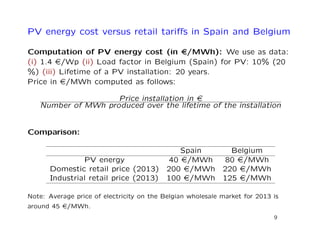
PV energy cost versus retail tariffs in Spain and Belgium
Computation of PV energy cost (in e/MWh): We use as data:
(i) 1.4 e/Wp (ii) Load factor in Belgium (Spain) for PV: 10% (20
%) (iii) Lifetime of a PV installation: 20 years.
Price in e/MWh computed as follows:
Price installation in e
Number of MWh produced over the lifetime of the installation
Comparison:
Spain Belgium
PV energy 40 e/MWh 80 e/MWh
Domestic retail price (2013) 200 e/MWh 220 e/MWh
Industrial retail price (2013) 100 e/MWh 125 e/MWh
Note: Average price of electricity on the Belgian wholesale market for 2013 is
around 45 e/MWh.
9
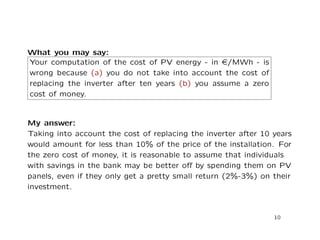
What you may say:
Your computation of the cost of PV energy - in e/MWh - is
wrong because (a) you do not take into account the cost of
replacing the inverter after ten years (b) you assume a zero
cost of money.
My answer:
Taking into account the cost of replacing the inverter after 10 years
would amount for less than 10% of the price of the installation. For
the zero cost of money, it is reasonable to assume that individuals
with savings in the bank may be better off by spending them on PV
panels, even if they only get a pretty small return (2%-3%) on their
investment.
10
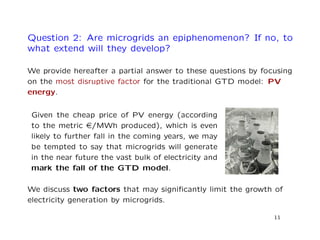
Question 2: Are microgrids an epiphenomenon? If no, to
what extend will they develop?
We provide hereafter a partial answer to these questions by focusing
on the most disruptive factor for the traditional GTD model: PV
energy.
Given the cheap price of PV energy (according
to the metric e/MWh produced), which is even
likely to further fall in the coming years, we may
be tempted to say that microgrids will generate
in the near future the vast bulk of electricity and
mark the fall of the GTD model.
We discuss two factors that may significantly limit the growth of
electricity generation by microgrids.
11
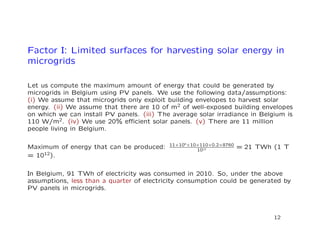
Factor I: Limited surfaces for harvesting solar energy in
microgrids
Let us compute the maximum amount of energy that could be generated by
microgrids in Belgium using PV panels. We use the following data/assumptions:
(i) We assume that microgrids only exploit building envelopes to harvest solar
energy. (ii) We assume that there are 10 of m2 of well-exposed building envelopes
on which we can install PV panels. (iii) The average solar irradiance in Belgium is
110 W/m2. (iv) We use 20% efficient solar panels. (v) There are 11 million
people living in Belgium.
Maximum of energy that can be produced: 11×106
×10×110×0.2×8760
1012 = 21 TWh (1 T
= 1012).
In Belgium, 91 TWh of electricity was consumed in 2010. So, under the above
assumptions, less than a quarter of electricity consumption could be generated by
PV panels in microgrids.
12
Factor II: Market model/regulation changes that will
worsen business cases for microgrids
Microgrids get services from the grid but do not pay a fair price for
them. Even in a model where they are remunerated at the wholesale
market price for injecting electricity into the grid and pay the retail
price for taking electricity from the grid, they usually do not share a
fair burden of the network costs (even if it is difficult to define what
is fair).
They also evade taxes that are often linked to distribution and
transmission tariffs.
With the rapid development of microgrids, such a situation is soon
going to become unsustainable ⇒ New market models less
favorable to microgrids will appear.
13
Which market model(s) for microgrids will appear?
Difficult to know to which market model(s) electrical systems will
converge to.
Let marketworst be the market model such that (i) the energy
produced by PV panels in the microgrids (not the net energy injected
by the microgrid into the network) is paid at the wholesale market
price (ii) the load in the microgrid pays all the electricity it consumes
at the market price. It is reasonable to conjecture that the system
will not converge towards a market model that would lead to smaller
revenues for microgrids than those obtained with marketworst.
Question: Would microgrids survive the market model marketworst?
14
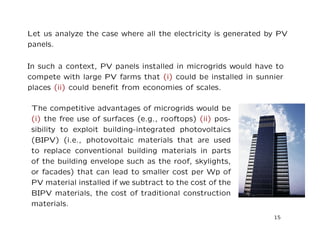
Let us analyze the case where all the electricity is generated by PV
panels.
In such a context, PV panels installed in microgrids would have to
compete with large PV farms that (i) could be installed in sunnier
places (ii) could benefit from economies of scales.
The competitive advantages of microgrids would be
(i) the free use of surfaces (e.g., rooftops) (ii) pos-
sibility to exploit building-integrated photovoltaics
(BIPV) (i.e., photovoltaic materials that are used
to replace conventional building materials in parts
of the building envelope such as the roof, skylights,
or facades) that can lead to smaller cost per Wp of
PV material installed if we subtract to the cost of the
BIPV materials, the cost of traditional construction
materials.
15
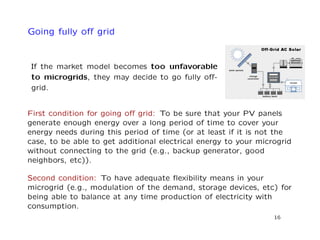
Going fully off grid
If the market model becomes too unfavorable
to microgrids, they may decide to go fully off-
grid.
First condition for going off grid: To be sure that your PV panels
generate enough energy over a long period of time to cover your
energy needs during this period of time (or at least if it is not the
case, to be able to get additional electrical energy to your microgrid
without connecting to the grid (e.g., backup generator, good
neighbors, etc)).
Second condition: To have adequate flexibility means in your
microgrid (e.g., modulation of the demand, storage devices, etc) for
being able to balance at any time production of electricity with
consumption.
16
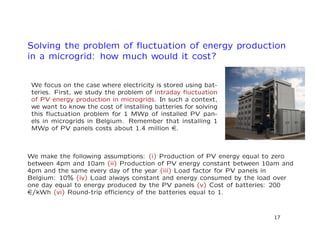
Solving the problem of fluctuation of energy production
in a microgrid: how much would it cost?
We focus on the case where electricity is stored using bat-
teries. First, we study the problem of intraday fluctuation
of PV energy production in microgrids. In such a context,
we want to know the cost of installing batteries for solving
this fluctuation problem for 1 MWp of installed PV pan-
els in microgrids in Belgium. Remember that installing 1
MWp of PV panels costs about 1.4 million e.
We make the following assumptions: (i) Production of PV energy equal to zero
between 4pm and 10am (ii) Production of PV energy constant between 10am and
4pm and the same every day of the year (iii) Load factor for PV panels in
Belgium: 10% (iv) Load always constant and energy consumed by the load over
one day equal to energy produced by the PV panels (v) Cost of batteries: 200
e/kWh (vi) Round-trip efficiency of the batteries equal to 1.
17
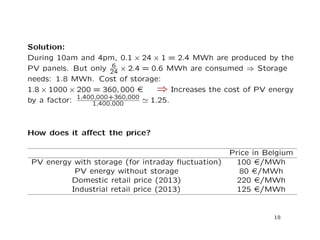
Solution:
During 10am and 4pm, 0.1 × 24 × 1 = 2.4 MWh are produced by the
PV panels. But only 6
24 × 2.4 = 0.6 MWh are consumed ⇒ Storage
needs: 1.8 MWh. Cost of storage:
1.8 × 1000 × 200 = 360, 000 e ⇒ Increases the cost of PV energy
by a factor: 1,400,000+360,000
1,400,000 1.25.
How does it affect the price?
Price in Belgium
PV energy with storage (for intraday fluctuation) 100 e/MWh
PV energy without storage 80 e/MWh
Domestic retail price (2013) 220 e/MWh
Industrial retail price (2013) 125 e/MWh
18
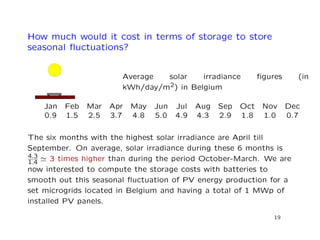
How much would it cost in terms of storage to store
seasonal fluctuations?
Average solar irradiance figures (in
kWh/day/m2) in Belgium
Jan Feb Mar Apr May Jun Jul Aug Sep Oct Nov Dec
0.9 1.5 2.5 3.7 4.8 5.0 4.9 4.3 2.9 1.8 1.0 0.7
The six months with the highest solar irradiance are April till
September. On average, solar irradiance during these 6 months is
4.3
1.4 3 times higher than during the period October-March. We are
now interested to compute the storage costs with batteries to
smooth out this seasonal fluctuation of PV energy production for a
set microgrids located in Belgium and having a total of 1 MWp of
installed PV panels.
19
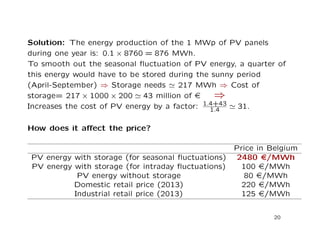
Solution: The energy production of the 1 MWp of PV panels
during one year is: 0.1 × 8760 = 876 MWh.
To smooth out the seasonal fluctuation of PV energy, a quarter of
this energy would have to be stored during the sunny period
(April-September) ⇒ Storage needs 217 MWh ⇒ Cost of
storage= 217 × 1000 × 200 43 million of e ⇒
Increases the cost of PV energy by a factor: 1.4+43
1.4 31.
How does it affect the price?
Price in Belgium
PV energy with storage (for seasonal fluctuations) 2480 e/MWh
PV energy with storage (for intraday fluctuations) 100 e/MWh
PV energy without storage 80 e/MWh
Domestic retail price (2013) 220 e/MWh
Industrial retail price (2013) 125 e/MWh
20
You may say:
These numbers show for certain that fully off-grid microgrids
powered by PV panels will never appear due to this problem of
interseasonal fluctuations of PV energy production.
My question: Are you really certain about this?
21
Four good reasons for not killing too rapidly off-grid
microgrids with PV panels
1. The PV installation could be sized for producing during the less
sunny periods of the year, an amount of energy equal to the energy
consumed during these periods ⇒ Decrease in storage costs.
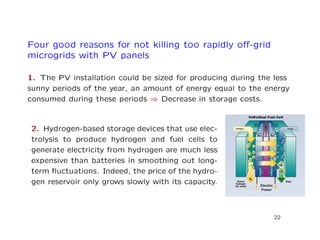
2. Hydrogen-based storage devices that use elec-
trolysis to produce hydrogen and fuel cells to
generate electricity from hydrogen are much less
expensive than batteries in smoothing out long-
term fluctuations. Indeed, the price of the hydro-
gen reservoir only grows slowly with its capacity.
22
3. The closer you get from the equator, the less this problem of
interseasonal fluctuation of PV energy production is marked. For
example, while in Belgium PV panels produce 3 times as much
energy in the six most sunny months of the years than during the
rest of the year, this factor drops to 1.8 in South of Spain.
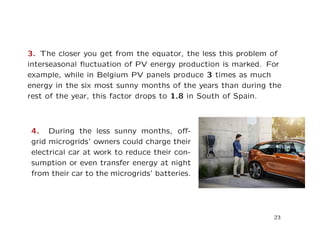
4. During the less sunny months, off-
grid microgrids’ owners could charge their
electrical car at work to reduce their con-
sumption or even transfer energy at night
from their car to the microgrids’ batteries.
23
Fully off-grid microgrids: a bargaining power for
microgrids
Microgrids connected to the grid are very likely to develop strongly in the coming
years if the other actors of the electrical system (producers, TSO, DNO,
government, consumers) do not push too hard for implementing changes in
regulation that would cut out - at least partially - their direct or indirect subsidies
(mostly, evading taxes linked to distribution and transmission tariffs and not
paying a fair share for the services the grid offers).
However, if regulation starts disfavoring microgrids too much, they may start
going off-grid. And, for the other actors of the power system, it may be better to
have microgrids not paying a fair share for the services the grid offers - but still
paying - rather than having fully off-grid microgrids. This is due to the huge fixed
costs of electrical networks.
What I suspect:
In many areas of the world, regulation for microgrids will settle to a point
for which it is more advantageous for microgrids to stay connected to the
grid than going fully off-grid.
24
Question 3a: What advice to give to production
companies to deal with microgrids?
Microgrids are serious competitors to traditional power production
companies, especially microgrids in sunny areas of the world.
They should lobby for a regulation that remunerates the energy
produced by PV panels at the wholesale market price. This would
probably imply arguing that there is no need to subsidize directly or
indirectly PV energy, which in turn may hurt their renewable energy
projects - mostly wind - for which they are looking for subsidies.
Microgrids or no microgrids, solar energy is very likely to become an
important source of electricity in the years to come. Therefore, they
should seek to develop large-scale hydrogen-based storage devices
having a high-efficiency to profit from seasonal variations of solar
power.
25
Question 3b: What advice to give to distribution
companies to deal with microgrids?
In many rural areas, distribution network customers often own large surfaces that
they can exploit for harvesting solar energy. Per MWh of energy distributed, rural
distribution networks are also more expensive than urban ones ⇒ Likely that in
sunny parts of the world, not too far from the equator, fully off-grid microgrids
solutions are or will be those that maximize the social welfare. Distribution
companies should not invest in these networks anymore.
Distribution networks are often seen as bottlenecks for transferring renewable
energy produced by sources connected to these networks to other consumers (due
to for example to overvoltage problems at the low-voltage level caused by PV
panels or congestion problems at the MT/HT transformer(s)). This often results
in curtailing the electrical production of renewable sources.
Question:
Should distribution companies seeking to maximize their own interests take
the necessary steps for better integrating renewable energy sources?
26
A few elements of answers:
1. Better integrating renewable energy will be an incentive for microgrids since
they will be able to sell more of their electricity surplus. Note that with
appropriate changes in the way grid costs are shared among grid users, the
development of microgrids is not necessarily a bad thing for distribution networks.
2. Not taking the necessary steps for integrating renewable energy sources will
slow down the development of microgrids. However, it may act as an incentive for
fully off-grid microgrids that jeopardize the survival of (parts of) distribution
networks.
3. Better integrating renewable energy implies new investments in the distribution
network that will increase distribution tariffs and so favor the business case for
fully off-grid microgrids. Rather than to rely on hefty investments in
infrastructure, distribution networks should develop relatively cheap active network
management schemes for integrating renewable sources of energy.
27
Question 3c: What advice to give to transmission
companies to deal with microgrids?
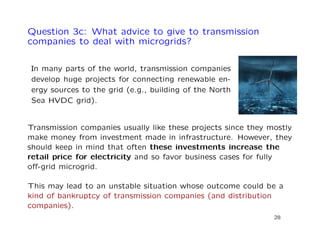
In many parts of the world, transmission companies
develop huge projects for connecting renewable en-
ergy sources to the grid (e.g., building of the North
Sea HVDC grid).
Transmission companies usually like these projects since they mostly
make money from investment made in infrastructure. However, they
should keep in mind that often these investments increase the
retail price for electricity and so favor business cases for fully
off-grid microgrid.
This may lead to an unstable situation whose outcome could be a
kind of bankruptcy of transmission companies (and distribution
companies).
28
Transmission companies should refocus on investments that decrease the retail
price of electricity.
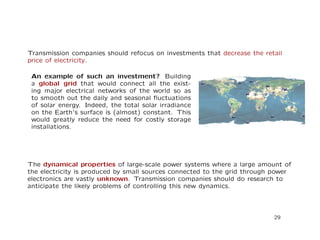
An example of such an investment? Building
a global grid that would connect all the exist-
ing major electrical networks of the world so as
to smooth out the daily and seasonal fluctuations
of solar energy. Indeed, the total solar irradiance
on the Earth’s surface is (almost) constant. This
would greatly reduce the need for costly storage
installations.
The dynamical properties of large-scale power systems where a large amount of
the electricity is produced by small sources connected to the grid through power
electronics are vastly unknown. Transmission companies should do research to
anticipate the likely problems of controlling this new dynamics.
29
Question 3d: What advice to give to governments to
deal with microgrids?
Adapt very carefully/dynamically the regulation for microgrids and subsidies for
renewable energy so as to mitigate the likelihood of: (a) not being able to pay
anymore for promised subsidies for renewable energy (b) having distribution or
transmission companies that may experience a kind of bankruptcy (c) Anger
microgrid owners by suddenly modifying their revenues.
Encourage distribution and transmission companies to increase their reserves of
cash or to finance without borrowing their new investments in infrastructure,
especially if they are doing business in sunny places.
A more speculative advice: Transmission and distribution companies are
regulated monopolies that have not benefited from competition. You may want to
organize competition between microgrids and these companies to help them to
become more cost-efficient/creative.
30
My recent research papers (loosely) related to the
material of this talk
“Active network management: planning under uncertainty for exploiting load
modulation”. Q. Gemine, E. Karangelos, D. Ernst and B. Corn´elusse.
Proceedings of the 2013 IREP Symposium-Bulk Power System Dynamics and
Control IX (IREP), Rethymnon, Greece, August 25-30, 2013.
“The global grid”. S. Chatzivasileiadis, D. Ernst and G. Andersson. Renewable
Energy, Volume 57, September 2013, pages 372-383.
“Estimating the revenues of a hydrogen-based high-capacity storage device:
methodology and results”. V. Fran¸cois-Lavet, R. Fonteneau and D. Ernst.
Proceedings of the 9th French Meeting on Planning, Decision Making and
Learning, Li`ege, Belgium, May 12-13, 2014.
“Relaxations for multi-period optimal power flow problems with discrete decision
variables”. Q. Gemine, D. Ernst, Q. Louveaux and B. Corn´elusse. Proceedings of
the 18th Power System Computation Conference (PSCC-14), Wroclaw, Poland,
August 18-24, 2014.
“Global power grids for harnessing world renewable energy”. S. Chatzivasileiadis,
D. Ernst and G. Andersson To appear in In Lawrence E. Jones (Ed.), Renewable
Energy Integration: Practical Management of Variability, Uncertainty and
Flexibility in Power Grids. To be published by Elsevier.
31

Microgrids and their destructuring eff ects on the electrical industry

  • 1.
    Microgrids and theirdestructuring effects on the electrical industry Prof. Damien Ernst University of Li`ege May 2014 1
  • 2.
    Microgrid: what isit? A microgrid is an electrical system that includes one or multiple loads as well as one or several distributed energy sources that can be operated in parallel with the broader utility grid. Examples of microgrids: 2
  • 3.
    The first powersystem, built in 1881, would be considered today as a neighborhood size fully in- dependent micro-grid. Power systems have progressively moved through the years towards a structure where most of the electricity is produced in large facilities, such as fossil fuel (coal, gas powered), nuclear, or hydropower plants and transmitted to loads through a transmission and a distribution network. This is the Generation-Transmission-Distribution (GTD) model. This progressive move has been caused by economies of scale in generation. 3
  • 4.
    These last fewyears, microgrids have been strongly developing and the GTD model seems to be loosing its (almost) absolute predominance. In this talk, we answer three main questions: Question 1: What are the main factors that have set off the development of microgrids? Question 2: Are microgrids an epiphenomenon? If no, to what extend will they develop? Question 3: What advice to give to (a) power production companies, (b) distribution companies (c) transmission companies, (d) governments to deal with microgrids? 4
  • 5.
    Question 1: Whatare the main factors driving the development of microgrids? The force behind microgrids development: the price of producing electricity next to the load(s) is cheaper than the retail price of electricity. Six factors fostering this force: Factor VI: Deregulation of power system industry has failed to make the GTD model more cost-efficient. The opposite has even happened due to the creation of new activities related to deregulation (trading activities, increased regulation, etc) and increased difficulties in optimizing/operating the GTD model in a deregulated environment. 5
  • 6.
    Factor V: Newnon-renewable- based micro-generation tech- nologies and, especially, co- generation ones. Factor IV: Direct subsidies for microgrids by subsidizing renewable energy. 6
  • 7.
    Factor III: Financingsubsidies for renewable energy by increasing the retail price of electricity. Factor II: Increase in distribution and transmission tariffs caused by microgrids that decrease the demand for the “product(s)” the grid can offer. Would not be the case if fixed costs were not so important for grids. This gives rises to an instability mechanism: decrease need for the grid ⇒ increase in trans- mission and distribution tariffs ⇒ fosters the de- velopment of microgrids ⇒ decrease need for the grid ⇒ . . . 7
  • 8.
    Factor I: Theimpressive cost reductions in PV panels that make PV energy relatively cheap in many places of the world (using the metric e/MWh produced). Note: Last domestic rooftop installations in Belgium have dropped in 2014 to an average price of 1.4 e/Wp. 8
  • 9.
    PV energy costversus retail tariffs in Spain and Belgium Computation of PV energy cost (in e/MWh): We use as data: (i) 1.4 e/Wp (ii) Load factor in Belgium (Spain) for PV: 10% (20 %) (iii) Lifetime of a PV installation: 20 years. Price in e/MWh computed as follows: Price installation in e Number of MWh produced over the lifetime of the installation Comparison: Spain Belgium PV energy 40 e/MWh 80 e/MWh Domestic retail price (2013) 200 e/MWh 220 e/MWh Industrial retail price (2013) 100 e/MWh 125 e/MWh Note: Average price of electricity on the Belgian wholesale market for 2013 is around 45 e/MWh. 9
  • 10.
    What you maysay: Your computation of the cost of PV energy - in e/MWh - is wrong because (a) you do not take into account the cost of replacing the inverter after ten years (b) you assume a zero cost of money. My answer: Taking into account the cost of replacing the inverter after 10 years would amount for less than 10% of the price of the installation. For the zero cost of money, it is reasonable to assume that individuals with savings in the bank may be better off by spending them on PV panels, even if they only get a pretty small return (2%-3%) on their investment. 10
  • 11.
    Question 2: Aremicrogrids an epiphenomenon? If no, to what extend will they develop? We provide hereafter a partial answer to these questions by focusing on the most disruptive factor for the traditional GTD model: PV energy. Given the cheap price of PV energy (according to the metric e/MWh produced), which is even likely to further fall in the coming years, we may be tempted to say that microgrids will generate in the near future the vast bulk of electricity and mark the fall of the GTD model. We discuss two factors that may significantly limit the growth of electricity generation by microgrids. 11
  • 12.
    Factor I: Limitedsurfaces for harvesting solar energy in microgrids Let us compute the maximum amount of energy that could be generated by microgrids in Belgium using PV panels. We use the following data/assumptions: (i) We assume that microgrids only exploit building envelopes to harvest solar energy. (ii) We assume that there are 10 of m2 of well-exposed building envelopes on which we can install PV panels. (iii) The average solar irradiance in Belgium is 110 W/m2. (iv) We use 20% efficient solar panels. (v) There are 11 million people living in Belgium. Maximum of energy that can be produced: 11×106 ×10×110×0.2×8760 1012 = 21 TWh (1 T = 1012). In Belgium, 91 TWh of electricity was consumed in 2010. So, under the above assumptions, less than a quarter of electricity consumption could be generated by PV panels in microgrids. 12
  • 13.
    Factor II: Marketmodel/regulation changes that will worsen business cases for microgrids Microgrids get services from the grid but do not pay a fair price for them. Even in a model where they are remunerated at the wholesale market price for injecting electricity into the grid and pay the retail price for taking electricity from the grid, they usually do not share a fair burden of the network costs (even if it is difficult to define what is fair). They also evade taxes that are often linked to distribution and transmission tariffs. With the rapid development of microgrids, such a situation is soon going to become unsustainable ⇒ New market models less favorable to microgrids will appear. 13
  • 14.
    Which market model(s)for microgrids will appear? Difficult to know to which market model(s) electrical systems will converge to. Let marketworst be the market model such that (i) the energy produced by PV panels in the microgrids (not the net energy injected by the microgrid into the network) is paid at the wholesale market price (ii) the load in the microgrid pays all the electricity it consumes at the market price. It is reasonable to conjecture that the system will not converge towards a market model that would lead to smaller revenues for microgrids than those obtained with marketworst. Question: Would microgrids survive the market model marketworst? 14
  • 15.
    Let us analyzethe case where all the electricity is generated by PV panels. In such a context, PV panels installed in microgrids would have to compete with large PV farms that (i) could be installed in sunnier places (ii) could benefit from economies of scales. The competitive advantages of microgrids would be (i) the free use of surfaces (e.g., rooftops) (ii) pos- sibility to exploit building-integrated photovoltaics (BIPV) (i.e., photovoltaic materials that are used to replace conventional building materials in parts of the building envelope such as the roof, skylights, or facades) that can lead to smaller cost per Wp of PV material installed if we subtract to the cost of the BIPV materials, the cost of traditional construction materials. 15
  • 16.
    Going fully offgrid If the market model becomes too unfavorable to microgrids, they may decide to go fully off- grid. First condition for going off grid: To be sure that your PV panels generate enough energy over a long period of time to cover your energy needs during this period of time (or at least if it is not the case, to be able to get additional electrical energy to your microgrid without connecting to the grid (e.g., backup generator, good neighbors, etc)). Second condition: To have adequate flexibility means in your microgrid (e.g., modulation of the demand, storage devices, etc) for being able to balance at any time production of electricity with consumption. 16
  • 17.
    Solving the problemof fluctuation of energy production in a microgrid: how much would it cost? We focus on the case where electricity is stored using bat- teries. First, we study the problem of intraday fluctuation of PV energy production in microgrids. In such a context, we want to know the cost of installing batteries for solving this fluctuation problem for 1 MWp of installed PV pan- els in microgrids in Belgium. Remember that installing 1 MWp of PV panels costs about 1.4 million e. We make the following assumptions: (i) Production of PV energy equal to zero between 4pm and 10am (ii) Production of PV energy constant between 10am and 4pm and the same every day of the year (iii) Load factor for PV panels in Belgium: 10% (iv) Load always constant and energy consumed by the load over one day equal to energy produced by the PV panels (v) Cost of batteries: 200 e/kWh (vi) Round-trip efficiency of the batteries equal to 1. 17
  • 18.
    Solution: During 10am and4pm, 0.1 × 24 × 1 = 2.4 MWh are produced by the PV panels. But only 6 24 × 2.4 = 0.6 MWh are consumed ⇒ Storage needs: 1.8 MWh. Cost of storage: 1.8 × 1000 × 200 = 360, 000 e ⇒ Increases the cost of PV energy by a factor: 1,400,000+360,000 1,400,000 1.25. How does it affect the price? Price in Belgium PV energy with storage (for intraday fluctuation) 100 e/MWh PV energy without storage 80 e/MWh Domestic retail price (2013) 220 e/MWh Industrial retail price (2013) 125 e/MWh 18
  • 19.
    How much wouldit cost in terms of storage to store seasonal fluctuations? Average solar irradiance figures (in kWh/day/m2) in Belgium Jan Feb Mar Apr May Jun Jul Aug Sep Oct Nov Dec 0.9 1.5 2.5 3.7 4.8 5.0 4.9 4.3 2.9 1.8 1.0 0.7 The six months with the highest solar irradiance are April till September. On average, solar irradiance during these 6 months is 4.3 1.4 3 times higher than during the period October-March. We are now interested to compute the storage costs with batteries to smooth out this seasonal fluctuation of PV energy production for a set microgrids located in Belgium and having a total of 1 MWp of installed PV panels. 19
  • 20.
    Solution: The energyproduction of the 1 MWp of PV panels during one year is: 0.1 × 8760 = 876 MWh. To smooth out the seasonal fluctuation of PV energy, a quarter of this energy would have to be stored during the sunny period (April-September) ⇒ Storage needs 217 MWh ⇒ Cost of storage= 217 × 1000 × 200 43 million of e ⇒ Increases the cost of PV energy by a factor: 1.4+43 1.4 31. How does it affect the price? Price in Belgium PV energy with storage (for seasonal fluctuations) 2480 e/MWh PV energy with storage (for intraday fluctuations) 100 e/MWh PV energy without storage 80 e/MWh Domestic retail price (2013) 220 e/MWh Industrial retail price (2013) 125 e/MWh 20
  • 21.
    You may say: Thesenumbers show for certain that fully off-grid microgrids powered by PV panels will never appear due to this problem of interseasonal fluctuations of PV energy production. My question: Are you really certain about this? 21
  • 22.
    Four good reasonsfor not killing too rapidly off-grid microgrids with PV panels 1. The PV installation could be sized for producing during the less sunny periods of the year, an amount of energy equal to the energy consumed during these periods ⇒ Decrease in storage costs. 2. Hydrogen-based storage devices that use elec- trolysis to produce hydrogen and fuel cells to generate electricity from hydrogen are much less expensive than batteries in smoothing out long- term fluctuations. Indeed, the price of the hydro- gen reservoir only grows slowly with its capacity. 22
  • 23.
    3. The closeryou get from the equator, the less this problem of interseasonal fluctuation of PV energy production is marked. For example, while in Belgium PV panels produce 3 times as much energy in the six most sunny months of the years than during the rest of the year, this factor drops to 1.8 in South of Spain. 4. During the less sunny months, off- grid microgrids’ owners could charge their electrical car at work to reduce their con- sumption or even transfer energy at night from their car to the microgrids’ batteries. 23
  • 24.
    Fully off-grid microgrids:a bargaining power for microgrids Microgrids connected to the grid are very likely to develop strongly in the coming years if the other actors of the electrical system (producers, TSO, DNO, government, consumers) do not push too hard for implementing changes in regulation that would cut out - at least partially - their direct or indirect subsidies (mostly, evading taxes linked to distribution and transmission tariffs and not paying a fair share for the services the grid offers). However, if regulation starts disfavoring microgrids too much, they may start going off-grid. And, for the other actors of the power system, it may be better to have microgrids not paying a fair share for the services the grid offers - but still paying - rather than having fully off-grid microgrids. This is due to the huge fixed costs of electrical networks. What I suspect: In many areas of the world, regulation for microgrids will settle to a point for which it is more advantageous for microgrids to stay connected to the grid than going fully off-grid. 24
  • 25.
    Question 3a: Whatadvice to give to production companies to deal with microgrids? Microgrids are serious competitors to traditional power production companies, especially microgrids in sunny areas of the world. They should lobby for a regulation that remunerates the energy produced by PV panels at the wholesale market price. This would probably imply arguing that there is no need to subsidize directly or indirectly PV energy, which in turn may hurt their renewable energy projects - mostly wind - for which they are looking for subsidies. Microgrids or no microgrids, solar energy is very likely to become an important source of electricity in the years to come. Therefore, they should seek to develop large-scale hydrogen-based storage devices having a high-efficiency to profit from seasonal variations of solar power. 25
  • 26.
    Question 3b: Whatadvice to give to distribution companies to deal with microgrids? In many rural areas, distribution network customers often own large surfaces that they can exploit for harvesting solar energy. Per MWh of energy distributed, rural distribution networks are also more expensive than urban ones ⇒ Likely that in sunny parts of the world, not too far from the equator, fully off-grid microgrids solutions are or will be those that maximize the social welfare. Distribution companies should not invest in these networks anymore. Distribution networks are often seen as bottlenecks for transferring renewable energy produced by sources connected to these networks to other consumers (due to for example to overvoltage problems at the low-voltage level caused by PV panels or congestion problems at the MT/HT transformer(s)). This often results in curtailing the electrical production of renewable sources. Question: Should distribution companies seeking to maximize their own interests take the necessary steps for better integrating renewable energy sources? 26
  • 27.
    A few elementsof answers: 1. Better integrating renewable energy will be an incentive for microgrids since they will be able to sell more of their electricity surplus. Note that with appropriate changes in the way grid costs are shared among grid users, the development of microgrids is not necessarily a bad thing for distribution networks. 2. Not taking the necessary steps for integrating renewable energy sources will slow down the development of microgrids. However, it may act as an incentive for fully off-grid microgrids that jeopardize the survival of (parts of) distribution networks. 3. Better integrating renewable energy implies new investments in the distribution network that will increase distribution tariffs and so favor the business case for fully off-grid microgrids. Rather than to rely on hefty investments in infrastructure, distribution networks should develop relatively cheap active network management schemes for integrating renewable sources of energy. 27
  • 28.
    Question 3c: Whatadvice to give to transmission companies to deal with microgrids? In many parts of the world, transmission companies develop huge projects for connecting renewable en- ergy sources to the grid (e.g., building of the North Sea HVDC grid). Transmission companies usually like these projects since they mostly make money from investment made in infrastructure. However, they should keep in mind that often these investments increase the retail price for electricity and so favor business cases for fully off-grid microgrid. This may lead to an unstable situation whose outcome could be a kind of bankruptcy of transmission companies (and distribution companies). 28
  • 29.
    Transmission companies shouldrefocus on investments that decrease the retail price of electricity. An example of such an investment? Building a global grid that would connect all the exist- ing major electrical networks of the world so as to smooth out the daily and seasonal fluctuations of solar energy. Indeed, the total solar irradiance on the Earth’s surface is (almost) constant. This would greatly reduce the need for costly storage installations. The dynamical properties of large-scale power systems where a large amount of the electricity is produced by small sources connected to the grid through power electronics are vastly unknown. Transmission companies should do research to anticipate the likely problems of controlling this new dynamics. 29
  • 30.
    Question 3d: Whatadvice to give to governments to deal with microgrids? Adapt very carefully/dynamically the regulation for microgrids and subsidies for renewable energy so as to mitigate the likelihood of: (a) not being able to pay anymore for promised subsidies for renewable energy (b) having distribution or transmission companies that may experience a kind of bankruptcy (c) Anger microgrid owners by suddenly modifying their revenues. Encourage distribution and transmission companies to increase their reserves of cash or to finance without borrowing their new investments in infrastructure, especially if they are doing business in sunny places. A more speculative advice: Transmission and distribution companies are regulated monopolies that have not benefited from competition. You may want to organize competition between microgrids and these companies to help them to become more cost-efficient/creative. 30
  • 31.
    My recent researchpapers (loosely) related to the material of this talk “Active network management: planning under uncertainty for exploiting load modulation”. Q. Gemine, E. Karangelos, D. Ernst and B. Corn´elusse. Proceedings of the 2013 IREP Symposium-Bulk Power System Dynamics and Control IX (IREP), Rethymnon, Greece, August 25-30, 2013. “The global grid”. S. Chatzivasileiadis, D. Ernst and G. Andersson. Renewable Energy, Volume 57, September 2013, pages 372-383. “Estimating the revenues of a hydrogen-based high-capacity storage device: methodology and results”. V. Fran¸cois-Lavet, R. Fonteneau and D. Ernst. Proceedings of the 9th French Meeting on Planning, Decision Making and Learning, Li`ege, Belgium, May 12-13, 2014. “Relaxations for multi-period optimal power flow problems with discrete decision variables”. Q. Gemine, D. Ernst, Q. Louveaux and B. Corn´elusse. Proceedings of the 18th Power System Computation Conference (PSCC-14), Wroclaw, Poland, August 18-24, 2014. “Global power grids for harnessing world renewable energy”. S. Chatzivasileiadis, D. Ernst and G. Andersson To appear in In Lawrence E. Jones (Ed.), Renewable Energy Integration: Practical Management of Variability, Uncertainty and Flexibility in Power Grids. To be published by Elsevier. 31