INDIA
ERICSSON MOBILITY REPORT
2016JUNE
2  ERICSSON MOBILITY REPORT INDIA JUNE 2016
MARKET
OVERVIEW
There will be 810 million Indian smartphone subscriptions by 2021
South Asia is projected to be a bright spot amongst
developing economies, with India being the dominant
economy in the region, as well as the second largest
telecommunications market in the world in terms of
subscriptions.1
The Indian economy is projected to grow by
7.4 percent in 2016.2
Liberal telecom policies, deregulation of
foreign direct investment (FDI) and strong consumer demand
have led to the rapid growth of the telecom sector in India.
There is a clear urban-rural divide in the telecommunications
sector in India. The teledensity in urban areas is three times
higher than in rural areas, as of the end of 2015, and the
divide is even higher for internet users. Internet subscription
has huge growth potential in both rural and urban areas
in India, with total subscription at just 25 percent of
the population.3
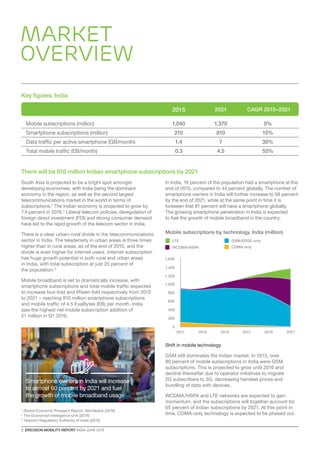
Mobile broadband is set to dramatically increase, with
smartphone subscriptions and total mobile traffic expected
to increase four-fold and fifteen-fold respectively from 2015
to 2021 – reaching 810 million smartphone subscriptions
and mobile traffic of 4.5 ExaBytes (EB) per month. India
saw the highest net mobile subscription addition of
21 million in Q1 2016.
In India, 16 percent of the population had a smartphone at the
end of 2015, compared to 44 percent globally. The number of
smartphone owners in India will further increase to 58 percent
by the end of 2021, while at the same point in time it is
foreseen that 81 percent will have a smartphone globally.
The growing smartphone penetration in India is expected
to fuel the growth of mobile broadband in the country.
1
Global Economic Prospect Report, Worldbank (2016)
2
The Economist Intelligence Unit (2016)
3
Telecom Regulatory Authority of India (2015)
Mobile subscriptions by technology, India (million)
GSM/EDGE-only
CDMA-onlyWCDMA/HSPA
LTE
1,400
1,600
0
200
400
600
800
1,000
1,200
2011 2013 2015 2017 2019 2021
Key figures: India
2015 2021 CAGR 2015–2021
Mobile subscriptions (million) 1,040 1,370 5%
Smartphone subscriptions (million) 210 810 15%
Data traffic per active smartphone (GB/month) 1.4 7 30%
Total mobile traffic (EB/month) 0.3 4.5 55%
Shift in mobile technology
GSM still dominates the Indian market. In 2015, over
80 percent of mobile subscriptions in India were GSM
subscriptions. This is projected to grow until 2016 and
decline thereafter due to operator initiatives to migrate
2G subscribers to 3G, decreasing handset prices and
bundling of data with devices.
WCDMA/HSPA and LTE networks are expected to gain
momentum, and the subscriptions will together account for
65 percent of Indian subscriptions by 2021. At this point in
time, CDMA-only technology is expected to be phased out.
Smartphone owners in India will increase
to almost 60 percent by 2021 and fuel
the growth of mobile broadband usage
INDIA JUNE 2016 ERICSSON MOBILITY REPORT  3
Data gaining prominence over voice for smartphone users in India
Calls and text messages are the top two activities of
smartphone users. In India, web browsing, emailing and
social networking are the top three internet activities on
smartphones, which is aligned to the global trend. Around
15 percent of smartphone users in India make online video
calls daily, and this is similar to the global average.4
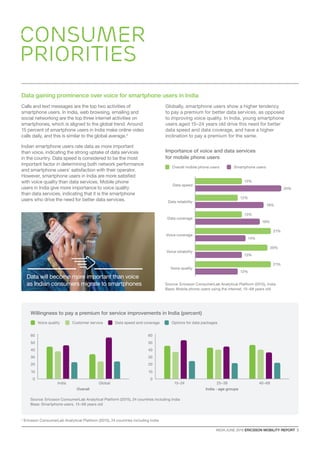
Indian smartphone users rate data as more important
than voice, indicating the strong uptake of data services
in the country. Data speed is considered to be the most
important factor in determining both network performance
and smartphone users’ satisfaction with their operator.
However, smartphone users in India are more satisfied
with voice quality than data services. Mobile phone
users in India give more importance to voice quality
than data services, indicating that it is the smartphone
users who drive the need for better data services.
Globally, smartphone users show a higher tendency
to pay a premium for better data services, as opposed
to improving voice quality. In India, young smartphone
users aged 15–24 years old drive this need for better
data speed and data coverage, and have a higher
inclination to pay a premium for the same.
30 30
Willingness to pay a premium for service improvements in India (percent)
Source: Ericsson ConsumerLab Analytical Platform (2015), 24 countries including India
Base: Smartphone users, 15–69 years old
4
Ericsson ConsumerLab Analytical Platform (2015), 24 countries including India
Consumer
priorities
Importance of voice and data services
for mobile phone users
Source: Ericsson ConsumerLab Analytical Platform (2015), India
Base: Mobile phone users using the internet, 15–69 years old
Data speed
Voice coverage
Data reliability
Voice reliability
Data coverage
Voice quality
13%
21%
12%
20%
13%
21%
24%
14%
19%
13%
18%
12%
India
Overall
15–24
India - age groups
40–69Global 25–39
60 60
0 0
10 10
20 20
40 40
50 50
Voice quality
Overall mobile phone users
Data speed and coverageCustomer service
Smartphone users
Options for data packages
Data will become more important than voice
as Indian consumers migrate to smartphones
4  ERICSSON MOBILITY REPORT INDIA JUNE 2016
Over 70 percent of Indian internet users consider being
contactable online as important. Consumers in India rely on
reviews posted on online forums and express their views on
blogs and social networks. Social forum feedback is trusted
more than other sources, and around 90 percent of internet
users in India are part of at least one social networking group.5
Consumers use e-commerce websites and mobile apps to
purchase products online. Online product reviews influence
purchasing, with over 25 percent of users in India relying on
the internet to research products and services before buying.5
Smartphone usage is increasing in India, specifically among
younger generations; with over 77 percent of smartphone
users aged 15–24 years old using the internet on their
smartphone every day. Smartphones are also widely used to
browse the internet, with over 71 percent of consumers using
it on a weekly basis, while more than one in two smartphone
users play games and access emails on their smartphone.5
This increasing mobile broadband usage is also facilitating
m-commerce activities. Around 40 percent of smartphone
users aged 15–24 years old purchase products using mobile
payments on a weekly basis. Mobile banking activities are also
increasing, with over 30 percent of users accessing banking
websites via their smartphone, or using mobile banking apps.5
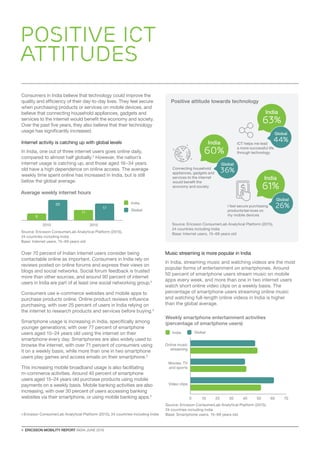
Music streaming is more popular in India
In India, streaming music and watching videos are the most
popular forms of entertainment on smartphones. Around
50 percent of smartphone users stream music on mobile
apps every week, and more than one in two internet users
watch short online video clips on a weekly basis. The
percentage of smartphone users streaming online music
and watching full-length online videos in India is higher
than the global average.
Consumers in India believe that technology could improve the
quality and efficiency of their day-to-day lives. They feel secure
when purchasing products or services on mobile devices, and
believe that connecting household appliances, gadgets and
services to the internet would benefit the economy and society.
Over the past five years, they also believe that their technology
usage has significantly increased.
Internet activity is catching up with global levels
In India, one out of three internet users goes online daily,
compared to almost half globally.5
However, the nation’s
internet usage is catching up, and those aged 16–34 years
old have a high dependence on online access. The average
weekly time spent online has increased in India, but is still
below the global average.
Positive ICT
attitudes
Positive attitude towards technology
Connecting household
appliances, gadgets and
services to the internet
would benefit the
economy and society
India
60%
Global
36%
India
63%
Global
44%ICT helps me lead
a more successful life
through technology
I feel secure purchasing
products/services on
my mobile devices
India
61%
Global
26%
Source: Ericsson ConsumerLab Analytical Platform (2015),
24 countries including India
Base: Internet users, 15–69 years old
Source: Ericsson ConsumerLab Analytical Platform (2015),
24 countries including India
Base: Internet users, 15–69 years old
6
11
2010 2015
20
17
Average weekly internet hours
Global
India
5 Ericsson ConsumerLab Analytical Platform (2015), 24 countries including India
GlobalIndia
Source: Ericsson ConsumerLab Analytical Platform (2015),
24 countries including India
Base: Smartphone users, 15–69 years old
Weekly smartphone entertainment activities
(percentage of smartphone users)
100 20 5030 40 7060
Video clips
Online music
streaming
Movies, TV
and sports
INDIA JUNE 2016 ERICSSON MOBILITY REPORT  5
E-commerce apps growing in popularity
Smartphone users primarily access the internet on their mobile
devices in India. With the projected growth of 3G and 4G
subscriptions in India, mobile app usage is expected to rise.
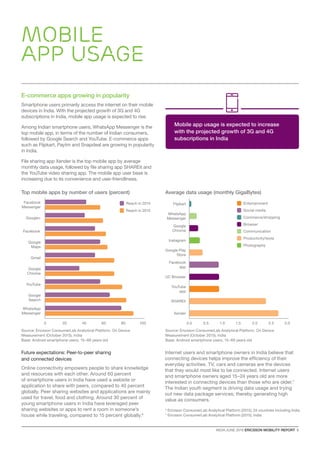
Among Indian smartphone users, WhatsApp Messenger is the
top mobile app, in terms of the number of Indian consumers,
followed by Google Search and YouTube. E-commerce apps
such as Flipkart, Paytm and Snapdeal are growing in popularity
in India.
File sharing app Xender is the top mobile app by average
monthly data usage, followed by file sharing app SHAREit and
the YouTube video sharing app. The mobile app user base is
increasing due to its convenience and user-friendliness.
Internet users and smartphone owners in India believe that
connecting devices helps improve the efficiency of their
everyday activities. TV, cars and cameras are the devices
that they would most like to be connected. Internet users
and smartphone owners aged 15–24 years old are more
interested in connecting devices than those who are older.7
The Indian youth segment is driving data usage and trying
out new data package services; thereby generating high
value as consumers.
Future expectations: Peer-to-peer sharing
and connected devices
Online connectivity empowers people to share knowledge
and resources with each other. Around 60 percent
of smartphone users in India have used a website or
application to share with peers, compared to 40 percent
globally. Peer sharing websites and applications are mainly
used for travel, food and clothing. Around 30 percent of
young smartphone users in India have leveraged peer
sharing websites or apps to rent a room in someone’s
house while traveling, compared to 15 percent globally.6
Mobile
app usage
Source: Ericsson ConsumerLab Analytical Platform, On Device
Measurement (October 2015), India
Base: Android smartphone users, 15–69 years old
Source: Ericsson ConsumerLab Analytical Platform, On Device
Measurement (October 2015), India
Base: Android smartphone users, 15–69 years old
6
Ericsson ConsumerLab Analytical Platform (2015), 24 countries including India
7
Ericsson ConsumerLab Analytical Platform (2015), India
Top mobile apps by number of users (percent)
Reach in 2014
Reach in 2015
0 20 40 8060 100
Facebook
Messenger
Google
Maps
YouTube
Google+
Gmail
Google
Search
Facebook
Google
Chrome
WhatsApp
Messenger
Average data usage (monthly GigaBytes)
Productivity/tools
Photography
Entertainment
Social media
Commerce/shopping
Browser
Communication
0.0 0.5 1.0 1.5 2.0 2.5 3.0
Xender
Instagram
Flipkart
Facebook
app
Google
Chrome
YouTube
app
Google Play
Store
WhatsApp
Messenger
UC Browser
SHAREit
Mobile app usage is expected to increase
with the projected growth of 3G and 4G
subscriptions in India
6  ERICSSON MOBILITY REPORT INDIA JUNE 2016
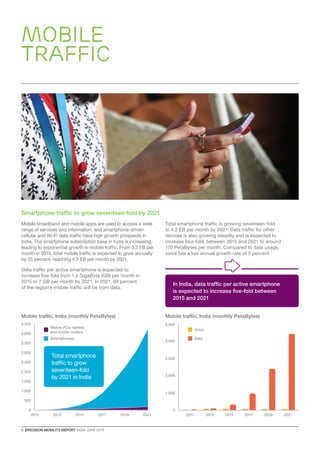
Smartphone traffic to grow seventeen-fold by 2021
Mobile broadband and mobile apps are used to access a wide
range of services and information, and smartphone-driven
cellular and Wi-Fi data traffic have high growth prospects in
India. The smartphone subscription base in India is increasing,
leading to exponential growth in mobile traffic. From 0.3 EB per
month in 2015, total mobile traffic is expected to grow annually
by 55 percent, reaching 4.5 EB per month by 2021.
Data traffic per active smartphone is expected to
increase five-fold from 1.4 GigaByte (GB) per month in
2015 to 7 GB per month by 2021. In 2021, 99 percent
of the region’s mobile traffic will be from data.
Total smartphone traffic is growing seventeen-fold
to 4.2 EB per month by 2021. Data traffic for other
devices is also growing steadily and is expected to
increase four-fold, between 2015 and 2021 to around
170 PetaBytes per month. Compared to data usage,
voice has a low annual growth rate of 3 percent.
Mobile
Traffic
Mobile traffic, India (monthly PetaBytes) Mobile traffic, India (monthly PetaBytes)
0 0
500
1,000
1,000
1,500
2,000
2,000
2,500
3,000
3,000
3,500
4,000
4,000
5,0004,500
2011 2011 2013 2015 2017 2019 20212013 2015 2017 2019 2021
In India, data traffic per active smartphone
is expected to increase five-fold between
2015 and 2021
Total smartphone
traffic to grow
seventeen-fold
by 2021 in India
Mobile PCs, tablets
and mobile routers
Voice
Smartphones Data
INDIA JUNE 2016 ERICSSON MOBILITY REPORT  7
Network
Performance
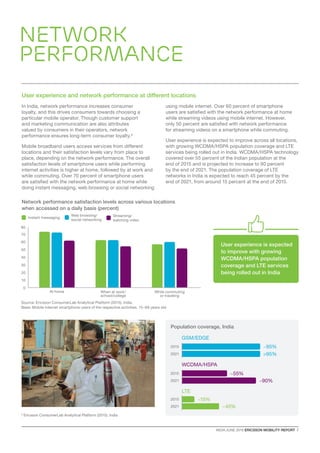
User experience and network performance at different locations
In India, network performance increases consumer
loyalty, and this drives consumers towards choosing a
particular mobile operator. Though customer support
and marketing communication are also attributes
valued by consumers in their operators, network
performance ensures long-term consumer loyalty.8
Mobile broadband users access services from different
locations and their satisfaction levels vary from place to
place, depending on the network performance. The overall
satisfaction levels of smartphone users while performing
internet activities is higher at home, followed by at work and
while commuting. Over 70 percent of smartphone users
are satisfied with the network performance at home while
doing instant messaging, web browsing or social networking
using mobile internet. Over 60 percent of smartphone
users are satisfied with the network performance at home
while streaming videos using mobile internet. However,
only 50 percent are satisfied with network performance
for streaming videos on a smartphone while commuting.
User experience is expected to improve across all locations,
with growing WCDMA/HSPA population coverage and LTE
services being rolled out in India. WCDMA/HSPA technology
covered over 55 percent of the Indian population at the
end of 2015 and is projected to increase to 90 percent
by the end of 2021. The population coverage of LTE
networks in India is expected to reach 45 percent by the
end of 2021, from around 15 percent at the end of 2015.
Population coverage, India
Network performance satisfaction levels across various locations
when accessed on a daily basis (percent)
User experience is expected
to improve with growing
WCDMA/HSPA population
coverage and LTE services
being rolled out in India
2015
2021
~15%
~45%
LTE
2015
2021
~95%
95%
GSM/EDGE
2015
2021
~55%
~90%
WCDMA/HSPA
30
At home When at work/
school/college
While commuting
or traveling
60
70
80
0
10
20
40
50
Web browsing/
social networking
Instant messaging Streaming/
watching video
Source: Ericsson ConsumerLab Analytical Platform (2015), India
Base: Mobile internet smartphone users of the respective activities, 15–69 years old
8
Ericsson ConsumerLab Analytical Platform (2015), India
EAB-16:006602 Uen
© Ericsson AB 2016
Ericsson
SE-164 80 Stockholm, Sweden
Telephone +46 10 719 0000
www.ericsson.com
Ericsson is the driving force behind the Networked Society – a world leader in
communications technology and services. Our long-term relationships with every
major telecom operator in the world allow people, business and society to fulfill their
potential and create a more sustainable future.
Our services, software and infrastructure – especially in mobility, broadband and the
cloud – are enabling the telecom industry and other sectors to do better business,
increase efficiency, improve the user experience and capture new opportunities.
With approximately 115,000 professionals and customers in 180 countries, we
combine global scale with technology and services leadership. We support networks
that connect more than 2.5 billion subscribers. Forty percent of the world’s mobile
traffic is carried over Ericsson networks. And our investments in research and
development ensure that our solutions – and our customers – stay in front.

Ericsson Mobility Report, June 2016 - Regional report India

  • 1.
  • 2.
    2  ERICSSON MOBILITYREPORT INDIA JUNE 2016 MARKET OVERVIEW There will be 810 million Indian smartphone subscriptions by 2021 South Asia is projected to be a bright spot amongst developing economies, with India being the dominant economy in the region, as well as the second largest telecommunications market in the world in terms of subscriptions.1 The Indian economy is projected to grow by 7.4 percent in 2016.2 Liberal telecom policies, deregulation of foreign direct investment (FDI) and strong consumer demand have led to the rapid growth of the telecom sector in India. There is a clear urban-rural divide in the telecommunications sector in India. The teledensity in urban areas is three times higher than in rural areas, as of the end of 2015, and the divide is even higher for internet users. Internet subscription has huge growth potential in both rural and urban areas in India, with total subscription at just 25 percent of the population.3 Mobile broadband is set to dramatically increase, with smartphone subscriptions and total mobile traffic expected to increase four-fold and fifteen-fold respectively from 2015 to 2021 – reaching 810 million smartphone subscriptions and mobile traffic of 4.5 ExaBytes (EB) per month. India saw the highest net mobile subscription addition of 21 million in Q1 2016. In India, 16 percent of the population had a smartphone at the end of 2015, compared to 44 percent globally. The number of smartphone owners in India will further increase to 58 percent by the end of 2021, while at the same point in time it is foreseen that 81 percent will have a smartphone globally. The growing smartphone penetration in India is expected to fuel the growth of mobile broadband in the country. 1 Global Economic Prospect Report, Worldbank (2016) 2 The Economist Intelligence Unit (2016) 3 Telecom Regulatory Authority of India (2015) Mobile subscriptions by technology, India (million) GSM/EDGE-only CDMA-onlyWCDMA/HSPA LTE 1,400 1,600 0 200 400 600 800 1,000 1,200 2011 2013 2015 2017 2019 2021 Key figures: India 2015 2021 CAGR 2015–2021 Mobile subscriptions (million) 1,040 1,370 5% Smartphone subscriptions (million) 210 810 15% Data traffic per active smartphone (GB/month) 1.4 7 30% Total mobile traffic (EB/month) 0.3 4.5 55% Shift in mobile technology GSM still dominates the Indian market. In 2015, over 80 percent of mobile subscriptions in India were GSM subscriptions. This is projected to grow until 2016 and decline thereafter due to operator initiatives to migrate 2G subscribers to 3G, decreasing handset prices and bundling of data with devices. WCDMA/HSPA and LTE networks are expected to gain momentum, and the subscriptions will together account for 65 percent of Indian subscriptions by 2021. At this point in time, CDMA-only technology is expected to be phased out. Smartphone owners in India will increase to almost 60 percent by 2021 and fuel the growth of mobile broadband usage
  • 3.
    INDIA JUNE 2016ERICSSON MOBILITY REPORT  3 Data gaining prominence over voice for smartphone users in India Calls and text messages are the top two activities of smartphone users. In India, web browsing, emailing and social networking are the top three internet activities on smartphones, which is aligned to the global trend. Around 15 percent of smartphone users in India make online video calls daily, and this is similar to the global average.4 Indian smartphone users rate data as more important than voice, indicating the strong uptake of data services in the country. Data speed is considered to be the most important factor in determining both network performance and smartphone users’ satisfaction with their operator. However, smartphone users in India are more satisfied with voice quality than data services. Mobile phone users in India give more importance to voice quality than data services, indicating that it is the smartphone users who drive the need for better data services. Globally, smartphone users show a higher tendency to pay a premium for better data services, as opposed to improving voice quality. In India, young smartphone users aged 15–24 years old drive this need for better data speed and data coverage, and have a higher inclination to pay a premium for the same. 30 30 Willingness to pay a premium for service improvements in India (percent) Source: Ericsson ConsumerLab Analytical Platform (2015), 24 countries including India Base: Smartphone users, 15–69 years old 4 Ericsson ConsumerLab Analytical Platform (2015), 24 countries including India Consumer priorities Importance of voice and data services for mobile phone users Source: Ericsson ConsumerLab Analytical Platform (2015), India Base: Mobile phone users using the internet, 15–69 years old Data speed Voice coverage Data reliability Voice reliability Data coverage Voice quality 13% 21% 12% 20% 13% 21% 24% 14% 19% 13% 18% 12% India Overall 15–24 India - age groups 40–69Global 25–39 60 60 0 0 10 10 20 20 40 40 50 50 Voice quality Overall mobile phone users Data speed and coverageCustomer service Smartphone users Options for data packages Data will become more important than voice as Indian consumers migrate to smartphones
  • 4.
    4  ERICSSON MOBILITYREPORT INDIA JUNE 2016 Over 70 percent of Indian internet users consider being contactable online as important. Consumers in India rely on reviews posted on online forums and express their views on blogs and social networks. Social forum feedback is trusted more than other sources, and around 90 percent of internet users in India are part of at least one social networking group.5 Consumers use e-commerce websites and mobile apps to purchase products online. Online product reviews influence purchasing, with over 25 percent of users in India relying on the internet to research products and services before buying.5 Smartphone usage is increasing in India, specifically among younger generations; with over 77 percent of smartphone users aged 15–24 years old using the internet on their smartphone every day. Smartphones are also widely used to browse the internet, with over 71 percent of consumers using it on a weekly basis, while more than one in two smartphone users play games and access emails on their smartphone.5 This increasing mobile broadband usage is also facilitating m-commerce activities. Around 40 percent of smartphone users aged 15–24 years old purchase products using mobile payments on a weekly basis. Mobile banking activities are also increasing, with over 30 percent of users accessing banking websites via their smartphone, or using mobile banking apps.5 Music streaming is more popular in India In India, streaming music and watching videos are the most popular forms of entertainment on smartphones. Around 50 percent of smartphone users stream music on mobile apps every week, and more than one in two internet users watch short online video clips on a weekly basis. The percentage of smartphone users streaming online music and watching full-length online videos in India is higher than the global average. Consumers in India believe that technology could improve the quality and efficiency of their day-to-day lives. They feel secure when purchasing products or services on mobile devices, and believe that connecting household appliances, gadgets and services to the internet would benefit the economy and society. Over the past five years, they also believe that their technology usage has significantly increased. Internet activity is catching up with global levels In India, one out of three internet users goes online daily, compared to almost half globally.5 However, the nation’s internet usage is catching up, and those aged 16–34 years old have a high dependence on online access. The average weekly time spent online has increased in India, but is still below the global average. Positive ICT attitudes Positive attitude towards technology Connecting household appliances, gadgets and services to the internet would benefit the economy and society India 60% Global 36% India 63% Global 44%ICT helps me lead a more successful life through technology I feel secure purchasing products/services on my mobile devices India 61% Global 26% Source: Ericsson ConsumerLab Analytical Platform (2015), 24 countries including India Base: Internet users, 15–69 years old Source: Ericsson ConsumerLab Analytical Platform (2015), 24 countries including India Base: Internet users, 15–69 years old 6 11 2010 2015 20 17 Average weekly internet hours Global India 5 Ericsson ConsumerLab Analytical Platform (2015), 24 countries including India GlobalIndia Source: Ericsson ConsumerLab Analytical Platform (2015), 24 countries including India Base: Smartphone users, 15–69 years old Weekly smartphone entertainment activities (percentage of smartphone users) 100 20 5030 40 7060 Video clips Online music streaming Movies, TV and sports
  • 5.
    INDIA JUNE 2016ERICSSON MOBILITY REPORT  5 E-commerce apps growing in popularity Smartphone users primarily access the internet on their mobile devices in India. With the projected growth of 3G and 4G subscriptions in India, mobile app usage is expected to rise. Among Indian smartphone users, WhatsApp Messenger is the top mobile app, in terms of the number of Indian consumers, followed by Google Search and YouTube. E-commerce apps such as Flipkart, Paytm and Snapdeal are growing in popularity in India. File sharing app Xender is the top mobile app by average monthly data usage, followed by file sharing app SHAREit and the YouTube video sharing app. The mobile app user base is increasing due to its convenience and user-friendliness. Internet users and smartphone owners in India believe that connecting devices helps improve the efficiency of their everyday activities. TV, cars and cameras are the devices that they would most like to be connected. Internet users and smartphone owners aged 15–24 years old are more interested in connecting devices than those who are older.7 The Indian youth segment is driving data usage and trying out new data package services; thereby generating high value as consumers. Future expectations: Peer-to-peer sharing and connected devices Online connectivity empowers people to share knowledge and resources with each other. Around 60 percent of smartphone users in India have used a website or application to share with peers, compared to 40 percent globally. Peer sharing websites and applications are mainly used for travel, food and clothing. Around 30 percent of young smartphone users in India have leveraged peer sharing websites or apps to rent a room in someone’s house while traveling, compared to 15 percent globally.6 Mobile app usage Source: Ericsson ConsumerLab Analytical Platform, On Device Measurement (October 2015), India Base: Android smartphone users, 15–69 years old Source: Ericsson ConsumerLab Analytical Platform, On Device Measurement (October 2015), India Base: Android smartphone users, 15–69 years old 6 Ericsson ConsumerLab Analytical Platform (2015), 24 countries including India 7 Ericsson ConsumerLab Analytical Platform (2015), India Top mobile apps by number of users (percent) Reach in 2014 Reach in 2015 0 20 40 8060 100 Facebook Messenger Google Maps YouTube Google+ Gmail Google Search Facebook Google Chrome WhatsApp Messenger Average data usage (monthly GigaBytes) Productivity/tools Photography Entertainment Social media Commerce/shopping Browser Communication 0.0 0.5 1.0 1.5 2.0 2.5 3.0 Xender Instagram Flipkart Facebook app Google Chrome YouTube app Google Play Store WhatsApp Messenger UC Browser SHAREit Mobile app usage is expected to increase with the projected growth of 3G and 4G subscriptions in India
  • 6.
    6  ERICSSON MOBILITYREPORT INDIA JUNE 2016 Smartphone traffic to grow seventeen-fold by 2021 Mobile broadband and mobile apps are used to access a wide range of services and information, and smartphone-driven cellular and Wi-Fi data traffic have high growth prospects in India. The smartphone subscription base in India is increasing, leading to exponential growth in mobile traffic. From 0.3 EB per month in 2015, total mobile traffic is expected to grow annually by 55 percent, reaching 4.5 EB per month by 2021. Data traffic per active smartphone is expected to increase five-fold from 1.4 GigaByte (GB) per month in 2015 to 7 GB per month by 2021. In 2021, 99 percent of the region’s mobile traffic will be from data. Total smartphone traffic is growing seventeen-fold to 4.2 EB per month by 2021. Data traffic for other devices is also growing steadily and is expected to increase four-fold, between 2015 and 2021 to around 170 PetaBytes per month. Compared to data usage, voice has a low annual growth rate of 3 percent. Mobile Traffic Mobile traffic, India (monthly PetaBytes) Mobile traffic, India (monthly PetaBytes) 0 0 500 1,000 1,000 1,500 2,000 2,000 2,500 3,000 3,000 3,500 4,000 4,000 5,0004,500 2011 2011 2013 2015 2017 2019 20212013 2015 2017 2019 2021 In India, data traffic per active smartphone is expected to increase five-fold between 2015 and 2021 Total smartphone traffic to grow seventeen-fold by 2021 in India Mobile PCs, tablets and mobile routers Voice Smartphones Data
  • 7.
    INDIA JUNE 2016ERICSSON MOBILITY REPORT  7 Network Performance User experience and network performance at different locations In India, network performance increases consumer loyalty, and this drives consumers towards choosing a particular mobile operator. Though customer support and marketing communication are also attributes valued by consumers in their operators, network performance ensures long-term consumer loyalty.8 Mobile broadband users access services from different locations and their satisfaction levels vary from place to place, depending on the network performance. The overall satisfaction levels of smartphone users while performing internet activities is higher at home, followed by at work and while commuting. Over 70 percent of smartphone users are satisfied with the network performance at home while doing instant messaging, web browsing or social networking using mobile internet. Over 60 percent of smartphone users are satisfied with the network performance at home while streaming videos using mobile internet. However, only 50 percent are satisfied with network performance for streaming videos on a smartphone while commuting. User experience is expected to improve across all locations, with growing WCDMA/HSPA population coverage and LTE services being rolled out in India. WCDMA/HSPA technology covered over 55 percent of the Indian population at the end of 2015 and is projected to increase to 90 percent by the end of 2021. The population coverage of LTE networks in India is expected to reach 45 percent by the end of 2021, from around 15 percent at the end of 2015. Population coverage, India Network performance satisfaction levels across various locations when accessed on a daily basis (percent) User experience is expected to improve with growing WCDMA/HSPA population coverage and LTE services being rolled out in India 2015 2021 ~15% ~45% LTE 2015 2021 ~95% 95% GSM/EDGE 2015 2021 ~55% ~90% WCDMA/HSPA 30 At home When at work/ school/college While commuting or traveling 60 70 80 0 10 20 40 50 Web browsing/ social networking Instant messaging Streaming/ watching video Source: Ericsson ConsumerLab Analytical Platform (2015), India Base: Mobile internet smartphone users of the respective activities, 15–69 years old 8 Ericsson ConsumerLab Analytical Platform (2015), India
  • 8.
    EAB-16:006602 Uen © EricssonAB 2016 Ericsson SE-164 80 Stockholm, Sweden Telephone +46 10 719 0000 www.ericsson.com Ericsson is the driving force behind the Networked Society – a world leader in communications technology and services. Our long-term relationships with every major telecom operator in the world allow people, business and society to fulfill their potential and create a more sustainable future. Our services, software and infrastructure – especially in mobility, broadband and the cloud – are enabling the telecom industry and other sectors to do better business, increase efficiency, improve the user experience and capture new opportunities. With approximately 115,000 professionals and customers in 180 countries, we combine global scale with technology and services leadership. We support networks that connect more than 2.5 billion subscribers. Forty percent of the world’s mobile traffic is carried over Ericsson networks. And our investments in research and development ensure that our solutions – and our customers – stay in front.