CHAPTER FIVE
STOCK & EQUITY VALUATION
OUTLINE
 Stock characteristic
 Balance sheet valuation
 Dividend discount model
 Free cash flow model
 Earning multiplier approach
1
Stock characteristics
What is a Stock?
 A stock represents ownership in a corporation.
 There are two types of stock named as common stock and
preferred stock.
 The common stock represents the equity shares of the corporation
where as preferred stock represents the preference share of the
corporation.
 The equity share when fully paid by the investor is termed as
stock.
 The equity shares of the corporation are called the common stock.
2
 Voting Rights
◦ In general, common shareholders are the only
security holders given the right to vote.
◦ Common shareholders have the right to elect the
board of directors and approve any changes in the
corporate charter.
◦ Some firms have multiple classes of stock with
different voting rights.
Ownership rights:-
◦ The equity stockholders are also the owners of the
firm.
◦ Each stockholder receives an ownership right
equivalent to the stock that he holds in the firm.
 Par value:
o An equity stock has a face value which is also called the par value
of the stock.
o Equity stock may be sold or issued at a premium or at a discount
but the face value will be the denominations.
 Right shares:
o The shareholder has a right of receiving shares whenever they are
issued by the company.
o Shares are offered to the existing shareholders & only on these
refused can others be offered.
o Sometimes some amount is reserved for the existing shareholders
& then an issues is made by the company.
 The most important characteristics of common stock as an
investment are its residual claim and its limited liability features.
 Residual claim means stockholders are the last in line of all those
who have a claim on the assets and income of the corporation.
 Limited liability means that the most shareholders can lose in
event of the failure of the corporation is their original investment.
 PREFERRED STOCK
Preferred stock is called as preference shares.
The preferred stock has the following characteristics:
 Dividend:- A preference shareholders has priority over equity
shareholders in the payment of dividends but the rate is fixed
unlike the common stockholders which vary.
 Right to vote:- The preference shareholders do not have a right to
vote in the annual general meeting of company. But in the event of
non availability of preference dividend for 2 years or more the
preference shareholder can vote.
 Right on assets:- At the time of liquidation the pref. Shares
have a prior right to that of the equity shareholders but the payment
& the face value of the pref. Shareholders are paid only after the
right of the bondholders & other creditors are met.
 Par value:- The pref. Shares usually has a par or face valued.
This par value can also be changed by the corporate shareholders.
 Retirement of debt through sinking fund:- A
company usually retires its pref. Shares with the help of a special
fund called sinking fund.
 Pre–emptive right:- The preference shareholders like the
equity shareholders have a right of receiving further issues from
the company before it is advertised.
 Convertibility: - The pref. Shares are usually non-
convertible unless otherwise stated in a clause inserted at the time
of issuing of these shares.
 Hybrid:- The preferred Stock is a hybrid between a bond &
common stock because bond has a greater claim on assets and
common stock is entitled to rights of dividend.
Valuation of Common Stock
• The valuation of share and business is done by
determining its market price.
• In publicly quoted companies, whose shares are
regularly quoted in stock exchange, the valuation
of a company is simply valued by =share price X
number of shares in issue.
Value of shares and company
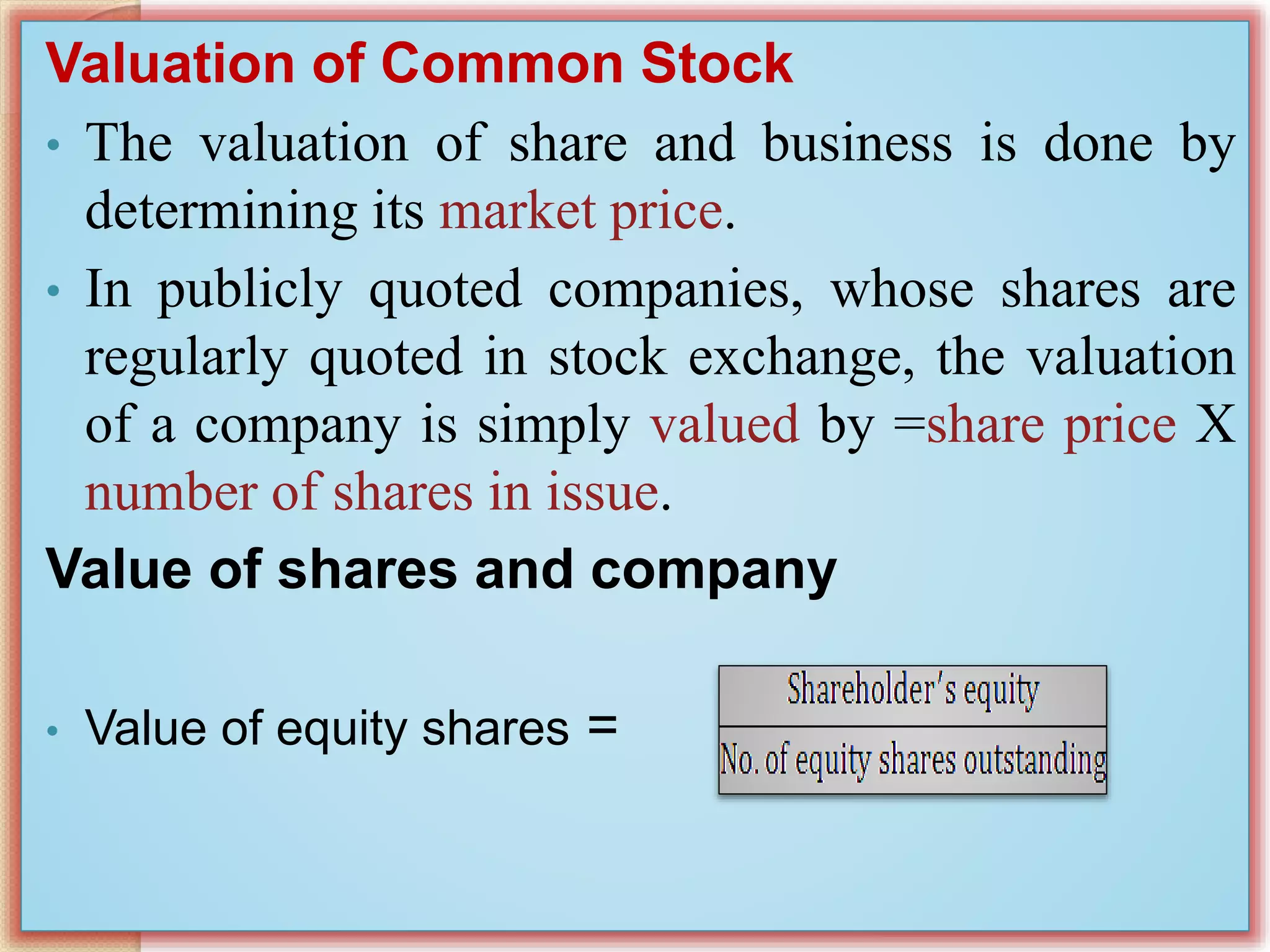
• Value of equity shares =
 If the company’s stocks are publicly traded, the value of equity
equals the market capitalization of the company.
 Value of company = Market price of equity shares x No. of equity
shares outstanding.
 Another way of valuing company is to determine the value of
enterprise. It consists of the market value of the company’s equity
plus the market value of company’s debt, its pension provisions,
minority interest and other claims.
 Enterprise value = Equity value + Market value of debt +
Minority interests + Pension provisions + other claims
 Equity value = Enterprise value – (Market value of debt +
Minority interest +Pension provisions +other claims)
 There are different methods exist for valuing
the shares and the company. Some methods
are discussed below:
◦ Balance sheet valuation
◦ Dividend discount model
◦ Free cash flow model
◦ Earning multiplier approach
Balance sheet Valuation
 Balance sheet methods are the methods
which utilize the balance sheet information to
value a company.
 These techniques consider everything for
which accounting in the books of accounts is
done.
 Three measures derived from the balance
sheet are: book value, liquidation value and
replacement cost
Book value:
 In this method, book value as per balance sheet is considered the
value of equity.
 Book value means the net worth of the company.
 Net worth is calculated as follows:
Net Worth = Equity Share capital + Preference Share Capital +
Reserves & Surplus – Miscellaneous Expenditure (as per B/Sheet) –
Accumulated Losses.
 Book value per share is the amount per share of common stock
that would be received if all of the firm’s assets were sold for their
exact book (accounting) value and the proceeds remaining after
paying all liabilities (including preferred stock) were divided
among the common stockholders.
 - is simply the net worth of the company
= paid up equity + reserve & surplus
no. of outstanding equity shares
Eg. If the net worth of zenith co’ is Br.37 m/n and
the number of outstanding equity shares is 2
m/n.
Book value/ share= Br. 37 m/n
2 m/n
• This method lacks sophistication and can be
criticized on the basis of its reliance on historical
balance sheet data.
• It ignores the firm’s expected earnings potential
and generally lacks any true relationship to the
firm’s value in the marketplace.
Liquidation value
 Liquidation/ share= value realized from liquidating all
the assets of the firm less amount to be paid to all the
creditors & pref. shareholders divided by no. of
outstanding equity shares.
 Liquidation Value = Net Realizable Value of All Assets – Amounts
paid to All Creditors including Preference Shareholders.
 Eg. Assume that pioneer industries would realize Br.
45m/n from the liquidation of its assets and pay Br. 18
m/n to its creditors and pref. shareholders in full
settlement of their claims. If the number of outstanding
equity shares is 1.5 m/n.
 Liquidation value/share = Br. 45m/n - Br. 18
1.5 m/n shares
 While the liquidation value appears more realistic than
the book value, there are two serious problems in
applying it.
• First, it is very to estimate what amounts would be
realized from the liquidation of various assets.
• Second, the liquidation value does not reflect earning
capacity.
 Given these problems, the measure of liquidation value
seems to make sense only for firms which are ‘better dead
than alive’
Replacement cost
 Here, the value of equity is the replacement value.
 It means the cost that would be incurred to create a
duplicate firm is the value of the firm.
 This concept assumes that in valuing a firm is the
replacement cost of its assets less its liabilities.
 Some analysts believe the market value of the firm
cannot get too far above its replacement cost for
long because, if it did, competitors would try to
replicate the firm.
 The use of this measure is based on the premises that the
market value of the firm cannot deviate too much from its
replacement cost.
 If it did so, competitive pressures will tend to align the two.
 The ratio of market price to replacement cost is called Tobin q,
after James Tobin a Nobel laureate in economics.
 The proponents of replacement cost believe that in the long run
Tobin’s q will tend to 1.
Equity Value = Replacement Cost of Assets – Liabilities
 A major limitation of the replacement cost concept is that
organizational capital, a very valuable asset, is not shown on the
balance sheet.
 Organizational value is the value created by bringing together
employees, customers, suppliers, managers, and others in a
mutually beneficial and productive r/n ship.
 An important characteristics of organizational capital is that it
cannot be easily separated from the firm as a going entity.
Dividend Discount Model
 Method of estimating the value of a share of stock as the present
value of all expected future dividend payments.)
 Conceptually a very sound and appealing model.
 If you buy a share of stock, you can receive cash in two ways
◦ The company pays dividends
◦ You sell your shares either to another investor in the market or
back to the company
 As with bonds, the price of the stock is the present value of these
expected cash flows
 The value of an equity share = PV. Of dividends expected from its
ownership + PV. Of the sale price expected when the share is sold.
 For applying the dividend discount model, we will make the
following assumptions:
 Dividends are paid annually
 The first dividend is received 1 year after the equity share is
bought.
SINGLE PERIOD VALUATION MODEL
Let us begin with the case where the investor expects
to hold the equity share for 1 year. The price of the
equity share will be:
P0 = D1 + P1
(1+r) (1+r)
 Eg. Prestige’s equity share is expected to provide a dividend of Br.
2 & fetch of a price of Br. 18 a year hence. What price would it sell
for now if investors’ RRR is 12%.
P0 = Br.2 + Br.18 = Br.17.86
(1.12) (1.12)
 What happens if the price of share is
expected to grow at a rate of g percent
annually?
P0 = D1 + P0 (1+g)
(1+r) (1+r)
 Eg. The expected dividend per share on the equity
share of roadking co’ is Br. 2. the dividend per share
of roadking co’ has grown over the past 5 years at the
rate of 5 % per year. This growth rate will continue for
the future. Further the market price of the share of
Roadking co’, too, is expected to growth at the same
rate. What is a fair estimate of the intrinsic value of
the share if the rrr is 15% ?
 P0 = Br. 2 / 0.15 – 0.05
Br. 20
MULTI - PERIOD VALUATION MODEL
Having learnt the basics of equity share valuation in a
single-period framework, we now discuss the more
realistic ,and also the more complex, case of multi-
period valuation.
P0 = 𝒕=𝟏
∞
𝑫𝒕/ 𝟏 + 𝒓 𝒕
Since equity shares have no maturity period, they
may be expected to bring a dividend stream of
infinite duration.
• Is it applicable to a finite horizon? Yes
To demonstrate this, consider how an equity share
would be valued by an investor who plans to hold it
for n years and sell it thereafter for a price.
The value of the equity to him is:
P0 = D1 + D2 +…..+Dn + Pn
(1+r)1 (1+r)2 (1+r)n (1+r)n

=  Dt + Pn
t=1 (1+r)t (1+r)n
ZERO GROWTH MODEL
The zero dividend growth model assumes that the stock
will pay the same dividend each year, year after year.
The equation shows that with zero growth, the value
of a share of stock would equal the present value of
a perpetuity of D1 dollars discounted at a rate rs.
• Eg. Swimmer estimates that the dividend of Denham
Company, an established textile producer, is
expected to remain constant at $3 per share
indefinitely.
• If his required return on its stock is 15%, the stock’s
value is:
 $20 ($3 ÷ 0.15) per share
Constant-Growth Model
 The constant-growth model is a widely cited
dividend valuation approach that assumes that
dividends will grow at a constant rate, but a rate that
is less than the required return.
The Gordon model is a common name for the
constant-growth model that is widely cited in
dividend valuation.
 Eg. A stock just paid an annual dividend of
$3/share. The dividend is expected to grow at
8% indefinitely, and the market capitalization
rate (from CAPM) is 14%.
= $ 3 = $3 = $50
.14 - .08 .06
Free cash flow model
 A free cash flow valuation model determines the value of an
entire company (this is called the enterprise value) as the present
value of its expected free cash flows discounted at the firm’s
weighted average cost of capital, which is its expected average
future cost of funds over the long run and then subtracting the
value of preference and debt to obtain the value of equity.
 More specifically, it involves the f/f procedure.
1. Divide the future into two parts, the explicit forecast period
& the balance period.
 The explicit forecast period (w/c is usually 5 to 15 yrs)
represents the period during w/c the firm is expected to
evolve & finally reach a steady state – a state in w/c the return
on invested capital, growth rate, and cost of capital stabilize.
2. Forecast the free cash flow, year by year, during the explicit
forecast period.
FCF- is the cash flow available to providers of capital after
providing for the investment in fixed assets and net working
capital required to support the growth of the firm.
FCF = NOPAT( Net Operating Profit After Tax) – Net investment
 FCF = EBIT (1 - tax)
= change in NFA + change in NWC
3. Calculate The Weighted Average Cost Of Capital
WACC – is the blended post-tax cost of equity,
preference, and debt employed by the firm.
WACC = Were + Wprp + Wdrd (1 - t)
4. Establish The Horizontal Value Of The Firm
VH – is the value placed on the firm at the end of the
explicit forecast period (H yrs). Since the FCF is
expected to grow at a constant rate of g beyond H,
VH =
FCFH+1
WACC - g
5. Estimate The Enterprise Value
EV – is the PV Of the FCF during the explicit
forecast period plus the present value of the
horizontal value.
EV =
6. Derive The Equity Value
EV = Enterprise value– Preference value – Debt
value
7. Compute The Value Per Share
Equity value divided by # of outstanding shares
FCF1 + FCF2 + … + FCFH + VH
(1+WACC) + (1+WACC)2 + (1+WACC)H + (1+WACC)H
 Illustration : The B/Sheet of Azura ltd at the end of
year 0 is as follows:
 The return on invested capital (ROIC), which is defined as
NOPAT/invested capital, of Azura is expected to be 12 %. The
growth rate in assets & revenues will be 20% for the first 3 yrs,
12% for the next 2 yrs, and 8% thereafter. The cost of equity is
16%. The effective tax rate of the firm is 33.33%.
Liabilities Assets (in m/ns)
•Share holders’ funds
250
•Equity capital (10 m/n shares of $ 10 each)
100
•Reserves & surplus
150
•Loan funds rate (9 percent)
250
•Net fixed assets
400
•Net working capital
100
total 500
500
 The pre-tax cost of debt is 9%. The debt-equity ratio
of the firm will be maintained at 1:1
 Based on the above information we can calculate
the intrinsic value of the equity share as follows.
1. The explicit forecast period is 6 yrs b/c the firm
reaches a steady state at the end of 6 yrs.
2. The FCF forecast for the explicit forecast period is
given in table follows (in millions)
Year 1 2 3 4 5 6
Asset value
(beginning)
500 600 720 864 967.7 1083.2
NOPAT 60 72 86.4 103.7 116.1 130.1
Net investment 100 120 144 103.7 116.1 86.7
FCF (40) (48) (57.6) - - 43.4
Growth rate (%) 20 20 20 12 12 8
3. WACC = .5x16+.5x9(1-.3333) = 11%
4.VH =
5. The enterprise value of Azura is
EV =
= $ 741.4 m/n
6. The equity value of Azura is
= 741.4 – 250 = $ 491.4 m/n
7. The value/share = $491.4m/n / 10 m/n shares
= $ 49.1
FCFH+1 = FCFH(1+g) = 43.4 (1.08) = $ 1,562.4 m/n
WACC –g .11 -.08 .11 - .08
-40 - 48 - 57.6 + 0 + 0 + 43.4 + 1562.4
(1.11) (1.11)2 (1.11)3 (1.11) 4 (1.11)5 (1.11) 6 (1.11)6
Earning multiplier approach
 Much of the real-world discussion of stock market valuation
concentrates on the firm’s price–earnings multiple, the ratio of
price per share to earnings per share, commonly called the P/E
ratio.
 P/E Ratios are a function of two factors
◦ Required Rates of Return (k)
◦ Expected growth in Dividends
 Uses
◦ Relative valuation
◦ Extensive Use in industry
P/E Ratio: No expected growth
E1 - expected earnings for next year
E1 is equal to D1 under no growth
k - required rate of return
P
E
k
P
E k
0
1
0
1
1


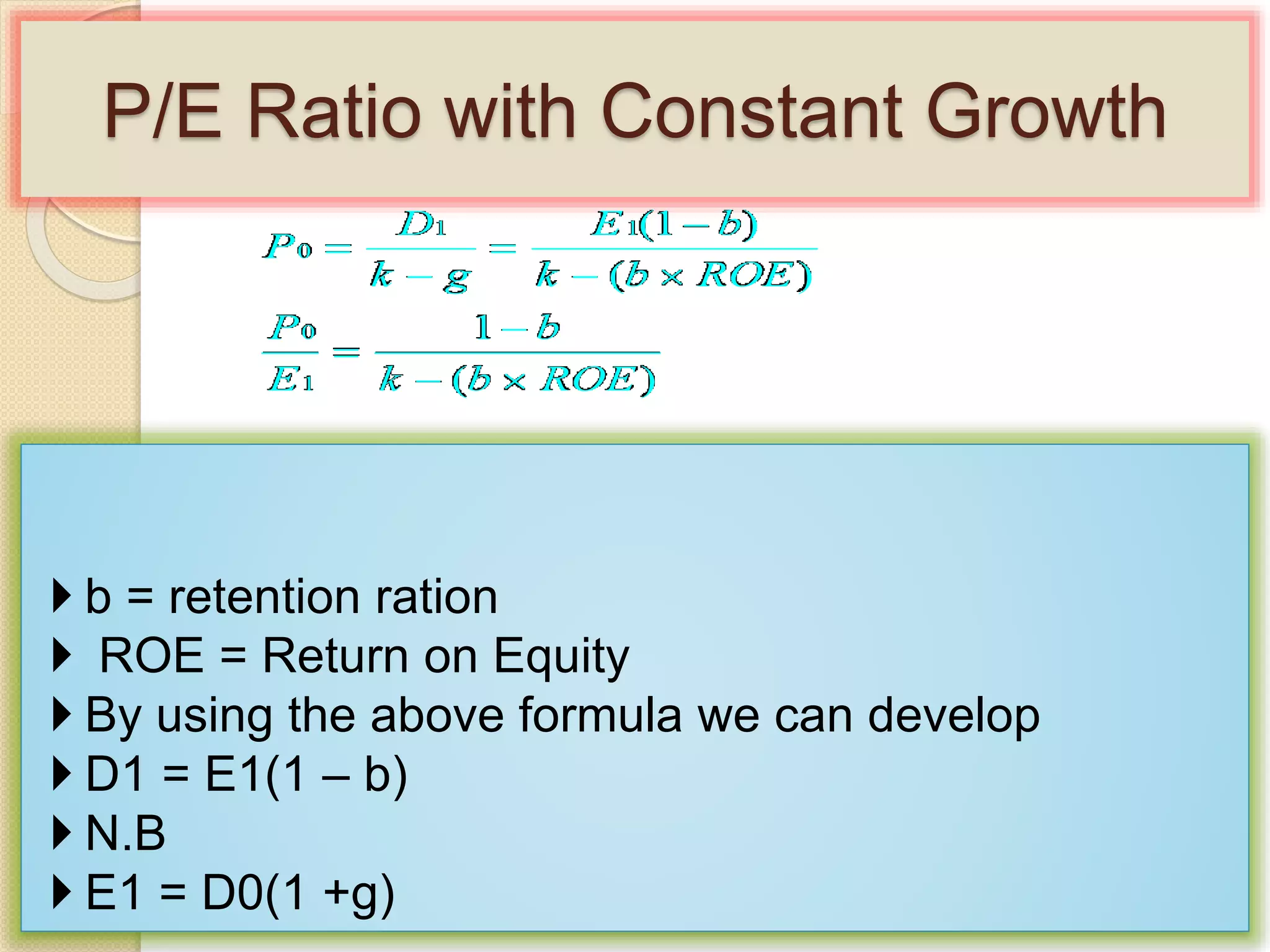
P/E Ratio with Constant Growth
P
D
k g
E b
k b ROE
P
E
b
k b ROE
0
1 1
0
1
1
1




 


 
( )
( )
( )
 b = retention ration
 ROE = Return on Equity
 By using the above formula we can develop
 D1 = E1(1 – b)
 N.B
 E1 = D0(1 +g)
Example
 Both companies considered, Cash Cow and Growth Prospects, had
earnings per share (EPS) of $5, but Growth Prospects reinvested
60% of earnings in prospects with ROE of 15%, whereas Cash
Cow paid out all earnings as dividends.
 Consider the require rate of return is 12.5% Cash Cow had a price
of $40, whereas Growth Prospects sold for $57.14. calculate P/E
multiples.
Cont ...
 Low Tech Chip Company is expected to have EPS in the
coming year of $2.50. The expected ROE is 14%.
 An appropriate required return on the stock is 12.5%. If
the firm has a dividend payout ratio of 40%,
 calculate the intrinsic value of the stock calculate the
price earning ratio
Numerical Example: No Growth
E0 = $2.50 g = 0 k = 12.5%
P0 = D/k = $2.50/.125 = $20.00
P/E = 1/k = 1/.125 = 8
Numerical Example with Growth
b = 60% ROE = 15% (1-b) = 40%
E1 = $2.50 (1 + (.6)(.15)) = $2.73
D1 = $2.73 (1-.6) = $1.09
k = 12.5% g = 9%
P0 = 1.09/(.125-.09) = $31.14
PE = 31.14/2.73 = 11.4
PE = (1 - .60) / (.125 - .09) = 11.4
THANKS!!

equity valuation CH 5.pptx

  • 1.
    CHAPTER FIVE STOCK &EQUITY VALUATION OUTLINE  Stock characteristic  Balance sheet valuation  Dividend discount model  Free cash flow model  Earning multiplier approach 1
  • 2.
    Stock characteristics What isa Stock?  A stock represents ownership in a corporation.  There are two types of stock named as common stock and preferred stock.  The common stock represents the equity shares of the corporation where as preferred stock represents the preference share of the corporation.  The equity share when fully paid by the investor is termed as stock.  The equity shares of the corporation are called the common stock. 2
  • 3.
     Voting Rights ◦In general, common shareholders are the only security holders given the right to vote. ◦ Common shareholders have the right to elect the board of directors and approve any changes in the corporate charter. ◦ Some firms have multiple classes of stock with different voting rights. Ownership rights:- ◦ The equity stockholders are also the owners of the firm. ◦ Each stockholder receives an ownership right equivalent to the stock that he holds in the firm.
  • 4.
     Par value: oAn equity stock has a face value which is also called the par value of the stock. o Equity stock may be sold or issued at a premium or at a discount but the face value will be the denominations.  Right shares: o The shareholder has a right of receiving shares whenever they are issued by the company. o Shares are offered to the existing shareholders & only on these refused can others be offered. o Sometimes some amount is reserved for the existing shareholders & then an issues is made by the company.
  • 5.
     The mostimportant characteristics of common stock as an investment are its residual claim and its limited liability features.  Residual claim means stockholders are the last in line of all those who have a claim on the assets and income of the corporation.  Limited liability means that the most shareholders can lose in event of the failure of the corporation is their original investment.
  • 6.
     PREFERRED STOCK Preferredstock is called as preference shares. The preferred stock has the following characteristics:  Dividend:- A preference shareholders has priority over equity shareholders in the payment of dividends but the rate is fixed unlike the common stockholders which vary.  Right to vote:- The preference shareholders do not have a right to vote in the annual general meeting of company. But in the event of non availability of preference dividend for 2 years or more the preference shareholder can vote.
  • 7.
     Right onassets:- At the time of liquidation the pref. Shares have a prior right to that of the equity shareholders but the payment & the face value of the pref. Shareholders are paid only after the right of the bondholders & other creditors are met.  Par value:- The pref. Shares usually has a par or face valued. This par value can also be changed by the corporate shareholders.  Retirement of debt through sinking fund:- A company usually retires its pref. Shares with the help of a special fund called sinking fund.
  • 8.
     Pre–emptive right:-The preference shareholders like the equity shareholders have a right of receiving further issues from the company before it is advertised.  Convertibility: - The pref. Shares are usually non- convertible unless otherwise stated in a clause inserted at the time of issuing of these shares.  Hybrid:- The preferred Stock is a hybrid between a bond & common stock because bond has a greater claim on assets and common stock is entitled to rights of dividend.
  • 9.
    Valuation of CommonStock • The valuation of share and business is done by determining its market price. • In publicly quoted companies, whose shares are regularly quoted in stock exchange, the valuation of a company is simply valued by =share price X number of shares in issue. Value of shares and company • Value of equity shares =
  • 10.
     If thecompany’s stocks are publicly traded, the value of equity equals the market capitalization of the company.  Value of company = Market price of equity shares x No. of equity shares outstanding.  Another way of valuing company is to determine the value of enterprise. It consists of the market value of the company’s equity plus the market value of company’s debt, its pension provisions, minority interest and other claims.
  • 11.
     Enterprise value= Equity value + Market value of debt + Minority interests + Pension provisions + other claims  Equity value = Enterprise value – (Market value of debt + Minority interest +Pension provisions +other claims)  There are different methods exist for valuing the shares and the company. Some methods are discussed below: ◦ Balance sheet valuation ◦ Dividend discount model ◦ Free cash flow model ◦ Earning multiplier approach
  • 12.
    Balance sheet Valuation Balance sheet methods are the methods which utilize the balance sheet information to value a company.  These techniques consider everything for which accounting in the books of accounts is done.  Three measures derived from the balance sheet are: book value, liquidation value and replacement cost
  • 13.
    Book value:  Inthis method, book value as per balance sheet is considered the value of equity.  Book value means the net worth of the company.  Net worth is calculated as follows: Net Worth = Equity Share capital + Preference Share Capital + Reserves & Surplus – Miscellaneous Expenditure (as per B/Sheet) – Accumulated Losses.  Book value per share is the amount per share of common stock that would be received if all of the firm’s assets were sold for their exact book (accounting) value and the proceeds remaining after paying all liabilities (including preferred stock) were divided among the common stockholders.
  • 14.
     - issimply the net worth of the company = paid up equity + reserve & surplus no. of outstanding equity shares Eg. If the net worth of zenith co’ is Br.37 m/n and the number of outstanding equity shares is 2 m/n. Book value/ share= Br. 37 m/n 2 m/n • This method lacks sophistication and can be criticized on the basis of its reliance on historical balance sheet data. • It ignores the firm’s expected earnings potential and generally lacks any true relationship to the firm’s value in the marketplace.
  • 15.
    Liquidation value  Liquidation/share= value realized from liquidating all the assets of the firm less amount to be paid to all the creditors & pref. shareholders divided by no. of outstanding equity shares.  Liquidation Value = Net Realizable Value of All Assets – Amounts paid to All Creditors including Preference Shareholders.  Eg. Assume that pioneer industries would realize Br. 45m/n from the liquidation of its assets and pay Br. 18 m/n to its creditors and pref. shareholders in full settlement of their claims. If the number of outstanding equity shares is 1.5 m/n.  Liquidation value/share = Br. 45m/n - Br. 18 1.5 m/n shares
  • 16.
     While theliquidation value appears more realistic than the book value, there are two serious problems in applying it. • First, it is very to estimate what amounts would be realized from the liquidation of various assets. • Second, the liquidation value does not reflect earning capacity.  Given these problems, the measure of liquidation value seems to make sense only for firms which are ‘better dead than alive’
  • 17.
    Replacement cost  Here,the value of equity is the replacement value.  It means the cost that would be incurred to create a duplicate firm is the value of the firm.  This concept assumes that in valuing a firm is the replacement cost of its assets less its liabilities.  Some analysts believe the market value of the firm cannot get too far above its replacement cost for long because, if it did, competitors would try to replicate the firm.  The use of this measure is based on the premises that the market value of the firm cannot deviate too much from its replacement cost.
  • 18.
     If itdid so, competitive pressures will tend to align the two.  The ratio of market price to replacement cost is called Tobin q, after James Tobin a Nobel laureate in economics.  The proponents of replacement cost believe that in the long run Tobin’s q will tend to 1. Equity Value = Replacement Cost of Assets – Liabilities  A major limitation of the replacement cost concept is that organizational capital, a very valuable asset, is not shown on the balance sheet.  Organizational value is the value created by bringing together employees, customers, suppliers, managers, and others in a mutually beneficial and productive r/n ship.  An important characteristics of organizational capital is that it cannot be easily separated from the firm as a going entity.
  • 19.
    Dividend Discount Model Method of estimating the value of a share of stock as the present value of all expected future dividend payments.)  Conceptually a very sound and appealing model.  If you buy a share of stock, you can receive cash in two ways ◦ The company pays dividends ◦ You sell your shares either to another investor in the market or back to the company  As with bonds, the price of the stock is the present value of these expected cash flows
  • 20.
     The valueof an equity share = PV. Of dividends expected from its ownership + PV. Of the sale price expected when the share is sold.  For applying the dividend discount model, we will make the following assumptions:  Dividends are paid annually  The first dividend is received 1 year after the equity share is bought. SINGLE PERIOD VALUATION MODEL Let us begin with the case where the investor expects to hold the equity share for 1 year. The price of the equity share will be: P0 = D1 + P1 (1+r) (1+r)
  • 21.
     Eg. Prestige’sequity share is expected to provide a dividend of Br. 2 & fetch of a price of Br. 18 a year hence. What price would it sell for now if investors’ RRR is 12%. P0 = Br.2 + Br.18 = Br.17.86 (1.12) (1.12)  What happens if the price of share is expected to grow at a rate of g percent annually? P0 = D1 + P0 (1+g) (1+r) (1+r)
  • 22.
     Eg. Theexpected dividend per share on the equity share of roadking co’ is Br. 2. the dividend per share of roadking co’ has grown over the past 5 years at the rate of 5 % per year. This growth rate will continue for the future. Further the market price of the share of Roadking co’, too, is expected to growth at the same rate. What is a fair estimate of the intrinsic value of the share if the rrr is 15% ?  P0 = Br. 2 / 0.15 – 0.05 Br. 20 MULTI - PERIOD VALUATION MODEL Having learnt the basics of equity share valuation in a single-period framework, we now discuss the more realistic ,and also the more complex, case of multi- period valuation. P0 = 𝒕=𝟏 ∞ 𝑫𝒕/ 𝟏 + 𝒓 𝒕
  • 23.
    Since equity shareshave no maturity period, they may be expected to bring a dividend stream of infinite duration. • Is it applicable to a finite horizon? Yes To demonstrate this, consider how an equity share would be valued by an investor who plans to hold it for n years and sell it thereafter for a price. The value of the equity to him is: P0 = D1 + D2 +…..+Dn + Pn (1+r)1 (1+r)2 (1+r)n (1+r)n  =  Dt + Pn t=1 (1+r)t (1+r)n
  • 24.
    ZERO GROWTH MODEL Thezero dividend growth model assumes that the stock will pay the same dividend each year, year after year. The equation shows that with zero growth, the value of a share of stock would equal the present value of a perpetuity of D1 dollars discounted at a rate rs. • Eg. Swimmer estimates that the dividend of Denham Company, an established textile producer, is expected to remain constant at $3 per share indefinitely. • If his required return on its stock is 15%, the stock’s value is:  $20 ($3 ÷ 0.15) per share
  • 25.
    Constant-Growth Model  Theconstant-growth model is a widely cited dividend valuation approach that assumes that dividends will grow at a constant rate, but a rate that is less than the required return. The Gordon model is a common name for the constant-growth model that is widely cited in dividend valuation.
  • 26.
     Eg. Astock just paid an annual dividend of $3/share. The dividend is expected to grow at 8% indefinitely, and the market capitalization rate (from CAPM) is 14%. = $ 3 = $3 = $50 .14 - .08 .06
  • 27.
    Free cash flowmodel  A free cash flow valuation model determines the value of an entire company (this is called the enterprise value) as the present value of its expected free cash flows discounted at the firm’s weighted average cost of capital, which is its expected average future cost of funds over the long run and then subtracting the value of preference and debt to obtain the value of equity.
  • 28.
     More specifically,it involves the f/f procedure. 1. Divide the future into two parts, the explicit forecast period & the balance period.  The explicit forecast period (w/c is usually 5 to 15 yrs) represents the period during w/c the firm is expected to evolve & finally reach a steady state – a state in w/c the return on invested capital, growth rate, and cost of capital stabilize. 2. Forecast the free cash flow, year by year, during the explicit forecast period. FCF- is the cash flow available to providers of capital after providing for the investment in fixed assets and net working capital required to support the growth of the firm. FCF = NOPAT( Net Operating Profit After Tax) – Net investment
  • 29.
     FCF =EBIT (1 - tax) = change in NFA + change in NWC 3. Calculate The Weighted Average Cost Of Capital WACC – is the blended post-tax cost of equity, preference, and debt employed by the firm. WACC = Were + Wprp + Wdrd (1 - t) 4. Establish The Horizontal Value Of The Firm VH – is the value placed on the firm at the end of the explicit forecast period (H yrs). Since the FCF is expected to grow at a constant rate of g beyond H, VH = FCFH+1 WACC - g
  • 30.
    5. Estimate TheEnterprise Value EV – is the PV Of the FCF during the explicit forecast period plus the present value of the horizontal value. EV = 6. Derive The Equity Value EV = Enterprise value– Preference value – Debt value 7. Compute The Value Per Share Equity value divided by # of outstanding shares FCF1 + FCF2 + … + FCFH + VH (1+WACC) + (1+WACC)2 + (1+WACC)H + (1+WACC)H
  • 31.
     Illustration :The B/Sheet of Azura ltd at the end of year 0 is as follows:  The return on invested capital (ROIC), which is defined as NOPAT/invested capital, of Azura is expected to be 12 %. The growth rate in assets & revenues will be 20% for the first 3 yrs, 12% for the next 2 yrs, and 8% thereafter. The cost of equity is 16%. The effective tax rate of the firm is 33.33%. Liabilities Assets (in m/ns) •Share holders’ funds 250 •Equity capital (10 m/n shares of $ 10 each) 100 •Reserves & surplus 150 •Loan funds rate (9 percent) 250 •Net fixed assets 400 •Net working capital 100 total 500 500
  • 32.
     The pre-taxcost of debt is 9%. The debt-equity ratio of the firm will be maintained at 1:1  Based on the above information we can calculate the intrinsic value of the equity share as follows. 1. The explicit forecast period is 6 yrs b/c the firm reaches a steady state at the end of 6 yrs. 2. The FCF forecast for the explicit forecast period is given in table follows (in millions) Year 1 2 3 4 5 6 Asset value (beginning) 500 600 720 864 967.7 1083.2 NOPAT 60 72 86.4 103.7 116.1 130.1 Net investment 100 120 144 103.7 116.1 86.7 FCF (40) (48) (57.6) - - 43.4 Growth rate (%) 20 20 20 12 12 8
  • 33.
    3. WACC =.5x16+.5x9(1-.3333) = 11% 4.VH = 5. The enterprise value of Azura is EV = = $ 741.4 m/n 6. The equity value of Azura is = 741.4 – 250 = $ 491.4 m/n 7. The value/share = $491.4m/n / 10 m/n shares = $ 49.1 FCFH+1 = FCFH(1+g) = 43.4 (1.08) = $ 1,562.4 m/n WACC –g .11 -.08 .11 - .08 -40 - 48 - 57.6 + 0 + 0 + 43.4 + 1562.4 (1.11) (1.11)2 (1.11)3 (1.11) 4 (1.11)5 (1.11) 6 (1.11)6
  • 34.
    Earning multiplier approach Much of the real-world discussion of stock market valuation concentrates on the firm’s price–earnings multiple, the ratio of price per share to earnings per share, commonly called the P/E ratio.  P/E Ratios are a function of two factors ◦ Required Rates of Return (k) ◦ Expected growth in Dividends  Uses ◦ Relative valuation ◦ Extensive Use in industry
  • 35.
    P/E Ratio: Noexpected growth E1 - expected earnings for next year E1 is equal to D1 under no growth k - required rate of return P E k P E k 0 1 0 1 1  
  • 36.
    P/E Ratio withConstant Growth P D k g E b k b ROE P E b k b ROE 0 1 1 0 1 1 1           ( ) ( ) ( )  b = retention ration  ROE = Return on Equity  By using the above formula we can develop  D1 = E1(1 – b)  N.B  E1 = D0(1 +g)
  • 37.
    Example  Both companiesconsidered, Cash Cow and Growth Prospects, had earnings per share (EPS) of $5, but Growth Prospects reinvested 60% of earnings in prospects with ROE of 15%, whereas Cash Cow paid out all earnings as dividends.  Consider the require rate of return is 12.5% Cash Cow had a price of $40, whereas Growth Prospects sold for $57.14. calculate P/E multiples.
  • 38.
    Cont ...  LowTech Chip Company is expected to have EPS in the coming year of $2.50. The expected ROE is 14%.  An appropriate required return on the stock is 12.5%. If the firm has a dividend payout ratio of 40%,  calculate the intrinsic value of the stock calculate the price earning ratio
  • 39.
    Numerical Example: NoGrowth E0 = $2.50 g = 0 k = 12.5% P0 = D/k = $2.50/.125 = $20.00 P/E = 1/k = 1/.125 = 8
  • 40.
    Numerical Example withGrowth b = 60% ROE = 15% (1-b) = 40% E1 = $2.50 (1 + (.6)(.15)) = $2.73 D1 = $2.73 (1-.6) = $1.09 k = 12.5% g = 9% P0 = 1.09/(.125-.09) = $31.14 PE = 31.14/2.73 = 11.4 PE = (1 - .60) / (.125 - .09) = 11.4
  • 41.