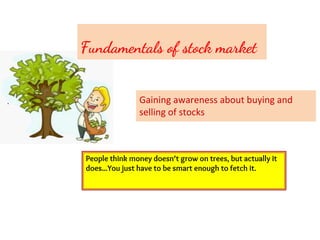
People think money doesn’t grow on trees, but actually it
does…You just have to be smart enough to fetch it.
Fundamentals of stock market
, Gaining awareness about buying and
selling of stocks
What Is the Stock
Market?
• A market is a public place where
things are bought and sold. The
term "stock market" refers to
the business of buying and
selling stock
• The word stock simply refers to
a supply. In the financial
market, stock refers to a supply
of money that a company has
raised. This supply comes from
people who have given the
company money in the hope
that the company will make
their money grow
BUYING AND SELLING OF STOCKS
Why Companies Issue Stock...
• If a company wants to
grow—maybe build more
factories, hire more people,
or develop new products—
it needs money. It could
get a loan from a bank. But
then it would owe money.
By issuing stock, a company
can raise money without
going into debt. People
who buy the stock are
giving the company the
money it needs to grow.
...And Why Do People Buy It
• Owning stock in a company
means owning part of that
company. Each part is
known as a share. If a
company has issued 100
shares of stock, and you
bought one, you own 1% of
that company. People who
own stock are called
stockholders, or
shareholders
Bears and Bulls
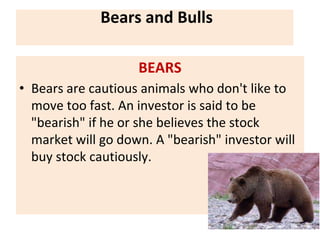
BEARS
• Bears are cautious animals who don't like to
move too fast. An investor is said to be
"bearish" if he or she believes the stock
market will go down. A "bearish" investor will
buy stock cautiously.
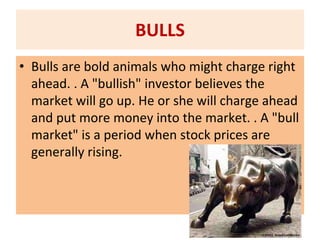
BULLS
• Bulls are bold animals who might charge right
ahead. . A "bullish" investor believes the
market will go up. He or she will charge ahead
and put more money into the market. . A "bull
market" is a period when stock prices are
generally rising.
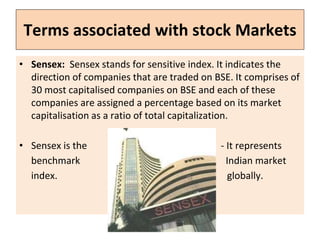
Terms associated with stock Markets
• Sensex: Sensex stands for sensitive index. It indicates the
direction of companies that are traded on BSE. It comprises of
30 most capitalised companies on BSE and each of these
companies are assigned a percentage based on its market
capitalisation as a ratio of total capitalization.
• Sensex is the - It represents
benchmark Indian market
index. globally.
NIFTY
• It is the sensex counterpart on the National
Stock Exchange or NSE. It is comprised of 50
companies which include all 30 companies of
BSE. It is therefore more broad based as
compared to sensex
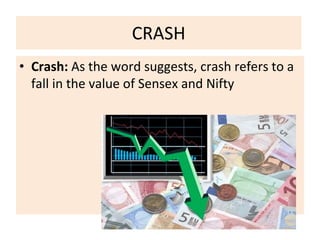
CRASH
• Crash: As the word suggests, crash refers to a
fall in the value of Sensex and Nifty
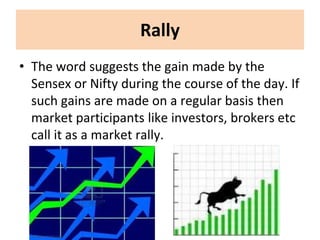
Rally
• The word suggests the gain made by the
Sensex or Nifty during the course of the day. If
such gains are made on a regular basis then
market participants like investors, brokers etc
call it as a market rally.
• Squaring off: A process whereby
investors/traders buy or sell shares and later
reverse their trade to complete a transaction is
called squaring off of a trade.
• Correction: A correction (or a measured fall) in
the Sensex and Nifty takes place when these
indices rise for a few days and then retrace or
shave off some of these gains.
• Dividend: Cash payment made to the
shareholders out of the profits of the company.
Cash dividends are paid out of corporate earnings
and the percentage of earnings paid out varies
from corporation to corporation
• Blue Chips: Well-established and financially strong companies,
with little investment risk and a history of earnings and
dividend payments.
• Capitalization:The value of a company as measured by the
market price of its common shares, multiplied by the total
number of shares that have been issued.
• Circuit Breaker:A mechanism used to restrain the market
when it gets overheated. The Exchange may relax the limit
after a cooling off period.
• Depository Participant (DP): A DP is a representative of the
depository in the system. The DP maintains the client's
securities account balances and keeps him informed about the
status of holdings. According to SEBI regulations, financial
institutions (FI's), banks, custodians, stockbrokers, etc. can
become DPs. It is comparable with a branch of a bank if a
Depository is likened to a bank. A DP is offered depository
services only after it gets proper registration from SEBI.
• Earning Per Share (EPS):Profit after tax divided by average number of
shares.
• Ex Dividend: A Share is described as ex dividend when the buyer is not
entitled for the dividend. The seller remains the beneficiary. The day after
dividends is paid!
• Ex Rights : A share is described as ex rights when the buyer is not entitled
for the Rights. The seller remains the beneficiary. Ex rights shares are
cheaper than Cum Rights and offer a good 'buy' opportunity for investment
oriented players.
• Face Value: The nominal value of a security. All companies issue shares with
a fixed denomination called the face value (or par value) of the share. This
face value be indicated on the share certificate. Generally Indian shares has
a face value of Rs. 10/-
• Book Value:A measure used by owners of common shares in a firm to
determine the level of safety associated with each individual share after all
debts are paid accordingly.
Book Value = Total Assets of the Company- Total Liabilities
Total outstanding Shares
Market Sentiment
• A measure of the bullish or bearish attitude of
the crowd
• Intrinsic Value: A term favored by value oriented fundamental analysts to
express the actual value of a corporation, as opposed to the current value
based on the stock price. Usually calculated by adding the current value of
estimated future earning to the book value.
• Market Capitalization: Total market value of the company on the stock
exchange. Total number of shares multiplied by the official price quoted on
the stock exchange.
• Mutual Fund: A portfolio of stocks, bonds or other securities administered
by a team of one or more managers from an investment company who
make buy and sell decisions on component securities. Capital is contributed
by smaller investors who buy shares in the mutual fund rather than the
individual stocks and bonds in its portfolio. The return on the funds
holdings is distributed back to its contributors, or shareholders, minus
various fees and commissions. This system allows small investors to
participate in the reduced risk of large and diverse portfolio that they could
not otherwise afford to build themselves. They also have the benefit of
professional managers overseeing their money who have the time and
expertise to analyze and pick securities.
Story of a Beggar
A beggar was sitting by the side of a road for God knows how
long totally uncared for and lamenting his bad luck for the
position he was in. Suddenly a stranger appears before
him.He asks the beggar..What is this that you are sitting on? It
is an old trunk that I have been sitting on for ages. But what is
in it asks the stranger. Have you ever cared to open this box?
The beggar replies in negative. What is the use says the
beggar. The stranger insists to open that box. To his utter
surprise the beggar finds the box to be filled with Gold.
Awareness Factor
• The awareness factor is missing in your life,
resulting in all kinds of problems including the
subject in question- Stock Markets and
unnecessary losses.
• gaining awareness is the most essential aspect ,for
becoming a very successful trader.
Essential Element of Winning
Management of Emotions
Traders ride an emotional roller-coaster
• either they squirm from pain or
• grin with pleasure
Essential element of Winning – CONTROL THE
DEMON CALLED EMOTIONS.
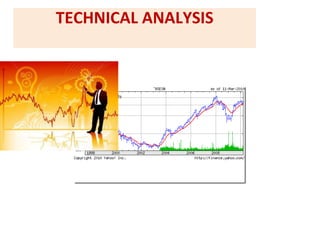
TECHNICAL ANALYSIS
Technical Analysis
• Technical analysis is a method of evaluating securities
by analyzing the statistics generated by market
activity, such as past prices and volume
• Technical analysis is based on three assumptions:
1. The market discounts everything.
2. Price moves in trends.
3. History tends to repeat itself.
The Market Discounts Everything
Stock Prices
• Stock's Price reflects
everything that has or could
affect the company
• Company's fundamentals,
along with broader
economic factors and
market psychology, are all
priced into the stock
Price Moves in Trends
• After a trend has been established, the
future price movement is more likely to be in
the same direction as the trend than to be
against it.
History Tends To Repeat Itself
• Market participants tend to provide a
consistent reaction to similar market stimuli
over time.
• Technical analysis uses chart patterns to
analyze market movements and understand
trends.
Technical Analysis vs
Fundamental Analysis
The Differences
Charts vs. Financial Statements
Technical Analysis
▪ looks at the price movement
of a security and uses this data
to predict its future price
movements.
▪ technical analyst approaches a
security from the charts.
▪ all the information they need
about a stock is found in its
charts.
Fundamental Analysis
▪ looks at economic factors,
known as fundamentals
▪ fundamental analyst starts
with the financial statements.
Looks at
• balance sheet
• cash flow statement
• income statement,
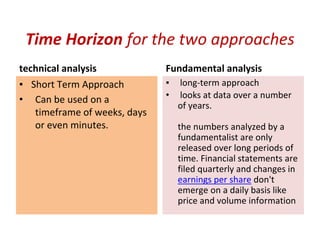
Time Horizon for the two approaches
technical analysis
▪ Short Term Approach
• Can be used on a
timeframe of weeks, days
or even minutes.
Fundamental analysis
▪ long-term approach
• looks at data over a number
of years.
the numbers analyzed by a
fundamentalist are only
released over long periods of
time. Financial statements are
filed quarterly and changes in
earnings per share don't
emerge on a daily basis like
price and volume information
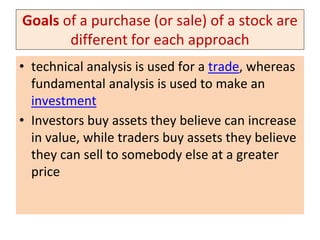
Goals of a purchase (or sale) of a stock are
different for each approach
• technical analysis is used for a trade, whereas
fundamental analysis is used to make an
investment
• Investors buy assets they believe can increase
in value, while traders buy assets they believe
they can sell to somebody else at a greater
price

Fundamentals of stock market

  • 1.
    People think moneydoesn’t grow on trees, but actually it does…You just have to be smart enough to fetch it. Fundamentals of stock market , Gaining awareness about buying and selling of stocks
  • 2.
    What Is theStock Market? • A market is a public place where things are bought and sold. The term "stock market" refers to the business of buying and selling stock • The word stock simply refers to a supply. In the financial market, stock refers to a supply of money that a company has raised. This supply comes from people who have given the company money in the hope that the company will make their money grow
  • 3.
    BUYING AND SELLINGOF STOCKS Why Companies Issue Stock... • If a company wants to grow—maybe build more factories, hire more people, or develop new products— it needs money. It could get a loan from a bank. But then it would owe money. By issuing stock, a company can raise money without going into debt. People who buy the stock are giving the company the money it needs to grow. ...And Why Do People Buy It • Owning stock in a company means owning part of that company. Each part is known as a share. If a company has issued 100 shares of stock, and you bought one, you own 1% of that company. People who own stock are called stockholders, or shareholders
  • 4.
    Bears and Bulls BEARS •Bears are cautious animals who don't like to move too fast. An investor is said to be "bearish" if he or she believes the stock market will go down. A "bearish" investor will buy stock cautiously.
  • 5.
    BULLS • Bulls arebold animals who might charge right ahead. . A "bullish" investor believes the market will go up. He or she will charge ahead and put more money into the market. . A "bull market" is a period when stock prices are generally rising.
  • 6.
    Terms associated withstock Markets • Sensex: Sensex stands for sensitive index. It indicates the direction of companies that are traded on BSE. It comprises of 30 most capitalised companies on BSE and each of these companies are assigned a percentage based on its market capitalisation as a ratio of total capitalization. • Sensex is the - It represents benchmark Indian market index. globally.
  • 7.
    NIFTY • It isthe sensex counterpart on the National Stock Exchange or NSE. It is comprised of 50 companies which include all 30 companies of BSE. It is therefore more broad based as compared to sensex
  • 8.
    CRASH • Crash: Asthe word suggests, crash refers to a fall in the value of Sensex and Nifty
  • 9.
    Rally • The wordsuggests the gain made by the Sensex or Nifty during the course of the day. If such gains are made on a regular basis then market participants like investors, brokers etc call it as a market rally.
  • 10.
    • Squaring off:A process whereby investors/traders buy or sell shares and later reverse their trade to complete a transaction is called squaring off of a trade. • Correction: A correction (or a measured fall) in the Sensex and Nifty takes place when these indices rise for a few days and then retrace or shave off some of these gains. • Dividend: Cash payment made to the shareholders out of the profits of the company. Cash dividends are paid out of corporate earnings and the percentage of earnings paid out varies from corporation to corporation
  • 11.
    • Blue Chips:Well-established and financially strong companies, with little investment risk and a history of earnings and dividend payments. • Capitalization:The value of a company as measured by the market price of its common shares, multiplied by the total number of shares that have been issued. • Circuit Breaker:A mechanism used to restrain the market when it gets overheated. The Exchange may relax the limit after a cooling off period. • Depository Participant (DP): A DP is a representative of the depository in the system. The DP maintains the client's securities account balances and keeps him informed about the status of holdings. According to SEBI regulations, financial institutions (FI's), banks, custodians, stockbrokers, etc. can become DPs. It is comparable with a branch of a bank if a Depository is likened to a bank. A DP is offered depository services only after it gets proper registration from SEBI.
  • 12.
    • Earning PerShare (EPS):Profit after tax divided by average number of shares. • Ex Dividend: A Share is described as ex dividend when the buyer is not entitled for the dividend. The seller remains the beneficiary. The day after dividends is paid! • Ex Rights : A share is described as ex rights when the buyer is not entitled for the Rights. The seller remains the beneficiary. Ex rights shares are cheaper than Cum Rights and offer a good 'buy' opportunity for investment oriented players. • Face Value: The nominal value of a security. All companies issue shares with a fixed denomination called the face value (or par value) of the share. This face value be indicated on the share certificate. Generally Indian shares has a face value of Rs. 10/- • Book Value:A measure used by owners of common shares in a firm to determine the level of safety associated with each individual share after all debts are paid accordingly. Book Value = Total Assets of the Company- Total Liabilities Total outstanding Shares
  • 13.
    Market Sentiment • Ameasure of the bullish or bearish attitude of the crowd
  • 14.
    • Intrinsic Value:A term favored by value oriented fundamental analysts to express the actual value of a corporation, as opposed to the current value based on the stock price. Usually calculated by adding the current value of estimated future earning to the book value. • Market Capitalization: Total market value of the company on the stock exchange. Total number of shares multiplied by the official price quoted on the stock exchange. • Mutual Fund: A portfolio of stocks, bonds or other securities administered by a team of one or more managers from an investment company who make buy and sell decisions on component securities. Capital is contributed by smaller investors who buy shares in the mutual fund rather than the individual stocks and bonds in its portfolio. The return on the funds holdings is distributed back to its contributors, or shareholders, minus various fees and commissions. This system allows small investors to participate in the reduced risk of large and diverse portfolio that they could not otherwise afford to build themselves. They also have the benefit of professional managers overseeing their money who have the time and expertise to analyze and pick securities.
  • 15.
    Story of aBeggar
  • 16.
    A beggar wassitting by the side of a road for God knows how long totally uncared for and lamenting his bad luck for the position he was in. Suddenly a stranger appears before him.He asks the beggar..What is this that you are sitting on? It is an old trunk that I have been sitting on for ages. But what is in it asks the stranger. Have you ever cared to open this box? The beggar replies in negative. What is the use says the beggar. The stranger insists to open that box. To his utter surprise the beggar finds the box to be filled with Gold.
  • 17.
    Awareness Factor • Theawareness factor is missing in your life, resulting in all kinds of problems including the subject in question- Stock Markets and unnecessary losses. • gaining awareness is the most essential aspect ,for becoming a very successful trader.
  • 18.
    Essential Element ofWinning Management of Emotions Traders ride an emotional roller-coaster • either they squirm from pain or • grin with pleasure Essential element of Winning – CONTROL THE DEMON CALLED EMOTIONS.
  • 19.
  • 20.
    Technical Analysis • Technicalanalysis is a method of evaluating securities by analyzing the statistics generated by market activity, such as past prices and volume • Technical analysis is based on three assumptions: 1. The market discounts everything. 2. Price moves in trends. 3. History tends to repeat itself.
  • 21.
    The Market DiscountsEverything Stock Prices • Stock's Price reflects everything that has or could affect the company • Company's fundamentals, along with broader economic factors and market psychology, are all priced into the stock
  • 22.
    Price Moves inTrends • After a trend has been established, the future price movement is more likely to be in the same direction as the trend than to be against it.
  • 23.
    History Tends ToRepeat Itself • Market participants tend to provide a consistent reaction to similar market stimuli over time. • Technical analysis uses chart patterns to analyze market movements and understand trends.
  • 24.
  • 25.
    The Differences Charts vs.Financial Statements Technical Analysis ▪ looks at the price movement of a security and uses this data to predict its future price movements. ▪ technical analyst approaches a security from the charts. ▪ all the information they need about a stock is found in its charts. Fundamental Analysis ▪ looks at economic factors, known as fundamentals ▪ fundamental analyst starts with the financial statements. Looks at • balance sheet • cash flow statement • income statement,
  • 26.
    Time Horizon forthe two approaches technical analysis ▪ Short Term Approach • Can be used on a timeframe of weeks, days or even minutes. Fundamental analysis ▪ long-term approach • looks at data over a number of years. the numbers analyzed by a fundamentalist are only released over long periods of time. Financial statements are filed quarterly and changes in earnings per share don't emerge on a daily basis like price and volume information
  • 27.
    Goals of apurchase (or sale) of a stock are different for each approach • technical analysis is used for a trade, whereas fundamental analysis is used to make an investment • Investors buy assets they believe can increase in value, while traders buy assets they believe they can sell to somebody else at a greater price