The Winds of Change
Reflections on the international adoption
of evidence-based training
Dr Andrew McLean
Equitation Science International
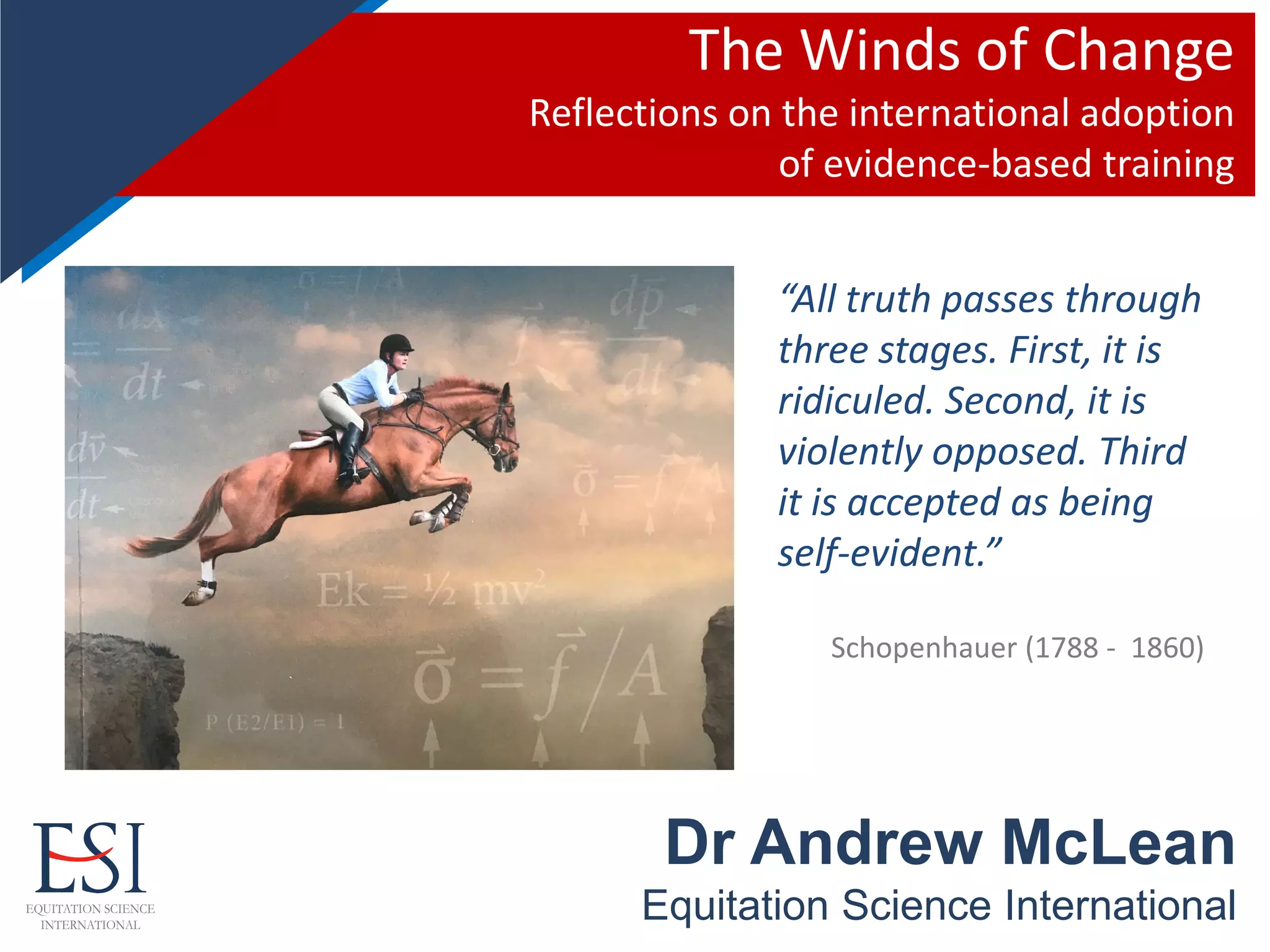
“All truth passes through
three stages. First, it is
ridiculed. Second, it is
violently opposed. Third
it is accepted as being
self-evident.”
Schopenhauer (1788 - 1860)
History of Horse Training
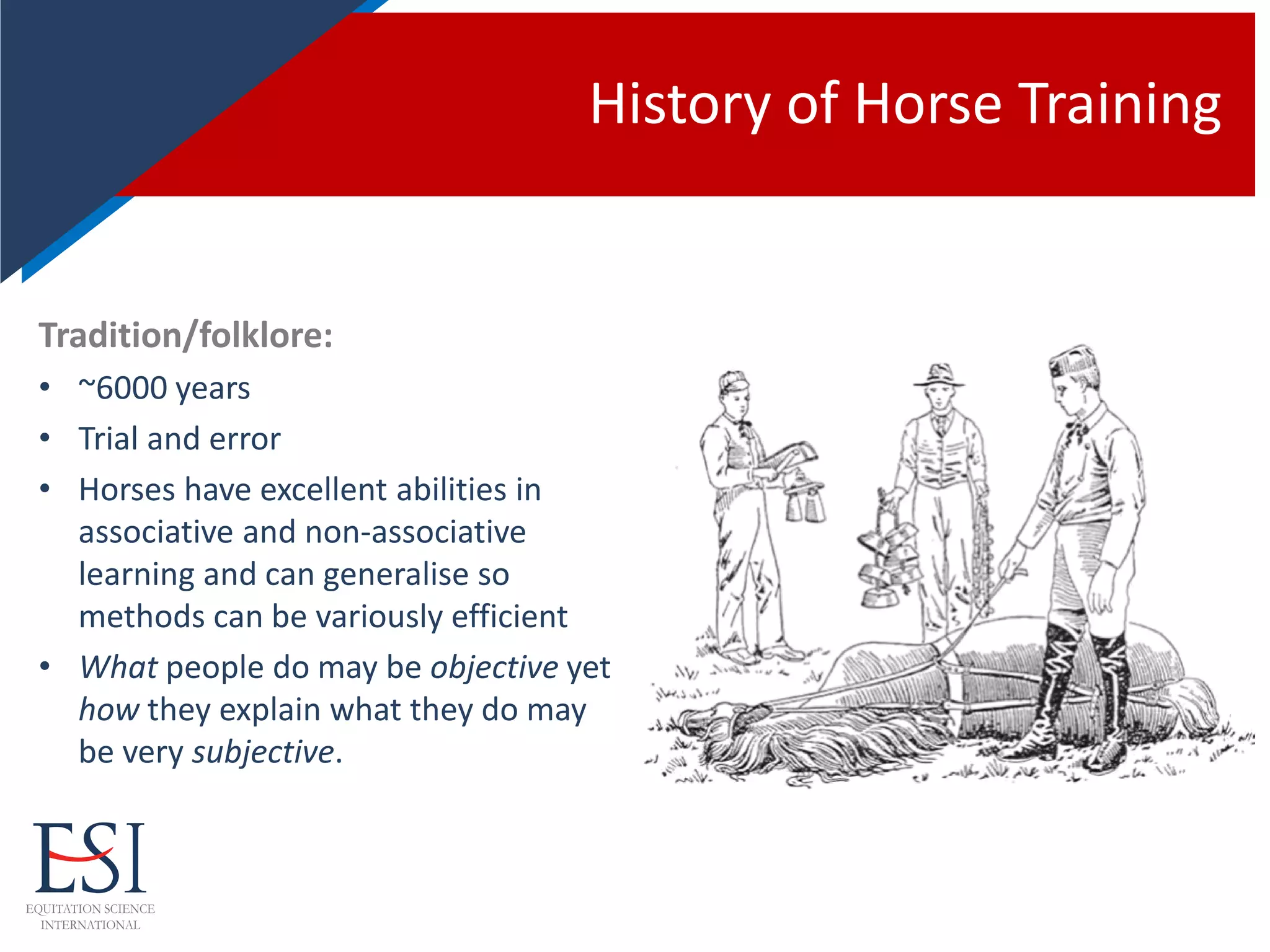
Tradition/folklore:
• ~6000 years
• Trial and error
• Horses have excellent abilities in
associative and non-associative
learning and can generalise so
methods can be variously efficient
• What people do may be objective yet
how they explain what they do may
be very subjective.
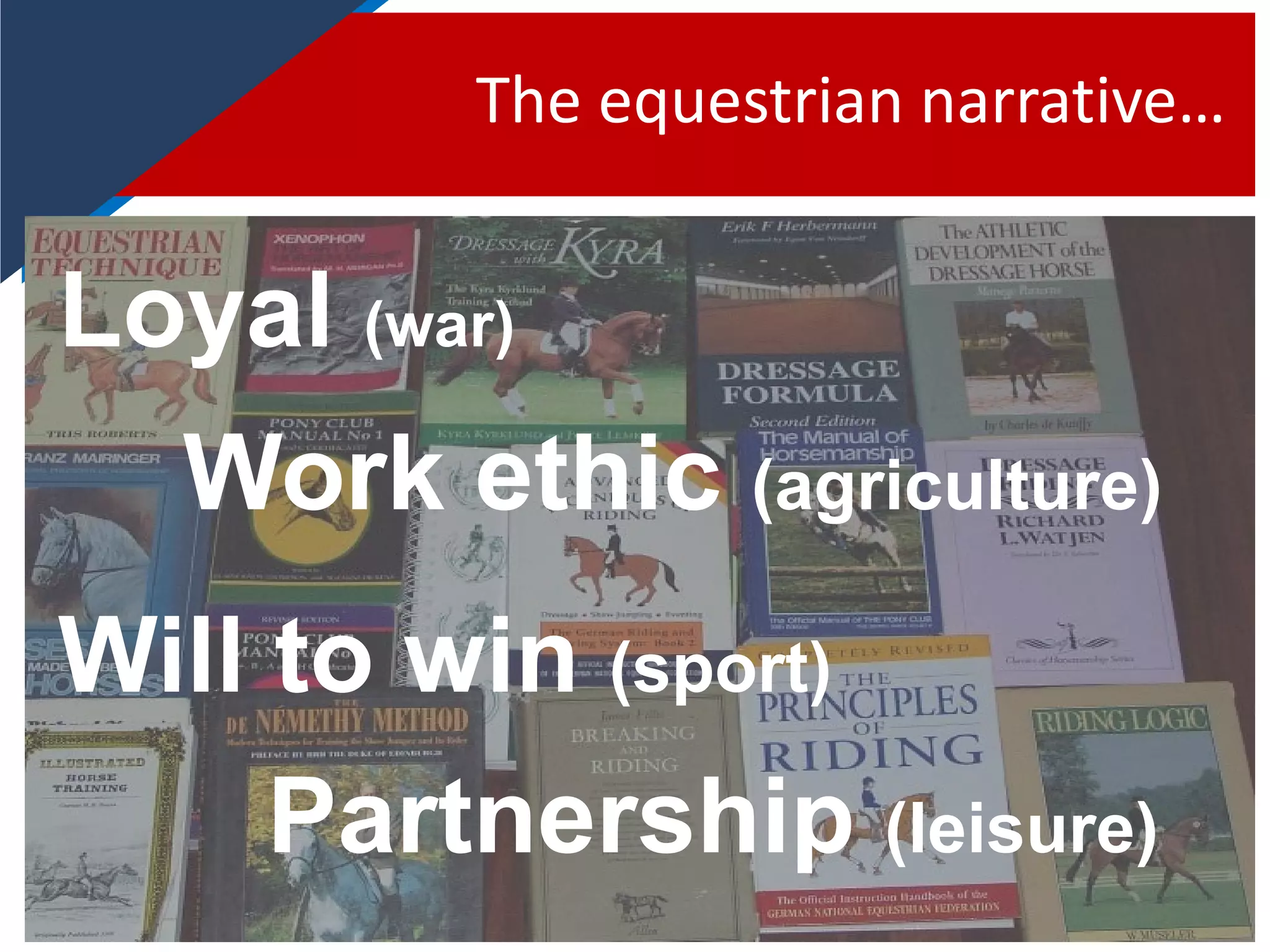
The equestrian narrative…
Will to win (sport)
Partnership (leisure)
Loyal (war)
Work ethic (agriculture)
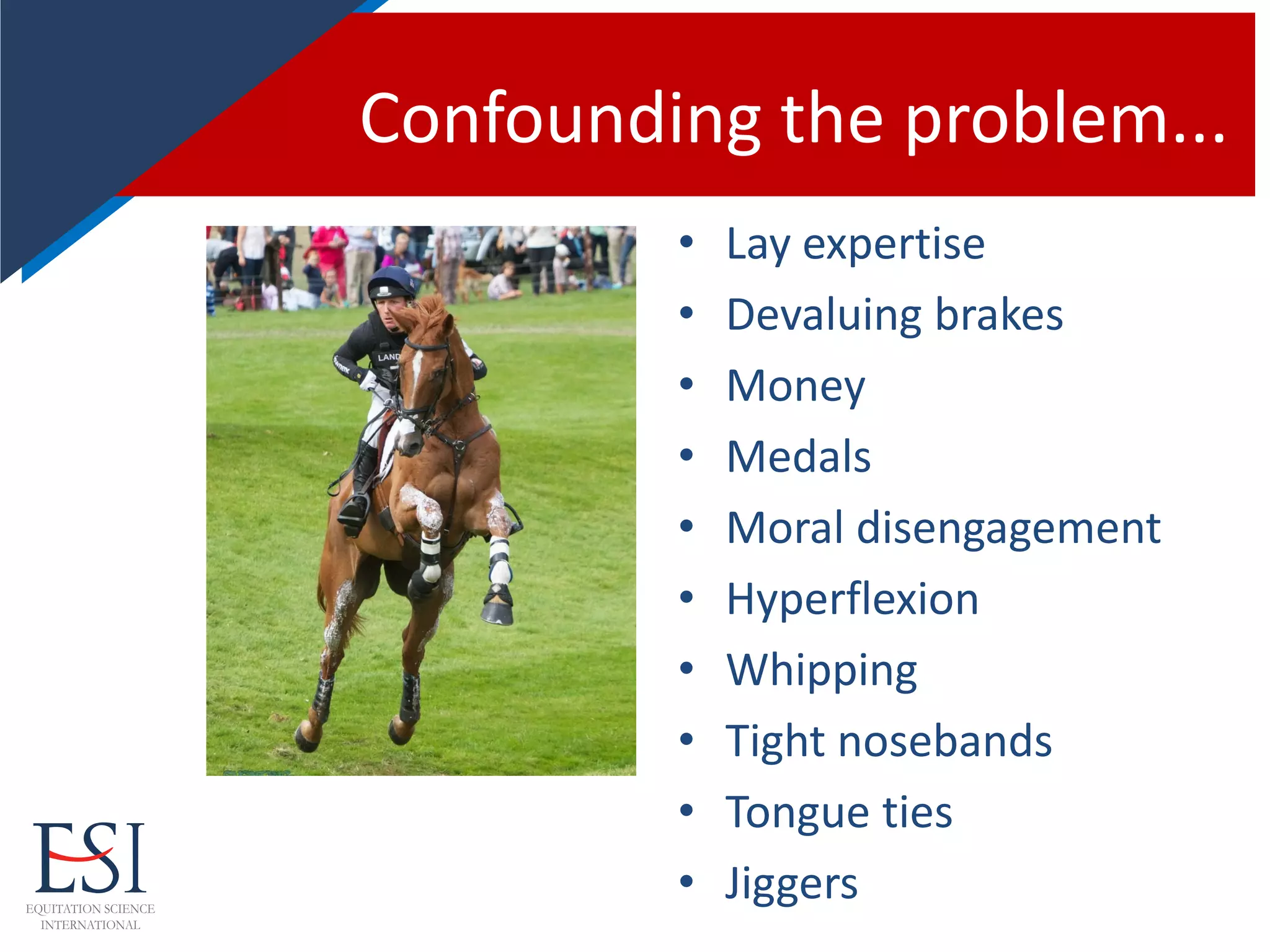
Confounding the problem...
• Lay expertise
• Devaluing brakes
• Money
• Medals
• Moral disengagement
• Hyperflexion
• Whipping
• Tight nosebands
• Tongue ties
• Jiggers
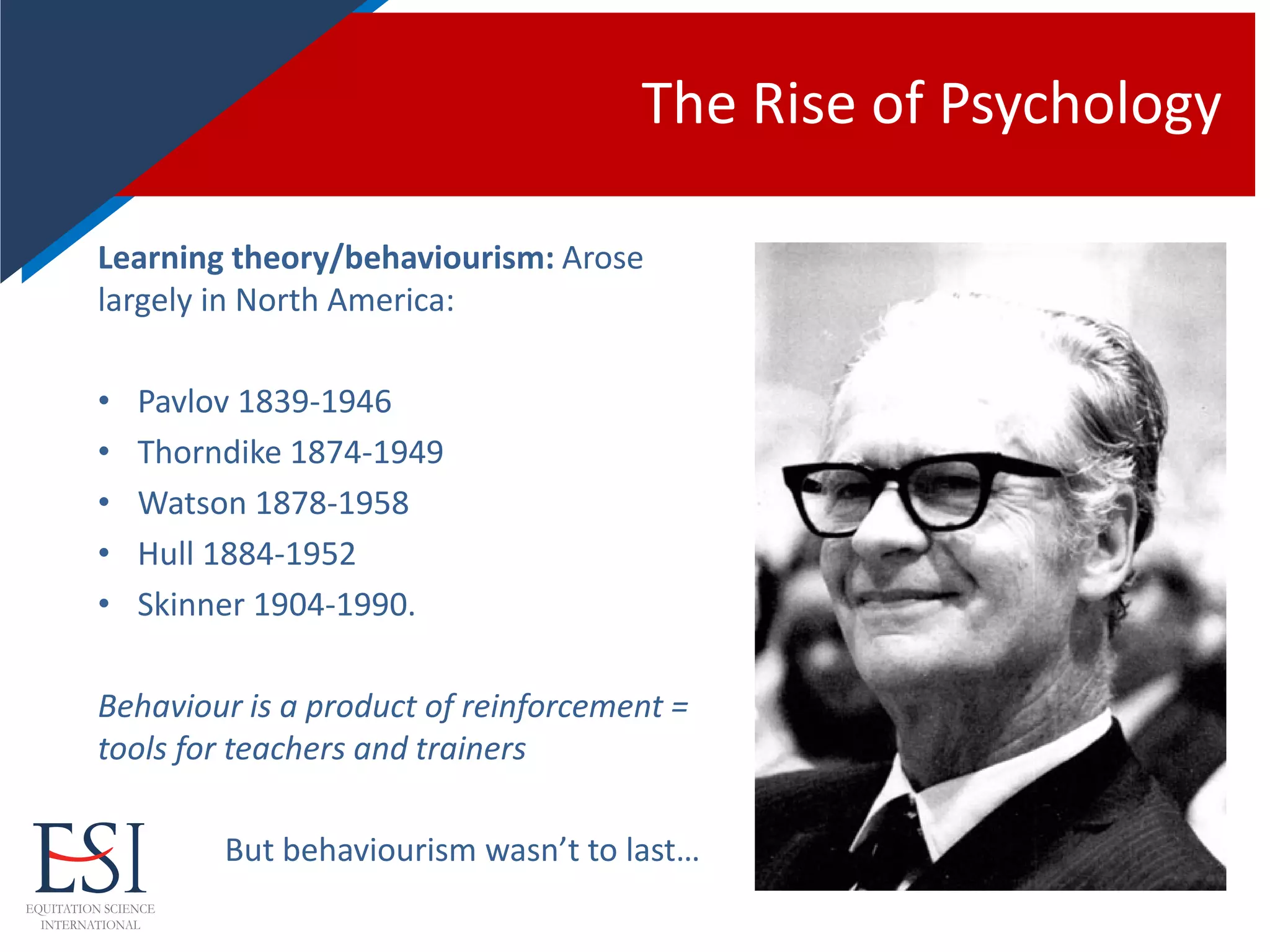
The Rise of Psychology
Learning theory/behaviourism: Arose
largely in North America:
• Pavlov 1839-1946
• Thorndike 1874-1949
• Watson 1878-1958
• Hull 1884-1952
• Skinner 1904-1990.
Behaviour is a product of reinforcement =
tools for teachers and trainers
But behaviourism wasn’t to last…
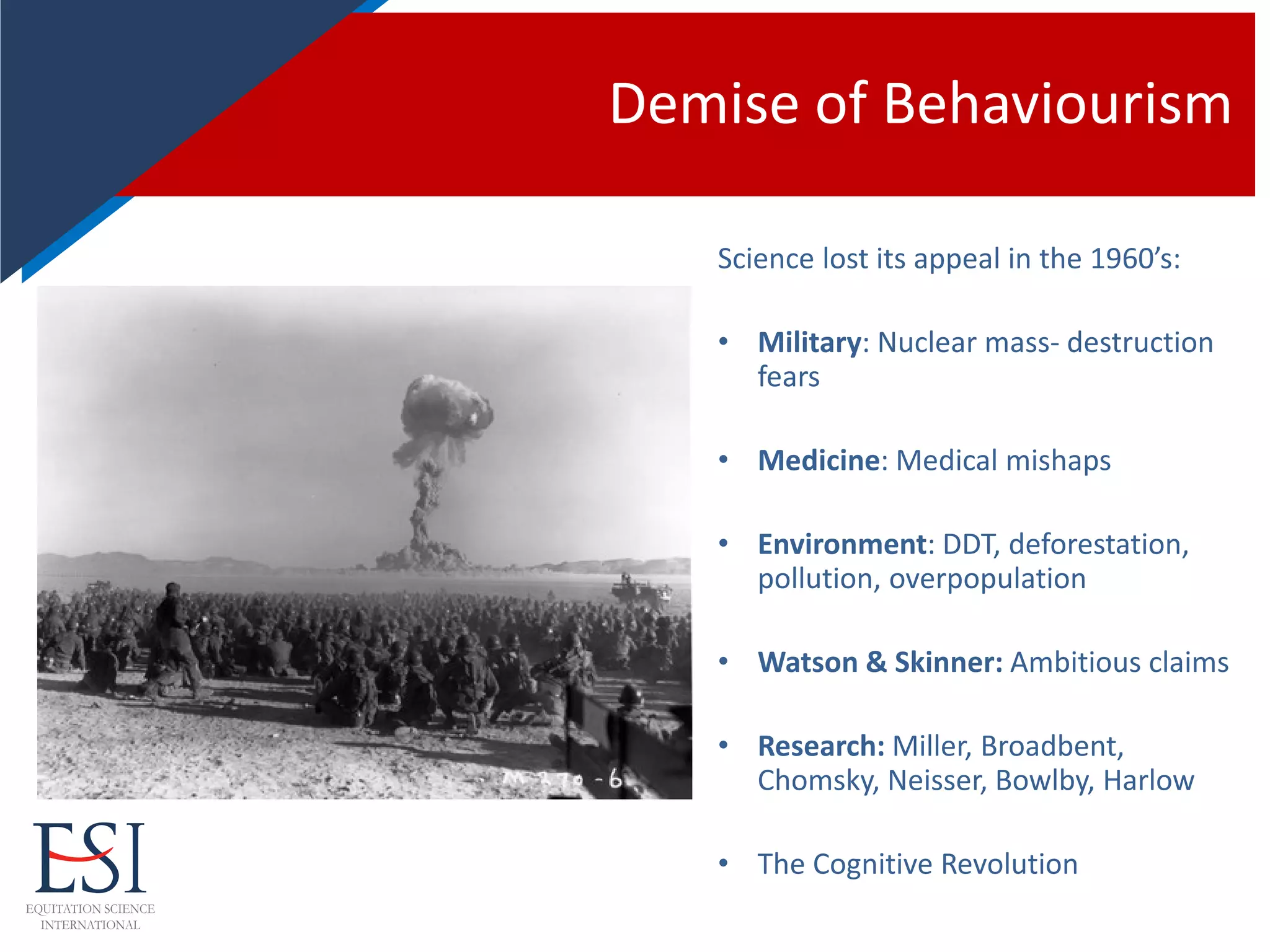
Demise of Behaviourism
Science lost its appeal in the 1960’s:
• Military: Nuclear mass- destruction
fears
• Medicine: Medical mishaps
• Environment: DDT, deforestation,
pollution, overpopulation
• Watson & Skinner: Ambitious claims
• Research: Miller, Broadbent,
Chomsky, Neisser, Bowlby, Harlow
• The Cognitive Revolution
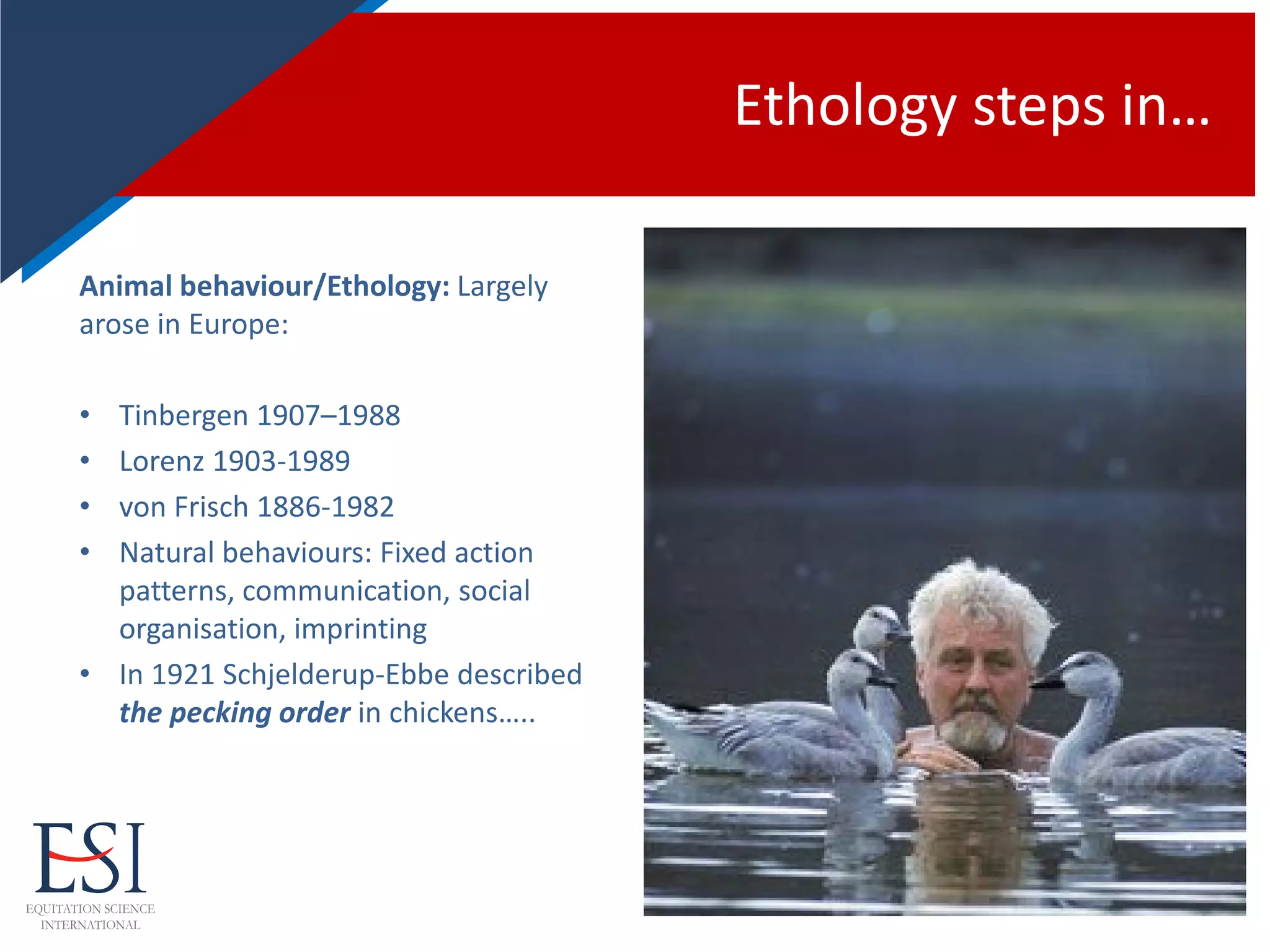
Ethology steps in…
Animal behaviour/Ethology: Largely
arose in Europe:
• Tinbergen 1907–1988
• Lorenz 1903-1989
• von Frisch 1886-1982
• Natural behaviours: Fixed action
patterns, communication, social
organisation, imprinting
• In 1921 Schjelderup-Ebbe described
the pecking order in chickens…..
The Animal Hierarchy
• Pop-science appeal of hierarchy: military, state,
business, church, school, family…
• The rise of ‘New-Age’ trainers in the 1960’s and 70’s
• Sought explanation from science
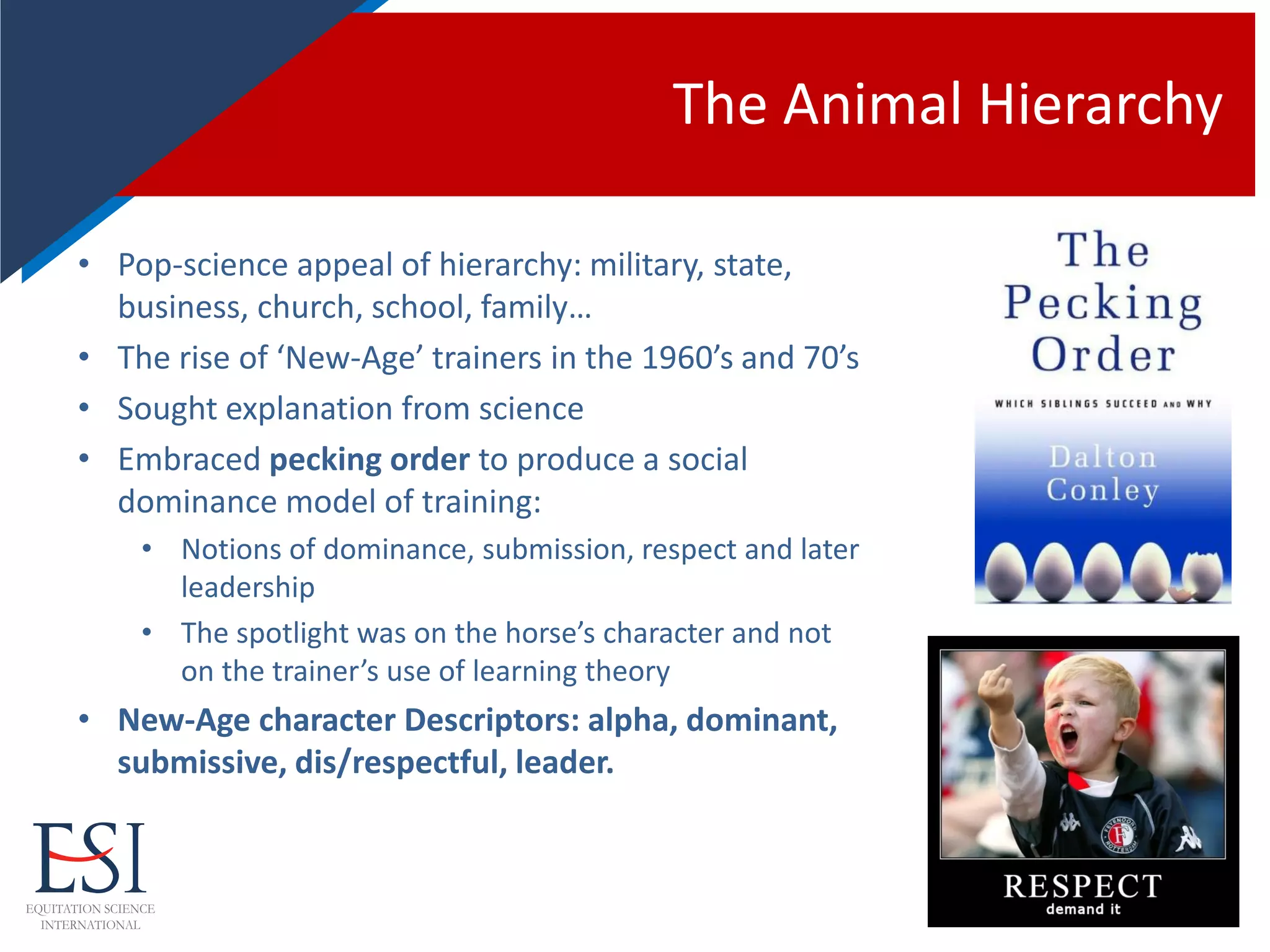
• Embraced pecking order to produce a social
dominance model of training:
• Notions of dominance, submission, respect and later
leadership
• The spotlight was on the horse’s character and not
on the trainer’s use of learning theory
• New-Age character Descriptors: alpha, dominant,
submissive, dis/respectful, leader.
My Journey…
• 1976 - Zoology double major, 1977 to 1990 lecturer in zoology Uni of
Tasmania, plus breaking / training Woodmount Equestrian Centre.
• 1989 - Australian 3DE team Trans Tasman, short list 1990 world
championships. Grand Prix SJ, bareback racing and Dressage.
• 1994 - Australian Equine Behaviour Centre
• 2004 - PhD – the mental process of the horse and its consequences for
training
• 1995 - Australian Equine Behaviour Centre (AEBC)
• The Truth About Horses (plus 5 other publications)
• 2004 - Co-founder – The International Society for Equitation Science
(ISES)
• McLean, A.N. 2005. The positive aspects of correct negative
reinforcement. Anthrozoos, 18, 3, 245–254. (…the need is urgent for
universities throughout the world to become the knowledge bases for
equitation science.)
• Author/co-author 50 journal papers
• Equitation Science International (ESI)
Extinguishing the naughty horse…
Training via negative reinforcement rules:
1. The strength of the aversive stimulus must meet the sensitivity of the individual
animal.
2. The aversive stimulus must be terminated at a right moment to avoid
punishment.
3. The animal should be in a sufficiently relaxed state to assess its situation and give
an adequate behavioural reaction.
4. Aversive tactile stimuli should be rapidly reduced to light versions of those stimuli
via classical conditioning.
Neglecting any of these conditions may lead to substantial emotional problems,
conflict behaviours, hyperactivity, or excessive fear in the horse-human relationship,
regardless of the training method
[How "natural" training methods can affect equine mental state? A critical approach - A review
Rozempolska-Rucińska et al, 2013 (Animal science papers and reports 31(3):185-19]
Affective states (optimism / pessimism)
Dysfunctions in negative reinforcement:
1. Reinforcing inconsistent responses,
2. incorrect responses,
3. no removal of pressure or
4. no shaping of responses.
Dysfunctions in positive reinforcement:
1. Reinforcement is discontinued when shaping behaviours (aversive non-reward).
2. Reinforcement is discontinued when changing reinforcement schedules
(McLean and Christensen, 2017)
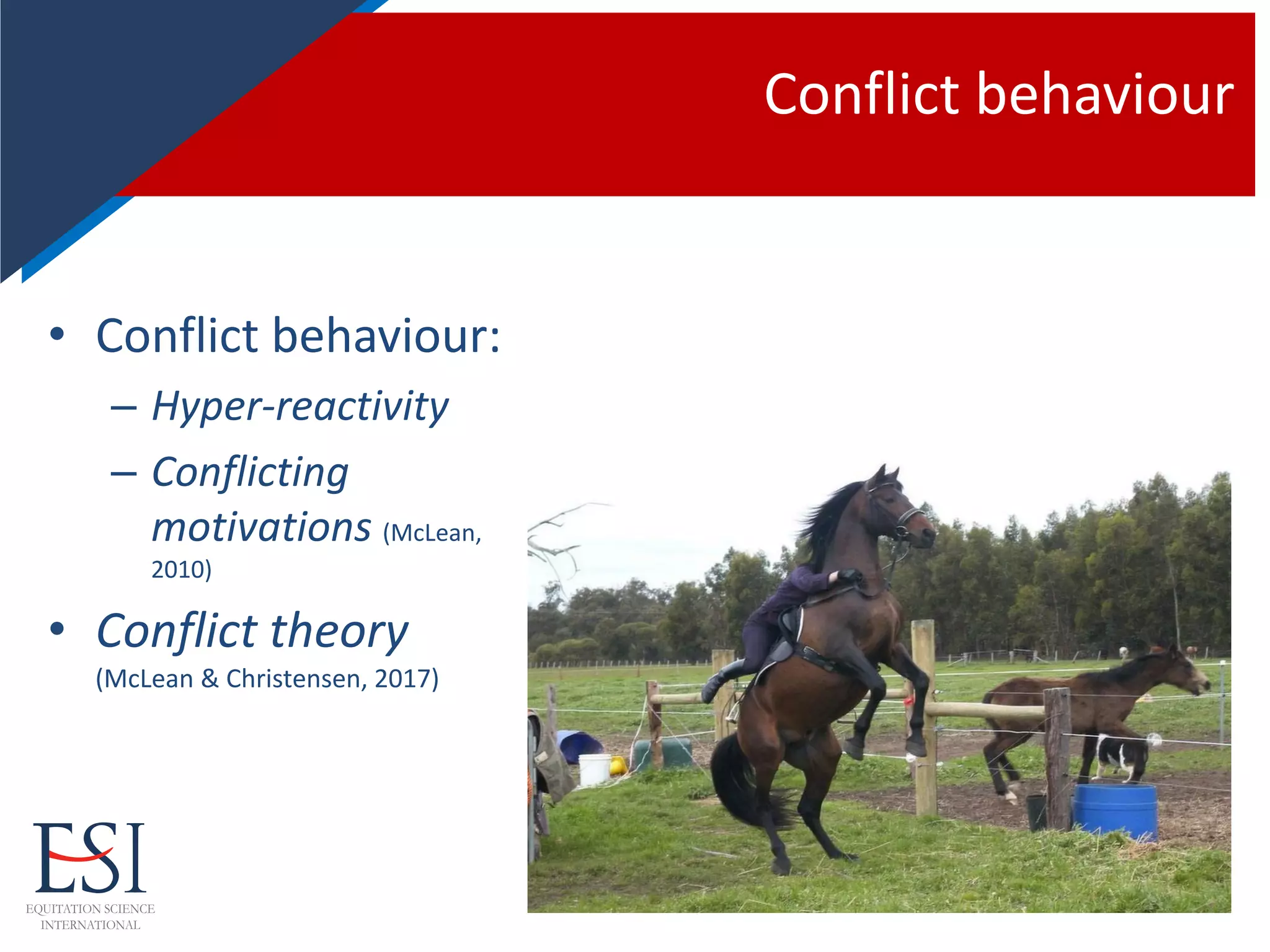
Conflict behaviour
• Conflict behaviour:
– Hyper-reactivity
– Conflicting
motivations (McLean,
2010)
• Conflict theory
(McLean & Christensen, 2017)
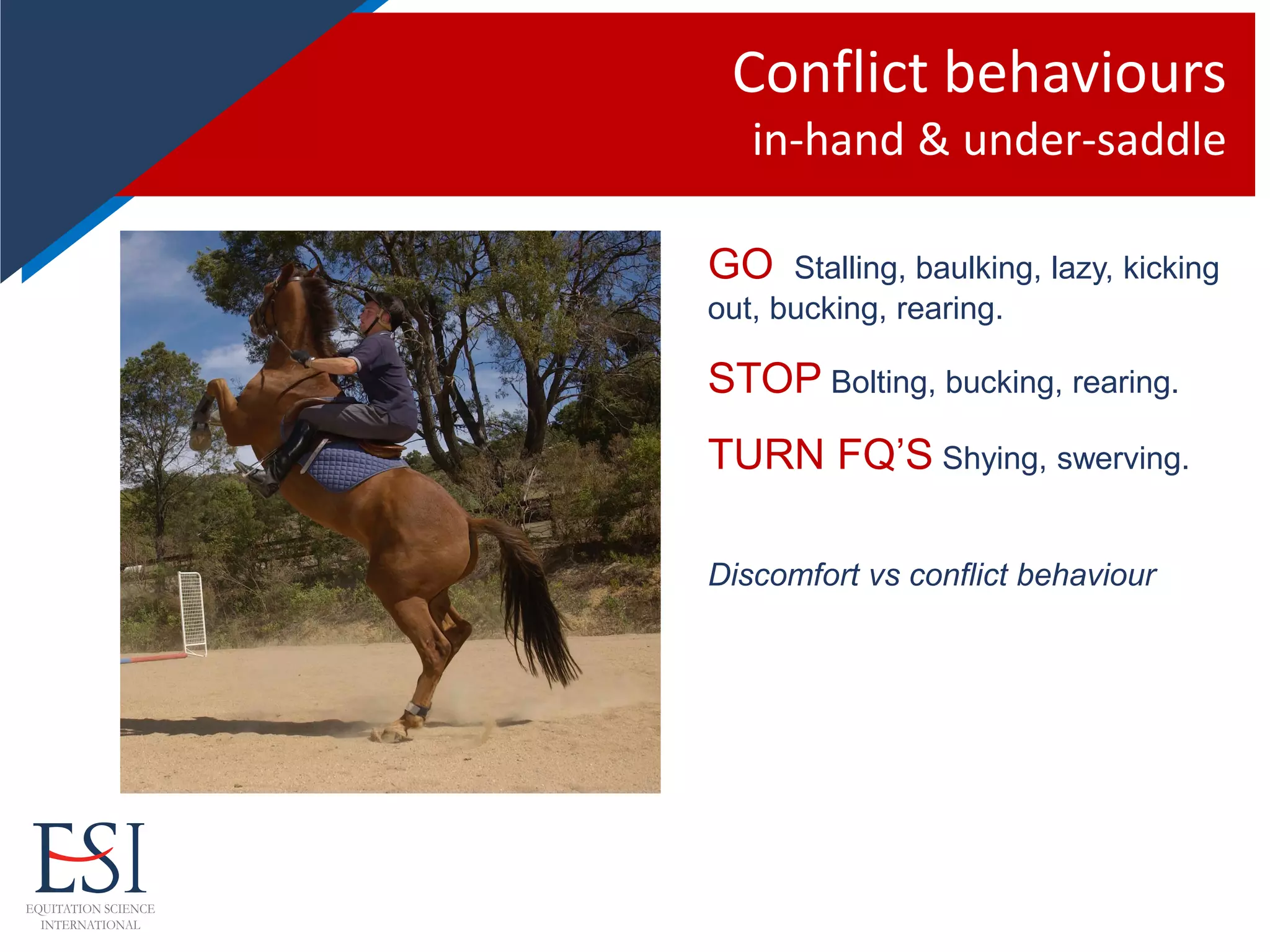
Conflict behaviours
in-hand & under-saddle
GO Stalling, baulking, lazy, kicking
out, bucking, rearing.
STOP Bolting, bucking, rearing.
TURN FQ’S Shying, swerving.
Discomfort vs conflict behaviour
Conflict Prevention
Co-author:
“First Training Principles” for
ISES
[www.equitationscience.com]
Behaviour change…
• British Horse Society – Guest coach, 2010, 2018
• Pony Club Australia – Board, syllabus
• National Federations (Australia, Sweden, Finland, UK,
Netherlands, Germany, Italy, Switzerland, Canada)
• Global Dressage Forum (2006, 2010, 2012) presented revised
judging scale for dressage
• North America Western Dressage (NAWD) adopting objective
judging scale
• International clinics (USA, Belgium, New Zealand, Ireland,
Denmark)
• Jody Hartstone (noseband rule changes)
• Gemma Pearson – behaviour workshops for
veterinarians
Behaviour change…
• Racing Victoria - AEBC - Off The
Track Programme
• Harness Racing Australia – whip-
free harness racing
• Forensic Work – Expert witness
work, 80 cases since 2001
Behaviour change…
Recognition of Equitation Science
• 2010 - Eureka Science Prize with Prof Paul
McGreevy and Dr Bidda Jones
• 2014 - Daniel Fellows Fellowship, USA Sporting
Library and Museum
• 2018 - Flambio award for horse welfare – Italian
Equestrian Federation, 2018
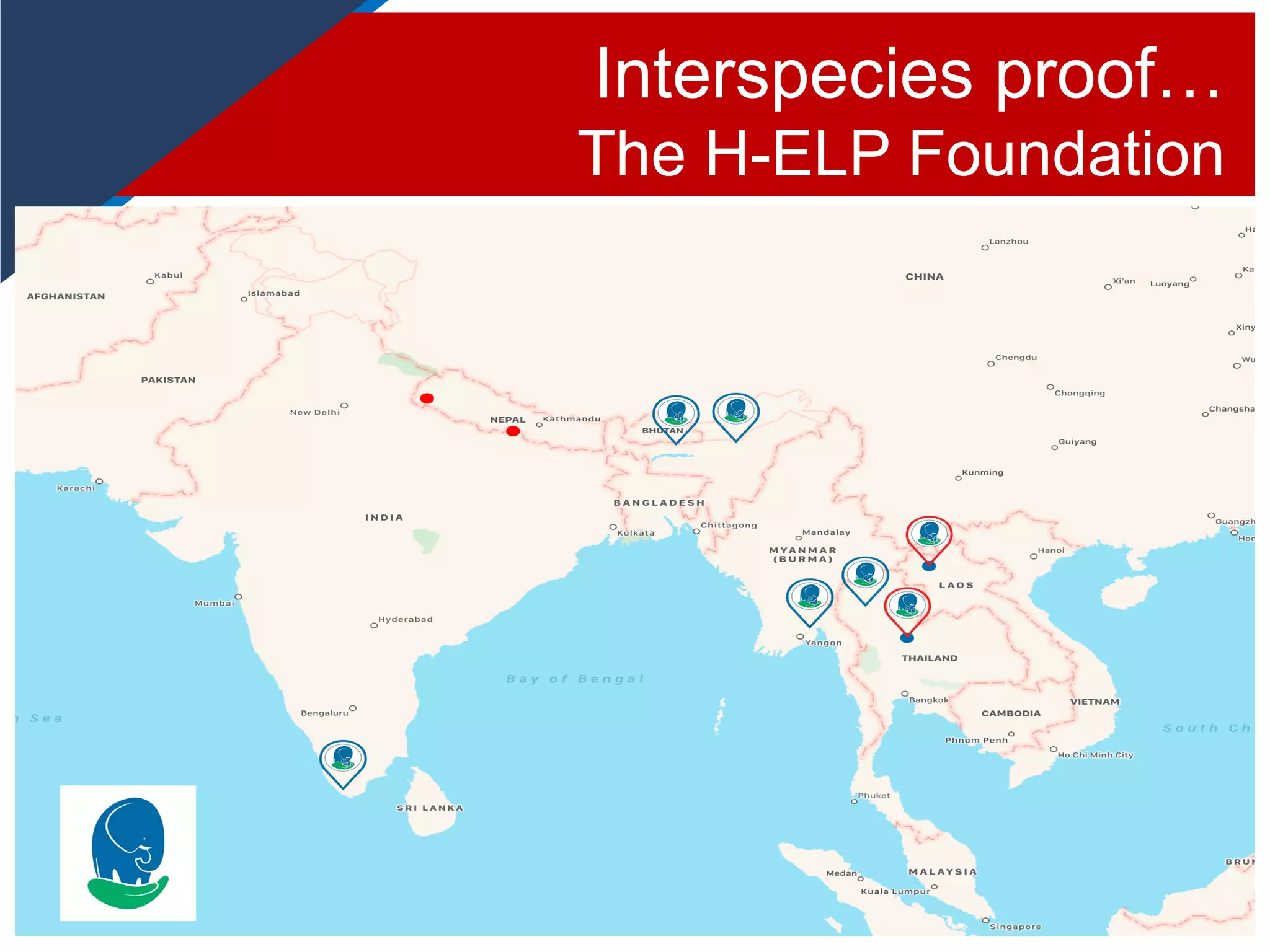
Interspecies proof…
The H-ELP Foundation
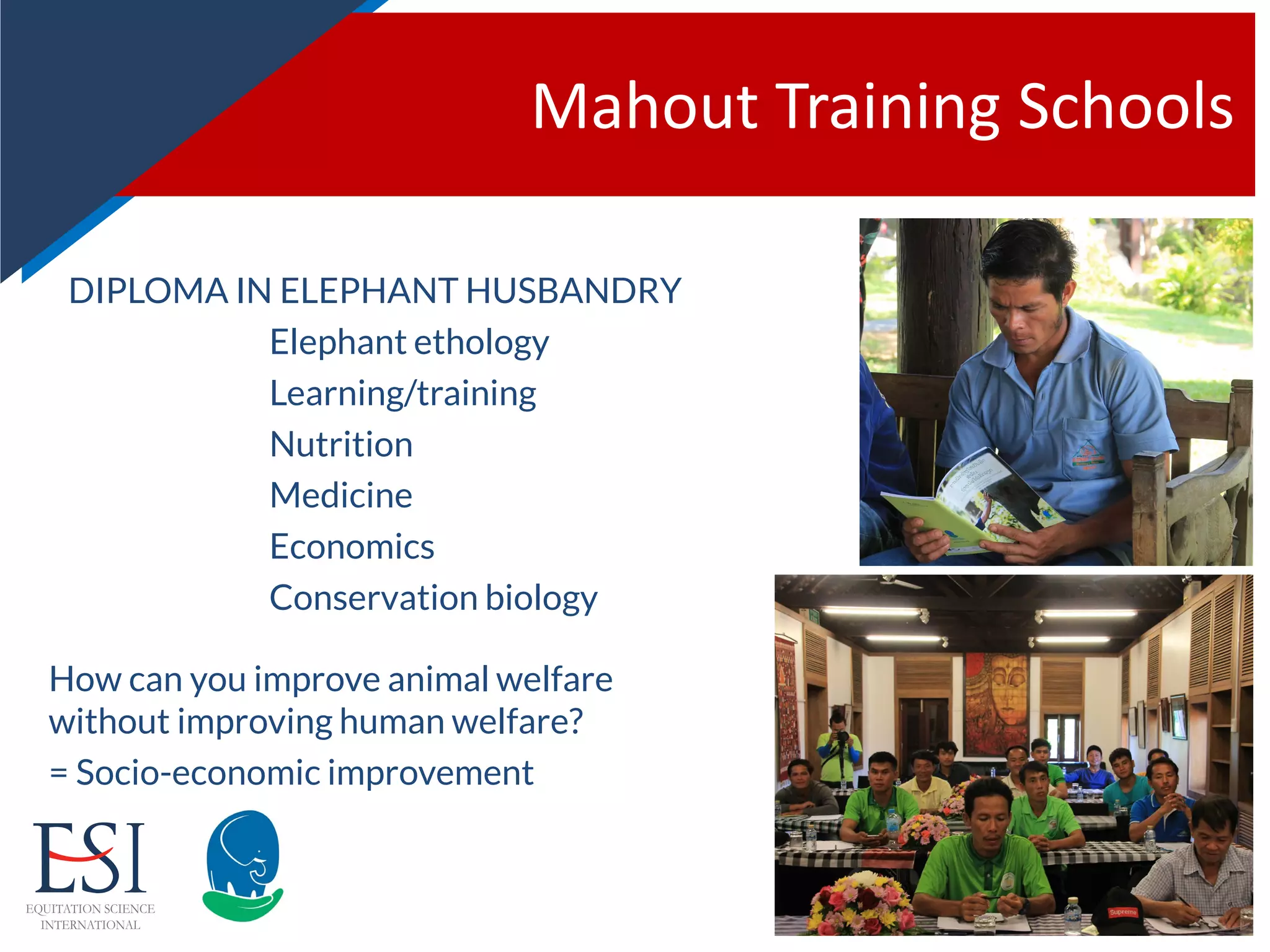
Mahout Training Schools
DIPLOMA IN ELEPHANT HUSBANDRY
– Elephant ethology
– Learning/training
– Nutrition
– Medicine
– Economics
– Conservation biology
How can you improve animal welfare
without improving human welfare?
= Socio-economic improvement
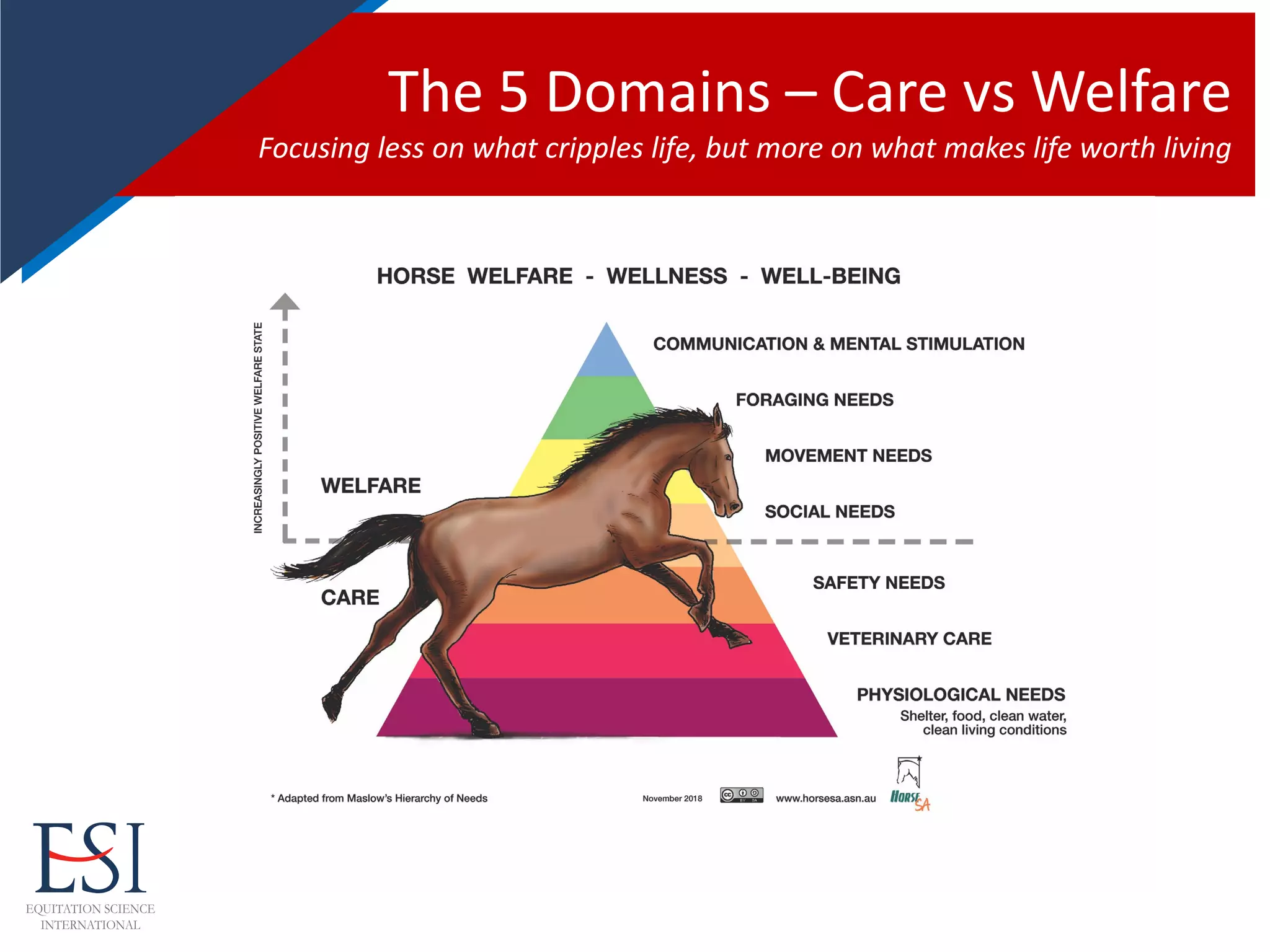
The 5 Domains – Care vs Welfare
Focusing less on what cripples life, but more on what makes life worth living
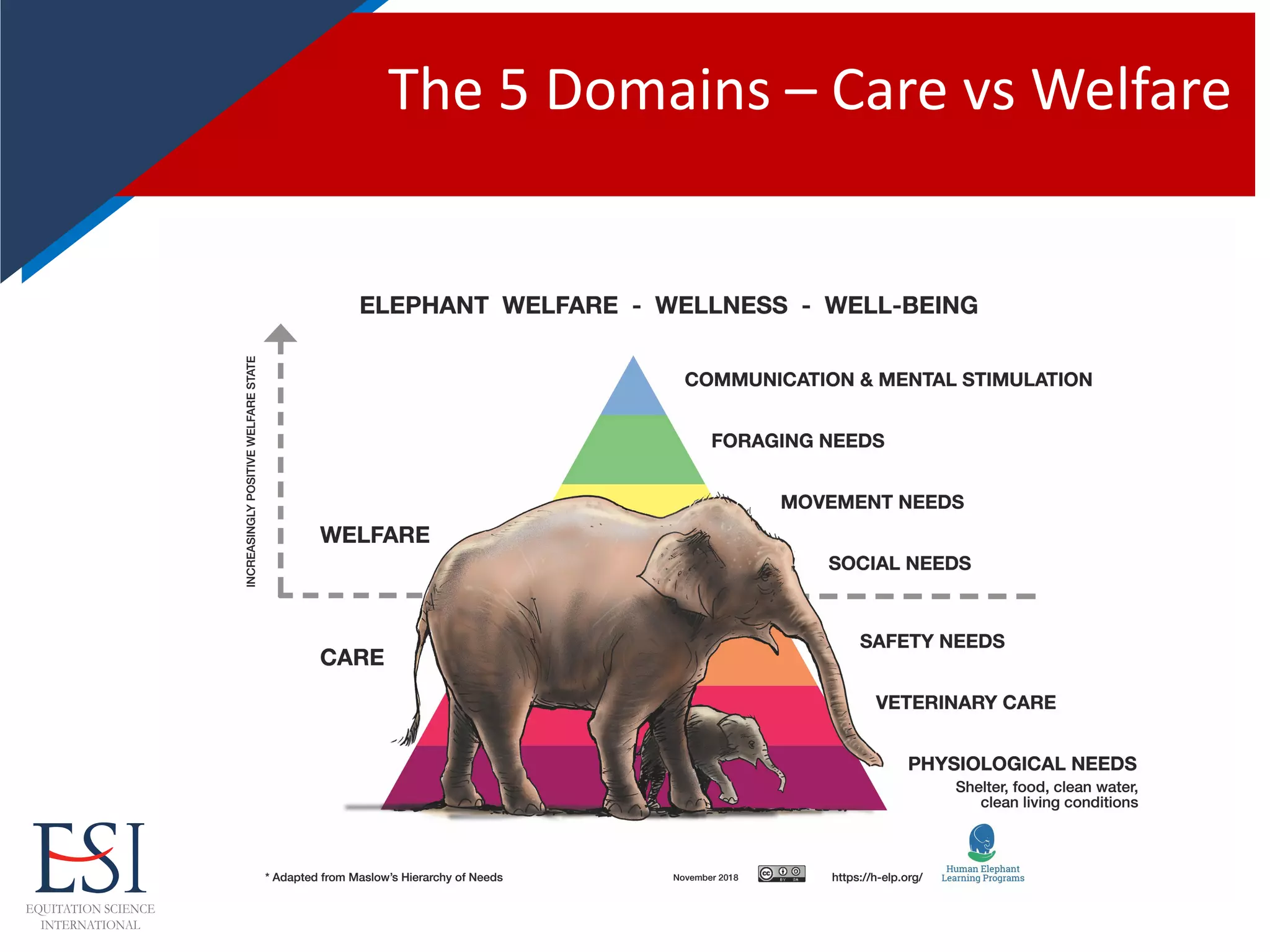
The 5 Domains – Care vs Welfare
Thank you for listening
Dr Andrew McLean
Equitation Science International
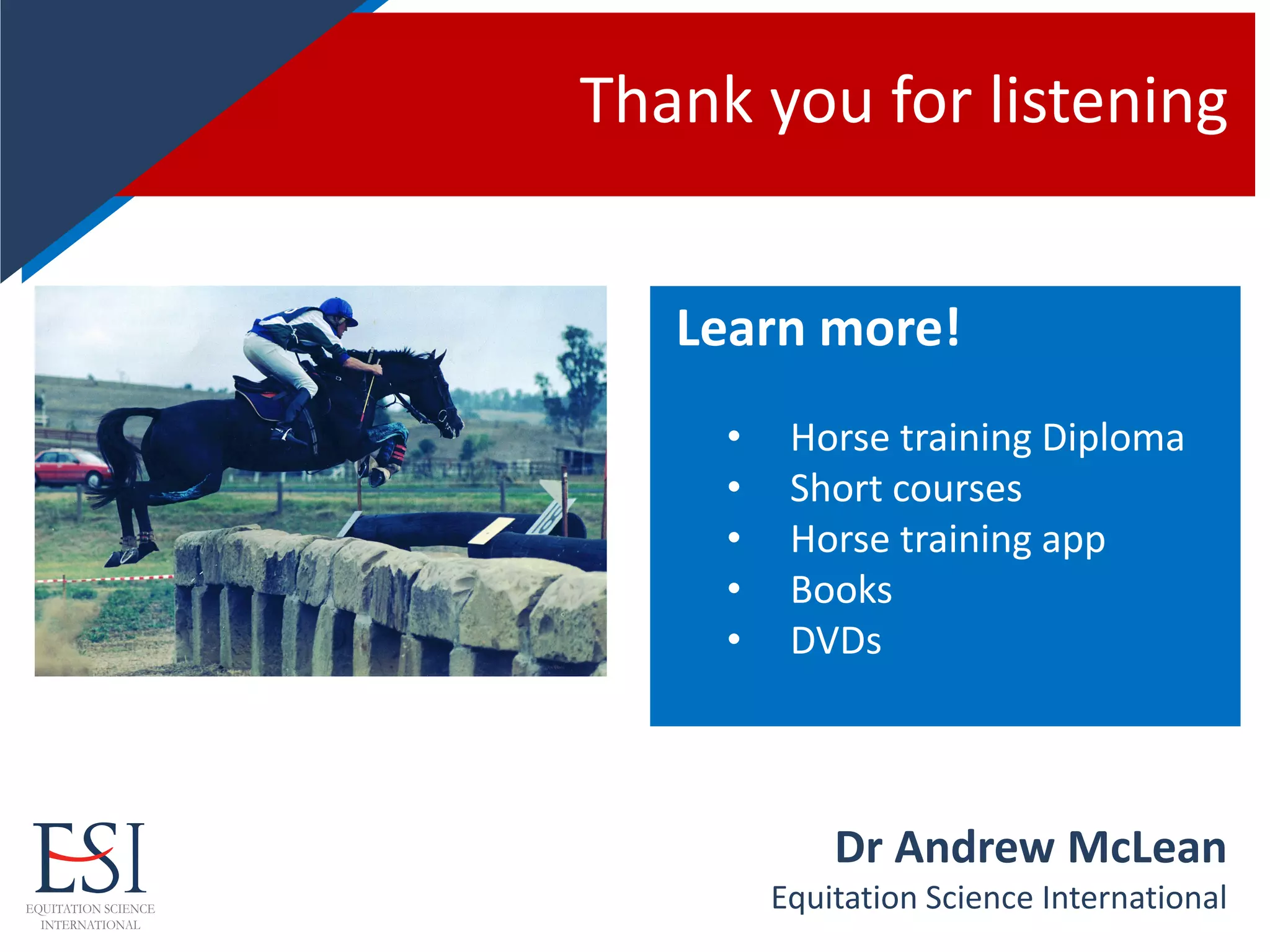
Learn more!
• Horse training Diploma
• Short courses
• Horse training app
• Books
• DVDs

The Winds of Change: Reflections on the international adoption of evidenced based training #horsetraining

  • 1.
    The Winds ofChange Reflections on the international adoption of evidence-based training Dr Andrew McLean Equitation Science International “All truth passes through three stages. First, it is ridiculed. Second, it is violently opposed. Third it is accepted as being self-evident.” Schopenhauer (1788 - 1860)
  • 2.
    History of HorseTraining Tradition/folklore: • ~6000 years • Trial and error • Horses have excellent abilities in associative and non-associative learning and can generalise so methods can be variously efficient • What people do may be objective yet how they explain what they do may be very subjective.
  • 3.
    The equestrian narrative… Willto win (sport) Partnership (leisure) Loyal (war) Work ethic (agriculture)
  • 4.
    Confounding the problem... •Lay expertise • Devaluing brakes • Money • Medals • Moral disengagement • Hyperflexion • Whipping • Tight nosebands • Tongue ties • Jiggers
  • 5.
    The Rise ofPsychology Learning theory/behaviourism: Arose largely in North America: • Pavlov 1839-1946 • Thorndike 1874-1949 • Watson 1878-1958 • Hull 1884-1952 • Skinner 1904-1990. Behaviour is a product of reinforcement = tools for teachers and trainers But behaviourism wasn’t to last…
  • 6.
    Demise of Behaviourism Sciencelost its appeal in the 1960’s: • Military: Nuclear mass- destruction fears • Medicine: Medical mishaps • Environment: DDT, deforestation, pollution, overpopulation • Watson & Skinner: Ambitious claims • Research: Miller, Broadbent, Chomsky, Neisser, Bowlby, Harlow • The Cognitive Revolution
  • 7.
    Ethology steps in… Animalbehaviour/Ethology: Largely arose in Europe: • Tinbergen 1907–1988 • Lorenz 1903-1989 • von Frisch 1886-1982 • Natural behaviours: Fixed action patterns, communication, social organisation, imprinting • In 1921 Schjelderup-Ebbe described the pecking order in chickens…..
  • 8.
    The Animal Hierarchy •Pop-science appeal of hierarchy: military, state, business, church, school, family… • The rise of ‘New-Age’ trainers in the 1960’s and 70’s • Sought explanation from science • Embraced pecking order to produce a social dominance model of training: • Notions of dominance, submission, respect and later leadership • The spotlight was on the horse’s character and not on the trainer’s use of learning theory • New-Age character Descriptors: alpha, dominant, submissive, dis/respectful, leader.
  • 9.
    My Journey… • 1976- Zoology double major, 1977 to 1990 lecturer in zoology Uni of Tasmania, plus breaking / training Woodmount Equestrian Centre. • 1989 - Australian 3DE team Trans Tasman, short list 1990 world championships. Grand Prix SJ, bareback racing and Dressage. • 1994 - Australian Equine Behaviour Centre • 2004 - PhD – the mental process of the horse and its consequences for training • 1995 - Australian Equine Behaviour Centre (AEBC) • The Truth About Horses (plus 5 other publications) • 2004 - Co-founder – The International Society for Equitation Science (ISES) • McLean, A.N. 2005. The positive aspects of correct negative reinforcement. Anthrozoos, 18, 3, 245–254. (…the need is urgent for universities throughout the world to become the knowledge bases for equitation science.) • Author/co-author 50 journal papers • Equitation Science International (ESI)
  • 10.
    Extinguishing the naughtyhorse… Training via negative reinforcement rules: 1. The strength of the aversive stimulus must meet the sensitivity of the individual animal. 2. The aversive stimulus must be terminated at a right moment to avoid punishment. 3. The animal should be in a sufficiently relaxed state to assess its situation and give an adequate behavioural reaction. 4. Aversive tactile stimuli should be rapidly reduced to light versions of those stimuli via classical conditioning. Neglecting any of these conditions may lead to substantial emotional problems, conflict behaviours, hyperactivity, or excessive fear in the horse-human relationship, regardless of the training method [How "natural" training methods can affect equine mental state? A critical approach - A review Rozempolska-Rucińska et al, 2013 (Animal science papers and reports 31(3):185-19]
  • 11.
    Affective states (optimism/ pessimism) Dysfunctions in negative reinforcement: 1. Reinforcing inconsistent responses, 2. incorrect responses, 3. no removal of pressure or 4. no shaping of responses. Dysfunctions in positive reinforcement: 1. Reinforcement is discontinued when shaping behaviours (aversive non-reward). 2. Reinforcement is discontinued when changing reinforcement schedules (McLean and Christensen, 2017)
  • 12.
    Conflict behaviour • Conflictbehaviour: – Hyper-reactivity – Conflicting motivations (McLean, 2010) • Conflict theory (McLean & Christensen, 2017)
  • 13.
    Conflict behaviours in-hand &under-saddle GO Stalling, baulking, lazy, kicking out, bucking, rearing. STOP Bolting, bucking, rearing. TURN FQ’S Shying, swerving. Discomfort vs conflict behaviour
  • 14.
    Conflict Prevention Co-author: “First TrainingPrinciples” for ISES [www.equitationscience.com]
  • 15.
    Behaviour change… • BritishHorse Society – Guest coach, 2010, 2018 • Pony Club Australia – Board, syllabus • National Federations (Australia, Sweden, Finland, UK, Netherlands, Germany, Italy, Switzerland, Canada) • Global Dressage Forum (2006, 2010, 2012) presented revised judging scale for dressage • North America Western Dressage (NAWD) adopting objective judging scale • International clinics (USA, Belgium, New Zealand, Ireland, Denmark) • Jody Hartstone (noseband rule changes) • Gemma Pearson – behaviour workshops for veterinarians
  • 16.
    Behaviour change… • RacingVictoria - AEBC - Off The Track Programme • Harness Racing Australia – whip- free harness racing • Forensic Work – Expert witness work, 80 cases since 2001
  • 17.
    Behaviour change… Recognition ofEquitation Science • 2010 - Eureka Science Prize with Prof Paul McGreevy and Dr Bidda Jones • 2014 - Daniel Fellows Fellowship, USA Sporting Library and Museum • 2018 - Flambio award for horse welfare – Italian Equestrian Federation, 2018
  • 18.
  • 19.
    Mahout Training Schools DIPLOMAIN ELEPHANT HUSBANDRY – Elephant ethology – Learning/training – Nutrition – Medicine – Economics – Conservation biology How can you improve animal welfare without improving human welfare? = Socio-economic improvement
  • 20.
    The 5 Domains– Care vs Welfare Focusing less on what cripples life, but more on what makes life worth living
  • 21.
    The 5 Domains– Care vs Welfare
  • 22.
    Thank you forlistening Dr Andrew McLean Equitation Science International Learn more! • Horse training Diploma • Short courses • Horse training app • Books • DVDs