Fall Safety Training
People.Horses.Culture
Morphettville , 24th May 2018
Reducing injury risk
Lindsay Nylund
horseriderfallsafety.com.au
Agenda
•Why do fall safety training?
•What is fall safety training?
•How much training is required?
•PhD study (University of Sydney)
Why do fall safety training?
1. Science on fall times and response capability
2. Written feedback from over 1,000 riders who have done
some training (99% say the training was beneficial)
3. Preliminary statistical evidence of reduced fall rates
4. Unsolicited feedback (skills transfer to actual falls)
5. Research and safety professional recommendations
6. Other countries – what is being done?
Fall times* 1 second = 1,000 milliseconds (ms)
Racing Falls (flat)
Case 1: 1,040 ms
Case 2: 967 ms
Case 3: 880 ms
Case 4: 760 ms
Case 5: 760 ms
Case 6: 709 ms
Case 7: 701 ms
Case 8: 680 ms
Case 9: 665 ms
Case 10: 500 ms
Average: 766 ms
Eventing Falls (jumps)
Case 1: 1,334 ms
Case 2: 1,100 ms
Case 3: 1,097 ms
Case 4: 900 ms
Case 5: 800 ms
Case 6: 800 ms
Case 7: 734 ms
Case 8: 667 ms
Case 9: 600 ms
Case 10: 553 ms
Average: 856 ms
* Unpublished video review, 2016.Time measured from estimated point of no return.
Factors affecting response capability
Human reaction time (SRT) . . . . . . . .
Response latency (warning cues) . . .
Movement time (initial response) . . . .
Fall time ≈ 750 ms ± 250 ms
200 ms (150 to 250)
150 ms ( 50 to 250)
250 ms (200 to 300)
600 ms (400 to 800)
Studies (SRT) Subjects Time (ms)
Kosinski, R. (2005) University students 160-190
Hitchens, P. et al. (2011) Jockeys and track riders 192-215
Pilianidis, T. et al. (2012) Olympic sprinters 146-210
Fall techniques study (van Swigchem, et al., 2009)
How do humans react during a fall and how much can they
change their behaviour prior to hitting the surface?
• 14 subjects (age 21-35)
• 5 were experienced judokas, 9 were not experienced
• Fall from kneeling position by releasing rope: Avg fall time 405 ms
• Choice reaction time task (2 difference auditory cues)
• Technique A – reach out with arm (Low pitch auditory cue)
• Technique B – side turn + block (High pitch auditory cue)
Results
• Choice RT = 190 to 200 ms (measured by EMG)
• 85% success rate in applying the correct technique before impact
• No difference between experienced and inexperienced judokas
Fall safety survey (Jan 2018)
Preliminary statistical findings (last 3 years)
479 respondents – Avge of 1.9 falls (1 every 19 months)
• No falls: 24% (n=116)
• One fall: 29% (n=137)
• Two falls: 25% (n=115)
• Three+ falls: 24% (n=111)
Multivariable regression (independent factors): r-sq = 28%
Risk factor Effect Magnitude (over 3-yrs)
Breaking in horses Increased risk + 8.0 falls
Hunting Increased risk + 2.8 falls
Endurance Increased risk + 1.3 falls
Eventing or show-jumping Increased risk + 0.6 falls
Pony club riders Increased risk + 0.6 falls
Ride professionally Increased risk + 0.6 falls
Done some fall safety training Reduced risk - 0.5 falls
Exercise – other than riding Reduced risk - 1.1 falls
Unsolicited feedback: skills transfer
Case 1 – Polo player (NSW)
Case 2 – Professional rider / instructor (NSW)
Case 3 – Eventer (SA)
Cases 4 & 5 – Riding instructor (TAS)
Research / safety professionals
Monash University Accident Research Centre
Teaching and using falling techniques . . . may offer a cheap and
effective avenue of reducing a wide range of injuries, including those to
the head, neck and upper extremities. (Finch et al.,1996)
Study of improvements in international health protection
standards for jockeys in UK, Ireland, France and Germany
Recommendations included: Apprentice jockeys be trained in how to
fall. (Jander, 2009)
VIC coroners finding - investigation into track work rider death
Recommendation: . . . consider the feasibility of compulsory fall safety
training for individuals engaged in track work with racehorses.
(Coroners Court of VIC, 2018)
Other countries
UK - British Riding School – Fall training
Use gym-based activities, followed by simulator
France - Apprentice jockey program
Originally developed Equichute, now doing general fall safety training
10 x 60 minute sessions per year.
German Eventing – tuck and roll training (FEI Report, 2012)
USA (Landsafe Equestrian)
Subsidies provided by US Eventing Association for top riders to
undertake fall safety training.
British racing school
https://www.brs.org.uk/courses/amateur-rider-development-programme
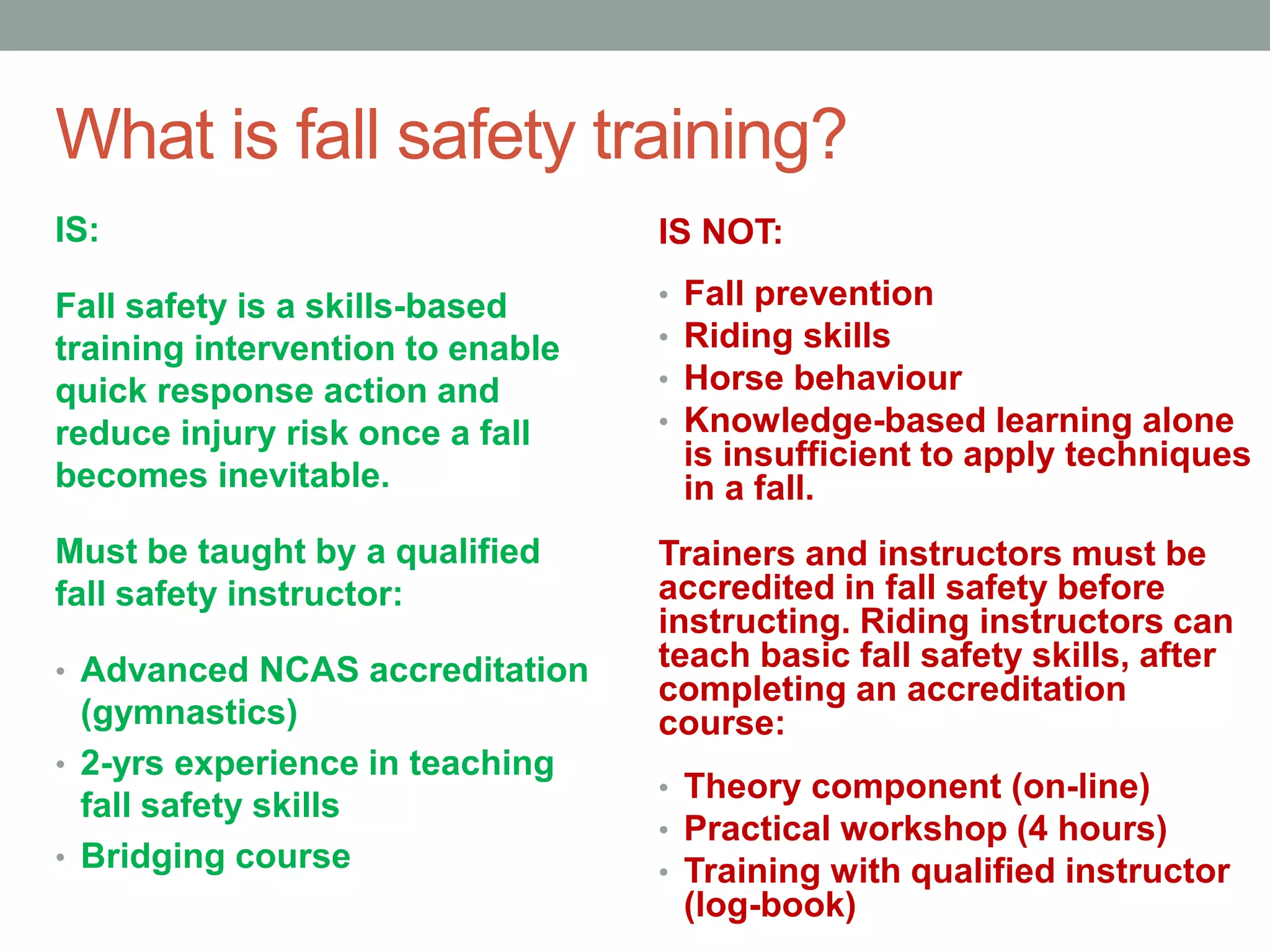
What is fall safety training?
IS:
Fall safety is a skills-based
training intervention to enable
quick response action and
reduce injury risk once a fall
becomes inevitable.
Must be taught by a qualified
fall safety instructor:
• Advanced NCAS accreditation
(gymnastics)
• 2-yrs experience in teaching
fall safety skills
• Bridging course
IS NOT:
• Fall prevention
• Riding skills
• Horse behaviour
• Knowledge-based learning alone
is insufficient to apply techniques
in a fall.
Trainers and instructors must be
accredited in fall safety before
instructing. Riding instructors can
teach basic fall safety skills, after
completing an accreditation
course:
• Theory component (on-line)
• Practical workshop (4 hours)
• Training with qualified instructor
(log-book)
Response Action
Diagram: Surviving the
Unexpected: Fall safety training
for horse riders (Nylund, 2016)
How much training is required?
Basic (2-hour introductory session)
+
Intermediate (8-hours over 3 or 4 sessions)
+
Advanced (10-hours over 4 or 5 sessions)
TOTAL for best practice ≈ 20 hours of training
• Individuals learn at different rates
• Riders who engage in higher-risk riding activities should
do 20 hours of training
• Requires support from industry bodies
PhD study
Faculty of Health Science
Discipline of Exercise and Sports Science
Jockey and Rider Safety:
A study of Rider Response Capability to Reduce
Catastrophic and Serious Injury Risk in Racing
and Equestrian Falls
Research Team:
PhD student: Lindsay Nylund (University of Sydney)
Primary supervisor: Associate Professor Peter Sinclair (University of Sydney)
Auxiliary supervisor: Dr Stephen Cobley (University of Sydney)
External advisor: Dr Peta Hitchens (University of Melbourne)
PhD study
Study one (2018)
• Video observation of falls
• 300 videos (75 x 4 disciplines)
• Racing (Flat & Jumps)
• Eventing (SJ & XC)
• Fall times, warning cues, fall
characteristics
• Expert panel to examine warning cues
Study two (2018/19)
• Laboratory experiment (NSW)
• 60 participants
• Approx. 3 hours per subject
• Reaction time & movement time
• Response latency with/without
warning cues
• Mechanical horse + video screen
Study three (2019/20)
• Training intervention (Locations TBA)
• 60 participants (groups of 8-10)
• Approx. 20 hours of training
• Skills assessment in basic, intermediate and
advanced skills
PhD study
• Videos of falls in original (unaltered) format
• USyd mutual non-disclosure agreement provided
Eventing panel (4 members) + Racing panel (4 members)
• 3-yrs riding experience, Qualifications: NCAS or Vocational or
Tertiary, and 2 yrs experience instructing or observing (eg. riding
instructor or judge or steward)
• Approx. 1-2 day commitment (can be weekend if needed)
• Locations (TBA), may be in any state
To express interest in providing videos or being an expert panel
member or riders who wish to volunteer for the lab experiment and
/ or training intervention please contact:
Lindsay Nylund e: lnyl4681@uni.sydney.edu.au
m 0416 043 058
“The Queen of Netherlands was only willing to let
her daughters ride if they had a degree in Judo
rather than with an air jacket” *
AND
“Lowering the risk had to be done through
education and training . . . active risk
management actions have to prevail on passive
risk management actions” *
* FEI Eventing Risk Management Seminar Report (2015)
References
Coroners Court of Victoria (2018) ‘Finding Without Inquest into the Death of Friederike Antonia Ruhle’
Accessed 22/05/2018. http://www.coronerscourt.vic.gov.au/home/coroners+written+findings/findings+-
+324215++friederike+antonia+ruhle
Jander, C. (2009) Study of improvemetns in international health protection standards for jockeys in the
UK, Ireland France and Germany, The Winston Churchill Memorial Trust of Australia.
FEI (2012) ‘FEI Eventing Risk Management Seminar Report’,
https://inside.fei.org/fei/disc/eventing/risk-management
FEI (2015) ‘FEI Eventing Risk Management Seminar Report’,
http://inside.fei.org/system/files/2015ERMSeminar%20ReportFINAL.pdf
Finch, C.F. and Watt, G.M. (1996) ‘Locking the Stable Door: Preventing Equestrian Injuries,’ Monash
University Accident Research Centre, Report #103, 1996.
Hitchens, P., Blizzard, C., Jones, G., Day, L. and Fell, J. (2011) ‘Are physiological attributes of jockeys
predictors of falls? A pilot study’, Supplementary table 1, British Medical Journal, BMJ Open,
doi:10.1136/bmjopen-2011-000142.
Kosinski, R. (2008) ‘A Literature Review on Reaction Time’, Clemson University.
Nylund, L. (2016) Surviving the Unexpected: Fall safety training for horse riders, Nylund Pty Ltd,
Hunters Hill, Australia, p. 49.
Pilianidis, T., Kasabalis, A., Mantzouranis, N. and Mavvidis, A. (2012) ‘Start reaction time and
performance at the sprint events in the Olympic games’, Kinesiology, vol. 44(1), pp.67-72.
Van Swigchem, R., Groen, Brenda E., Weerdesteyn, Vivian., Duysens, Jacques. (2009) ‘The effects of
time pressure and experience on the performance of fall techniques during a fall”, Journal of
Electromyography and Kinesiology, vol. 19(3), pp.521-531.

(Horse) Fall Safety Training- Reducing Injury Risk #horsesafety

  • 1.
    Fall Safety Training People.Horses.Culture Morphettville, 24th May 2018 Reducing injury risk Lindsay Nylund horseriderfallsafety.com.au
  • 2.
    Agenda •Why do fallsafety training? •What is fall safety training? •How much training is required? •PhD study (University of Sydney)
  • 3.
    Why do fallsafety training? 1. Science on fall times and response capability 2. Written feedback from over 1,000 riders who have done some training (99% say the training was beneficial) 3. Preliminary statistical evidence of reduced fall rates 4. Unsolicited feedback (skills transfer to actual falls) 5. Research and safety professional recommendations 6. Other countries – what is being done?
  • 4.
    Fall times* 1second = 1,000 milliseconds (ms) Racing Falls (flat) Case 1: 1,040 ms Case 2: 967 ms Case 3: 880 ms Case 4: 760 ms Case 5: 760 ms Case 6: 709 ms Case 7: 701 ms Case 8: 680 ms Case 9: 665 ms Case 10: 500 ms Average: 766 ms Eventing Falls (jumps) Case 1: 1,334 ms Case 2: 1,100 ms Case 3: 1,097 ms Case 4: 900 ms Case 5: 800 ms Case 6: 800 ms Case 7: 734 ms Case 8: 667 ms Case 9: 600 ms Case 10: 553 ms Average: 856 ms * Unpublished video review, 2016.Time measured from estimated point of no return.
  • 5.
    Factors affecting responsecapability Human reaction time (SRT) . . . . . . . . Response latency (warning cues) . . . Movement time (initial response) . . . . Fall time ≈ 750 ms ± 250 ms 200 ms (150 to 250) 150 ms ( 50 to 250) 250 ms (200 to 300) 600 ms (400 to 800) Studies (SRT) Subjects Time (ms) Kosinski, R. (2005) University students 160-190 Hitchens, P. et al. (2011) Jockeys and track riders 192-215 Pilianidis, T. et al. (2012) Olympic sprinters 146-210
  • 6.
    Fall techniques study(van Swigchem, et al., 2009) How do humans react during a fall and how much can they change their behaviour prior to hitting the surface? • 14 subjects (age 21-35) • 5 were experienced judokas, 9 were not experienced • Fall from kneeling position by releasing rope: Avg fall time 405 ms • Choice reaction time task (2 difference auditory cues) • Technique A – reach out with arm (Low pitch auditory cue) • Technique B – side turn + block (High pitch auditory cue) Results • Choice RT = 190 to 200 ms (measured by EMG) • 85% success rate in applying the correct technique before impact • No difference between experienced and inexperienced judokas
  • 7.
    Fall safety survey(Jan 2018) Preliminary statistical findings (last 3 years) 479 respondents – Avge of 1.9 falls (1 every 19 months) • No falls: 24% (n=116) • One fall: 29% (n=137) • Two falls: 25% (n=115) • Three+ falls: 24% (n=111) Multivariable regression (independent factors): r-sq = 28% Risk factor Effect Magnitude (over 3-yrs) Breaking in horses Increased risk + 8.0 falls Hunting Increased risk + 2.8 falls Endurance Increased risk + 1.3 falls Eventing or show-jumping Increased risk + 0.6 falls Pony club riders Increased risk + 0.6 falls Ride professionally Increased risk + 0.6 falls Done some fall safety training Reduced risk - 0.5 falls Exercise – other than riding Reduced risk - 1.1 falls
  • 8.
    Unsolicited feedback: skillstransfer Case 1 – Polo player (NSW) Case 2 – Professional rider / instructor (NSW) Case 3 – Eventer (SA) Cases 4 & 5 – Riding instructor (TAS)
  • 9.
    Research / safetyprofessionals Monash University Accident Research Centre Teaching and using falling techniques . . . may offer a cheap and effective avenue of reducing a wide range of injuries, including those to the head, neck and upper extremities. (Finch et al.,1996) Study of improvements in international health protection standards for jockeys in UK, Ireland, France and Germany Recommendations included: Apprentice jockeys be trained in how to fall. (Jander, 2009) VIC coroners finding - investigation into track work rider death Recommendation: . . . consider the feasibility of compulsory fall safety training for individuals engaged in track work with racehorses. (Coroners Court of VIC, 2018)
  • 10.
    Other countries UK -British Riding School – Fall training Use gym-based activities, followed by simulator France - Apprentice jockey program Originally developed Equichute, now doing general fall safety training 10 x 60 minute sessions per year. German Eventing – tuck and roll training (FEI Report, 2012) USA (Landsafe Equestrian) Subsidies provided by US Eventing Association for top riders to undertake fall safety training.
  • 11.
  • 12.
    What is fallsafety training? IS: Fall safety is a skills-based training intervention to enable quick response action and reduce injury risk once a fall becomes inevitable. Must be taught by a qualified fall safety instructor: • Advanced NCAS accreditation (gymnastics) • 2-yrs experience in teaching fall safety skills • Bridging course IS NOT: • Fall prevention • Riding skills • Horse behaviour • Knowledge-based learning alone is insufficient to apply techniques in a fall. Trainers and instructors must be accredited in fall safety before instructing. Riding instructors can teach basic fall safety skills, after completing an accreditation course: • Theory component (on-line) • Practical workshop (4 hours) • Training with qualified instructor (log-book)
  • 13.
    Response Action Diagram: Survivingthe Unexpected: Fall safety training for horse riders (Nylund, 2016)
  • 14.
    How much trainingis required? Basic (2-hour introductory session) + Intermediate (8-hours over 3 or 4 sessions) + Advanced (10-hours over 4 or 5 sessions) TOTAL for best practice ≈ 20 hours of training • Individuals learn at different rates • Riders who engage in higher-risk riding activities should do 20 hours of training • Requires support from industry bodies
  • 15.
    PhD study Faculty ofHealth Science Discipline of Exercise and Sports Science Jockey and Rider Safety: A study of Rider Response Capability to Reduce Catastrophic and Serious Injury Risk in Racing and Equestrian Falls Research Team: PhD student: Lindsay Nylund (University of Sydney) Primary supervisor: Associate Professor Peter Sinclair (University of Sydney) Auxiliary supervisor: Dr Stephen Cobley (University of Sydney) External advisor: Dr Peta Hitchens (University of Melbourne)
  • 16.
    PhD study Study one(2018) • Video observation of falls • 300 videos (75 x 4 disciplines) • Racing (Flat & Jumps) • Eventing (SJ & XC) • Fall times, warning cues, fall characteristics • Expert panel to examine warning cues Study two (2018/19) • Laboratory experiment (NSW) • 60 participants • Approx. 3 hours per subject • Reaction time & movement time • Response latency with/without warning cues • Mechanical horse + video screen Study three (2019/20) • Training intervention (Locations TBA) • 60 participants (groups of 8-10) • Approx. 20 hours of training • Skills assessment in basic, intermediate and advanced skills
  • 17.
    PhD study • Videosof falls in original (unaltered) format • USyd mutual non-disclosure agreement provided Eventing panel (4 members) + Racing panel (4 members) • 3-yrs riding experience, Qualifications: NCAS or Vocational or Tertiary, and 2 yrs experience instructing or observing (eg. riding instructor or judge or steward) • Approx. 1-2 day commitment (can be weekend if needed) • Locations (TBA), may be in any state To express interest in providing videos or being an expert panel member or riders who wish to volunteer for the lab experiment and / or training intervention please contact: Lindsay Nylund e: lnyl4681@uni.sydney.edu.au m 0416 043 058
  • 18.
    “The Queen ofNetherlands was only willing to let her daughters ride if they had a degree in Judo rather than with an air jacket” * AND “Lowering the risk had to be done through education and training . . . active risk management actions have to prevail on passive risk management actions” * * FEI Eventing Risk Management Seminar Report (2015)
  • 19.
    References Coroners Court ofVictoria (2018) ‘Finding Without Inquest into the Death of Friederike Antonia Ruhle’ Accessed 22/05/2018. http://www.coronerscourt.vic.gov.au/home/coroners+written+findings/findings+- +324215++friederike+antonia+ruhle Jander, C. (2009) Study of improvemetns in international health protection standards for jockeys in the UK, Ireland France and Germany, The Winston Churchill Memorial Trust of Australia. FEI (2012) ‘FEI Eventing Risk Management Seminar Report’, https://inside.fei.org/fei/disc/eventing/risk-management FEI (2015) ‘FEI Eventing Risk Management Seminar Report’, http://inside.fei.org/system/files/2015ERMSeminar%20ReportFINAL.pdf Finch, C.F. and Watt, G.M. (1996) ‘Locking the Stable Door: Preventing Equestrian Injuries,’ Monash University Accident Research Centre, Report #103, 1996. Hitchens, P., Blizzard, C., Jones, G., Day, L. and Fell, J. (2011) ‘Are physiological attributes of jockeys predictors of falls? A pilot study’, Supplementary table 1, British Medical Journal, BMJ Open, doi:10.1136/bmjopen-2011-000142. Kosinski, R. (2008) ‘A Literature Review on Reaction Time’, Clemson University. Nylund, L. (2016) Surviving the Unexpected: Fall safety training for horse riders, Nylund Pty Ltd, Hunters Hill, Australia, p. 49. Pilianidis, T., Kasabalis, A., Mantzouranis, N. and Mavvidis, A. (2012) ‘Start reaction time and performance at the sprint events in the Olympic games’, Kinesiology, vol. 44(1), pp.67-72. Van Swigchem, R., Groen, Brenda E., Weerdesteyn, Vivian., Duysens, Jacques. (2009) ‘The effects of time pressure and experience on the performance of fall techniques during a fall”, Journal of Electromyography and Kinesiology, vol. 19(3), pp.521-531.