KAIMAI SCHOOL
    Calf Club

    Calves
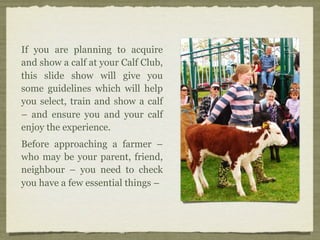
If you are planning to acquire
and show a calf at your Calf Club,
this slide show will give you
some guidelines which will help
you select, train and show a calf
– and ensure you and your calf
enjoy the experience.
Before approaching a farmer –
who may be your parent, friend,
neighbour – you need to check
you have a few essential things –
GRAZING
Calves need safe, well fenced
paddocks with shelter from
extreme heat or cold, and clean
water in a low trough which the
calf can reach easily.
Calves need good quality, fresh,
long grass as (when they are very
young) they tend to nibble at the
tips of the grass.
FEEDING
A milk feeder – preferably a
‘personal’ one which allows you
to feed the calf on its own so you
develop a friendship with it. This
can be anything from a bucket, to
a ‘mother udder’ (a handheld
small bucket with its own teat),
or a standard calfeteria (a calf
feeder which has teats for a
number of calves).
FEEDING
• Right from the start, your calf will need feeding twice a day - in the
morning (before you leave for school) and the afternoon (when you
get home).
• If you’re lucky enough to live on a dairy farm, you will probably get
your milk direct from the farm dairy in the mornings and afternoons,
when it is still warm so you can immediately feed your calf. If you
don’t live on a dairy farm, you cab mix special calf milk formula with
warm water (the water-powder ratio is given on the outside of the bag
of milk powder) and feed your calf.
• It is very important to keep whatever utensil you use to feed your
calf (bucket, mother udder, calfeteria) very, very clean – calves can
get ‘a tummy bug’ called scours (diarrhoea!!!) from dirty feeding
utensils, so be very careful to clean everything in hot soapy water
after each feed so it is clean for the next feed.
CALF MEAL
Your calf will grow quickly and will soon
begin nibbling grass and drinking water
from the trough. At around two weeks you
will want to introduce calf meal to its diet so
it grows well and has ‘good condition’ (has a
good cover of fat and muscle) and is
contented during the day between feeds.


Meal is fed in the mornings, after your calf’s milk feed. You will need a
large, flat-bottomed feeder which your calf can’t push around the
paddock.Although the supply of grass, hay and meal increases as your
calf grows, it is still important to keep feeding milk as this ensures your
calf will have a ‘bloom’ (shine) on its coat when it competes at calf club.
WEANING
At around two to three weeks,
and after checking with your
farmer, the calf’s twice daily milk
feeds can be reduced to one –
generally in the morning. The
amount of milk generally
increases so your calf is getting
one larger drink of milk each
day.
Calves generally remain on once-
a-day milk feeds with grain until
after Calf Club. Weaning then
takes place when the calf returns
to the farm.
HALTERS
• Calf halters can be purchased from
your local farming store; they are
made of soft leather and can be
adjusted so they fit very small, and
quite large, calves.
• Halters are fitted for around one
hour each day of the calf’s life with
you – leaving it on for longer would
rub hair off. As soon as possible after
your calf arrives, fit the halter with
help from the farmer, Mum or Dad.
•When fitted correctly, you should be
able to fit two fingers between any
part of the halter and your calf’s skin,
and it should not pull off if the calf
pulls back.
Make sure you make time to look
after your calf before and after
school each day. You will need to
allow around 30 minutes each
morning, and again in the afternoon
to care for your calf
Remember this is your
responsibility, not Mum or Dad’s, so
you may need to get up earlier in the
morning, and allow for this time
before you do your homework in the
afternoon after school. Your calf is
going to rely on you, so you have to
be there, every day, caring for it. It’s
a big responsibility and you want to
be sure you can do it for 6 to 12
weeks.
TIPS FOR SUCCESS
• Is the calf the right size for you. You need to be able to control it
when it is two to three months old, so its size relative to yours is
important.
• Has a good body shape – nice straight back, good shoulders,
attractive head with well-set ears.
• Has soft skin, fine coat and hair that sits flat so it will be easier to
groom
• Has a good temperament – a friendly, outgoing calf will enjoy its
life with you and be easier to train and show at calf club than a calf
with a shy or nervous temperament.
• Healthy with no diarrhea and has been fed colostrum in the first
12 hours of its life.
TIPS FOR SUCCESS
• In addition, the farmer will also make sure your calf meets with
the requirements of the Animal Health Board (AHB). The AHB is a
Government organization which ensures that all dairy animals wear
ear tags which identify them and their health status, and also asks
farmers to let them know when animals move off the farm.
• Calves less than one month of age don’t need to be tagged, but it’s
a good idea to ask the farmer to tag the calf’s ear with an approved
plastic ear tag and a secondary smaller tag.
TRAINING
When the calf appears to accept the
halter, you can begin teaching it to lead.
There are several ways to do this – you
can pull and tug, or you can get Mum or
Dad to help you tie a long soft rope into a
big loop – big enough to fit around your
calf’s bottom, under its tail, with the lead
coming over its back and through the loop
on the halter.
Now, when you pull the lead, the rope will
come up under the calf’s tail and it will
move forward. As it moves forward, the
pressure under it’s tail stops, and so it
learns to move forward. This way often
trains a calf in a shorter time than any
other method.
LEADING
You want your calf to walk on your
right, and for its head/shoulder to be
alongside you. Your right hand holds
the rope close to the halter (around
15-25 cm away from the side of your
calf’s head), with the rest of the rope
in your left hand so it is not trailing
on the ground where you or your calf
can walk or trip on it. Remember
never to wrap the rope around your
hand – this is very dangerous as it
could mean you are dragged if the calf
gets a fright and attempts to run away
from you.
TURNING
If you have followed the steps described,
you will have your calf moving happily
forward with you. Now you have to learn to
turn the calf.
Remember you are on the outside of the
calf when it turns, so you need to push its
head towards the new direction as you
begin to make the turn – and remember,
the turns need to be very big at the start as
your calf won’t be used to this new
movement and you don’t want it to become
unbalanced and trip or it would get a fright
and lose confidence in you.
STOPPING
You also need to learn how to stop your
calf. This is done by a gentle pull on the
lead rope and shouldn’t be done
suddenly which would give your calf a
fright.
Let it know you’re going to stop, by
giving gentle tugs on the rope, and then
a long pull, fixing your feet on the
ground and leaning back a bit so the calf
feels your weight on the rope – don’t
give any hard, sudden pulls on the rope
though as this would hurt the calf’s
nose.
Remain stationery (still) for a 3-5
seconds – the calf only moving forward
again when you decide to.
COMPETITION

     There are three classes;


• Leading
• Child Effort
• Type
LEADING IN THE RING
                             3) Stop at next peg for
                             three seconds                  2) Walk around first peg.
  4) Proceed around
  next peg to finish line


                                                                     Lead your calf
                                                                     anti-clockwise
                                                                     around the ring,
                                                                     stopping midway
Finish                                                               for 3 seconds. You
                            Start   1) Calf is positioned            may be asked to do
                                    on your right side.
                                                                     a second circle so
                                                                     listen carefully to
                                                                     the judge.
CHILD EFFORT
The judge will ask you a number
of questions about your calf.
• “When was it born”
• “How often is it fed”
• “How much does it drink”
• “What breed is it”
Learn as much as you can about
your calf and have him/her as
clean as possible.
TYPE
The judge will be looking at your calf to
see if it is a good example of its breed,
and a great example of a future dairy/
beef cow.
Its mouth will be checked to ensure its
teeth are in a line so it can chew grass
well
Its head will be checked to be sure it
has alert eyes and its ears are on the
same angle
Its legs will be checked to ensure they
are straight and strong
The judge will run his/her hands over
its back and ribs and will check its
udder to make sure it has four teats

Calf Care

  • 1.
    KAIMAI SCHOOL Calf Club Calves
  • 2.
    If you areplanning to acquire and show a calf at your Calf Club, this slide show will give you some guidelines which will help you select, train and show a calf – and ensure you and your calf enjoy the experience. Before approaching a farmer – who may be your parent, friend, neighbour – you need to check you have a few essential things –
  • 3.
    GRAZING Calves need safe,well fenced paddocks with shelter from extreme heat or cold, and clean water in a low trough which the calf can reach easily. Calves need good quality, fresh, long grass as (when they are very young) they tend to nibble at the tips of the grass.
  • 4.
    FEEDING A milk feeder– preferably a ‘personal’ one which allows you to feed the calf on its own so you develop a friendship with it. This can be anything from a bucket, to a ‘mother udder’ (a handheld small bucket with its own teat), or a standard calfeteria (a calf feeder which has teats for a number of calves).
  • 5.
    FEEDING • Right fromthe start, your calf will need feeding twice a day - in the morning (before you leave for school) and the afternoon (when you get home). • If you’re lucky enough to live on a dairy farm, you will probably get your milk direct from the farm dairy in the mornings and afternoons, when it is still warm so you can immediately feed your calf. If you don’t live on a dairy farm, you cab mix special calf milk formula with warm water (the water-powder ratio is given on the outside of the bag of milk powder) and feed your calf. • It is very important to keep whatever utensil you use to feed your calf (bucket, mother udder, calfeteria) very, very clean – calves can get ‘a tummy bug’ called scours (diarrhoea!!!) from dirty feeding utensils, so be very careful to clean everything in hot soapy water after each feed so it is clean for the next feed.
  • 6.
    CALF MEAL Your calfwill grow quickly and will soon begin nibbling grass and drinking water from the trough. At around two weeks you will want to introduce calf meal to its diet so it grows well and has ‘good condition’ (has a good cover of fat and muscle) and is contented during the day between feeds. Meal is fed in the mornings, after your calf’s milk feed. You will need a large, flat-bottomed feeder which your calf can’t push around the paddock.Although the supply of grass, hay and meal increases as your calf grows, it is still important to keep feeding milk as this ensures your calf will have a ‘bloom’ (shine) on its coat when it competes at calf club.
  • 7.
    WEANING At around twoto three weeks, and after checking with your farmer, the calf’s twice daily milk feeds can be reduced to one – generally in the morning. The amount of milk generally increases so your calf is getting one larger drink of milk each day. Calves generally remain on once- a-day milk feeds with grain until after Calf Club. Weaning then takes place when the calf returns to the farm.
  • 8.
    HALTERS • Calf halterscan be purchased from your local farming store; they are made of soft leather and can be adjusted so they fit very small, and quite large, calves. • Halters are fitted for around one hour each day of the calf’s life with you – leaving it on for longer would rub hair off. As soon as possible after your calf arrives, fit the halter with help from the farmer, Mum or Dad. •When fitted correctly, you should be able to fit two fingers between any part of the halter and your calf’s skin, and it should not pull off if the calf pulls back.
  • 9.
    Make sure youmake time to look after your calf before and after school each day. You will need to allow around 30 minutes each morning, and again in the afternoon to care for your calf Remember this is your responsibility, not Mum or Dad’s, so you may need to get up earlier in the morning, and allow for this time before you do your homework in the afternoon after school. Your calf is going to rely on you, so you have to be there, every day, caring for it. It’s a big responsibility and you want to be sure you can do it for 6 to 12 weeks.
  • 10.
    TIPS FOR SUCCESS •Is the calf the right size for you. You need to be able to control it when it is two to three months old, so its size relative to yours is important. • Has a good body shape – nice straight back, good shoulders, attractive head with well-set ears. • Has soft skin, fine coat and hair that sits flat so it will be easier to groom • Has a good temperament – a friendly, outgoing calf will enjoy its life with you and be easier to train and show at calf club than a calf with a shy or nervous temperament. • Healthy with no diarrhea and has been fed colostrum in the first 12 hours of its life.
  • 11.
    TIPS FOR SUCCESS •In addition, the farmer will also make sure your calf meets with the requirements of the Animal Health Board (AHB). The AHB is a Government organization which ensures that all dairy animals wear ear tags which identify them and their health status, and also asks farmers to let them know when animals move off the farm. • Calves less than one month of age don’t need to be tagged, but it’s a good idea to ask the farmer to tag the calf’s ear with an approved plastic ear tag and a secondary smaller tag.
  • 12.
    TRAINING When the calfappears to accept the halter, you can begin teaching it to lead. There are several ways to do this – you can pull and tug, or you can get Mum or Dad to help you tie a long soft rope into a big loop – big enough to fit around your calf’s bottom, under its tail, with the lead coming over its back and through the loop on the halter. Now, when you pull the lead, the rope will come up under the calf’s tail and it will move forward. As it moves forward, the pressure under it’s tail stops, and so it learns to move forward. This way often trains a calf in a shorter time than any other method.
  • 13.
    LEADING You want yourcalf to walk on your right, and for its head/shoulder to be alongside you. Your right hand holds the rope close to the halter (around 15-25 cm away from the side of your calf’s head), with the rest of the rope in your left hand so it is not trailing on the ground where you or your calf can walk or trip on it. Remember never to wrap the rope around your hand – this is very dangerous as it could mean you are dragged if the calf gets a fright and attempts to run away from you.
  • 14.
    TURNING If you havefollowed the steps described, you will have your calf moving happily forward with you. Now you have to learn to turn the calf. Remember you are on the outside of the calf when it turns, so you need to push its head towards the new direction as you begin to make the turn – and remember, the turns need to be very big at the start as your calf won’t be used to this new movement and you don’t want it to become unbalanced and trip or it would get a fright and lose confidence in you.
  • 15.
    STOPPING You also needto learn how to stop your calf. This is done by a gentle pull on the lead rope and shouldn’t be done suddenly which would give your calf a fright. Let it know you’re going to stop, by giving gentle tugs on the rope, and then a long pull, fixing your feet on the ground and leaning back a bit so the calf feels your weight on the rope – don’t give any hard, sudden pulls on the rope though as this would hurt the calf’s nose. Remain stationery (still) for a 3-5 seconds – the calf only moving forward again when you decide to.
  • 16.
    COMPETITION There are three classes; • Leading • Child Effort • Type
  • 17.
    LEADING IN THERING 3) Stop at next peg for three seconds 2) Walk around first peg. 4) Proceed around next peg to finish line Lead your calf anti-clockwise around the ring, stopping midway Finish for 3 seconds. You Start 1) Calf is positioned may be asked to do on your right side. a second circle so listen carefully to the judge.
  • 18.
    CHILD EFFORT The judgewill ask you a number of questions about your calf. • “When was it born” • “How often is it fed” • “How much does it drink” • “What breed is it” Learn as much as you can about your calf and have him/her as clean as possible.
  • 19.
    TYPE The judge willbe looking at your calf to see if it is a good example of its breed, and a great example of a future dairy/ beef cow. Its mouth will be checked to ensure its teeth are in a line so it can chew grass well Its head will be checked to be sure it has alert eyes and its ears are on the same angle Its legs will be checked to ensure they are straight and strong The judge will run his/her hands over its back and ribs and will check its udder to make sure it has four teats