Equality and
Technology?
Dr. Karen Gregory
Lecturer in Digital Sociology
k.gregory@ed.ac.uk
• What type of digital world
are we building? Why?
• How do technological
developments mirror social
values or social structures?
• Who does technology
“work” for? Why?
• What is the relationship
between education and the
world we design and
develop?
The Promise of Tech
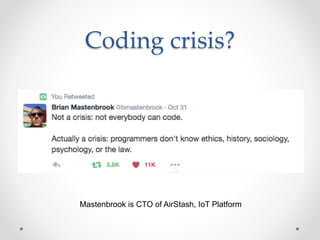
Coding crisis?
Mastenbrook is CTO of AirStash, IoT Platform
• Although the proportion of managers at U.S. commercial banks
who were Hispanic rose from 4.7% in 2003 to 5.7% in 2014,
white women’s representation dropped from 39% to 35%,
and black men’s from 2.5% to 2.3%.
• Among all U.S. companies with 100 or more employees, the
proportion of black men in management increased just
slightly—from 3% to 3.3%—from 1985 to 2014.
• White women saw bigger gains from 1985 to 2000—rising from
22% to 29% of managers—but their numbers haven’t budged
since then.
• Even in Silicon Valley, where many leaders tout the need to
increase diversity for both business and social justice reasons,
bread-and-butter tech jobs remain dominated by white men.
Source: Quotes taken from Harvard Business Review. 2016. “Why Diversity Programs Fail.”
So What?
• Why does this matter?
o Job demand. Estimated 1.4 million tech jobs by 2020. (29% US; of that
29% only 3% will be women)
o The research shows that mixed-gender teams are more innovative, more
creative and more productive.
o Companies with a diverse group of employees make more money.
o Companies with women in leadership positions have higher profits,
higher sales and higher rates of revenue growth.
• “You are not your user.” Can one social demographic design for a complex
world?
• More broadly, what is the relationship between discrimination in tech and
discriminatory systems?
(Source: “Women Technologists Count: Recommendations and Best Practices to Retain Women in Computing.
Anita Borg Institute, 2013)
Beyond Diversity?
• Response to this phenomena has been “diversity” training and
“diversity initiatives”, but recent research suggests:
o The positive effects of diversity training rarely last beyond a day or two,
and a number of studies suggest that it can activate bias or spark a
backlash.
o Managers and employees react negatively to “mandatory trainings.”
Voluntary training has marginally better success rates.
o Diversity testing has resulted in “cherry picking” results, which amplifies
bias.
o Performance ratings and ranking have also been found to amplify bias.
o Data driven, “control” solutions may compound existing inequalities and
interpersonal bias.
(Source: Harvard Business Review. 2016. “Why Diversity Programs Fail.”)
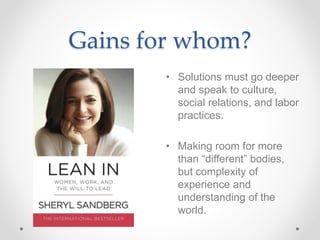
Gains for whom?
• Solutions must go deeper
and speak to culture,
social relations, and labor
practices.
• Making room for more
than “different” bodies,
but complexity of
experience and
understanding of the
world.
Some Definitions
• Prejudice: A positive or negative cultural attitude.
• Bias: Implicit or Explicit? Gender bias & racial bias.
• Stereotypes: associations, and attributions of specific characteristics to
a group
• Racism, Sexism, Classism: Ideology, or a system of ideas.
• Discrimination: bias behavior or action taken toward
• Intersectional understanding: Double Jeopardy
Source: Dovidio, et al. 2010. “Prejudice, Stereotyping and Discrimination: Theoretical and Empirical Overview” in The
Sage Handbook of Prejudice, Stereotyping and Discrimination. London: Sage.
Implicit Bias
• “Unconscious” bias. Unintentional or “human condition”?
• Design interventions, such as in Orchestra experiment.
There is a tendency in implicit bias work to want to
outsource judgment.
• Can data be less biased than the human who produce or
analyze the data?
Psychology & Sociology
• But, is there a better way to understanding inequality
and how it is socially reproduced?
• To that end, I thought we would look at the technology
industry as a pipeline. And take a look at the
sociological picture at each stage.
The“Digital Divide” &
Education
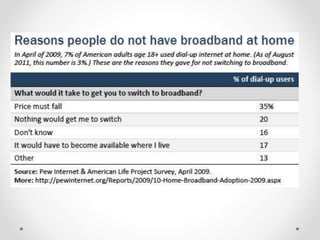
• “The demographic factors most correlated with home
broadband adoption continue to be educational attainment,
age, and household income.”
• 74% of white adults have broadband Internet at home while
64% of African American and 53% of Latino adults do.
• 89% of those with a college degree have broadband at home;
57% of high school graduates and 37% of those without a
high school diploma do.
• 88% of those who earn more than $75,000 have broadband at
home; just 54% of those who earn less than $30,000 a year
do.
(Source: Pew Research, “Home Broadband”, 2013)
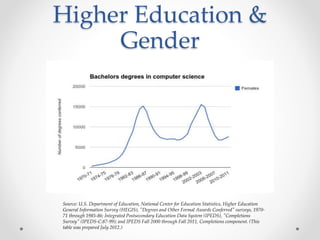
Higher Education &
Gender
Source: U.S. Department of Education, National Center for Education Statistics, Higher Education
General Information Survey (HEGIS), "Degrees and Other Formal Awards Conferred" surveys, 1970-
71 through 1985-86; Integrated Postsecondary Education Data System (IPEDS), "Completions
Survey" (IPEDS-C:87-99); and IPEDS Fall 2000 through Fall 2011, Completions component. (This
table was prepared July 2012.)
“The central conclusion is that the first personal computers
were essentially early gaming systems that firmly catered
to males. While early word processing tools were also
available, the marketing narrative told the story of a new
device that met the needs of men.
As more males began purchasing computers for personal
use, the “nerdy programmer” classification began to take
hold in the professional world of computer science. By the
mid-nineties, the percentage of women studying computer
science at the postsecondary level had fallen to 28%.”
• Poor preparation and lack of encouragement in STEM subjects in
school also contributes to a lack of women in STEM fields.
• The classroom climate for girls in school classrooms and for women
students and faculty in university departments has been classically
described as “chilly” (Hall & Sandler 1982).
• A dearth of role models: Women students look to faculty as role
models for balancing career and family, and if career demands are
seen as excessive, may leave their department in higher numbers
than men (Ferreira 2003).
• Lack of “critical mass” of women in a department may lead to
dissatisfaction and greater attrition of women scientists
(Dresselhaus et al. 1995; Ferreira 2003).
• Salary gap and work-life balance issues already deter women in
college.
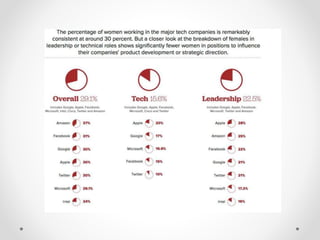
Hiring Practices
“Over the past few years, we have been working hard to
increase diversity at Facebook through a variety of internal and
external programs and partnerships. We still have a long way to
go, but as we continue to strive for greater change, we are
encouraged by positive hiring trends.
For example, while our current representation in senior
leadership is 3% Black, 3% Hispanic and 27% women, of new
senior leadership hires at Facebook in the US over the last 12
months, 9% are Black, 5% are Hispanic and 29% are women.”–
Maxine Williams, Director of Global Diversity, Facebook
Workplace Practices
• If women find themselves in workplaces where colleagues or bosses
assume they're less competent than men.
• Typically they work longer hours than their male colleagues, and cut back
outside-work activities, which may lead to burnout.
• Women are likelier than men to suffer from imposter syndrome.
• Tech culture is hostile or even harassing.
• It may be harder for women to attend industry events than it is for men,
because of personal obligations.
• There aren't very many female mentors, sponsors or role models.
• Women are impeded from forming strong professional networks to the
extent those networks ordinarily form around gendered pursuits such as
sports, or activities that may be risky for a lone woman among men such as
getting drunk.
These quotes are taken from “Why Women Leave Tech” compiled by Sue Gardner: https://docs.google.com/document/d/1soIYek-
YEIvqtu9brv3ecdPbuVzQKp_GhAozC06UrLo/edit#
Career Trajectory
• Career “Plateau” and lack of advancement.
• Women leave tech in mid-30s, when men’s careers
begin to develop.
• Not only “work-life balance” or family… as they leave for
other jobs outside of tech industry.
(source: The Athena Factor: Reversing the Brain Drain in Science, Engineering, and
Technology, 2008)
Social Effects: From Apps to
Social Systems
• SketchFactor: An app to allow users to report having
seen or experienced something “sketchy” in a particular
location; these reports would then be geotagged and
overlaid on a Google map, creating a sketchiness heat
map of a neighborhood or city.
Marantz, A. 2015. “When An App is Called Racist.” The New Yorker:
http://www.newyorker.com/business/currency/what-to-do-when-your-app-is-racist
• Noble, S. 2013. “Google Search: Hyper-visibility as a
Means of Rendering Black Women and Girls Invisible.”
InVisible Culture: An Electronic Journal for Visual
Culture. http://ivc.lib.rochester.edu/google-search-hyper-
visibility-as-a-means-of-rendering-black-women-and-
girls-invisible/
• Try searching for “professor” in Google:
https://www.google.co.uk/search?q=professor&safe=strict&
espv=2&biw=1440&bih=721&source=lnms&tbm=isch&sa=
X&ved=0ahUKEwjsiMDUx4zQAhWJCcAKHU3BAGUQ_AU
IBigB
• Bivens, R. and Haimson, O. 2016. “Baking Gender Into
Social Media Design: How Platforms Shape Categories
for Users and Advertisers.” Social Media + Society.
October-December: 1–12.
http://sms.sagepub.com.ezproxy.is.ed.ac.uk/content/2/4/
2056305116672486.full.pdf+html
• Zukin, S., Lindeman, S. and Hurson, L. 2015. “The
Omnivore’s Neighborhood: Online restaurant reviews, race,
and gentrification.” Journal of Consumer Culture.
• The study suggests that Yelp reviews not only reflect the impacts and
public perception of gentrification, but ultimately help to determine who
occupies a neighborhood as well. Indeed, the study concludes that,
“intentionally or not, Yelp restaurant reviewers may encourage, confirm,
or even accelerate processes of gentrification by signaling that a locality
is good for people who share their tastes.” Beyond persuading potential
customers to visit a restaurant, social media may in fact be part of the
process of actually transforming neighborhoods.
• Angwin, J. and Parris, T. 2016. “Facebook Lets
Advertisers Exclude Users by Race: Facebook’s system
allows advertisers to exclude black, Hispanic, and other
“ethnic affinities” from seeing ads.” ProPublica:
Journalism in the Public Interest.
https://www.propublica.org/article/facebook-lets-
advertisers-exclude-users-by-race
“In an experiment on Airbnb, we find that applications from guests with
distinctively African-American names are 16% less likely to be accepted relative
to identical guests with distinctively White names. Discrimination occurs among
landlords of all sizes, including small landlords sharing the property and larger
landlords with multiple properties. It is most pronounced among hosts who
have never had an African-American guest, suggesting only a subset of hosts
discriminate. While rental markets have achieved significant reductions in
discrimination in recent decades, our results suggest that Airbnb’s current
design choices facilitate discrimination and raise the possibility of erasing some
of these civil rights gains.”
• Edelman, B., Luca, M. and Svirsky, D. 2016. “Racial Discrimination in the
Sharing Economy: Evidence from a Field Experiment”
Court ruling on November 1, 2017:
http://www.nytimes.com/2016/11/02/technology/federal-judge-blocks-racial-discrimination-suit-against-airbnb.html
• “Passengers have faced a history of discrimination in transportation systems. Peer
transportation companies such as Uber and Lyft present the opportunity to rectify
long-standing discrimination or worsen it. We sent passengers in Seattle, WA and
Boston, MA to hail nearly 1,500 rides on controlled routes and recorded key
performance metrics. Results indicated a pattern of discrimination, which we
observed in Seattle through longer waiting times for African American passengers—
as much as a 35 percent increase. In Boston, we observed discrimination by Uber
drivers via more frequent cancellations against passengers when they used African
American-sounding names. Across all trips, the cancellation rate for African American
sounding names was more than twice as frequent compared to white sounding
names. Male passengers requesting a ride in low-density areas were more than three
times as likely to have their trip canceled when they used a African American-
sounding name than when they used a white-sounding name. We also find evidence
that drivers took female passengers for longer, more expensive, rides in Boston. We
observe that removing names from trip booking may alleviate the immediate problem
but could introduce other pathways for unequal treatment of passengers.”
• http://www.nber.org/papers/w22776
• Christopher Soghoian: “Your smartphone is a civil rights
issue.”
• https://www.ted.com/talks/christopher_soghoian_your_s
martphone_is_a_civil_rights_issue
• Predictive Policing:
• https://www.propublica.org/article/machine-bias-risk-
assessments-in-criminal-sentencing

Equality and Technology_Gregory

  • 1.
    Equality and Technology? Dr. KarenGregory Lecturer in Digital Sociology k.gregory@ed.ac.uk
  • 2.
    • What typeof digital world are we building? Why? • How do technological developments mirror social values or social structures? • Who does technology “work” for? Why? • What is the relationship between education and the world we design and develop? The Promise of Tech
  • 3.
    Coding crisis? Mastenbrook isCTO of AirStash, IoT Platform
  • 5.
    • Although theproportion of managers at U.S. commercial banks who were Hispanic rose from 4.7% in 2003 to 5.7% in 2014, white women’s representation dropped from 39% to 35%, and black men’s from 2.5% to 2.3%. • Among all U.S. companies with 100 or more employees, the proportion of black men in management increased just slightly—from 3% to 3.3%—from 1985 to 2014. • White women saw bigger gains from 1985 to 2000—rising from 22% to 29% of managers—but their numbers haven’t budged since then. • Even in Silicon Valley, where many leaders tout the need to increase diversity for both business and social justice reasons, bread-and-butter tech jobs remain dominated by white men. Source: Quotes taken from Harvard Business Review. 2016. “Why Diversity Programs Fail.”
  • 6.
    So What? • Whydoes this matter? o Job demand. Estimated 1.4 million tech jobs by 2020. (29% US; of that 29% only 3% will be women) o The research shows that mixed-gender teams are more innovative, more creative and more productive. o Companies with a diverse group of employees make more money. o Companies with women in leadership positions have higher profits, higher sales and higher rates of revenue growth. • “You are not your user.” Can one social demographic design for a complex world? • More broadly, what is the relationship between discrimination in tech and discriminatory systems? (Source: “Women Technologists Count: Recommendations and Best Practices to Retain Women in Computing. Anita Borg Institute, 2013)
  • 7.
    Beyond Diversity? • Responseto this phenomena has been “diversity” training and “diversity initiatives”, but recent research suggests: o The positive effects of diversity training rarely last beyond a day or two, and a number of studies suggest that it can activate bias or spark a backlash. o Managers and employees react negatively to “mandatory trainings.” Voluntary training has marginally better success rates. o Diversity testing has resulted in “cherry picking” results, which amplifies bias. o Performance ratings and ranking have also been found to amplify bias. o Data driven, “control” solutions may compound existing inequalities and interpersonal bias. (Source: Harvard Business Review. 2016. “Why Diversity Programs Fail.”)
  • 8.
    Gains for whom? •Solutions must go deeper and speak to culture, social relations, and labor practices. • Making room for more than “different” bodies, but complexity of experience and understanding of the world.
  • 9.
    Some Definitions • Prejudice:A positive or negative cultural attitude. • Bias: Implicit or Explicit? Gender bias & racial bias. • Stereotypes: associations, and attributions of specific characteristics to a group • Racism, Sexism, Classism: Ideology, or a system of ideas. • Discrimination: bias behavior or action taken toward • Intersectional understanding: Double Jeopardy Source: Dovidio, et al. 2010. “Prejudice, Stereotyping and Discrimination: Theoretical and Empirical Overview” in The Sage Handbook of Prejudice, Stereotyping and Discrimination. London: Sage.
  • 10.
    Implicit Bias • “Unconscious”bias. Unintentional or “human condition”? • Design interventions, such as in Orchestra experiment. There is a tendency in implicit bias work to want to outsource judgment. • Can data be less biased than the human who produce or analyze the data?
  • 11.
    Psychology & Sociology •But, is there a better way to understanding inequality and how it is socially reproduced? • To that end, I thought we would look at the technology industry as a pipeline. And take a look at the sociological picture at each stage.
  • 12.
    The“Digital Divide” & Education •“The demographic factors most correlated with home broadband adoption continue to be educational attainment, age, and household income.” • 74% of white adults have broadband Internet at home while 64% of African American and 53% of Latino adults do. • 89% of those with a college degree have broadband at home; 57% of high school graduates and 37% of those without a high school diploma do. • 88% of those who earn more than $75,000 have broadband at home; just 54% of those who earn less than $30,000 a year do. (Source: Pew Research, “Home Broadband”, 2013)
  • 14.
    Higher Education & Gender Source:U.S. Department of Education, National Center for Education Statistics, Higher Education General Information Survey (HEGIS), "Degrees and Other Formal Awards Conferred" surveys, 1970- 71 through 1985-86; Integrated Postsecondary Education Data System (IPEDS), "Completions Survey" (IPEDS-C:87-99); and IPEDS Fall 2000 through Fall 2011, Completions component. (This table was prepared July 2012.)
  • 15.
    “The central conclusionis that the first personal computers were essentially early gaming systems that firmly catered to males. While early word processing tools were also available, the marketing narrative told the story of a new device that met the needs of men. As more males began purchasing computers for personal use, the “nerdy programmer” classification began to take hold in the professional world of computer science. By the mid-nineties, the percentage of women studying computer science at the postsecondary level had fallen to 28%.”
  • 16.
    • Poor preparationand lack of encouragement in STEM subjects in school also contributes to a lack of women in STEM fields. • The classroom climate for girls in school classrooms and for women students and faculty in university departments has been classically described as “chilly” (Hall & Sandler 1982). • A dearth of role models: Women students look to faculty as role models for balancing career and family, and if career demands are seen as excessive, may leave their department in higher numbers than men (Ferreira 2003). • Lack of “critical mass” of women in a department may lead to dissatisfaction and greater attrition of women scientists (Dresselhaus et al. 1995; Ferreira 2003). • Salary gap and work-life balance issues already deter women in college.
  • 17.
    Hiring Practices “Over thepast few years, we have been working hard to increase diversity at Facebook through a variety of internal and external programs and partnerships. We still have a long way to go, but as we continue to strive for greater change, we are encouraged by positive hiring trends. For example, while our current representation in senior leadership is 3% Black, 3% Hispanic and 27% women, of new senior leadership hires at Facebook in the US over the last 12 months, 9% are Black, 5% are Hispanic and 29% are women.”– Maxine Williams, Director of Global Diversity, Facebook
  • 18.
    Workplace Practices • Ifwomen find themselves in workplaces where colleagues or bosses assume they're less competent than men. • Typically they work longer hours than their male colleagues, and cut back outside-work activities, which may lead to burnout. • Women are likelier than men to suffer from imposter syndrome. • Tech culture is hostile or even harassing. • It may be harder for women to attend industry events than it is for men, because of personal obligations. • There aren't very many female mentors, sponsors or role models. • Women are impeded from forming strong professional networks to the extent those networks ordinarily form around gendered pursuits such as sports, or activities that may be risky for a lone woman among men such as getting drunk. These quotes are taken from “Why Women Leave Tech” compiled by Sue Gardner: https://docs.google.com/document/d/1soIYek- YEIvqtu9brv3ecdPbuVzQKp_GhAozC06UrLo/edit#
  • 19.
    Career Trajectory • Career“Plateau” and lack of advancement. • Women leave tech in mid-30s, when men’s careers begin to develop. • Not only “work-life balance” or family… as they leave for other jobs outside of tech industry. (source: The Athena Factor: Reversing the Brain Drain in Science, Engineering, and Technology, 2008)
  • 21.
    Social Effects: FromApps to Social Systems • SketchFactor: An app to allow users to report having seen or experienced something “sketchy” in a particular location; these reports would then be geotagged and overlaid on a Google map, creating a sketchiness heat map of a neighborhood or city. Marantz, A. 2015. “When An App is Called Racist.” The New Yorker: http://www.newyorker.com/business/currency/what-to-do-when-your-app-is-racist
  • 22.
    • Noble, S.2013. “Google Search: Hyper-visibility as a Means of Rendering Black Women and Girls Invisible.” InVisible Culture: An Electronic Journal for Visual Culture. http://ivc.lib.rochester.edu/google-search-hyper- visibility-as-a-means-of-rendering-black-women-and- girls-invisible/
  • 23.
    • Try searchingfor “professor” in Google: https://www.google.co.uk/search?q=professor&safe=strict& espv=2&biw=1440&bih=721&source=lnms&tbm=isch&sa= X&ved=0ahUKEwjsiMDUx4zQAhWJCcAKHU3BAGUQ_AU IBigB
  • 24.
    • Bivens, R.and Haimson, O. 2016. “Baking Gender Into Social Media Design: How Platforms Shape Categories for Users and Advertisers.” Social Media + Society. October-December: 1–12. http://sms.sagepub.com.ezproxy.is.ed.ac.uk/content/2/4/ 2056305116672486.full.pdf+html
  • 25.
    • Zukin, S.,Lindeman, S. and Hurson, L. 2015. “The Omnivore’s Neighborhood: Online restaurant reviews, race, and gentrification.” Journal of Consumer Culture. • The study suggests that Yelp reviews not only reflect the impacts and public perception of gentrification, but ultimately help to determine who occupies a neighborhood as well. Indeed, the study concludes that, “intentionally or not, Yelp restaurant reviewers may encourage, confirm, or even accelerate processes of gentrification by signaling that a locality is good for people who share their tastes.” Beyond persuading potential customers to visit a restaurant, social media may in fact be part of the process of actually transforming neighborhoods.
  • 26.
    • Angwin, J.and Parris, T. 2016. “Facebook Lets Advertisers Exclude Users by Race: Facebook’s system allows advertisers to exclude black, Hispanic, and other “ethnic affinities” from seeing ads.” ProPublica: Journalism in the Public Interest. https://www.propublica.org/article/facebook-lets- advertisers-exclude-users-by-race
  • 27.
    “In an experimenton Airbnb, we find that applications from guests with distinctively African-American names are 16% less likely to be accepted relative to identical guests with distinctively White names. Discrimination occurs among landlords of all sizes, including small landlords sharing the property and larger landlords with multiple properties. It is most pronounced among hosts who have never had an African-American guest, suggesting only a subset of hosts discriminate. While rental markets have achieved significant reductions in discrimination in recent decades, our results suggest that Airbnb’s current design choices facilitate discrimination and raise the possibility of erasing some of these civil rights gains.” • Edelman, B., Luca, M. and Svirsky, D. 2016. “Racial Discrimination in the Sharing Economy: Evidence from a Field Experiment” Court ruling on November 1, 2017: http://www.nytimes.com/2016/11/02/technology/federal-judge-blocks-racial-discrimination-suit-against-airbnb.html
  • 28.
    • “Passengers havefaced a history of discrimination in transportation systems. Peer transportation companies such as Uber and Lyft present the opportunity to rectify long-standing discrimination or worsen it. We sent passengers in Seattle, WA and Boston, MA to hail nearly 1,500 rides on controlled routes and recorded key performance metrics. Results indicated a pattern of discrimination, which we observed in Seattle through longer waiting times for African American passengers— as much as a 35 percent increase. In Boston, we observed discrimination by Uber drivers via more frequent cancellations against passengers when they used African American-sounding names. Across all trips, the cancellation rate for African American sounding names was more than twice as frequent compared to white sounding names. Male passengers requesting a ride in low-density areas were more than three times as likely to have their trip canceled when they used a African American- sounding name than when they used a white-sounding name. We also find evidence that drivers took female passengers for longer, more expensive, rides in Boston. We observe that removing names from trip booking may alleviate the immediate problem but could introduce other pathways for unequal treatment of passengers.” • http://www.nber.org/papers/w22776
  • 29.
    • Christopher Soghoian:“Your smartphone is a civil rights issue.” • https://www.ted.com/talks/christopher_soghoian_your_s martphone_is_a_civil_rights_issue • Predictive Policing: • https://www.propublica.org/article/machine-bias-risk- assessments-in-criminal-sentencing