




How does technology
empower women?
Technology allows you to…
CONNECT	
  
ACCESS	
  
BYPASS	
  
REACH	
  OUT	
  
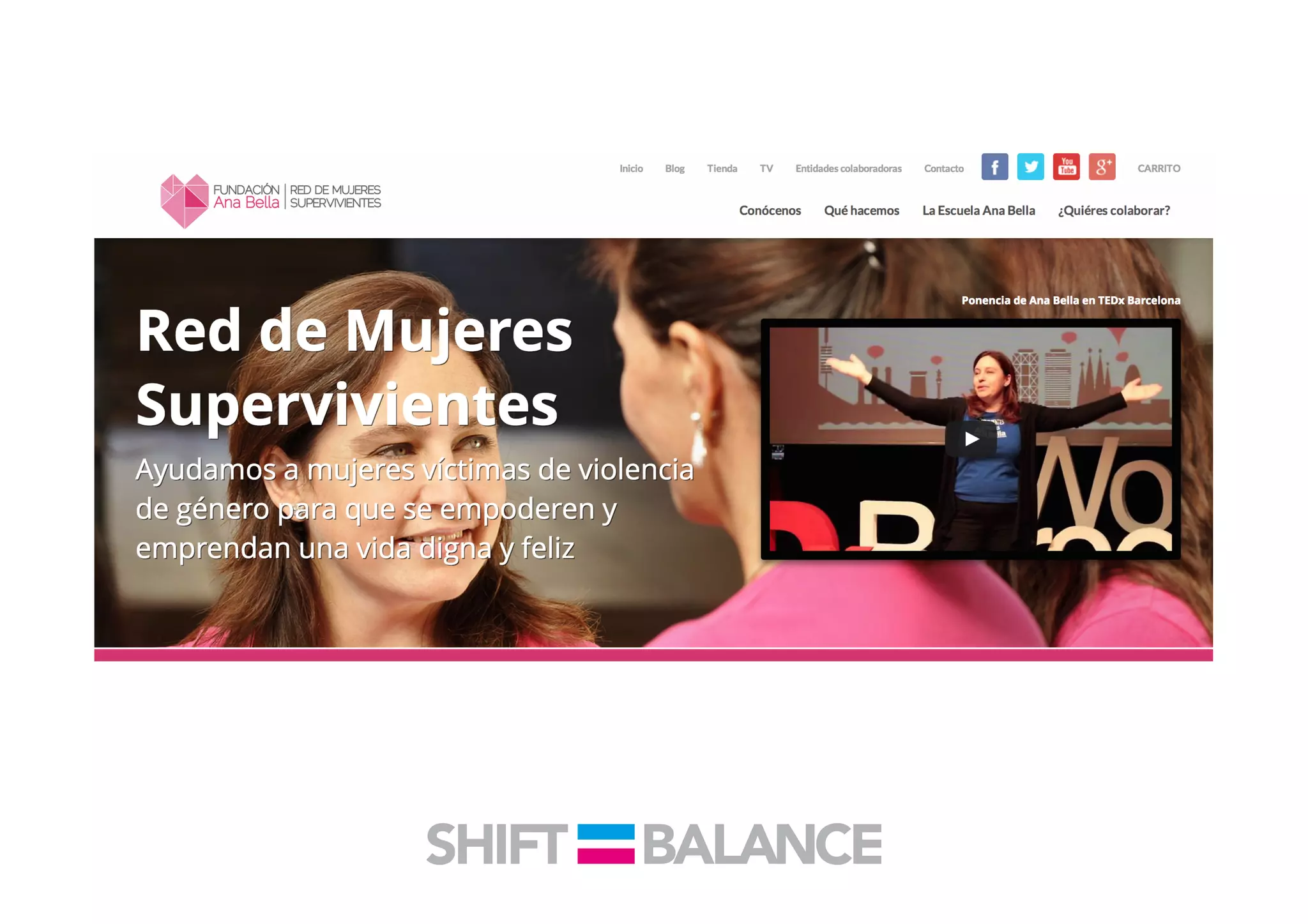
Organize and connect a
community
«	
  Being	
  connected,	
  heard,	
  and	
  externally	
  validated	
  within	
  a	
  global	
  community	
  provides	
  many	
  
women	
  the	
  courage	
  and	
  support	
  they	
  need	
  to	
  become	
  change	
  agents	
  at	
  home	
  »	


Jensine	
  Larsen,	
  founder	
  of	
  the	
  global	
  women’s	
  network	
  and	
  online	
  forum	
  World	
  Pulse	
  
Access inspiring mentors
Access remote markets

Sell your products
everywhere
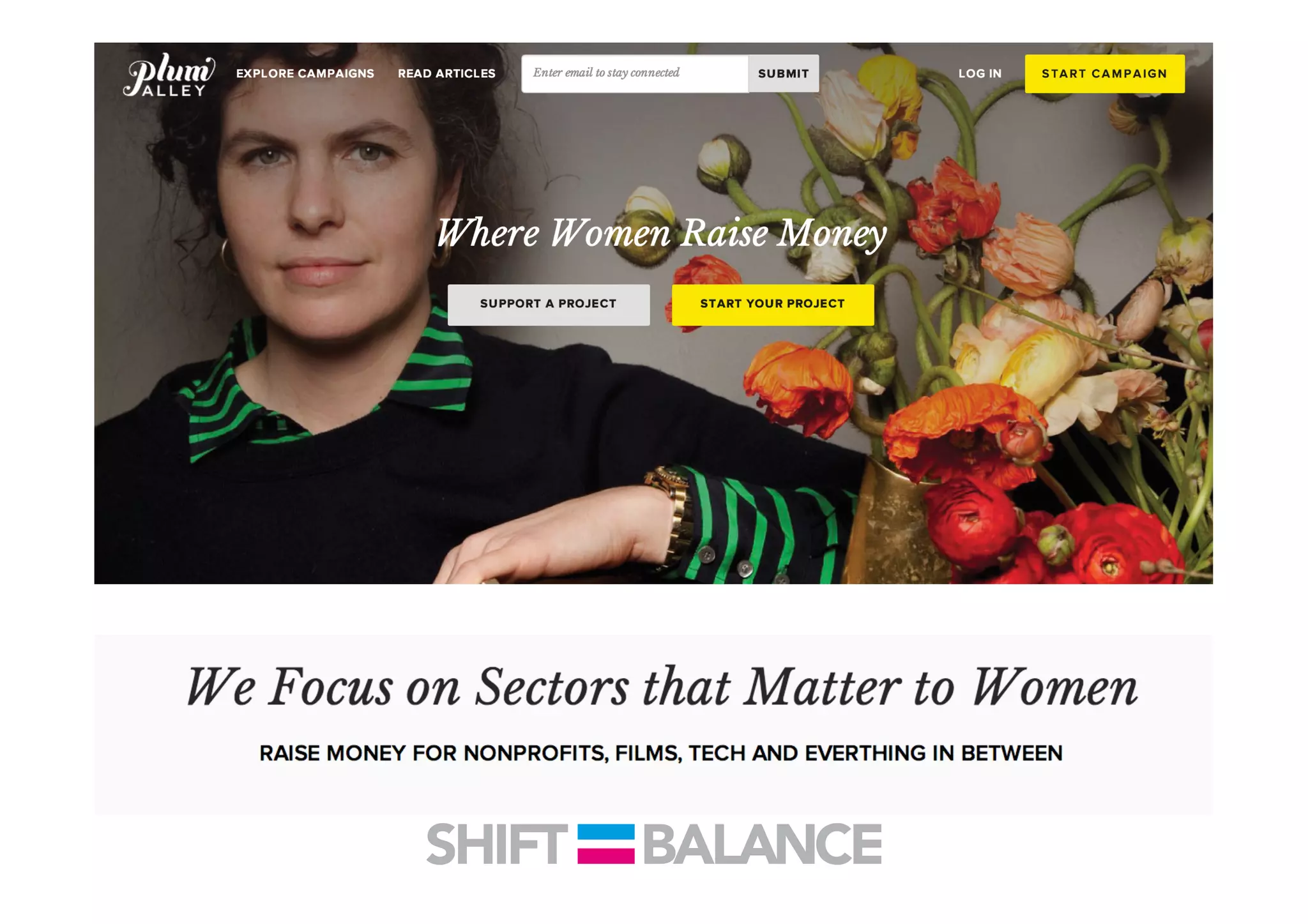
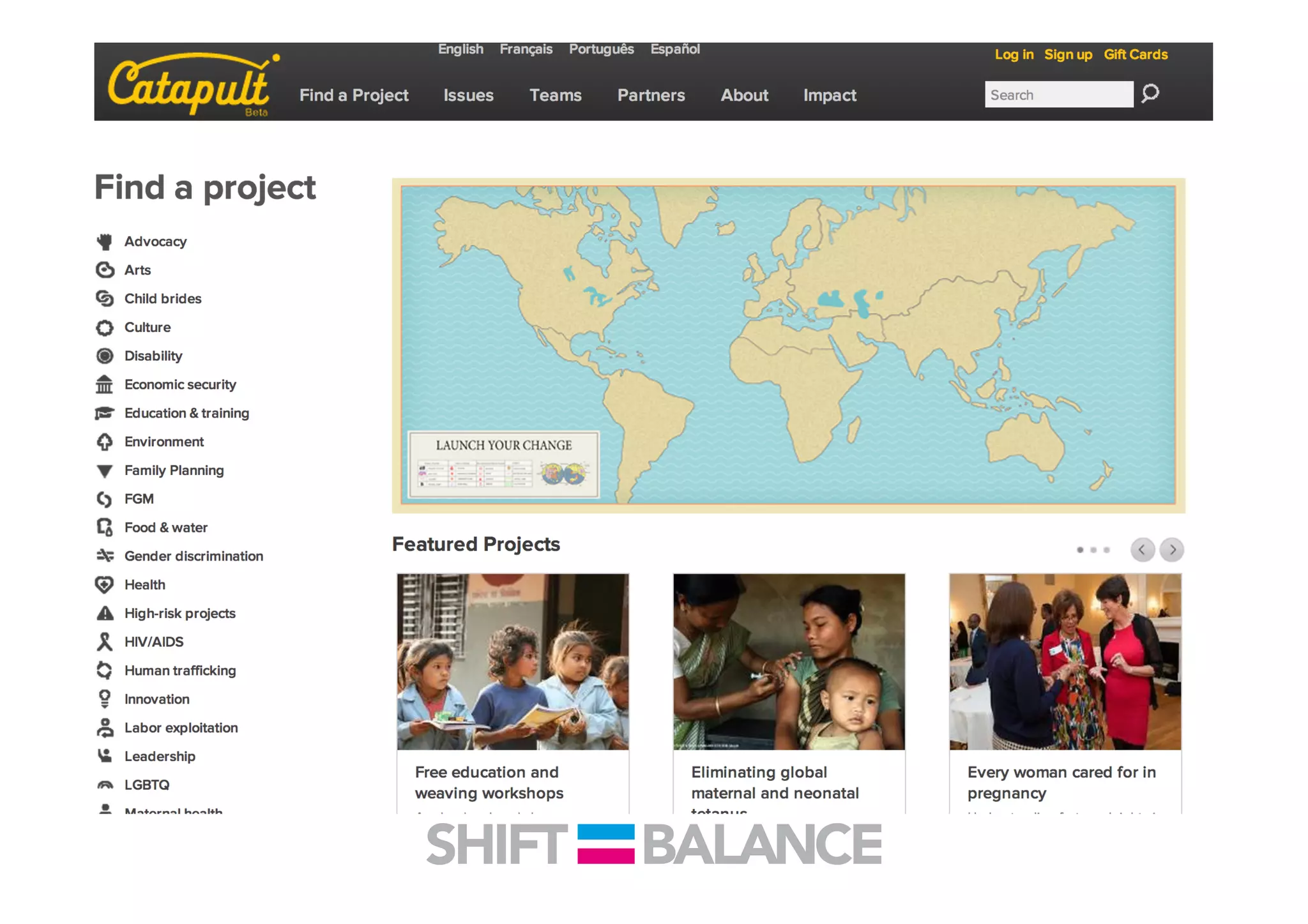
Access funds
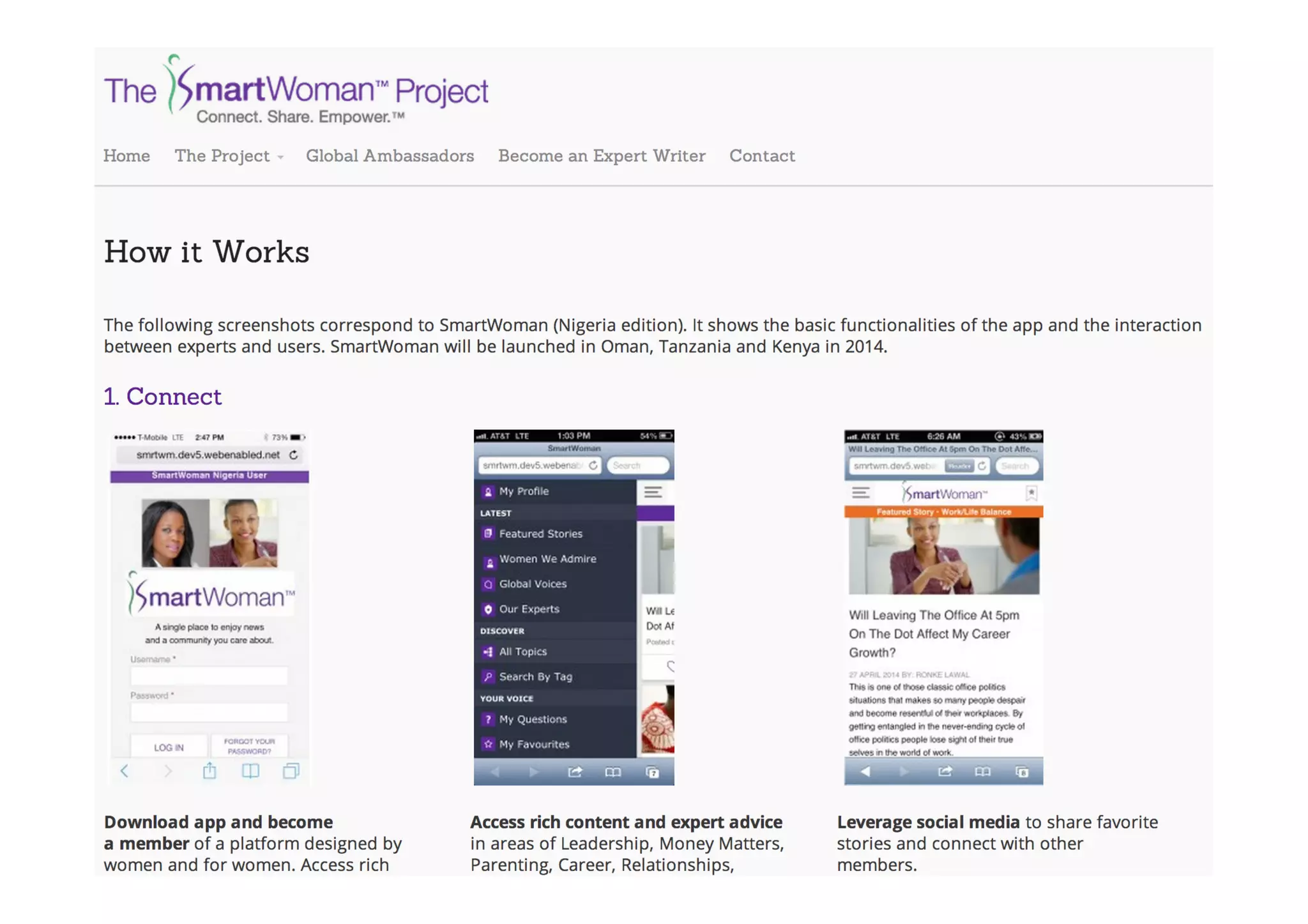
Access information
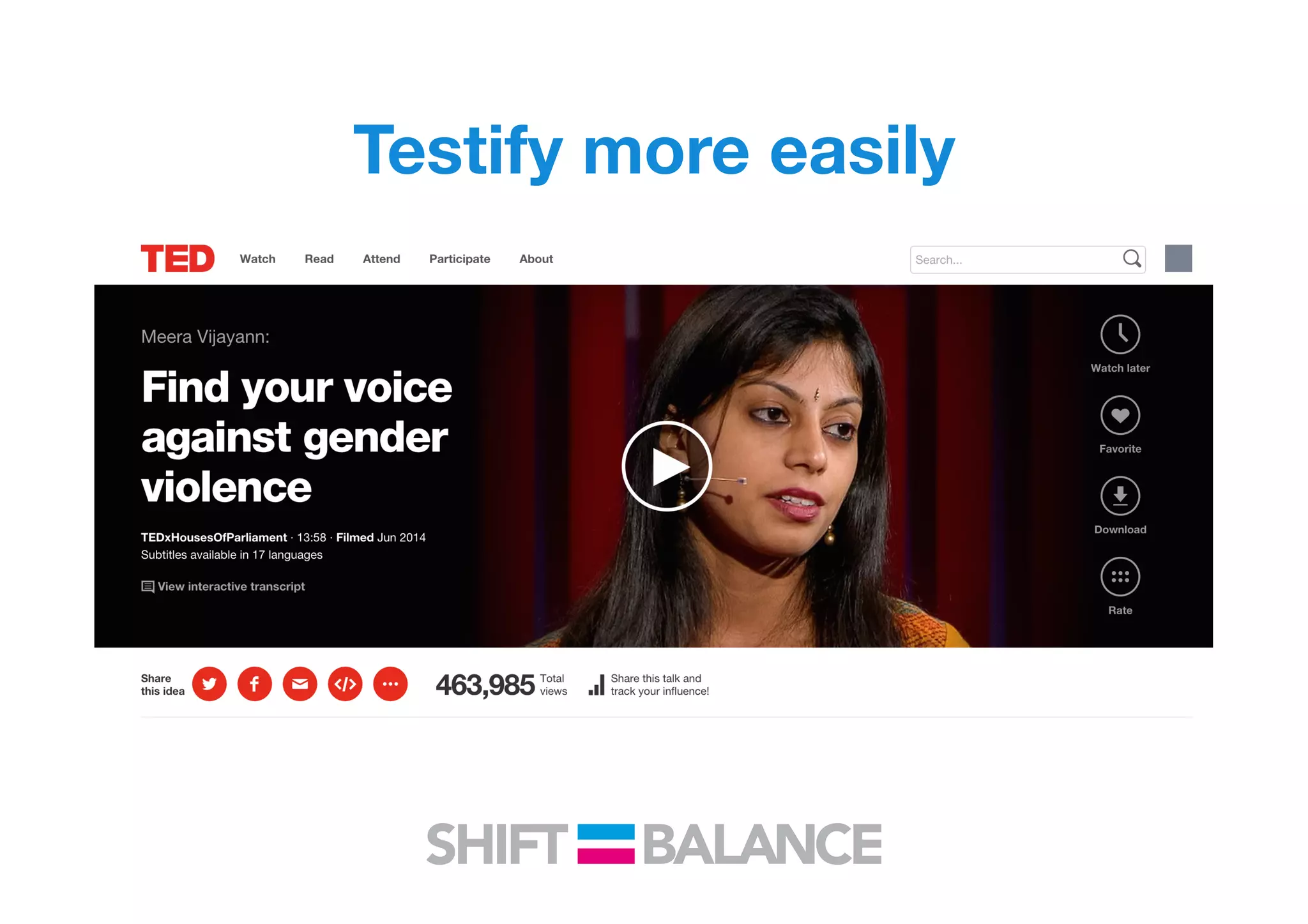
Testify more easily
Testify more easily
Testify more easily
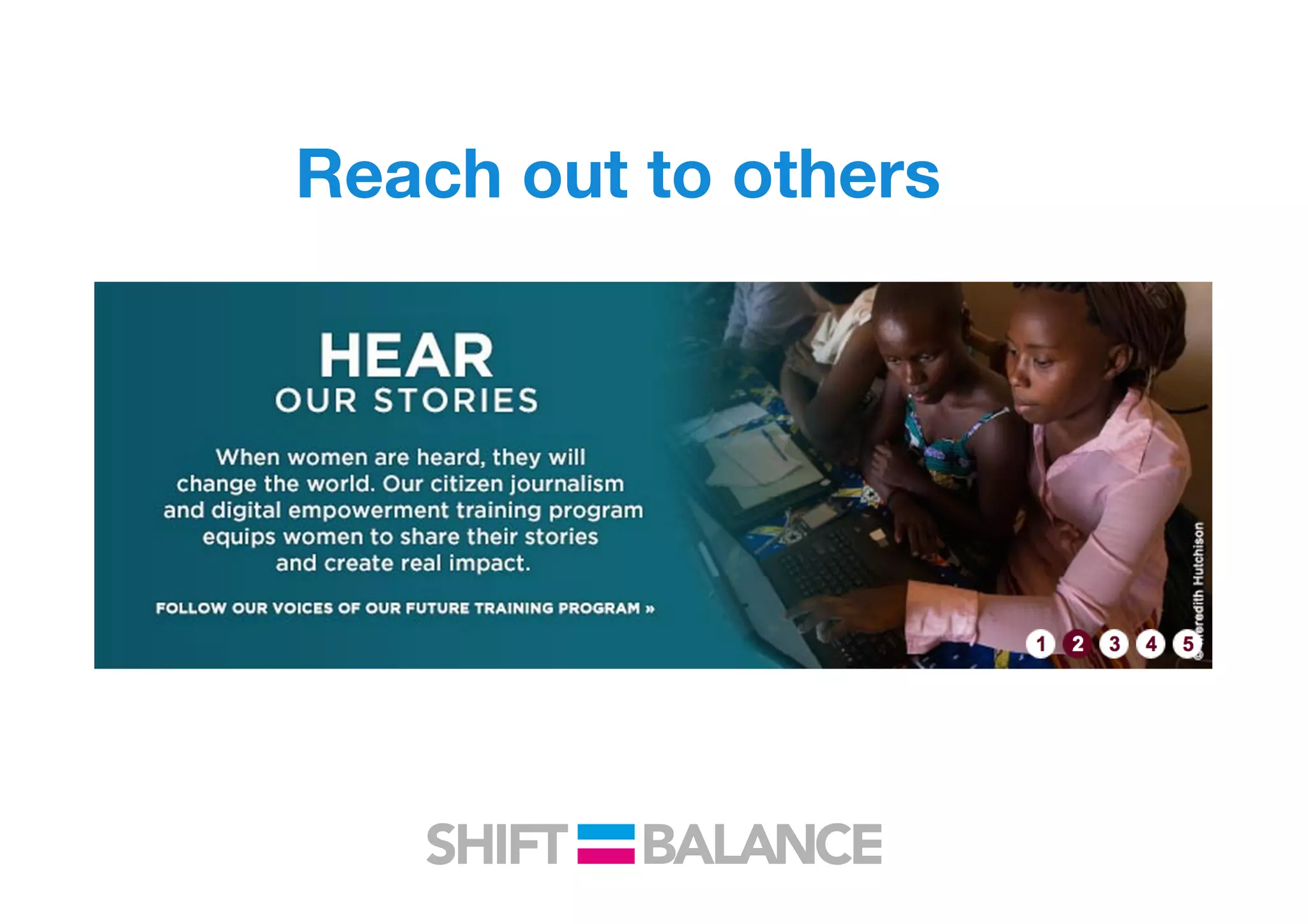
Reach out to others
Have a voice
Have a voice
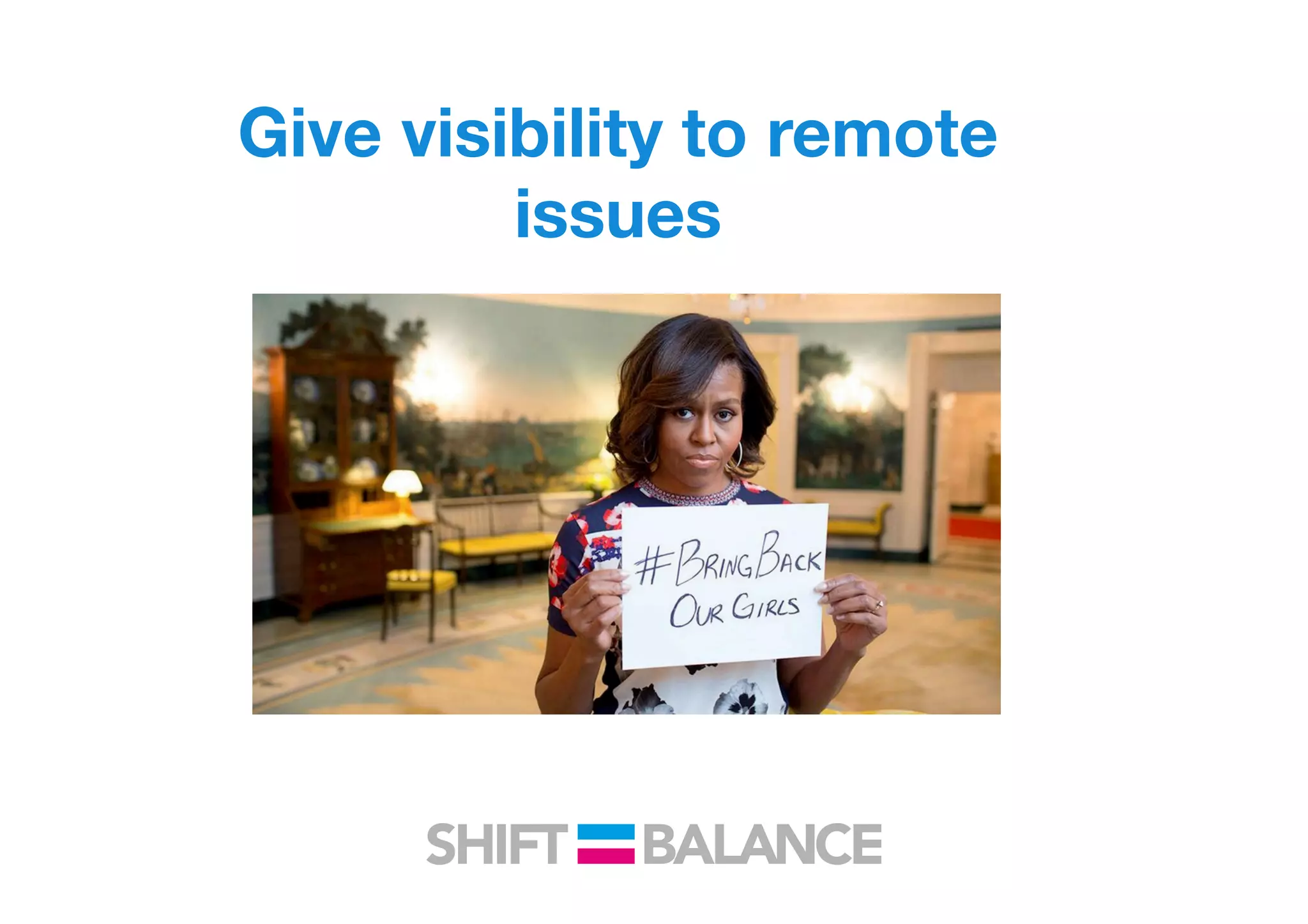
Give visibility to remote
issues
Democratize social activism
Provide real time data
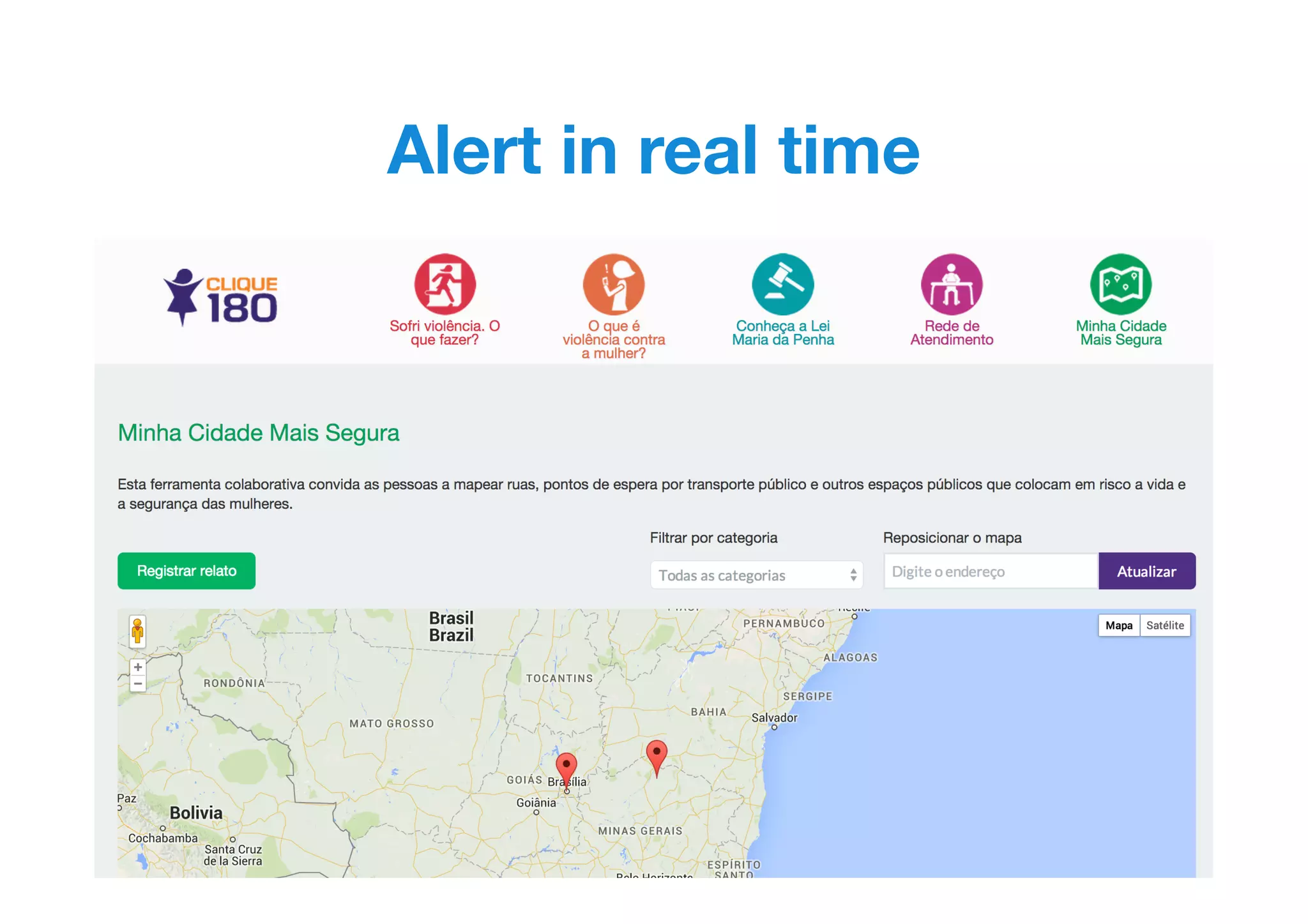
Alert in real time
Alert in real time
Alert in real time
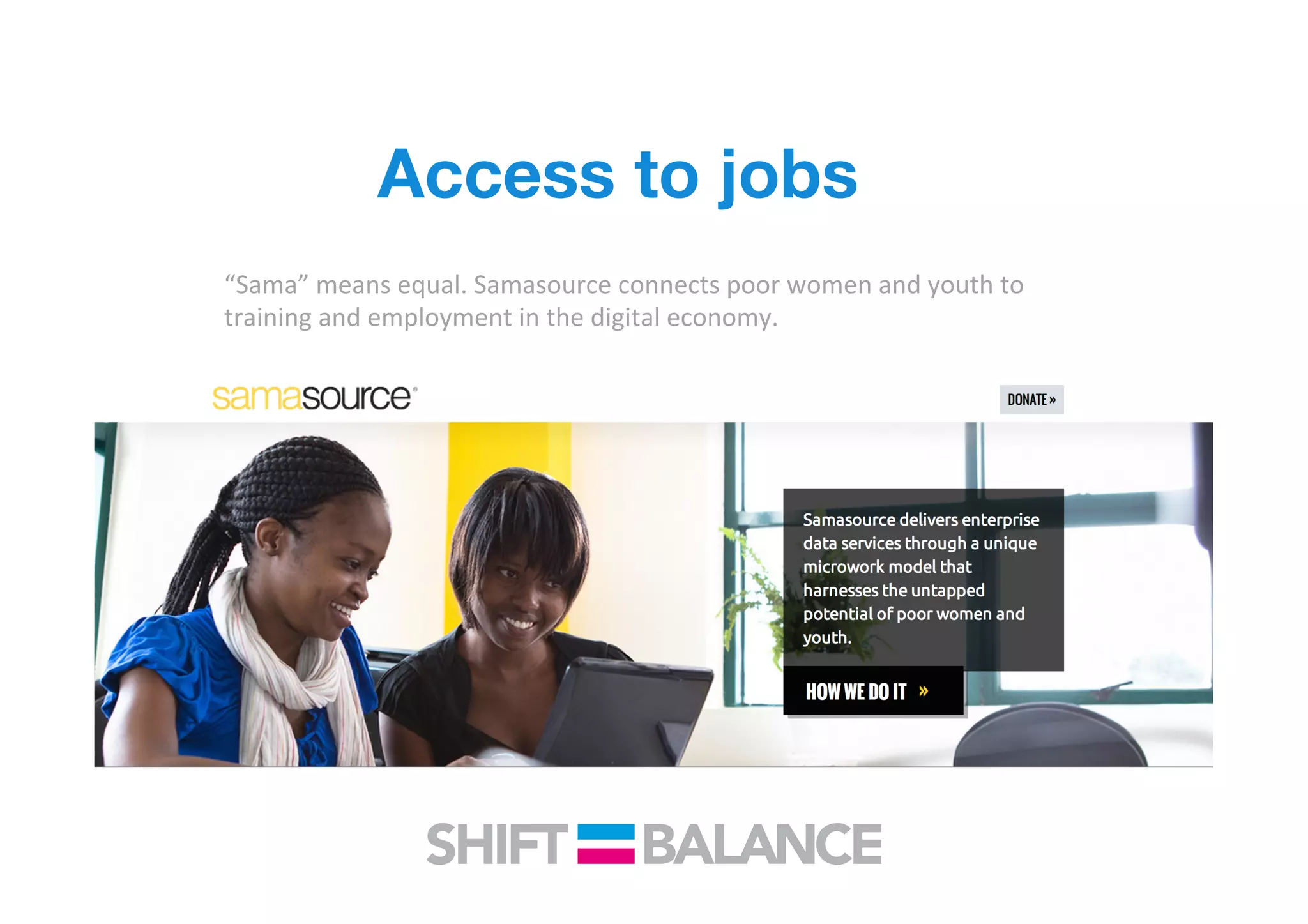
Access to jobs
“Sama”	
  means	
  equal.	
  Samasource	
  connects	
  poor	
  women	
  and	
  youth	
  to	
  
training	
  and	
  employment	
  in	
  the	
  digital	
  economy.	
  	
  
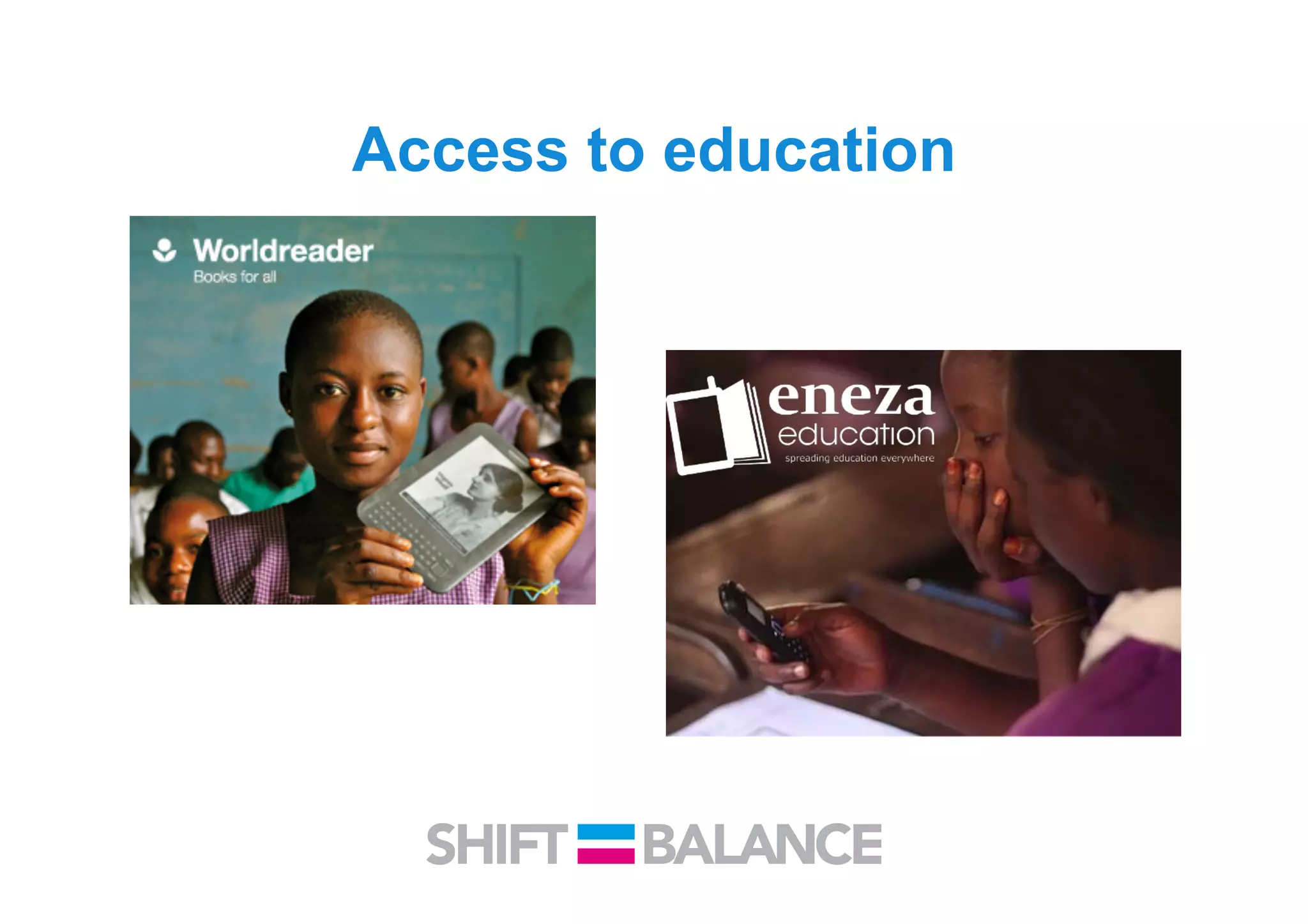
Access to education
Access to healthcare
Accelerate communication
pace
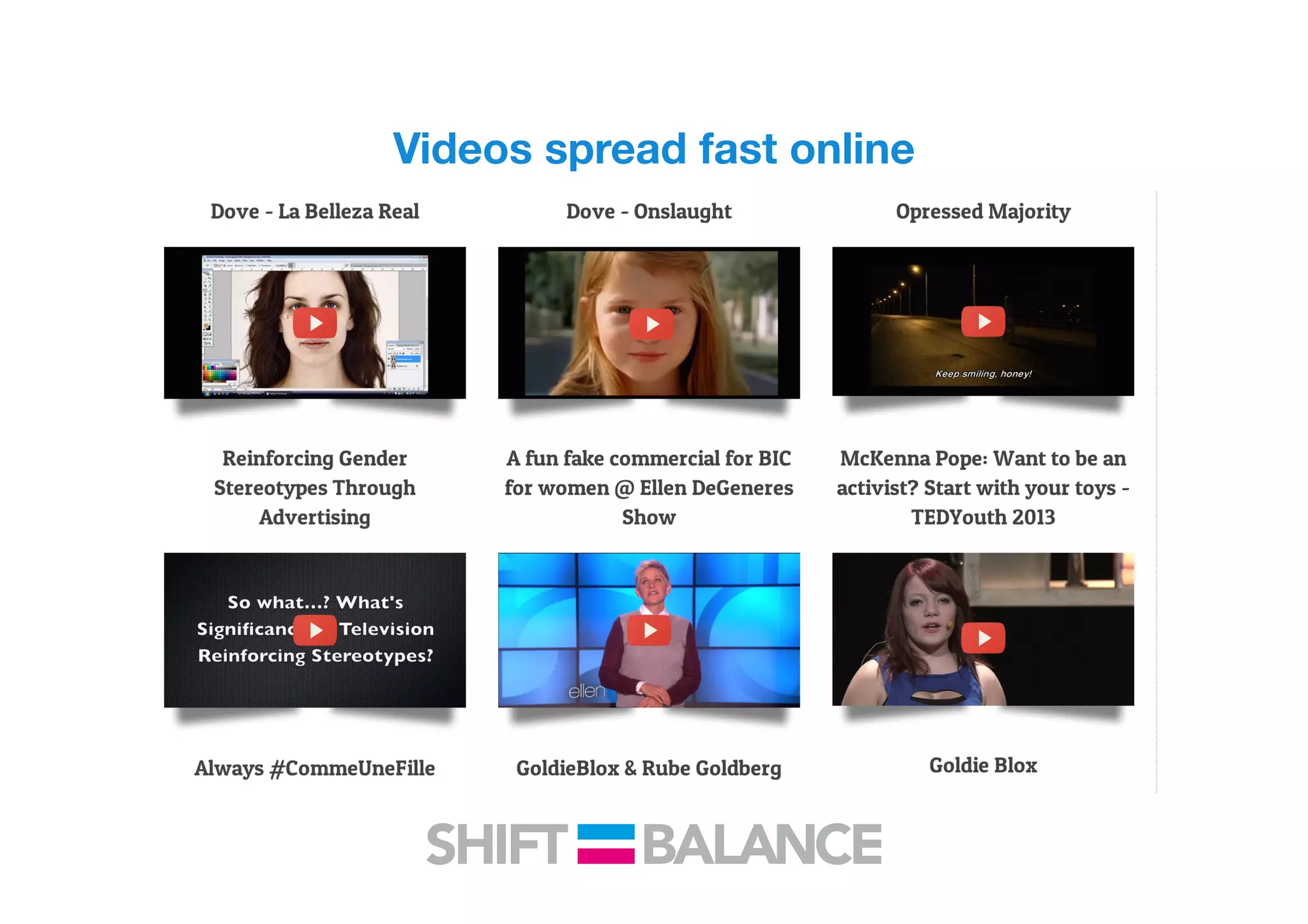
Videos spread fast online
Become citizen journalists
'no-­‐cuts,	
  no	
  censorship'	
  approach	
  
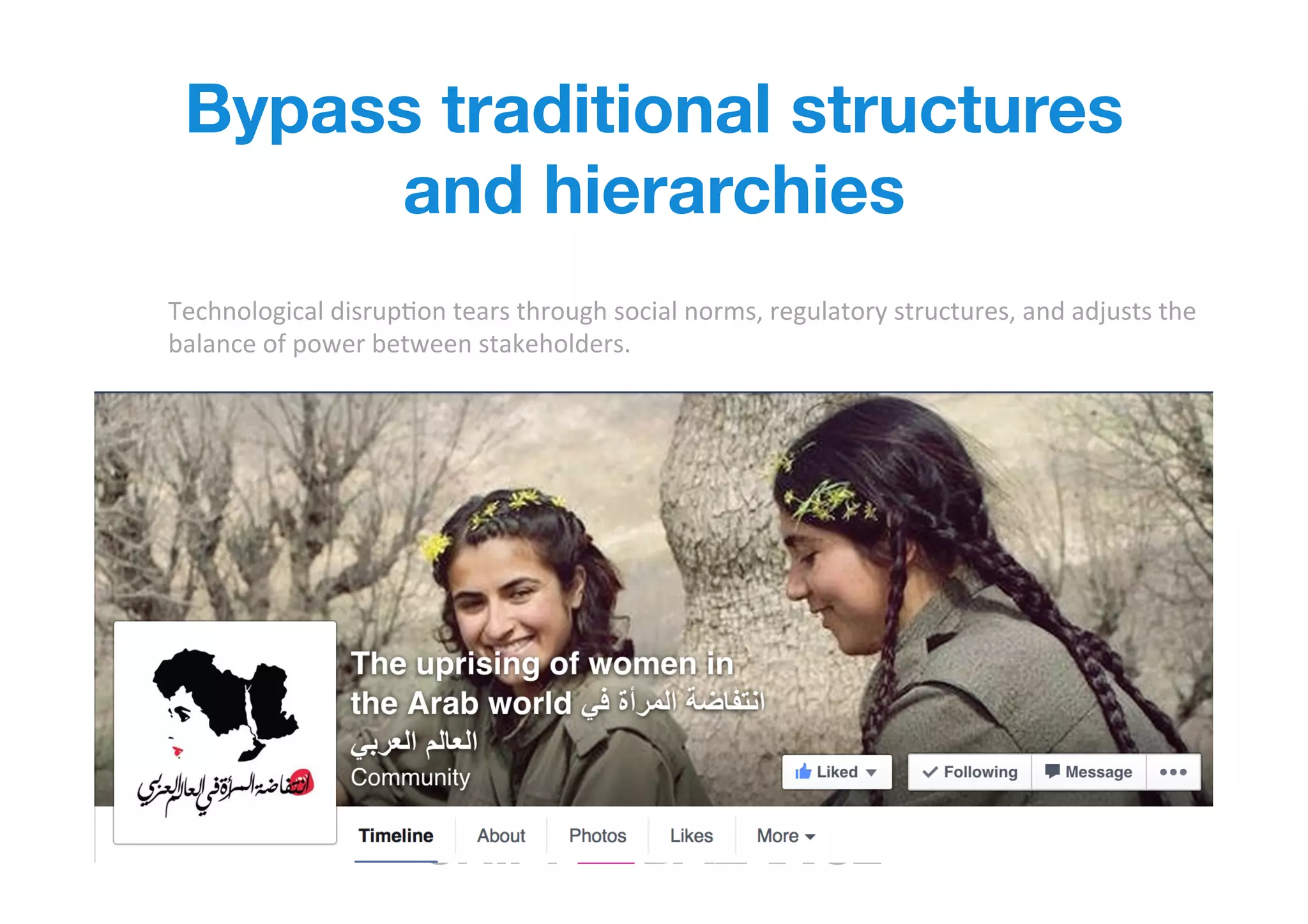
Bypass traditional structures
and hierarchies
Technological	
  disrupIon	
  tears	
  through	
  social	
  norms,	
  regulatory	
  structures,	
  and	
  adjusts	
  the	
  
balance	
  of	
  power	
  between	
  stakeholders.	
  	
  
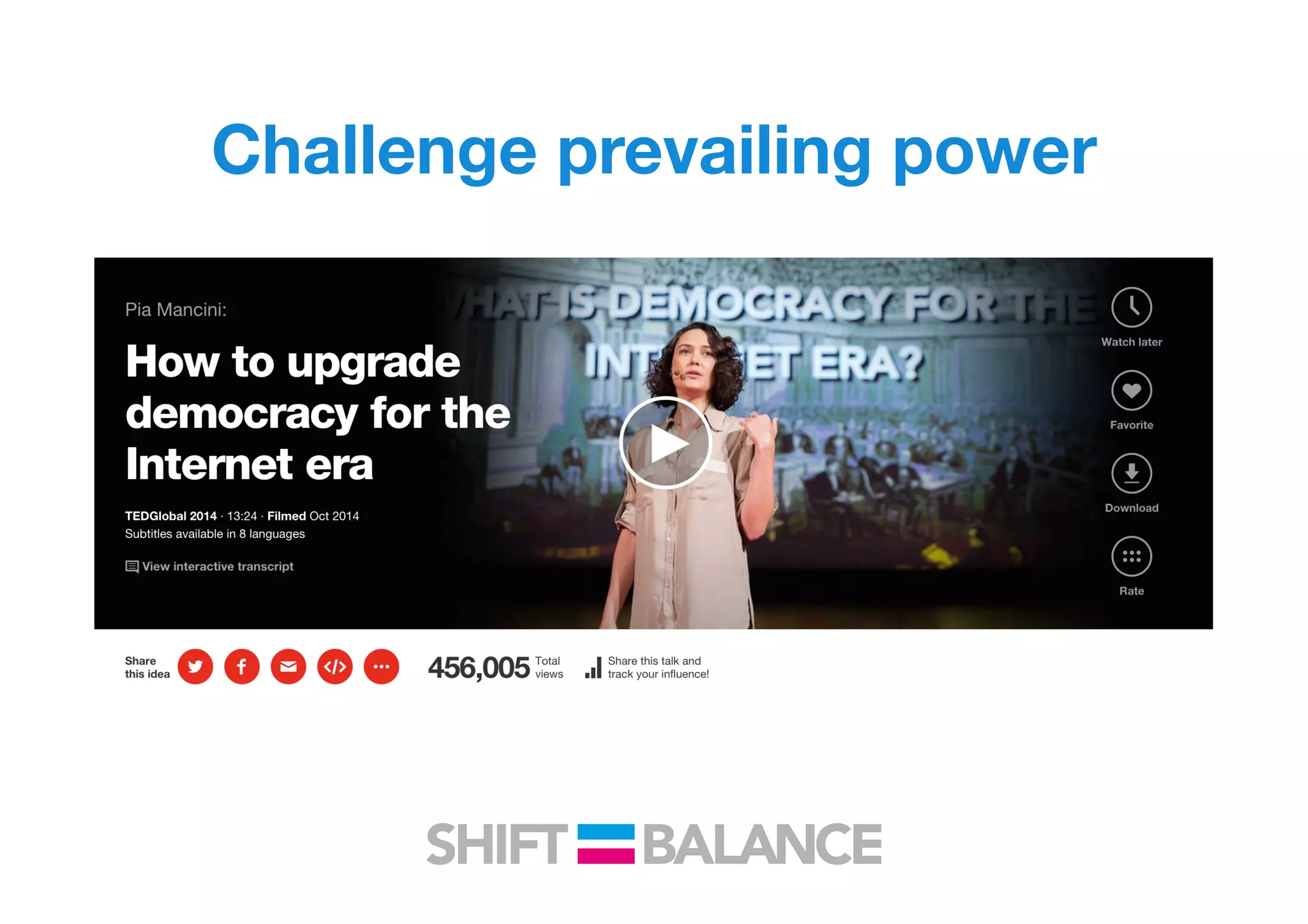
Challenge prevailing power
Change the narrative
WE NEED MORE WOMEN IN
TECHNOLOGY!
The future will be shaped by
technology
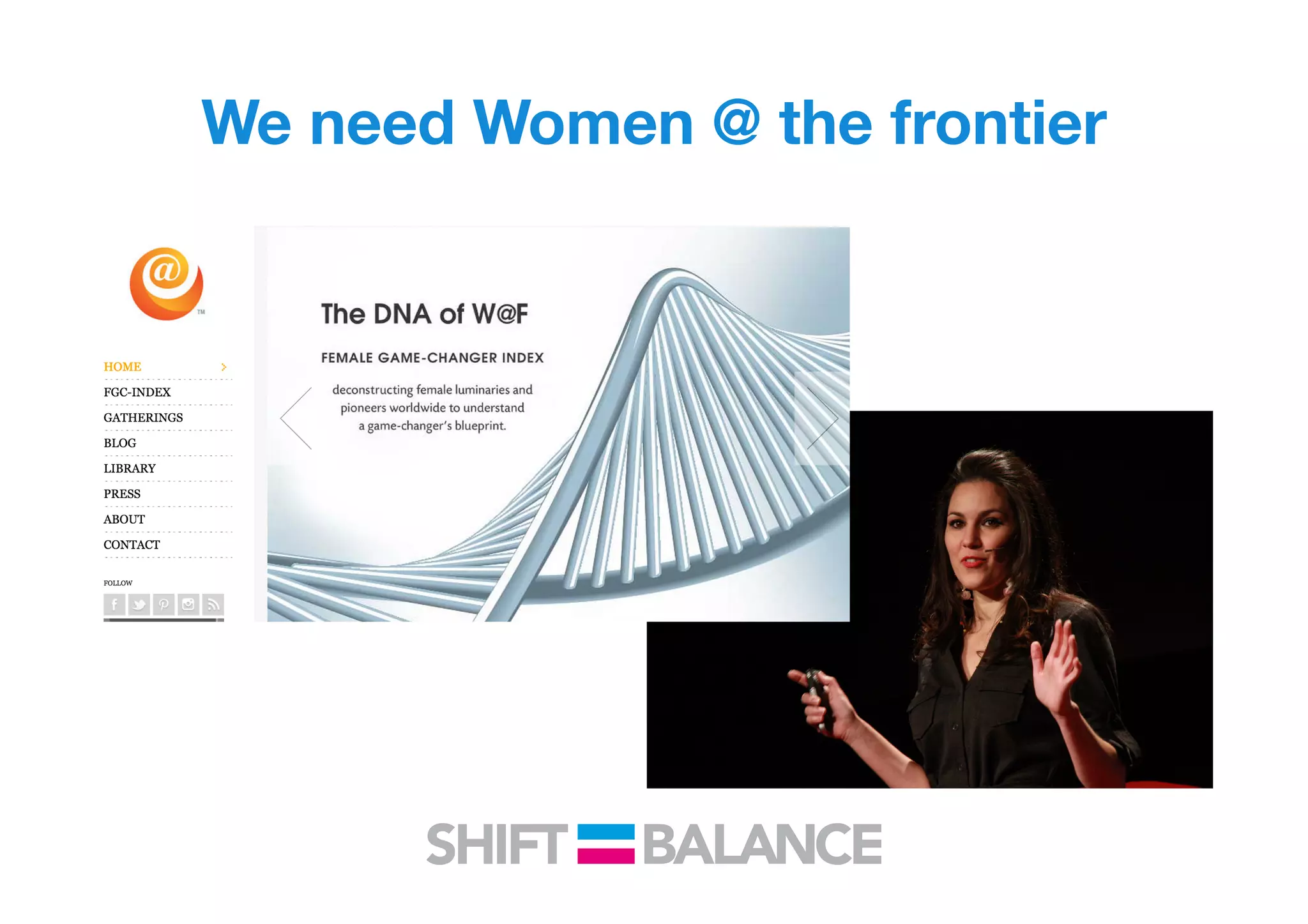
We need Women @ the frontier
Better opportunities
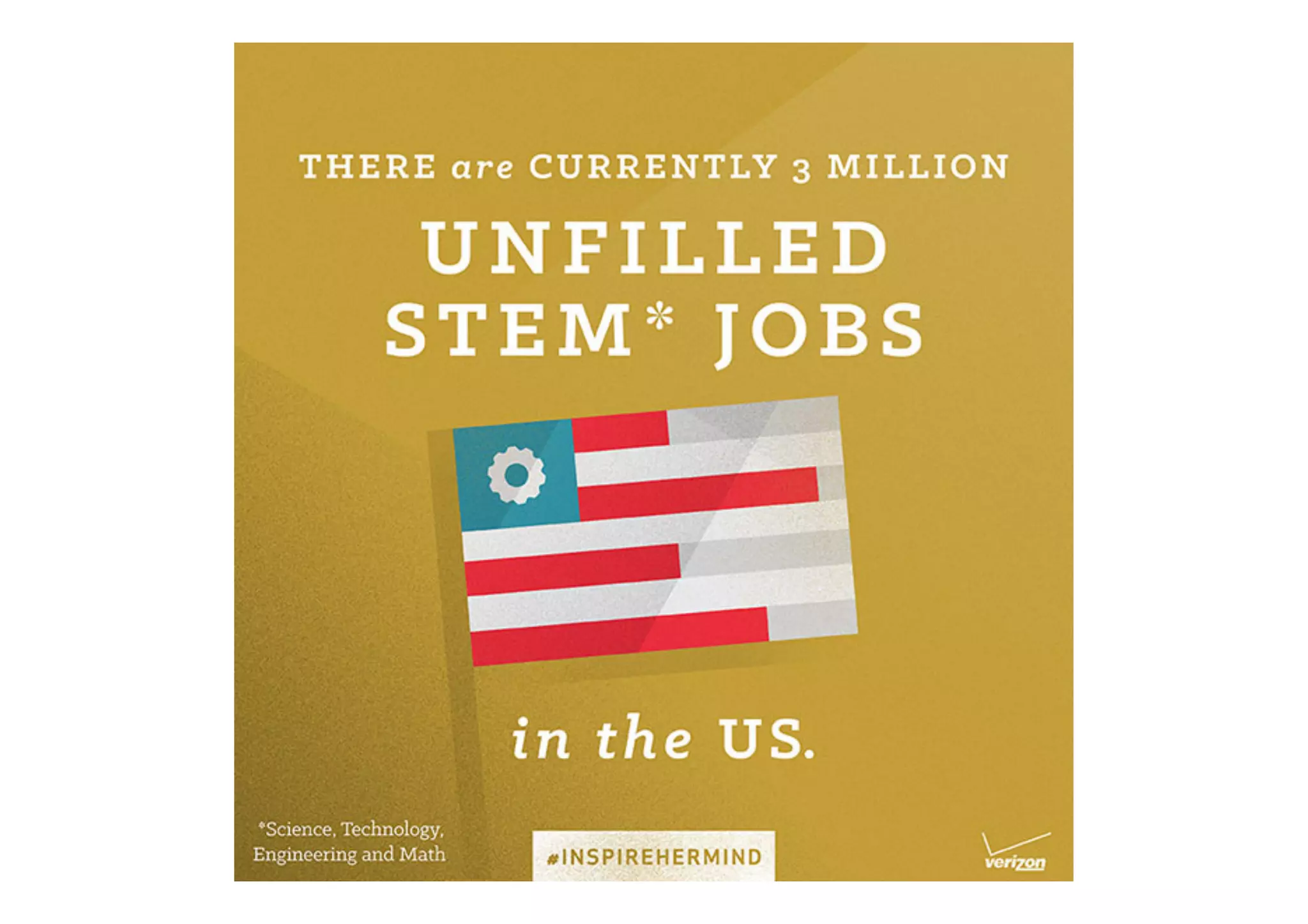
•  The number of ICT positions in the EU has grown by 4%
since 2000, 7 times  the evolution of overall
employment. 
•  Engineering jobs grow faster than all other jobs in the US
•  Female engineers earn 33% more than women in other
fields
•  Only 13% of the engineers are women…
Larger income
“In	
  a	
  world	
  where	
  95%	
  of	
  all	
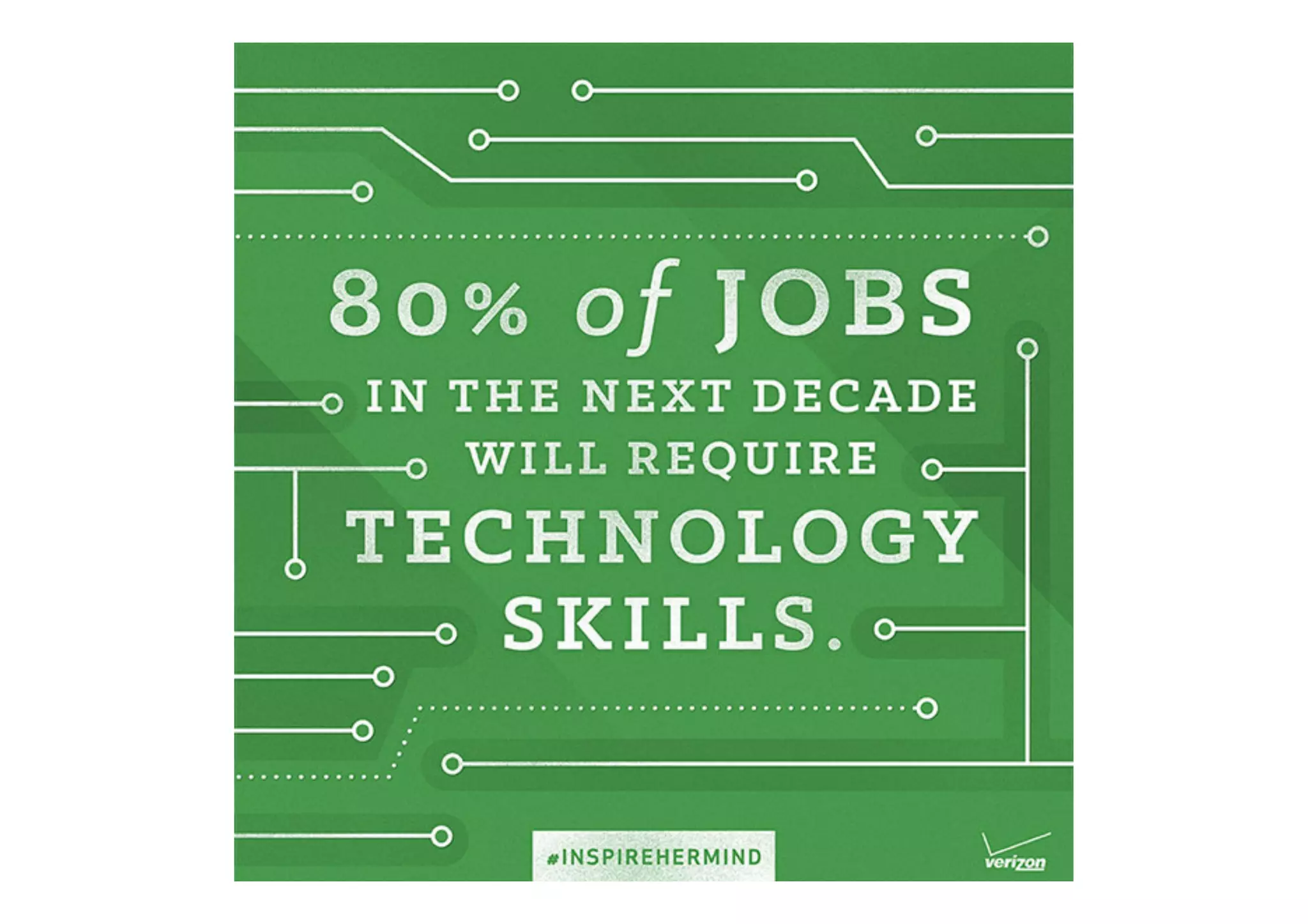
  jobs	
  now	
  have	
  a	
  digital	
  component,	
  encouraging	
  
women	
  and	
  girls	
  in	
  ICT	
  is	
  criIcal.”	


–	
  Hamadoun	
  Touré,	
  Secretary-­‐General	
  of	
  the	
  InternaIonal	
  TelecommunicaIon	
  
Union	
  
ConnecIng	
  women	
  through	
  the	
  use	
  of	
  technology	
  can	
  yield	
  incredible	
  returns	
  in	
  social	
  
and	
  economic	
  development;	
  developing	
  economies	
  could,	
  for	
  example,	
  see	
  an	
  increase	
  
of	
  $13	
  –	
  18	
  billion	
  in	
  their	
  GDPs	
  if	
  the	
  number	
  of	
  girls	
  and	
  women	
  currently	
  online	
  
worldwide	
  were	
  doubled	
  (Intel’s	
  “Women	
  and	
  the	
  Web”	
  Report	
  2012).	
  
And yet, it is still a boy’s club
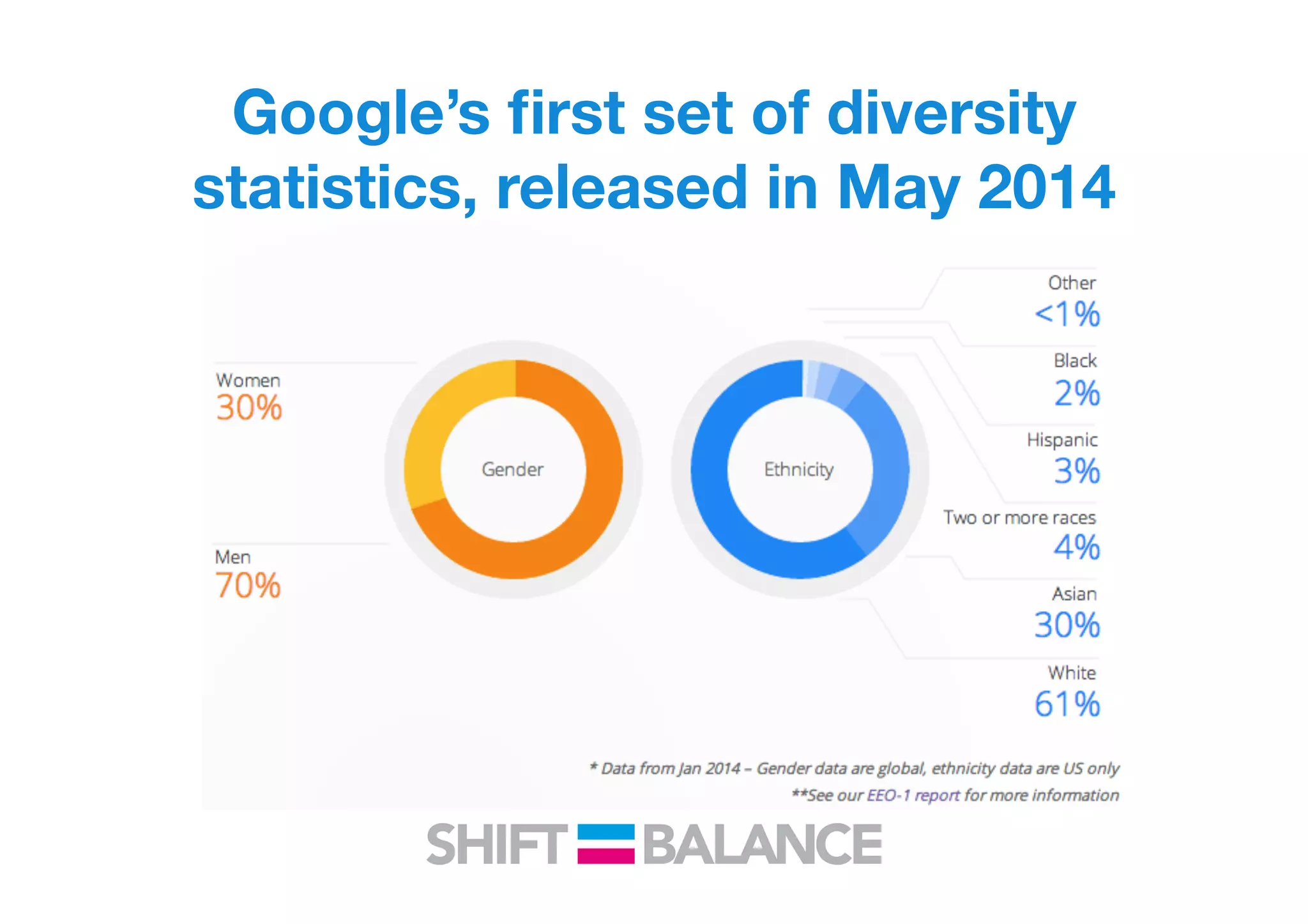
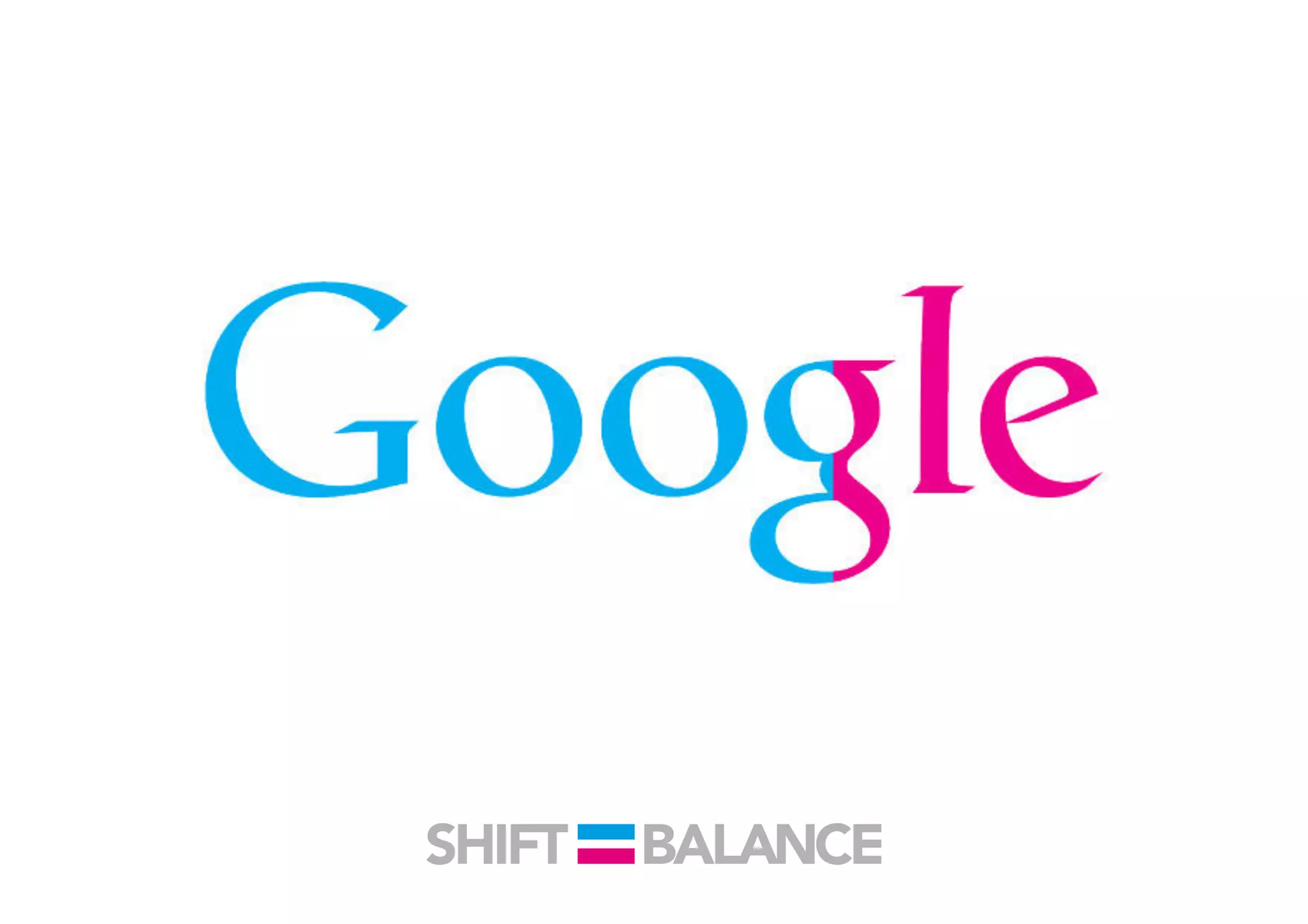
Google’s first set of diversity
statistics, released in May 2014
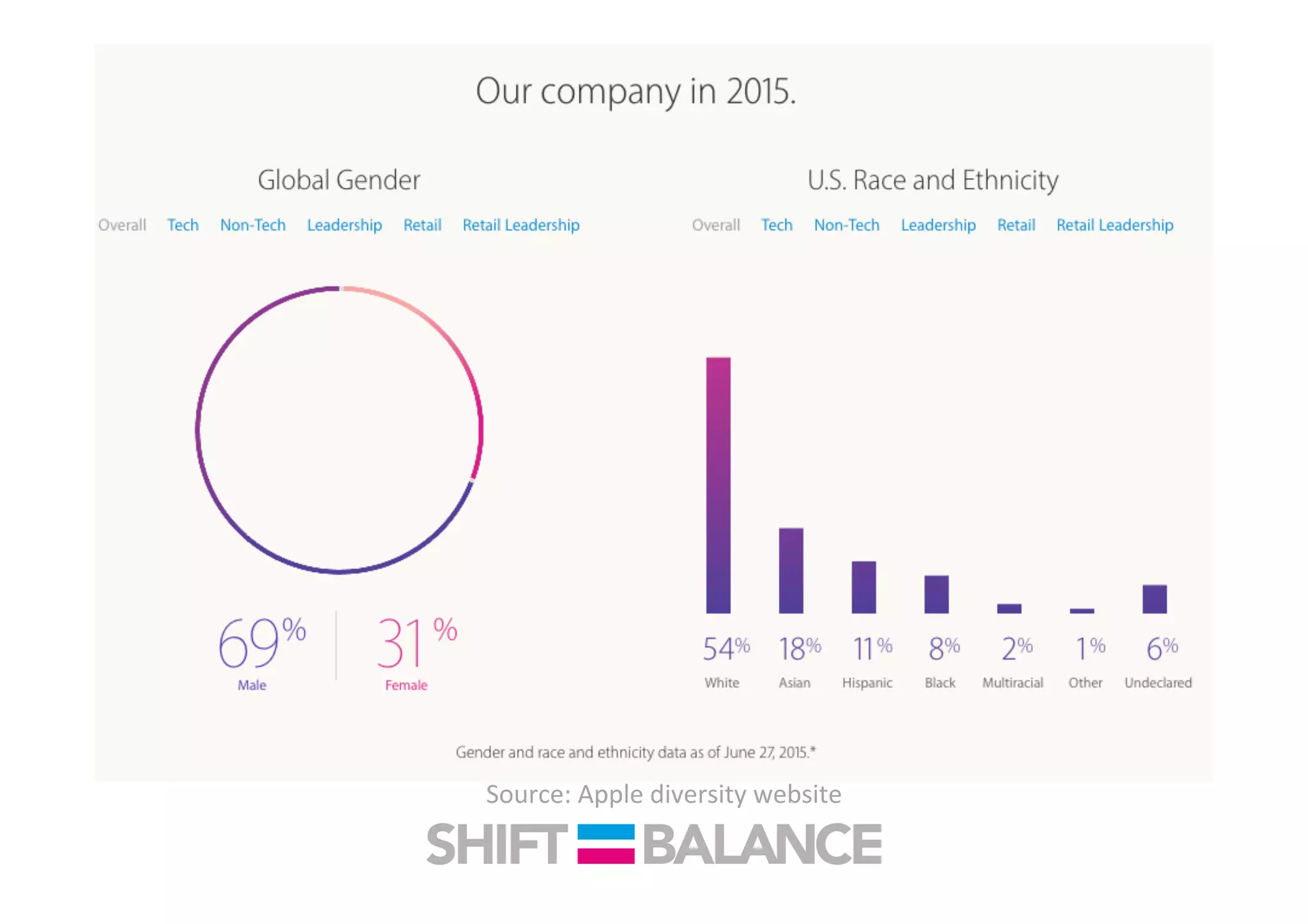
Source:	
  Apple	
  diversity	
  website	
  
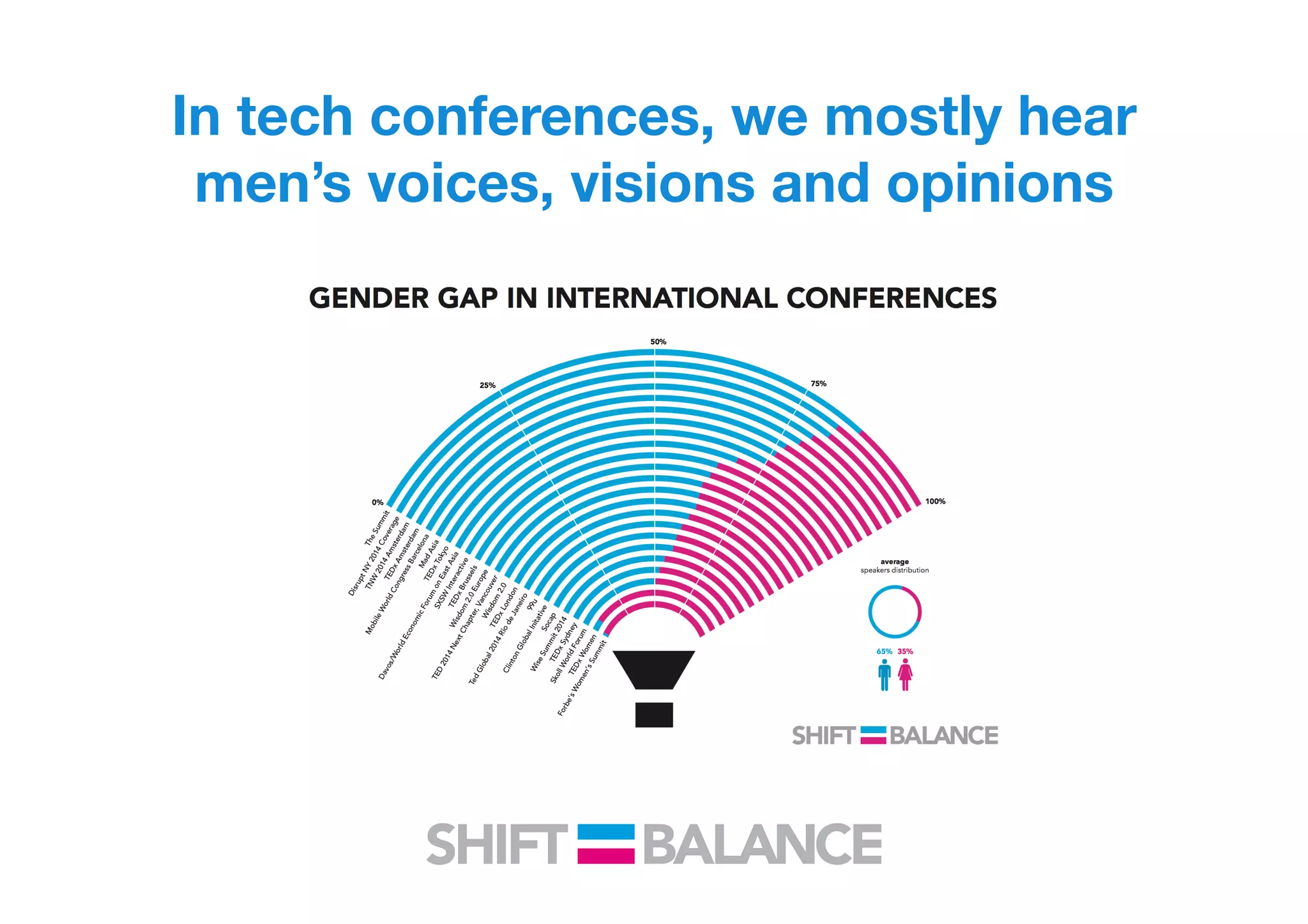
In tech conferences, we mostly hear
men’s voices, visions and opinions
And the numbers of women in
tech are dropping!
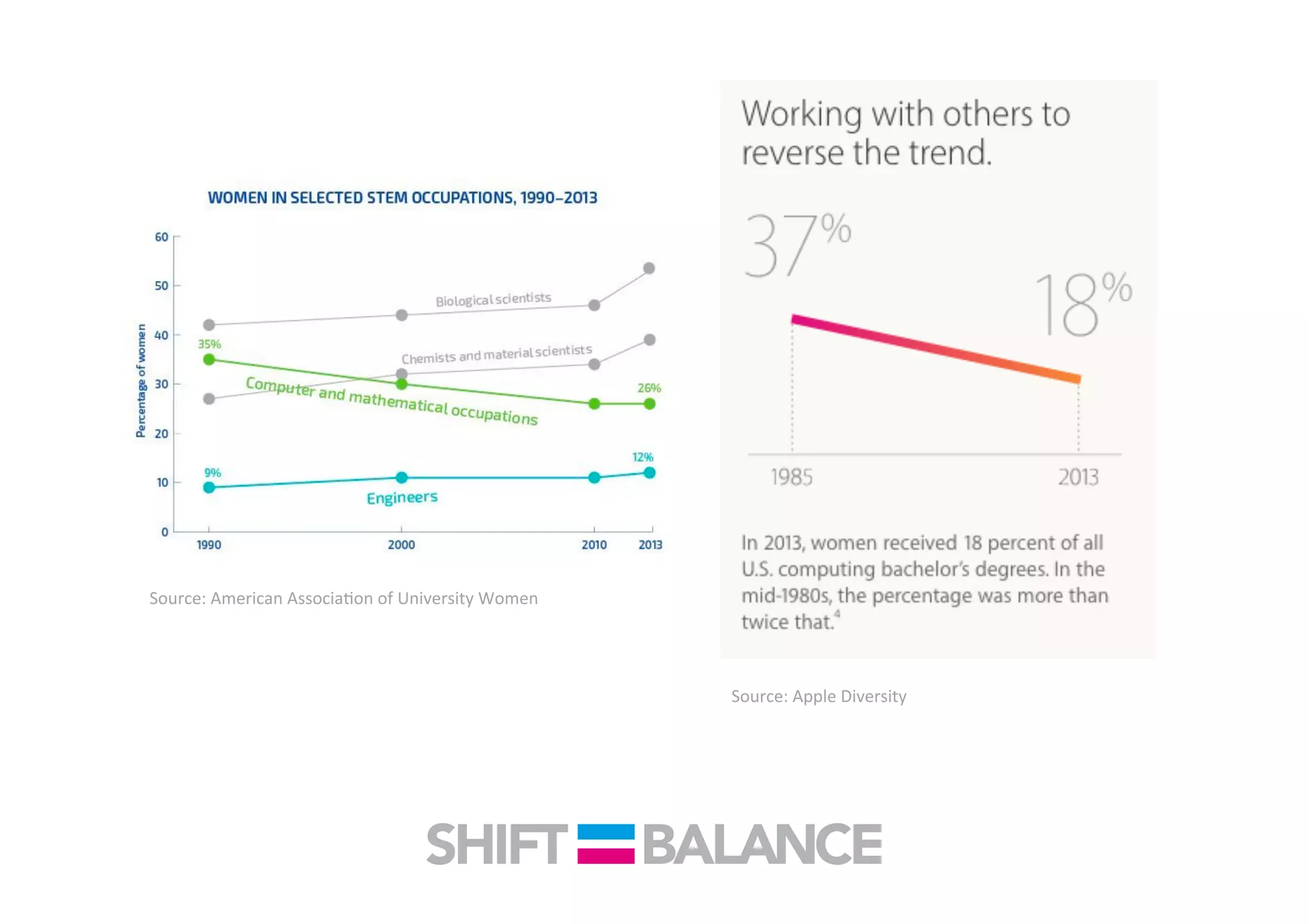
•  Women make up a tiny fraction, roughly 15%, of people
working in technical roles in the tech industry. And
amazingly, that percentage is dropping, not rising.
•  Multiple studies have found that the proportion of
women in the tech workforce peaked in about 1989 and
has been steadily dropping ever since.
Source:	
  American	
  AssociaIon	
  of	
  University	
  Women	
  
Source:	
  American	
  AssociaIon	
  of	
  University	
  Women	
  
Source:	
  Apple	
  Diversity	
  
Why?
•  Most have very few female role models and colleagues.
•  Surveys find 23% to 66% report experiencing sexual harassment
or seeing it happen to others. 
•  Half the respondents to my survey said they've been treated in a
way they find hostile, demeaning or condescending, and a third
said their bosses are friendlier and more supportive with their male
colleagues. 
•  Women report being encouraged to move out of pure tech into
support functions, which offer less pay, are less prestigious and
have limited upward mobility. 
•  A 2014 Glassdoor analysis concluded that women in tech are paid
less than their male colleagues, with another 2014 study putting the
salary gap at 12%.
The Athena Factor
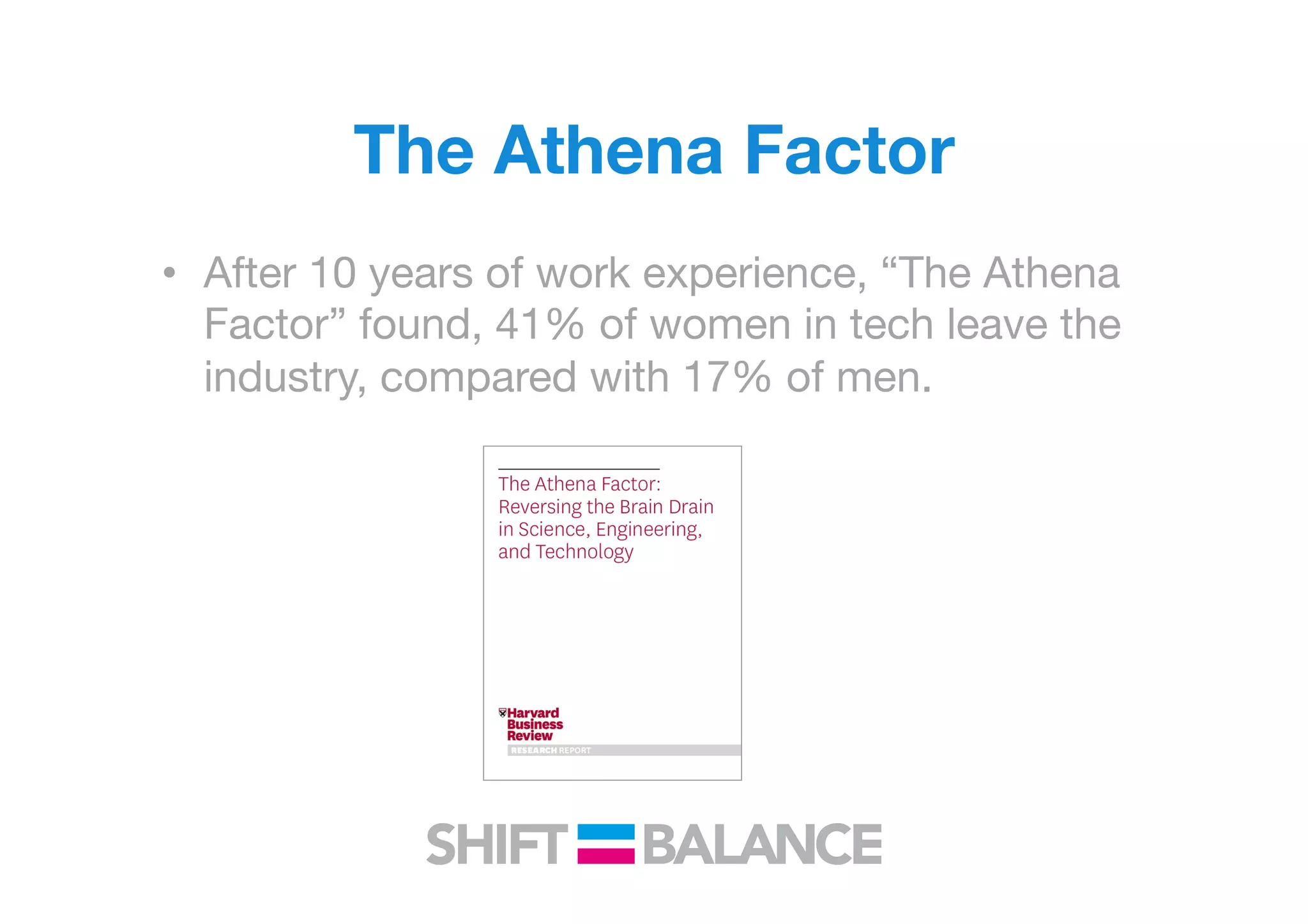
•  After 10 years of work experience, “The Athena
Factor” found, 41% of women in tech leave the
industry, compared with 17% of men.
Forty-­‐one	
  percent	
  of	
  highly	
  qualified	
  scienIsts,	
  engineers,	
  and	
  technologists	
  on	
  the	
  lower	
  rungs	
  of	
  
corporate	
  career	
  ladders	
  are	
  female.	
  But	
  more	
  than	
  half	
  (52%)	
  drop	
  out.	


Why?	
  To	
  beger	
  understand	
  the	
  scope	
  and	
  shape	
  of	
  female	
  talent,	
  the	
  Athena	
  Factor	
  research	
  project	
  
studied	
  the	
  career	
  trajectories	
  of	
  women	
  with	
  SET	
  credenIals	
  in	
  the	
  private	
  sector.	
  
	
  It	
  found	
  5	
  powerful	
  "an.gens"	
  in	
  corporate	
  cultures.	
  	
  
•  Women	
  in	
  SET	
  are	
  marginalized	
  by	
  hosIle	
  macho	
  cultures.	
  Being	
  the	
  sole	
  woman	
  on	
  a	
  team	
  or	
  at	
  a	
  
site	
  can	
  create	
  isolaIon.	
  
•  Many	
  women	
  report	
  mysterious	
  career	
  paths:	
  fully	
  40%	
  feel	
  stalled.	
  	
  
•  Systems	
  of	
  risk	
  and	
  reward	
  in	
  SET	
  cultures	
  can	
  disadvantage	
  women,	
  who	
  tend	
  to	
  be	
  risk	
  averse.	
  
•  Finally,	
  SET	
  jobs	
  include	
  extreme	
  work	
  pressures:	
  they	
  are	
  unusually	
  Ime	
  intensive.	
  
•  Moreover,	
  female	
  agriIon	
  rates	
  spike	
  10	
  years	
  into	
  a	
  career.	
  Women	
  experience	
  a	
  perfect	
  storm	
  in	
  
their	
  mid-­‐	
  to	
  late	
  thirIes:	
  They	
  hit	
  serious	
  career	
  hurdles	
  precisely	
  when	
  family	
  pressures	
  intensify.	
  
Companies	
  that	
  step	
  in	
  with	
  targeted	
  support	
  before	
  this	
  "fight	
  or	
  flight	
  moment"	
  may	
  be	
  able	
  to	
  
lower	
  the	
  female	
  agriIon	
  rate	
  significantly.	
  	
  
•  This	
  study	
  features	
  13	
  company	
  iniIaIves	
  that	
  address	
  this	
  female	
  brain	
  drain.	
  Some,	
  for	
  example,	
  
are	
  designed	
  to	
  break	
  down	
  female	
  isolaIon;	
  others	
  create	
  on-­‐ramps	
  for	
  women	
  who	
  want	
  to	
  return	
  
to	
  work.	
  These	
  iniIaIves	
  are	
  likely	
  to	
  be	
  "game	
  changers":	
  They	
  will	
  allow	
  many	
  more	
  women	
  to	
  stay	
  
on	
  track	
  in	
  SET	
  careers.	
  
Increasing attention of tech
companies on diversity challenges
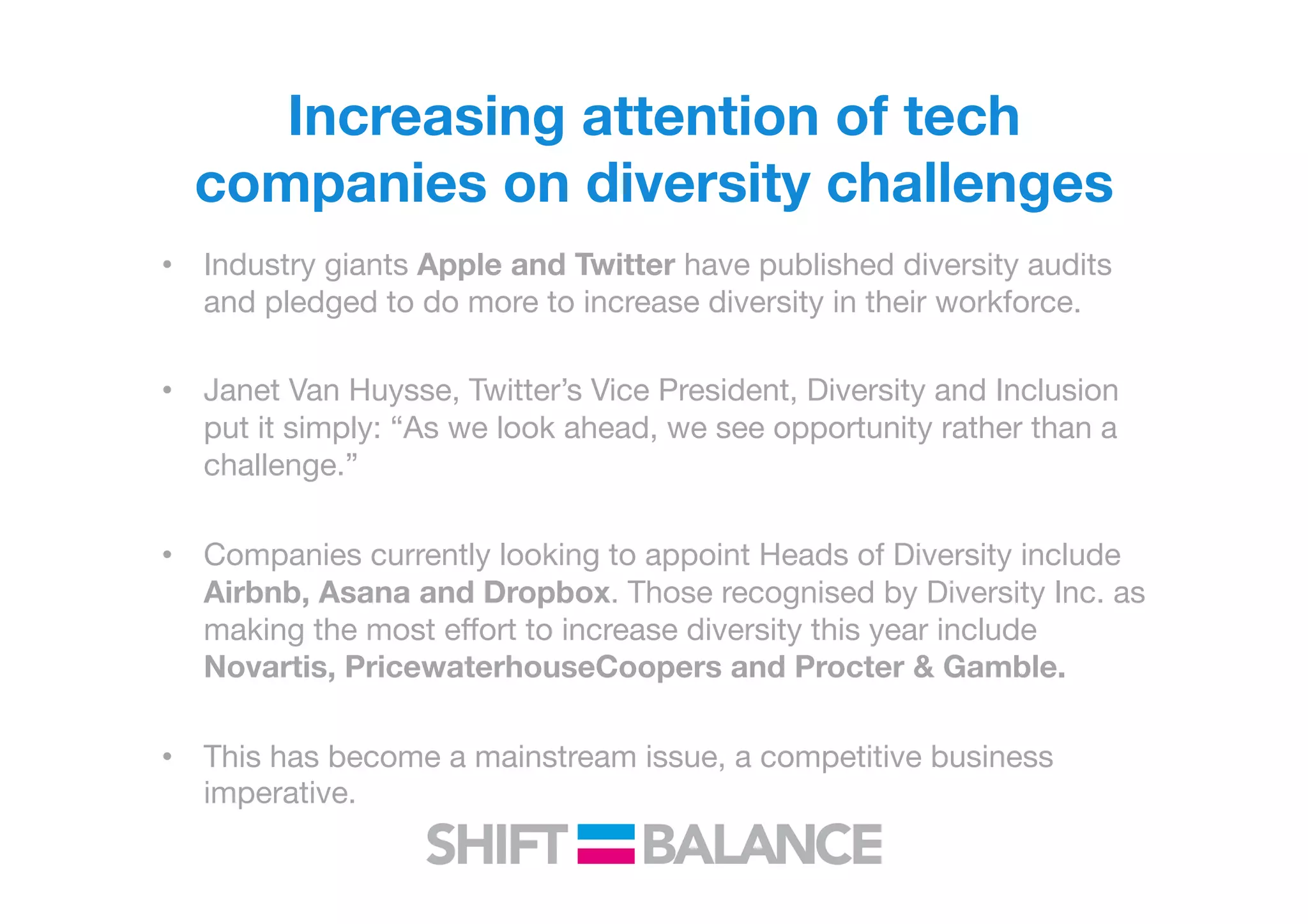
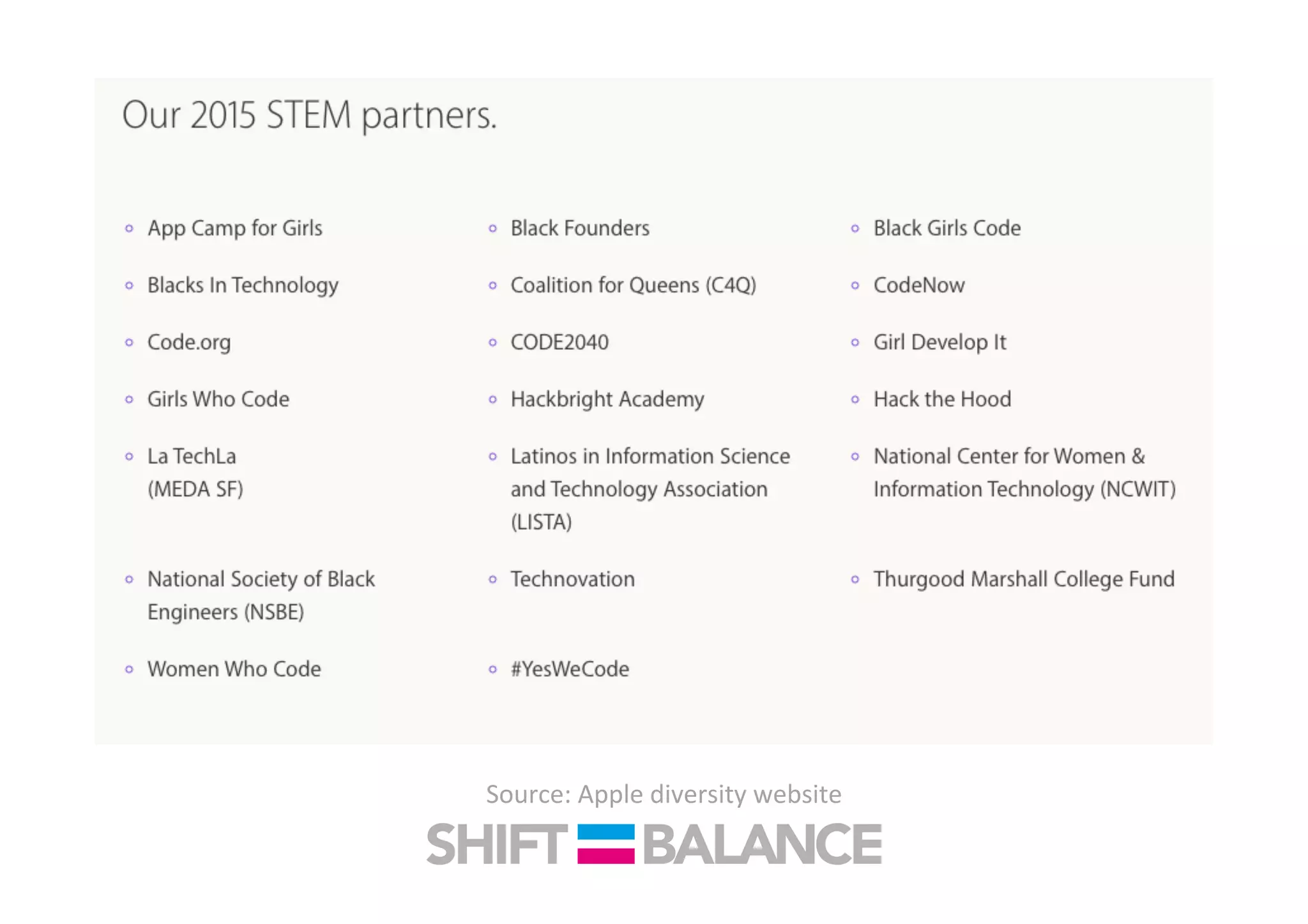
•  Industry giants Apple and Twitter have published diversity audits
and pledged to do more to increase diversity in their workforce.
•  Janet Van Huysse, Twitter’s Vice President, Diversity and Inclusion
put it simply: “As we look ahead, we see opportunity rather than a
challenge.”
•  Companies currently looking to appoint Heads of Diversity include
Airbnb, Asana and Dropbox. Those recognised by Diversity Inc. as
making the most effort to increase diversity this year include
Novartis, PricewaterhouseCoopers and Procter & Gamble.
•  This has become a mainstream issue, a competitive business
imperative.
Source:	
  Apple	
  diversity	
  website	
  
Mark Zuckerberg paternity
leave
The tech world is changing

Women need to be part of it!
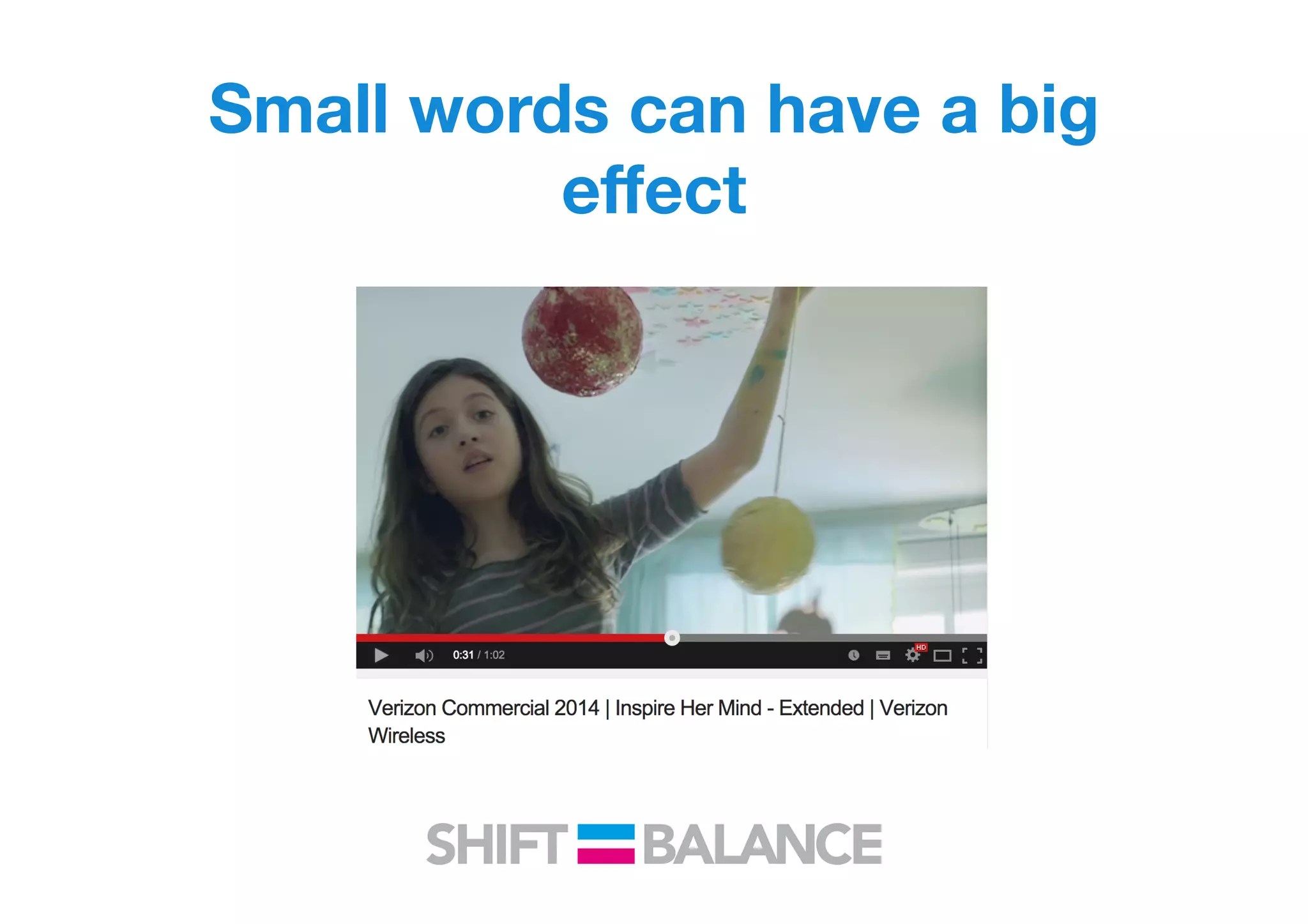
Small words can have a big
effect
Many messages hold women
back
We need new role models
We need to teach girls to code
We need more female engineers
We need new toys
More than just a princess
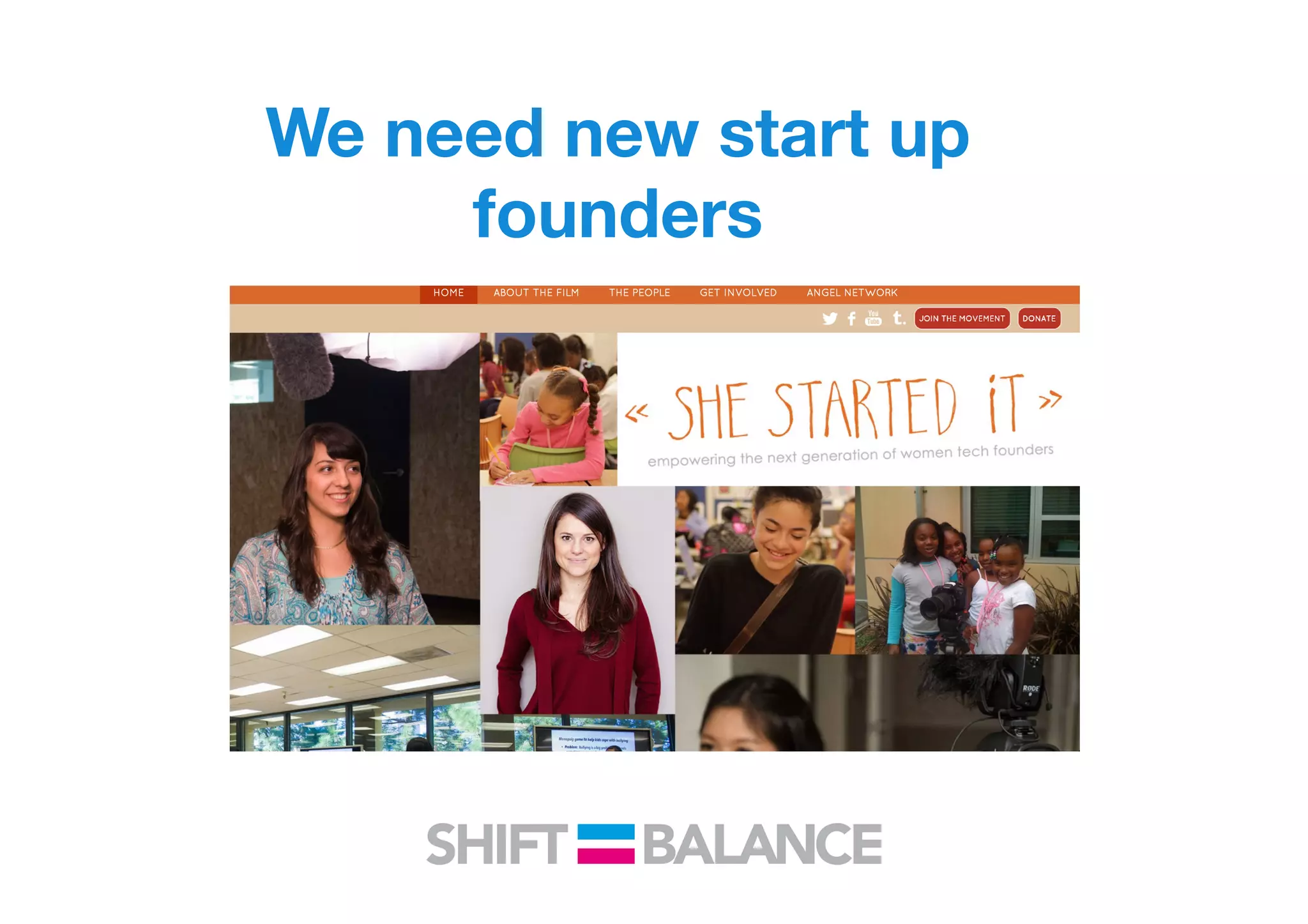
We need new start up
founders
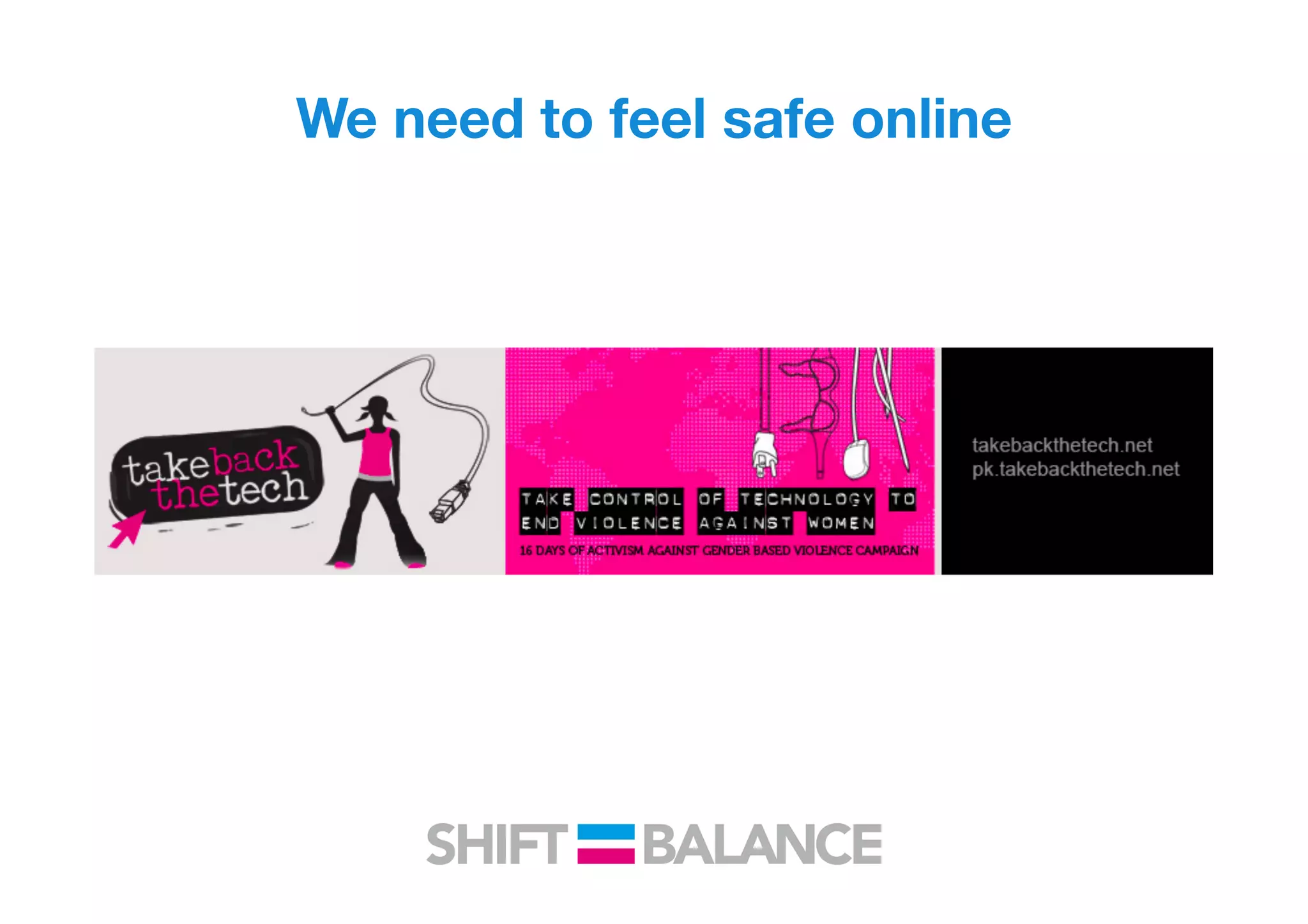
We need to feel safe online
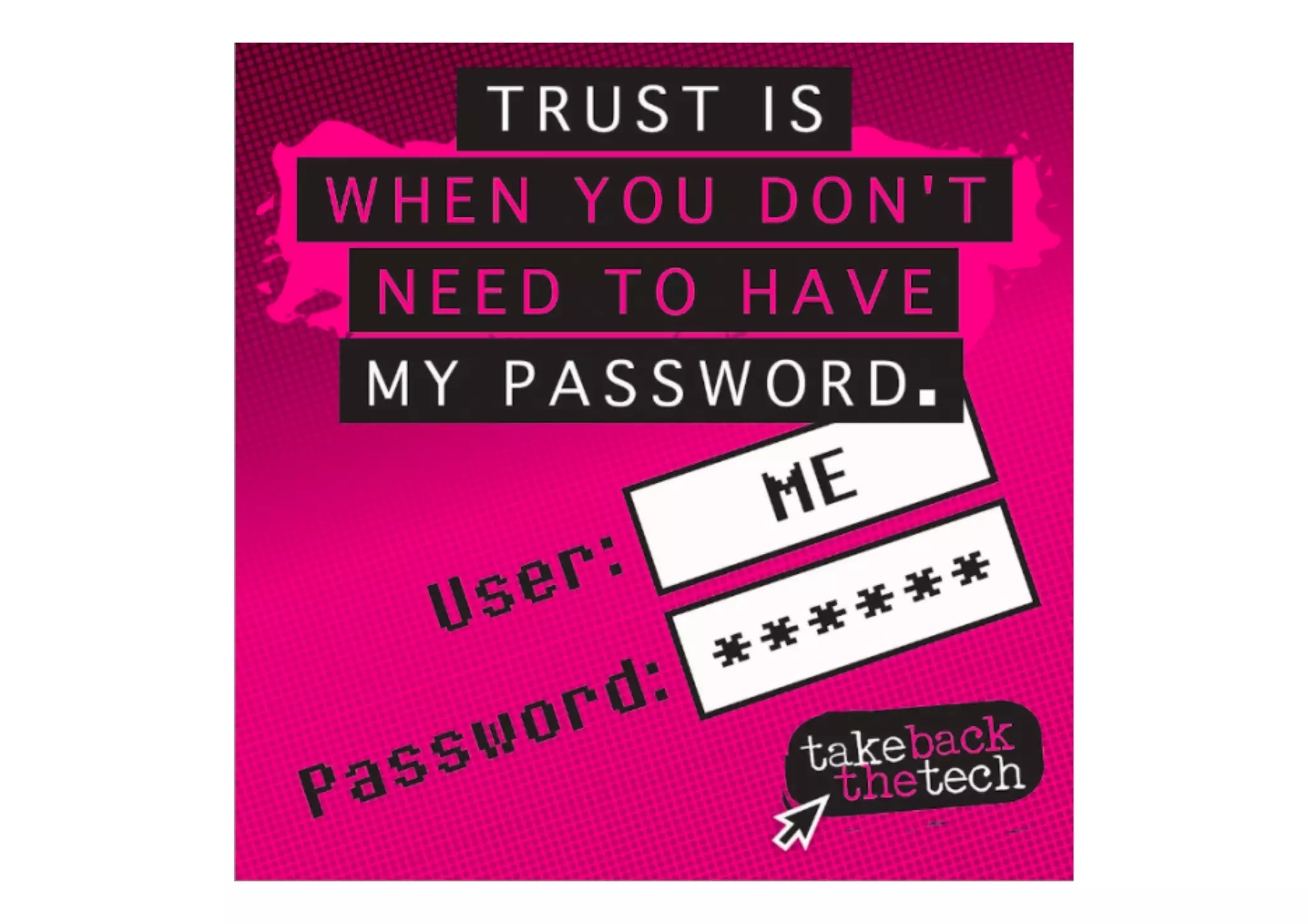
Take back the tech
We need to portray women
differently
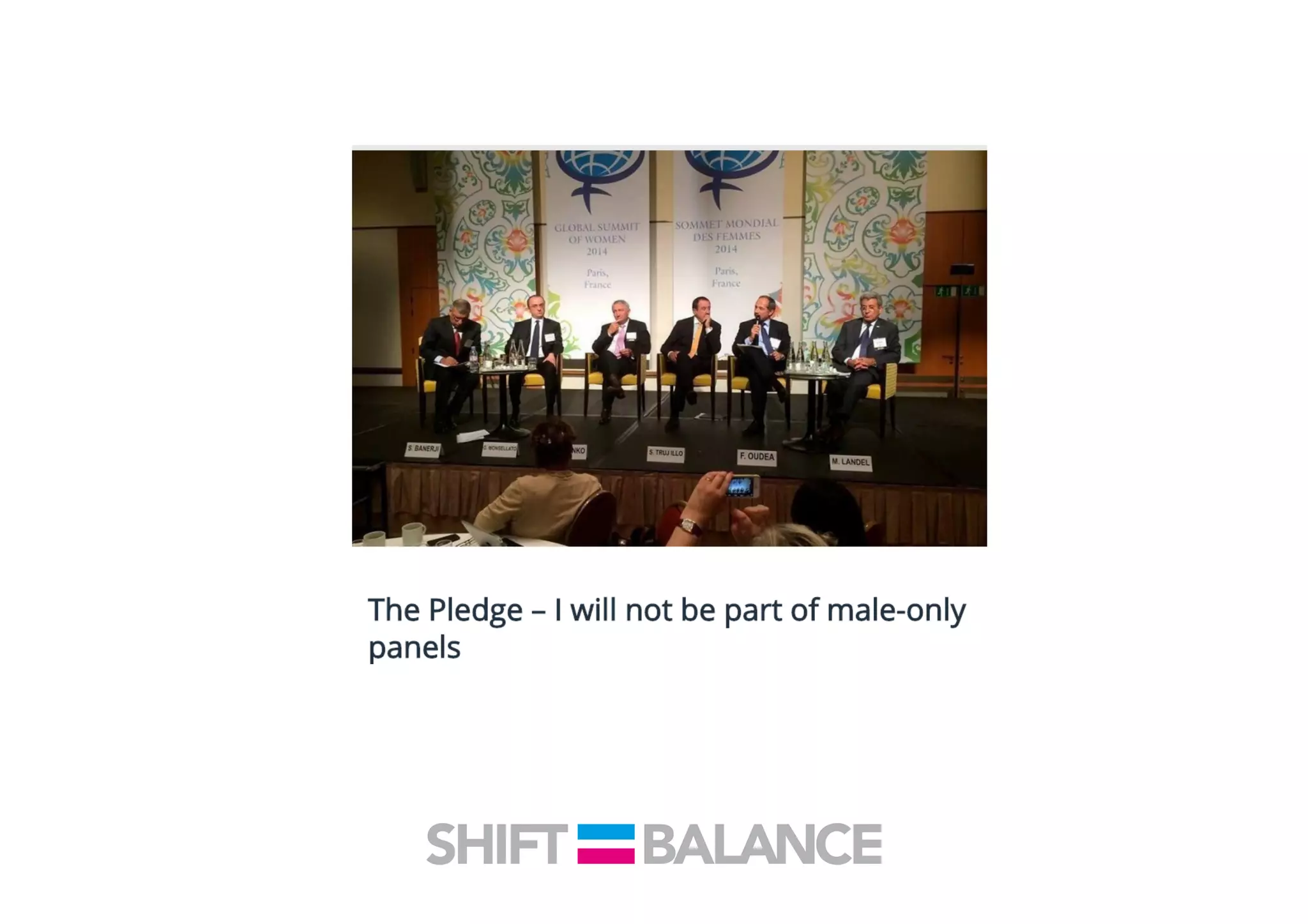
We need to actively look for
women speakers
We need new tech spaces
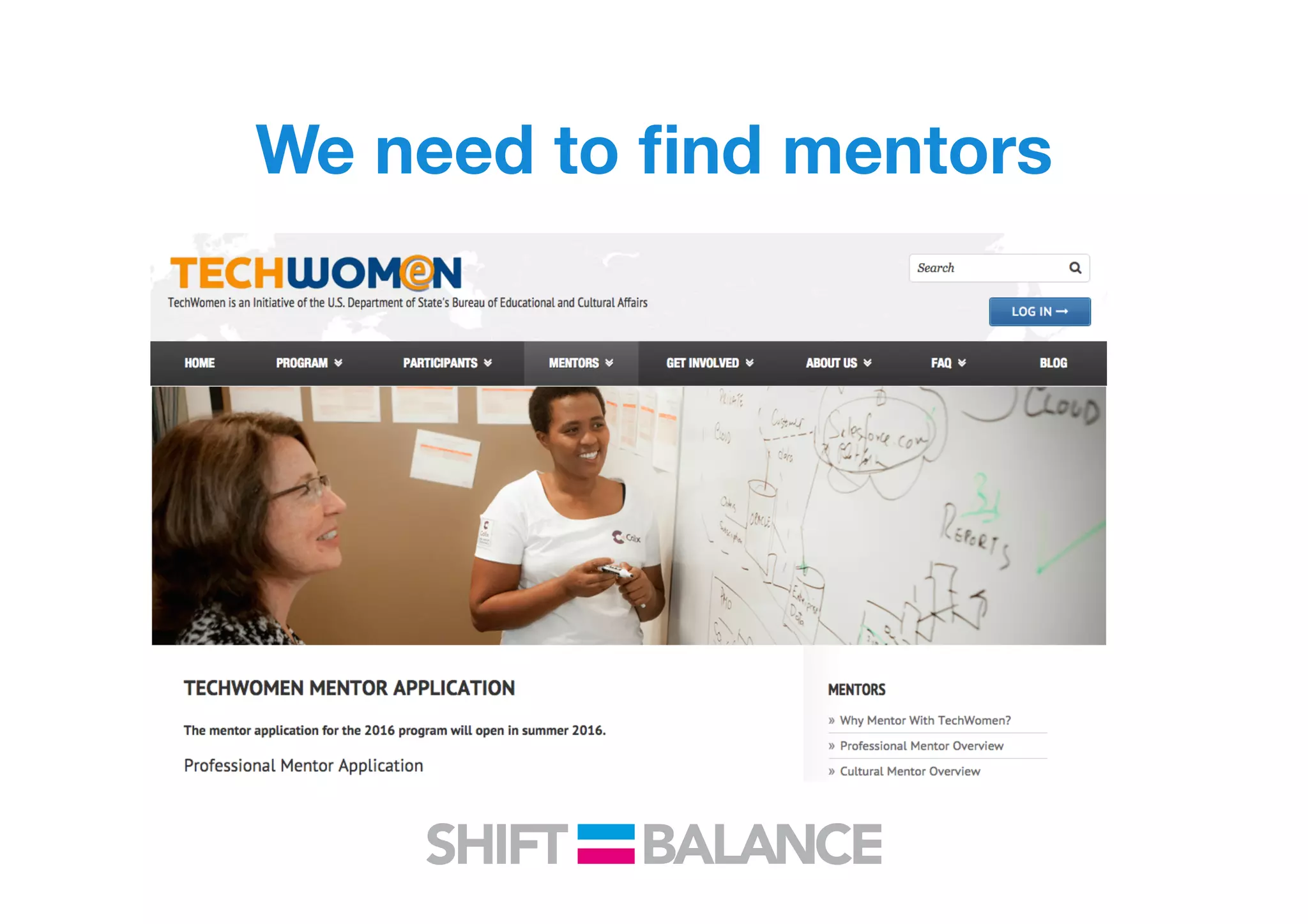
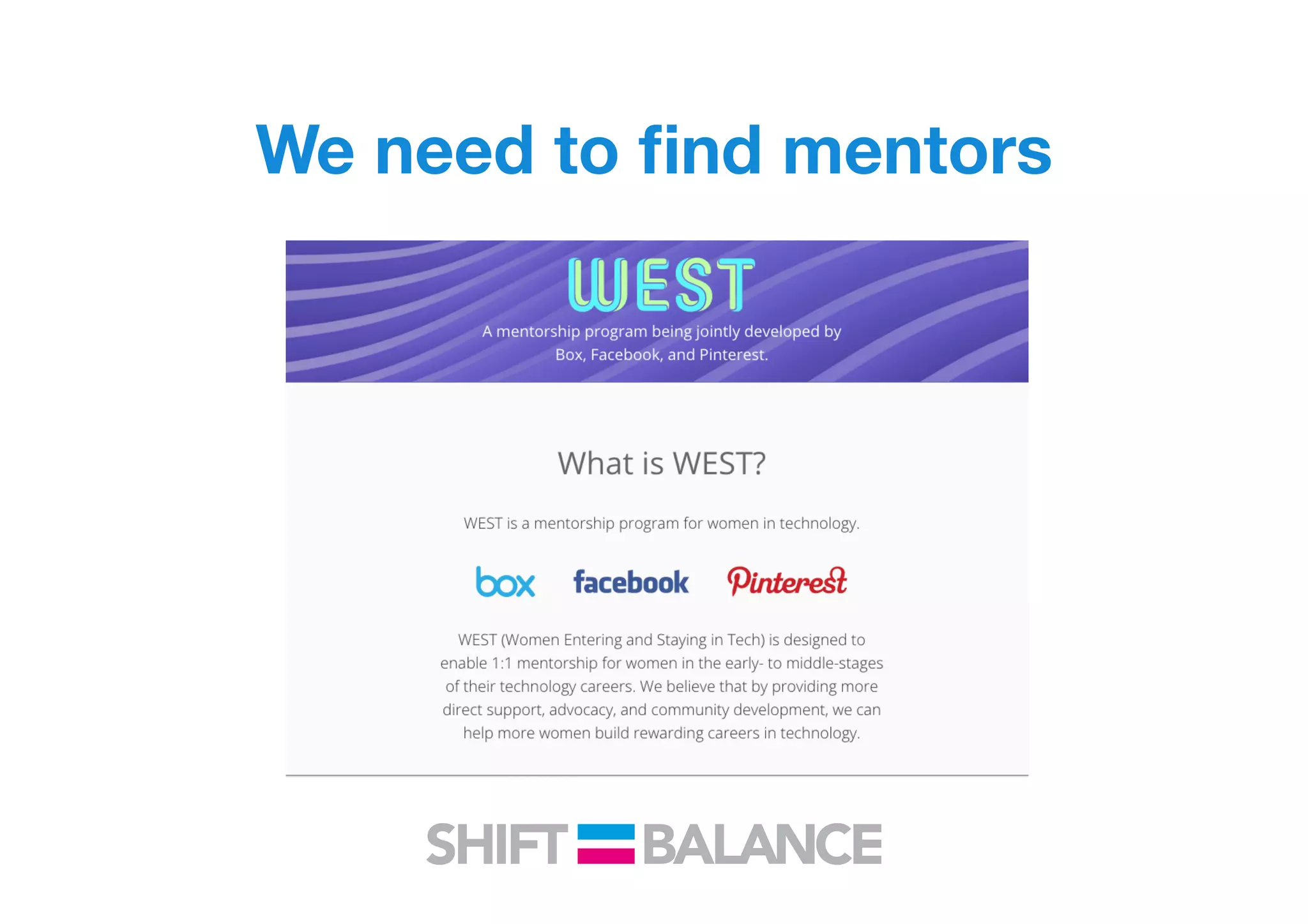
We need to find mentors
We need more women in tech
events
What about you?
When did you speak at a conference?
When did you mentor a young woman?
When did you write an article about your
experience?
Why we need more women in technology

Why we need more women in technology

  • 1.
  • 2.
    Technology allows youto… CONNECT   ACCESS   BYPASS   REACH  OUT  
  • 3.
    Organize and connecta community «  Being  connected,  heard,  and  externally  validated  within  a  global  community  provides  many   women  the  courage  and  support  they  need  to  become  change  agents  at  home  »       Jensine  Larsen,  founder  of  the  global  women’s  network  and  online  forum  World  Pulse  
  • 5.
  • 6.
  • 7.
  • 8.
  • 11.
  • 14.
  • 15.
  • 16.
  • 17.
  • 18.
  • 19.
  • 20.
    Give visibility toremote issues
  • 21.
  • 22.
  • 23.
  • 24.
  • 25.
  • 26.
    Access to jobs “Sama”  means  equal.  Samasource  connects  poor  women  and  youth  to   training  and  employment  in  the  digital  economy.    
  • 27.
  • 28.
  • 29.
  • 30.
  • 31.
  • 33.
    Become citizen journalists 'no-­‐cuts,  no  censorship'  approach  
  • 34.
    Bypass traditional structures andhierarchies Technological  disrupIon  tears  through  social  norms,  regulatory  structures,  and  adjusts  the   balance  of  power  between  stakeholders.    
  • 35.
  • 36.
  • 37.
    WE NEED MOREWOMEN IN TECHNOLOGY!
  • 38.
    The future willbe shaped by technology
  • 39.
    We need Women@ the frontier
  • 42.
    Better opportunities •  Thenumber of ICT positions in the EU has grown by 4% since 2000, 7 times  the evolution of overall employment. •  Engineering jobs grow faster than all other jobs in the US •  Female engineers earn 33% more than women in other fields •  Only 13% of the engineers are women…
  • 43.
    Larger income “In  a  world  where  95%  of  all  jobs  now  have  a  digital  component,  encouraging   women  and  girls  in  ICT  is  criIcal.”       –  Hamadoun  Touré,  Secretary-­‐General  of  the  InternaIonal  TelecommunicaIon   Union   ConnecIng  women  through  the  use  of  technology  can  yield  incredible  returns  in  social   and  economic  development;  developing  economies  could,  for  example,  see  an  increase   of  $13  –  18  billion  in  their  GDPs  if  the  number  of  girls  and  women  currently  online   worldwide  were  doubled  (Intel’s  “Women  and  the  Web”  Report  2012).  
  • 44.
    And yet, itis still a boy’s club
  • 45.
    Google’s first setof diversity statistics, released in May 2014
  • 47.
  • 48.
    In tech conferences,we mostly hear men’s voices, visions and opinions
  • 51.
    And the numbersof women in tech are dropping! •  Women make up a tiny fraction, roughly 15%, of people working in technical roles in the tech industry. And amazingly, that percentage is dropping, not rising. •  Multiple studies have found that the proportion of women in the tech workforce peaked in about 1989 and has been steadily dropping ever since. Source:  American  AssociaIon  of  University  Women  
  • 52.
    Source:  American  AssociaIon  of  University  Women   Source:  Apple  Diversity  
  • 53.
    Why? •  Most havevery few female role models and colleagues. •  Surveys find 23% to 66% report experiencing sexual harassment or seeing it happen to others. •  Half the respondents to my survey said they've been treated in a way they find hostile, demeaning or condescending, and a third said their bosses are friendlier and more supportive with their male colleagues. •  Women report being encouraged to move out of pure tech into support functions, which offer less pay, are less prestigious and have limited upward mobility. •  A 2014 Glassdoor analysis concluded that women in tech are paid less than their male colleagues, with another 2014 study putting the salary gap at 12%.
  • 54.
    The Athena Factor • After 10 years of work experience, “The Athena Factor” found, 41% of women in tech leave the industry, compared with 17% of men.
  • 55.
    Forty-­‐one  percent  of  highly  qualified  scienIsts,  engineers,  and  technologists  on  the  lower  rungs  of   corporate  career  ladders  are  female.  But  more  than  half  (52%)  drop  out.       Why?  To  beger  understand  the  scope  and  shape  of  female  talent,  the  Athena  Factor  research  project   studied  the  career  trajectories  of  women  with  SET  credenIals  in  the  private  sector.    It  found  5  powerful  "an.gens"  in  corporate  cultures.     •  Women  in  SET  are  marginalized  by  hosIle  macho  cultures.  Being  the  sole  woman  on  a  team  or  at  a   site  can  create  isolaIon.   •  Many  women  report  mysterious  career  paths:  fully  40%  feel  stalled.     •  Systems  of  risk  and  reward  in  SET  cultures  can  disadvantage  women,  who  tend  to  be  risk  averse.   •  Finally,  SET  jobs  include  extreme  work  pressures:  they  are  unusually  Ime  intensive.   •  Moreover,  female  agriIon  rates  spike  10  years  into  a  career.  Women  experience  a  perfect  storm  in   their  mid-­‐  to  late  thirIes:  They  hit  serious  career  hurdles  precisely  when  family  pressures  intensify.   Companies  that  step  in  with  targeted  support  before  this  "fight  or  flight  moment"  may  be  able  to   lower  the  female  agriIon  rate  significantly.     •  This  study  features  13  company  iniIaIves  that  address  this  female  brain  drain.  Some,  for  example,   are  designed  to  break  down  female  isolaIon;  others  create  on-­‐ramps  for  women  who  want  to  return   to  work.  These  iniIaIves  are  likely  to  be  "game  changers":  They  will  allow  many  more  women  to  stay   on  track  in  SET  careers.  
  • 56.
    Increasing attention oftech companies on diversity challenges •  Industry giants Apple and Twitter have published diversity audits and pledged to do more to increase diversity in their workforce. •  Janet Van Huysse, Twitter’s Vice President, Diversity and Inclusion put it simply: “As we look ahead, we see opportunity rather than a challenge.” •  Companies currently looking to appoint Heads of Diversity include Airbnb, Asana and Dropbox. Those recognised by Diversity Inc. as making the most effort to increase diversity this year include Novartis, PricewaterhouseCoopers and Procter & Gamble. •  This has become a mainstream issue, a competitive business imperative.
  • 57.
  • 61.
  • 62.
    The tech worldis changing Women need to be part of it!
  • 64.
    Small words canhave a big effect
  • 65.
  • 67.
    We need newrole models
  • 68.
    We need toteach girls to code
  • 69.
    We need toteach girls to code
  • 70.
    We need morefemale engineers
  • 73.
  • 74.
    More than justa princess
  • 76.
    We need newstart up founders
  • 78.
    We need tofeel safe online
  • 79.
  • 82.
    We need toportray women differently
  • 83.
    We need toactively look for women speakers
  • 84.
    We need newtech spaces
  • 85.
    We need tofind mentors
  • 86.
    We need tofind mentors
  • 87.
    We need morewomen in tech events
  • 88.
    What about you? Whendid you speak at a conference? When did you mentor a young woman? When did you write an article about your experience?