EQUALITY –
GOVERNANCE AND
LEADERSHIP
Mole (Laura) Chapman
Welcome
•Powerful language.
•Professional purpose.
•Validating experience.
•Not an add-on.
Without certain groups represented in the room, we miss out
on the voices we need to hear in order to change.
Ground Rules
Agreed understandings or social
contract?
What do you need to participate?
Shared Outcomes:
• Hopes and fears:
From mindscapes to
landscapes
We would be foolish to assume that it’s easy to
achieve a fairer society.
If it was easy we would have cracked it, and we
would all live in an equitable world.
• It is not.
• We have not.
• We do not.
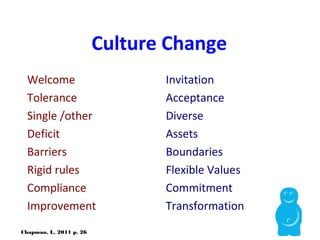
Culture Change
Welcome
Tolerance
Single /other
Deficit
Barriers
Rigid rules
Compliance
Improvement
Invitation
Acceptance
Diverse
Assets
Boundaries
Flexible Values
Commitment
Transformation
Chapman, L. 2011 p. 26
Culture Change
• Tackling inequality is best understood as a
practitioner’s ethical commitment to realise
every child’s rights in full.
• Cultural change takes both time and
innovation: it is neither immediately
available nor instantly achievable.
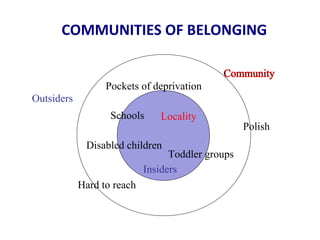
COMMUNITIES OF BELONGING
Locality
Disabled children
Schools
Toddler groups
Outsiders
Insiders
Hard to reach
Polish
Pockets of deprivation
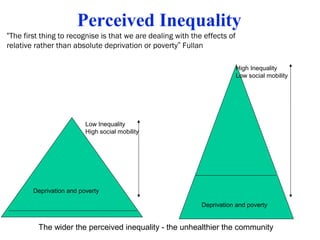
Perceived Inequality
High Inequality
Low social mobility
Deprivation and poverty
Low Inequality
High social mobility
The wider the perceived inequality - the unhealthier the community
“The first thing to recognise is that we are dealing with the effects of
relative rather than absolute deprivation or poverty” Fullan
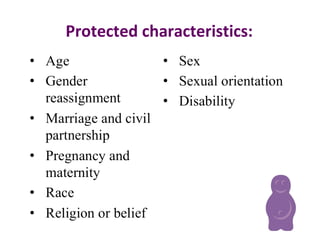
Protected characteristics:
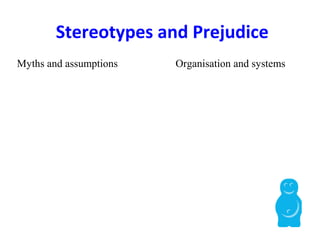
Stereotypes and Prejudice
Myths and assumptions Organisation and systems
Behaviour and communication
Feeling Action
Whose cake?
Inequality is best explained as a powerful
social force that leads to community
divisions and hierarchies.
Inequality weakens community life, reduces
trust and increases violence across
populations.
Equality:
• Equal treatment for all: The availability of the same
rights, position, and status to all people, regardless of
gender, sexual preference, age, race, ethnicity, ability or
religion.
• Agreement of equal value
• State of being equal: rights, treatment, quantity, or value
equal to all others in a specific group
• All individuals need to have equal choices and opportunities
regardless of their ability.
Inclusive practice:
"Inclusion is a process of identifying and breaking down
barriers which can be environmental, attitudinal and
institutional. This process eliminates discrimination thus
providing all children and young people with equal access
to play.”
(Play Partnership 2007)
“Is an ongoing process of reviewing and developing practice
in order to adjust and celebrate diversity. It is the
journey not the destination!”
(EQuality Training 2006)
Equalities Act
• Eliminate unlawful discrimination,
harassment and victimisation and other
conduct prohibited by the Act.
• Advance equality of opportunity between
people who share a protected characteristic
and those who do not.
• Foster good relations between people who
share a protected characteristic and those
who do not.
Values & Principles
Values: ‘for all human beings must have some common
values or they cease to be human, and also some different
values else they cease to differ, as in fact they do’
Berlin, I. 2001, p.12
Principles of inclusive practice:
•Equality
•Equity
•Diversity
•Balance
•Fluidity
•Ethical practice
Chapman, L. 2011, p. 20
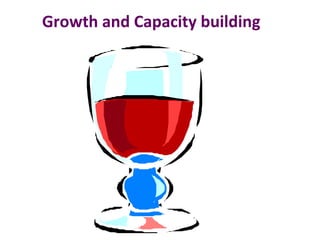
Growth and Capacity building
A Tool in Practice:
• Between learner, teaching professionals,
the governing body and community?
• Trust: time and space.
• Growth and thinking.
• Respectful challenge.
Positive & Possible
We can:







Meaningful relationships
Our judgments about almost all social
interactions, organisations and
communities depend upon our
perceptions of the relationships
involved.
Professor John West-Burnham
Implications for personal and
shared practice?
Personal meaning
• What do I understand by
inequality?
• How do I promote wellbeing
and health and happiness?
• How do I strengthen my own
understanding?
• How do I enable others to
grow?
• What can I do to take more
responsibility?
Governor understanding
• How do we tackle hierarchy?
• How do we work together?
• How do we value others?
• How do we address common
language?
• How do we enable our learers?
• How do we involve parents and
other groups?
• How do we share leadership?
Multi-Agency Teams
• Respect for equality and wellbeing though joined
up service and shared resources
• Personal meaning - acknowledge different models
• Shared understanding - develop shared language
• Leadership - identify management and personal
responsibility
Closing Circle
Good bye!
See you again
…on Facebook or
www.equalitytraining.co.uk

Oldham 6th form college equality

  • 1.
  • 2.
    Welcome •Powerful language. •Professional purpose. •Validatingexperience. •Not an add-on. Without certain groups represented in the room, we miss out on the voices we need to hear in order to change.
  • 3.
    Ground Rules Agreed understandingsor social contract? What do you need to participate?
  • 4.
  • 5.
    From mindscapes to landscapes Wewould be foolish to assume that it’s easy to achieve a fairer society. If it was easy we would have cracked it, and we would all live in an equitable world. • It is not. • We have not. • We do not.
  • 6.
    Culture Change Welcome Tolerance Single /other Deficit Barriers Rigidrules Compliance Improvement Invitation Acceptance Diverse Assets Boundaries Flexible Values Commitment Transformation Chapman, L. 2011 p. 26
  • 7.
    Culture Change • Tacklinginequality is best understood as a practitioner’s ethical commitment to realise every child’s rights in full. • Cultural change takes both time and innovation: it is neither immediately available nor instantly achievable.
  • 8.
    COMMUNITIES OF BELONGING Locality Disabledchildren Schools Toddler groups Outsiders Insiders Hard to reach Polish Pockets of deprivation
  • 9.
    Perceived Inequality High Inequality Lowsocial mobility Deprivation and poverty Deprivation and poverty Low Inequality High social mobility The wider the perceived inequality - the unhealthier the community “The first thing to recognise is that we are dealing with the effects of relative rather than absolute deprivation or poverty” Fullan
  • 10.
  • 11.
    Stereotypes and Prejudice Mythsand assumptions Organisation and systems
  • 12.
  • 13.
    Whose cake? Inequality isbest explained as a powerful social force that leads to community divisions and hierarchies. Inequality weakens community life, reduces trust and increases violence across populations.
  • 14.
    Equality: • Equal treatmentfor all: The availability of the same rights, position, and status to all people, regardless of gender, sexual preference, age, race, ethnicity, ability or religion. • Agreement of equal value • State of being equal: rights, treatment, quantity, or value equal to all others in a specific group • All individuals need to have equal choices and opportunities regardless of their ability.
  • 15.
    Inclusive practice: "Inclusion isa process of identifying and breaking down barriers which can be environmental, attitudinal and institutional. This process eliminates discrimination thus providing all children and young people with equal access to play.” (Play Partnership 2007) “Is an ongoing process of reviewing and developing practice in order to adjust and celebrate diversity. It is the journey not the destination!” (EQuality Training 2006)
  • 16.
    Equalities Act • Eliminateunlawful discrimination, harassment and victimisation and other conduct prohibited by the Act. • Advance equality of opportunity between people who share a protected characteristic and those who do not. • Foster good relations between people who share a protected characteristic and those who do not.
  • 17.
    Values & Principles Values:‘for all human beings must have some common values or they cease to be human, and also some different values else they cease to differ, as in fact they do’ Berlin, I. 2001, p.12 Principles of inclusive practice: •Equality •Equity •Diversity •Balance •Fluidity •Ethical practice Chapman, L. 2011, p. 20
  • 18.
  • 19.
    A Tool inPractice: • Between learner, teaching professionals, the governing body and community? • Trust: time and space. • Growth and thinking. • Respectful challenge.
  • 20.
    Positive & Possible Wecan:       
  • 21.
    Meaningful relationships Our judgmentsabout almost all social interactions, organisations and communities depend upon our perceptions of the relationships involved. Professor John West-Burnham
  • 22.
    Implications for personaland shared practice? Personal meaning • What do I understand by inequality? • How do I promote wellbeing and health and happiness? • How do I strengthen my own understanding? • How do I enable others to grow? • What can I do to take more responsibility? Governor understanding • How do we tackle hierarchy? • How do we work together? • How do we value others? • How do we address common language? • How do we enable our learers? • How do we involve parents and other groups? • How do we share leadership?
  • 23.
    Multi-Agency Teams • Respectfor equality and wellbeing though joined up service and shared resources • Personal meaning - acknowledge different models • Shared understanding - develop shared language • Leadership - identify management and personal responsibility
  • 24.
    Closing Circle Good bye! Seeyou again …on Facebook or www.equalitytraining.co.uk