Equal Employment Opportunity Affirmative Action
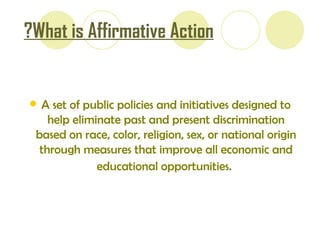
What is Affirmative Action?   A set of public policies and initiatives designed to help eliminate past and present discrimination based on race, color, religion, sex, or national origin   through measures that improve all economic and educational opportunities.
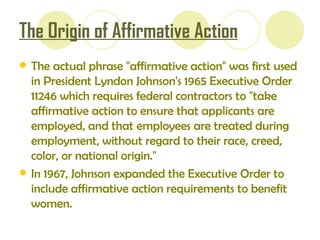
The Origin of Affirmative Action The actual phrase "affirmative action" was first used in President Lyndon Johnson's 1965 Executive Order 11246 which requires federal contractors to "take affirmative action to ensure that applicants are employed, and that employees are treated during employment, without regard to their race, creed, color, or national origin."  In 1967, Johnson expanded the Executive Order to include affirmative action requirements to benefit women.
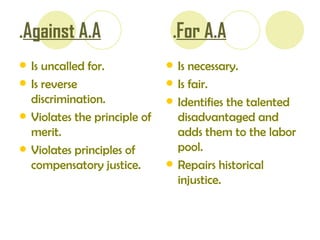
Against A.A .  For A.A . Is uncalled for. Is reverse discrimination. Violates the principle of merit. Violates principles of compensatory justice. Is necessary. Is fair. Identifies the talented disadvantaged and adds them to the labor pool. Repairs historical injustice.
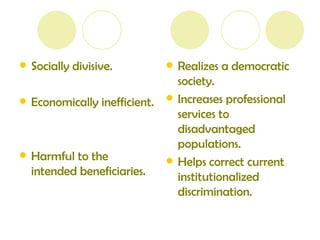
Socially divisive. Economically inefficient. Harmful to the intended beneficiaries. Realizes a democratic society. Increases professional services to disadvantaged populations. Helps correct current institutionalized discrimination.
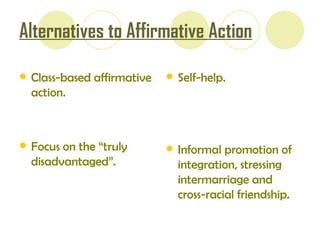
Alternatives to Affirmative Action Class-based affirmative action. Focus on the “truly disadvantaged”. Self - help. Informal promotion of integration, stressing intermarriage and cross-racial friendship.
 
BCU Hawaii University   Business Ethics Presentation Presented by: Maram Kabbara & Samah Harmouche Presented to: Dr. M. Rawas Wed. 22/12/2004

Equal Employment Opportunity

  • 1.
    Equal Employment OpportunityAffirmative Action
  • 2.
    What is AffirmativeAction? A set of public policies and initiatives designed to help eliminate past and present discrimination based on race, color, religion, sex, or national origin through measures that improve all economic and educational opportunities.
  • 3.
    The Origin ofAffirmative Action The actual phrase "affirmative action" was first used in President Lyndon Johnson's 1965 Executive Order 11246 which requires federal contractors to "take affirmative action to ensure that applicants are employed, and that employees are treated during employment, without regard to their race, creed, color, or national origin." In 1967, Johnson expanded the Executive Order to include affirmative action requirements to benefit women.
  • 4.
    Against A.A . For A.A . Is uncalled for. Is reverse discrimination. Violates the principle of merit. Violates principles of compensatory justice. Is necessary. Is fair. Identifies the talented disadvantaged and adds them to the labor pool. Repairs historical injustice.
  • 5.
    Socially divisive. Economicallyinefficient. Harmful to the intended beneficiaries. Realizes a democratic society. Increases professional services to disadvantaged populations. Helps correct current institutionalized discrimination.
  • 6.
    Alternatives to AffirmativeAction Class-based affirmative action. Focus on the “truly disadvantaged”. Self - help. Informal promotion of integration, stressing intermarriage and cross-racial friendship.
  • 7.
  • 8.
    BCU Hawaii University Business Ethics Presentation Presented by: Maram Kabbara & Samah Harmouche Presented to: Dr. M. Rawas Wed. 22/12/2004