Carbon fibre reinforce
polymer(CFRP)
Presented by
Shaikh imran
Why CFRP(carbon fibre reinforced polymer) Cables used
for Suspended Bridges?
To avoid:
• corrosion
• stress corrosion
• fatigue
• design fault
• production fault
INTRODUCTION
Civil Engineers are known for realizing the
limits of building structures and for discovering
technologies to make the buildings go higher, last
longer and consist of lighter materials. The challenge
to reduce weight, increase spans, build higher or
slender structures motivate the search for new
materials such as a composite ones.
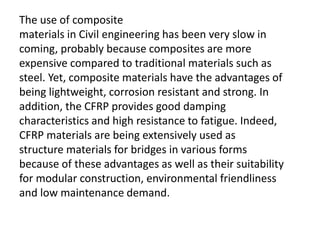
The use of composite
materials in Civil engineering has been very slow in
coming, probably because composites are more
expensive compared to traditional materials such as
steel. Yet, composite materials have the advantages of
being lightweight, corrosion resistant and strong. In
addition, the CFRP provides good damping
characteristics and high resistance to fatigue. Indeed,
CFRP materials are being extensively used as
structure materials for bridges in various forms
because of these advantages as well as their suitability
for modular construction, environmental friendliness
and low maintenance demand.
Carbon Fibre Reinforced
Polymer(CFRP)
Carbon Fibre Reinforced Polymer (CFRP) is
a composite Polymer matrix reinforced with carbon
fibres, which are very strong and light. In CFRP the
reinforcement material is carbon fibre that provides
the strength. The matrix is commonly a polymer resin
like epoxy, which binds the reinforcement together.
Thus, the CFRP is a combination of extremely thin
carbon fibres of 5-10μm in diameter, embedded in
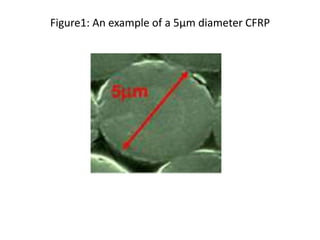
polyester resin . Figure 1 illustrates a thin carbon
fibre of 5μm in diameter (in red).
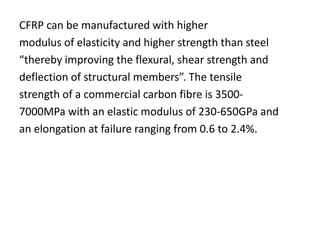
CFRP can be manufactured with higher
modulus of elasticity and higher strength than steel
“thereby improving the flexural, shear strength and
deflection of structural members”. The tensile
strength of a commercial carbon fibre is 3500-
7000MPa with an elastic modulus of 230-650GPa and
an elongation at failure ranging from 0.6 to 2.4%.
Figure1: An example of a 5μm diameter CFRP
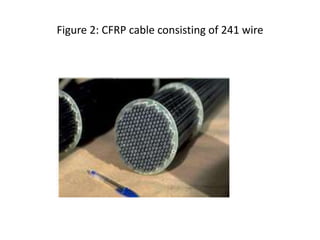
Figure 2: CFRP cable consisting of 241 wire
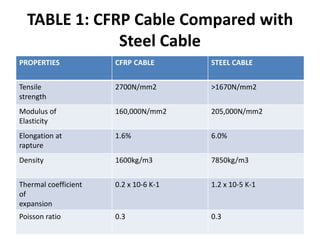
TABLE 1: CFRP Cable Compared with
Steel Cable
PROPERTIES CFRP CABLE STEEL CABLE
Tensile
strength
2700N/mm2 >1670N/mm2
Modulus of
Elasticity
160,000N/mm2 205,000N/mm2
Elongation at
rapture
1.6% 6.0%
Density 1600kg/m3 7850kg/m3
Thermal coefficient
of
expansion
0.2 x 10⁻⁶ K-1 1.2 x 10⁻⁵ K-1
Poisson ratio 0.3 0.3
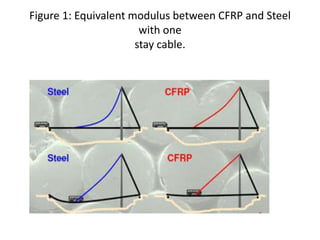
Figure 1: Equivalent modulus between CFRP and Steel
with one
stay cable.
PROPOSED AREA OF APPLICATION
There are still visions which need to be
achieved fully to realize the potentials of these
promising materials. Though CFRP is an expensive
material, the safety and life service of structures are
paramount. Hence, the use of CFRP cables should not
be limited to bridges as support, the cables should be
used to support other civil engineering structures like
the suspen-dome system.
CFRP WIRES
CFRP wires are made through pultrusion, a
process that ensures continuous extrusion of
reinforced plastic materials. Roving strands of
reinforcement are pulled through an impregnating tank
containing epoxy resin, the forming die and finally a
curing area. The process aims at producing a
structural material that is workable and with adequate
ductility while still retaining the favourable features of
carbon. Since CFRP wires are resistant to corrosion, it
is not required to apply any corrosion-inhabiting
compound or grout. However, the wires still need to
be protected against wind erosion and the attack of
ultraviolet radiation because the combined effect of
these two factors on the wires could lead to their
degradation. For this reason, an UV-resistant polyolin
sheath would be required for adequate shielding.
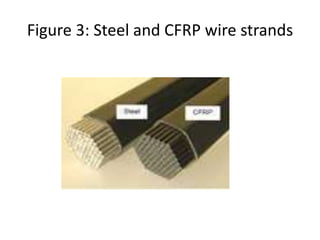
Figure 3 illustrates rolls of CFRP and steel wires.
Figure 3: Steel and CFRP wire strands
THANK YOU

Carbon fibre reinforce polymer(cfrp)

  • 1.
  • 2.
    Why CFRP(carbon fibrereinforced polymer) Cables used for Suspended Bridges? To avoid: • corrosion • stress corrosion • fatigue • design fault • production fault
  • 3.
    INTRODUCTION Civil Engineers areknown for realizing the limits of building structures and for discovering technologies to make the buildings go higher, last longer and consist of lighter materials. The challenge to reduce weight, increase spans, build higher or slender structures motivate the search for new materials such as a composite ones.
  • 4.
    The use ofcomposite materials in Civil engineering has been very slow in coming, probably because composites are more expensive compared to traditional materials such as steel. Yet, composite materials have the advantages of being lightweight, corrosion resistant and strong. In addition, the CFRP provides good damping characteristics and high resistance to fatigue. Indeed, CFRP materials are being extensively used as structure materials for bridges in various forms because of these advantages as well as their suitability for modular construction, environmental friendliness and low maintenance demand.
  • 5.
    Carbon Fibre Reinforced Polymer(CFRP) CarbonFibre Reinforced Polymer (CFRP) is a composite Polymer matrix reinforced with carbon fibres, which are very strong and light. In CFRP the reinforcement material is carbon fibre that provides the strength. The matrix is commonly a polymer resin like epoxy, which binds the reinforcement together. Thus, the CFRP is a combination of extremely thin carbon fibres of 5-10μm in diameter, embedded in polyester resin . Figure 1 illustrates a thin carbon fibre of 5μm in diameter (in red).
  • 6.
    CFRP can bemanufactured with higher modulus of elasticity and higher strength than steel “thereby improving the flexural, shear strength and deflection of structural members”. The tensile strength of a commercial carbon fibre is 3500- 7000MPa with an elastic modulus of 230-650GPa and an elongation at failure ranging from 0.6 to 2.4%.
  • 7.
    Figure1: An exampleof a 5μm diameter CFRP
  • 8.
    Figure 2: CFRPcable consisting of 241 wire
  • 9.
    TABLE 1: CFRPCable Compared with Steel Cable PROPERTIES CFRP CABLE STEEL CABLE Tensile strength 2700N/mm2 >1670N/mm2 Modulus of Elasticity 160,000N/mm2 205,000N/mm2 Elongation at rapture 1.6% 6.0% Density 1600kg/m3 7850kg/m3 Thermal coefficient of expansion 0.2 x 10⁻⁶ K-1 1.2 x 10⁻⁵ K-1 Poisson ratio 0.3 0.3
  • 10.
    Figure 1: Equivalentmodulus between CFRP and Steel with one stay cable.
  • 11.
    PROPOSED AREA OFAPPLICATION There are still visions which need to be achieved fully to realize the potentials of these promising materials. Though CFRP is an expensive material, the safety and life service of structures are paramount. Hence, the use of CFRP cables should not be limited to bridges as support, the cables should be used to support other civil engineering structures like the suspen-dome system.
  • 12.
    CFRP WIRES CFRP wiresare made through pultrusion, a process that ensures continuous extrusion of reinforced plastic materials. Roving strands of reinforcement are pulled through an impregnating tank containing epoxy resin, the forming die and finally a curing area. The process aims at producing a structural material that is workable and with adequate ductility while still retaining the favourable features of carbon. Since CFRP wires are resistant to corrosion, it
  • 13.
    is not requiredto apply any corrosion-inhabiting compound or grout. However, the wires still need to be protected against wind erosion and the attack of ultraviolet radiation because the combined effect of these two factors on the wires could lead to their degradation. For this reason, an UV-resistant polyolin sheath would be required for adequate shielding. Figure 3 illustrates rolls of CFRP and steel wires.
  • 14.
    Figure 3: Steeland CFRP wire strands
  • 15.