From Cells to Organisms
Organisation of Life
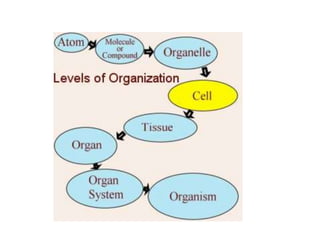
Levels of Organization
• Cell—Basic unit of structure and function
in organisms.
– Some organisms, like bacteria and protists, are
unicellular (made entirely of one cell).
– Some organisms, like fungi, plants, and animals, are
multicellular (made of many cells).
– In multicellular organisms, cells exhibit cell
specialisation. They take on specific jobs and look
different from each other.
– The cells also exhibit division of labor. They split up
the work of the organism.
Levels of Organization
• Tissues—Groups of similar cells that
work together to perform a specific
function.
–4 major tissue types in animals
• Epithelial tissue
• Connective tissue
• Muscle tissue
• Nervous tissue
Levels of Organization
• Organs—structures made of different types of
tissues that work together to perform a
specific function.
– Examples
• Heart
• Lungs
• Stomach
• Small intestine
• Liver
• Large Intestine
• Gall Bladder
• Plant Roots
• Plant Stems
• Plant Leaves
Levels of Organization
• Organ Systems—Groups of organs that work
together to perform a specific function.
–Examples:
• Digestive system
• Circulatory system
• Respiratory system
• Nervous system
• Muscular system
• Skeletal system
• Integumentary system (skin)
• Vascular system in plants
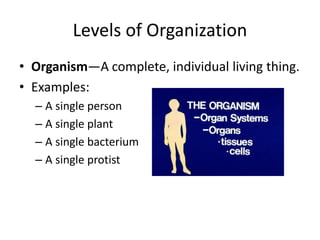
Levels of Organization
• Organism—A complete, individual living thing.
• Examples:
– A single person
– A single plant
– A single bacterium
– A single protist
Membrane Bounded Organelles in
a Eukaryotic Cell
• Eukaryotic cells contain many membrane-bound organelles.
An organelle is an organized and specialized structure within a living cell.
• The organelles include:
– The nucleus
– Ribosomes
– Endoplasmic Reticulum
– Golgi Apparatus
– Vacuoles
– Lysosomes
– Mitochondria
– In plants, chloroplasts.
9
Organization of Vertebrate Body
• Tissues are groups of cells that are similar in
structure and function
• In humans, there are four primary tissues:
– Epithelial
– Connective
– Muscle
– Nerve
• Organs are combinations of different tissues that
form a structural and functional unit
10
Organization of Vertebrate Body
• Organ systems are groups of organs that cooperate to
perform the major activities of the body
• The human body contains 11 principal organ systems
• The five main organ systems that we will be focusing
on in this unit are:
– The Respiratory System
– The Circulatory System
– The Reproductive System
– The Digestive System
– The Excretory System
11
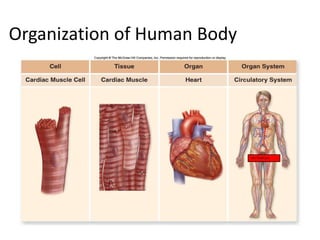
Organization of Human Body
NO Thank you!
12
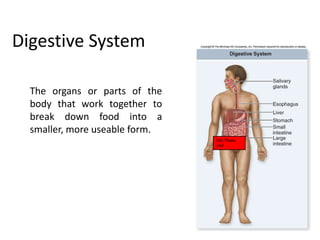
Digestive System
NO Thank
you!
The organs or parts of the
body that work together to
break down food into a
smaller, more useable form.
13
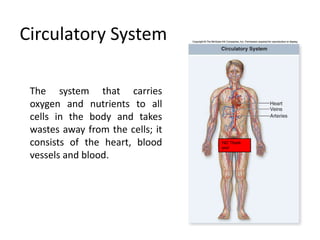
Circulatory System
NO Thank
you!
The system that carries
oxygen and nutrients to all
cells in the body and takes
wastes away from the cells; it
consists of the heart, blood
vessels and blood.
14
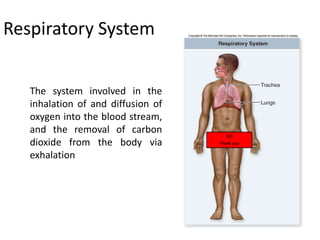
Respiratory System
NO
Thank you!
The system involved in the
inhalation of and diffusion of
oxygen into the blood stream,
and the removal of carbon
dioxide from the body via
exhalation
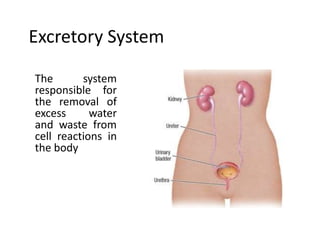
Excretory System
The system
responsible for
the removal of
excess water
and waste from
cell reactions in
the body
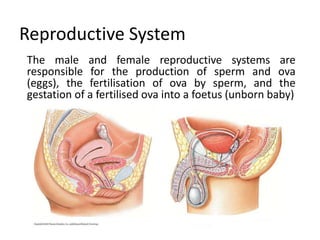
Reproductive System
The male and female reproductive systems are
responsible for the production of sperm and ova
(eggs), the fertilisation of ova by sperm, and the
gestation of a fertilised ova into a foetus (unborn baby)

Cells to Organisms.ppt

  • 1.
    From Cells toOrganisms Organisation of Life
  • 2.
    Levels of Organization •Cell—Basic unit of structure and function in organisms. – Some organisms, like bacteria and protists, are unicellular (made entirely of one cell). – Some organisms, like fungi, plants, and animals, are multicellular (made of many cells). – In multicellular organisms, cells exhibit cell specialisation. They take on specific jobs and look different from each other. – The cells also exhibit division of labor. They split up the work of the organism.
  • 4.
    Levels of Organization •Tissues—Groups of similar cells that work together to perform a specific function. –4 major tissue types in animals • Epithelial tissue • Connective tissue • Muscle tissue • Nervous tissue
  • 5.
    Levels of Organization •Organs—structures made of different types of tissues that work together to perform a specific function. – Examples • Heart • Lungs • Stomach • Small intestine • Liver • Large Intestine • Gall Bladder • Plant Roots • Plant Stems • Plant Leaves
  • 6.
    Levels of Organization •Organ Systems—Groups of organs that work together to perform a specific function. –Examples: • Digestive system • Circulatory system • Respiratory system • Nervous system • Muscular system • Skeletal system • Integumentary system (skin) • Vascular system in plants
  • 7.
    Levels of Organization •Organism—A complete, individual living thing. • Examples: – A single person – A single plant – A single bacterium – A single protist
  • 8.
    Membrane Bounded Organellesin a Eukaryotic Cell • Eukaryotic cells contain many membrane-bound organelles. An organelle is an organized and specialized structure within a living cell. • The organelles include: – The nucleus – Ribosomes – Endoplasmic Reticulum – Golgi Apparatus – Vacuoles – Lysosomes – Mitochondria – In plants, chloroplasts.
  • 9.
    9 Organization of VertebrateBody • Tissues are groups of cells that are similar in structure and function • In humans, there are four primary tissues: – Epithelial – Connective – Muscle – Nerve • Organs are combinations of different tissues that form a structural and functional unit
  • 10.
    10 Organization of VertebrateBody • Organ systems are groups of organs that cooperate to perform the major activities of the body • The human body contains 11 principal organ systems • The five main organ systems that we will be focusing on in this unit are: – The Respiratory System – The Circulatory System – The Reproductive System – The Digestive System – The Excretory System
  • 11.
    11 Organization of HumanBody NO Thank you!
  • 12.
    12 Digestive System NO Thank you! Theorgans or parts of the body that work together to break down food into a smaller, more useable form.
  • 13.
    13 Circulatory System NO Thank you! Thesystem that carries oxygen and nutrients to all cells in the body and takes wastes away from the cells; it consists of the heart, blood vessels and blood.
  • 14.
    14 Respiratory System NO Thank you! Thesystem involved in the inhalation of and diffusion of oxygen into the blood stream, and the removal of carbon dioxide from the body via exhalation
  • 15.
    Excretory System The system responsiblefor the removal of excess water and waste from cell reactions in the body
  • 16.
    Reproductive System The maleand female reproductive systems are responsible for the production of sperm and ova (eggs), the fertilisation of ova by sperm, and the gestation of a fertilised ova into a foetus (unborn baby)