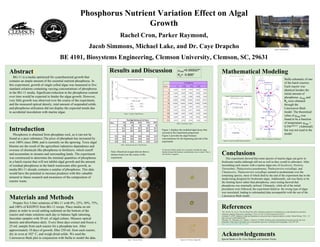
Phosphorus Nutrient Variation Effect on Algal
Growth
Rachel Cron, Parker Raymond,
Jacob Simmons, Michael Lake, and Dr. Caye Drapcho
BE 4101, Biosystems Engineering, Clemson University, Clemson, SC, 29631
Abstract
BG-11 is a media optimized for cyanobacterial growth that
contains an ample amount of the essential nutrient phosphorus. In
this experiment, growth of single celled algae was measured in five
standard solutions containing varying concentrations of phosphorus
in the BG-11 media. Significant reduction in the phosphorus content
over time would be expected to hinder the algae growth. However,
very little growth was observed over the course of the experiment,
and the measured optical density, total amount of suspended solids,
and phosphorus utilization did not display the expected trends due
to accidental inoculation with marine algae.
Introduction
Phosphorus is obtained from phosphate rock, as it can not be
found as a pure substance.The price of phosphate has increased by
over 100% since 2006, and is currently on the upswing. Toxic algal
blooms are the result of the agriculture industries dependence and
overuse of chemicals like phosphorus in fertilizers, which runoff
and accumulate in streams and surrounding lands. The experiment
was constructed to determine the minimal quantities of phosphorus
in a batch reactor that will not inhibit algal growth and the amount
of residual phosphorus in the batch wastewater after growth, as
media BG-11 already contains a surplus of phosphorus. This data
would have the potential to increase prudence with this valuable
mineral in future research and awareness of the composition of
reactor waste.
Materials and Methods
Prepare five 3-liter solutions of BG-11 with 0%, 25%, 50%, 75%,
and 100% of KH2PO3 from BG-11 recipe. Place media on stir
plates in order to avoid settling sediment on the bottom of the
reactor and rotate solutions each day to balance light rationing.
Inoculate samples with 50 mL of algal culture. Measure optical
density and absorbance daily. Every three days extract and freeze a
25 mL sample from each reactor for a phosphate test. After
approximately 10 days of growth, filter 250 mL from each reactor,
dry in oven at 102° C, and weigh dried solids. We used the
Lineweaver-Burk plot in conjunction with Stella to model the data.
Mathematical Modeling
Conclusions
This experiment showed that some species of marine algae can grow in
freshwater media (although still not as well as they would in saltwater). After
inoculating each reactor with a marine algae mix of Isochrysis, Pavlova,
Tetraselmis, Thalassiosira psuedonana, Thalassiorsira weissflogii, and
Chaetoceros, Thalassiorsira weissflogii seemed to predominate over the
remaining species, most of which died by the end of the experiment due to the
media being designed for freshwater algae. Additionally, salt was likely to be
the limiting factor rather than phosphorus, since testing showed that
phosphorus was minimally utilized. Ultimately, while all of the initial
procedures were followed, the experiment failed as the wrong type of algae
was inoculated, leading to substandard data incompatible with the use of the
Lineweaver-Burk model.
References
-Wu, Yin-Hu, Yu, Yin, Li, Xin, Hu, Hong-Ying. (2012). Biomass production of a Scenedesmus sp. under phosphorous-starvation
cultivation condition: Bioresource Technology, 112(5), 193-198. 10.1016/j.biortech.2012.02.037
-Admiraal, N. (1997). Influence of light and temperature on the growth rate of estuarine diatoms in culture: Marine Biology, 39(1), 1-9.
https://doi.org/10.1007/BF00395586
-Bissinger, J.E., Montagnes, D.J., Harples, J, Atkinson, D. (2008). Predicting marine phytoplankton maximum growth rates from
temperature: Improving on the Eppley curve using quantile regression: Limnology and Oceanography, 52(2), 487-493.
https://doi.org/10.4319/lo.2008.53.2.0487
Acknowledgements
Special thanks to Dr. Caye Drapcho and Jazmine Taylor.
Results and Discussion
Stella schematic of one
of the batch reactors.
Each reactor was
identical besides the
initial amount of
phosphorus. 𝜇max and
Ks were obtained
through the
Lineweaver-Burk
model. The theoretical
value of 𝜇max was
found to be a function
of temperature 𝜇max =
0.59e0.0633T (Admiraal)
but was not used in the
model
Figure 1 displays the modeled algal decay that
occured as the experiment progressed.
Figure 2 provides the algal biomass
concentrations for the beginning and end of the
experiment
*Lineweaver-Burk model can’t accurately calculate the algae
kinetics because the biomass concentrations vary so much. This is
why the Ks is negative.
𝜇max=0.000027*
Ks= -0.895*
% Phosphorus
Hours 0 0.25 0.5 0.75 1
0 0.027 0.015 0.013 0.041 0.029
26 0.016 0.025 0.032 0.033 0.032
41 0.024 0.02 0.028 0.039 0.042
64 0.0262 0.0282 0.0322 0.0432 0.0412
89 0.0202 0.0242 0.0262 0.0362 0.0362
113 0.017 0.018 0.018 0.031 0.034
137 0.014 0.014 0.017 0.028 0.03
165 0.028 0.025 0.039 0.078 0.085
189 0.027 0.027 0.02 0.024 0.026
214 0.013 0.016 0.019 0.03 0.03
Figure 1. Graph of Algal Biomass
Table 1. Beginning and end of Algal Biomass
Figure 2. Optical Density versus Concentration
Figure 6. Batch Reactors
Table 2. Absorbance Values
Figure 3. Natural Log of Biomass over Time
Figure 4. Lineweaver-Burk Kinetic Parameters
Figure 5. STELLA Schematic of Bioreactor
Figure 7. Biomass Filtrate Figures 8-10. Pictures of algae (40)
Note: Dissolved oxygen did not show a
distinct trend over the course of the
experiment.

Kinetics project poster

  • 1.
    Phosphorus Nutrient VariationEffect on Algal Growth Rachel Cron, Parker Raymond, Jacob Simmons, Michael Lake, and Dr. Caye Drapcho BE 4101, Biosystems Engineering, Clemson University, Clemson, SC, 29631 Abstract BG-11 is a media optimized for cyanobacterial growth that contains an ample amount of the essential nutrient phosphorus. In this experiment, growth of single celled algae was measured in five standard solutions containing varying concentrations of phosphorus in the BG-11 media. Significant reduction in the phosphorus content over time would be expected to hinder the algae growth. However, very little growth was observed over the course of the experiment, and the measured optical density, total amount of suspended solids, and phosphorus utilization did not display the expected trends due to accidental inoculation with marine algae. Introduction Phosphorus is obtained from phosphate rock, as it can not be found as a pure substance.The price of phosphate has increased by over 100% since 2006, and is currently on the upswing. Toxic algal blooms are the result of the agriculture industries dependence and overuse of chemicals like phosphorus in fertilizers, which runoff and accumulate in streams and surrounding lands. The experiment was constructed to determine the minimal quantities of phosphorus in a batch reactor that will not inhibit algal growth and the amount of residual phosphorus in the batch wastewater after growth, as media BG-11 already contains a surplus of phosphorus. This data would have the potential to increase prudence with this valuable mineral in future research and awareness of the composition of reactor waste. Materials and Methods Prepare five 3-liter solutions of BG-11 with 0%, 25%, 50%, 75%, and 100% of KH2PO3 from BG-11 recipe. Place media on stir plates in order to avoid settling sediment on the bottom of the reactor and rotate solutions each day to balance light rationing. Inoculate samples with 50 mL of algal culture. Measure optical density and absorbance daily. Every three days extract and freeze a 25 mL sample from each reactor for a phosphate test. After approximately 10 days of growth, filter 250 mL from each reactor, dry in oven at 102° C, and weigh dried solids. We used the Lineweaver-Burk plot in conjunction with Stella to model the data. Mathematical Modeling Conclusions This experiment showed that some species of marine algae can grow in freshwater media (although still not as well as they would in saltwater). After inoculating each reactor with a marine algae mix of Isochrysis, Pavlova, Tetraselmis, Thalassiosira psuedonana, Thalassiorsira weissflogii, and Chaetoceros, Thalassiorsira weissflogii seemed to predominate over the remaining species, most of which died by the end of the experiment due to the media being designed for freshwater algae. Additionally, salt was likely to be the limiting factor rather than phosphorus, since testing showed that phosphorus was minimally utilized. Ultimately, while all of the initial procedures were followed, the experiment failed as the wrong type of algae was inoculated, leading to substandard data incompatible with the use of the Lineweaver-Burk model. References -Wu, Yin-Hu, Yu, Yin, Li, Xin, Hu, Hong-Ying. (2012). Biomass production of a Scenedesmus sp. under phosphorous-starvation cultivation condition: Bioresource Technology, 112(5), 193-198. 10.1016/j.biortech.2012.02.037 -Admiraal, N. (1997). Influence of light and temperature on the growth rate of estuarine diatoms in culture: Marine Biology, 39(1), 1-9. https://doi.org/10.1007/BF00395586 -Bissinger, J.E., Montagnes, D.J., Harples, J, Atkinson, D. (2008). Predicting marine phytoplankton maximum growth rates from temperature: Improving on the Eppley curve using quantile regression: Limnology and Oceanography, 52(2), 487-493. https://doi.org/10.4319/lo.2008.53.2.0487 Acknowledgements Special thanks to Dr. Caye Drapcho and Jazmine Taylor. Results and Discussion Stella schematic of one of the batch reactors. Each reactor was identical besides the initial amount of phosphorus. 𝜇max and Ks were obtained through the Lineweaver-Burk model. The theoretical value of 𝜇max was found to be a function of temperature 𝜇max = 0.59e0.0633T (Admiraal) but was not used in the model Figure 1 displays the modeled algal decay that occured as the experiment progressed. Figure 2 provides the algal biomass concentrations for the beginning and end of the experiment *Lineweaver-Burk model can’t accurately calculate the algae kinetics because the biomass concentrations vary so much. This is why the Ks is negative. 𝜇max=0.000027* Ks= -0.895* % Phosphorus Hours 0 0.25 0.5 0.75 1 0 0.027 0.015 0.013 0.041 0.029 26 0.016 0.025 0.032 0.033 0.032 41 0.024 0.02 0.028 0.039 0.042 64 0.0262 0.0282 0.0322 0.0432 0.0412 89 0.0202 0.0242 0.0262 0.0362 0.0362 113 0.017 0.018 0.018 0.031 0.034 137 0.014 0.014 0.017 0.028 0.03 165 0.028 0.025 0.039 0.078 0.085 189 0.027 0.027 0.02 0.024 0.026 214 0.013 0.016 0.019 0.03 0.03 Figure 1. Graph of Algal Biomass Table 1. Beginning and end of Algal Biomass Figure 2. Optical Density versus Concentration Figure 6. Batch Reactors Table 2. Absorbance Values Figure 3. Natural Log of Biomass over Time Figure 4. Lineweaver-Burk Kinetic Parameters Figure 5. STELLA Schematic of Bioreactor Figure 7. Biomass Filtrate Figures 8-10. Pictures of algae (40) Note: Dissolved oxygen did not show a distinct trend over the course of the experiment.