Clinical evidence of compression
systems with a high SSI for
treatment of venous leg ulcer
patients
1A Andriessen PhD, 2T Eberlein MD, 3M Abel PhD
1Andriessen Consultants, Malden & UMC St Radboud Nijmegen, The Netherlands
2College of Medicine and Medical Sciences, Arabian Gulf University, Manama, Kingdom of Bahrain.
3Head of Medical & Regulatory Affairs, Lohmann & Rauscher, Rengsdorf, Germany
anneke.a@tiscali.nl
EP513EWMA2013
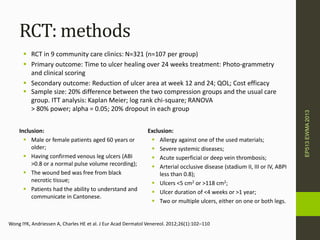
RCT: methods
Inclusion:
 Male or female patients aged 60 years or
older;
 Having confirmed venous leg ulcers (ABI
>0.8 or a normal pulse volume recording);
 The wound bed was free from black
necrotic tissue;
 Patients had the ability to understand and
communicate in Cantonese.
Exclusion:
 Allergy against one of the used materials;
 Severe systemic diseases;
 Acute superficial or deep vein thrombosis;
 Arterial occlusive disease (stadium II, III or IV, ABPI
less than 0.8);
 Ulcers <5 cm2 or >118 cm2;
 Ulcer duration of <4 weeks or >1 year;
 Two or multiple ulcers, either on one or both legs.
Wong IYK, Andriessen A, Charles HE et al. J Eur Acad Dermatol Venereol. 2012;26(1):102–110
EP513EWMA2013
 RCT in 9 community care clinics: N=321 (n=107 per group)
 Primary outcome: Time to ulcer healing over 24 weeks treatment: Photo-grammetry
and clinical scoring
 Secondary outcome: Reduction of ulcer area at week 12 and 24; QOL; Cost efficacy
 Sample size: 20% difference between the two compression groups and the usual care
group. ITT analysis: Kaplan Meier; log rank chi-square; RANOVA
> 80% power; alpha = 0.05; 20% dropout in each group
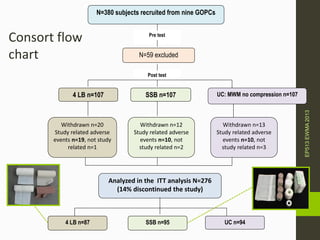
N=380 subjects recruited from nine GOPCs
N=59 excluded
4 LB n=107 SSB n=107 UC: MWM no compression n=107
Pre test
Post test
Withdrawn n=20
Study related adverse
events n=19, not study
related n=1
Withdrawn n=12
Study related adverse
events n=10, not
study related n=2
Withdrawn n=13
Study related adverse
events n=10, not
study related n=3
Analyzed in the ITT analysis N=276
(14% discontinued the study)
4 LB n=87 SSB n=95 UC n=94
Consort flow
chart
EP513EWMA2013
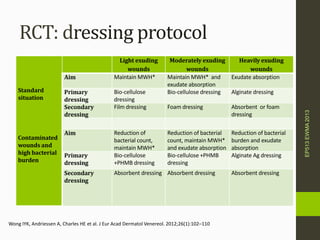
RCT: dressing protocol
Standard
situation
Contaminated
wounds and
high bacterial
burden
Light exuding
wounds
Moderately exuding
wounds
Heavily exuding
wounds
Aim Maintain MWH* Maintain MWH* and
exudate absorption
Exudate absorption
Primary
dressing
Bio-cellulose
dressing
Bio-cellulose dressing Alginate dressing
Secondary
dressing
Film dressing Foam dressing Absorbent or foam
dressing
Aim Reduction of
bacterial count,
maintain MWH*
Reduction of bacterial
count, maintain MWH*
and exudate absorption
Reduction of bacterial
burden and exudate
absorption
Primary
dressing
Bio-cellulose
+PHMB dressing
Bio-cellulose +PHMB
dressing
Alginate Ag dressing
Secondary
dressing
Absorbent dressing Absorbent dressing Absorbent dressing
EP513EWMA2013
Wong IYK, Andriessen A, Charles HE et al. J Eur Acad Dermatol Venereol. 2012;26(1):102–110
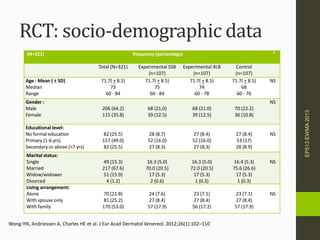
RCT: socio-demographic data
(N=321) frequency (percentage) χ²
Total (N=321) Experimental SSB
(n=107)
Experimental 4LB
(n=107)
Control
(n=107)
Age : Mean ( ± SD)
Median
Range
71.7( + 8.5)
73
60 - 84
71.7( + 8.5)
75
60 - 84
71.7( + 8.5)
74
60 - 78
71.7( + 8.5)
68
60 - 76
NS
Gender :
Male
Female
206 (64.2)
115 (35.8)
68 (21,0)
39 (12.5)
68 (21.0)
39 (12.5)
70 (22.2)
36 (10.8)
NS
Educational level:
No formal education
Primary (1-6 yrs)
Secondary or above (>7 yrs)
82 (25.5)
157 (49.0)
82 (25.5)
28 (8.7)
52 (16.0)
27 (8.3)
27 (8.4)
52 (16.0)
27 (8,3)
27 (8.4)
53 (17)
28 (8.9)
NS
Marital status:
Single
Married
Widow/widower
Divorced
49 (15.3)
217 (67.6)
51 (15.9)
4 (1.2)
16.3 (5.0)
70.0 (20.5)
17 (5.3)
2 (0.6)
16.3 (5.0)
72.0 (20.5)
17 (5.3)
1 (0.3)
16.4 (5.3)
75.6 (26.6)
17 (5.3)
1 (0.3)
NS
Living arrangement:
Alone
With spouse only
With family
70 (21.8)
81 (25.2)
170 (53.0)
24 (7.6)
27 (8.4)
57 (17.9)
23 (7.1)
27 (8.4)
56 (17.2)
23 (7.1)
27 (8.4)
57 (17.9)
NS
EP513EWMA2013
Wong IYK, Andriessen A, Charles HE et al. J Eur Acad Dermatol Venereol. 2012;26(1):102–110
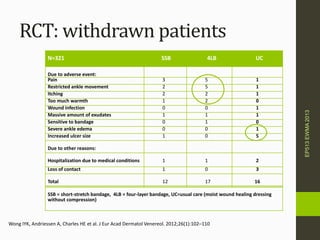
RCT: withdrawn patients
N=321 SSB 4LB UC
Due to adverse event:
Pain 3 5 1
Restricted ankle movement 2 5 1
Itching 2 2 1
Too much warmth 1 2 0
Wound infection 0 0 1
Massive amount of exudates 1 1 1
Sensitive to bandage 0 1 0
Severe ankle edema 0 0 1
Increased ulcer size 1 0 5
Due to other reasons:
Hospitalization due to medical conditions 1 1 2
Loss of contact 1 0 3
Total 12 17 16
SSB = short-stretch bandage, 4LB = four-layer bandage, UC=usual care (moist wound healing dressing
without compression)
EP513EWMA2013
Wong IYK, Andriessen A, Charles HE et al. J Eur Acad Dermatol Venereol. 2012;26(1):102–110
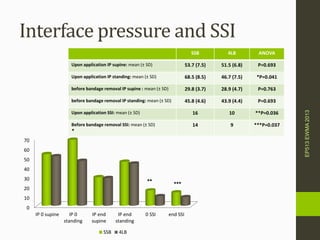
Interface pressure and SSI
SSB 4LB ANOVA
Upon application IP supine: mean (± SD) 53.7 (7.5) 51.5 (6.8) P=0.693
Upon application IP standing: mean (± SD) 68.5 (8.5) 46.7 (7.5) *P=0.041
before bandage removal IP supine : mean (± SD) 29.8 (3.7) 28.9 (4.7) P=0.763
before bandage removal IP standing: mean (± SD) 45.8 (4.6) 43.9 (4.4) P=0.693
Upon application SSI: mean (± SD) 16 10 **P=0.036
Before bandage removal SSI: mean (± SD) 14 9 ***P=0.037
0
10
20
30
40
50
60
70
IP 0 supine IP 0
standing
IP end
supine
IP end
standing
0 SSI end SSI
SSB 4LB
*
** ***
EP513EWMA2013
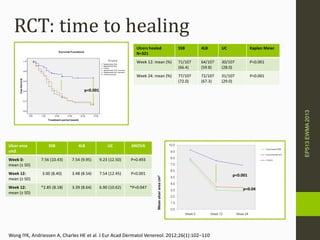
RCT: time to healing
p<0.001
Ulcers healed
N=321
SSB 4LB UC Kaplan Meier
Week 12: mean (%) 71/107
(66.4)
64/107
(59.8)
30/107
(28.0)
P<0.001
Week 24: mean (%) 77/107
(72.0)
72/107
(67.3)
31/107
(29.0)
P<0.001
EP513EWMA2013
Wong IYK, Andriessen A, Charles HE et al. J Eur Acad Dermatol Venereol. 2012;26(1):102–110
Meanulcerareacm2
Ulcer area
cm2
SSB 4LB UC ANOVA
Week 0:
mean (± SD)
7.56 (10.43) 7.54 (9.95) 9.23 (12.50) P=0.493
Week 12:
mean (± SD)
3.00 (8.40) 3.48 (8.54) 7.54 (12.45) P<0.001
Week 12:
mean (± SD)
*2.85 (8.18) 3.39 (8.64) 6.90 (10.62) *P=0.047
p<0.001
p<0.04
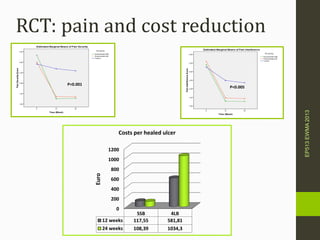
RCT: pain and cost reduction
P<0.001
P<0.005
EP513EWMA2013
0
200
400
600
800
1000
1200
SSB 4LB
12 weeks 117,55 581,81
24 weeks 108,39 1034,3
Euro
Costs per healed ulcer
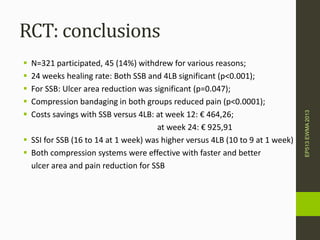
RCT: conclusions
 N=321 participated, 45 (14%) withdrew for various reasons;
 24 weeks healing rate: Both SSB and 4LB significant (p<0.001);
 For SSB: Ulcer area reduction was significant (p=0.047);
 Compression bandaging in both groups reduced pain (p<0.0001);
 Costs savings with SSB versus 4LB: at week 12: € 464,26;
at week 24: € 925,91
 SSI for SSB (16 to 14 at 1 week) was higher versus 4LB (10 to 9 at 1 week)
 Both compression systems were effective with faster and better
ulcer area and pain reduction for SSB
EP513EWMA2013

EWMA 2013 - Ep513 - Clinical evidence of compression systems with a high SSI for treatment of venous leg ulcer patients

  • 1.
    Clinical evidence ofcompression systems with a high SSI for treatment of venous leg ulcer patients 1A Andriessen PhD, 2T Eberlein MD, 3M Abel PhD 1Andriessen Consultants, Malden & UMC St Radboud Nijmegen, The Netherlands 2College of Medicine and Medical Sciences, Arabian Gulf University, Manama, Kingdom of Bahrain. 3Head of Medical & Regulatory Affairs, Lohmann & Rauscher, Rengsdorf, Germany anneke.a@tiscali.nl EP513EWMA2013
  • 2.
    RCT: methods Inclusion:  Maleor female patients aged 60 years or older;  Having confirmed venous leg ulcers (ABI >0.8 or a normal pulse volume recording);  The wound bed was free from black necrotic tissue;  Patients had the ability to understand and communicate in Cantonese. Exclusion:  Allergy against one of the used materials;  Severe systemic diseases;  Acute superficial or deep vein thrombosis;  Arterial occlusive disease (stadium II, III or IV, ABPI less than 0.8);  Ulcers <5 cm2 or >118 cm2;  Ulcer duration of <4 weeks or >1 year;  Two or multiple ulcers, either on one or both legs. Wong IYK, Andriessen A, Charles HE et al. J Eur Acad Dermatol Venereol. 2012;26(1):102–110 EP513EWMA2013  RCT in 9 community care clinics: N=321 (n=107 per group)  Primary outcome: Time to ulcer healing over 24 weeks treatment: Photo-grammetry and clinical scoring  Secondary outcome: Reduction of ulcer area at week 12 and 24; QOL; Cost efficacy  Sample size: 20% difference between the two compression groups and the usual care group. ITT analysis: Kaplan Meier; log rank chi-square; RANOVA > 80% power; alpha = 0.05; 20% dropout in each group
  • 3.
    N=380 subjects recruitedfrom nine GOPCs N=59 excluded 4 LB n=107 SSB n=107 UC: MWM no compression n=107 Pre test Post test Withdrawn n=20 Study related adverse events n=19, not study related n=1 Withdrawn n=12 Study related adverse events n=10, not study related n=2 Withdrawn n=13 Study related adverse events n=10, not study related n=3 Analyzed in the ITT analysis N=276 (14% discontinued the study) 4 LB n=87 SSB n=95 UC n=94 Consort flow chart EP513EWMA2013
  • 4.
    RCT: dressing protocol Standard situation Contaminated woundsand high bacterial burden Light exuding wounds Moderately exuding wounds Heavily exuding wounds Aim Maintain MWH* Maintain MWH* and exudate absorption Exudate absorption Primary dressing Bio-cellulose dressing Bio-cellulose dressing Alginate dressing Secondary dressing Film dressing Foam dressing Absorbent or foam dressing Aim Reduction of bacterial count, maintain MWH* Reduction of bacterial count, maintain MWH* and exudate absorption Reduction of bacterial burden and exudate absorption Primary dressing Bio-cellulose +PHMB dressing Bio-cellulose +PHMB dressing Alginate Ag dressing Secondary dressing Absorbent dressing Absorbent dressing Absorbent dressing EP513EWMA2013 Wong IYK, Andriessen A, Charles HE et al. J Eur Acad Dermatol Venereol. 2012;26(1):102–110
  • 5.
    RCT: socio-demographic data (N=321)frequency (percentage) χ² Total (N=321) Experimental SSB (n=107) Experimental 4LB (n=107) Control (n=107) Age : Mean ( ± SD) Median Range 71.7( + 8.5) 73 60 - 84 71.7( + 8.5) 75 60 - 84 71.7( + 8.5) 74 60 - 78 71.7( + 8.5) 68 60 - 76 NS Gender : Male Female 206 (64.2) 115 (35.8) 68 (21,0) 39 (12.5) 68 (21.0) 39 (12.5) 70 (22.2) 36 (10.8) NS Educational level: No formal education Primary (1-6 yrs) Secondary or above (>7 yrs) 82 (25.5) 157 (49.0) 82 (25.5) 28 (8.7) 52 (16.0) 27 (8.3) 27 (8.4) 52 (16.0) 27 (8,3) 27 (8.4) 53 (17) 28 (8.9) NS Marital status: Single Married Widow/widower Divorced 49 (15.3) 217 (67.6) 51 (15.9) 4 (1.2) 16.3 (5.0) 70.0 (20.5) 17 (5.3) 2 (0.6) 16.3 (5.0) 72.0 (20.5) 17 (5.3) 1 (0.3) 16.4 (5.3) 75.6 (26.6) 17 (5.3) 1 (0.3) NS Living arrangement: Alone With spouse only With family 70 (21.8) 81 (25.2) 170 (53.0) 24 (7.6) 27 (8.4) 57 (17.9) 23 (7.1) 27 (8.4) 56 (17.2) 23 (7.1) 27 (8.4) 57 (17.9) NS EP513EWMA2013 Wong IYK, Andriessen A, Charles HE et al. J Eur Acad Dermatol Venereol. 2012;26(1):102–110
  • 6.
    RCT: withdrawn patients N=321SSB 4LB UC Due to adverse event: Pain 3 5 1 Restricted ankle movement 2 5 1 Itching 2 2 1 Too much warmth 1 2 0 Wound infection 0 0 1 Massive amount of exudates 1 1 1 Sensitive to bandage 0 1 0 Severe ankle edema 0 0 1 Increased ulcer size 1 0 5 Due to other reasons: Hospitalization due to medical conditions 1 1 2 Loss of contact 1 0 3 Total 12 17 16 SSB = short-stretch bandage, 4LB = four-layer bandage, UC=usual care (moist wound healing dressing without compression) EP513EWMA2013 Wong IYK, Andriessen A, Charles HE et al. J Eur Acad Dermatol Venereol. 2012;26(1):102–110
  • 7.
    Interface pressure andSSI SSB 4LB ANOVA Upon application IP supine: mean (± SD) 53.7 (7.5) 51.5 (6.8) P=0.693 Upon application IP standing: mean (± SD) 68.5 (8.5) 46.7 (7.5) *P=0.041 before bandage removal IP supine : mean (± SD) 29.8 (3.7) 28.9 (4.7) P=0.763 before bandage removal IP standing: mean (± SD) 45.8 (4.6) 43.9 (4.4) P=0.693 Upon application SSI: mean (± SD) 16 10 **P=0.036 Before bandage removal SSI: mean (± SD) 14 9 ***P=0.037 0 10 20 30 40 50 60 70 IP 0 supine IP 0 standing IP end supine IP end standing 0 SSI end SSI SSB 4LB * ** *** EP513EWMA2013
  • 8.
    RCT: time tohealing p<0.001 Ulcers healed N=321 SSB 4LB UC Kaplan Meier Week 12: mean (%) 71/107 (66.4) 64/107 (59.8) 30/107 (28.0) P<0.001 Week 24: mean (%) 77/107 (72.0) 72/107 (67.3) 31/107 (29.0) P<0.001 EP513EWMA2013 Wong IYK, Andriessen A, Charles HE et al. J Eur Acad Dermatol Venereol. 2012;26(1):102–110 Meanulcerareacm2 Ulcer area cm2 SSB 4LB UC ANOVA Week 0: mean (± SD) 7.56 (10.43) 7.54 (9.95) 9.23 (12.50) P=0.493 Week 12: mean (± SD) 3.00 (8.40) 3.48 (8.54) 7.54 (12.45) P<0.001 Week 12: mean (± SD) *2.85 (8.18) 3.39 (8.64) 6.90 (10.62) *P=0.047 p<0.001 p<0.04
  • 9.
    RCT: pain andcost reduction P<0.001 P<0.005 EP513EWMA2013 0 200 400 600 800 1000 1200 SSB 4LB 12 weeks 117,55 581,81 24 weeks 108,39 1034,3 Euro Costs per healed ulcer
  • 10.
    RCT: conclusions  N=321participated, 45 (14%) withdrew for various reasons;  24 weeks healing rate: Both SSB and 4LB significant (p<0.001);  For SSB: Ulcer area reduction was significant (p=0.047);  Compression bandaging in both groups reduced pain (p<0.0001);  Costs savings with SSB versus 4LB: at week 12: € 464,26; at week 24: € 925,91  SSI for SSB (16 to 14 at 1 week) was higher versus 4LB (10 to 9 at 1 week)  Both compression systems were effective with faster and better ulcer area and pain reduction for SSB EP513EWMA2013