* Contact e-mail: porimed@abv.bg 1
CONTEMPORARY SILVER DRESSINGS IN THE TREATMENT
OF INFECTED BONE DEFFECTS IN NEUROPATHIC DIABETIC
FOOT (NDF)
Ivan Poromanski*, Yordan Milev
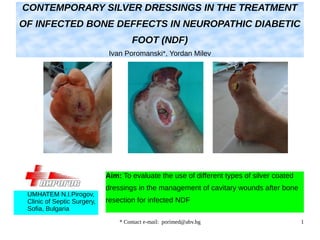
Aim: To evaluate the use of different types of silver coated
dressings in the management of cavitary wounds after bone
resection for infected NDF
UMHATEM N.I.Pirogov,
Clinic of Septic Surgery,
Sofia, Bulgaria
2
Diabetic foot ulcer
● Most common initial sign of diabetic foot
● Location – weigth bearing points – under I and V metatarsal heads ( or
elseware if deformity allready exists)
● Often associated with underlying osteomyelitis
● Successful treatment requires bone infection sanation by :
Metatarsal head resection/
metatarsophalangeal joint
resection => infected
bone deffect
IF presence of ischaemia OR extensive
soft tissue destruction
Yes No
Amputation
3
Management of infected bone defect – challenging and costly
task
● Systemic antibiotic treatment – for longer periods – costly
● Closed irrigation/aspiration drainage – requires inpatient
treatment
● Topical antibiotic – PMMA beads – limited space
● Negative pressure therapy – relatively contraindicated, costly
● Topical antiseptic treatment
– Jodine based (cytotoxic)
– Silver based - proven safe for soft tissues, flexible
(variety of products available), cost effective
4
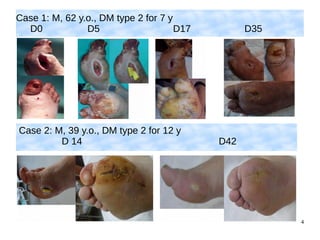
Case 1: M, 62 y.o., DM type 2 for 7 y
D0 D5 D17 D35
Case 2: M, 39 y.o., DM type 2 for 12 y
D 14 D42
5
Results and discussion
● At operation plantar ulcer was excised and sutured or left. Joint was
resected via side access.
● Residual bone deffect was filled using silver coated alginate/foam
dressing in 2 cases and silver alginate filler in one case
● Dressings were changed at intervals 48-72 hours; standart offloading
was performed
● Systemic antibiotic use was no more than 10 days, determined of
subsiding of soft tissue infection
● Cavitary wounds healed by secondary intention in no more than 42
days; plantar ulcers healed in 14-21 days
● Healing time and length of antibiotic treatment were shorter than
usual, when using conventional measures
● Higher unit prise of silver dressings was well balanced by reduced
frequency of dressing change and shorthened treatment course.

EWMA 2014 - EP496 CONTEMPORARY SILVER DRESSINGS IN THE TREATMENT OF INFECTED BONE DEFFECTS IN NEUROPATHIC DIABETIC FOOT (NDF)

  • 1.
    * Contact e-mail:porimed@abv.bg 1 CONTEMPORARY SILVER DRESSINGS IN THE TREATMENT OF INFECTED BONE DEFFECTS IN NEUROPATHIC DIABETIC FOOT (NDF) Ivan Poromanski*, Yordan Milev Aim: To evaluate the use of different types of silver coated dressings in the management of cavitary wounds after bone resection for infected NDF UMHATEM N.I.Pirogov, Clinic of Septic Surgery, Sofia, Bulgaria
  • 2.
    2 Diabetic foot ulcer ●Most common initial sign of diabetic foot ● Location – weigth bearing points – under I and V metatarsal heads ( or elseware if deformity allready exists) ● Often associated with underlying osteomyelitis ● Successful treatment requires bone infection sanation by : Metatarsal head resection/ metatarsophalangeal joint resection => infected bone deffect IF presence of ischaemia OR extensive soft tissue destruction Yes No Amputation
  • 3.
    3 Management of infectedbone defect – challenging and costly task ● Systemic antibiotic treatment – for longer periods – costly ● Closed irrigation/aspiration drainage – requires inpatient treatment ● Topical antibiotic – PMMA beads – limited space ● Negative pressure therapy – relatively contraindicated, costly ● Topical antiseptic treatment – Jodine based (cytotoxic) – Silver based - proven safe for soft tissues, flexible (variety of products available), cost effective
  • 4.
    4 Case 1: M,62 y.o., DM type 2 for 7 y D0 D5 D17 D35 Case 2: M, 39 y.o., DM type 2 for 12 y D 14 D42
  • 5.
    5 Results and discussion ●At operation plantar ulcer was excised and sutured or left. Joint was resected via side access. ● Residual bone deffect was filled using silver coated alginate/foam dressing in 2 cases and silver alginate filler in one case ● Dressings were changed at intervals 48-72 hours; standart offloading was performed ● Systemic antibiotic use was no more than 10 days, determined of subsiding of soft tissue infection ● Cavitary wounds healed by secondary intention in no more than 42 days; plantar ulcers healed in 14-21 days ● Healing time and length of antibiotic treatment were shorter than usual, when using conventional measures ● Higher unit prise of silver dressings was well balanced by reduced frequency of dressing change and shorthened treatment course.