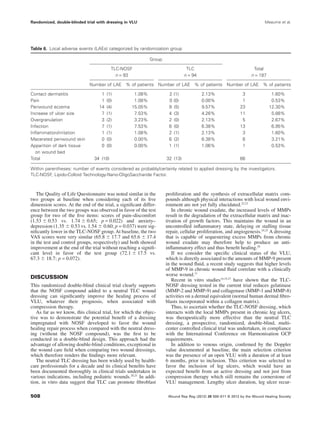
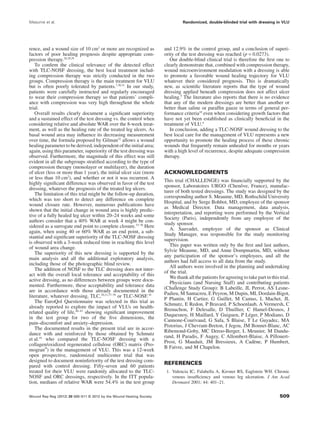
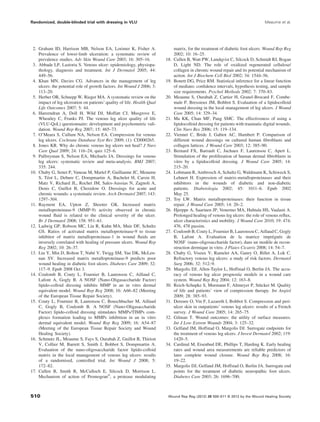
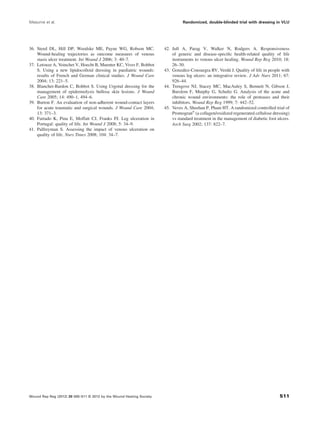
A randomized, controlled, double-blind prospective trial
with a Lipido-Colloid Technology-Nano-OligoSaccharide
Factor wound dressing in the local management of
venous leg ulcers
Sylvie Meaume, MD1
; François Truchetet, MD2
; Frédéric Cambazard, MD3
; Catherine Lok, MD4
;
Clélia Debure, MD5
; Sophie Dalac, MD6
; Isabelle Lazareth, MD7
; Michèle-Léa Sigal, MD8
;
Anne Sauvadet, PhD9
; Serge Bohbot, MD9
; Anne Dompmartin, MD, PhD10
; on behalf of the CHALLENGE
Study Group
1. Dermatology & Geriatric Department, Rothschild University Hospital, Paris, France,
2. Dermatology Department, Beauregard Hospital, Thionville, France,
3. Dermatology Department, North University Hospital, Saint-Etienne, France,
4. Dermatology Department, South University Hospital, Amiens, France,
5. Department of Vascular Medicine, Corentin Celton Hospital, Issy-les-Moulineaux, France,
6. Dermatology Department, Bocage University Hospital, Dijon, France,
7. Department of Vascular Medicine, Saint-Joseph Hospital, Paris, France,
8. Dermatology Department, Victor Dupouy Hospital, Argenteuil, France,
9. Clinical Research Department, Laboratoires URGO, Chenôve, France, and
10. Dermatology Department, Clemenceau University Hospital, Caen, France
Reprint requests:
Dr. S. Meaume, Hôpital Rothschild,
Service de Gériatrie, 5 rue Santerre, 75571
Paris Cedex 12, France.
Tel: +33 1 4019 3306;
Fax: +33 1 4019 3057;
Email: sylvie.meaume@rth.aphp.fr
Manuscript received: August 1, 2011
Accepted in final form: March 30, 2012
DOI:10.1111/j.1524-475X.2012.00797.x
ABSTRACT
Venous leg ulcers (VLUs) are the most prevalent chronic wounds in western countries
with a heavy socioeconomic impact. Compression therapy is the etiologic treatment
of VLU but until now no wound dressing has been shown to be more effective than
another. The aim of this study was to assess the efficacy of a new dressing in the
management of VLU. Adult patients presenting a noninfected VLU and receiving
effective compression therapy were enrolled in this randomized, controlled, double-
blind trial. The VLUs were assessed every 2 weeks for 8 weeks. The primary study
outcome was the relative Wound Area Reduction (WAR, in %), and the secondary
objectives were absolute WAR, healing rate, and percentage of wounds with >40%
surface area reduction. One hundred eighty-seven patients were randomly allocated
to treatment groups. Median WAR was 58.3% in the Lipido-Colloid Technology-
Nano-OligoSaccharide Factor (TLC-NOSF) dressing group (test group) and 31.6%
in the TLC dressing group (control group) (difference: -26.7%; 95% confidence
interval: -38.3 to -15.1%; p = 0.002). All other efficacy outcomes were also signifi-
cant in favor of the TLC-NOSF dressing group. Clinical outcomes for patients
treated with the new dressing are superior to those patients treated with the TLC
dressing (without NOSF compound), suggesting a strong promotion of the VLU
healing process.
Venous leg ulceration is the most prevalent chronic wound in
Western countries.1
The reported prevalence rates of open
ulcers, in studies with clinical validation, ranged from 0.12 to
1.1% of the population and that of open or healed ulcers was
reported to be 1.8%.2
These lesions are characterized by a
cyclical pattern of healing and recurrence that is estimated to
be in the range of 54–78% and has a significant socioeco-
nomic impact in terms of both medical care and days off
work3
in the United States alone; the treatment cost is esti-
mated to be around one billion dollars per annum.4
Overall,
these chronic wounds are responsible for a substantial impair-
ment in quality of life.5,6
The management of venous leg ulcers (VLUs) is based
on its etiologic treatment, compression therapy, which is the
cornerstone of leg ulcer therapy.7
Despite appropriate care,
50–60% of VLU will take more than 20–24 weeks to heal.8
There is no evidence of differences in healing rates
between the numerous types of available wound dressings
when used with compression therapy.9
The objective of
current management with dressings is to maintain an appro-
priate environment that favors the normal smooth tissue
repair process.10
In chronic wounds, matrix metalloproteinases (MMPs)
have been implicated by a number of studies as the major
protease family responsible for the degradation of key factors
critical to the ulcer’s ability to heal.11
The enhanced level of
MMPs, whatever the etiology of the chronic wounds, is
responsible for the lack of extracellular matrix compound
Wound Rep Reg (2012) 20 500–511 © 2012 by the Wound Healing Society500
synthesis and the persistence of an inappropriate local inflam-
matory process.11–13
For this reason, MMP inhibitors have
recently been developed and are expected to improve the local
treatment of these chronic wounds.
Supported by in vitro studies showing its MMP modulation
properties,14,15
a Nano-OligoSaccharide Factor (NOSF)
was incorporated into a widely used, neutral, Lipido-Colloid
Technology (TLC) dressing, providing its additional proper-
ties to promote the wound healing process in chronic wounds.
An initial randomized, controlled trial showed superior
clinical benefits of the NOSF compound in the local manage-
ment of VLU16
when compared with a collagen/regenerated,
oxidized cellulose matrix designed to reduce the activity of
MMPs in exudates and to protect local growth factors from
degradation.17,18
The aim of this randomized, controlled,
double-blind prospective trial was therefore to compare the
clinical efficacy of a TLC dressing impregnated with NOSF
with a neutral TLC dressing (without NOSF) to support the
encouraging results from the first trial.
MATERIAL AND METHODS
Patients
Screened patients were of both sexes, over 18 years of age
(with no upper age limit), and were being managed for a
VLU, either as a hospital inpatient or outpatient. Participating
patients had to give written consent after receiving full infor-
mation from the investigating physician, agree to their ulcer
being treated with an effective compression system therapy
(monolayer or multilayer), and agree to be followed up over
the whole study period by the investigators’ team.
At inclusion, VLU area had to be between 5 and 50 cm2
,
with between 6- and 36-month duration, despite appropriate
treatment, according to the investigators’opinion. At baseline,
the Ankle Brachial Pressure Index (ABPI) had to be between
0.8 and 1.3 and at least 50% of the leg ulcer wound bed
had to be covered with granulation tissue without any black
necrotic/devitalized tissue (colorimetric scale). If more than
one ulcer was present, the ulcer that best met the selection
criteria was selected (target ulcer) and had to be at least 3 cm
away from any other wound.
The main exclusion criteria were the following: suspected
clinical infection that could require systemic antibiotics, a
known contact dermatitis to carboxymethylcellulose (CMC),
a history of venous surgery within the previous 2 months,
the occurrence of deep vein thrombosis in the previous 3
months, a concomitant severe comorbid disease or poor
health status that could impair the expected 8-week follow-
up, any known malignant wound degeneration, and con-
comitant treatment with immunosuppressive agents or high
dose of oral corticosteroids.
Randomization
The randomization code was generated in blocks of two
using a computer program and was stratified by center. Both
dressings were identical in appearance, shape, color, and
packaging. Prior to the start of the trial, an assessment team
examined the two dressings and found no distinguishing fea-
tures, indicating that they could be used in a double-blind
trial.
Individual sterile dressings were packed in boxes of 35
dressings per patient. Each box and dressing was identified by
a center identification number and patient number corre-
sponding to the chronological patient inclusion number.
Because knowledge of the type of dressing was not neces-
sary for patient management during any medical problems,
the procedure to break the randomization code was not pro-
vided to the participating centers.
Treatments
The TLC-NOSF wound dressing (Urgostart®
, Laboratoires
Urgo, Chenôve, France) is composed of a micro-adherent
wound contact layer that includes sodium CMC particles, a
NOSF, and polymers; this layer is attached to a hydrophilic
polyurethane foam pad and the overall dressing is protected by
a nonwoven polyurethane backing layer that allows gaseous
exchange and provides a physical barrier to cover and protect
the wound.
The control TLC dressing (Urgotul®
Absorb, Laboratoires
Urgo) has exactly the same composition but does not include
the NOSF compound.
Dressing change was recommended at least every 2–4 days
or more frequently, depending on the level of exudate and the
clinical aspect of the wound.
During the study period, only sterile saline was used for
wound cleaning during dressing change. The use of topical
antibiotics, antimicrobial paste/cream, or antiseptics was not
allowed. All other general and local treatments were allowed
but had to be fully documented in the patients’ case report
forms.
Procedures
This was an 8-week French, prospective, multicenter, double-
blind, randomized, controlled trial.
Any patient presenting with a VLU who met the selection
criteria could be approached for inclusion in the study, irre-
spective of previous local treatment. After obtaining the
patients’ written informed consent to participate in the trial
and the measurement of ABPI with a Doppler provided by the
sponsor (Mini/Audio DOPPLEX®
D900, Huntleigh Health-
care, Cardiff, UK), patients were enrolled and randomly allo-
cated to either the test (TLC-NOSF) or control dressing
(TLC). Demographic parameters and patient’s medical, sur-
gical, and leg ulcer history were documented. The previous
treatment of the studied ulcer, location, and detailed wound
description were recorded including periwound skin condi-
tion and colorimetric evaluation of the wound bed, i.e., the
presence of granulation tissue (red), slough (yellow), and
necrosis (dark) was given as percentage of each color cover-
ing the wound area.
An acetate tracing (planimetric record) of the wound
surface area was performed (according to a standardized pro-
tocol provided by the sponsor) and a photograph of the wound
was taken (digital photographic image of at least 3 megapixels
using a standardized protocol, after cleansing the wound with
saline), both of which were identified by the individual patient
number.
The target wound was cleaned and then the allocated dress-
ing was applied. An appropriate compression therapy system,
according to patient and ulcer status, was selected and applied
by the investigating physician.
Meaume et al. Randomized, double-blinded trial with dressing in VLU
Wound Rep Reg (2012) 20 500–511 © 2012 by the Wound Healing Society 501
The VLU was evaluated by the investigating physician
every 2 weeks until week 8, even if the tested dressing had
been discontinued for whatever reason (except consent with-
drawal or healing). At each visit, the wound evaluations were
repeated (clinical assessment, acetate tracing, and wound
photo). Investigators were required to notify any unexpected
local adverse events whether dressing related or not. In the
case of complete wound closure, an acetate tracing and
a photo documenting complete epithelialization were to be
taken.
Between the biweekly investigator’s assessments, all local
procedures were recorded by health-care professionals,
including detailed information on dressing removal and appli-
cation and the compression system applied. The parameters
(ease of dressing application and removal, pain at removal,
and between dressing changes and periwound maceration)
were subjectively assessed using a four-level scale (from
“very easy” to “extremely difficult” or “none” to “very impor-
tant” depending on the parameter).
The EuroQol Quality of Life Questionnaire was docu-
mented by the patient at baseline and at week 8 (or before if a
treatment discontinuation occurred), including five items rep-
resenting the five following dimensions: mobility, autonomy,
activity, pain–discomfort, and anxiety–depression, each one
being assessed using a three-level scale.Avisual analogic scale
(VAS) was also associated to this patients’ self-completed
questionnaire.
Outcomes
Primary study outcome was relative Wound Area Reduction
(WAR) calculated as [Arealast – Areat0)/Areat0] ¥ 100 and
expressed as a percentage (%). Arealast was the last available
wound tracing value. All acetate tracings were blinded and
centrally measured by two nonparticipating clinicians using
digital software (DeskTop Ruler™). Wound area and wound
perimeter were recorded as the mean of both measurements.
Neither of the measurements deviated by more than 5%. In
addition, 10% of the tracings were randomly selected for a
controlled evaluation using Scion Image™ program.
Secondary outcomes were absolute WAR (Arealast – Areat0,
expressed in square centimeter) and wound edge progression
according to Gilman’s formula. Wound edge progression is
calculated as 2 ¥ (Arealast – Areat0)/(Pto + Plast), where P repre-
sents the wound perimeter. This formula is expected to give a
wound area evolution independent of the baseline surface area
value.
Other efficacy outcomes were the wound healing rate
[(Arealast – Areat0)/(tlast – t0)], expressed in square millimeter
per day of treatment, the percentage of wounds with a relative
WAR Ն40% (WAR40%) and Ն60% (WAR60%) at last avail-
able tracing, and the mean time to reach the WAR Ն40% goal.
Other end points included local tolerance (occurrence of
local adverse events documented by the investigating physi-
cian) and the acceptability of the tested dressings (assessed by
the nursing staff) at each dressing change during the 8-week
follow-up.
Ethical considerations
This study was conducted according to European Good Clini-
cal Pratices recommendations, the principles of the Declara-
tion of Helsinki (1975), and current French regulations. Study
protocol and documentation were submitted to the Comité de
Protection des Personnes (French Ethics Committee) of Paris
VIII (Ambroise Paré University Hospital), which gave its
approval on January 21, 2009. The study was also approved
by the French Competent Authority (Agence Française de
Sécurité Sanitaire des Produits de Santé [AFSSAPS]) on
January 13, 2009 (AFSSAPS Registration Number 2008-
A1573-52).
At baseline, before being included in the trial, all patients
received full information on the study objectives, potential
harm, and benefits both verbally and in writing and gave their
written consent to participate in the trial.
Statistics
Sample size was calculated to document the superiority of
the TLC-NOSF dressing compared with the control TLC
dressing, after 8-week follow-up.
A difference of 15% between the two groups had to be
detected, on relative WAR, if standard deviation (SD) of the
parameter is 34% maximum, on the basis of the previous trial,
with a power of 80%. The alpha risk (bilateral) was fixed at
5%. Accordingly, 82 patients per group were required and it
was decided to include a minimum of 180 patients in case of
dropouts.
Analyses were conducted using SPSS 18.0 software on an
unblinded database (allocated dressings were identified as A
or B and treatment disclosure was performed after the final
statistical report had been written).
Baseline comparability of the two groups was verified using
adapted tests (Student’s t-test, nonparametric Mann–Whitney
test, and chi-square test), dependent on the distribution and the
nature of the variables.
Knowing the large deviation of wound regression variable
distributions from normal and the difficulties in normalizing
these distributions, only nonparametric Mann–Whitney tests
were used to compare the allocated dressing effects on
primary and secondary efficacy outcomes.
For the other outcomes, chi-square tests were used and
odds ratio (OR) was calculated with 95% confidence intervals
(CIs). Time to reach relative WAR40% was evaluated using a
Kaplan–Meier approach followed by log-rank test. Addition-
ally, for WAR40%, a binary logistic regression was conducted
with wound surface area at baseline, wound duration, and
whether the ulcer was recurrent including in the model.
Local tolerance analyses were described and the percentage
of patients suffering from at least one adverse event was
compared by using chi-square test.
All analyses were conducted on an “intent-to-treat” (ITT)
population, defined as all randomized patients who received
the allocated dressing at least once.
All tests were bilateral and a p-value <0.05 was considered
to be indicative of statistical significance.
Post hoc subgroup evaluations were performed to appreci-
ate the magnitude of treatment differences according to base-
line wound area (10 cm2
cutoff), recurrent ulcer status, ulcer
duration (one cutoff), and the nature of the compression
system used during the study period (monolayer or multilayer
compression therapy).
Scale variables are presented by their mean Ϯ SD, their
median, and range. Median differences are given with 95%
CIs according to the method proposed by Bonett and Price.19
Randomized, double-blinded trial with dressing in VLU Meaume et al.
Wound Rep Reg (2012) 20 500–511 © 2012 by the Wound Healing Society502
Ordinal and nominal variables are presented by the number
of patients involved and percentage.
At the end of the trial, the photographs taken during the
trial were analyzed during a blind review. The photographs
were reviewed independently of the sponsor by two experi-
enced clinicians who had not participated in the trial as inves-
tigators and who were blinded to the dressing type. Each
clinician rated their overall impression separately, on a seven-
point scale (1: “strongly improved or healed” to 7: “strongly
aggravated”), without knowing the results of the other clini-
cian’s review. If the results of a photograph differed by more
than one point, the clinicians discussed their decisions during
a reconciliation meeting to achieve a consensus of opinion.
RESULTS
From March 2009 to July 2010, 187 patients were included
and randomly allocated to either the test dressing (TLC-
NOSF, n = 93) or the control dressing (TLC, n = 94) by 45
hospital investigators who were dermatologists, internal
medicine specialists, or vascular medicine specialists.
The mean study participation time for each patient was
54.1 Ϯ 9.2 days in the TLC-NOSF group and 53.2 Ϯ 11.4
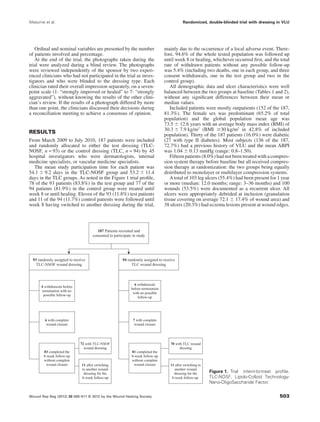
days in the TLC groups. As noted in the Figure 1 trial profile,
78 of the 93 patients (83.8%) in the test group and 77 of the
94 patients (81.9%) in the control group were treated until
week 8 or until healing. Eleven of the 93 (11.8%) test patients
and 11 of the 94 (11.7%) control patients were followed until
week 8 having switched to another dressing during the trial,
mainly due to the occurrence of a local adverse event. There-
fore, 94.6% of the whole tested population was followed up
until week 8 or healing, whichever occurred first, and the total
rate of withdrawn patients without any possible follow-up
was 5.4% (including two deaths, one in each group, and three
consent withdrawals, one in the test group and two in the
control group).
All demographic data and ulcer characteristics were well
balanced between the two groups at baseline (Tables 1 and 2),
without any significant differences between their mean or
median values.
Included patients were mostly outpatients (152 of the 187,
81.3%). The female sex was predominant (65.2% of total
population) and the global population mean age was
73.5 Ϯ 12.6 years with an average body mass index (BMI) of
30.3 Ϯ 7.9 kg/m2
(BMI Ն30 kg/m2
in 42.8% of included
population). Thirty of the 187 patients (16.0%) were diabetic
(27 with type II diabetes). Most subjects (136 of the 187,
72.7%) had a previous history of VLU and the mean ABPI
was 1.04 Ϯ 0.13 mmHg (range: 0.8–1.50).
Fifteen patients (8.0%) had not been treated with a compres-
sion system therapy before baseline but all received compres-
sion therapy at randomization: the two groups being equally
distributed to monolayer or multilayer compression systems.
Atotal of 103 leg ulcers (55.4%) had been present for 1 year
or more (median: 12.0 months; range: 3–36 months) and 100
wounds (53.5%) were documented as a recurrent ulcer. All
ulcers were appropriately debrided at inclusion (granulation
tissue covering on average 72.1 Ϯ 17.4% of wound area) and
38 ulcers (20.3%) had eczema lesions present at wound edges.
187 Patients recruited and
consented to participate in study
93 randomly assigned to receive
TLC-NSOF wound dressing
94 randomly assigned to receive
TLC wound dressing
4 withdrawals before
termination with no
possible follow-up
6 withdrawals
before termination
with no possible
follow-up
6 with complete
wound closure
7 with complete
wound closure
72 with TLC-NSOF
wound dressing
70 with TLC wound
dressing
83 completed the
8-week follow-up
without complete
wound closure
81 completed the
8-week follow-up
without complete
wound closure11 after switching
to another wound
dressing for the
8-week follow-up
11 after switching to
another wound
dressing for the
8-week follow-up
Figure 1. Trial intent-to-treat profile.
TLC-NOSF, Lipido-Colloid Technology-
Nano-OligoSaccharide Factor.
Meaume et al. Randomized, double-blinded trial with dressing in VLU
Wound Rep Reg (2012) 20 500–511 © 2012 by the Wound Healing Society 503
Mean ulcer area was 16.8 Ϯ 15.7 cm2
(median: 11.2 cm2
;
range: 2.3–86.9 cm2
; wound area >10 cm2
in 102 ulcers outof
187, 54.5%), without any difference between the two groups.
Efficacy outcomes
Patient compliance with the compression therapy prescribed
at inclusion was very good with 98.9% of the patients seen at
week 2, 96.6% at week 4, and 96.4% at week 6 still wearing
compression. Between these visits, compression wearing was
also checked by nurses during all the documented local pro-
cedures.
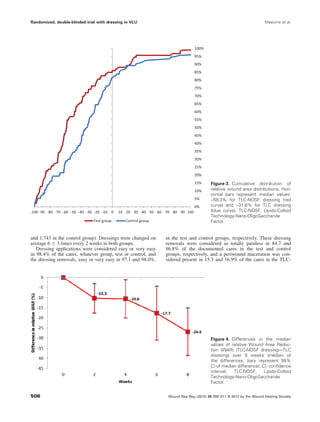
Concerning the primary outcome, the median relative WAR
(Table 3) decreased by -58.3% in the test group and by
-31.6% in the control group (difference: -26.7%; 95% CI for
median difference: -38.3 to -15.1%; p = 0.002), as presented
in Figure 2. Cumulative distributions of relative WAR are
presented in Figure 3, showing a left shift of distribution for
the test group compared with the control group.
By using the process of last-observed value carried forward
to compensate for missing data, the profiles of relative WAR
between-group differences over the 8-week period are pre-
sented in Figure 4; a superior effect of the test dressing was
observed after only 2 weeks and increased steadily thereafter.
A highly statistically significant difference was observed in
favor of the test dressing for absolute WAR (-6.1 cm2
in the
test group and -3.2 cm2
in the control group) and healing rate
(-10.81 mm2
/day in the test group and -5.15 mm2
/day in the
control group) (Table 3).
Moreover, when considering the Gilman’s formula (wound
edge progression), which allows a calculation of the wound
area independent of the baseline wound area value, the supe-
riority of the test dressing can be confirmed (p = 0.001).
The WAR of more than 40% from baseline value (WAR
>40%) was noted in 65.6% of patients receiving test dressing
Table 1. Distribution at baseline of the patient’s characteris-
tics for the treatment groups (n = 187)
TLC-NOSF TLC
n = 93 n = 94
Females (n, %) 62 (66.7%) 60 (63.8%)
Age (year)
(mean Ϯ SD)
72.6 Ϯ 13.0 74.4 Ϯ 12.1
BMI (kg/m2
)
(mean Ϯ SD)
30.5 Ϯ 8.7 30.1 Ϯ 6.9
BMI >30 kg/m2
(n, %) 40 (43.0%) 40 (42.6%)
Diabetes (n, %) 13 (14.0%) 17 (18.1%)
Smoking (n, %) 10 (10.8%) 14 (14.9%)
History of deep
venous
thrombosis
(n, %)
40 (43.0%) 32 (34.0%)
History of venous
surgery (n, %)
32 (34.4%) 37 (39.4%)
History of VLU (n, %) 67 (72.0%) 69 (73.4%)
ABPI
(mean Ϯ SD) 1.05 Ϯ 0.14 1.03 Ϯ 0.12
Median [range] 1.00 [0.8; 1.5] 1.00 [0.8; 1.3]
Patient status (n, %)
• Outpatient 75 (80.6%) 77 (81.9%)
• Hospitalized 18 (19.4%) 17 (18.1%)
Ankle mobility (n, %)
• Fully mobile 65 (69.9 %) 56 (59.6 %)
• Limited mobility 25 (26.9 %) 35 (37.2 %)
• Immobile 3 (3.2 %) 3 (3.2 %)
Autonomy of the
patient (n, %)
• Can easily walk 53 (57.0 %) 45 (47.9 %)
• Can walk with
difficulty
39 (41.9 %) 48 (51.1 %)
• Confined to bed 1 (1.1 %) 1 (1.1 %)
ABPI, Ankle Brachial Pressure Index; BMI, body mass index;
TLC-NOSF, Lipido-Colloid Technology-Nano-OligoSaccharide
Factor; VLU, venous leg ulcer.
Table 2. Distribution at baseline of the VLU characteristics for
the treatment groups (n = 187)
TLC-NOSF TLC
n = 93 n = 94
Duration of VLU (month) 15.6 Ϯ 9.1 15.1 Ϯ 8.7
Median [range] 12 [3; 35] 12 [6; 36]
Duration >1 year
(n; %)
54 (58.1%) 49 (52.7%)
Recurrent ulcer (n; %) 51 (54.8%) 49 (52.1%)
Healthy periwound
skin (n; %)
35 (37.6%) 43 (45.7%)
Erythematous
periwound skin
(n; %)
34 (36.6%) 37 (39.4%)
Periwound eczema
(n; %)
23 (24.7%) 15 (16.0%)
Wound bed aspect*
% granulation 71.4 Ϯ 17.9 72.8 Ϯ 17.0
Median [range] 70 [30; 100] 72 [30; 100]
% slough 28.6 Ϯ 17.9 27.0 Ϯ 16.8
Median [range] 30 [0; 70] 27.5 [0; 70]
Wound size
Wound area (cm2
) 17.0 Ϯ 15.6 16.6 Ϯ 15.8
Median [range] 12.9 [2.3; 86.9] 10.5 [2.7; 85.3]
Wound perimeter (cm) 19.3 Ϯ 9.4 19.8 Ϯ 10.9
Median [range] 17.2 [6.5; 54.2] 16.7 [7.7; 70.4]
Area >10 cm2
(n; %) 54 (58.1%) 48 (51.1%)
*Percentage of wound area covered by granulation tissue or
sloughy tissue (colorimetric scale).
TLC-NOSF, Lipido-Colloid Technology-Nano-OligoSaccharide
Factor; VLU, venous leg ulcer.
Randomized, double-blinded trial with dressing in VLU Meaume et al.
Wound Rep Reg (2012) 20 500–511 © 2012 by the Wound Healing Society504
compared with 39.4% in the control group (OR: 2.9; 95% CI:
1.6; 5.3; p = 0.0003; Table 3) and the median time to reach
WAR >40% was 43 days (95% CI: 37.2–48.8 days) in
the test group and 63 days (95% CI: 57.8–68.1 days) in the
control group, showing a statistically significant difference
(p = 0.002; log-rank test).
When a more stringent criterion is used (relative WAR
Ն60%), the OR is 2.2 (95% CI: 1.2; 4.0; p = 0.013). Figure 5
shows the percentages of patients presenting WAR Ն40% and
WAR Ն60% in the TLC-NOSF group (A) and TLC group
(B) at each investigator’s evaluation (weeks 2, 4, 6, and 8;
Table 4).
By week 8, six and seven wounds had healed (with 100%
reepithelialization and no further need of a primary dressing)
in the test and control groups, respectively.
Complementary analyses were undertaken to document the
relative WAR when considering parameters of poor healing
prognosis such as the recurrence of the leg ulcer, the duration
of the ulcer of more than 1 year, or an initial surface area
greater than 10 cm2
(Table 5). Whichever subgroup is consid-
ered, the superiority of the TLC-NOSF dressing is docu-
mented as having a very homogeneous effect, more marked
when ulcers are of poor prognosis.
Finally, by using a binary logistic regression method that
includes basal wound area (10 cm2
cutoff), ulcer recurrence
(yes/no), and duration (<1, 1–2, and >2 years) in the model,
OR of WAR >40% is 3.3 (95% CI: 1.8–6.1; p < 0.001) in
favor of the test dressing. Only the basal area was significant
in this model (OR area <10 cm2
vs. Ն10 cm2
: 2.1; 95% CI:
1.1–4.0; p = 0.020).
At the end of the trial, the blind review, based on the
photographs considered valuable by the two independent cli-
nicians, was undertaken on 86 patients in the test group and 82
patients in the control group; 81.4% (70/86) ulcers were con-
sidered improved in the test group compared with 65.9%
(54/82) in the control group, which is significantly different
(p = 0.022). Thus, the blind review fully corroborates the
evaluations made by the investigators during the course of
the trial.
Dressing acceptability, adverse events,
and local tolerance
Over the study period, a total of 3,547 local procedures were
documented by the participating nurses (1,804 in the test group
Table 3. Efficacy outcomes in patients randomized to TLC-NOSF (n = 93) and TLC dressing (n = 94) on an ITT basis
TLC-NOSF TLC
p*n = 93 n = 94
Last area (cm2
) Mean Ϯ SD 10.1 Ϯ 15.4 14.0 Ϯ 17.6
Median (range) 5.0 [0.0; 101.1] 6.1 [0.0; 87.4]
Last perimeter (cm) Mean Ϯ SD 14.4 Ϯ 10.3 17.9 Ϯ 13.8
Median (range) 11.8 [0.0; 53.1] 13.2 [0.0; 75.8]
Relative WAR (%) Mean Ϯ SD –45.2 Ϯ 47.9 –21.4 Ϯ 81.0 0.002
Median (range) –58.3 [–100.0; 173.0] –31.6 [–100.0; 571.0]
Absolute WAR (cm2
) Mean Ϯ SD –6.9 Ϯ 11.4 –2.5 Ϯ 11.9 0.003
Median (range) –6.1 [–55.5; 31.7] –3.2 [–33.1; 74.4]
Wound edge progression (mm)
(Gilman)
Mean Ϯ SD –1.15 Ϯ 1.20 –0.56 Ϯ 1.19 0.001
Median (range) –1.15 [–3.96; 2.20] –0.56 [–3.43; 6.97]
Healing rate (mm2
/day) Mean Ϯ SD –13.32 Ϯ 24.56 –4.54 Ϯ 23.20 0.005
Median (range) –10.83 [–158.32; 57.59] –5.15 [–60.19; 132.87]
*Mann–Whitney test.
ITT, intent to treat; SD, standard deviation; TLC-NOSF, Lipido-Colloid Technology-Nano-OligoSaccharide Factor; WAR, Wound Area
Reduction.
Figure 2. Relative Wound Area Reduction (WAR) calculated
as [Arealast - Areat0)/Areat0] ¥ 100 (Areat0 is the baseline wound
tracing value and Arealast is the last available wound tracing
value) and expressed as a percentage over the 8-week
follow-up in patients randomized to TLC-NOSF (test) (n = 93)
and TLC dressing (control) (n = 94) on an ITT basis. Values
indicate median. ITT, intent to treat; TLC-NOSF, Lipido-Colloid
Technology-Nano-OligoSaccharide Factor.
Meaume et al. Randomized, double-blinded trial with dressing in VLU
Wound Rep Reg (2012) 20 500–511 © 2012 by the Wound Healing Society 505
and 1,743 in the control group). Dressings were changed on
average 6 Ϯ 3 times every 2 weeks in both groups.
Dressing applications were considered easy or very easy
in 98.4% of the cares, whatever group, test or control, and
the dressing removals, easy or very easy in 97.1 and 98.0%,
in the test and control groups, respectively. These dressing
removals were considered as totally painless in 84.7 and
86.8% of the documented cares in the test and control
groups, respectively, and a periwound maceration was con-
sidered present in 15.3 and 16.9% of the cares in the TLC-
Figure 3. Cumulative distribution of
relative wound area distributions. Hori-
zontal bars represent median values:
-58.3% for TLC-NOSF dressing (red
curve) and -31.6% for TLC dressing
(blue curve). TLC-NOSF, Lipido-Colloid
Technology-Nano-OligoSaccharide
Factor.
Figure 4. Differences in the median
values of relative Wound Area Reduc-
tion (WAR) (TLC-NOSF dressing—TLC
dressing) over 8 weeks (median of
the differences; bars represent 95%
CI of median difference). CI, confidence
interval; TLC-NOSF, Lipido-Colloid
Technology-Nano-OligoSaccharide
Factor.
Randomized, double-blinded trial with dressing in VLU Meaume et al.
Wound Rep Reg (2012) 20 500–511 © 2012 by the Wound Healing Society506
NOSF and TLC groups. So, no difference between the two
groups has been noted whatever acceptability parameter that
was considered and documented by the nursing staff during
the trial.
At least one local adverse event (emergent or already
known at baseline) was reported in 29 patients allocated to the
test dressing (31.2%; 95% CI: 22.0–41.6%) and in 27 allo-
cated to the control dressing (28.7%; 95% CI: 19.9–38.0%).
A total of 66 local adverse events were noted (Table 6),
with no obvious differences in event prevalence between the
two groups. Periwound eczema was the most frequently
reported problem (23 of the 187 patients, 12.3%), but this was
already present in these patients at the time of randomization.
Of the 66 local adverse events documented, 23 (10 in the test
group and 13 in the control group) were considered by the
investigators as most probably dressing related.
For 11 patients in the test group and 12 patients in the
control group, the local adverse event was the reason justify-
ing the discontinuation of the dressing before week 8.
Figure 5. Percentages of patients presenting Wound Area
Reduction (WAR) Ն40% and WAR Ն60% in the TLC-NOSF
group (A) and TLC group (B) at each evaluation (weeks
2, 4, 6, and 8). TLC-NOSF, Lipido-Colloid Technology-Nano-
OligoSaccharide Factor.
Table 4. Percentage of wounds with a relative Wound Area
Reduction Ն40% (WAR Ն40%) and Ն60% (WAR Ն60%) at
last available tracing on an ITT basis
Relative WAR
Ն40%
Relative WAR
Ն60%
TLC-NOSF (n, %) 61/93 (65.6%) 42/93 (45.2%)
TLC (n, %) 37/94 (39.4%) 26/94 (27.7%)
Odds ratio (95% CI) 2.9 [1.6; 5.3] 2.2 [1.2; 4.0]
p 0.0003 0.013
CI, confidence interval; ITT, intent to treat; TLC-NOSF,
Lipido-Colloid Technology-Nano-OligoSaccharide Factor.
Table5.RelativeWoundAreaReduction(WAR).Subgroupanalysis.Calculatedwithrespectofthecompressionbandaging(monolayerormultilayerbandages),the
ulcerduration(Յ1yearor>1year),therecurrence,andthebaselinewoundarea(Յ10or>10cm2
).Expressedasapercentageoverthe8-weekfollow-upinpatients
randomizedtoTLC-NOSF(test;n=93)andTLCdressing(control;n=94)onanITTbasis
TLC-NOSFTLC
Mediandifference95%CIofmediandiffnMeanϮSDMediannMeanϮSDMedian
Compression
bandaging*
Monolayer57–40.4Ϯ54.9–58.361–16Ϯ91.8–31.7–26.6[–42.3;-11.0]
Multilayer27–51.8Ϯ33.3–58.226–27.5Ϯ58.7–32.7–25.5[–51.9;0.9]
UlcerdurationՅ1year39–55.9Ϯ37.5–63.344–34.2Ϯ49.8–38.1–25.3[–49.5;-1.0]
>1year54–37.4Ϯ53.1–55.250–10Ϯ100.0–23.1–32.0[–48.7;-15.4]
RecurrentulcerYes51–40.8Ϯ54.6–58.249–16.9Ϯ61.2–26.1–32.1[–49.8;-14.5]
No42–50.5Ϯ38.1–61.845–26.2Ϯ98.7–39.3–22.5[–40.5;-4.6]
BaselinewoundareaՅ10cm2
39–48.7Ϯ54.0–61.746–38.1Ϯ50.7–40.6–21.1[–39.8;-2.3]
>10cm2
54–42.6Ϯ43.3–55.248–5.3Ϯ100.0–19.2–35.9[–54.5;-17.3]
*Patientswithfullconcordancetoprescribedcompressiontherapy(84intestand87incontrolgroup).
CI,confidenceinterval;ITT,intenttotreat;SD,standarddeviation;TLC-NOSF,Lipido-ColloidTechnology-Nano-OligoSaccharideFactor.
Meaume et al. Randomized, double-blinded trial with dressing in VLU
Wound Rep Reg (2012) 20 500–511 © 2012 by the Wound Healing Society 507
The Quality of Life Questionnaire was noted similar in the
two groups at baseline when considering each of its five
dimension scores. At the end of the trial, a significant differ-
ence between the two groups was observed in favor of the test
group for two of the five items: scores of pain–discomfort
(1.53 Ϯ 0.53 vs. 1.74 Ϯ 0.65; p = 0.022) and anxiety–
depression (1.35 Ϯ 0.53 vs. 1.54 Ϯ 0.60; p = 0.037) were sig-
nificantly lower in the TLC-NOSF group. At baseline, the two
VAS scores were very similar (65.8 Ϯ 17.7 and 65.6 Ϯ 17.4
in the test and control groups, respectively) and both showed
improvement at the end of the trial without reaching a signifi-
cant level in favor of the test group (72.1 Ϯ 17.5 vs.
67.3 Ϯ 18.7; p = 0.072).
DISCUSSION
This randomized double-blind clinical trial clearly supports
that the NOSF compound added to a neutral TLC wound
dressing can significantly improve the healing process of
VLU, whatever their prognosis, when associated with
compression therapy.
As far as we know, this clinical trial, for which the objec-
tive was to demonstrate the potential benefit of a dressing
impregnated with NOSF developed to favor the wound
healing repair process when compared with the neutral dress-
ing (without the NOSF compound), was the first to be
conducted in a double-blind design. This approach had the
advantage of allowing double-blind conditions, exceptional in
the wound care field when comparing two wound dressings,
which therefore renders the findings more relevant.
The neutral TLC dressing has been widely used by health-
care professionals for a decade and its clinical benefits have
been documented thoroughly in clinical trials undertaken in
various indications, including pediatric wounds.20,21
In addi-
tion, in vitro data suggest that TLC can promote fibroblast
proliferation and the synthesis of extracellular matrix com-
pounds although physical interactions with local wound envi-
ronment are not yet fully elucidated.22,23
In chronic wound exudate, the increased levels of MMPs
result in the degradation of the extracellular matrix and inac-
tivation of growth factors. This maintains the wound in an
uncontrolled inflammatory state, delaying or stalling tissue
repair, cellular proliferation, and angiogenesis.24,25
A dressing
that is capable of sequestering excess MMPs from chronic
wound exudate may therefore help to produce an anti-
inflammatory effect and thus benefit healing.26
If we consider the specific clinical status of the VLU,
which is directly associated to the amounts of MMP-9 present
in the wound fluid, a recent study suggests that higher levels
of MMP-9 in chronic wound fluid correlate with a clinically
worse wound.11
Recent in vitro studies14,15,27
have shown that the TLC-
NOSF dressing tested in the current trial reduces gelatinase
(MMP-2 and MMP-9) and collagenase (MMP-1 and MMP-8)
activities on a dermal equivalent (normal human dermal fibro-
blasts incorporated within a collagen matrix).
Thus, to ascertain whether the TLC-NOSF dressing, which
interacts with the local MMPs present in chronic leg ulcers,
was therapeutically more effective than the neutral TLC
dressing, a prospective, randomized, double-blind, multi-
center controlled clinical trial was undertaken, in compliance
with the International Conference on Harmonisation GCP
requirements.
In addition to venous origin, confirmed by the Doppler
value documented at baseline, the main selection criterion
was the presence of an open VLU with a duration of at least
6 months, prior to inclusion. This criterion was selected to
favor the inclusion of leg ulcers, which would have an
expected benefit from an active dressing and not just from
compression therapy which still remains the cornerstone of
VLU management. Lengthy ulcer duration, leg ulcer recur-
Table 6. Local adverse events (LAEs) categorized by randomization group
Group
Total
n = 187
TLC-NOSF
n = 93
TLC
n = 94
Number of LAE % of patients Number of LAE % of patients Number of LAE % of patients
Contact dermatitis 1 (1) 1.08% 2 (1) 2.13% 3 1.60%
Pain 1 (0) 1.08% 0 (0) 0.00% 1 0.53%
Periwound eczema 14 (4) 15.05% 9 (5) 9.57% 23 12.30%
Increase of ulcer size 7 (1) 7.53% 4 (3) 4.26% 11 5.88%
Overgranulation 3 (2) 3.23% 2 (0) 2.13% 5 2.67%
Infection 7 (1) 7.53% 6 (0) 6.38% 13 6.95%
Inflammation/irritation 1 (1) 1.08% 2 (1) 2.13% 3 1.60%
Macerated periwound skin 0 (0) 0.00% 6 (2) 6.38% 6 3.21%
Apparition of dark tissue
on wound bed
0 (0) 0.00% 1 (1) 1.06% 1 0.53%
Total 34 (10) 32 (13) 66
Within parentheses: number of events considered as probably/certainly related to applied dressing by the investigators.
TLC-NOSF, Lipido-Colloid Technology-Nano-OligoSaccharide Factor.
Randomized, double-blinded trial with dressing in VLU Meaume et al.
Wound Rep Reg (2012) 20 500–511 © 2012 by the Wound Healing Society508
rence, and a wound size of 10 cm2
or more are recognized as
factors of poor healing prognosis despite appropriate com-
pression therapy.26,28,29
To confirm the clinical relevance of the detected effect
with TLC-NOSF dressing, the best local treatment includ-
ing compression therapy was strictly conducted in the two
groups. Compression therapy is the main treatment for VLU
but is often poorly tolerated by patients.7,30,31
In our study,
patients were carefully instructed and regularly encouraged
to wear their compression therapy so that patients’ compli-
ance with compression was very high throughout the whole
trial.
Overall results clearly document a significant superiority
and a sustained effect of the test dressing vs. the control when
considering relative and absolute WAR over the 8-week treat-
ment, as well as the healing rate of the treated leg ulcers. As
basal wound area may influence its decreasing measurement
over time, the formula proposed by Gilman32
allows a wound
healing parameter to be derived, independent of the initial area;
again, using this parameter, superiority of the test dressing was
observed. Furthermore, the magnitude of this effect was still
evident in all the subgroups stratified according to the type of
compression therapy (monolayer or multilayer), the duration
of ulcer (less or more than 1 year), the initial ulcer size (more
or less than 10 cm2
), and whether or not it was recurrent. A
highly significant difference was observed in favor of the test
dressing, whatever the prognosis of the treated leg ulcers.
The limitation of this trial might be the follow-up duration,
which was too short to detect any difference on complete
wound closure rate. However, numerous publications have
shown that the initial change in wound area is highly predic-
tive of a fully healed leg ulcer within 20–24 weeks and some
authors consider that a 40% WAR at week 4 might be con-
sidered as a surrogate end point to complete closure.33–36
Here
again, when using 40 or 60% WAR as an end point, a sub-
stantial and significant superiority of the TLC-NOSF dressing
is observed with a 3-week reduced time in reaching this level
of wound area change.
The superiority of this new dressing is supported by the
main analysis and all the additional exploratory analysis,
including those of the photographic blind review.
The addition of NOSF to the TLC dressing does not inter-
act with the overall local tolerance and acceptability of this
active dressing, as no differences between groups were docu-
mented. Furthermore, these acceptability and tolerance data
are in accordance with those already documented in the
literature, whatever dressing, TLC,20,21,37–39
or TLC-NOSF.16
The EuroQol Questionnaire was selected in this trial as
already reported to explore the impact of VLUs on health-
related quality of life,40–43
showing significant improvement
in the test group for two of the five dimensions, the
pain–discomfort and anxiety–depression.
The documented results in the present trial are in accor-
dance with and reinforced by those obtained by Schmutz
et al.16
who compared the TLC-NOSF dressing with a
collagen/oxidized regenerated cellulose (ORC) matrix (Pro-
mogran®
) in the management of VLU. This was a 12-week
open prospective, randomized multicenter trial that was
designed to document noninferiority of the test dressing com-
pared with control dressing. Fifty-seven and 60 patients
treated for their VLU were randomly allocated to the TLC-
NOSF and ORC dressings, respectively. In the ITT popula-
tion, medians of relative WAR were 54.4% in the test group
and 12.9% in the control group, and a conclusion of superi-
ority of the test dressing was reached (p = 0.0273).
Our double-blind clinical trial is therefore the first one to
clearly demonstrate that, combined with compression therapy,
wound microenvironment modulation with a dressing is able
to promote a favorable wound healing trajectory for VLU
whatever their considered prognosis. This is dramatically
new, as scientific literature reports that the type of wound
dressing applied beneath compression does not affect ulcer
healing.9
The literature also reports that there is no evidence
that any of the modern dressings are better than another or
better than saline or paraffin gauze in terms of general per-
formance criteria10
even when considering growth factors that
have not yet been established as clinically beneficial in the
treatment of VLU.4
In conclusion, adding a TLC-NOSF wound dressing to the
best local care for the management of VLU represents a new
opportunity to promote the healing process of these chronic
wounds that frequently remain unhealed for months or years
with a high level of recurrence, despite adequate compression
therapy.
ACKNOWLEDGMENTS
This trial (CHALLENGE) was financially supported by the
sponsor, Laboratoires URGO (Chenôve, France), manufac-
turer of both tested dressings. The study was designed by the
corresponding author S. Meaume, MD, Rothschild University
Hospital, and by Serge Bohbot, MD, employee of the sponsor
as Medical Director. Data management, data analysis,
interpretation, and reporting were performed by the Vertical
Society (Paris), independently from any employee of the
study sponsor.
A. Sauvadet, employee of the sponsor as Clinical
Study Manager, was responsible for the study monitoring
supervision.
This paper was written only by the first and last authors,
Sylvie Meaume, MD, and Anne Dompmartin, MD, without
any participation of the sponsor’s employees, and all the
authors had full access to all data from the study.
All authors were involved in the planning and undertaking
of the trial.
We thank all the patients for agreeing to take part in this trial.
Physicians (and Nursing Staff) and contributing patients
(Challenge Study Group): B Labeille, JL Perrot, AS Lesne-
Padieu, M Santacreu, E Peyron, M Dupin, ML Dordain-Bigot,
P Plantin, H Cartier, G Guillet, M Camus, L Machet, JL
Schmutz, E Redon, P Bravard, P Schoenlaub, A Vermersh, C
Brenuchon, F Delesalle, D Thuillier, C Hamel-Desnos, J
Duquesnoy, H Maillard, Y Guiguen, P Léger, P Modiano, D
Cannone-Courivaud, G Safa, S Blaise, T Le Guyadec, MA
Pistorius, J Chevrant-Breton, J Jegou, JM Bonnet-Blanc, AC
Ribemond-Goby, MC Deroo-Berger, L Meunier, M Dandu-
rand, H Paradis, F Augey, C Allombert-Blaise, A Pillouert-
Prost, G Mauduit, JM Bressieux, A Cadène, P Humbert,
B Faivre, and M Chapelon.
REFERENCES
1. Valencia IC, Falabella A, Kirsner RS, Eaglstein WH. Chronic
venous insufficiency and venous leg ulceration. J Am Acad
Dermatol 2001; 44: 401–21.
Meaume et al. Randomized, double-blinded trial with dressing in VLU
Wound Rep Reg (2012) 20 500–511 © 2012 by the Wound Healing Society 509
2. Graham ID, Harrison MB, Nelson EA, Lorimer K, Fisher A.
Prevalence of lower-limb ulceration: a systematic review of
prevalence studies. Adv Skin Wound Care 2003; 16: 305–16.
3. Abbade LP, Lastoria S. Venous ulcer: epidemiology, physiopa-
thology, diagnosis and treatment. Int J Dermatol 2005; 44:
449–56.
4. Khan MN, Davies CG. Advances in the management of leg
ulcers: the potential role of growth factors. Int Wound J 2006; 3:
113–20.
5. Herber OR, Schnepp W, Rieger MA. A systematic review on the
impact of leg ulceration on patients’ quality of life. Health Qual
Life Outcomes 2007; 5: 44.
6. Hareendran A, Doll H, Wild DJ, Moffatt CJ, Musgrove E,
Wheatley C, Franks PJ. The venous leg ulcer quality of life
(VLU-QoL) questionnaire: development and psychometric vali-
dation. Wound Rep Reg 2007; 15: 465–73.
7. O’Meara S, Cullum NA, Nelson EA. Compression for venous
leg ulcers. Cochrane Database Syst Rev 2009; (1): CD000265.
8. Jones KR. Why do chronic venous leg ulcers not heal? J Nurs
Care Qual 2009; 24: 116–24; quiz 125–6.
9. Palfreyman S, Nelson EA, Michaels JA. Dressings for venous
leg ulcers: systematic review and meta-analysis. BMJ 2007;
335: 244.
10. Chaby G, Senet P, Vaneau M, Martel P, Guillaume JC, Meaume
S, Téot L, Debure C, Dompmartin A, Bachelet H, Carsin H,
Matz V, Richard JL, Rochet JM, Sales-Aussias N, Zagnoli A,
Denis C, Guillot B, Chosidow O. Dressings for acute and
chronic wounds: a systematic review. Arch Dermatol 2007; 143:
1297–304.
11. Rayment EA, Upton Z, Shooter GK. Increased matrix
metalloproteinase-9 (MMP-9) activity observed in chronic
wound fluid is related to the clinical severity of the ulcer.
Br J Dermatol 2008; 158: 951–61.
12. Ladwig GP, Robson MC, Liu R, Kuhn MA, Muir DF, Schultz
GS. Ratios of activated matrix metalloproteinase-9 to tissue
inhibitor of matrix metalloproteinase-1 in wound fluids are
inversely correlated with healing of pressure ulcers. Wound Rep
Reg 2002; 10: 26–37.
13. Liu Y, Min D, Bolton T, Nubé V, Twigg SM, Yue DK, McLen-
nan SV. Increased matrix metalloproteinase-9 predicts poor
wound healing in diabetic foot ulcers. Diabetes Care 2009; 32:
117–9. Epub 2008 Oct 3.
14. Coulomb B, Couty L, Fournier B, Laurensou C, Aillaud C,
Lafont A, Gogly B. A NOSF (Nano-Oligasaccharide Factor)
lipido-colloid dressing inhibits MMP in an in vitro dermal
equivalent model. Wound Rep Reg 2008; 16: A66–82 (Meeting
of the European Tissue Repair Society).
15. Couty L, Fournier B, Laurensou C, Bouschbacher M, Aillaud
C, Gogly B, Coulomb B. A NOSF (Nano-Oligasaccharide
Factor) lipido-colloid dressing stimulates MMPs/TIMPs com-
plexes formation leading to MMPs inhibition in an in vitro
dermal equivalent model. Wound Rep Reg 2009; 16: A54–87
(Meeting of the European Tissue Repair Society and Wound
Healing Society).
16. Schmutz JL, Meaume S, Fays S, Ourabah Z, Guillot B, Thirion
V, Collier M, Barrett S, Smith J, Bohbot S, Dompmartin A.
Evaluation of the nano-oligosaccharide factor lipido-colloid
matrix in the local management of venous leg ulcers: results
of a randomised, controlled trial. Int Wound J 2008; 5:
172–82.
17. Cullen B, Smith R, McCulloch E, Silcock D, Morrison L.
Mechanism of action of Promogran®
, a protease modulating
matrix, for the treatment of diabetic foot ulcers. Wound Rep Reg
2002; 10: 16–25.
18. Cullen B, Watt PW, Lundqvist C, Silcock D, Schmidt RJ, Bogan
D, Light ND. The role of oxidized regenerated cellulose/
collagen in chronic wound repair and its potential mechanism of
action. Int J Biochem Cell Biol 2002; 34: 1544–56.
19. Bonett DG, Price RM. Statistical inference for a linear function
of medians: confidence intervals, hypothesis testing, and sample
size requirements. Psychol Methods 2002; 7: 370–83.
20. Meaume S, Ourabah Z, Cartier H, Granel-Brocard F, Combe-
male P, Bressieux JM, Bohbot S. Evaluation of a lipidocolloid
wound dressing in the local management of leg ulcers. J Wound
Care 2005; 14: 329–34.
21. Ma KK, Chan MF, Pang SMC. The effectiveness of using a
lipidocolloid dressing for patients with traumatic digital wounds.
Clin Nurs Res 2006; 15: 119–134.
22. Viennet C, Bride J, Gabiot AC, Humbert P. Comparison of
different wound dressings on cultured human fibroblasts and
collagen lattices. J Wound Care 2003; 12: 385–90.
23. Bernard FX, Barrault C, Juchaux F, Laurensou C, Apert L.
Stimulation of the proliferation of human dermal fibroblasts in
vitro by a lipidocolloid dressing. J Wound Care 2005; 14:
215–20.
24. Lobmann R, Ambrosch A, Schultz G, Waldmann K, Schiweck S,
Lehnert H. Expression of matrix-metalloproteinases and their
inhibitors in the wounds of diabetic and non-diabetic
patients. Diabetologia 2002; 45: 1011–6. Epub 2002
May 25.
25. Toy LW. Matrix metalloproteinases: their function in tissue
repair. J Wound Care 2005; 14: 20–2.
26. Hjerppe A, Saarinen JP, Venermo MA, Huhtala HS, Vaalasti A.
Prolonged healing of venous leg ulcers: the role of venous reflux,
ulcer characteristics and mobility. J Wound Care 2010; 19: 474;
476, 478 passim.
27. Coulomb B, Couty L, Fournier B, Laurensou C, Aillaud C, Gogly
B, Lafont A. Evaluation de la matrice imprégnée de
NOSF (nano-oligosaccharide factor), dans un modèle de recon-
struction dermique in vitro. J Plaies Cicatris 2008; 14: 54–7.
28. Chaby G, Viseux V, Ramelet AA, Ganry O, Billet A, Lok C.
Refractory venous leg ulcers: a study of risk factors. Dermatol
Surg 2006; 32: 512–9.
29. Margolis DJ, Allen-Taylor L, Hoffstad O, Berlin JA. The accu-
racy of venous leg ulcer prognostic models in a wound care
system. Wound Rep Reg 2004; 12: 163–8.
30. Reich-Schupke S, Murmann F, Altmeyer P, Stücker M. Quality
of life and patients’ view of compression therapy. Int Angiol
2009; 28: 385–93.
31. Dereure O, Vin F, Lazareth I, Bohbot S. Compression and peri-
ulcer skin in outpatients’ venous leg ulcers: results of a French
survey. J Wound Care 2005; 14: 265–75.
32. Gilman T. Wound outcomes: the utility of surface measures.
Int J Low Extrem Wounds 2004; 3: 125–32.
33. Gelfand JM, Hoffstad O, Margolis DJ. Surrogate endpoints for
the treatment of venous leg ulcers. J Invest Dermatol 2002; 119:
1420–5.
34. Cardinal M, Eisenbud DE, Phillips T, Harding K. Early healing
rates and wound area measurements are reliable predictors of
later complete wound closure. Wound Rep Reg 2008; 16:
19–22.
35. Margolis DJ, Gelfand JM, Hoffstad O, Berlin JA. Surrogate end
points for the treatment of diabetic neuropathic foot ulcers.
Diabetes Care 2003; 26: 1696–700.
Randomized, double-blinded trial with dressing in VLU Meaume et al.
Wound Rep Reg (2012) 20 500–511 © 2012 by the Wound Healing Society510
36. Steed DL, Hill DP, Woodske ME, Payne WG, Robson MC.
Wound-healing trajectories as outcome measures of venous
stasis ulcer treatment. Int Wound J 2006; 3: 40–7.
37. Letouze A, Voinchet V, Hoecht B, Muenter KC, Vives F, Bohbot
S. Using a new lipidocolloid dressing in paediatric wounds:
results of French and German clinical studies. J Wound Care
2004; 13: 221–5.
38. Blanchet-Bardon C, Bohbot S. Using Urgotul dressing for the
management of epidermolysis bullosa skin lesions. J Wound
Care 2005; 14: 490–1, 494–6.
39. Burton F. An evaluation of non-adherent wound-contact layers
for acute traumatic and surgical wounds. J Wound Care 2004;
13: 371–3.
40. Furtado K, Pina E, Moffatt CJ, Franks PJ. Leg ulceration in
Portugal: quality of life. Int Wound J 2008; 5: 34–9.
41. Palfreyman S. Assessing the impact of venous ulceration on
quality of life. Nurs Times 2008; 104: 34–7.
42. Jull A, Parag V, Walker N, Rodgers A. Responsiveness
of generic and disease-specific health-related quality of life
instruments to venous ulcer healing. Wound Rep Reg 2010; 18:
26–30.
43. González-Consuegra RV, Verdú J. Quality of life in people with
venous leg ulcers: an integrative review. J Adv Nurs 2011; 67:
926–44.
44. Trengove NJ, Stacey MC, MacAuley S, Bennett N, Gibson J,
Burslem F, Murphy G, Schultz G. Analysis of the acute and
chronic wound environments: the role of proteases and their
inhibitors. Wound Rep Reg 1999; 7: 442–52.
45. Veves A, Sheehan P, Pham HT. A randomized controlled trial of
Promogran®
(a collagen/oxidized regenerated cellulose dressing)
vs standard treatment in the management of diabetic foot ulcers.
Arch Surg 2002; 137: 822–7.
Meaume et al. Randomized, double-blinded trial with dressing in VLU
Wound Rep Reg (2012) 20 500–511 © 2012 by the Wound Healing Society 511
Copyright of Wound Repair & Regeneration is the property of Wiley-Blackwell and its content may not be
copied or emailed to multiple sites or posted to a listserv without the copyright holder's express written
permission. However, users may print, download, or email articles for individual use.

Content server (10)A randomized, controlled, double-blind prospective trial with a Lipido-Colloid Technology-Nano-OligoSaccharide Factor wound dressing in the local management of venous leg ulcers

  • 1.
    A randomized, controlled,double-blind prospective trial with a Lipido-Colloid Technology-Nano-OligoSaccharide Factor wound dressing in the local management of venous leg ulcers Sylvie Meaume, MD1 ; François Truchetet, MD2 ; Frédéric Cambazard, MD3 ; Catherine Lok, MD4 ; Clélia Debure, MD5 ; Sophie Dalac, MD6 ; Isabelle Lazareth, MD7 ; Michèle-Léa Sigal, MD8 ; Anne Sauvadet, PhD9 ; Serge Bohbot, MD9 ; Anne Dompmartin, MD, PhD10 ; on behalf of the CHALLENGE Study Group 1. Dermatology & Geriatric Department, Rothschild University Hospital, Paris, France, 2. Dermatology Department, Beauregard Hospital, Thionville, France, 3. Dermatology Department, North University Hospital, Saint-Etienne, France, 4. Dermatology Department, South University Hospital, Amiens, France, 5. Department of Vascular Medicine, Corentin Celton Hospital, Issy-les-Moulineaux, France, 6. Dermatology Department, Bocage University Hospital, Dijon, France, 7. Department of Vascular Medicine, Saint-Joseph Hospital, Paris, France, 8. Dermatology Department, Victor Dupouy Hospital, Argenteuil, France, 9. Clinical Research Department, Laboratoires URGO, Chenôve, France, and 10. Dermatology Department, Clemenceau University Hospital, Caen, France Reprint requests: Dr. S. Meaume, Hôpital Rothschild, Service de Gériatrie, 5 rue Santerre, 75571 Paris Cedex 12, France. Tel: +33 1 4019 3306; Fax: +33 1 4019 3057; Email: sylvie.meaume@rth.aphp.fr Manuscript received: August 1, 2011 Accepted in final form: March 30, 2012 DOI:10.1111/j.1524-475X.2012.00797.x ABSTRACT Venous leg ulcers (VLUs) are the most prevalent chronic wounds in western countries with a heavy socioeconomic impact. Compression therapy is the etiologic treatment of VLU but until now no wound dressing has been shown to be more effective than another. The aim of this study was to assess the efficacy of a new dressing in the management of VLU. Adult patients presenting a noninfected VLU and receiving effective compression therapy were enrolled in this randomized, controlled, double- blind trial. The VLUs were assessed every 2 weeks for 8 weeks. The primary study outcome was the relative Wound Area Reduction (WAR, in %), and the secondary objectives were absolute WAR, healing rate, and percentage of wounds with >40% surface area reduction. One hundred eighty-seven patients were randomly allocated to treatment groups. Median WAR was 58.3% in the Lipido-Colloid Technology- Nano-OligoSaccharide Factor (TLC-NOSF) dressing group (test group) and 31.6% in the TLC dressing group (control group) (difference: -26.7%; 95% confidence interval: -38.3 to -15.1%; p = 0.002). All other efficacy outcomes were also signifi- cant in favor of the TLC-NOSF dressing group. Clinical outcomes for patients treated with the new dressing are superior to those patients treated with the TLC dressing (without NOSF compound), suggesting a strong promotion of the VLU healing process. Venous leg ulceration is the most prevalent chronic wound in Western countries.1 The reported prevalence rates of open ulcers, in studies with clinical validation, ranged from 0.12 to 1.1% of the population and that of open or healed ulcers was reported to be 1.8%.2 These lesions are characterized by a cyclical pattern of healing and recurrence that is estimated to be in the range of 54–78% and has a significant socioeco- nomic impact in terms of both medical care and days off work3 in the United States alone; the treatment cost is esti- mated to be around one billion dollars per annum.4 Overall, these chronic wounds are responsible for a substantial impair- ment in quality of life.5,6 The management of venous leg ulcers (VLUs) is based on its etiologic treatment, compression therapy, which is the cornerstone of leg ulcer therapy.7 Despite appropriate care, 50–60% of VLU will take more than 20–24 weeks to heal.8 There is no evidence of differences in healing rates between the numerous types of available wound dressings when used with compression therapy.9 The objective of current management with dressings is to maintain an appro- priate environment that favors the normal smooth tissue repair process.10 In chronic wounds, matrix metalloproteinases (MMPs) have been implicated by a number of studies as the major protease family responsible for the degradation of key factors critical to the ulcer’s ability to heal.11 The enhanced level of MMPs, whatever the etiology of the chronic wounds, is responsible for the lack of extracellular matrix compound Wound Rep Reg (2012) 20 500–511 © 2012 by the Wound Healing Society500
  • 2.
    synthesis and thepersistence of an inappropriate local inflam- matory process.11–13 For this reason, MMP inhibitors have recently been developed and are expected to improve the local treatment of these chronic wounds. Supported by in vitro studies showing its MMP modulation properties,14,15 a Nano-OligoSaccharide Factor (NOSF) was incorporated into a widely used, neutral, Lipido-Colloid Technology (TLC) dressing, providing its additional proper- ties to promote the wound healing process in chronic wounds. An initial randomized, controlled trial showed superior clinical benefits of the NOSF compound in the local manage- ment of VLU16 when compared with a collagen/regenerated, oxidized cellulose matrix designed to reduce the activity of MMPs in exudates and to protect local growth factors from degradation.17,18 The aim of this randomized, controlled, double-blind prospective trial was therefore to compare the clinical efficacy of a TLC dressing impregnated with NOSF with a neutral TLC dressing (without NOSF) to support the encouraging results from the first trial. MATERIAL AND METHODS Patients Screened patients were of both sexes, over 18 years of age (with no upper age limit), and were being managed for a VLU, either as a hospital inpatient or outpatient. Participating patients had to give written consent after receiving full infor- mation from the investigating physician, agree to their ulcer being treated with an effective compression system therapy (monolayer or multilayer), and agree to be followed up over the whole study period by the investigators’ team. At inclusion, VLU area had to be between 5 and 50 cm2 , with between 6- and 36-month duration, despite appropriate treatment, according to the investigators’opinion. At baseline, the Ankle Brachial Pressure Index (ABPI) had to be between 0.8 and 1.3 and at least 50% of the leg ulcer wound bed had to be covered with granulation tissue without any black necrotic/devitalized tissue (colorimetric scale). If more than one ulcer was present, the ulcer that best met the selection criteria was selected (target ulcer) and had to be at least 3 cm away from any other wound. The main exclusion criteria were the following: suspected clinical infection that could require systemic antibiotics, a known contact dermatitis to carboxymethylcellulose (CMC), a history of venous surgery within the previous 2 months, the occurrence of deep vein thrombosis in the previous 3 months, a concomitant severe comorbid disease or poor health status that could impair the expected 8-week follow- up, any known malignant wound degeneration, and con- comitant treatment with immunosuppressive agents or high dose of oral corticosteroids. Randomization The randomization code was generated in blocks of two using a computer program and was stratified by center. Both dressings were identical in appearance, shape, color, and packaging. Prior to the start of the trial, an assessment team examined the two dressings and found no distinguishing fea- tures, indicating that they could be used in a double-blind trial. Individual sterile dressings were packed in boxes of 35 dressings per patient. Each box and dressing was identified by a center identification number and patient number corre- sponding to the chronological patient inclusion number. Because knowledge of the type of dressing was not neces- sary for patient management during any medical problems, the procedure to break the randomization code was not pro- vided to the participating centers. Treatments The TLC-NOSF wound dressing (Urgostart® , Laboratoires Urgo, Chenôve, France) is composed of a micro-adherent wound contact layer that includes sodium CMC particles, a NOSF, and polymers; this layer is attached to a hydrophilic polyurethane foam pad and the overall dressing is protected by a nonwoven polyurethane backing layer that allows gaseous exchange and provides a physical barrier to cover and protect the wound. The control TLC dressing (Urgotul® Absorb, Laboratoires Urgo) has exactly the same composition but does not include the NOSF compound. Dressing change was recommended at least every 2–4 days or more frequently, depending on the level of exudate and the clinical aspect of the wound. During the study period, only sterile saline was used for wound cleaning during dressing change. The use of topical antibiotics, antimicrobial paste/cream, or antiseptics was not allowed. All other general and local treatments were allowed but had to be fully documented in the patients’ case report forms. Procedures This was an 8-week French, prospective, multicenter, double- blind, randomized, controlled trial. Any patient presenting with a VLU who met the selection criteria could be approached for inclusion in the study, irre- spective of previous local treatment. After obtaining the patients’ written informed consent to participate in the trial and the measurement of ABPI with a Doppler provided by the sponsor (Mini/Audio DOPPLEX® D900, Huntleigh Health- care, Cardiff, UK), patients were enrolled and randomly allo- cated to either the test (TLC-NOSF) or control dressing (TLC). Demographic parameters and patient’s medical, sur- gical, and leg ulcer history were documented. The previous treatment of the studied ulcer, location, and detailed wound description were recorded including periwound skin condi- tion and colorimetric evaluation of the wound bed, i.e., the presence of granulation tissue (red), slough (yellow), and necrosis (dark) was given as percentage of each color cover- ing the wound area. An acetate tracing (planimetric record) of the wound surface area was performed (according to a standardized pro- tocol provided by the sponsor) and a photograph of the wound was taken (digital photographic image of at least 3 megapixels using a standardized protocol, after cleansing the wound with saline), both of which were identified by the individual patient number. The target wound was cleaned and then the allocated dress- ing was applied. An appropriate compression therapy system, according to patient and ulcer status, was selected and applied by the investigating physician. Meaume et al. Randomized, double-blinded trial with dressing in VLU Wound Rep Reg (2012) 20 500–511 © 2012 by the Wound Healing Society 501
  • 3.
    The VLU wasevaluated by the investigating physician every 2 weeks until week 8, even if the tested dressing had been discontinued for whatever reason (except consent with- drawal or healing). At each visit, the wound evaluations were repeated (clinical assessment, acetate tracing, and wound photo). Investigators were required to notify any unexpected local adverse events whether dressing related or not. In the case of complete wound closure, an acetate tracing and a photo documenting complete epithelialization were to be taken. Between the biweekly investigator’s assessments, all local procedures were recorded by health-care professionals, including detailed information on dressing removal and appli- cation and the compression system applied. The parameters (ease of dressing application and removal, pain at removal, and between dressing changes and periwound maceration) were subjectively assessed using a four-level scale (from “very easy” to “extremely difficult” or “none” to “very impor- tant” depending on the parameter). The EuroQol Quality of Life Questionnaire was docu- mented by the patient at baseline and at week 8 (or before if a treatment discontinuation occurred), including five items rep- resenting the five following dimensions: mobility, autonomy, activity, pain–discomfort, and anxiety–depression, each one being assessed using a three-level scale.Avisual analogic scale (VAS) was also associated to this patients’ self-completed questionnaire. Outcomes Primary study outcome was relative Wound Area Reduction (WAR) calculated as [Arealast – Areat0)/Areat0] ¥ 100 and expressed as a percentage (%). Arealast was the last available wound tracing value. All acetate tracings were blinded and centrally measured by two nonparticipating clinicians using digital software (DeskTop Ruler™). Wound area and wound perimeter were recorded as the mean of both measurements. Neither of the measurements deviated by more than 5%. In addition, 10% of the tracings were randomly selected for a controlled evaluation using Scion Image™ program. Secondary outcomes were absolute WAR (Arealast – Areat0, expressed in square centimeter) and wound edge progression according to Gilman’s formula. Wound edge progression is calculated as 2 ¥ (Arealast – Areat0)/(Pto + Plast), where P repre- sents the wound perimeter. This formula is expected to give a wound area evolution independent of the baseline surface area value. Other efficacy outcomes were the wound healing rate [(Arealast – Areat0)/(tlast – t0)], expressed in square millimeter per day of treatment, the percentage of wounds with a relative WAR Ն40% (WAR40%) and Ն60% (WAR60%) at last avail- able tracing, and the mean time to reach the WAR Ն40% goal. Other end points included local tolerance (occurrence of local adverse events documented by the investigating physi- cian) and the acceptability of the tested dressings (assessed by the nursing staff) at each dressing change during the 8-week follow-up. Ethical considerations This study was conducted according to European Good Clini- cal Pratices recommendations, the principles of the Declara- tion of Helsinki (1975), and current French regulations. Study protocol and documentation were submitted to the Comité de Protection des Personnes (French Ethics Committee) of Paris VIII (Ambroise Paré University Hospital), which gave its approval on January 21, 2009. The study was also approved by the French Competent Authority (Agence Française de Sécurité Sanitaire des Produits de Santé [AFSSAPS]) on January 13, 2009 (AFSSAPS Registration Number 2008- A1573-52). At baseline, before being included in the trial, all patients received full information on the study objectives, potential harm, and benefits both verbally and in writing and gave their written consent to participate in the trial. Statistics Sample size was calculated to document the superiority of the TLC-NOSF dressing compared with the control TLC dressing, after 8-week follow-up. A difference of 15% between the two groups had to be detected, on relative WAR, if standard deviation (SD) of the parameter is 34% maximum, on the basis of the previous trial, with a power of 80%. The alpha risk (bilateral) was fixed at 5%. Accordingly, 82 patients per group were required and it was decided to include a minimum of 180 patients in case of dropouts. Analyses were conducted using SPSS 18.0 software on an unblinded database (allocated dressings were identified as A or B and treatment disclosure was performed after the final statistical report had been written). Baseline comparability of the two groups was verified using adapted tests (Student’s t-test, nonparametric Mann–Whitney test, and chi-square test), dependent on the distribution and the nature of the variables. Knowing the large deviation of wound regression variable distributions from normal and the difficulties in normalizing these distributions, only nonparametric Mann–Whitney tests were used to compare the allocated dressing effects on primary and secondary efficacy outcomes. For the other outcomes, chi-square tests were used and odds ratio (OR) was calculated with 95% confidence intervals (CIs). Time to reach relative WAR40% was evaluated using a Kaplan–Meier approach followed by log-rank test. Addition- ally, for WAR40%, a binary logistic regression was conducted with wound surface area at baseline, wound duration, and whether the ulcer was recurrent including in the model. Local tolerance analyses were described and the percentage of patients suffering from at least one adverse event was compared by using chi-square test. All analyses were conducted on an “intent-to-treat” (ITT) population, defined as all randomized patients who received the allocated dressing at least once. All tests were bilateral and a p-value <0.05 was considered to be indicative of statistical significance. Post hoc subgroup evaluations were performed to appreci- ate the magnitude of treatment differences according to base- line wound area (10 cm2 cutoff), recurrent ulcer status, ulcer duration (one cutoff), and the nature of the compression system used during the study period (monolayer or multilayer compression therapy). Scale variables are presented by their mean Ϯ SD, their median, and range. Median differences are given with 95% CIs according to the method proposed by Bonett and Price.19 Randomized, double-blinded trial with dressing in VLU Meaume et al. Wound Rep Reg (2012) 20 500–511 © 2012 by the Wound Healing Society502
  • 4.
    Ordinal and nominalvariables are presented by the number of patients involved and percentage. At the end of the trial, the photographs taken during the trial were analyzed during a blind review. The photographs were reviewed independently of the sponsor by two experi- enced clinicians who had not participated in the trial as inves- tigators and who were blinded to the dressing type. Each clinician rated their overall impression separately, on a seven- point scale (1: “strongly improved or healed” to 7: “strongly aggravated”), without knowing the results of the other clini- cian’s review. If the results of a photograph differed by more than one point, the clinicians discussed their decisions during a reconciliation meeting to achieve a consensus of opinion. RESULTS From March 2009 to July 2010, 187 patients were included and randomly allocated to either the test dressing (TLC- NOSF, n = 93) or the control dressing (TLC, n = 94) by 45 hospital investigators who were dermatologists, internal medicine specialists, or vascular medicine specialists. The mean study participation time for each patient was 54.1 Ϯ 9.2 days in the TLC-NOSF group and 53.2 Ϯ 11.4 days in the TLC groups. As noted in the Figure 1 trial profile, 78 of the 93 patients (83.8%) in the test group and 77 of the 94 patients (81.9%) in the control group were treated until week 8 or until healing. Eleven of the 93 (11.8%) test patients and 11 of the 94 (11.7%) control patients were followed until week 8 having switched to another dressing during the trial, mainly due to the occurrence of a local adverse event. There- fore, 94.6% of the whole tested population was followed up until week 8 or healing, whichever occurred first, and the total rate of withdrawn patients without any possible follow-up was 5.4% (including two deaths, one in each group, and three consent withdrawals, one in the test group and two in the control group). All demographic data and ulcer characteristics were well balanced between the two groups at baseline (Tables 1 and 2), without any significant differences between their mean or median values. Included patients were mostly outpatients (152 of the 187, 81.3%). The female sex was predominant (65.2% of total population) and the global population mean age was 73.5 Ϯ 12.6 years with an average body mass index (BMI) of 30.3 Ϯ 7.9 kg/m2 (BMI Ն30 kg/m2 in 42.8% of included population). Thirty of the 187 patients (16.0%) were diabetic (27 with type II diabetes). Most subjects (136 of the 187, 72.7%) had a previous history of VLU and the mean ABPI was 1.04 Ϯ 0.13 mmHg (range: 0.8–1.50). Fifteen patients (8.0%) had not been treated with a compres- sion system therapy before baseline but all received compres- sion therapy at randomization: the two groups being equally distributed to monolayer or multilayer compression systems. Atotal of 103 leg ulcers (55.4%) had been present for 1 year or more (median: 12.0 months; range: 3–36 months) and 100 wounds (53.5%) were documented as a recurrent ulcer. All ulcers were appropriately debrided at inclusion (granulation tissue covering on average 72.1 Ϯ 17.4% of wound area) and 38 ulcers (20.3%) had eczema lesions present at wound edges. 187 Patients recruited and consented to participate in study 93 randomly assigned to receive TLC-NSOF wound dressing 94 randomly assigned to receive TLC wound dressing 4 withdrawals before termination with no possible follow-up 6 withdrawals before termination with no possible follow-up 6 with complete wound closure 7 with complete wound closure 72 with TLC-NSOF wound dressing 70 with TLC wound dressing 83 completed the 8-week follow-up without complete wound closure 81 completed the 8-week follow-up without complete wound closure11 after switching to another wound dressing for the 8-week follow-up 11 after switching to another wound dressing for the 8-week follow-up Figure 1. Trial intent-to-treat profile. TLC-NOSF, Lipido-Colloid Technology- Nano-OligoSaccharide Factor. Meaume et al. Randomized, double-blinded trial with dressing in VLU Wound Rep Reg (2012) 20 500–511 © 2012 by the Wound Healing Society 503
  • 5.
    Mean ulcer areawas 16.8 Ϯ 15.7 cm2 (median: 11.2 cm2 ; range: 2.3–86.9 cm2 ; wound area >10 cm2 in 102 ulcers outof 187, 54.5%), without any difference between the two groups. Efficacy outcomes Patient compliance with the compression therapy prescribed at inclusion was very good with 98.9% of the patients seen at week 2, 96.6% at week 4, and 96.4% at week 6 still wearing compression. Between these visits, compression wearing was also checked by nurses during all the documented local pro- cedures. Concerning the primary outcome, the median relative WAR (Table 3) decreased by -58.3% in the test group and by -31.6% in the control group (difference: -26.7%; 95% CI for median difference: -38.3 to -15.1%; p = 0.002), as presented in Figure 2. Cumulative distributions of relative WAR are presented in Figure 3, showing a left shift of distribution for the test group compared with the control group. By using the process of last-observed value carried forward to compensate for missing data, the profiles of relative WAR between-group differences over the 8-week period are pre- sented in Figure 4; a superior effect of the test dressing was observed after only 2 weeks and increased steadily thereafter. A highly statistically significant difference was observed in favor of the test dressing for absolute WAR (-6.1 cm2 in the test group and -3.2 cm2 in the control group) and healing rate (-10.81 mm2 /day in the test group and -5.15 mm2 /day in the control group) (Table 3). Moreover, when considering the Gilman’s formula (wound edge progression), which allows a calculation of the wound area independent of the baseline wound area value, the supe- riority of the test dressing can be confirmed (p = 0.001). The WAR of more than 40% from baseline value (WAR >40%) was noted in 65.6% of patients receiving test dressing Table 1. Distribution at baseline of the patient’s characteris- tics for the treatment groups (n = 187) TLC-NOSF TLC n = 93 n = 94 Females (n, %) 62 (66.7%) 60 (63.8%) Age (year) (mean Ϯ SD) 72.6 Ϯ 13.0 74.4 Ϯ 12.1 BMI (kg/m2 ) (mean Ϯ SD) 30.5 Ϯ 8.7 30.1 Ϯ 6.9 BMI >30 kg/m2 (n, %) 40 (43.0%) 40 (42.6%) Diabetes (n, %) 13 (14.0%) 17 (18.1%) Smoking (n, %) 10 (10.8%) 14 (14.9%) History of deep venous thrombosis (n, %) 40 (43.0%) 32 (34.0%) History of venous surgery (n, %) 32 (34.4%) 37 (39.4%) History of VLU (n, %) 67 (72.0%) 69 (73.4%) ABPI (mean Ϯ SD) 1.05 Ϯ 0.14 1.03 Ϯ 0.12 Median [range] 1.00 [0.8; 1.5] 1.00 [0.8; 1.3] Patient status (n, %) • Outpatient 75 (80.6%) 77 (81.9%) • Hospitalized 18 (19.4%) 17 (18.1%) Ankle mobility (n, %) • Fully mobile 65 (69.9 %) 56 (59.6 %) • Limited mobility 25 (26.9 %) 35 (37.2 %) • Immobile 3 (3.2 %) 3 (3.2 %) Autonomy of the patient (n, %) • Can easily walk 53 (57.0 %) 45 (47.9 %) • Can walk with difficulty 39 (41.9 %) 48 (51.1 %) • Confined to bed 1 (1.1 %) 1 (1.1 %) ABPI, Ankle Brachial Pressure Index; BMI, body mass index; TLC-NOSF, Lipido-Colloid Technology-Nano-OligoSaccharide Factor; VLU, venous leg ulcer. Table 2. Distribution at baseline of the VLU characteristics for the treatment groups (n = 187) TLC-NOSF TLC n = 93 n = 94 Duration of VLU (month) 15.6 Ϯ 9.1 15.1 Ϯ 8.7 Median [range] 12 [3; 35] 12 [6; 36] Duration >1 year (n; %) 54 (58.1%) 49 (52.7%) Recurrent ulcer (n; %) 51 (54.8%) 49 (52.1%) Healthy periwound skin (n; %) 35 (37.6%) 43 (45.7%) Erythematous periwound skin (n; %) 34 (36.6%) 37 (39.4%) Periwound eczema (n; %) 23 (24.7%) 15 (16.0%) Wound bed aspect* % granulation 71.4 Ϯ 17.9 72.8 Ϯ 17.0 Median [range] 70 [30; 100] 72 [30; 100] % slough 28.6 Ϯ 17.9 27.0 Ϯ 16.8 Median [range] 30 [0; 70] 27.5 [0; 70] Wound size Wound area (cm2 ) 17.0 Ϯ 15.6 16.6 Ϯ 15.8 Median [range] 12.9 [2.3; 86.9] 10.5 [2.7; 85.3] Wound perimeter (cm) 19.3 Ϯ 9.4 19.8 Ϯ 10.9 Median [range] 17.2 [6.5; 54.2] 16.7 [7.7; 70.4] Area >10 cm2 (n; %) 54 (58.1%) 48 (51.1%) *Percentage of wound area covered by granulation tissue or sloughy tissue (colorimetric scale). TLC-NOSF, Lipido-Colloid Technology-Nano-OligoSaccharide Factor; VLU, venous leg ulcer. Randomized, double-blinded trial with dressing in VLU Meaume et al. Wound Rep Reg (2012) 20 500–511 © 2012 by the Wound Healing Society504
  • 6.
    compared with 39.4%in the control group (OR: 2.9; 95% CI: 1.6; 5.3; p = 0.0003; Table 3) and the median time to reach WAR >40% was 43 days (95% CI: 37.2–48.8 days) in the test group and 63 days (95% CI: 57.8–68.1 days) in the control group, showing a statistically significant difference (p = 0.002; log-rank test). When a more stringent criterion is used (relative WAR Ն60%), the OR is 2.2 (95% CI: 1.2; 4.0; p = 0.013). Figure 5 shows the percentages of patients presenting WAR Ն40% and WAR Ն60% in the TLC-NOSF group (A) and TLC group (B) at each investigator’s evaluation (weeks 2, 4, 6, and 8; Table 4). By week 8, six and seven wounds had healed (with 100% reepithelialization and no further need of a primary dressing) in the test and control groups, respectively. Complementary analyses were undertaken to document the relative WAR when considering parameters of poor healing prognosis such as the recurrence of the leg ulcer, the duration of the ulcer of more than 1 year, or an initial surface area greater than 10 cm2 (Table 5). Whichever subgroup is consid- ered, the superiority of the TLC-NOSF dressing is docu- mented as having a very homogeneous effect, more marked when ulcers are of poor prognosis. Finally, by using a binary logistic regression method that includes basal wound area (10 cm2 cutoff), ulcer recurrence (yes/no), and duration (<1, 1–2, and >2 years) in the model, OR of WAR >40% is 3.3 (95% CI: 1.8–6.1; p < 0.001) in favor of the test dressing. Only the basal area was significant in this model (OR area <10 cm2 vs. Ն10 cm2 : 2.1; 95% CI: 1.1–4.0; p = 0.020). At the end of the trial, the blind review, based on the photographs considered valuable by the two independent cli- nicians, was undertaken on 86 patients in the test group and 82 patients in the control group; 81.4% (70/86) ulcers were con- sidered improved in the test group compared with 65.9% (54/82) in the control group, which is significantly different (p = 0.022). Thus, the blind review fully corroborates the evaluations made by the investigators during the course of the trial. Dressing acceptability, adverse events, and local tolerance Over the study period, a total of 3,547 local procedures were documented by the participating nurses (1,804 in the test group Table 3. Efficacy outcomes in patients randomized to TLC-NOSF (n = 93) and TLC dressing (n = 94) on an ITT basis TLC-NOSF TLC p*n = 93 n = 94 Last area (cm2 ) Mean Ϯ SD 10.1 Ϯ 15.4 14.0 Ϯ 17.6 Median (range) 5.0 [0.0; 101.1] 6.1 [0.0; 87.4] Last perimeter (cm) Mean Ϯ SD 14.4 Ϯ 10.3 17.9 Ϯ 13.8 Median (range) 11.8 [0.0; 53.1] 13.2 [0.0; 75.8] Relative WAR (%) Mean Ϯ SD –45.2 Ϯ 47.9 –21.4 Ϯ 81.0 0.002 Median (range) –58.3 [–100.0; 173.0] –31.6 [–100.0; 571.0] Absolute WAR (cm2 ) Mean Ϯ SD –6.9 Ϯ 11.4 –2.5 Ϯ 11.9 0.003 Median (range) –6.1 [–55.5; 31.7] –3.2 [–33.1; 74.4] Wound edge progression (mm) (Gilman) Mean Ϯ SD –1.15 Ϯ 1.20 –0.56 Ϯ 1.19 0.001 Median (range) –1.15 [–3.96; 2.20] –0.56 [–3.43; 6.97] Healing rate (mm2 /day) Mean Ϯ SD –13.32 Ϯ 24.56 –4.54 Ϯ 23.20 0.005 Median (range) –10.83 [–158.32; 57.59] –5.15 [–60.19; 132.87] *Mann–Whitney test. ITT, intent to treat; SD, standard deviation; TLC-NOSF, Lipido-Colloid Technology-Nano-OligoSaccharide Factor; WAR, Wound Area Reduction. Figure 2. Relative Wound Area Reduction (WAR) calculated as [Arealast - Areat0)/Areat0] ¥ 100 (Areat0 is the baseline wound tracing value and Arealast is the last available wound tracing value) and expressed as a percentage over the 8-week follow-up in patients randomized to TLC-NOSF (test) (n = 93) and TLC dressing (control) (n = 94) on an ITT basis. Values indicate median. ITT, intent to treat; TLC-NOSF, Lipido-Colloid Technology-Nano-OligoSaccharide Factor. Meaume et al. Randomized, double-blinded trial with dressing in VLU Wound Rep Reg (2012) 20 500–511 © 2012 by the Wound Healing Society 505
  • 7.
    and 1,743 inthe control group). Dressings were changed on average 6 Ϯ 3 times every 2 weeks in both groups. Dressing applications were considered easy or very easy in 98.4% of the cares, whatever group, test or control, and the dressing removals, easy or very easy in 97.1 and 98.0%, in the test and control groups, respectively. These dressing removals were considered as totally painless in 84.7 and 86.8% of the documented cares in the test and control groups, respectively, and a periwound maceration was con- sidered present in 15.3 and 16.9% of the cares in the TLC- Figure 3. Cumulative distribution of relative wound area distributions. Hori- zontal bars represent median values: -58.3% for TLC-NOSF dressing (red curve) and -31.6% for TLC dressing (blue curve). TLC-NOSF, Lipido-Colloid Technology-Nano-OligoSaccharide Factor. Figure 4. Differences in the median values of relative Wound Area Reduc- tion (WAR) (TLC-NOSF dressing—TLC dressing) over 8 weeks (median of the differences; bars represent 95% CI of median difference). CI, confidence interval; TLC-NOSF, Lipido-Colloid Technology-Nano-OligoSaccharide Factor. Randomized, double-blinded trial with dressing in VLU Meaume et al. Wound Rep Reg (2012) 20 500–511 © 2012 by the Wound Healing Society506
  • 8.
    NOSF and TLCgroups. So, no difference between the two groups has been noted whatever acceptability parameter that was considered and documented by the nursing staff during the trial. At least one local adverse event (emergent or already known at baseline) was reported in 29 patients allocated to the test dressing (31.2%; 95% CI: 22.0–41.6%) and in 27 allo- cated to the control dressing (28.7%; 95% CI: 19.9–38.0%). A total of 66 local adverse events were noted (Table 6), with no obvious differences in event prevalence between the two groups. Periwound eczema was the most frequently reported problem (23 of the 187 patients, 12.3%), but this was already present in these patients at the time of randomization. Of the 66 local adverse events documented, 23 (10 in the test group and 13 in the control group) were considered by the investigators as most probably dressing related. For 11 patients in the test group and 12 patients in the control group, the local adverse event was the reason justify- ing the discontinuation of the dressing before week 8. Figure 5. Percentages of patients presenting Wound Area Reduction (WAR) Ն40% and WAR Ն60% in the TLC-NOSF group (A) and TLC group (B) at each evaluation (weeks 2, 4, 6, and 8). TLC-NOSF, Lipido-Colloid Technology-Nano- OligoSaccharide Factor. Table 4. Percentage of wounds with a relative Wound Area Reduction Ն40% (WAR Ն40%) and Ն60% (WAR Ն60%) at last available tracing on an ITT basis Relative WAR Ն40% Relative WAR Ն60% TLC-NOSF (n, %) 61/93 (65.6%) 42/93 (45.2%) TLC (n, %) 37/94 (39.4%) 26/94 (27.7%) Odds ratio (95% CI) 2.9 [1.6; 5.3] 2.2 [1.2; 4.0] p 0.0003 0.013 CI, confidence interval; ITT, intent to treat; TLC-NOSF, Lipido-Colloid Technology-Nano-OligoSaccharide Factor. Table5.RelativeWoundAreaReduction(WAR).Subgroupanalysis.Calculatedwithrespectofthecompressionbandaging(monolayerormultilayerbandages),the ulcerduration(Յ1yearor>1year),therecurrence,andthebaselinewoundarea(Յ10or>10cm2 ).Expressedasapercentageoverthe8-weekfollow-upinpatients randomizedtoTLC-NOSF(test;n=93)andTLCdressing(control;n=94)onanITTbasis TLC-NOSFTLC Mediandifference95%CIofmediandiffnMeanϮSDMediannMeanϮSDMedian Compression bandaging* Monolayer57–40.4Ϯ54.9–58.361–16Ϯ91.8–31.7–26.6[–42.3;-11.0] Multilayer27–51.8Ϯ33.3–58.226–27.5Ϯ58.7–32.7–25.5[–51.9;0.9] UlcerdurationՅ1year39–55.9Ϯ37.5–63.344–34.2Ϯ49.8–38.1–25.3[–49.5;-1.0] >1year54–37.4Ϯ53.1–55.250–10Ϯ100.0–23.1–32.0[–48.7;-15.4] RecurrentulcerYes51–40.8Ϯ54.6–58.249–16.9Ϯ61.2–26.1–32.1[–49.8;-14.5] No42–50.5Ϯ38.1–61.845–26.2Ϯ98.7–39.3–22.5[–40.5;-4.6] BaselinewoundareaՅ10cm2 39–48.7Ϯ54.0–61.746–38.1Ϯ50.7–40.6–21.1[–39.8;-2.3] >10cm2 54–42.6Ϯ43.3–55.248–5.3Ϯ100.0–19.2–35.9[–54.5;-17.3] *Patientswithfullconcordancetoprescribedcompressiontherapy(84intestand87incontrolgroup). CI,confidenceinterval;ITT,intenttotreat;SD,standarddeviation;TLC-NOSF,Lipido-ColloidTechnology-Nano-OligoSaccharideFactor. Meaume et al. Randomized, double-blinded trial with dressing in VLU Wound Rep Reg (2012) 20 500–511 © 2012 by the Wound Healing Society 507
  • 9.
    The Quality ofLife Questionnaire was noted similar in the two groups at baseline when considering each of its five dimension scores. At the end of the trial, a significant differ- ence between the two groups was observed in favor of the test group for two of the five items: scores of pain–discomfort (1.53 Ϯ 0.53 vs. 1.74 Ϯ 0.65; p = 0.022) and anxiety– depression (1.35 Ϯ 0.53 vs. 1.54 Ϯ 0.60; p = 0.037) were sig- nificantly lower in the TLC-NOSF group. At baseline, the two VAS scores were very similar (65.8 Ϯ 17.7 and 65.6 Ϯ 17.4 in the test and control groups, respectively) and both showed improvement at the end of the trial without reaching a signifi- cant level in favor of the test group (72.1 Ϯ 17.5 vs. 67.3 Ϯ 18.7; p = 0.072). DISCUSSION This randomized double-blind clinical trial clearly supports that the NOSF compound added to a neutral TLC wound dressing can significantly improve the healing process of VLU, whatever their prognosis, when associated with compression therapy. As far as we know, this clinical trial, for which the objec- tive was to demonstrate the potential benefit of a dressing impregnated with NOSF developed to favor the wound healing repair process when compared with the neutral dress- ing (without the NOSF compound), was the first to be conducted in a double-blind design. This approach had the advantage of allowing double-blind conditions, exceptional in the wound care field when comparing two wound dressings, which therefore renders the findings more relevant. The neutral TLC dressing has been widely used by health- care professionals for a decade and its clinical benefits have been documented thoroughly in clinical trials undertaken in various indications, including pediatric wounds.20,21 In addi- tion, in vitro data suggest that TLC can promote fibroblast proliferation and the synthesis of extracellular matrix com- pounds although physical interactions with local wound envi- ronment are not yet fully elucidated.22,23 In chronic wound exudate, the increased levels of MMPs result in the degradation of the extracellular matrix and inac- tivation of growth factors. This maintains the wound in an uncontrolled inflammatory state, delaying or stalling tissue repair, cellular proliferation, and angiogenesis.24,25 A dressing that is capable of sequestering excess MMPs from chronic wound exudate may therefore help to produce an anti- inflammatory effect and thus benefit healing.26 If we consider the specific clinical status of the VLU, which is directly associated to the amounts of MMP-9 present in the wound fluid, a recent study suggests that higher levels of MMP-9 in chronic wound fluid correlate with a clinically worse wound.11 Recent in vitro studies14,15,27 have shown that the TLC- NOSF dressing tested in the current trial reduces gelatinase (MMP-2 and MMP-9) and collagenase (MMP-1 and MMP-8) activities on a dermal equivalent (normal human dermal fibro- blasts incorporated within a collagen matrix). Thus, to ascertain whether the TLC-NOSF dressing, which interacts with the local MMPs present in chronic leg ulcers, was therapeutically more effective than the neutral TLC dressing, a prospective, randomized, double-blind, multi- center controlled clinical trial was undertaken, in compliance with the International Conference on Harmonisation GCP requirements. In addition to venous origin, confirmed by the Doppler value documented at baseline, the main selection criterion was the presence of an open VLU with a duration of at least 6 months, prior to inclusion. This criterion was selected to favor the inclusion of leg ulcers, which would have an expected benefit from an active dressing and not just from compression therapy which still remains the cornerstone of VLU management. Lengthy ulcer duration, leg ulcer recur- Table 6. Local adverse events (LAEs) categorized by randomization group Group Total n = 187 TLC-NOSF n = 93 TLC n = 94 Number of LAE % of patients Number of LAE % of patients Number of LAE % of patients Contact dermatitis 1 (1) 1.08% 2 (1) 2.13% 3 1.60% Pain 1 (0) 1.08% 0 (0) 0.00% 1 0.53% Periwound eczema 14 (4) 15.05% 9 (5) 9.57% 23 12.30% Increase of ulcer size 7 (1) 7.53% 4 (3) 4.26% 11 5.88% Overgranulation 3 (2) 3.23% 2 (0) 2.13% 5 2.67% Infection 7 (1) 7.53% 6 (0) 6.38% 13 6.95% Inflammation/irritation 1 (1) 1.08% 2 (1) 2.13% 3 1.60% Macerated periwound skin 0 (0) 0.00% 6 (2) 6.38% 6 3.21% Apparition of dark tissue on wound bed 0 (0) 0.00% 1 (1) 1.06% 1 0.53% Total 34 (10) 32 (13) 66 Within parentheses: number of events considered as probably/certainly related to applied dressing by the investigators. TLC-NOSF, Lipido-Colloid Technology-Nano-OligoSaccharide Factor. Randomized, double-blinded trial with dressing in VLU Meaume et al. Wound Rep Reg (2012) 20 500–511 © 2012 by the Wound Healing Society508
  • 10.
    rence, and awound size of 10 cm2 or more are recognized as factors of poor healing prognosis despite appropriate com- pression therapy.26,28,29 To confirm the clinical relevance of the detected effect with TLC-NOSF dressing, the best local treatment includ- ing compression therapy was strictly conducted in the two groups. Compression therapy is the main treatment for VLU but is often poorly tolerated by patients.7,30,31 In our study, patients were carefully instructed and regularly encouraged to wear their compression therapy so that patients’ compli- ance with compression was very high throughout the whole trial. Overall results clearly document a significant superiority and a sustained effect of the test dressing vs. the control when considering relative and absolute WAR over the 8-week treat- ment, as well as the healing rate of the treated leg ulcers. As basal wound area may influence its decreasing measurement over time, the formula proposed by Gilman32 allows a wound healing parameter to be derived, independent of the initial area; again, using this parameter, superiority of the test dressing was observed. Furthermore, the magnitude of this effect was still evident in all the subgroups stratified according to the type of compression therapy (monolayer or multilayer), the duration of ulcer (less or more than 1 year), the initial ulcer size (more or less than 10 cm2 ), and whether or not it was recurrent. A highly significant difference was observed in favor of the test dressing, whatever the prognosis of the treated leg ulcers. The limitation of this trial might be the follow-up duration, which was too short to detect any difference on complete wound closure rate. However, numerous publications have shown that the initial change in wound area is highly predic- tive of a fully healed leg ulcer within 20–24 weeks and some authors consider that a 40% WAR at week 4 might be con- sidered as a surrogate end point to complete closure.33–36 Here again, when using 40 or 60% WAR as an end point, a sub- stantial and significant superiority of the TLC-NOSF dressing is observed with a 3-week reduced time in reaching this level of wound area change. The superiority of this new dressing is supported by the main analysis and all the additional exploratory analysis, including those of the photographic blind review. The addition of NOSF to the TLC dressing does not inter- act with the overall local tolerance and acceptability of this active dressing, as no differences between groups were docu- mented. Furthermore, these acceptability and tolerance data are in accordance with those already documented in the literature, whatever dressing, TLC,20,21,37–39 or TLC-NOSF.16 The EuroQol Questionnaire was selected in this trial as already reported to explore the impact of VLUs on health- related quality of life,40–43 showing significant improvement in the test group for two of the five dimensions, the pain–discomfort and anxiety–depression. The documented results in the present trial are in accor- dance with and reinforced by those obtained by Schmutz et al.16 who compared the TLC-NOSF dressing with a collagen/oxidized regenerated cellulose (ORC) matrix (Pro- mogran® ) in the management of VLU. This was a 12-week open prospective, randomized multicenter trial that was designed to document noninferiority of the test dressing com- pared with control dressing. Fifty-seven and 60 patients treated for their VLU were randomly allocated to the TLC- NOSF and ORC dressings, respectively. In the ITT popula- tion, medians of relative WAR were 54.4% in the test group and 12.9% in the control group, and a conclusion of superi- ority of the test dressing was reached (p = 0.0273). Our double-blind clinical trial is therefore the first one to clearly demonstrate that, combined with compression therapy, wound microenvironment modulation with a dressing is able to promote a favorable wound healing trajectory for VLU whatever their considered prognosis. This is dramatically new, as scientific literature reports that the type of wound dressing applied beneath compression does not affect ulcer healing.9 The literature also reports that there is no evidence that any of the modern dressings are better than another or better than saline or paraffin gauze in terms of general per- formance criteria10 even when considering growth factors that have not yet been established as clinically beneficial in the treatment of VLU.4 In conclusion, adding a TLC-NOSF wound dressing to the best local care for the management of VLU represents a new opportunity to promote the healing process of these chronic wounds that frequently remain unhealed for months or years with a high level of recurrence, despite adequate compression therapy. ACKNOWLEDGMENTS This trial (CHALLENGE) was financially supported by the sponsor, Laboratoires URGO (Chenôve, France), manufac- turer of both tested dressings. The study was designed by the corresponding author S. Meaume, MD, Rothschild University Hospital, and by Serge Bohbot, MD, employee of the sponsor as Medical Director. Data management, data analysis, interpretation, and reporting were performed by the Vertical Society (Paris), independently from any employee of the study sponsor. A. Sauvadet, employee of the sponsor as Clinical Study Manager, was responsible for the study monitoring supervision. This paper was written only by the first and last authors, Sylvie Meaume, MD, and Anne Dompmartin, MD, without any participation of the sponsor’s employees, and all the authors had full access to all data from the study. All authors were involved in the planning and undertaking of the trial. We thank all the patients for agreeing to take part in this trial. Physicians (and Nursing Staff) and contributing patients (Challenge Study Group): B Labeille, JL Perrot, AS Lesne- Padieu, M Santacreu, E Peyron, M Dupin, ML Dordain-Bigot, P Plantin, H Cartier, G Guillet, M Camus, L Machet, JL Schmutz, E Redon, P Bravard, P Schoenlaub, A Vermersh, C Brenuchon, F Delesalle, D Thuillier, C Hamel-Desnos, J Duquesnoy, H Maillard, Y Guiguen, P Léger, P Modiano, D Cannone-Courivaud, G Safa, S Blaise, T Le Guyadec, MA Pistorius, J Chevrant-Breton, J Jegou, JM Bonnet-Blanc, AC Ribemond-Goby, MC Deroo-Berger, L Meunier, M Dandu- rand, H Paradis, F Augey, C Allombert-Blaise, A Pillouert- Prost, G Mauduit, JM Bressieux, A Cadène, P Humbert, B Faivre, and M Chapelon. REFERENCES 1. Valencia IC, Falabella A, Kirsner RS, Eaglstein WH. Chronic venous insufficiency and venous leg ulceration. J Am Acad Dermatol 2001; 44: 401–21. Meaume et al. Randomized, double-blinded trial with dressing in VLU Wound Rep Reg (2012) 20 500–511 © 2012 by the Wound Healing Society 509
  • 11.
    2. Graham ID,Harrison MB, Nelson EA, Lorimer K, Fisher A. Prevalence of lower-limb ulceration: a systematic review of prevalence studies. Adv Skin Wound Care 2003; 16: 305–16. 3. Abbade LP, Lastoria S. Venous ulcer: epidemiology, physiopa- thology, diagnosis and treatment. Int J Dermatol 2005; 44: 449–56. 4. Khan MN, Davies CG. Advances in the management of leg ulcers: the potential role of growth factors. Int Wound J 2006; 3: 113–20. 5. Herber OR, Schnepp W, Rieger MA. A systematic review on the impact of leg ulceration on patients’ quality of life. Health Qual Life Outcomes 2007; 5: 44. 6. Hareendran A, Doll H, Wild DJ, Moffatt CJ, Musgrove E, Wheatley C, Franks PJ. The venous leg ulcer quality of life (VLU-QoL) questionnaire: development and psychometric vali- dation. Wound Rep Reg 2007; 15: 465–73. 7. O’Meara S, Cullum NA, Nelson EA. Compression for venous leg ulcers. Cochrane Database Syst Rev 2009; (1): CD000265. 8. Jones KR. Why do chronic venous leg ulcers not heal? J Nurs Care Qual 2009; 24: 116–24; quiz 125–6. 9. Palfreyman S, Nelson EA, Michaels JA. Dressings for venous leg ulcers: systematic review and meta-analysis. BMJ 2007; 335: 244. 10. Chaby G, Senet P, Vaneau M, Martel P, Guillaume JC, Meaume S, Téot L, Debure C, Dompmartin A, Bachelet H, Carsin H, Matz V, Richard JL, Rochet JM, Sales-Aussias N, Zagnoli A, Denis C, Guillot B, Chosidow O. Dressings for acute and chronic wounds: a systematic review. Arch Dermatol 2007; 143: 1297–304. 11. Rayment EA, Upton Z, Shooter GK. Increased matrix metalloproteinase-9 (MMP-9) activity observed in chronic wound fluid is related to the clinical severity of the ulcer. Br J Dermatol 2008; 158: 951–61. 12. Ladwig GP, Robson MC, Liu R, Kuhn MA, Muir DF, Schultz GS. Ratios of activated matrix metalloproteinase-9 to tissue inhibitor of matrix metalloproteinase-1 in wound fluids are inversely correlated with healing of pressure ulcers. Wound Rep Reg 2002; 10: 26–37. 13. Liu Y, Min D, Bolton T, Nubé V, Twigg SM, Yue DK, McLen- nan SV. Increased matrix metalloproteinase-9 predicts poor wound healing in diabetic foot ulcers. Diabetes Care 2009; 32: 117–9. Epub 2008 Oct 3. 14. Coulomb B, Couty L, Fournier B, Laurensou C, Aillaud C, Lafont A, Gogly B. A NOSF (Nano-Oligasaccharide Factor) lipido-colloid dressing inhibits MMP in an in vitro dermal equivalent model. Wound Rep Reg 2008; 16: A66–82 (Meeting of the European Tissue Repair Society). 15. Couty L, Fournier B, Laurensou C, Bouschbacher M, Aillaud C, Gogly B, Coulomb B. A NOSF (Nano-Oligasaccharide Factor) lipido-colloid dressing stimulates MMPs/TIMPs com- plexes formation leading to MMPs inhibition in an in vitro dermal equivalent model. Wound Rep Reg 2009; 16: A54–87 (Meeting of the European Tissue Repair Society and Wound Healing Society). 16. Schmutz JL, Meaume S, Fays S, Ourabah Z, Guillot B, Thirion V, Collier M, Barrett S, Smith J, Bohbot S, Dompmartin A. Evaluation of the nano-oligosaccharide factor lipido-colloid matrix in the local management of venous leg ulcers: results of a randomised, controlled trial. Int Wound J 2008; 5: 172–82. 17. Cullen B, Smith R, McCulloch E, Silcock D, Morrison L. Mechanism of action of Promogran® , a protease modulating matrix, for the treatment of diabetic foot ulcers. Wound Rep Reg 2002; 10: 16–25. 18. Cullen B, Watt PW, Lundqvist C, Silcock D, Schmidt RJ, Bogan D, Light ND. The role of oxidized regenerated cellulose/ collagen in chronic wound repair and its potential mechanism of action. Int J Biochem Cell Biol 2002; 34: 1544–56. 19. Bonett DG, Price RM. Statistical inference for a linear function of medians: confidence intervals, hypothesis testing, and sample size requirements. Psychol Methods 2002; 7: 370–83. 20. Meaume S, Ourabah Z, Cartier H, Granel-Brocard F, Combe- male P, Bressieux JM, Bohbot S. Evaluation of a lipidocolloid wound dressing in the local management of leg ulcers. J Wound Care 2005; 14: 329–34. 21. Ma KK, Chan MF, Pang SMC. The effectiveness of using a lipidocolloid dressing for patients with traumatic digital wounds. Clin Nurs Res 2006; 15: 119–134. 22. Viennet C, Bride J, Gabiot AC, Humbert P. Comparison of different wound dressings on cultured human fibroblasts and collagen lattices. J Wound Care 2003; 12: 385–90. 23. Bernard FX, Barrault C, Juchaux F, Laurensou C, Apert L. Stimulation of the proliferation of human dermal fibroblasts in vitro by a lipidocolloid dressing. J Wound Care 2005; 14: 215–20. 24. Lobmann R, Ambrosch A, Schultz G, Waldmann K, Schiweck S, Lehnert H. Expression of matrix-metalloproteinases and their inhibitors in the wounds of diabetic and non-diabetic patients. Diabetologia 2002; 45: 1011–6. Epub 2002 May 25. 25. Toy LW. Matrix metalloproteinases: their function in tissue repair. J Wound Care 2005; 14: 20–2. 26. Hjerppe A, Saarinen JP, Venermo MA, Huhtala HS, Vaalasti A. Prolonged healing of venous leg ulcers: the role of venous reflux, ulcer characteristics and mobility. J Wound Care 2010; 19: 474; 476, 478 passim. 27. Coulomb B, Couty L, Fournier B, Laurensou C, Aillaud C, Gogly B, Lafont A. Evaluation de la matrice imprégnée de NOSF (nano-oligosaccharide factor), dans un modèle de recon- struction dermique in vitro. J Plaies Cicatris 2008; 14: 54–7. 28. Chaby G, Viseux V, Ramelet AA, Ganry O, Billet A, Lok C. Refractory venous leg ulcers: a study of risk factors. Dermatol Surg 2006; 32: 512–9. 29. Margolis DJ, Allen-Taylor L, Hoffstad O, Berlin JA. The accu- racy of venous leg ulcer prognostic models in a wound care system. Wound Rep Reg 2004; 12: 163–8. 30. Reich-Schupke S, Murmann F, Altmeyer P, Stücker M. Quality of life and patients’ view of compression therapy. Int Angiol 2009; 28: 385–93. 31. Dereure O, Vin F, Lazareth I, Bohbot S. Compression and peri- ulcer skin in outpatients’ venous leg ulcers: results of a French survey. J Wound Care 2005; 14: 265–75. 32. Gilman T. Wound outcomes: the utility of surface measures. Int J Low Extrem Wounds 2004; 3: 125–32. 33. Gelfand JM, Hoffstad O, Margolis DJ. Surrogate endpoints for the treatment of venous leg ulcers. J Invest Dermatol 2002; 119: 1420–5. 34. Cardinal M, Eisenbud DE, Phillips T, Harding K. Early healing rates and wound area measurements are reliable predictors of later complete wound closure. Wound Rep Reg 2008; 16: 19–22. 35. Margolis DJ, Gelfand JM, Hoffstad O, Berlin JA. Surrogate end points for the treatment of diabetic neuropathic foot ulcers. Diabetes Care 2003; 26: 1696–700. Randomized, double-blinded trial with dressing in VLU Meaume et al. Wound Rep Reg (2012) 20 500–511 © 2012 by the Wound Healing Society510
  • 12.
    36. Steed DL,Hill DP, Woodske ME, Payne WG, Robson MC. Wound-healing trajectories as outcome measures of venous stasis ulcer treatment. Int Wound J 2006; 3: 40–7. 37. Letouze A, Voinchet V, Hoecht B, Muenter KC, Vives F, Bohbot S. Using a new lipidocolloid dressing in paediatric wounds: results of French and German clinical studies. J Wound Care 2004; 13: 221–5. 38. Blanchet-Bardon C, Bohbot S. Using Urgotul dressing for the management of epidermolysis bullosa skin lesions. J Wound Care 2005; 14: 490–1, 494–6. 39. Burton F. An evaluation of non-adherent wound-contact layers for acute traumatic and surgical wounds. J Wound Care 2004; 13: 371–3. 40. Furtado K, Pina E, Moffatt CJ, Franks PJ. Leg ulceration in Portugal: quality of life. Int Wound J 2008; 5: 34–9. 41. Palfreyman S. Assessing the impact of venous ulceration on quality of life. Nurs Times 2008; 104: 34–7. 42. Jull A, Parag V, Walker N, Rodgers A. Responsiveness of generic and disease-specific health-related quality of life instruments to venous ulcer healing. Wound Rep Reg 2010; 18: 26–30. 43. González-Consuegra RV, Verdú J. Quality of life in people with venous leg ulcers: an integrative review. J Adv Nurs 2011; 67: 926–44. 44. Trengove NJ, Stacey MC, MacAuley S, Bennett N, Gibson J, Burslem F, Murphy G, Schultz G. Analysis of the acute and chronic wound environments: the role of proteases and their inhibitors. Wound Rep Reg 1999; 7: 442–52. 45. Veves A, Sheehan P, Pham HT. A randomized controlled trial of Promogran® (a collagen/oxidized regenerated cellulose dressing) vs standard treatment in the management of diabetic foot ulcers. Arch Surg 2002; 137: 822–7. Meaume et al. Randomized, double-blinded trial with dressing in VLU Wound Rep Reg (2012) 20 500–511 © 2012 by the Wound Healing Society 511
  • 13.
    Copyright of WoundRepair & Regeneration is the property of Wiley-Blackwell and its content may not be copied or emailed to multiple sites or posted to a listserv without the copyright holder's express written permission. However, users may print, download, or email articles for individual use.