COMPARISON OF ANGIOGRAPHIC
FINDINGS BETWEEN PATIENTS WITH
NON-HEALING DIABETIC FOOT ULCERS
WITH AND WITHOUT CHARCOT FOOT
Robert Bem, Alexandra Jirkovská, Michal Dubský, Andrea Němcová,
Veronika Wosková, Vladimíra Fejfarová, Jelena Skibová
Diabetes Centre, Institute for Clinical and Experimental Medicine, Prague
Backround
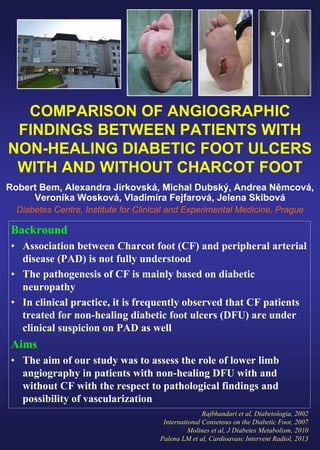
• Association between Charcot foot (CF) and peripheral arterial
disease (PAD) is not fully understood
• The pathogenesis of CF is mainly based on diabetic
neuropathy
• In clinical practice, it is frequently observed that CF patients
treated for non-healing diabetic foot ulcers (DFU) are under
clinical suspicion on PAD as well
Aims
• The aim of our study was to assess the role of lower limb
angiography in patients with non-healing DFU with and
without CF with the respect to pathological findings and
possibility of vascularization
Rajbhandari et al, Diabetologia, 2002
International Consensus on the Diabetic Foot, 2007
Molines et al, J Diabetes Metabolism, 2010
Palena LM et al, Cardioavasc Intervent Radiol, 2013
Patients and methods
Characteristics CF group Controls P
n 29 48 -
Age (years) 64±9.6 66.4±9.5 NS
Sex (M/F) 22/7 40/8 NS
Duration of DM (years) 23.9±9.4 18.5±10 0.02
Type 2 Diabetes n (%) 21 (72) 36(75) NS
HbA1C (%) 8.32±1.19 8.03±1.38 NS
VPT (%) 100 83.3 NS
Data are mean ± SDVPT= vibration perception treshold
The presence of PAD was compared between:
- 29 diabetic patients with ulcerated Charcot foot (CF group)
- 48 consecutive patients presenting with a new DFU, but without
CF (Controls)
The diagnosis of PAD
Clinical suspicion
(e.g. nonhealing ulcer,
gangrene, ...)
TcpO2 < 40mm Hg
Angiography
The presence of PAD was defined as an
abnormal angiographic findings on lower
limb arteries (stenosis >70% or oclusion)
Diagnosis of Charcot
foot
Active:
- Clinical - hot, swollen foot with/without
redness and skin temperatures ≥2 0C
compared to the contralateral foot
- Radiological examination (positive three
phase technetium-99m-labelled
bisphosphonate bone scan)
Inactive:
- Active CNO in history
- Reduction of clinical signs and
temperature difference below 2°C, typical
deformity
Graziani L et al, Eur J Vasc Endovasc Surg, 2007
Graziani classification
Characteristics of the study subjects
Results
The distribution of PAD by Graziani classification
Class Angiographic Finding CF group (%) Controls (%) p
1
Isolated, one vessel tibial or peroneal artery
obstruction
0 0 NS
2a
Isolated femoral/popliteal artery or two below
knee arteries obstructed but with patency of
one of the two tibial arteries
6.9 0 NS
2b
Isolated femoral/popliteal artery or two below
knee tibial arteries obstructed but with patency
of the peroneal artery
31.1 6.3 0.01
3
Isolated, one artery occluded and multiple
stenosis of tibial/peroneal and/or femoral/
popliteal arteries
27.6 25 NS
4
Two arteries occluded and multiple stenosis of
tibial/peroneal and/or femoral/popliteal vessels
27.6 41.6 0.04
5
Occlusion of all tibial and peroneal arteries
(below knee cross-sectional occlusion)
3.4 12.5 NS
6
Three arteries occluded and multiple stenosis of
tibial/peroneal and/or femoral/popliteal arteries
3.4 14.6 NS
7
Multiple femoro-popliteal obstructions with no
visible below the knee arterial segments
0 0 NS
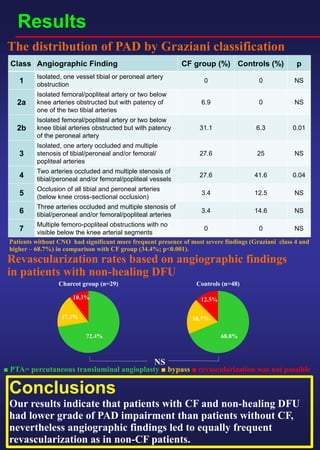
Revascularization rates based on angiographic findings
in patients with non-healing DFU
Charcot group (n=29) Controls (n=48)
NS
■ PTA= percutaneous transluminal angioplasty ■ bypass ■ revascularization was not possible
72.4% 68.8%
17.3% 18.7%
10.3% 12.5%
Patients without CNO had significant more frequent presence of most severe findings (Graziani class 4 and
higher – 68.7%) in comparison with CF group (34.4%; p<0.001).
Conclusions
Our results indicate that patients with CF and non-healing DFU
had lower grade of PAD impairment than patients without CF,
nevertheless angiographic findings led to equally frequent
revascularization as in non-CF patients.

EWMA 2014 - EP482 COMPARISON OF ANGIOGRAPHIC FINDINGS BETWEEN PATIENTS WITH NON-HEALING DIABETIC FOOT ULCERS WITH AND WITHOUT CHARCOT FOOT

  • 1.
    COMPARISON OF ANGIOGRAPHIC FINDINGSBETWEEN PATIENTS WITH NON-HEALING DIABETIC FOOT ULCERS WITH AND WITHOUT CHARCOT FOOT Robert Bem, Alexandra Jirkovská, Michal Dubský, Andrea Němcová, Veronika Wosková, Vladimíra Fejfarová, Jelena Skibová Diabetes Centre, Institute for Clinical and Experimental Medicine, Prague Backround • Association between Charcot foot (CF) and peripheral arterial disease (PAD) is not fully understood • The pathogenesis of CF is mainly based on diabetic neuropathy • In clinical practice, it is frequently observed that CF patients treated for non-healing diabetic foot ulcers (DFU) are under clinical suspicion on PAD as well Aims • The aim of our study was to assess the role of lower limb angiography in patients with non-healing DFU with and without CF with the respect to pathological findings and possibility of vascularization Rajbhandari et al, Diabetologia, 2002 International Consensus on the Diabetic Foot, 2007 Molines et al, J Diabetes Metabolism, 2010 Palena LM et al, Cardioavasc Intervent Radiol, 2013
  • 2.
    Patients and methods CharacteristicsCF group Controls P n 29 48 - Age (years) 64±9.6 66.4±9.5 NS Sex (M/F) 22/7 40/8 NS Duration of DM (years) 23.9±9.4 18.5±10 0.02 Type 2 Diabetes n (%) 21 (72) 36(75) NS HbA1C (%) 8.32±1.19 8.03±1.38 NS VPT (%) 100 83.3 NS Data are mean ± SDVPT= vibration perception treshold The presence of PAD was compared between: - 29 diabetic patients with ulcerated Charcot foot (CF group) - 48 consecutive patients presenting with a new DFU, but without CF (Controls) The diagnosis of PAD Clinical suspicion (e.g. nonhealing ulcer, gangrene, ...) TcpO2 < 40mm Hg Angiography The presence of PAD was defined as an abnormal angiographic findings on lower limb arteries (stenosis >70% or oclusion) Diagnosis of Charcot foot Active: - Clinical - hot, swollen foot with/without redness and skin temperatures ≥2 0C compared to the contralateral foot - Radiological examination (positive three phase technetium-99m-labelled bisphosphonate bone scan) Inactive: - Active CNO in history - Reduction of clinical signs and temperature difference below 2°C, typical deformity Graziani L et al, Eur J Vasc Endovasc Surg, 2007 Graziani classification Characteristics of the study subjects
  • 3.
    Results The distribution ofPAD by Graziani classification Class Angiographic Finding CF group (%) Controls (%) p 1 Isolated, one vessel tibial or peroneal artery obstruction 0 0 NS 2a Isolated femoral/popliteal artery or two below knee arteries obstructed but with patency of one of the two tibial arteries 6.9 0 NS 2b Isolated femoral/popliteal artery or two below knee tibial arteries obstructed but with patency of the peroneal artery 31.1 6.3 0.01 3 Isolated, one artery occluded and multiple stenosis of tibial/peroneal and/or femoral/ popliteal arteries 27.6 25 NS 4 Two arteries occluded and multiple stenosis of tibial/peroneal and/or femoral/popliteal vessels 27.6 41.6 0.04 5 Occlusion of all tibial and peroneal arteries (below knee cross-sectional occlusion) 3.4 12.5 NS 6 Three arteries occluded and multiple stenosis of tibial/peroneal and/or femoral/popliteal arteries 3.4 14.6 NS 7 Multiple femoro-popliteal obstructions with no visible below the knee arterial segments 0 0 NS Revascularization rates based on angiographic findings in patients with non-healing DFU Charcot group (n=29) Controls (n=48) NS ■ PTA= percutaneous transluminal angioplasty ■ bypass ■ revascularization was not possible 72.4% 68.8% 17.3% 18.7% 10.3% 12.5% Patients without CNO had significant more frequent presence of most severe findings (Graziani class 4 and higher – 68.7%) in comparison with CF group (34.4%; p<0.001). Conclusions Our results indicate that patients with CF and non-healing DFU had lower grade of PAD impairment than patients without CF, nevertheless angiographic findings led to equally frequent revascularization as in non-CF patients.