TOTAL CONTACT CASTING –
A SOUTH AFRICAN APPROACH TOWARDS
OFFLOADING THE DIABETIC FOOT
LIEZL NAUDE
WOUND MANAGEMENT SPECIALIST AT ADVANCED LOWER LIMB & WOUND MANAGEMENT CENTRE, PRETORIA, SOUTH AFRICA
HOWARD ALEXANDER
PODIATRIST AT ALEXANDER & FARREL PODIATRY EDENVALE, SOUTH AFRICA
INTRODUCTION
• Foot ulcerations are the most common complications associated with
the patient living with diabetes worldwide and South Africa is no
different.
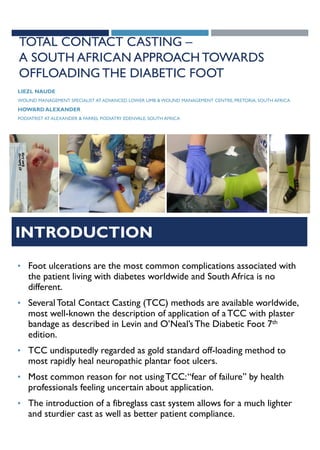
• SeveralTotal Contact Casting (TCC) methods are available worldwide,
most well-known the description of application of aTCC with plaster
bandage as described in Levin and O’Neal’sThe Diabetic Foot 7th
edition.
• TCC undisputedly regarded as gold standard off-loading method to
most rapidly heal neuropathic plantar foot ulcers.
• Most common reason for not usingTCC:“fear of failure” by health
professionals feeling uncertain about application.
• The introduction of a fibreglass cast system allows for a much lighter
and sturdier cast as well as better patient compliance.
STUDY AIM & METHOD
 To adapt the current existingTCC systems available to fit the
South African Environment.
 Total of fifty (n = 50)TCC’s were applied at the two (2)
centres.
 Patient Inclusion criteria:
 Neuropathic ulcers in need of off-loading by reduction of plantar pressures
whilst walking.
 Charcot foot in order to stabilize the structural deformity with or without
plantar ulceration.
 Several existingTCC methods were evaluated such as:
• Removable Cast Walker
• Plaster Bandage
• Fibre glass cast
 Two fibreglass systems were evaluated and described for the
purpose of this study
EWMA 2014 EP495 2
System A
o Fibreglass hard cast x 1
o Fibreglass soft cast x2
o Stockinet x 2
o Microfoam
o Woolpadding
o Cast Shoe
System B
o Fibreglass hard cast x 1
o Fibreglass soft cast x2
o Stockinette x 1
o Water resistant Stockinette x 1
o Felt padding
o Woolpadding
o Cast Shoe
ATTRIBUTES EVALUATED IN ORDER
TO ENHANCE PATIENT
COMPLIANCE:
 Cast weight (light weight fibreglass
material)
 Durability (Strong and re-usable)
 Removability (easy re-application)
 Aeration (good evaporation due to
materials used)
 Wash-ability & Hygiene
 Total Plantar surface contact
 Protection and prevention of skin
abrasions and additional pressure points
 Open toe box (for easy inspection of toes
also allowing aeration)
CASE EXAMPLES
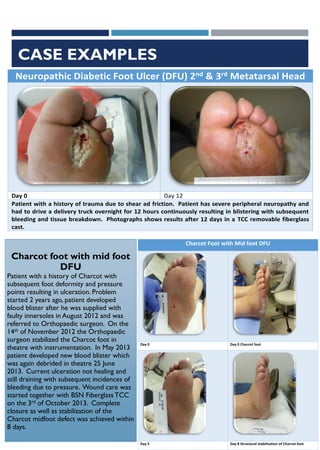
Neuropathic Diabetic Foot Ulcer (DFU) 2nd & 3rd Metatarsal Head
Day 0 Day 12
Patient with a history of trauma due to shear ad friction. Patient has severe peripheral neuropathy and
had to drive a delivery truck overnight for 12 hours continuously resulting in blistering with subsequent
bleeding and tissue breakdown. Photographs shows results after 12 days in a TCC removable fiberglass
cast.
EWMA 2014 EP495
3
Charcot Foot with Mid foot DFU
Day 0 Day 0 Charcot foot
Day 5 Day 8 Structural stabilisation of Charcot foot
Charcot foot with mid foot
DFU
Patient with a history of Charcot with
subsequent foot deformity and pressure
points resulting in ulceration. Problem
started 2 years ago, patient developed
blood blister after he was supplied with
faulty innersoles in August 2012 and was
referred to Orthopaedic surgeon. On the
14th of November 2012 the Orthopaedic
surgeon stabilized the Charcot foot in
theatre with instrumentation. In May 2013
patient developed new blood blister which
was again debrided in theatre 25 June
2013. Current ulceration not healing and
still draining with subsequent incidences of
bleeding due to pressure. Wound care was
started together with BSN Fiberglass TCC
on the 3rd of October 2013. Complete
closure as well as stabilization of the
Charcot midfoot defect was achieved within
8 days.
RESULTS
 System A & B both were effective in reducing plantar pressures while walking by 84% to 92%.
 Both systems demonstrate efficacy in stabilising Charcot foot.
 Both systems demonstrate a cohort mean wound closure time of 36 days during this study.
 Both systems reduced lower limb oedema due to the soft fibre glass cast.
 Both systems improved patient mobility.
 Both systems improved patient quality of life.
 Both systems reduced overall wound care costs.
 Both systems prevented further amputation.
 System B provides better aeration than System A, the Removable Cast Walker and Plaster
cast.
 System B enables better hygiene as a removable, washable cast.
 Improved patient’s adherence were seen with System B due to the aeration and hygiene
associated with the cast.
EWMA 2014 EP495
4
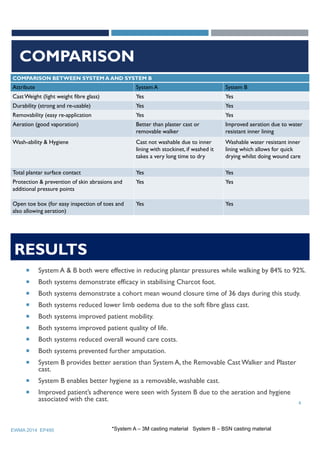
COMPARISON BETWEEN SYSTEM A AND SYSTEM B
Attribute System A System B
CastWeight (light weight fibre glass) Yes Yes
Durability (strong and re-usable) Yes Yes
Removability (easy re-application Yes Yes
Aeration (good vaporation) Better than plaster cast or
removable walker
Improved aeration due to water
resistant inner lining
Wash-ability & Hygiene Cast not washable due to inner
lining with stockinet, if washed it
takes a very long time to dry
Washable water resistant inner
lining which allows for quick
drying whilst doing wound care
Total plantar surface contact Yes Yes
Protection & prevention of skin abrasions and
additional pressure points
Yes Yes
Open toe box (for easy inspection of toes and
also allowing aeration)
Yes Yes
COMPARISON
*System A – 3M casting material System B – BSN casting material
CONCLUSION
 The study showed that through small adjustments
better patient adherence can be achieved especially in
the warm South African climate.
 System B demonstrated an improved patient
adherence due to the wash ability and aeration of the
cast material
 It is recommended that more skills training
workshops are needed in order to guide health
professionals and change perceptions in incorporating
TCC as the gold standard in all practices working
with patients with diabetic foot ulcers.
 Howard Alexander
 www.fixmyfeet.biz
 howardal@mweb.co.za
 Liezl Naude
 www.eloquent.co.za
 Liezl@eloquent.co.za
EWMA 2014 EP495
5
 1. Sinacore, D.R., Mueller, M.J.,. Off-loading for diabetic foot disease. [book auth.] Pfeifer M.A., Bowker J.H. Levin and O'Neal'sThe Diabetic Foot. Philadelphia : Mosby Elsevier, 2008, 13, pp. 287-
304.
 2. Wounds International. International Best Practice Guidelines:Wound Management in Diabetic Foot Ulcers. International Best Practice Guidelines:Wound Management in Diabetic Foot Ulcers.
London :Wounds International, 2013.Available from: www.woundsinternational.com.
 3. Current concepts in offloading diabetic foot ulcers. Fitzgerald R.H. 9, 2009, PodiatryToday,Vol. 22, pp. 16-21.
 4. Foot ulcers in the diabetic patient, prevention and treatment. Wu S.C., DriverV.R.,Wrobel J.S.,Armstrong D.G.,. 1, 2007,Vasc Health Risk Manag,Vol. 3, pp. 65-76.
 5. Podiatric intervention in the management of a diabetic foot ulceration: a case study using total contact casting. F.J., Howard. 2, s.l. : Medpharm Publications, 2012,Wound Healing Souther Africa,Vol. 5,
pp. 96-101.
 6. Cavanagh P.R., Ulbrecht J.S.,. The biomechanics of the foot in diabetes mellitus. [book auth.] Pfeifer M.A., Bowker J.H. Levin and O'Neal's the Diabetic Foot. Philadelphia : Mosby Elsevier,
2008, pp. 115-184.
 7. Armstrong D.G., Bevilacqua N.J.,Wu S.C.,. Offloading foot wounds in people with diabetes. [book auth.] Rodeheaver G.T., Sibbald R.G., Krasner D.L. ChronicWound Care: a clinical source
book for healthcare professionals. 4th edition. Malvern : HMP Communications, 2007, pp. 557-563.
 8. Effectiveness and saftey of a fiberglass offbearing cast versus a therapeutic shoe in the treatment of neuropathic foot ulcers. Caravaggi C., Faglia E., De Gigglio R., et al,. 12, 2000, Diabetes Care,
Vol. 23, pp. 1746-1751.
 9. What are the most effective interventions in preventing diabetic foot ulcers? Lavery L.A., Peters E.J.G.,Armstrong D.G.,. 1, 2008, International Wound Journal,Vol. 1, pp. 425-433.
 10. Orsted H.L., Inlow S.,. The team approach to treating ulcers in people with diabetes. [book auth.] Rodeheaver G.T., Sibbald R.G., Krasner D.L. Chronic wound care: a clinical source book for
healthcare professionals. 4th edition. Malvern : HMP Communications, 2007, pp. 565-571.
 11. Krasner D.L., Rodeheaver G.T., Sibbald R.G.,. Inter-professional wound care. Chronic wound care: a clinical source book for healthcare professionals, 4th edition. Malvern : HMP
Communications, 2007, pp. 3-11.
 12. Kenshole A.B., Macdonald J.,. The role of the healthcare team in the prevention and management of diabetic foot ulcers. [book auth.] Rodeheaver G.T., Sibbald R.G., Krasner D.L. Chronic
wound care: a clinical source book for healthcare professionals 4th edition. Malvern : HMP Communications, 2007, pp. 543-547.
 13. Principles of management of vascular problems in the diabetic foot. Tudhope L. 2, s.l. : CME, 2010,Vol. 28, pp. 158-163.
 14. Landis S., Ryan S.,Woo K., Sibbald R.G.,. Infections in chronic wounds. [book auth.] Rodeheaver G.T., Sibbald R.G., Krasner D.L. Chronic wound care: a clinical source book for healthcare
professionals. 4th edition. Malvern : HMP Communications, 2007, pp. 299-321
REFERENCES

EWMA 2014 - EP495 TOTAL CONTACT CASTING – A SOUTH AFRICAN APPROACH TOWARDS OFFLOADING THE DIABETIC FOOT

  • 1.
    TOTAL CONTACT CASTING– A SOUTH AFRICAN APPROACH TOWARDS OFFLOADING THE DIABETIC FOOT LIEZL NAUDE WOUND MANAGEMENT SPECIALIST AT ADVANCED LOWER LIMB & WOUND MANAGEMENT CENTRE, PRETORIA, SOUTH AFRICA HOWARD ALEXANDER PODIATRIST AT ALEXANDER & FARREL PODIATRY EDENVALE, SOUTH AFRICA INTRODUCTION • Foot ulcerations are the most common complications associated with the patient living with diabetes worldwide and South Africa is no different. • SeveralTotal Contact Casting (TCC) methods are available worldwide, most well-known the description of application of aTCC with plaster bandage as described in Levin and O’Neal’sThe Diabetic Foot 7th edition. • TCC undisputedly regarded as gold standard off-loading method to most rapidly heal neuropathic plantar foot ulcers. • Most common reason for not usingTCC:“fear of failure” by health professionals feeling uncertain about application. • The introduction of a fibreglass cast system allows for a much lighter and sturdier cast as well as better patient compliance.
  • 2.
    STUDY AIM &METHOD  To adapt the current existingTCC systems available to fit the South African Environment.  Total of fifty (n = 50)TCC’s were applied at the two (2) centres.  Patient Inclusion criteria:  Neuropathic ulcers in need of off-loading by reduction of plantar pressures whilst walking.  Charcot foot in order to stabilize the structural deformity with or without plantar ulceration.  Several existingTCC methods were evaluated such as: • Removable Cast Walker • Plaster Bandage • Fibre glass cast  Two fibreglass systems were evaluated and described for the purpose of this study EWMA 2014 EP495 2 System A o Fibreglass hard cast x 1 o Fibreglass soft cast x2 o Stockinet x 2 o Microfoam o Woolpadding o Cast Shoe System B o Fibreglass hard cast x 1 o Fibreglass soft cast x2 o Stockinette x 1 o Water resistant Stockinette x 1 o Felt padding o Woolpadding o Cast Shoe ATTRIBUTES EVALUATED IN ORDER TO ENHANCE PATIENT COMPLIANCE:  Cast weight (light weight fibreglass material)  Durability (Strong and re-usable)  Removability (easy re-application)  Aeration (good evaporation due to materials used)  Wash-ability & Hygiene  Total Plantar surface contact  Protection and prevention of skin abrasions and additional pressure points  Open toe box (for easy inspection of toes also allowing aeration)
  • 3.
    CASE EXAMPLES Neuropathic DiabeticFoot Ulcer (DFU) 2nd & 3rd Metatarsal Head Day 0 Day 12 Patient with a history of trauma due to shear ad friction. Patient has severe peripheral neuropathy and had to drive a delivery truck overnight for 12 hours continuously resulting in blistering with subsequent bleeding and tissue breakdown. Photographs shows results after 12 days in a TCC removable fiberglass cast. EWMA 2014 EP495 3 Charcot Foot with Mid foot DFU Day 0 Day 0 Charcot foot Day 5 Day 8 Structural stabilisation of Charcot foot Charcot foot with mid foot DFU Patient with a history of Charcot with subsequent foot deformity and pressure points resulting in ulceration. Problem started 2 years ago, patient developed blood blister after he was supplied with faulty innersoles in August 2012 and was referred to Orthopaedic surgeon. On the 14th of November 2012 the Orthopaedic surgeon stabilized the Charcot foot in theatre with instrumentation. In May 2013 patient developed new blood blister which was again debrided in theatre 25 June 2013. Current ulceration not healing and still draining with subsequent incidences of bleeding due to pressure. Wound care was started together with BSN Fiberglass TCC on the 3rd of October 2013. Complete closure as well as stabilization of the Charcot midfoot defect was achieved within 8 days.
  • 4.
    RESULTS  System A& B both were effective in reducing plantar pressures while walking by 84% to 92%.  Both systems demonstrate efficacy in stabilising Charcot foot.  Both systems demonstrate a cohort mean wound closure time of 36 days during this study.  Both systems reduced lower limb oedema due to the soft fibre glass cast.  Both systems improved patient mobility.  Both systems improved patient quality of life.  Both systems reduced overall wound care costs.  Both systems prevented further amputation.  System B provides better aeration than System A, the Removable Cast Walker and Plaster cast.  System B enables better hygiene as a removable, washable cast.  Improved patient’s adherence were seen with System B due to the aeration and hygiene associated with the cast. EWMA 2014 EP495 4 COMPARISON BETWEEN SYSTEM A AND SYSTEM B Attribute System A System B CastWeight (light weight fibre glass) Yes Yes Durability (strong and re-usable) Yes Yes Removability (easy re-application Yes Yes Aeration (good vaporation) Better than plaster cast or removable walker Improved aeration due to water resistant inner lining Wash-ability & Hygiene Cast not washable due to inner lining with stockinet, if washed it takes a very long time to dry Washable water resistant inner lining which allows for quick drying whilst doing wound care Total plantar surface contact Yes Yes Protection & prevention of skin abrasions and additional pressure points Yes Yes Open toe box (for easy inspection of toes and also allowing aeration) Yes Yes COMPARISON *System A – 3M casting material System B – BSN casting material
  • 5.
    CONCLUSION  The studyshowed that through small adjustments better patient adherence can be achieved especially in the warm South African climate.  System B demonstrated an improved patient adherence due to the wash ability and aeration of the cast material  It is recommended that more skills training workshops are needed in order to guide health professionals and change perceptions in incorporating TCC as the gold standard in all practices working with patients with diabetic foot ulcers.  Howard Alexander  www.fixmyfeet.biz  howardal@mweb.co.za  Liezl Naude  www.eloquent.co.za  Liezl@eloquent.co.za EWMA 2014 EP495 5  1. Sinacore, D.R., Mueller, M.J.,. Off-loading for diabetic foot disease. [book auth.] Pfeifer M.A., Bowker J.H. Levin and O'Neal'sThe Diabetic Foot. Philadelphia : Mosby Elsevier, 2008, 13, pp. 287- 304.  2. Wounds International. International Best Practice Guidelines:Wound Management in Diabetic Foot Ulcers. International Best Practice Guidelines:Wound Management in Diabetic Foot Ulcers. London :Wounds International, 2013.Available from: www.woundsinternational.com.  3. Current concepts in offloading diabetic foot ulcers. Fitzgerald R.H. 9, 2009, PodiatryToday,Vol. 22, pp. 16-21.  4. Foot ulcers in the diabetic patient, prevention and treatment. Wu S.C., DriverV.R.,Wrobel J.S.,Armstrong D.G.,. 1, 2007,Vasc Health Risk Manag,Vol. 3, pp. 65-76.  5. Podiatric intervention in the management of a diabetic foot ulceration: a case study using total contact casting. F.J., Howard. 2, s.l. : Medpharm Publications, 2012,Wound Healing Souther Africa,Vol. 5, pp. 96-101.  6. Cavanagh P.R., Ulbrecht J.S.,. The biomechanics of the foot in diabetes mellitus. [book auth.] Pfeifer M.A., Bowker J.H. Levin and O'Neal's the Diabetic Foot. Philadelphia : Mosby Elsevier, 2008, pp. 115-184.  7. Armstrong D.G., Bevilacqua N.J.,Wu S.C.,. Offloading foot wounds in people with diabetes. [book auth.] Rodeheaver G.T., Sibbald R.G., Krasner D.L. ChronicWound Care: a clinical source book for healthcare professionals. 4th edition. Malvern : HMP Communications, 2007, pp. 557-563.  8. Effectiveness and saftey of a fiberglass offbearing cast versus a therapeutic shoe in the treatment of neuropathic foot ulcers. Caravaggi C., Faglia E., De Gigglio R., et al,. 12, 2000, Diabetes Care, Vol. 23, pp. 1746-1751.  9. What are the most effective interventions in preventing diabetic foot ulcers? Lavery L.A., Peters E.J.G.,Armstrong D.G.,. 1, 2008, International Wound Journal,Vol. 1, pp. 425-433.  10. Orsted H.L., Inlow S.,. The team approach to treating ulcers in people with diabetes. [book auth.] Rodeheaver G.T., Sibbald R.G., Krasner D.L. Chronic wound care: a clinical source book for healthcare professionals. 4th edition. Malvern : HMP Communications, 2007, pp. 565-571.  11. Krasner D.L., Rodeheaver G.T., Sibbald R.G.,. Inter-professional wound care. Chronic wound care: a clinical source book for healthcare professionals, 4th edition. Malvern : HMP Communications, 2007, pp. 3-11.  12. Kenshole A.B., Macdonald J.,. The role of the healthcare team in the prevention and management of diabetic foot ulcers. [book auth.] Rodeheaver G.T., Sibbald R.G., Krasner D.L. Chronic wound care: a clinical source book for healthcare professionals 4th edition. Malvern : HMP Communications, 2007, pp. 543-547.  13. Principles of management of vascular problems in the diabetic foot. Tudhope L. 2, s.l. : CME, 2010,Vol. 28, pp. 158-163.  14. Landis S., Ryan S.,Woo K., Sibbald R.G.,. Infections in chronic wounds. [book auth.] Rodeheaver G.T., Sibbald R.G., Krasner D.L. Chronic wound care: a clinical source book for healthcare professionals. 4th edition. Malvern : HMP Communications, 2007, pp. 299-321 REFERENCES