Cutimed®
FAST FACTS ON A NEW 3D MATRIX™
TECHNOLOGY
THAT FAST-TRACKS HEALING FOR CHRONIC WOUNDS
PRIMARY ENDPOINT
• Reduction in wound area
COMPELLING RESULTS
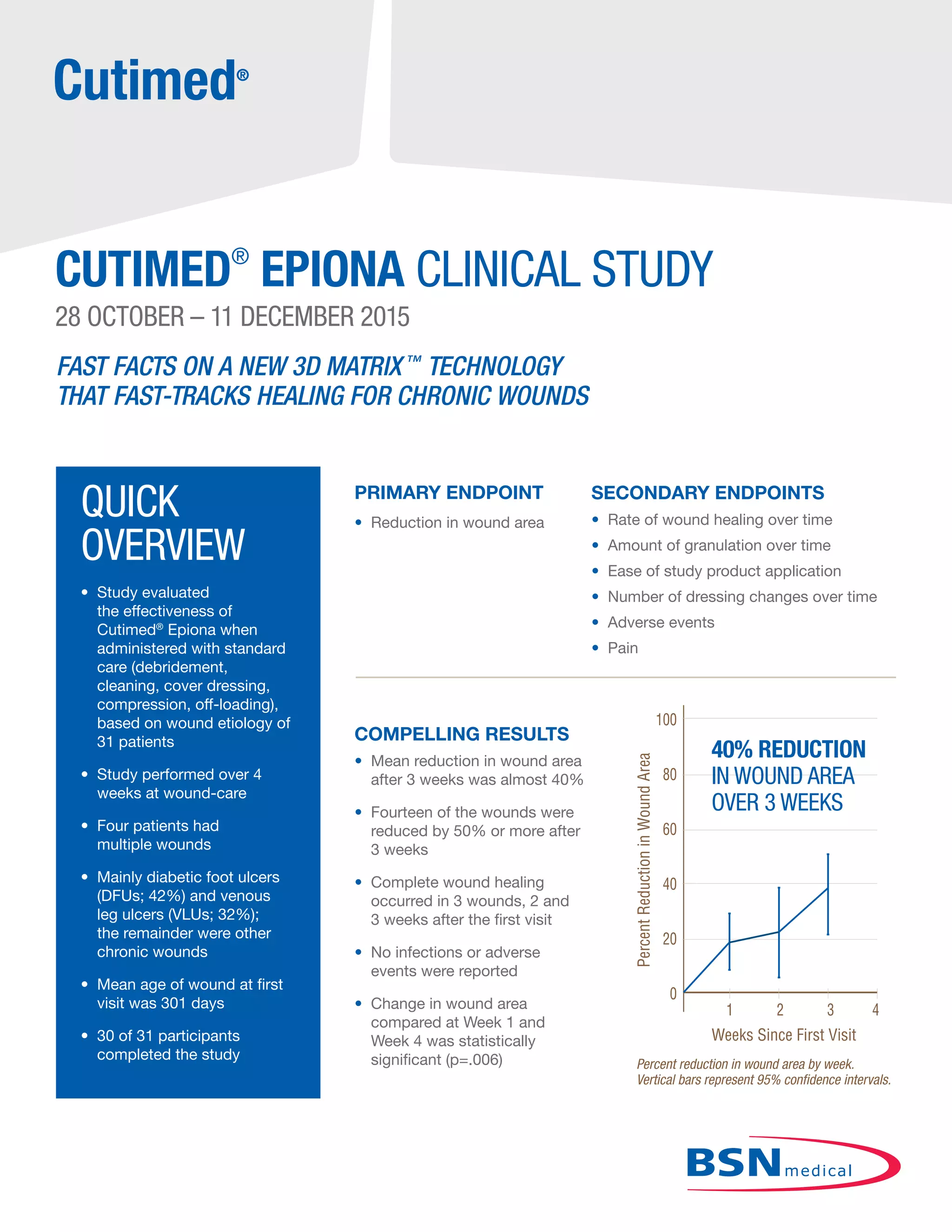
• Mean reduction in wound area
after 3 weeks was almost 40%
• Fourteen of the wounds were
reduced by 50% or more after
3 weeks
• Complete wound healing
occurred in 3 wounds, 2 and
3 weeks after the first visit
• No infections or adverse
events were reported
• Change in wound area
compared at Week 1 and
Week 4 was statistically
significant (p=.006)
SECONDARY ENDPOINTS
• Rate of wound healing over time
• Amount of granulation over time
• Ease of study product application
• Number of dressing changes over time
• Adverse events
• Pain
100
80
60
40
20
0
1 2 3 4
Weeks Since First Visit
QUICK
OVERVIEW
• Study evaluated
the effectiveness of
Cutimed®
Epiona when
administered with standard
care (debridement,
cleaning, cover dressing,
compression, off-loading),
based on wound etiology of
31 patients
• Study performed over 4
weeks at wound-care
• Four patients had
multiple wounds
• Mainly diabetic foot ulcers
(DFUs; 42%) and venous
leg ulcers (VLUs; 32%);
the remainder were other
chronic wounds
• Mean age of wound at first
visit was 301 days
• 30 of 31 participants
completed the study
28 OCTOBER – 11 DECEMBER 2015
CUTIMED®
EPIONA CLINICAL STUDY
Percent reduction in wound area by week.
Vertical bars represent 95% confidence intervals.
40% REDUCTION
IN WOUND AREA
OVER 3 WEEKS
Patient Variable Count (%) Mean/Median (SD)
Gender
Male 15 (48)
Female 16 (52)
Race
Caucasian 28 (90)
African American 3 (10)
Drug Count 9.3/9 (5.64)
Selected Drug Categories
For pain 19 (61)
For neuropathic pain 13 (42)
Pain for wound 1 (3)
For diabetes 15 (48)
For dyslipidemia/high cholesterol 15 (48)
For mental illness 7 (23)
For renal disorders 2 (7)
For hypertension 23 (74)
Wound Variable Count (%) Mean/Median (SD)
Type
DFU (diabetic foot ulcer) 13 (42)
VLU (venous leg ulcer) 10 (32)
Traumatic 4 (13)
PU (pressure ulcer) 2 (7)
Mixed 1 (3)
Surgical 1 (3)
Initial area (cm2)
All 4.8/1.8 (8.38)
DFU (diabetic foot ulcer) 2.1/1.5 (1.68)
VLU (venous leg ulcer) 8.9/2.3 (13.21)
Traumatic 1.6/1.5 (1.13)
PU (pressure ulcer) 0.5
Mixed 15.8
Surgical 11.2
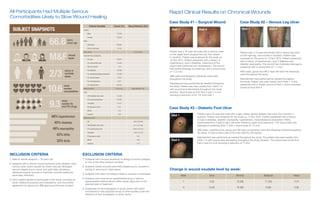
All Participants Had Multiple Serious
Comorbidities Likely to Slow Wound Healing
INCLUSION CRITERIA
1. Male or female subjects  18 years old
2. Subjects with a chronic wound (pressure ulcer, diabetic ulcer,
venous ulcer, ulcers caused by mixed vascular etiologies,
second-degree burns, donor and graft sites, abrasions,
dehisced surgical wounds or traumatic wounds healing by
secondary intention)
3. Each subject agreed to participate in the study, including all
study-related procedures and evaluations, and documents
agreement by signing the IRB-approved informed consent
EXCLUSION CRITERIA
1. Subjects with a known sensitivity or allergy to bovine collagen
or one of the other product contents
2. Subjects whose wounds were third-degree burns, covered in
eschar or were burnt, dead tissue
3. Subjects who were not willing or able to consent or participate
4. Subjects who received an experimental drug or used an
experimental medical device within seven days prior to the
planned start of treatment
5. Employees of the Investigator or study center with direct
involvement in the proposed study or other studies under the
direction of that Investigator or study center
Rapid Clinical Results on Chronical Wounds
Visit 4
Patient was a 78-year-old male with a chronic ulcer
on the upper back (surgical wound), four weeks
in duration. Patient was screened for the study on
10 Nov 2015. Patient presented with a history of
hypertension, type II diabetes, melanoma of the
upper back (removed) and dyslipidemia. The wound
had severe drainage at screening, with a wound area
of 11.2 cm2.
ABD pads and Medipore dressings were used
throughout the study.	
Debridement was performed as needed throughout
the study. Patient was seen weekly from Visits 1-4
with wound area decreasing throughout the study
duration. Wound area at final Visit 4 was 1.4 cm2
showing a reduction of 87.1% from Visit 1.
Case Study #1 – Surgical Wound
Visit 1 Visit 4
Patient was a 73-year-old female with a venous leg ulcer
on the right leg, nine months in duration. Patient was
screened for the study on 10 Nov 2015. Patient presented
with a history of hypertension, type II diabetes and
diabetic neuropathy. The wound had moderate drainage at
screening with a wound area of 1.1 cm2.
ABD pads, gauze and 3M 2-layer lite were the dressings
used throughout the study.
Debridement was performed as needed throughout
the study. Patient was seen weekly from Visits 1-4 and
presented with a closed wound at Visit 3, which remained
closed at final Visit 4.
Case Study #2 – Venous Leg Ulcer
Visit 1
Visit 4
Patient was a 53-year-old male with a right, distal, plantar diabetic foot ulcer, four months in
duration. Patient was screened for the study on 17 Nov 2015. Patient presented with a history
or type II diabetes, diabetic neuropathy, hypertension, transmetatarsal amputation (TMA),
cholecystectomy, tubes in ears, left knee meniscus repair and vasectomy. The wound had mild
drainage at screening (Visit 1) with a wound area of 1.8 cm2.
ABD pads, hydrofera blue, gauze and 3M layer compression were the dressings utilized throughout
the study. A total contact cast (TCC) was used for off-loading.
Debridement was performed as needed throughout the study. The patient was seen weekly from
Visits 1-4 with wound area decreasing throughout the study duration. The wound area at the final
Visit 4 was 0.5 cm2 showing a reduction of 71.8%.
Case Study #3 – Diabetic Foot Ulcer
Week None Minimal Moderate Heavy
1 0 (0) 18 (58) 11 (35) 2 (7)
4 5 (16) 18 (58) 8 (26) 0 (0)
Change in wound exudate level by week:
66.6years
mean age
MFalmost
equal
2/3
obese or
morbidly
obese
10.6
mean
number
comorbidities
9.3
mean
number Rx
and OTC drugs
SUBJECT SNAPSHOTS
68% hypertension
65% diabetes
42% DFUs
32% VLUs
48% neuropathy
Visit 1
Visit 1
Cutimed®
Epiona: Helps Speed Healing
for Chronic Wounds
•	The mean age of the wound at first visit was 301 days
•	Three weeks into the study, 14 of the 31 patients’ wounds (45%)
were reduced by 50% or more
•	Cutimed®
Epiona’s native collagen provides structural support with an ECM-like
scaffold to enhance tissue generation and promote healing of stalled wounds
	 –	It transforms into a flexible, moist gel covering when exposed
to would exudate or blood
	 –	Its unique and flexible 3D Matrix™
Technology provides an open,
porous structure to help capture and bind excessive proteases and
inflammation-inducing elements
	 –	Because it acts like an ECM scaffold, the collagen fibre network
encourages rapid cell proliferation and tissue growth
	 –	Cutimed®
Epiona helps put chronic wounds on the fast track to
healing—safely and inexpensively
Study Methodology
An intent-to-treat (ITT) approach was used for analyses. For missing observations, the
last observation carried forward (LOCF) principle was used. For wounds that healed, the
following variables were set to 0 at Week 4: area, pain, exudate level. Study variables were
summarized as means and standard deviations (SDs) for continuous variables unless data
were non-normal, as determined by the Shapiro-Wilk test, in which case medians were
also reported, and proportions or percentages of categorical variables. Paired t tests were
used to compare trial endpoints if data were normal, and the Wilcoxon signed rank test
is data were non-normal, and differences existed. To adjust for the family-wise error rate
(FWER), p values were reported using the Hochberg step-up procedure. Adjusted two-
side p values  0.05 were considered significant. PASW 19 (IBM, Chicago, IL) was used to
perform the statistical testing.
62460 RN ©2016 BSN medical Inc. REV 01/16
BSN medical Inc. 5825 Carnegie Blvd. Charlotte, NC 28209-4633
Tel. 704 554 9933 Fax 704 358 4558 www.bsnmedical.com
To order toll-free: BSN medical 800 552 1157

1_21_Epiona Clinical Study 62460 RN

  • 1.
    Cutimed® FAST FACTS ONA NEW 3D MATRIX™ TECHNOLOGY THAT FAST-TRACKS HEALING FOR CHRONIC WOUNDS PRIMARY ENDPOINT • Reduction in wound area COMPELLING RESULTS • Mean reduction in wound area after 3 weeks was almost 40% • Fourteen of the wounds were reduced by 50% or more after 3 weeks • Complete wound healing occurred in 3 wounds, 2 and 3 weeks after the first visit • No infections or adverse events were reported • Change in wound area compared at Week 1 and Week 4 was statistically significant (p=.006) SECONDARY ENDPOINTS • Rate of wound healing over time • Amount of granulation over time • Ease of study product application • Number of dressing changes over time • Adverse events • Pain 100 80 60 40 20 0 1 2 3 4 Weeks Since First Visit QUICK OVERVIEW • Study evaluated the effectiveness of Cutimed® Epiona when administered with standard care (debridement, cleaning, cover dressing, compression, off-loading), based on wound etiology of 31 patients • Study performed over 4 weeks at wound-care • Four patients had multiple wounds • Mainly diabetic foot ulcers (DFUs; 42%) and venous leg ulcers (VLUs; 32%); the remainder were other chronic wounds • Mean age of wound at first visit was 301 days • 30 of 31 participants completed the study 28 OCTOBER – 11 DECEMBER 2015 CUTIMED® EPIONA CLINICAL STUDY Percent reduction in wound area by week. Vertical bars represent 95% confidence intervals. 40% REDUCTION IN WOUND AREA OVER 3 WEEKS
  • 2.
    Patient Variable Count(%) Mean/Median (SD) Gender Male 15 (48) Female 16 (52) Race Caucasian 28 (90) African American 3 (10) Drug Count 9.3/9 (5.64) Selected Drug Categories For pain 19 (61) For neuropathic pain 13 (42) Pain for wound 1 (3) For diabetes 15 (48) For dyslipidemia/high cholesterol 15 (48) For mental illness 7 (23) For renal disorders 2 (7) For hypertension 23 (74) Wound Variable Count (%) Mean/Median (SD) Type DFU (diabetic foot ulcer) 13 (42) VLU (venous leg ulcer) 10 (32) Traumatic 4 (13) PU (pressure ulcer) 2 (7) Mixed 1 (3) Surgical 1 (3) Initial area (cm2) All 4.8/1.8 (8.38) DFU (diabetic foot ulcer) 2.1/1.5 (1.68) VLU (venous leg ulcer) 8.9/2.3 (13.21) Traumatic 1.6/1.5 (1.13) PU (pressure ulcer) 0.5 Mixed 15.8 Surgical 11.2 All Participants Had Multiple Serious Comorbidities Likely to Slow Wound Healing INCLUSION CRITERIA 1. Male or female subjects 18 years old 2. Subjects with a chronic wound (pressure ulcer, diabetic ulcer, venous ulcer, ulcers caused by mixed vascular etiologies, second-degree burns, donor and graft sites, abrasions, dehisced surgical wounds or traumatic wounds healing by secondary intention) 3. Each subject agreed to participate in the study, including all study-related procedures and evaluations, and documents agreement by signing the IRB-approved informed consent EXCLUSION CRITERIA 1. Subjects with a known sensitivity or allergy to bovine collagen or one of the other product contents 2. Subjects whose wounds were third-degree burns, covered in eschar or were burnt, dead tissue 3. Subjects who were not willing or able to consent or participate 4. Subjects who received an experimental drug or used an experimental medical device within seven days prior to the planned start of treatment 5. Employees of the Investigator or study center with direct involvement in the proposed study or other studies under the direction of that Investigator or study center Rapid Clinical Results on Chronical Wounds Visit 4 Patient was a 78-year-old male with a chronic ulcer on the upper back (surgical wound), four weeks in duration. Patient was screened for the study on 10 Nov 2015. Patient presented with a history of hypertension, type II diabetes, melanoma of the upper back (removed) and dyslipidemia. The wound had severe drainage at screening, with a wound area of 11.2 cm2. ABD pads and Medipore dressings were used throughout the study. Debridement was performed as needed throughout the study. Patient was seen weekly from Visits 1-4 with wound area decreasing throughout the study duration. Wound area at final Visit 4 was 1.4 cm2 showing a reduction of 87.1% from Visit 1. Case Study #1 – Surgical Wound Visit 1 Visit 4 Patient was a 73-year-old female with a venous leg ulcer on the right leg, nine months in duration. Patient was screened for the study on 10 Nov 2015. Patient presented with a history of hypertension, type II diabetes and diabetic neuropathy. The wound had moderate drainage at screening with a wound area of 1.1 cm2. ABD pads, gauze and 3M 2-layer lite were the dressings used throughout the study. Debridement was performed as needed throughout the study. Patient was seen weekly from Visits 1-4 and presented with a closed wound at Visit 3, which remained closed at final Visit 4. Case Study #2 – Venous Leg Ulcer Visit 1 Visit 4 Patient was a 53-year-old male with a right, distal, plantar diabetic foot ulcer, four months in duration. Patient was screened for the study on 17 Nov 2015. Patient presented with a history or type II diabetes, diabetic neuropathy, hypertension, transmetatarsal amputation (TMA), cholecystectomy, tubes in ears, left knee meniscus repair and vasectomy. The wound had mild drainage at screening (Visit 1) with a wound area of 1.8 cm2. ABD pads, hydrofera blue, gauze and 3M layer compression were the dressings utilized throughout the study. A total contact cast (TCC) was used for off-loading. Debridement was performed as needed throughout the study. The patient was seen weekly from Visits 1-4 with wound area decreasing throughout the study duration. The wound area at the final Visit 4 was 0.5 cm2 showing a reduction of 71.8%. Case Study #3 – Diabetic Foot Ulcer Week None Minimal Moderate Heavy 1 0 (0) 18 (58) 11 (35) 2 (7) 4 5 (16) 18 (58) 8 (26) 0 (0) Change in wound exudate level by week: 66.6years mean age MFalmost equal 2/3 obese or morbidly obese 10.6 mean number comorbidities 9.3 mean number Rx and OTC drugs SUBJECT SNAPSHOTS 68% hypertension 65% diabetes 42% DFUs 32% VLUs 48% neuropathy Visit 1 Visit 1
  • 3.
    Cutimed® Epiona: Helps SpeedHealing for Chronic Wounds • The mean age of the wound at first visit was 301 days • Three weeks into the study, 14 of the 31 patients’ wounds (45%) were reduced by 50% or more • Cutimed® Epiona’s native collagen provides structural support with an ECM-like scaffold to enhance tissue generation and promote healing of stalled wounds – It transforms into a flexible, moist gel covering when exposed to would exudate or blood – Its unique and flexible 3D Matrix™ Technology provides an open, porous structure to help capture and bind excessive proteases and inflammation-inducing elements – Because it acts like an ECM scaffold, the collagen fibre network encourages rapid cell proliferation and tissue growth – Cutimed® Epiona helps put chronic wounds on the fast track to healing—safely and inexpensively Study Methodology An intent-to-treat (ITT) approach was used for analyses. For missing observations, the last observation carried forward (LOCF) principle was used. For wounds that healed, the following variables were set to 0 at Week 4: area, pain, exudate level. Study variables were summarized as means and standard deviations (SDs) for continuous variables unless data were non-normal, as determined by the Shapiro-Wilk test, in which case medians were also reported, and proportions or percentages of categorical variables. Paired t tests were used to compare trial endpoints if data were normal, and the Wilcoxon signed rank test is data were non-normal, and differences existed. To adjust for the family-wise error rate (FWER), p values were reported using the Hochberg step-up procedure. Adjusted two- side p values 0.05 were considered significant. PASW 19 (IBM, Chicago, IL) was used to perform the statistical testing. 62460 RN ©2016 BSN medical Inc. REV 01/16 BSN medical Inc. 5825 Carnegie Blvd. Charlotte, NC 28209-4633 Tel. 704 554 9933 Fax 704 358 4558 www.bsnmedical.com To order toll-free: BSN medical 800 552 1157