EXPERIENCES WITH USING A
COLLAGEN WOUND MATRIX* ON
RECALCITRANT COMPLEX WOUNDS
Sarah Bradbury, Research Nurse
Nicola Ivins, Clinical Trials Manager
Keith Harding, Dean of Clinical Innovation
Wound Healing Research Unit, Cardiff University, UK.
Contact: Sarah Bradbury
+44 2920 746319
bradburyse@cf.ac.uk
WHRU 2014 1
*Proheal™, Medskin Solutions, Germany
BACKGROUND
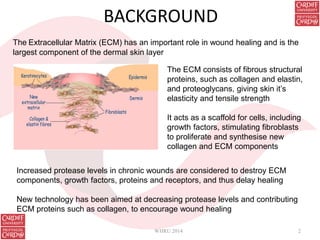
The Extracellular Matrix (ECM) has an important role in wound healing and is the
largest component of the dermal skin layer
WHRU 2014 2
The ECM consists of fibrous structural
proteins, such as collagen and elastin,
and proteoglycans, giving skin it’s
elasticity and tensile strength
It acts as a scaffold for cells, including
growth factors, stimulating fibroblasts
to proliferate and synthesise new
collagen and ECM components
Increased protease levels in chronic wounds are considered to destroy ECM
components, growth factors, proteins and receptors, and thus delay healing
New technology has been aimed at decreasing protease levels and contributing
ECM proteins such as collagen, to encourage wound healing
AIMS & METHOD
• A case series was performed to evaluate the use of a collagen wound
matrix on various recalcitrant complex chronic wounds
• Patients with chronic wounds and with multiple
factors affecting healing either local to the wounds
or through systemic disease were included.
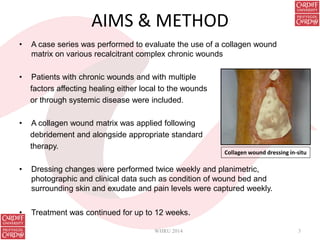
• A collagen wound matrix was applied following
debridement and alongside appropriate standard
therapy.
• Dressing changes were performed twice weekly and planimetric,
photographic and clinical data such as condition of wound bed and
surrounding skin and exudate and pain levels were captured weekly.
• Treatment was continued for up to 12 weeks.
WHRU 2014 3
Collagen wound dressing in-situ
RESULTS
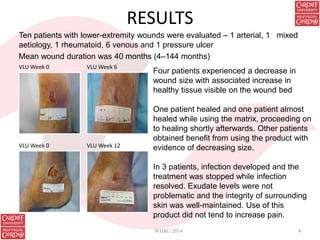
Ten patients with lower-extremity wounds were evaluated – 1 arterial, 1 mixed
aetiology, 1 rheumatoid, 6 venous and 1 pressure ulcer
Mean wound duration was 40 months (4–144 months)
WHRU 2014 4
VLU Week 0 VLU Week 6
VLU Week 0 VLU Week 12
Four patients experienced a decrease in
wound size with associated increase in
healthy tissue visible on the wound bed
One patient healed and one patient almost
healed while using the matrix, proceeding on
to healing shortly afterwards. Other patients
obtained benefit from using the product with
evidence of decreasing size.
In 3 patients, infection developed and the
treatment was stopped while infection
resolved. Exudate levels were not
problematic and the integrity of surrounding
skin was well-maintained. Use of this
product did not tend to increase pain.
CONCLUSION
• For the patients who did not develop an
infection, a common and persistent occurrence
for patients with chronic wounds, the outcomes
from a small group of complex wounds are
encouraging
• The matrix was generally well-tolerated and
exhibited the potential to increase granulation
tissue formation and encourage epithelialisation
WHRU 2014 5

EWMA 2014 - EP454 EXPERIENCES WITH USING A COLLAGEN WOUND MATRIX* ON RECALCITRANT COMPLEX WOUNDS

  • 1.
    EXPERIENCES WITH USINGA COLLAGEN WOUND MATRIX* ON RECALCITRANT COMPLEX WOUNDS Sarah Bradbury, Research Nurse Nicola Ivins, Clinical Trials Manager Keith Harding, Dean of Clinical Innovation Wound Healing Research Unit, Cardiff University, UK. Contact: Sarah Bradbury +44 2920 746319 bradburyse@cf.ac.uk WHRU 2014 1 *Proheal™, Medskin Solutions, Germany
  • 2.
    BACKGROUND The Extracellular Matrix(ECM) has an important role in wound healing and is the largest component of the dermal skin layer WHRU 2014 2 The ECM consists of fibrous structural proteins, such as collagen and elastin, and proteoglycans, giving skin it’s elasticity and tensile strength It acts as a scaffold for cells, including growth factors, stimulating fibroblasts to proliferate and synthesise new collagen and ECM components Increased protease levels in chronic wounds are considered to destroy ECM components, growth factors, proteins and receptors, and thus delay healing New technology has been aimed at decreasing protease levels and contributing ECM proteins such as collagen, to encourage wound healing
  • 3.
    AIMS & METHOD •A case series was performed to evaluate the use of a collagen wound matrix on various recalcitrant complex chronic wounds • Patients with chronic wounds and with multiple factors affecting healing either local to the wounds or through systemic disease were included. • A collagen wound matrix was applied following debridement and alongside appropriate standard therapy. • Dressing changes were performed twice weekly and planimetric, photographic and clinical data such as condition of wound bed and surrounding skin and exudate and pain levels were captured weekly. • Treatment was continued for up to 12 weeks. WHRU 2014 3 Collagen wound dressing in-situ
  • 4.
    RESULTS Ten patients withlower-extremity wounds were evaluated – 1 arterial, 1 mixed aetiology, 1 rheumatoid, 6 venous and 1 pressure ulcer Mean wound duration was 40 months (4–144 months) WHRU 2014 4 VLU Week 0 VLU Week 6 VLU Week 0 VLU Week 12 Four patients experienced a decrease in wound size with associated increase in healthy tissue visible on the wound bed One patient healed and one patient almost healed while using the matrix, proceeding on to healing shortly afterwards. Other patients obtained benefit from using the product with evidence of decreasing size. In 3 patients, infection developed and the treatment was stopped while infection resolved. Exudate levels were not problematic and the integrity of surrounding skin was well-maintained. Use of this product did not tend to increase pain.
  • 5.
    CONCLUSION • For thepatients who did not develop an infection, a common and persistent occurrence for patients with chronic wounds, the outcomes from a small group of complex wounds are encouraging • The matrix was generally well-tolerated and exhibited the potential to increase granulation tissue formation and encourage epithelialisation WHRU 2014 5