












Extra-Osseous TaloTarsal StabilizationChallengesA critical look at the bad & ugly side of EOTTS.Why did it happen?What can be done to prevent it from happening? and What to do if it did happen.
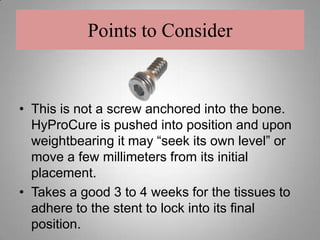
This is not a screw anchored into the bone. HyProCure is pushed into position and upon weightbearing it may “seek its own level” or move a few millimeters from its initial placement.
Takes a good 3 to 4 weeks for the tissues to adhere to the stent to lock into its final position.Points to Consider
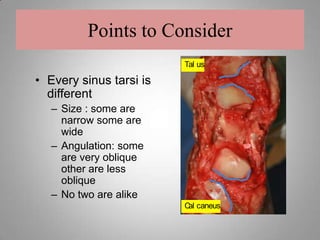
Points to ConsiderTalusEvery sinus tarsi is different
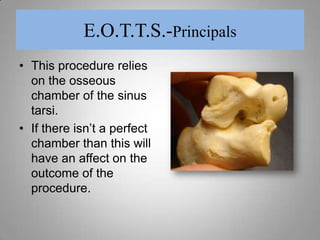
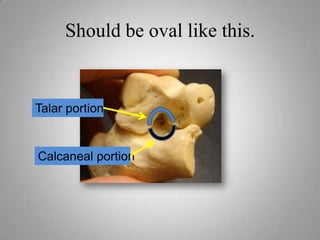
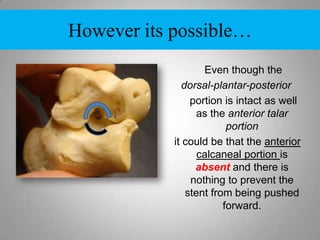
Size : some are narrow some are wide
Angulation: some are very oblique other are less oblique
No two are alikeCalcaneus
Patient ConsiderationsEvery patient is differentEach foot will have a different recoveryAn anxious patient may be at higher risk for poor surgical outcomePatients who stand/walk for a living could take longer to adjust compared to someone who has a sitting job.
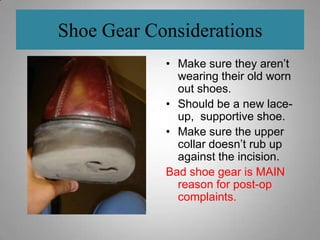
Shoe Gear ConsiderationsMake sure they aren’t wearing their old worn out shoes.
Should be a new lace-up,  supportive shoe.
Make sure the upper collar doesn’t rub up against the incision.Bad shoe gear is MAIN reason for post-op complaints.
BAD SHOEGEAR is the #1 cause for post-op discomfort.ALWAYS CHECK THE SHOES YOUR PATIENTS ARE WEARING.
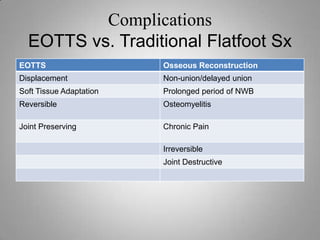
There is no such thing as a complication-free surgical procedure.Something can always potentially go wrong.
What makes a great versus a good surgeon is how that complication is handled.
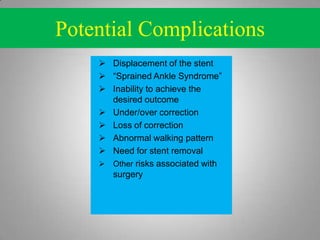
Potential ComplicationsDisplacement of the stent
“Sprained Ankle Syndrome”
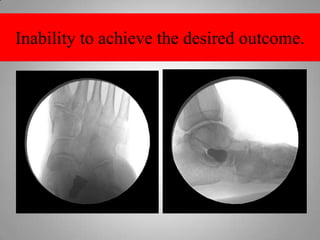
Inability to achieve the desired outcome
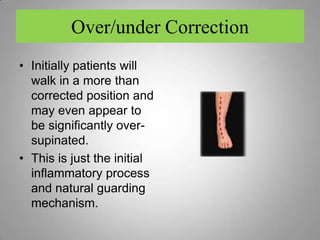
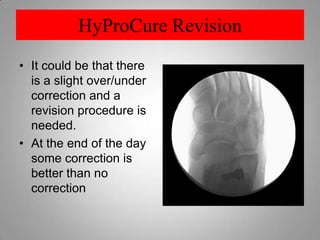
Under/over correction
Loss of correction
Abnormal walking pattern
Need for stent removal
Other risks associated with surgeryHyProCure DisplacementPartial to Full
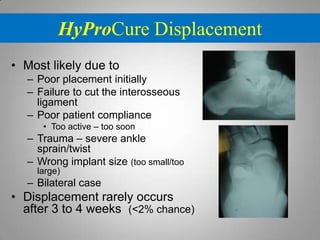
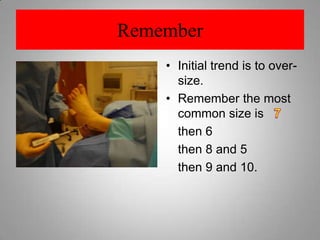
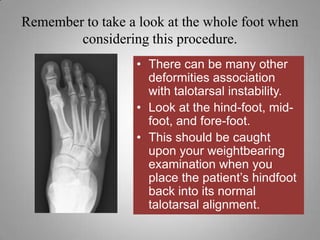
HyProCure DisplacementMost likely due toPoor placement initiallyFailure to cut the interosseous ligamentPoor patient compliance Too active – too soonTrauma – severe ankle sprain/twistWrong implant size (too small/too large)Bilateral case  Displacement rarely occurs after 3 to 4 weeks  (<2% chance)
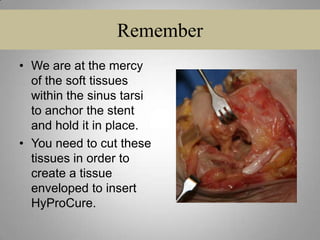
RememberWe are at the mercy of the soft tissues within the sinus tarsi to anchor the stent and hold it in place. You need to cut these tissues in order to create a tissue enveloped to insert HyProCure.
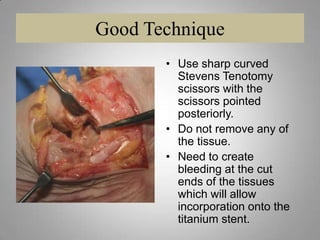
Good TechniqueUse sharp curved Stevens Tenotomy scissors with the scissors pointed posteriorly.
Do not remove any of the tissue.
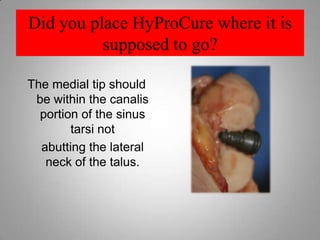
Need to create bleeding at the cut ends of the tissues which will allow incorporation onto the titanium stent.Did you place HyProCure where it is supposed to go?The medial tip should be within the canalis portion of the sinus tarsi not  	abutting the lateral neck of the talus.
If HyProCure isn’t properly positioned in the first place, it will most likely fail.
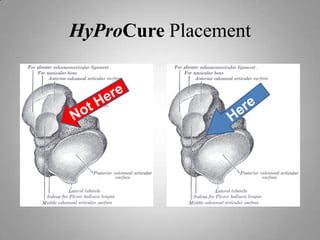
HyProCure PlacementNot HereHere
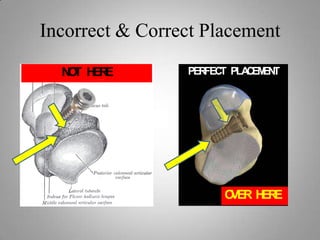
Incorrect & Correct PlacementNOT HEREPERFECT PLACEMENTOVER HERE
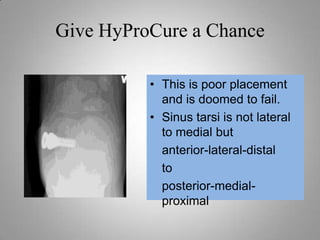
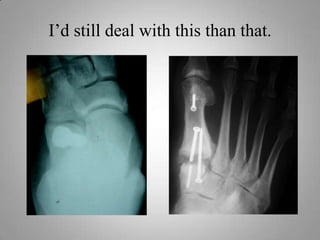
Give HyProCure a ChanceThis is poor placement and is doomed to fail.
Sinus tarsi is not lateral to medial but	anterior-lateral-distal	to 	posterior-medial-proximal
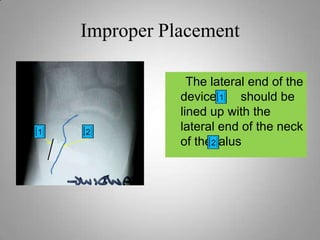
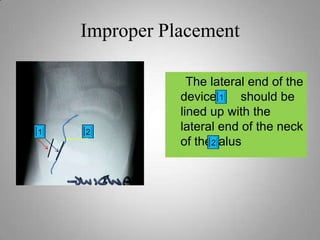
Improper Placement     The lateral end of the device       should be lined up with the lateral end of the neck of the talus 1122
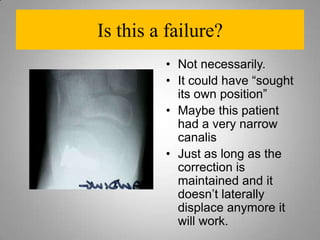
Is this a failure?Not necessarily.
It could have “sought its own position”
Maybe this patient had a very narrow canalis
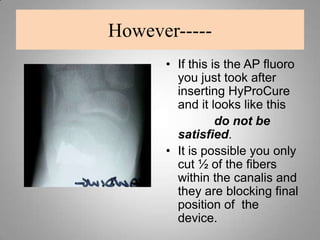
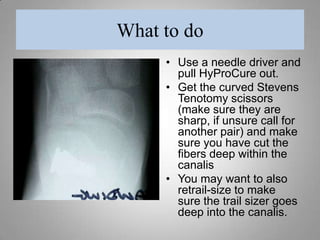
Just as long as the correction is maintained and it doesn’t laterally displace anymore it will work.  However-----If this is the AP fluoro you just took after inserting HyProCure and it looks like this               do not be satisfied.  It is possible you only cut ½ of the fibers within the canalis and they are blocking final position of  the device.What to doUse a needle driver and pull HyProCure out.
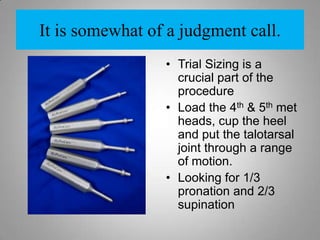
Get the curved Stevens Tenotomy scissors (make sure they are sharp, if unsure call for another pair) and make sure you have cut the fibers deep within the canalis
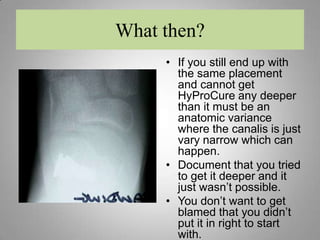
You may want to also retrail-size to make sure the trail sizer goes deep into the canalis.What then?If you still end up with the same placement and cannot get HyProCure any deeper than it must be an anatomic variance where the canalis is just vary narrow which can happen.
Document that you tried to get it deeper and it just wasn’t possible.
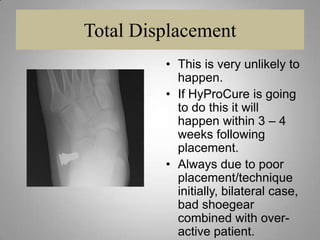
You don’t want to get blamed that you didn’t put it in right to start with.Total DisplacementThis is very unlikely to happen.
If HyProCure is going to do this it will happen within 3 – 4 weeks following placement.
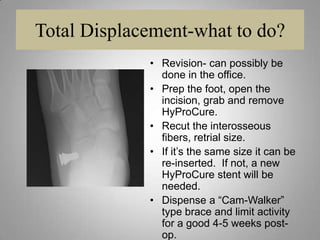
Always due to poor placement/technique initially, bilateral case, bad shoegear combined with over-active patient.Total Displacement-what to do?Revision- can possibly be done in the office.
Prep the foot, open the incision, grab and remove HyProCure.
Recut the interosseous fibers, retrial size.
If it’s the same size it can be re-inserted.  If not, a new HyProCure stent will be needed.
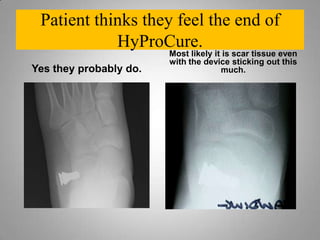
Dispense a “Cam-Walker” type brace and limit activity for a good 4-5 weeks post-op.Patient thinks they feel the end of HyProCure.Yes they probably do.Most likely it is scar tissue even with the device sticking out this much.
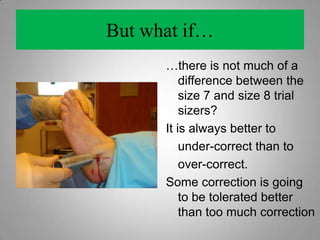
What do I do, if the HyProCure stent isn't exactly where I placed it at the time of surgery?The rule of thumb is a few millimeters of lateral displacement IS acceptable just as long as correction is maintained.
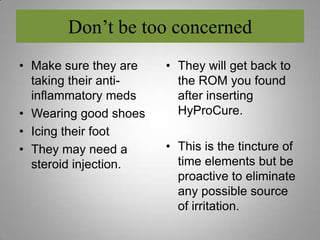
“Sprained Ankle Syndrome”Pain for 5 – 10 minute after rest/getting out of bed in the AM, subsides after a while.
Not “Sinus Tarsitis”
After sitting, get up to walk, ankle is stiff
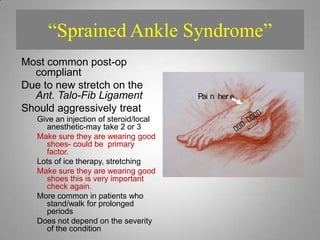
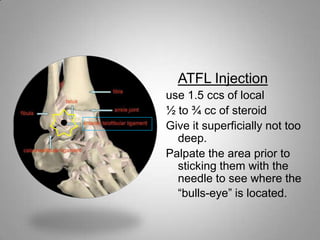
Due to the new strain on the soft tissues“Sprained Ankle Syndrome”Most common post-op compliantDue to new stretch on the Ant. Talo-Fib LigamentShould aggressively treatGive an injection of steroid/local anesthetic-may take 2 or 3Make sure they are wearing good shoes- could be  primary factor.Lots of ice therapy, stretchingMake sure they are wearing good shoes this is very important check again.More common in patients who stand/walk for prolonged periodsDoes not depend on the severity of the conditionPain hereNot Here
ATFL Injectionuse 1.5 ccs of local   ½ to ¾ cc of steroidGive it superficially not too deep. Palpate the area prior to sticking them with the needle to see where the “bulls-eye” is located.
How long could this sprained ankle feeling last?Really depends on many factors
Could last for a few days, weeks, or several months
Depends more about the compliance of the patient than on the tissue itself (are they wearing the right shoes, icing, resting, taking effective anti-inflammatory, coming in for their visit, responding to the injections).
Could be that their tissues have lost their elasticity and will not “stretch-out” or get used to their new position.When is it time to take further action?If after 6 months of conservative treatment with no positive long-term effect. Options are to either:
Downsize
Permanent Removal

HyProCure Trouble Shooting Guide

  • 2.
    Extra-Osseous TaloTarsal StabilizationChallengesAcritical look at the bad & ugly side of EOTTS.Why did it happen?What can be done to prevent it from happening? and What to do if it did happen.
  • 3.
    This is nota screw anchored into the bone. HyProCure is pushed into position and upon weightbearing it may “seek its own level” or move a few millimeters from its initial placement.
  • 4.
    Takes a good3 to 4 weeks for the tissues to adhere to the stent to lock into its final position.Points to Consider
  • 5.
    Points to ConsiderTalusEverysinus tarsi is different
  • 6.
    Size : someare narrow some are wide
  • 7.
    Angulation: some arevery oblique other are less oblique
  • 8.
    No two arealikeCalcaneus
  • 9.
    Patient ConsiderationsEvery patientis differentEach foot will have a different recoveryAn anxious patient may be at higher risk for poor surgical outcomePatients who stand/walk for a living could take longer to adjust compared to someone who has a sitting job.
  • 10.
    Shoe Gear ConsiderationsMakesure they aren’t wearing their old worn out shoes.
  • 11.
    Should be anew lace-up, supportive shoe.
  • 12.
    Make sure theupper collar doesn’t rub up against the incision.Bad shoe gear is MAIN reason for post-op complaints.
  • 13.
    BAD SHOEGEAR isthe #1 cause for post-op discomfort.ALWAYS CHECK THE SHOES YOUR PATIENTS ARE WEARING.
  • 14.
    There is nosuch thing as a complication-free surgical procedure.Something can always potentially go wrong.
  • 15.
    What makes agreat versus a good surgeon is how that complication is handled.
  • 16.
  • 17.
  • 18.
    Inability to achievethe desired outcome
  • 19.
  • 20.
  • 21.
  • 22.
  • 23.
    Other risks associatedwith surgeryHyProCure DisplacementPartial to Full
  • 24.
    HyProCure DisplacementMost likelydue toPoor placement initiallyFailure to cut the interosseous ligamentPoor patient compliance Too active – too soonTrauma – severe ankle sprain/twistWrong implant size (too small/too large)Bilateral case Displacement rarely occurs after 3 to 4 weeks (<2% chance)
  • 25.
    RememberWe are atthe mercy of the soft tissues within the sinus tarsi to anchor the stent and hold it in place. You need to cut these tissues in order to create a tissue enveloped to insert HyProCure.
  • 26.
    Good TechniqueUse sharpcurved Stevens Tenotomy scissors with the scissors pointed posteriorly.
  • 27.
    Do not removeany of the tissue.
  • 28.
    Need to createbleeding at the cut ends of the tissues which will allow incorporation onto the titanium stent.Did you place HyProCure where it is supposed to go?The medial tip should be within the canalis portion of the sinus tarsi not abutting the lateral neck of the talus.
  • 29.
    If HyProCure isn’tproperly positioned in the first place, it will most likely fail.
  • 30.
  • 31.
    Incorrect & CorrectPlacementNOT HEREPERFECT PLACEMENTOVER HERE
  • 32.
    Give HyProCure aChanceThis is poor placement and is doomed to fail.
  • 33.
    Sinus tarsi isnot lateral to medial but anterior-lateral-distal to posterior-medial-proximal
  • 34.
    Improper Placement The lateral end of the device should be lined up with the lateral end of the neck of the talus 1122
  • 35.
    Improper Placement The lateral end of the device should be lined up with the lateral end of the neck of the talus 1122
  • 36.
    Is this afailure?Not necessarily.
  • 37.
    It could have“sought its own position”
  • 38.
    Maybe this patienthad a very narrow canalis
  • 39.
    Just as longas the correction is maintained and it doesn’t laterally displace anymore it will work. However-----If this is the AP fluoro you just took after inserting HyProCure and it looks like this do not be satisfied. It is possible you only cut ½ of the fibers within the canalis and they are blocking final position of the device.What to doUse a needle driver and pull HyProCure out.
  • 40.
    Get the curvedStevens Tenotomy scissors (make sure they are sharp, if unsure call for another pair) and make sure you have cut the fibers deep within the canalis
  • 41.
    You may wantto also retrail-size to make sure the trail sizer goes deep into the canalis.What then?If you still end up with the same placement and cannot get HyProCure any deeper than it must be an anatomic variance where the canalis is just vary narrow which can happen.
  • 42.
    Document that youtried to get it deeper and it just wasn’t possible.
  • 43.
    You don’t wantto get blamed that you didn’t put it in right to start with.Total DisplacementThis is very unlikely to happen.
  • 44.
    If HyProCure isgoing to do this it will happen within 3 – 4 weeks following placement.
  • 45.
    Always due topoor placement/technique initially, bilateral case, bad shoegear combined with over-active patient.Total Displacement-what to do?Revision- can possibly be done in the office.
  • 46.
    Prep the foot,open the incision, grab and remove HyProCure.
  • 47.
    Recut the interosseousfibers, retrial size.
  • 48.
    If it’s thesame size it can be re-inserted. If not, a new HyProCure stent will be needed.
  • 49.
    Dispense a “Cam-Walker”type brace and limit activity for a good 4-5 weeks post-op.Patient thinks they feel the end of HyProCure.Yes they probably do.Most likely it is scar tissue even with the device sticking out this much.
  • 50.
    What do Ido, if the HyProCure stent isn't exactly where I placed it at the time of surgery?The rule of thumb is a few millimeters of lateral displacement IS acceptable just as long as correction is maintained.
  • 51.
    “Sprained Ankle Syndrome”Painfor 5 – 10 minute after rest/getting out of bed in the AM, subsides after a while.
  • 52.
  • 53.
    After sitting, getup to walk, ankle is stiff
  • 54.
    Due to thenew strain on the soft tissues“Sprained Ankle Syndrome”Most common post-op compliantDue to new stretch on the Ant. Talo-Fib LigamentShould aggressively treatGive an injection of steroid/local anesthetic-may take 2 or 3Make sure they are wearing good shoes- could be primary factor.Lots of ice therapy, stretchingMake sure they are wearing good shoes this is very important check again.More common in patients who stand/walk for prolonged periodsDoes not depend on the severity of the conditionPain hereNot Here
  • 55.
    ATFL Injectionuse 1.5ccs of local ½ to ¾ cc of steroidGive it superficially not too deep. Palpate the area prior to sticking them with the needle to see where the “bulls-eye” is located.
  • 56.
    How long couldthis sprained ankle feeling last?Really depends on many factors
  • 57.
    Could last fora few days, weeks, or several months
  • 58.
    Depends more aboutthe compliance of the patient than on the tissue itself (are they wearing the right shoes, icing, resting, taking effective anti-inflammatory, coming in for their visit, responding to the injections).
  • 59.
    Could be thattheir tissues have lost their elasticity and will not “stretch-out” or get used to their new position.When is it time to take further action?If after 6 months of conservative treatment with no positive long-term effect. Options are to either:
  • 60.
  • 61.