Anup Nirala
BBA
Bangalore Institute
of Management
StudiesCase Presentation on
Context
 Organizational Behavior
 Trending
 Relationship between Problem turned
Opportunity = Trend
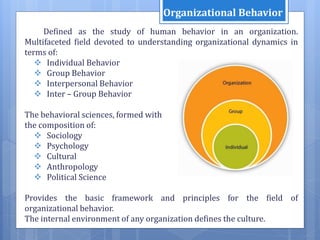
Defined as the study of human behavior in an organization.
Multifaceted field devoted to understanding organizational dynamics in
terms of:
 Individual Behavior
 Group Behavior
 Interpersonal Behavior
 Inter – Group Behavior
The behavioral sciences, formed with
the composition of:
 Sociology
 Psychology
 Cultural
 Anthropology
 Political Science
Provides the basic framework and principles for the field of
organizational behavior.
The internal environment of any organization defines the culture.
Organizational Behavior
 It is paramount importance for the entities that make up the
organization.
 Organizational culture manifests in an organization’s climate.
 Easily observable through the behavior and strategy of an organization.
The external environment of an organization can be characterized by the
industry:
 Intensity of competitive rivalry
 Certainty of information available
 Labor markets from which the organization recruits
 Operating technology employed
 Institutional and political context
Environment affect organizational behavior through their influence on the
organization design.
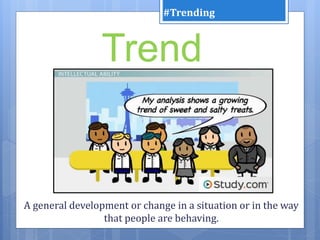
A general development or change in a situation or in the way
that people are behaving.
Trend
#Trending
1. Changes in the diversity of organization:
A new shift is observed from previous years that the organization is
making different changes in there structures and internal environment to
meet employee expectations and engagement from different backgrounds.
This trend helps to eliminate the diversity issues like:
 Perceptual distortions
 Influence on team development
 Potential for conflict among employees
2. Ethical Ideology:
A trend has been followed depending on various factors such as the
person’s reason for engaging in a specific behavior, conditions in that culture
and the influence of external factors on the behavior.
 With LPG Policy in India, choices expand and development of trade
found.
 The ethical ideology starts its expansion in the consumer based economy.
 Making a impact on behavior with processing a ethical concern on its
structure.
3. Organizational Justice as a Dependent Variable:
There is a paradigmatic shift in the organizational justice literature,
over years which shows fairness in treatment serves as the inter-dependent
variable rather than an obsolete independent variable.
New structure approaches to studying fairness as a consequence rather than
as a cause.
Today emphasizing conceptual and empirical works advances our
understanding of fairness.
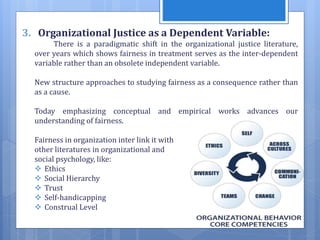
Fairness in organization inter link it with
other literatures in organizational and
social psychology, like:
 Ethics
 Social Hierarchy
 Trust
 Self-handicapping
 Construal Level
4. Organizational Efficient Mapping; Time & Money
Factor:
Today every management use control and measurement of time as its
prominent feature for modern management - an inevitable consequence of
employees (individual) selling their time for money.
 Earlier organization makes decisions about time and money differently.
 Todays management, practices to make the connection between time and
money salient can heighten the economic evaluation of time.
Todays management recognise organisational causes as:
Economical Evaluation = Personal & Societal Consequences
5. Group Behavior Evolution:
Trending organizational culture shows people form impressions of one
with another and how these impressions influence organizational and social
behavior such as group tone, group hierarchy, and group evaluation.
 New age management integrate the SEA (Selection, Extraction & Application) model
with other literature form like, organizational, social, cognitive, and visual sciences.
 Describing the important role of people perception in organizational and social
behavior.
6. Mechanism of Psychological Power :
Todays organization make habitat themselves to the factor affecting social
psychology and has examined how psychological power affects organizational
behaviors.
It is trending because power in organizations is generally viewed as a structural
construct. structural and psychological power and explore how their
interrelationships affect organizational behavior in two form:
 Cognitive network for power
 Conscious sense of power
Causal pathways that link psychological power and structural power:
 Sense of power will induce a sense of responsibility among structural
powerholders, making them more responsive to the views and needs of others.
 Sense of power in conscious awareness, activates a non-conscious association
between power and agentic behaviors creating agentic behaviors.
7. System Justification Model:
Todays management starts involvement of empirical work on the
situations in which people's system-justification motive is likely to be
particularly pronounced and discuss how these situations may manifest in
organizational contexts.
Emerged from System Justification Theory by Jost & Banaji, in 1994.
System Justification Theory's implacable for:
 Organizational change
 Employee citizenship behaviors
 Integration of a diverse workforce
Implications of system justification model develops:
 Organizational members' perceptions
 Attitudes
 Behaviors in the workplace
8. Involvement of perspective taking research in R&D:
Perspective-taking is a psychological process that is largely involved in
the Research & Development followed as trend in every organizational
context for customer and employee.
Current review critically specify perspective-taking's as different
antecedents, consequences, mechanisms, and moderators, as well as
identifies theoretical and/or empirical shortfalls.
Three important contributions made by perspective taking as:
 New definition of perspective-taking: Active cognitive process of
imagining the world from another's vantage point.
 Although perspective-taking has many positive benefits for managers and
leaders, it also carries with it the potential for perverse effects.
 Helps individuals effectively for navigating a world filled with mixed-
motive social interactions.
Mixed-motive model of perspective-taking not only captures the current
findings but also offers new directions for future research.
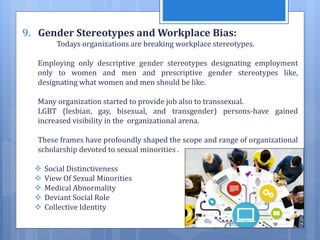
9. Gender Stereotypes and Workplace Bias:
Todays organizations are breaking workplace stereotypes.
Employing only descriptive gender stereotypes designating employment
only to women and men and prescriptive gender stereotypes like,
designating what women and men should be like.
Many organization started to provide job also to transsexual.
LGBT (lesbian, gay, bisexual, and transgender) persons-have gained
increased visibility in the organizational arena.
These frames have profoundly shaped the scope and range of organizational
scholarship devoted to sexual minorities .
 Social Distinctiveness
 View Of Sexual Minorities
 Medical Abnormality
 Deviant Social Role
 Collective Identity
10. Intercultural learning and implications for globalization:
Experiment-based research on learning to propose the cognitive processes
involved in intercultural learning is booming to cover individual differences and
situational conditions.
Suggested training for optimal use of cultural knowledge by adapting behaviors and
judgments according to situational factors.
Globalization emphasizes the need to recognize the contingencies of effective OB
practices in different cultures.
Section forming instinctual learning:
 Focus on acquiring cultural knowledge,
 Reviewing longstanding literatures on immigrant acculturation and
 Expatriate adjustment investigating antecedents of intercultural adjustment and
performance
 Focus on displaying proficiency,
 Examining how newcomers to a cultural setting deploy their knowledge of it in
order to adjust their behavior and judgments
Individual differences and situational conditions that predict performance to suggest
training for optimal use of cultural knowledge by adapting behaviors and judgments
according to situational factors.
11.Effort Recognition & Worth felt:
Todays organizational setting experimented a way to keep employee
motivate and applied it in HR development to provide learning by marking
their own work to recognise the intensity of their own contribution,
factoring as individual behavior it is developing the organisational behavior.
Providing hard quest to work make many non-systematic justified employee
to work hard for their recognition by achieve something impossible and
their will to achieve higher rises.
Trait’s like this helps in achievement of:
 Confidence
 Worthiness
 Alliances
 Radiance
 Attitude
 Dedication
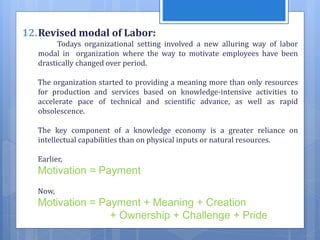
12.Revised modal of Labor:
Todays organizational setting involved a new alluring way of labor
modal in organization where the way to motivate employees have been
drastically changed over period.
The organization started to providing a meaning more than only resources
for production and services based on knowledge-intensive activities to
accelerate pace of technical and scientific advance, as well as rapid
obsolescence.
The key component of a knowledge economy is a greater reliance on
intellectual capabilities than on physical inputs or natural resources.
Earlier,
Motivation = Payment
Now,
Motivation = Payment + Meaning + Creation
+ Ownership + Challenge + Pride
13.Distinguishing Organizational behavior from
Inhibitory Constraints:
Kees van den Bos makes many organization understand and follow the
fact that organizational policies and practices are based on the view that
people's behavior needs to be inhibited to protect against their selfish basic
nature.
Most people are fundamentally pro-social, interested in securing good
outcomes for both themselves and others.
This pro-social attitude manifests itself more readily in actual behavior and
attitudes that the person in question is freed from some of his or her
inhibition.
Implications might enhance:
 The full potential of employees in organizations
 Stimulate helping and
 Creative behavior in teams,
 Improve decision making in organizations,
 Understand reactions to organizational change
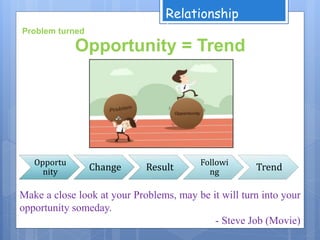
Opportunity = Trend
Opportu
nity Change Result Followi
ng Trend
Relationship
between
Make a close look at your Problems, may be it will turn into your
opportunity someday.
- Steve Job (Movie)
Problem turned
Employee Engagement:
 Figures (Gallup Reports, 2015):-
1. Only 20% of all employees feel very passionate about their jobs.
2. 75-80% are entirely disengaged employee. Customer turnover is 57%.
3. Less than 15% agree that they feel strongly energized by their work.
4. Only 31% (strongly or moderately) believe that their employer inspire.
 Lack of passion in corporate bottom line. Reasons:-
1. Low satisfaction in job.
2. Behavioral & Attitude issues from emloyer i.e., motivation, pressure
etc. their job & customers as well, because of extreme customer
oriented market.
 Ways to set new trend:
1. Strategic Reinforcement of extreme customer behavioral pattern to
loose need’s patterns.
2. Possible only through proper customer, employer and employee
attitude change program through reinforcement.
Using Greenwashing to fake Triple Bottom Line:
 Triple Bottom Line:
Accounting framework with three parts: Social, Environmental and
Financial. Adopted to evaluate their performance in a broader perspective
to create greater business value.
 Greenwashing:
When a company or organization spends more time and money claiming
to be “green” through advertising and marketing than actually
implementing business practices that minimize environmental impact.
 Challenges:
1. Satisfaction among employee; Hard hit to explain sustainable
development because of doppelganger; Frustration in Employee.
2. Interaction and personality issue because of ethical dilemma; Attitude
regarding explanation: Poor,
 Ways to set new trend:
1. Policy change regarding extend to use greenwashing.
2. Diversity Training Reinforcement session regarding handling
greenwashing method.
Millennial Generation:
 Millennial Generation:
Generation which includes those born between 1980 and 2000.
They differs from previous generations in terms of technology and
multitasking as a way of life.
 Challenges:
1. To keep individuals from different generations communicating effectively.
2. Managing people across generational lines despite different values placed
on teamwork, organizational rewards, work–life balance, and desired
levels of instruction.
 Ways to set new trend:
1. Tribunal method of reinforcement to different or upcoming generation.
Teaching old organizational behavior and sustainable development sight
in it.
2. Reinforcement session regarding the gap of organizational cultural
difference.
Global Marketplace:
 Outsourcing refers to having someone outside the formal on-going
organization doing work previously handled in-house.
 Offshoring means sending jobs previously done in one country to another
country.
 Challenges:
1. Potential unemployment issues as companies move toward a shamrock
layout.
2. Cross cultural issues and methodology in business processing, resulting
in attitude and response issues.
3. Managing teams consisting of different nationalities separated not only
by culture and language but also in time and space.
 Ways to set new trend:
1. Reinforcement in organizational learning pattern for adaption in cross
cultural organization.
2. Scheduled behavioral exchange through web alluring method.
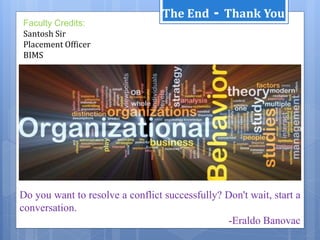
Do you want to resolve a conflict successfully? Don't wait, start a
conversation.
-Eraldo Banovac
Faculty Credits:
Santosh Sir
Placement Officer
BIMS
The End Thank You-

Trending in Organizational Behvaior

  • 1.
    Anup Nirala BBA Bangalore Institute ofManagement StudiesCase Presentation on
  • 2.
    Context  Organizational Behavior Trending  Relationship between Problem turned Opportunity = Trend
  • 3.
    Defined as thestudy of human behavior in an organization. Multifaceted field devoted to understanding organizational dynamics in terms of:  Individual Behavior  Group Behavior  Interpersonal Behavior  Inter – Group Behavior The behavioral sciences, formed with the composition of:  Sociology  Psychology  Cultural  Anthropology  Political Science Provides the basic framework and principles for the field of organizational behavior. The internal environment of any organization defines the culture. Organizational Behavior
  • 4.
     It isparamount importance for the entities that make up the organization.  Organizational culture manifests in an organization’s climate.  Easily observable through the behavior and strategy of an organization. The external environment of an organization can be characterized by the industry:  Intensity of competitive rivalry  Certainty of information available  Labor markets from which the organization recruits  Operating technology employed  Institutional and political context Environment affect organizational behavior through their influence on the organization design.
  • 5.
    A general developmentor change in a situation or in the way that people are behaving. Trend #Trending
  • 6.
    1. Changes inthe diversity of organization: A new shift is observed from previous years that the organization is making different changes in there structures and internal environment to meet employee expectations and engagement from different backgrounds. This trend helps to eliminate the diversity issues like:  Perceptual distortions  Influence on team development  Potential for conflict among employees 2. Ethical Ideology: A trend has been followed depending on various factors such as the person’s reason for engaging in a specific behavior, conditions in that culture and the influence of external factors on the behavior.  With LPG Policy in India, choices expand and development of trade found.  The ethical ideology starts its expansion in the consumer based economy.  Making a impact on behavior with processing a ethical concern on its structure.
  • 7.
    3. Organizational Justiceas a Dependent Variable: There is a paradigmatic shift in the organizational justice literature, over years which shows fairness in treatment serves as the inter-dependent variable rather than an obsolete independent variable. New structure approaches to studying fairness as a consequence rather than as a cause. Today emphasizing conceptual and empirical works advances our understanding of fairness. Fairness in organization inter link it with other literatures in organizational and social psychology, like:  Ethics  Social Hierarchy  Trust  Self-handicapping  Construal Level
  • 8.
    4. Organizational EfficientMapping; Time & Money Factor: Today every management use control and measurement of time as its prominent feature for modern management - an inevitable consequence of employees (individual) selling their time for money.  Earlier organization makes decisions about time and money differently.  Todays management, practices to make the connection between time and money salient can heighten the economic evaluation of time. Todays management recognise organisational causes as: Economical Evaluation = Personal & Societal Consequences 5. Group Behavior Evolution: Trending organizational culture shows people form impressions of one with another and how these impressions influence organizational and social behavior such as group tone, group hierarchy, and group evaluation.
  • 9.
     New agemanagement integrate the SEA (Selection, Extraction & Application) model with other literature form like, organizational, social, cognitive, and visual sciences.  Describing the important role of people perception in organizational and social behavior. 6. Mechanism of Psychological Power : Todays organization make habitat themselves to the factor affecting social psychology and has examined how psychological power affects organizational behaviors. It is trending because power in organizations is generally viewed as a structural construct. structural and psychological power and explore how their interrelationships affect organizational behavior in two form:  Cognitive network for power  Conscious sense of power Causal pathways that link psychological power and structural power:  Sense of power will induce a sense of responsibility among structural powerholders, making them more responsive to the views and needs of others.  Sense of power in conscious awareness, activates a non-conscious association between power and agentic behaviors creating agentic behaviors.
  • 10.
    7. System JustificationModel: Todays management starts involvement of empirical work on the situations in which people's system-justification motive is likely to be particularly pronounced and discuss how these situations may manifest in organizational contexts. Emerged from System Justification Theory by Jost & Banaji, in 1994. System Justification Theory's implacable for:  Organizational change  Employee citizenship behaviors  Integration of a diverse workforce Implications of system justification model develops:  Organizational members' perceptions  Attitudes  Behaviors in the workplace
  • 11.
    8. Involvement ofperspective taking research in R&D: Perspective-taking is a psychological process that is largely involved in the Research & Development followed as trend in every organizational context for customer and employee. Current review critically specify perspective-taking's as different antecedents, consequences, mechanisms, and moderators, as well as identifies theoretical and/or empirical shortfalls. Three important contributions made by perspective taking as:  New definition of perspective-taking: Active cognitive process of imagining the world from another's vantage point.  Although perspective-taking has many positive benefits for managers and leaders, it also carries with it the potential for perverse effects.  Helps individuals effectively for navigating a world filled with mixed- motive social interactions. Mixed-motive model of perspective-taking not only captures the current findings but also offers new directions for future research.
  • 12.
    9. Gender Stereotypesand Workplace Bias: Todays organizations are breaking workplace stereotypes. Employing only descriptive gender stereotypes designating employment only to women and men and prescriptive gender stereotypes like, designating what women and men should be like. Many organization started to provide job also to transsexual. LGBT (lesbian, gay, bisexual, and transgender) persons-have gained increased visibility in the organizational arena. These frames have profoundly shaped the scope and range of organizational scholarship devoted to sexual minorities .  Social Distinctiveness  View Of Sexual Minorities  Medical Abnormality  Deviant Social Role  Collective Identity
  • 13.
    10. Intercultural learningand implications for globalization: Experiment-based research on learning to propose the cognitive processes involved in intercultural learning is booming to cover individual differences and situational conditions. Suggested training for optimal use of cultural knowledge by adapting behaviors and judgments according to situational factors. Globalization emphasizes the need to recognize the contingencies of effective OB practices in different cultures. Section forming instinctual learning:  Focus on acquiring cultural knowledge,  Reviewing longstanding literatures on immigrant acculturation and  Expatriate adjustment investigating antecedents of intercultural adjustment and performance  Focus on displaying proficiency,  Examining how newcomers to a cultural setting deploy their knowledge of it in order to adjust their behavior and judgments Individual differences and situational conditions that predict performance to suggest training for optimal use of cultural knowledge by adapting behaviors and judgments according to situational factors.
  • 14.
    11.Effort Recognition &Worth felt: Todays organizational setting experimented a way to keep employee motivate and applied it in HR development to provide learning by marking their own work to recognise the intensity of their own contribution, factoring as individual behavior it is developing the organisational behavior. Providing hard quest to work make many non-systematic justified employee to work hard for their recognition by achieve something impossible and their will to achieve higher rises. Trait’s like this helps in achievement of:  Confidence  Worthiness  Alliances  Radiance  Attitude  Dedication
  • 15.
    12.Revised modal ofLabor: Todays organizational setting involved a new alluring way of labor modal in organization where the way to motivate employees have been drastically changed over period. The organization started to providing a meaning more than only resources for production and services based on knowledge-intensive activities to accelerate pace of technical and scientific advance, as well as rapid obsolescence. The key component of a knowledge economy is a greater reliance on intellectual capabilities than on physical inputs or natural resources. Earlier, Motivation = Payment Now, Motivation = Payment + Meaning + Creation + Ownership + Challenge + Pride
  • 16.
    13.Distinguishing Organizational behaviorfrom Inhibitory Constraints: Kees van den Bos makes many organization understand and follow the fact that organizational policies and practices are based on the view that people's behavior needs to be inhibited to protect against their selfish basic nature. Most people are fundamentally pro-social, interested in securing good outcomes for both themselves and others. This pro-social attitude manifests itself more readily in actual behavior and attitudes that the person in question is freed from some of his or her inhibition. Implications might enhance:  The full potential of employees in organizations  Stimulate helping and  Creative behavior in teams,  Improve decision making in organizations,  Understand reactions to organizational change
  • 17.
    Opportunity = Trend Opportu nityChange Result Followi ng Trend Relationship between Make a close look at your Problems, may be it will turn into your opportunity someday. - Steve Job (Movie) Problem turned
  • 18.
    Employee Engagement:  Figures(Gallup Reports, 2015):- 1. Only 20% of all employees feel very passionate about their jobs. 2. 75-80% are entirely disengaged employee. Customer turnover is 57%. 3. Less than 15% agree that they feel strongly energized by their work. 4. Only 31% (strongly or moderately) believe that their employer inspire.  Lack of passion in corporate bottom line. Reasons:- 1. Low satisfaction in job. 2. Behavioral & Attitude issues from emloyer i.e., motivation, pressure etc. their job & customers as well, because of extreme customer oriented market.  Ways to set new trend: 1. Strategic Reinforcement of extreme customer behavioral pattern to loose need’s patterns. 2. Possible only through proper customer, employer and employee attitude change program through reinforcement.
  • 19.
    Using Greenwashing tofake Triple Bottom Line:  Triple Bottom Line: Accounting framework with three parts: Social, Environmental and Financial. Adopted to evaluate their performance in a broader perspective to create greater business value.  Greenwashing: When a company or organization spends more time and money claiming to be “green” through advertising and marketing than actually implementing business practices that minimize environmental impact.  Challenges: 1. Satisfaction among employee; Hard hit to explain sustainable development because of doppelganger; Frustration in Employee. 2. Interaction and personality issue because of ethical dilemma; Attitude regarding explanation: Poor,  Ways to set new trend: 1. Policy change regarding extend to use greenwashing. 2. Diversity Training Reinforcement session regarding handling greenwashing method.
  • 20.
    Millennial Generation:  MillennialGeneration: Generation which includes those born between 1980 and 2000. They differs from previous generations in terms of technology and multitasking as a way of life.  Challenges: 1. To keep individuals from different generations communicating effectively. 2. Managing people across generational lines despite different values placed on teamwork, organizational rewards, work–life balance, and desired levels of instruction.  Ways to set new trend: 1. Tribunal method of reinforcement to different or upcoming generation. Teaching old organizational behavior and sustainable development sight in it. 2. Reinforcement session regarding the gap of organizational cultural difference.
  • 21.
    Global Marketplace:  Outsourcingrefers to having someone outside the formal on-going organization doing work previously handled in-house.  Offshoring means sending jobs previously done in one country to another country.  Challenges: 1. Potential unemployment issues as companies move toward a shamrock layout. 2. Cross cultural issues and methodology in business processing, resulting in attitude and response issues. 3. Managing teams consisting of different nationalities separated not only by culture and language but also in time and space.  Ways to set new trend: 1. Reinforcement in organizational learning pattern for adaption in cross cultural organization. 2. Scheduled behavioral exchange through web alluring method.
  • 22.
    Do you wantto resolve a conflict successfully? Don't wait, start a conversation. -Eraldo Banovac Faculty Credits: Santosh Sir Placement Officer BIMS The End Thank You-