Environmental Awareness L1
Session Outcomes
By the end of the session learners will;
 Be introduced to the principles of
environmental awareness.
 Understand the meaning of some common
terminology.
 Have an awareness of the impact of
environmental change.
 Have an awareness of resource efficiency.
 Identify practical ways to reduce
environmental impacts.
What do we mean by
‘Environmental Awareness’?
 Highlight environmentally friendly
working practices, relating to
 Waste
 Energy
 Transport
 Water issues
Group Exercises
Define the following terms;
 Climate change
 Ecological footprint
 Carbon management
 Sustainable development
 The three strands of sustainable development
GROUP TASK 1
Climate change
 Climate change is a significant and
lasting change weather patterns over
long periods.
Ecological Footprint
 Ecological footprint
is a measure of
human demand on
the Earth's
resources
 Amount of natural
resources required
to sustain our
consumption and
deal with our waste
Carbon Management
 The process of
managing an
individual or
organisation’s
emissions of
greenhouse gases
 CO2 reduction
Sustainable development
 Development that
meets the needs of
the present without
compromising the
ability of future
generations to
meet their own
needs
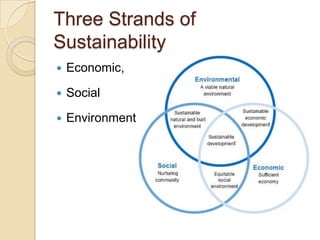
Three Strands of
Sustainability
 Economic,
 Social
 Environment
Group Exercises
Identify the following;
 The key features of an ecological footprint
 The key features of the science of climate
change
 The major impacts of climate change and
global warming
GROUP TASK 2
Impacts of Environmental
change
 Key features of an Ecological
Footprint
◦ Average footprint
◦ Developed world resource use
◦ Developing world resource use
◦ Need for food, transport, energy use,
agriculture, deforestation
◦ Population growth
◦ Speed in which it takes to regenerate
what we use in a year
Impacts of Environmental
change
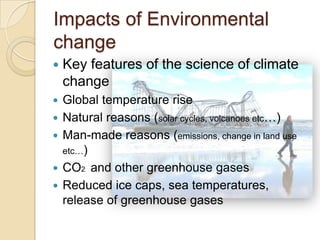
 Key features of the science of climate
change
 Global temperature rise
 Natural reasons (solar cycles, volcanoes etc…)
 Man-made reasons (emissions, change in land use
etc…)
 CO2 and other greenhouse gases
 Reduced ice caps, sea temperatures,
release of greenhouse gases
C02 Emissions – latest stats
 Between 1990 – 2009.... 20% higher
 Increase of 35% between 1995-2005
 Decrease of 9% 2008-2009
 Carbon footprint increased by 12%
over period
CO2 Emissions
 Agriculture
 Fluorinated gases (CFC’s, HFC’s)
 Waste industry
 Transport
 Industry
 Household
Impacts of Environmental
change
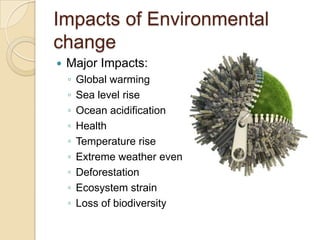
 Major Impacts:
◦ Global warming
◦ Sea level rise
◦ Ocean acidification
◦ Health
◦ Temperature rise
◦ Extreme weather events
◦ Deforestation
◦ Ecosystem strain
◦ Loss of biodiversity
Global Warming
 The main cause of global warming is the
emission of ‘greenhouse gases’ such as
carbon dioxide, methane and nitrous oxide.
 Human activity over the past 250 years,
including the burning of fossil fuels, change
of land use and agriculture, has increased
the concentration of greenhouse gases in
the earth’s atmosphere.
 As these gases build up in the atmosphere
they strengthen what is known as the
‘greenhouse effect’.
Global Warming
 There has been a clear decreasing trend in Arctic
summer sea ice levels since records began in
1979.
 Sea level around the Uk rose by 10cm during the
20th century.
 The Earth’s surface has warmed by 0.4 C on
average since the 1970s, 1 C in last 100 years.
 In 160 years of records the hottest years have
been since 1997.
Group Exercises
Identify the following;
 Commonly used resources
 How resource efficiency affects climate
change
 Reasons why a business should be
resource efficient
GROUP TASK 3
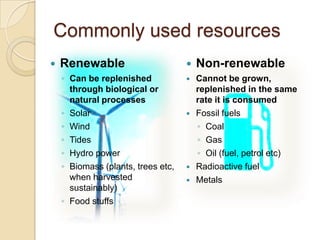
Commonly used resources
 Renewable
◦ Can be replenished
through biological or
natural processes
◦ Solar
◦ Wind
◦ Tides
◦ Hydro power
◦ Biomass (plants, trees etc,
when harvested
sustainably)
◦ Food stuffs
 Non-renewable
 Cannot be grown,
replenished in the same
rate it is consumed
 Fossil fuels
◦ Coal
◦ Gas
◦ Oil (fuel, petrol etc)
 Radioactive fuel
 Metals
A few facts
 We throw away more than 7 million tonnes of
food and drink every year from our homes -
most of which could have been safely
consumed.
 By pursuing opportunities for re-use, the UK
could reduce its reliance on raw materials,
including rare earths, by as much as 20% by
2020.
 Our research shows doubling the number of
sofas re-used, could save 52,000 tonnes of
CO2 equivalent. At the moment, 83% of
sofas are not re-used and are sent to landfill
or recycled.
 Tip of the iceberg……
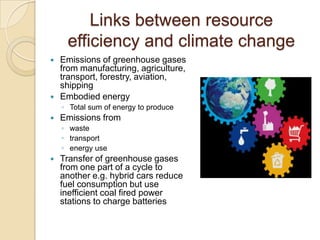
Links between resource
efficiency and climate change
 Emissions of greenhouse gases
from manufacturing, agriculture,
transport, forestry, aviation,
shipping
 Embodied energy
◦ Total sum of energy to produce
 Emissions from
◦ waste
◦ transport
◦ energy use
 Transfer of greenhouse gases
from one part of a cycle to
another e.g. hybrid cars reduce
fuel consumption but use
inefficient coal fired power
stations to charge batteries
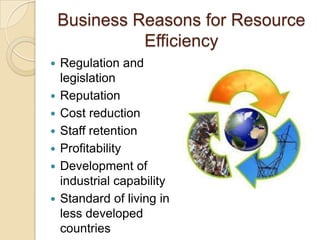
Business Reasons for Resource
Efficiency
 Regulation and
legislation
 Reputation
 Cost reduction
 Staff retention
 Profitability
 Development of
industrial capability
 Standard of living in
less developed
countries
Reduce, Reuse, Recycle
In order to minimise the impact of
waste products on the environment
there are actions that we can take by
reducing what we use, reusing
products and recycling waste.
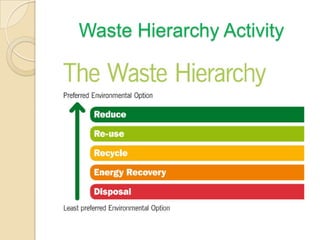
In groups complete the ‘waste
hierarchy’ activity and then feedback
your answers to the other groups
Waste Hierarchy Activity
Group Exercises
Identify the following;
 Ways to reduce consumption of
commonly used resources
 Ways to reuse commonly used
resources
 Identify recyclable resources
GROUP TASK 4
Waste Types
 Hazardous
 Waste which may contain hazardous substances,
may cause harm to the environment or react with
other materials
 Non-Hazardous
 Soils, builder materials, sludge, inert materials
 Clinical/Biological
 Sharps, infected material, some hospital waste,
waste from surgeries hospitals and clinics,
infectious organisms, absorbent materials, human
and animal tissue
 Inert and Active
 Building waste such as rubble, bricks, stone (Inert)
and wood, old window frames, guttering, pipework,
downspouts and other building related matter
(Active)
Waste Classification Activity
 Task 1… Split cards into:
 Recyclable/reusable
 Non-recyclable
 Compostable
 Energy recovery
 Task 2 … the non-recyclable cards
split
 Biological/Clinical
 Non-hazardous
 Hazardous
 Inert/inactive
Ways to reduce….
 Boil only water you need
 Buy only what you need
 Buy things with less packaging
 Cook food for only those eating
 Switch off lights, monitors, appliances
 Print on both sides of paper
 Flush toilet only when needed
 Solar power
 Insulation in homes
 Service vehicles and equip regularly
 Use public transport
 Walk…
Ways to reuse….
 New ways of using materials
 Reuse wrapping, boxes, plastic
bags
 ‘Bag for life’
 Repair rather than dispose
 Composting (paper, wood, food)
 Chip fat from local chip shop used
as diesel
 Sell unwanted items
 Re-use coffee cups
 Print on both sides
 Rechargeable batteries
 Grey water harvesting
 Rain water harvesting
Recyclable Resources
 Plastics
 Tins, aluminium, steel
 Paper
 Glass
 Cardboard
 Tetrapak
 Clothing
 Electronic equipment
 Mobile phones
 Spectacles
 Tyres
 Ink cartridges
 Some building materials
Recycling materials into.....
Paper
 More paper, depending on quality – 7 times
Cardboard
 Paper, jiffy bags, loft insulation, car bodies, packaging, animal bedding,
coffins
Cans
 New cans, car and aviation , bike frames, train tracks, pipes. Never loses
quality
Plastics
 new bottles, car parts, bins, home composters . It can also be used to make
clothing such as fleece jackets and hats or fibre filling for sleeping bags and
duvets. Plastic milk bottles are used in street and garden furniture
Glass
 Reused where possible (brown, clear) or crushed and turned into fine sand to
be used as building sand, if processed further can be used as floor and wall
insulation and lightweight construction aggregate.
Tyres
 Surfaces for playgrounds, shock absorption, car parts, retreads, fuel, mulch
for landscaping, 3G sports pitches
Complete your Workbook
Now that you have completed your
activities write the answers in your
work book.
Practice Questions
Complete the crossword and the
practice questions on your own.
We will then go through the answers as
a group to see how you all did.
This will prepare you for the on-line test.

Environmental Awareness.pdf

  • 1.
  • 2.
    Session Outcomes By theend of the session learners will;  Be introduced to the principles of environmental awareness.  Understand the meaning of some common terminology.  Have an awareness of the impact of environmental change.  Have an awareness of resource efficiency.  Identify practical ways to reduce environmental impacts.
  • 3.
    What do wemean by ‘Environmental Awareness’?  Highlight environmentally friendly working practices, relating to  Waste  Energy  Transport  Water issues
  • 4.
    Group Exercises Define thefollowing terms;  Climate change  Ecological footprint  Carbon management  Sustainable development  The three strands of sustainable development GROUP TASK 1
  • 5.
    Climate change  Climatechange is a significant and lasting change weather patterns over long periods.
  • 6.
    Ecological Footprint  Ecologicalfootprint is a measure of human demand on the Earth's resources  Amount of natural resources required to sustain our consumption and deal with our waste
  • 7.
    Carbon Management  Theprocess of managing an individual or organisation’s emissions of greenhouse gases  CO2 reduction
  • 8.
    Sustainable development  Developmentthat meets the needs of the present without compromising the ability of future generations to meet their own needs
  • 9.
    Three Strands of Sustainability Economic,  Social  Environment
  • 10.
    Group Exercises Identify thefollowing;  The key features of an ecological footprint  The key features of the science of climate change  The major impacts of climate change and global warming GROUP TASK 2
  • 11.
    Impacts of Environmental change Key features of an Ecological Footprint ◦ Average footprint ◦ Developed world resource use ◦ Developing world resource use ◦ Need for food, transport, energy use, agriculture, deforestation ◦ Population growth ◦ Speed in which it takes to regenerate what we use in a year
  • 12.
    Impacts of Environmental change Key features of the science of climate change  Global temperature rise  Natural reasons (solar cycles, volcanoes etc…)  Man-made reasons (emissions, change in land use etc…)  CO2 and other greenhouse gases  Reduced ice caps, sea temperatures, release of greenhouse gases
  • 13.
    C02 Emissions –latest stats  Between 1990 – 2009.... 20% higher  Increase of 35% between 1995-2005  Decrease of 9% 2008-2009  Carbon footprint increased by 12% over period
  • 14.
    CO2 Emissions  Agriculture Fluorinated gases (CFC’s, HFC’s)  Waste industry  Transport  Industry  Household
  • 15.
    Impacts of Environmental change Major Impacts: ◦ Global warming ◦ Sea level rise ◦ Ocean acidification ◦ Health ◦ Temperature rise ◦ Extreme weather events ◦ Deforestation ◦ Ecosystem strain ◦ Loss of biodiversity
  • 16.
    Global Warming  Themain cause of global warming is the emission of ‘greenhouse gases’ such as carbon dioxide, methane and nitrous oxide.  Human activity over the past 250 years, including the burning of fossil fuels, change of land use and agriculture, has increased the concentration of greenhouse gases in the earth’s atmosphere.  As these gases build up in the atmosphere they strengthen what is known as the ‘greenhouse effect’.
  • 17.
    Global Warming  Therehas been a clear decreasing trend in Arctic summer sea ice levels since records began in 1979.  Sea level around the Uk rose by 10cm during the 20th century.  The Earth’s surface has warmed by 0.4 C on average since the 1970s, 1 C in last 100 years.  In 160 years of records the hottest years have been since 1997.
  • 18.
    Group Exercises Identify thefollowing;  Commonly used resources  How resource efficiency affects climate change  Reasons why a business should be resource efficient GROUP TASK 3
  • 19.
    Commonly used resources Renewable ◦ Can be replenished through biological or natural processes ◦ Solar ◦ Wind ◦ Tides ◦ Hydro power ◦ Biomass (plants, trees etc, when harvested sustainably) ◦ Food stuffs  Non-renewable  Cannot be grown, replenished in the same rate it is consumed  Fossil fuels ◦ Coal ◦ Gas ◦ Oil (fuel, petrol etc)  Radioactive fuel  Metals
  • 20.
    A few facts We throw away more than 7 million tonnes of food and drink every year from our homes - most of which could have been safely consumed.  By pursuing opportunities for re-use, the UK could reduce its reliance on raw materials, including rare earths, by as much as 20% by 2020.  Our research shows doubling the number of sofas re-used, could save 52,000 tonnes of CO2 equivalent. At the moment, 83% of sofas are not re-used and are sent to landfill or recycled.  Tip of the iceberg……
  • 21.
    Links between resource efficiencyand climate change  Emissions of greenhouse gases from manufacturing, agriculture, transport, forestry, aviation, shipping  Embodied energy ◦ Total sum of energy to produce  Emissions from ◦ waste ◦ transport ◦ energy use  Transfer of greenhouse gases from one part of a cycle to another e.g. hybrid cars reduce fuel consumption but use inefficient coal fired power stations to charge batteries
  • 22.
    Business Reasons forResource Efficiency  Regulation and legislation  Reputation  Cost reduction  Staff retention  Profitability  Development of industrial capability  Standard of living in less developed countries
  • 23.
    Reduce, Reuse, Recycle Inorder to minimise the impact of waste products on the environment there are actions that we can take by reducing what we use, reusing products and recycling waste. In groups complete the ‘waste hierarchy’ activity and then feedback your answers to the other groups
  • 24.
  • 25.
    Group Exercises Identify thefollowing;  Ways to reduce consumption of commonly used resources  Ways to reuse commonly used resources  Identify recyclable resources GROUP TASK 4
  • 26.
    Waste Types  Hazardous Waste which may contain hazardous substances, may cause harm to the environment or react with other materials  Non-Hazardous  Soils, builder materials, sludge, inert materials  Clinical/Biological  Sharps, infected material, some hospital waste, waste from surgeries hospitals and clinics, infectious organisms, absorbent materials, human and animal tissue  Inert and Active  Building waste such as rubble, bricks, stone (Inert) and wood, old window frames, guttering, pipework, downspouts and other building related matter (Active)
  • 27.
    Waste Classification Activity Task 1… Split cards into:  Recyclable/reusable  Non-recyclable  Compostable  Energy recovery  Task 2 … the non-recyclable cards split  Biological/Clinical  Non-hazardous  Hazardous  Inert/inactive
  • 28.
    Ways to reduce…. Boil only water you need  Buy only what you need  Buy things with less packaging  Cook food for only those eating  Switch off lights, monitors, appliances  Print on both sides of paper  Flush toilet only when needed  Solar power  Insulation in homes  Service vehicles and equip regularly  Use public transport  Walk…
  • 29.
    Ways to reuse…. New ways of using materials  Reuse wrapping, boxes, plastic bags  ‘Bag for life’  Repair rather than dispose  Composting (paper, wood, food)  Chip fat from local chip shop used as diesel  Sell unwanted items  Re-use coffee cups  Print on both sides  Rechargeable batteries  Grey water harvesting  Rain water harvesting
  • 30.
    Recyclable Resources  Plastics Tins, aluminium, steel  Paper  Glass  Cardboard  Tetrapak  Clothing  Electronic equipment  Mobile phones  Spectacles  Tyres  Ink cartridges  Some building materials
  • 31.
    Recycling materials into..... Paper More paper, depending on quality – 7 times Cardboard  Paper, jiffy bags, loft insulation, car bodies, packaging, animal bedding, coffins Cans  New cans, car and aviation , bike frames, train tracks, pipes. Never loses quality Plastics  new bottles, car parts, bins, home composters . It can also be used to make clothing such as fleece jackets and hats or fibre filling for sleeping bags and duvets. Plastic milk bottles are used in street and garden furniture Glass  Reused where possible (brown, clear) or crushed and turned into fine sand to be used as building sand, if processed further can be used as floor and wall insulation and lightweight construction aggregate. Tyres  Surfaces for playgrounds, shock absorption, car parts, retreads, fuel, mulch for landscaping, 3G sports pitches
  • 32.
    Complete your Workbook Nowthat you have completed your activities write the answers in your work book.
  • 33.
    Practice Questions Complete thecrossword and the practice questions on your own. We will then go through the answers as a group to see how you all did. This will prepare you for the on-line test.