
INSIYA RATLAMWALA SEM :- 6TH ELECTIVE :- B PIADS, NAGPUR ASSIGNMENT NO. 2 DATE :- 26/04/2021
ASSIGNMENT NO. 2
 EXPLAIN ENVIRONMENT PSYCHOLOGY IN ARCHITECTURE WITH THE WORK EXPLAIN BY ARCHITECTS LIKE AR.
EUGENE PANDALA, AR. CHITRA VISHWANATH, AR. ASHOL B.LAL , AR. LAURIE BAKER ETC.
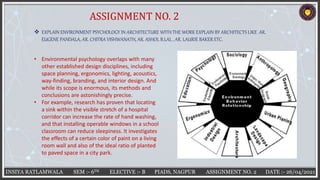
• Environmental psychology overlaps with many
other established design disciplines, including
space planning, ergonomics, lighting, acoustics,
way-finding, branding, and interior design. And
while its scope is enormous, its methods and
conclusions are astonishingly precise.
• For example, research has proven that locating
a sink within the visible stretch of a hospital
corridor can increase the rate of hand washing,
and that installing operable windows in a school
classroom can reduce sleepiness. It investigates
the effects of a certain color of paint on a living
room wall and also of the ideal ratio of planted
to paved space in a city park.
INSIYA RATLAMWALA SEM :- 6TH ELECTIVE :- B PIADS, NAGPUR ASSIGNMENT NO. 2 DATE :- 26/04/2021
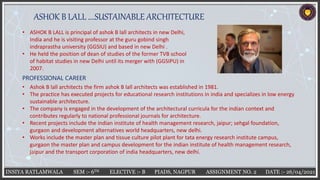
ASHOK B LALL ….SUSTAINABLE ARCHITECTURE
PROFESSIONAL CAREER
• Ashok B lall architects the firm ashok B lall architects was established in 1981.
• The practice has executed projects for educational research institutions in india and specializes in low energy
sustainable architecture.
• The company is engaged in the development of the architectural curricula for the indian context and
contributes regularly to national professional journals for architecture.
• Recent projects include the indian institute of health management research, jaipur; sehgal foundation,
gurgaon and development alternatives world headquarters, new delhi.
• Works include the master plan and tissue culture pilot plant for tata energy research institute campus,
gurgaon the master plan and campus development for the indian institute of health management research,
jaipur and the transport corporation of india headquarters, new delhi.
• ASHOK B LALL is principal of ashok B lall architects in new Delhi,
India and he is visiting professor at the guru gobind singh
indraprastha university (GGSIU) and based in new Delhi .
• He held the position of dean of studies of the former TVB school
of habitat studies in new Delhi until its merger with (GGSIPU) in
2007.
INSIYA RATLAMWALA SEM :- 6TH ELECTIVE :- B PIADS, NAGPUR ASSIGNMENT NO. 2 DATE :- 26/04/2021
SUSTAINABLE CONSTRUCTION
• His company specializes in low energy sustainable construction, Ashok B Lall is as well an active
advocate of sustainable architecture in India.
• He was a member of the regional jury of the Holcim Awards competition for Asia Pacific in 2005,
and a member of the global jury in 2006 and will be head of the regional jury of the Holcim
Awards competition for Asia Pacific in 2008.
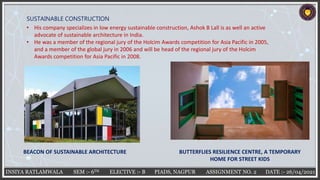
BUTTERFLIES RESILIENCE CENTRE, A TEMPORARY
HOME FOR STREET KIDS
BEACON OF SUSTAINABLE ARCHITECTURE
INSIYA RATLAMWALA SEM :- 6TH ELECTIVE :- B PIADS, NAGPUR ASSIGNMENT NO. 2 DATE :- 26/04/2021
AWARDS AND NOMINATIONS
• Low-Cost Housing Design for HUDCO - Prize winning design (placed
third) for National Competition of Low- Cost Housing Design 1980-81,
sponsored by Housing and Urban Development Corporation and Hari
Om Ashram Trust.
• S.P. Jain Centre for Management- Competition 1st prize, 1984-85 .
• Middle-Income Housing Design - DDA Competition, (placed third) 1985
(collaboration with MN Ashish Ganju) .
• Campus for Gujrat Energy Design Competition Entry (placed second),
1990-91 (collaboration Development Agency- with Naveen
Kulshreshtha) .
• Master Plan & Tissue Culture Nominated for Aga Khan Award, 1995 .
• Pilot Plant for TATA Energy Research Institute Campus Master Plan &
Campus Development for Competition First prize, Nominated for Aga
Khan Award, 1995 .
• Indian Institute of Health Management Research Transport
Corporation of India Nominated for Aga Khan Award, 2001
Headquarters .
• Disha Foundation for the Special Child DesignShare/SCN Citation
Award, 2005 .
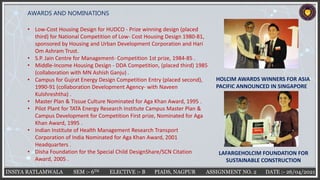
HOLCIM AWARDS WINNERS FOR ASIA
PACIFIC ANNOUNCED IN SINGAPORE
LAFARGEHOLCIM FOUNDATION FOR
SUSTAINABLE CONSTRUCTION
INSIYA RATLAMWALA SEM :- 6TH ELECTIVE :- B PIADS, NAGPUR ASSIGNMENT NO. 2 DATE :- 26/04/2021
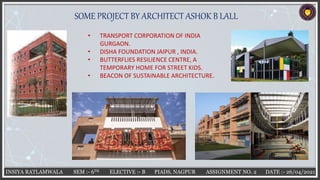
SOME PROJECT BY ARCHITECT ASHOK B LALL
• TRANSPORT CORPORATION OF INDIA
GURGAON.
• DISHA FOUNDATION JAIPUR , INDIA.
• BUTTERFLIES RESILIENCE CENTRE, A
TEMPORARY HOME FOR STREET KIDS.
• BEACON OF SUSTAINABLE ARCHITECTURE.
INSIYA RATLAMWALA SEM :- 6TH ELECTIVE :- B PIADS, NAGPUR ASSIGNMENT NO. 2 DATE :- 26/04/2021
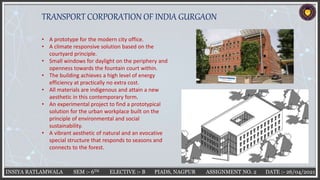
TRANSPORT CORPORATION OF INDIA GURGAON
• A prototype for the modern city office.
• A climate responsive solution based on the
courtyard principle.
• Small windows for daylight on the periphery and
openness towards the fountain court within.
• The building achieves a high level of energy
efficiency at practically no extra cost.
• All materials are indigenous and attain a new
aesthetic in this contemporary form.
• An experimental project to find a prototypical
solution for the urban workplace built on the
principle of environmental and social
sustainability.
• A vibrant aesthetic of natural and an evocative
special structure that responds to seasons and
connects to the forest.
INSIYA RATLAMWALA SEM :- 6TH ELECTIVE :- B PIADS, NAGPUR ASSIGNMENT NO. 2 DATE :- 26/04/2021
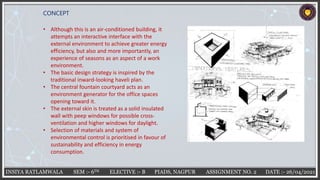
CONCEPT
• Although this is an air-conditioned building, it
attempts an interactive interface with the
external environment to achieve greater energy
efficiency, but also and more importantly, an
experience of seasons as an aspect of a work
environment.
• The basic design strategy is inspired by the
traditional inward-looking haveli plan.
• The central fountain courtyard acts as an
environment generator for the office spaces
opening toward it.
• The external skin is treated as a solid insulated
wall with peep windows for possible cross-
ventilation and higher windows for daylight.
• Selection of materials and system of
environmental control is prioritised in favour of
sustainability and efficiency in energy
consumption.
INSIYA RATLAMWALA SEM :- 6TH ELECTIVE :- B PIADS, NAGPUR ASSIGNMENT NO. 2 DATE :- 26/04/2021
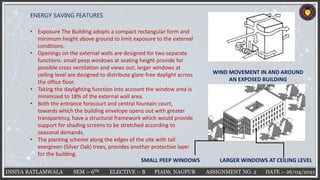
ENERGY SAVING FEATURES
• Exposure The Building adopts a compact rectangular form and
minimum height above ground to limit exposure to the external
conditions.
• Openings on the external walls are designed for two separate
functions: small peep windows at seating height provide for
possible cross ventilation and views out; larger windows at
ceiling level are designed to distribute glare-free daylight across
the office floor.
• Taking the daylighting function into account the window area is
minimized to 18% of the external wall area.
• Both the entrance forecourt and central fountain court,
towards which the building envelope opens out with greater
transparency, have a structural framework which would provide
support for shading screens to be stretched according to
seasonal demands.
• The planting scheme along the edges of the site with tall
evergreen (Silver Oak) trees, provides another protective layer
for the building.
WIND MOVEMENT IN AND AROUND
AN EXPOSED BUILDING
SMALL PEEP WINDOWS LARGER WINDOWS AT CEILING LEVEL
INSIYA RATLAMWALA SEM :- 6TH ELECTIVE :- B PIADS, NAGPUR ASSIGNMENT NO. 2 DATE :- 26/04/2021
FOUNTAIN COURT
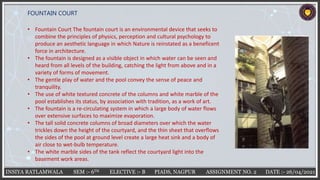
• Fountain Court The fountain court is an environmental device that seeks to
combine the principles of physics, perception and cultural psychology to
produce an aesthetic language in which Nature is reinstated as a beneficent
force in architecture.
• The fountain is designed as a visible object in which water can be seen and
heard from all levels of the building, catching the light from above and in a
variety of forms of movement.
• The gentle play of water and the pool convey the sense of peace and
tranquility.
• The use of white textured concrete of the columns and white marble of the
pool establishes its status, by association with tradition, as a work of art.
• The fountain is a re-circulating system in which a large body of water flows
over extensive surfaces to maximize evaporation.
• The tall solid concrete columns of broad diameters over which the water
trickles down the height of the courtyard, and the thin sheet that overflows
the sides of the pool at ground level create a large heat sink and a body of
air close to wet-bulb temperature.
• The white marble sides of the tank reflect the courtyard light into the
basement work areas.
INSIYA RATLAMWALA SEM :- 6TH ELECTIVE :- B PIADS, NAGPUR ASSIGNMENT NO. 2 DATE :- 26/04/2021
INTERACTIVE STRATEGY FOR AN AIR-
CONDITIONED BUILDING
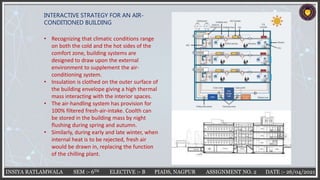
• Recognizing that climatic conditions range
on both the cold and the hot sides of the
comfort zone, building systems are
designed to draw upon the external
environment to supplement the air-
conditioning system.
• Insulation is clothed on the outer surface of
the building envelope giving a high thermal
mass interacting with the interior spaces.
• The air-handling system has provision for
100% filtered fresh-air-intake. Coolth can
be stored in the building mass by night
flushing during spring and autumn.
• Similarly, during early and late winter, when
internal heat is to be rejected, fresh air
would be drawn in, replacing the function
of the chilling plant.
INSIYA RATLAMWALA SEM :- 6TH ELECTIVE :- B PIADS, NAGPUR ASSIGNMENT NO. 2 DATE :- 26/04/2021
A SIGNIFICANT FEATURE OF ENERGY SAVING IS THE ECONOMY OF
THE BUILDING ENVELOPE.
STRUCTURAL SYSTEM AND FLOOR-TO-FLOOR HEIGHT
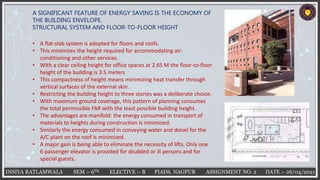
• A flat-slab system is adopted for floors and roofs.
• This minimizes the height required for accommodating air-
conditioning and other services.
• With a clear ceiling height for office spaces at 2.65 M the floor-to-floor
height of the building is 3.5 meters
• This compactness of height means minimizing heat transfer through
vertical surfaces of the external skin.
• Restricting the building height to three stories was a deliberate choice.
• With maximum ground coverage, this pattern of planning consumes
the total permissible FAR with the least possible building height.
• The advantages are manifold: the energy consumed in transport of
materials to heights during construction is minimized.
• Similarly the energy consumed in conveying water and diesel for the
A/C plant on the roof is minimized.
• A major gain is being able to eliminate the necessity of lifts. Only one
6 passenger elevator is provided for disabled or ill persons and for
special guests.
INSIYA RATLAMWALA SEM :- 6TH ELECTIVE :- B PIADS, NAGPUR ASSIGNMENT NO. 2 DATE :- 26/04/2021

Environment psychology 6 th sem

  • 1.
    INSIYA RATLAMWALA SEM:- 6TH ELECTIVE :- B PIADS, NAGPUR ASSIGNMENT NO. 2 DATE :- 26/04/2021 ASSIGNMENT NO. 2  EXPLAIN ENVIRONMENT PSYCHOLOGY IN ARCHITECTURE WITH THE WORK EXPLAIN BY ARCHITECTS LIKE AR. EUGENE PANDALA, AR. CHITRA VISHWANATH, AR. ASHOL B.LAL , AR. LAURIE BAKER ETC. • Environmental psychology overlaps with many other established design disciplines, including space planning, ergonomics, lighting, acoustics, way-finding, branding, and interior design. And while its scope is enormous, its methods and conclusions are astonishingly precise. • For example, research has proven that locating a sink within the visible stretch of a hospital corridor can increase the rate of hand washing, and that installing operable windows in a school classroom can reduce sleepiness. It investigates the effects of a certain color of paint on a living room wall and also of the ideal ratio of planted to paved space in a city park.
  • 2.
    INSIYA RATLAMWALA SEM:- 6TH ELECTIVE :- B PIADS, NAGPUR ASSIGNMENT NO. 2 DATE :- 26/04/2021 ASHOK B LALL ….SUSTAINABLE ARCHITECTURE PROFESSIONAL CAREER • Ashok B lall architects the firm ashok B lall architects was established in 1981. • The practice has executed projects for educational research institutions in india and specializes in low energy sustainable architecture. • The company is engaged in the development of the architectural curricula for the indian context and contributes regularly to national professional journals for architecture. • Recent projects include the indian institute of health management research, jaipur; sehgal foundation, gurgaon and development alternatives world headquarters, new delhi. • Works include the master plan and tissue culture pilot plant for tata energy research institute campus, gurgaon the master plan and campus development for the indian institute of health management research, jaipur and the transport corporation of india headquarters, new delhi. • ASHOK B LALL is principal of ashok B lall architects in new Delhi, India and he is visiting professor at the guru gobind singh indraprastha university (GGSIU) and based in new Delhi . • He held the position of dean of studies of the former TVB school of habitat studies in new Delhi until its merger with (GGSIPU) in 2007.
  • 3.
    INSIYA RATLAMWALA SEM:- 6TH ELECTIVE :- B PIADS, NAGPUR ASSIGNMENT NO. 2 DATE :- 26/04/2021 SUSTAINABLE CONSTRUCTION • His company specializes in low energy sustainable construction, Ashok B Lall is as well an active advocate of sustainable architecture in India. • He was a member of the regional jury of the Holcim Awards competition for Asia Pacific in 2005, and a member of the global jury in 2006 and will be head of the regional jury of the Holcim Awards competition for Asia Pacific in 2008. BUTTERFLIES RESILIENCE CENTRE, A TEMPORARY HOME FOR STREET KIDS BEACON OF SUSTAINABLE ARCHITECTURE
  • 4.
    INSIYA RATLAMWALA SEM:- 6TH ELECTIVE :- B PIADS, NAGPUR ASSIGNMENT NO. 2 DATE :- 26/04/2021 AWARDS AND NOMINATIONS • Low-Cost Housing Design for HUDCO - Prize winning design (placed third) for National Competition of Low- Cost Housing Design 1980-81, sponsored by Housing and Urban Development Corporation and Hari Om Ashram Trust. • S.P. Jain Centre for Management- Competition 1st prize, 1984-85 . • Middle-Income Housing Design - DDA Competition, (placed third) 1985 (collaboration with MN Ashish Ganju) . • Campus for Gujrat Energy Design Competition Entry (placed second), 1990-91 (collaboration Development Agency- with Naveen Kulshreshtha) . • Master Plan & Tissue Culture Nominated for Aga Khan Award, 1995 . • Pilot Plant for TATA Energy Research Institute Campus Master Plan & Campus Development for Competition First prize, Nominated for Aga Khan Award, 1995 . • Indian Institute of Health Management Research Transport Corporation of India Nominated for Aga Khan Award, 2001 Headquarters . • Disha Foundation for the Special Child DesignShare/SCN Citation Award, 2005 . HOLCIM AWARDS WINNERS FOR ASIA PACIFIC ANNOUNCED IN SINGAPORE LAFARGEHOLCIM FOUNDATION FOR SUSTAINABLE CONSTRUCTION
  • 5.
    INSIYA RATLAMWALA SEM:- 6TH ELECTIVE :- B PIADS, NAGPUR ASSIGNMENT NO. 2 DATE :- 26/04/2021 SOME PROJECT BY ARCHITECT ASHOK B LALL • TRANSPORT CORPORATION OF INDIA GURGAON. • DISHA FOUNDATION JAIPUR , INDIA. • BUTTERFLIES RESILIENCE CENTRE, A TEMPORARY HOME FOR STREET KIDS. • BEACON OF SUSTAINABLE ARCHITECTURE.
  • 6.
    INSIYA RATLAMWALA SEM:- 6TH ELECTIVE :- B PIADS, NAGPUR ASSIGNMENT NO. 2 DATE :- 26/04/2021 TRANSPORT CORPORATION OF INDIA GURGAON • A prototype for the modern city office. • A climate responsive solution based on the courtyard principle. • Small windows for daylight on the periphery and openness towards the fountain court within. • The building achieves a high level of energy efficiency at practically no extra cost. • All materials are indigenous and attain a new aesthetic in this contemporary form. • An experimental project to find a prototypical solution for the urban workplace built on the principle of environmental and social sustainability. • A vibrant aesthetic of natural and an evocative special structure that responds to seasons and connects to the forest.
  • 7.
    INSIYA RATLAMWALA SEM:- 6TH ELECTIVE :- B PIADS, NAGPUR ASSIGNMENT NO. 2 DATE :- 26/04/2021 CONCEPT • Although this is an air-conditioned building, it attempts an interactive interface with the external environment to achieve greater energy efficiency, but also and more importantly, an experience of seasons as an aspect of a work environment. • The basic design strategy is inspired by the traditional inward-looking haveli plan. • The central fountain courtyard acts as an environment generator for the office spaces opening toward it. • The external skin is treated as a solid insulated wall with peep windows for possible cross- ventilation and higher windows for daylight. • Selection of materials and system of environmental control is prioritised in favour of sustainability and efficiency in energy consumption.
  • 8.
    INSIYA RATLAMWALA SEM:- 6TH ELECTIVE :- B PIADS, NAGPUR ASSIGNMENT NO. 2 DATE :- 26/04/2021 ENERGY SAVING FEATURES • Exposure The Building adopts a compact rectangular form and minimum height above ground to limit exposure to the external conditions. • Openings on the external walls are designed for two separate functions: small peep windows at seating height provide for possible cross ventilation and views out; larger windows at ceiling level are designed to distribute glare-free daylight across the office floor. • Taking the daylighting function into account the window area is minimized to 18% of the external wall area. • Both the entrance forecourt and central fountain court, towards which the building envelope opens out with greater transparency, have a structural framework which would provide support for shading screens to be stretched according to seasonal demands. • The planting scheme along the edges of the site with tall evergreen (Silver Oak) trees, provides another protective layer for the building. WIND MOVEMENT IN AND AROUND AN EXPOSED BUILDING SMALL PEEP WINDOWS LARGER WINDOWS AT CEILING LEVEL
  • 9.
    INSIYA RATLAMWALA SEM:- 6TH ELECTIVE :- B PIADS, NAGPUR ASSIGNMENT NO. 2 DATE :- 26/04/2021 FOUNTAIN COURT • Fountain Court The fountain court is an environmental device that seeks to combine the principles of physics, perception and cultural psychology to produce an aesthetic language in which Nature is reinstated as a beneficent force in architecture. • The fountain is designed as a visible object in which water can be seen and heard from all levels of the building, catching the light from above and in a variety of forms of movement. • The gentle play of water and the pool convey the sense of peace and tranquility. • The use of white textured concrete of the columns and white marble of the pool establishes its status, by association with tradition, as a work of art. • The fountain is a re-circulating system in which a large body of water flows over extensive surfaces to maximize evaporation. • The tall solid concrete columns of broad diameters over which the water trickles down the height of the courtyard, and the thin sheet that overflows the sides of the pool at ground level create a large heat sink and a body of air close to wet-bulb temperature. • The white marble sides of the tank reflect the courtyard light into the basement work areas.
  • 10.
    INSIYA RATLAMWALA SEM:- 6TH ELECTIVE :- B PIADS, NAGPUR ASSIGNMENT NO. 2 DATE :- 26/04/2021 INTERACTIVE STRATEGY FOR AN AIR- CONDITIONED BUILDING • Recognizing that climatic conditions range on both the cold and the hot sides of the comfort zone, building systems are designed to draw upon the external environment to supplement the air- conditioning system. • Insulation is clothed on the outer surface of the building envelope giving a high thermal mass interacting with the interior spaces. • The air-handling system has provision for 100% filtered fresh-air-intake. Coolth can be stored in the building mass by night flushing during spring and autumn. • Similarly, during early and late winter, when internal heat is to be rejected, fresh air would be drawn in, replacing the function of the chilling plant.
  • 11.
    INSIYA RATLAMWALA SEM:- 6TH ELECTIVE :- B PIADS, NAGPUR ASSIGNMENT NO. 2 DATE :- 26/04/2021 A SIGNIFICANT FEATURE OF ENERGY SAVING IS THE ECONOMY OF THE BUILDING ENVELOPE. STRUCTURAL SYSTEM AND FLOOR-TO-FLOOR HEIGHT • A flat-slab system is adopted for floors and roofs. • This minimizes the height required for accommodating air- conditioning and other services. • With a clear ceiling height for office spaces at 2.65 M the floor-to-floor height of the building is 3.5 meters • This compactness of height means minimizing heat transfer through vertical surfaces of the external skin. • Restricting the building height to three stories was a deliberate choice. • With maximum ground coverage, this pattern of planning consumes the total permissible FAR with the least possible building height. • The advantages are manifold: the energy consumed in transport of materials to heights during construction is minimized. • Similarly the energy consumed in conveying water and diesel for the A/C plant on the roof is minimized. • A major gain is being able to eliminate the necessity of lifts. Only one 6 passenger elevator is provided for disabled or ill persons and for special guests.
  • 12.
    INSIYA RATLAMWALA SEM:- 6TH ELECTIVE :- B PIADS, NAGPUR ASSIGNMENT NO. 2 DATE :- 26/04/2021