
Introduction to Intellectual Property
NORCAT – November 20th, 2013
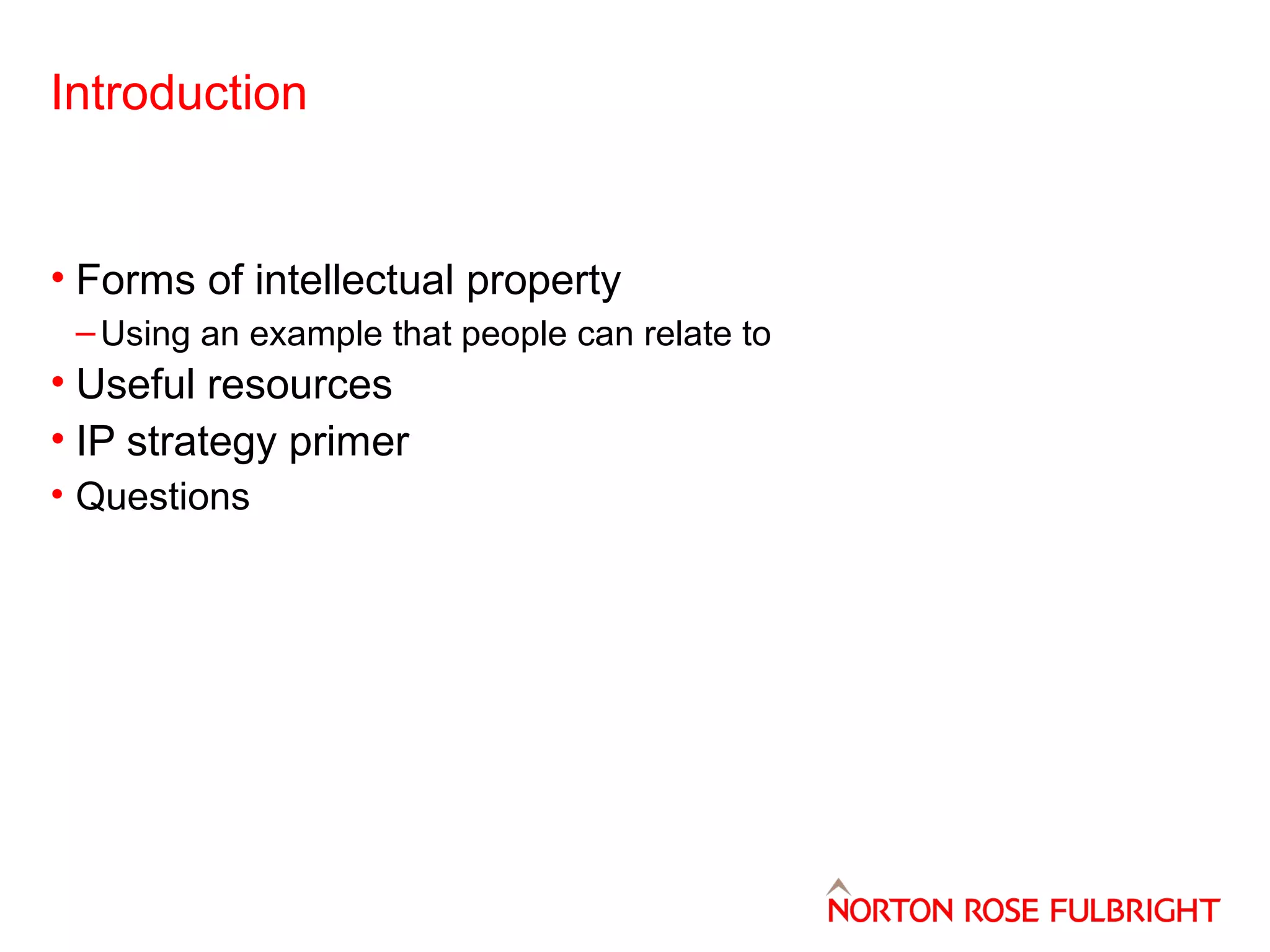
Introduction

• Forms of intellectual property
– Using an example that people can relate to

• Useful resources
• IP strategy primer
• Questions
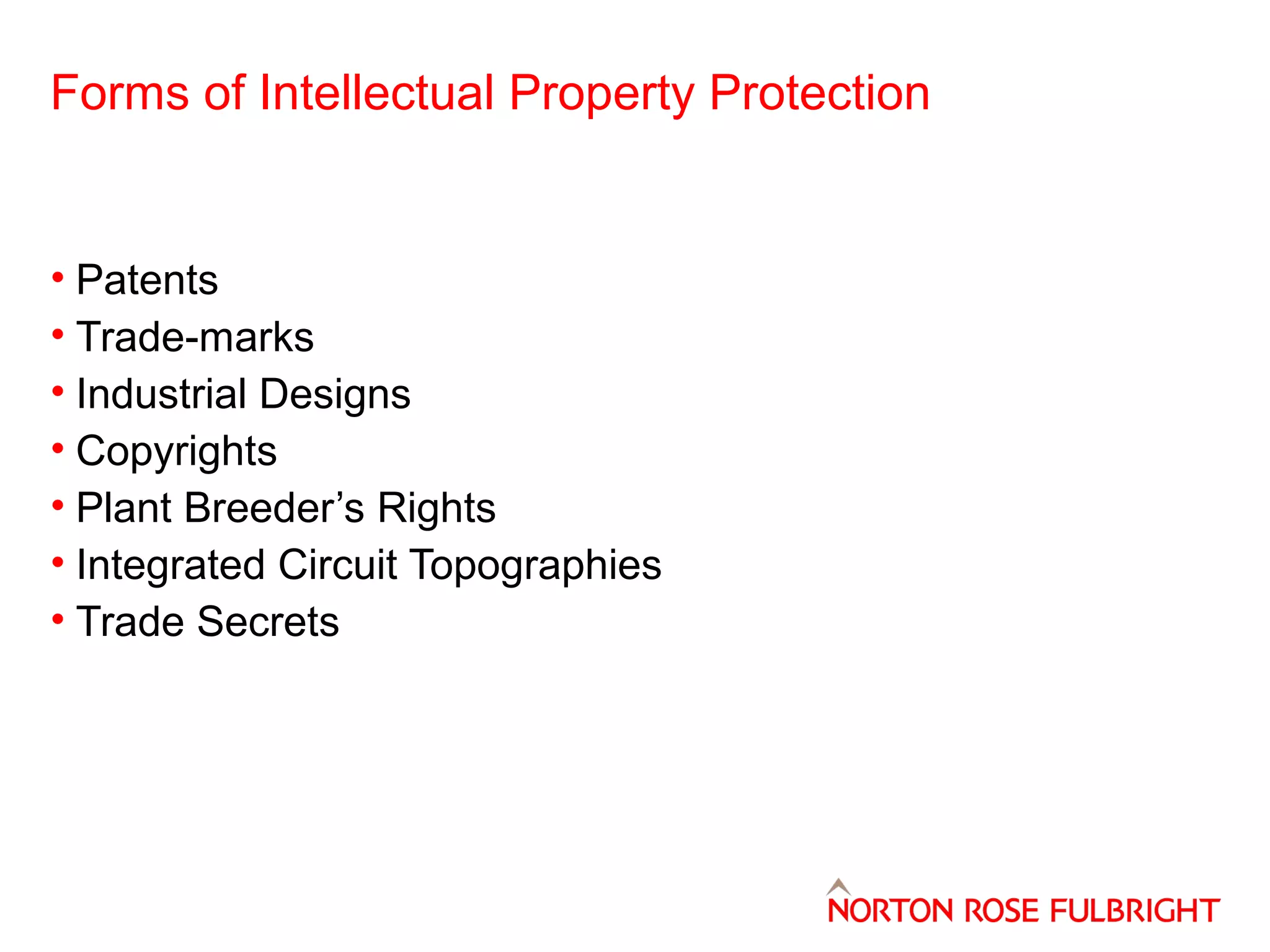
Forms of Intellectual Property Protection

• Patents
• Trade-marks
• Industrial Designs
• Copyrights
• Plant Breeder’s Rights
• Integrated Circuit Topographies
• Trade Secrets
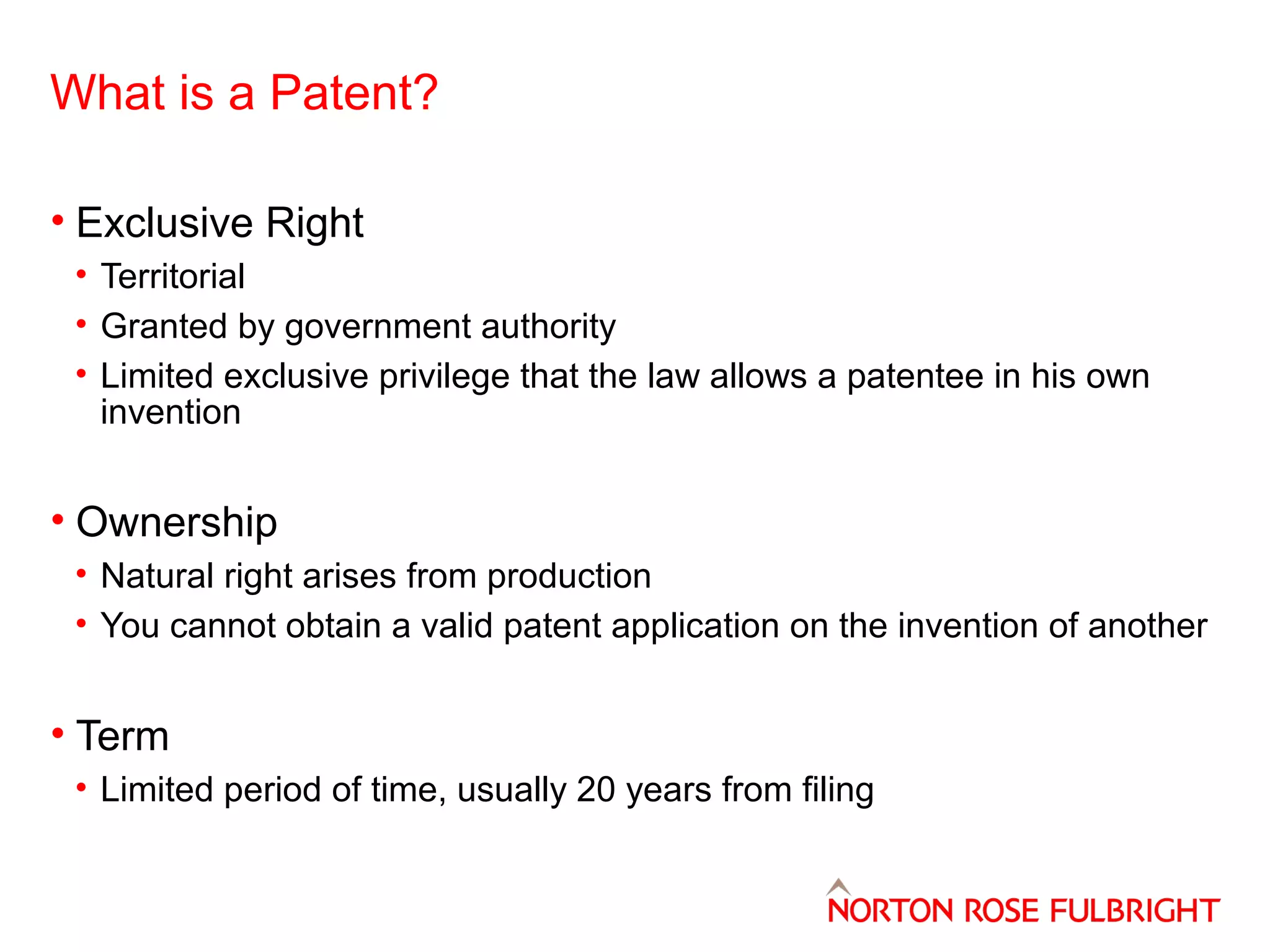
What is a Patent?
• Exclusive Right
• Territorial
• Granted by government authority
• Limited exclusive privilege that the law allows a patentee in his own
invention

• Ownership
• Natural right arises from production
• You cannot obtain a valid patent application on the invention of another

• Term
• Limited period of time, usually 20 years from filing
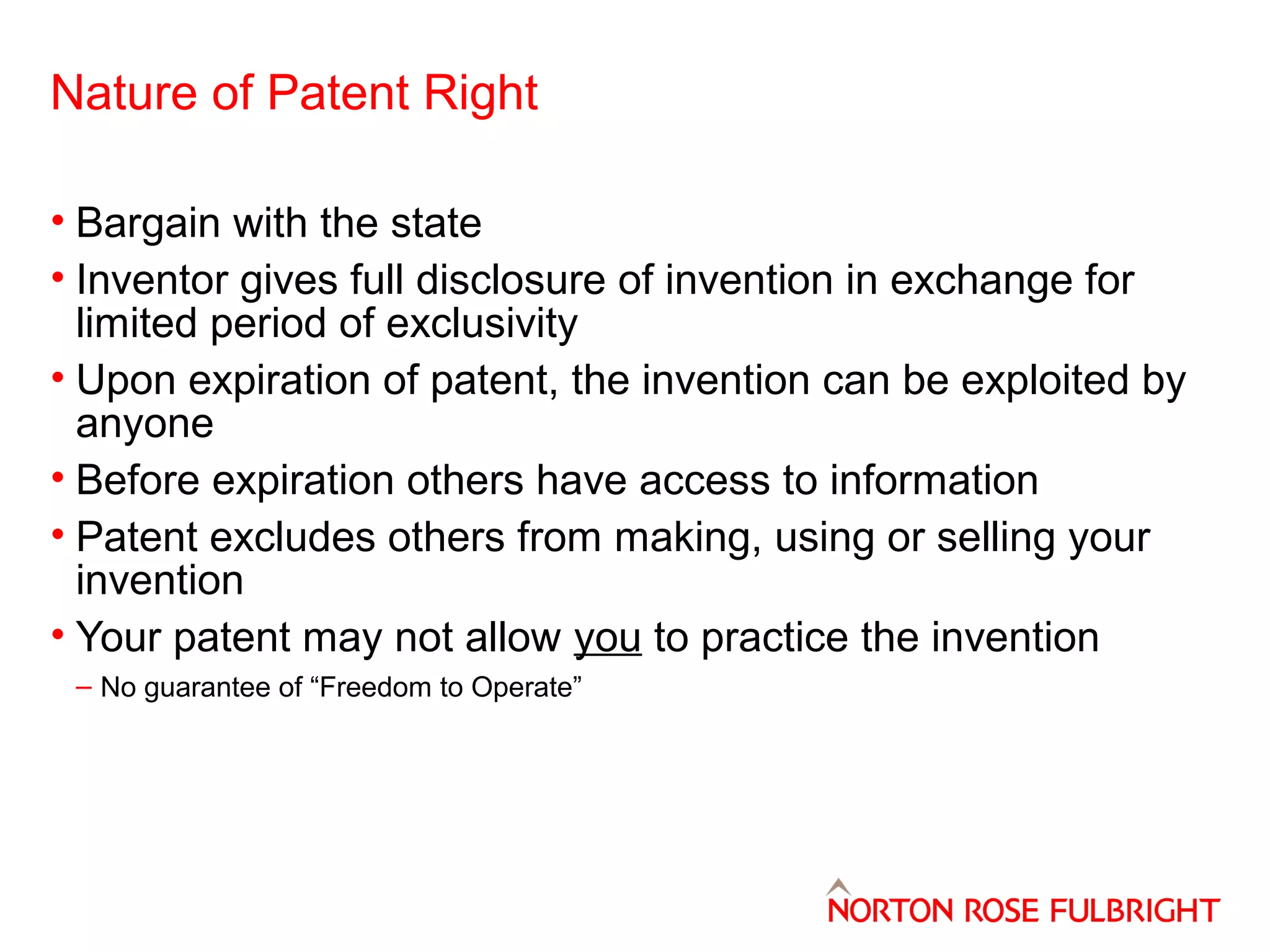
Nature of Patent Right
• Bargain with the state
• Inventor gives full disclosure of invention in exchange for
limited period of exclusivity
• Upon expiration of patent, the invention can be exploited by
anyone
• Before expiration others have access to information
• Patent excludes others from making, using or selling your
invention
• Your patent may not allow you to practice the invention
– No guarantee of “Freedom to Operate”
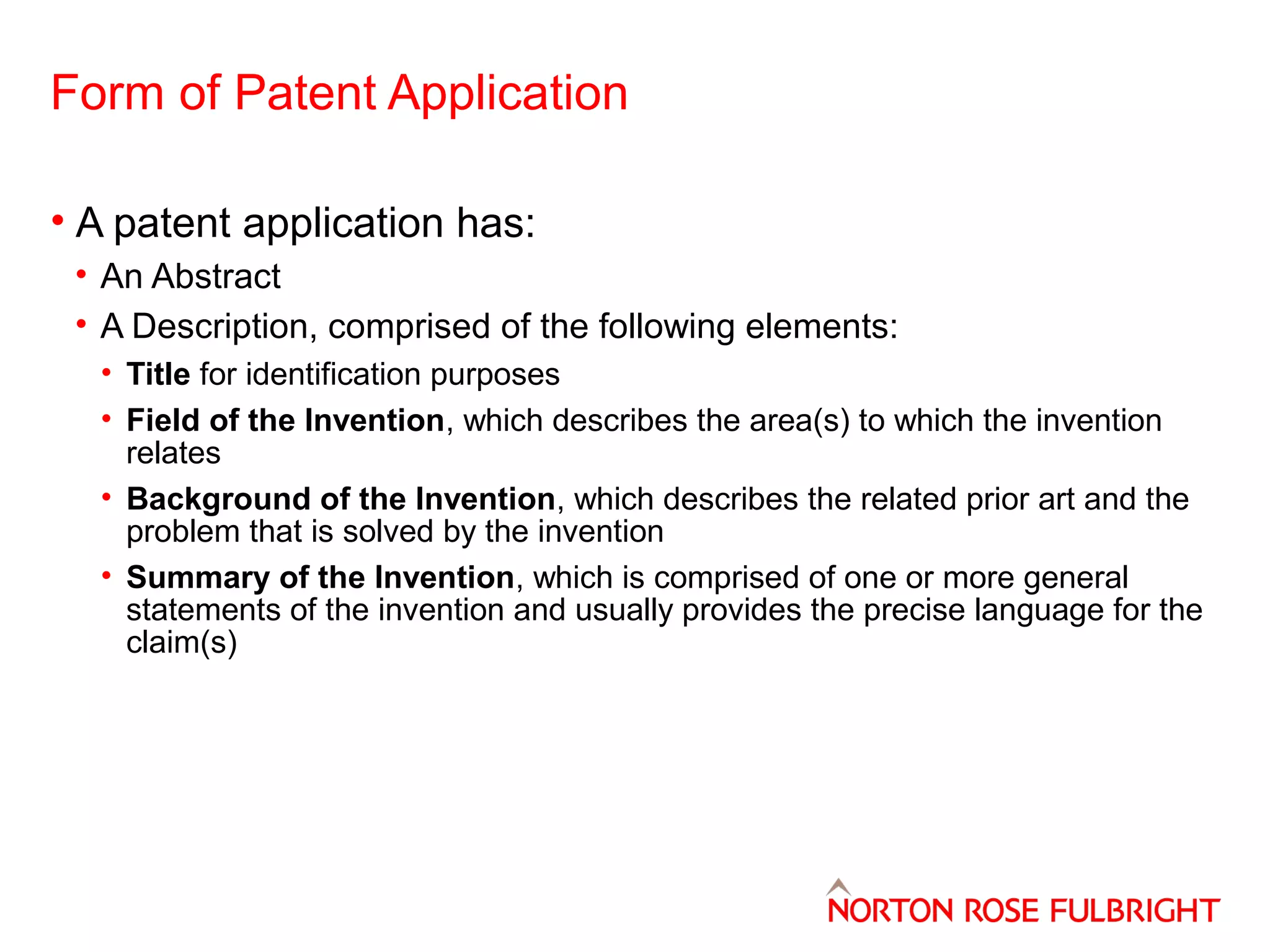
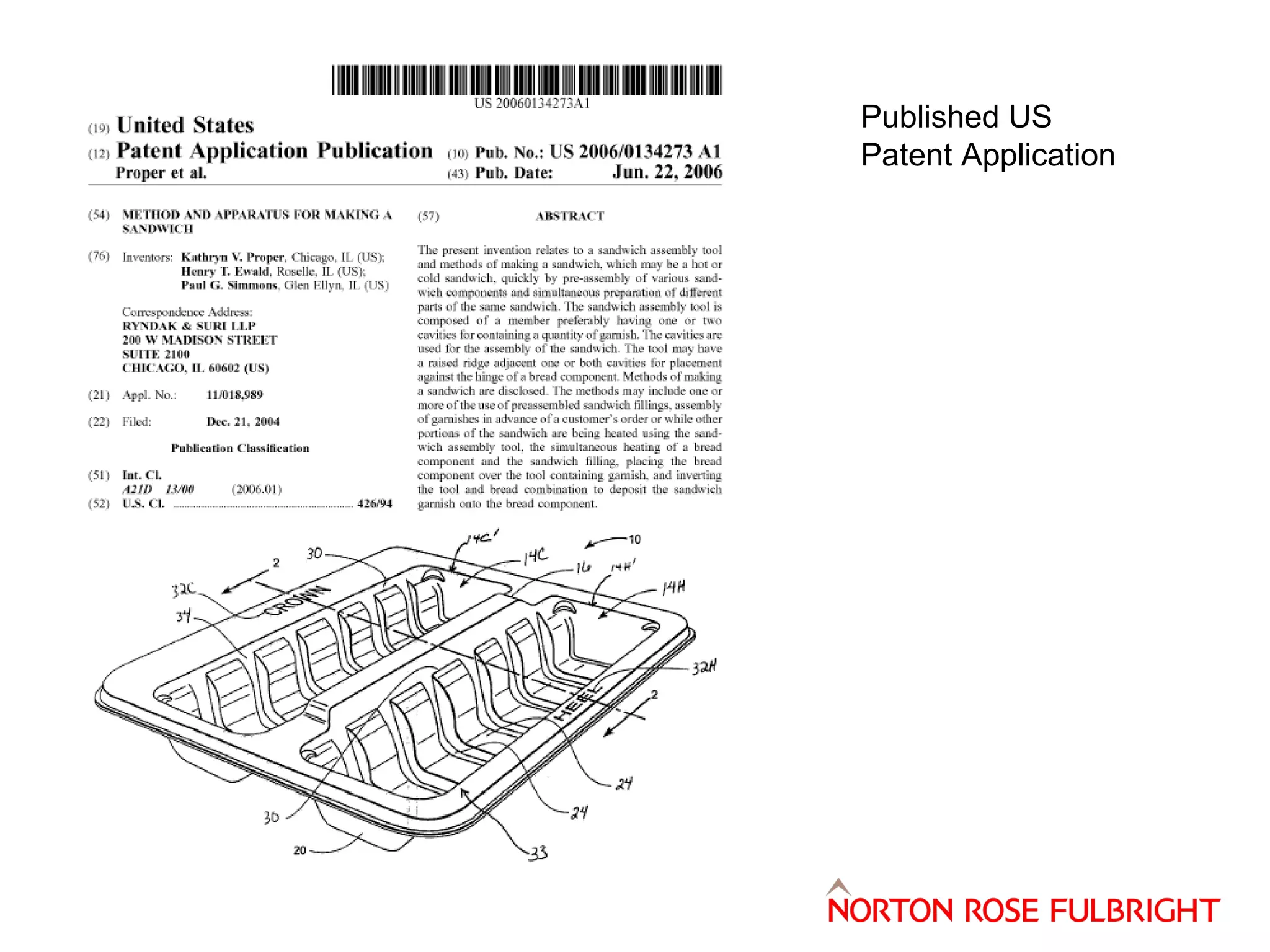
Form of Patent Application
• A patent application has:
• An Abstract
• A Description, comprised of the following elements:
• Title for identification purposes
• Field of the Invention, which describes the area(s) to which the invention
relates
• Background of the Invention, which describes the related prior art and the
problem that is solved by the invention
• Summary of the Invention, which is comprised of one or more general
statements of the invention and usually provides the precise language for the
claim(s)
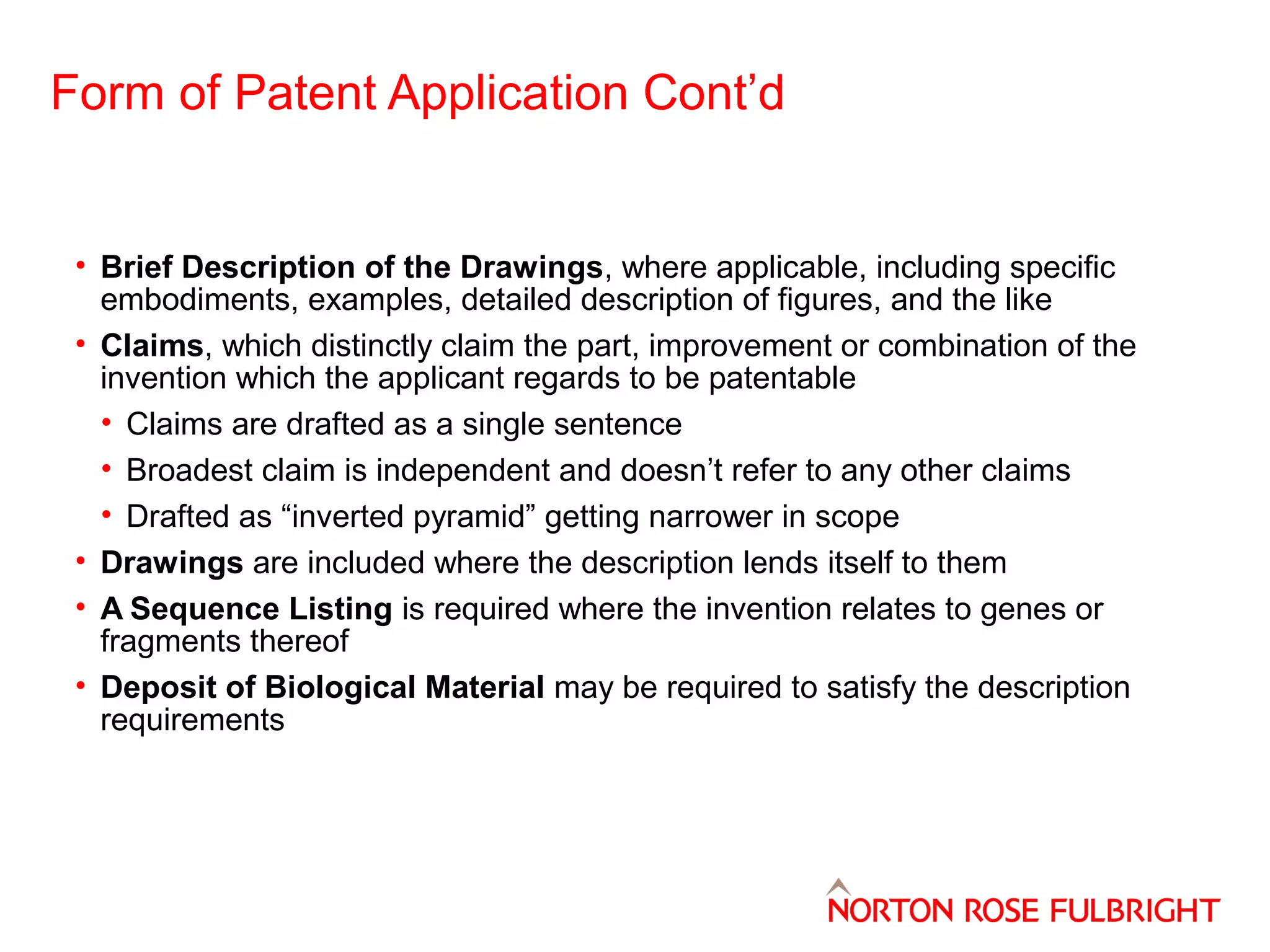
Form of Patent Application Cont’d

• Brief Description of the Drawings, where applicable, including specific
embodiments, examples, detailed description of figures, and the like
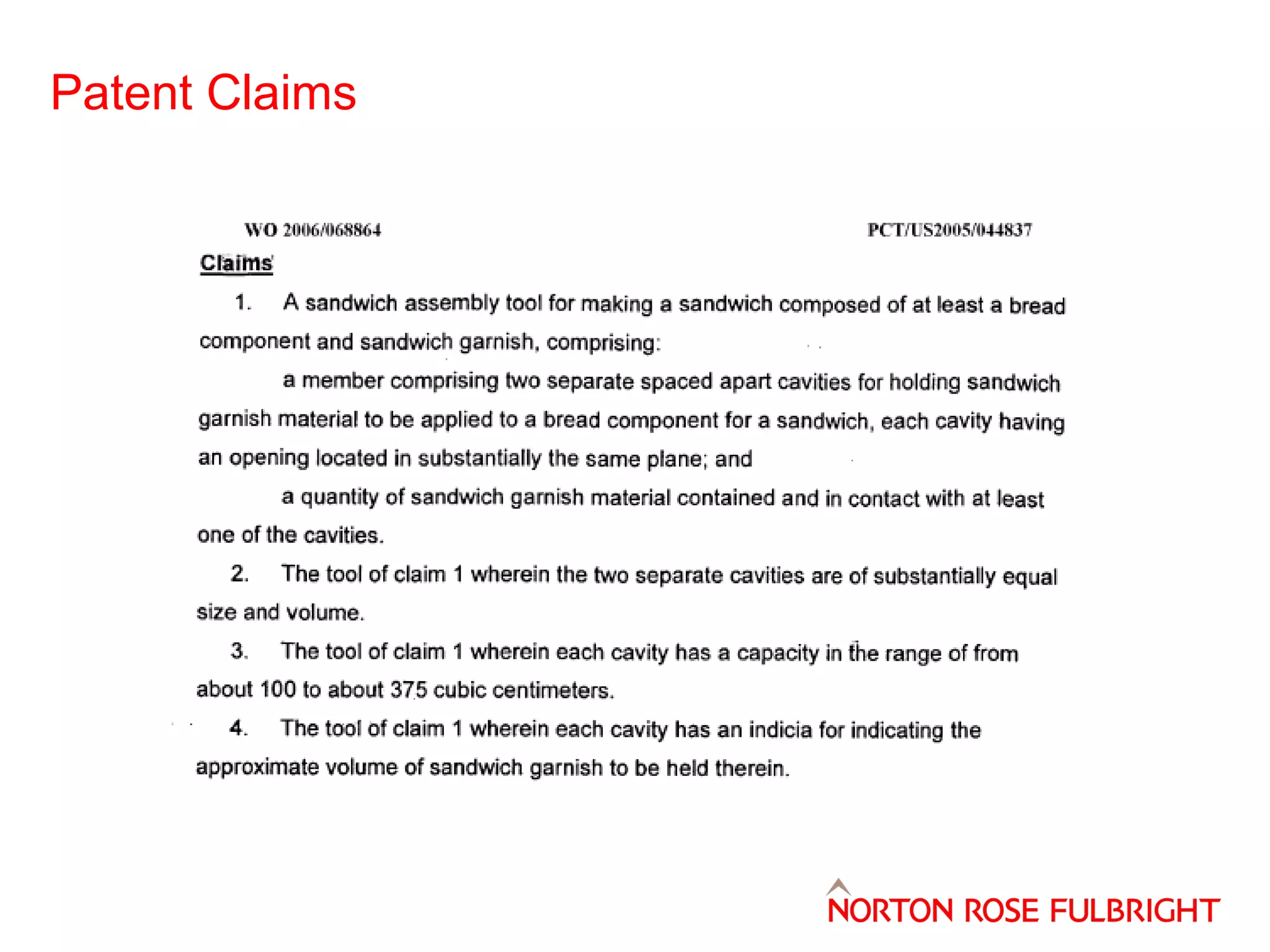
• Claims, which distinctly claim the part, improvement or combination of the
invention which the applicant regards to be patentable
• Claims are drafted as a single sentence
• Broadest claim is independent and doesn’t refer to any other claims
• Drafted as “inverted pyramid” getting narrower in scope
• Drawings are included where the description lends itself to them
• A Sequence Listing is required where the invention relates to genes or
fragments thereof
• Deposit of Biological Material may be required to satisfy the description
requirements
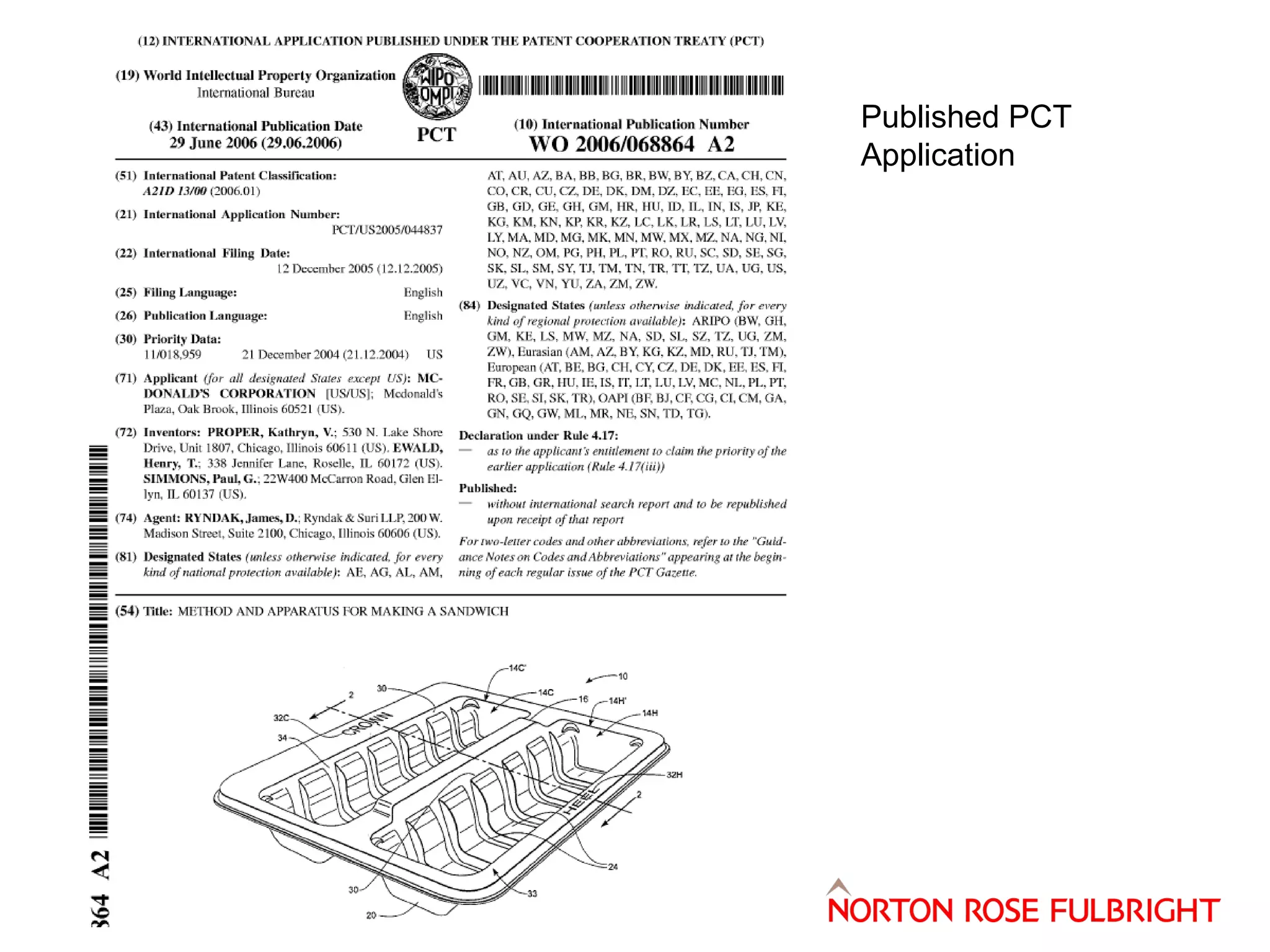
Published PCT
Application
Published US
Patent Application
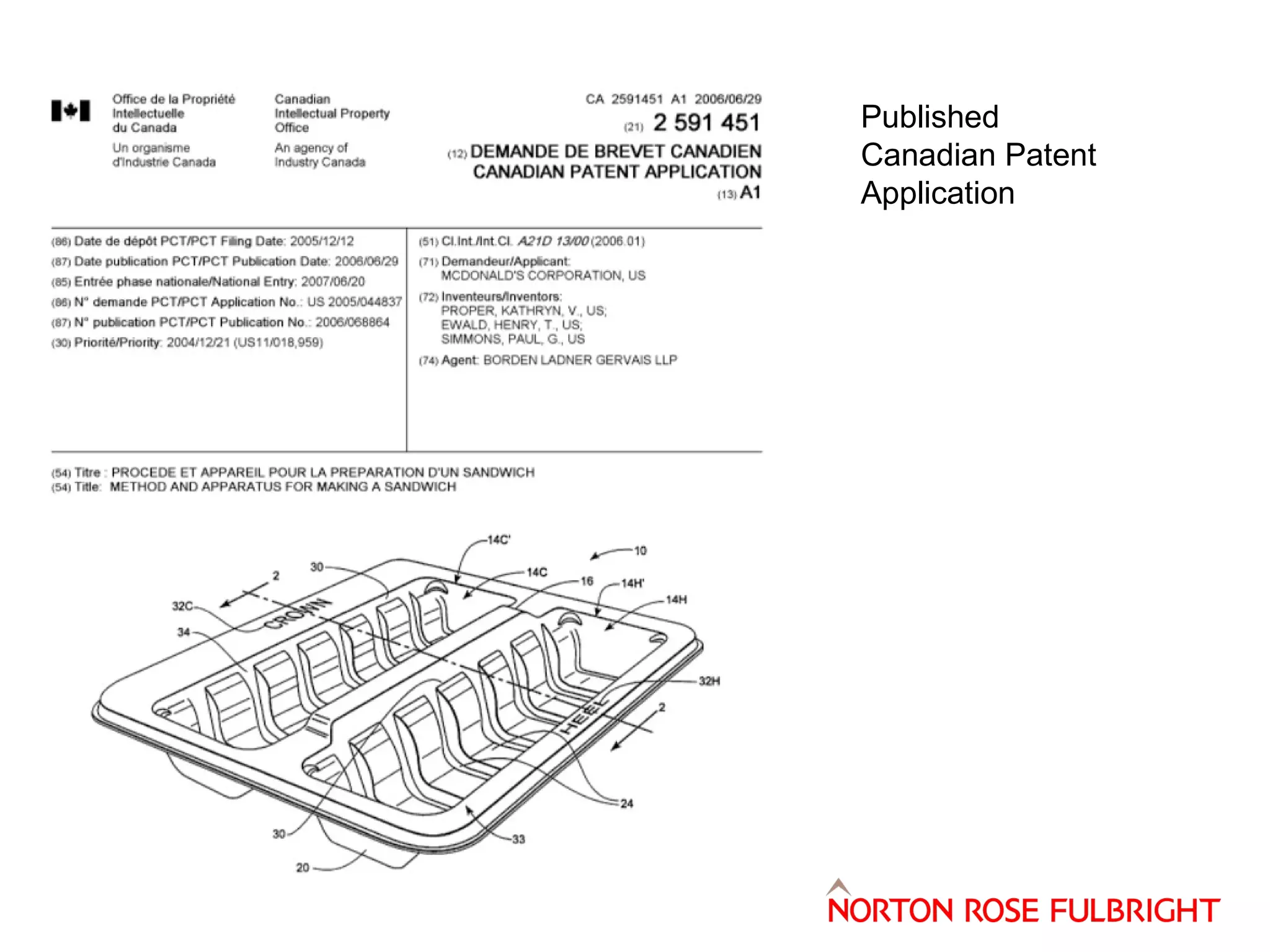
Published
Canadian Patent
Application
Patent Claims
Patentable Invention
• Requirements
•
•
•
•

New
Useful
Patentable subject matter
Unobvious

• The first three you often get a sense of in an initial interview
• Can further investigate new and unobvious through a patentability
search
Patentability Search and Assessment
•
•
•
•
•
•

Invaluable to avoid re-patenting the wheel
To establish scope of invention
Language of the patent art
Reveal the patent landscape in a particular area
Reveal activities of competitors
Useful information to consider when choosing countries or regions
where protection should be sought if at all
Filing a Patent Application
• Must be filed in a timely manner
• Before publication or disclosure to the public, or
• Within grace periods, or
• In keeping with International Treaty requirements
But,

• To provide a proper priority basis, the subject matter of a
later claim must be taught in the priority filing
Disclosure of Invention Before Filing
• US: one-year grace period
• Canada: one year grace period from Canadian filing date
• EP: public disclosure prior to priority filing precludes the
grant of valid patent rights
• Confidential disclosures may not be damaging, but are
relying on receiving party to maintain confidentiality
• Disclosures that take place after filing can cause problems
where an inadequate priority patent application is filed and
claims lose entitlement to the priority date
Patent Application Process in Context

• Patent application process fits within a larger cycle of events
in a plan for commercializing technology
Whether/How to File…

• There are many factors that may play a role
• Why? Because the costs associated with patent protection
and enforcement are significant and patents are territorial
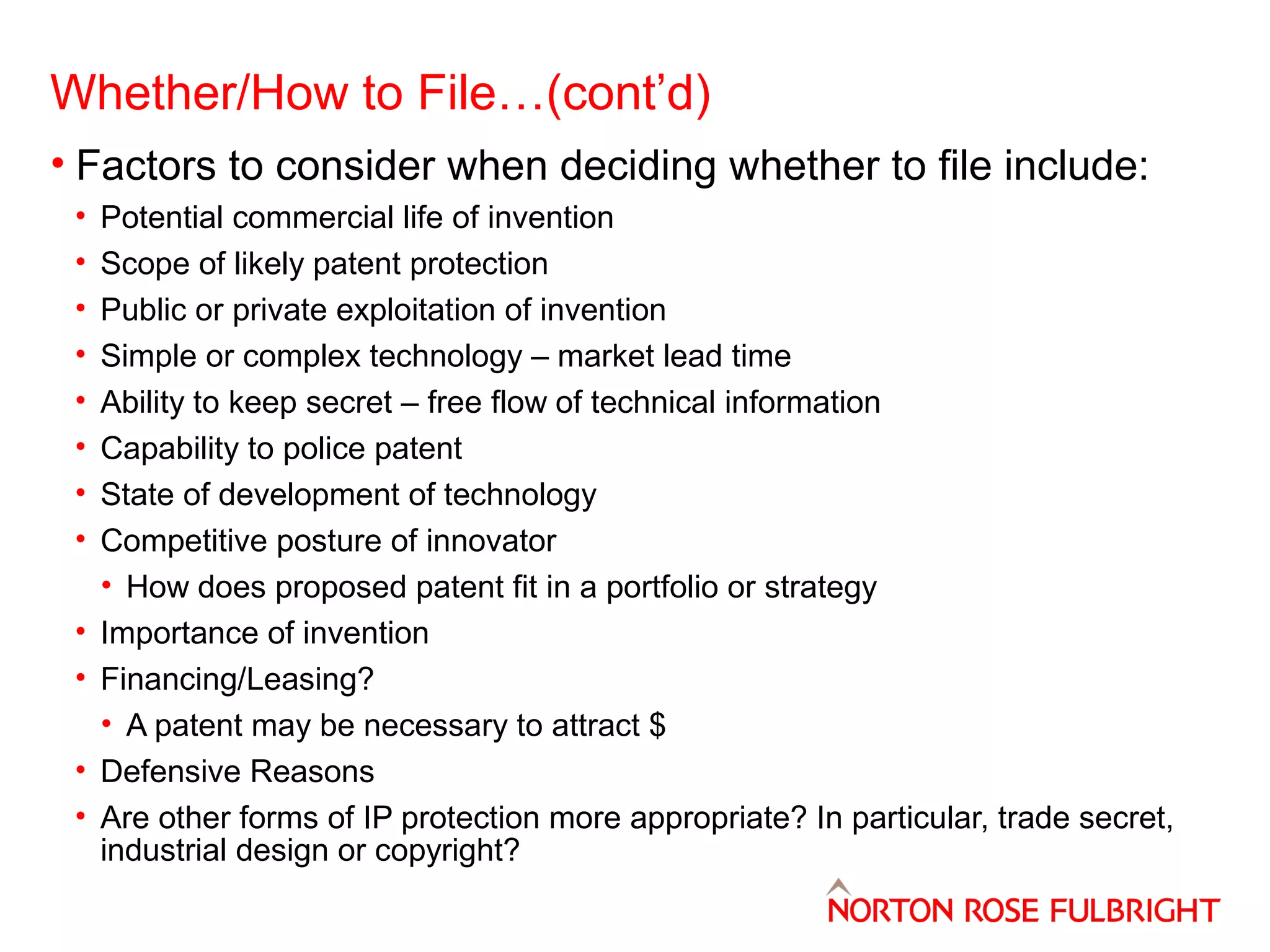
Whether/How to File…(cont’d)
• Factors to consider when deciding whether to file include:
•
•
•
•
•
•
•
•
•
•
•
•

Potential commercial life of invention
Scope of likely patent protection
Public or private exploitation of invention
Simple or complex technology – market lead time
Ability to keep secret – free flow of technical information
Capability to police patent
State of development of technology
Competitive posture of innovator
• How does proposed patent fit in a portfolio or strategy
Importance of invention
Financing/Leasing?
• A patent may be necessary to attract $
Defensive Reasons
Are other forms of IP protection more appropriate? In particular, trade secret,
industrial design or copyright?
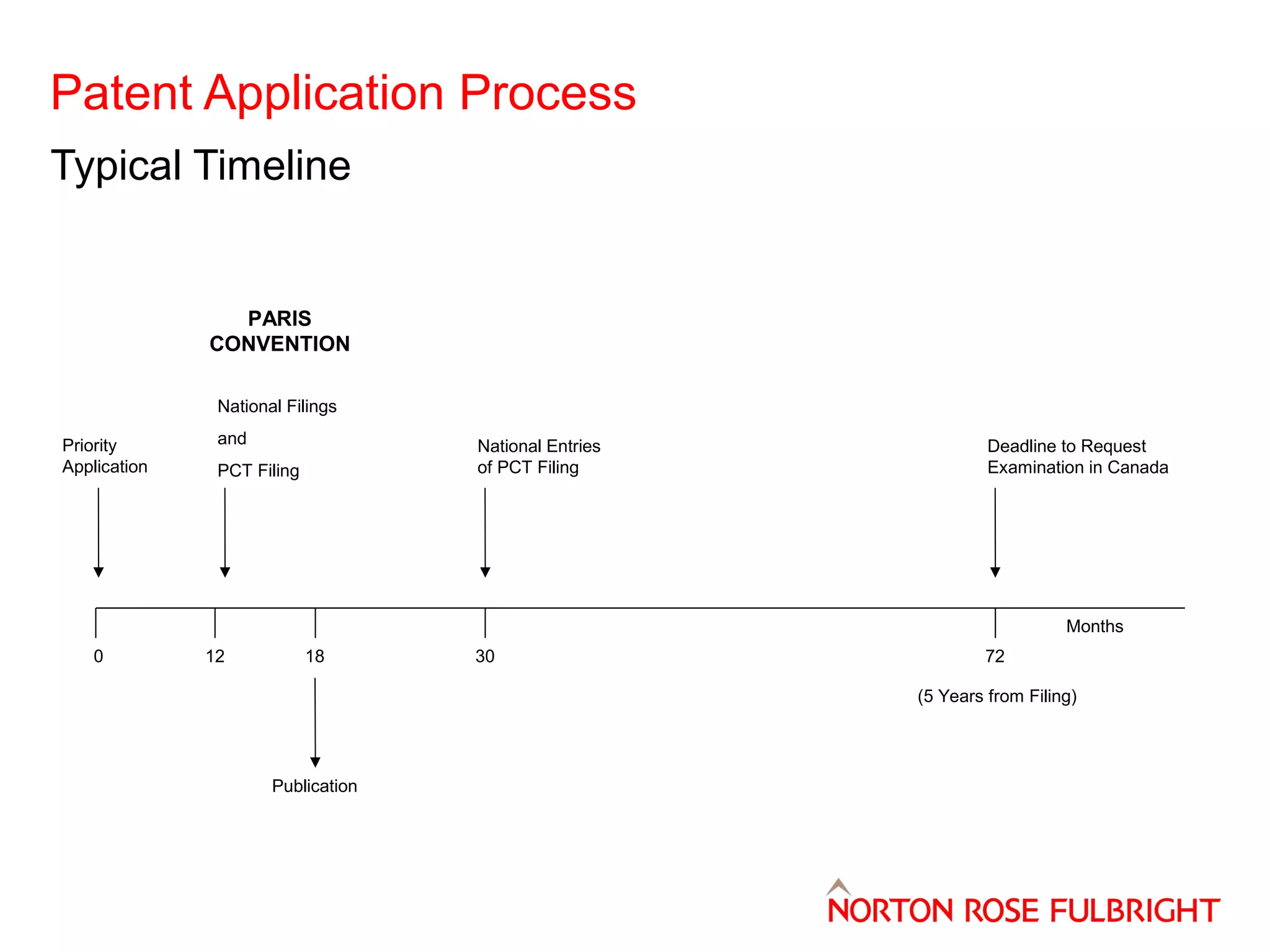
Patent Application Process
Typical Timeline

PARIS
CONVENTION
National Filings
Priority
Application

and

National Entries
of PCT Filing

PCT Filing

Deadline to Request
Examination in Canada

Months
0

12

18

30

72
(5 Years from Filing)

Publication
Enablement
• Ensures that public receives its “quid pro quo” for patent
grant
• Description must enable person skilled in the art to practice
the invention without undue experimentation
• Factors to consider:
•
•
•
•
•
•
•
•

Quantity of experimentation necessary
Amount of direction and guidance provided
Presence of working examples
Nature of invention
State of prior art
Relative skill of those in the art
Predictability of art
Breadth of claims
Example of interplay between different forms of
intellectual property
Vital Alert
-Patents on base technology (underground communications,
censor monitoring)
-Patents covering different applications (safer detonation)
-Trade-marks (CANARY™)
-Possible registered circuit topographies
-Shape of unit, possible industrial design and/or trade-mark
(distinguishing guise)
-Copyright protects computer code, and marketing materials
-Trade secrets used to protect certain aspects of technology,
and source code
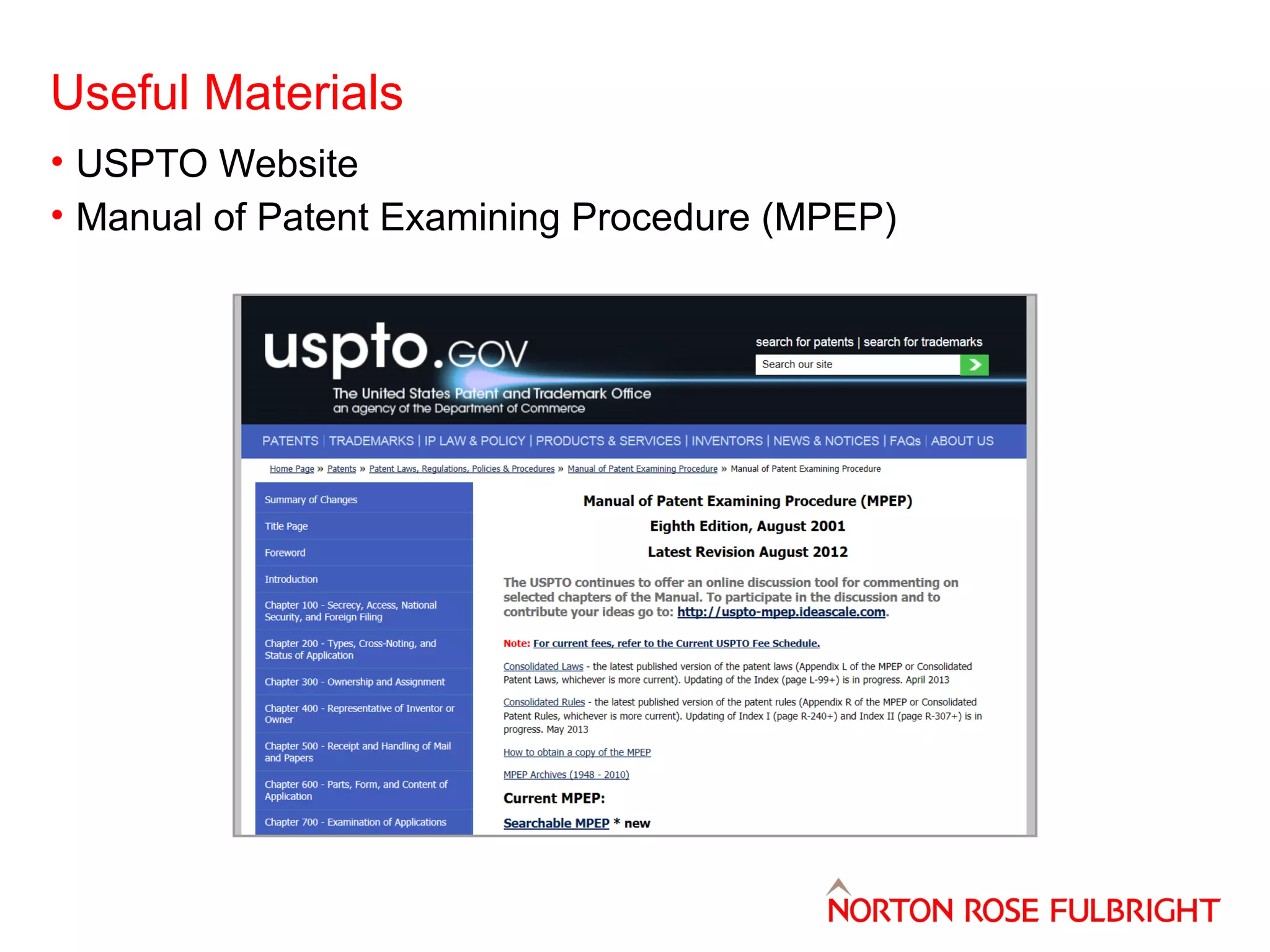
Useful Materials
• USPTO Website
• Manual of Patent Examining Procedure (MPEP)
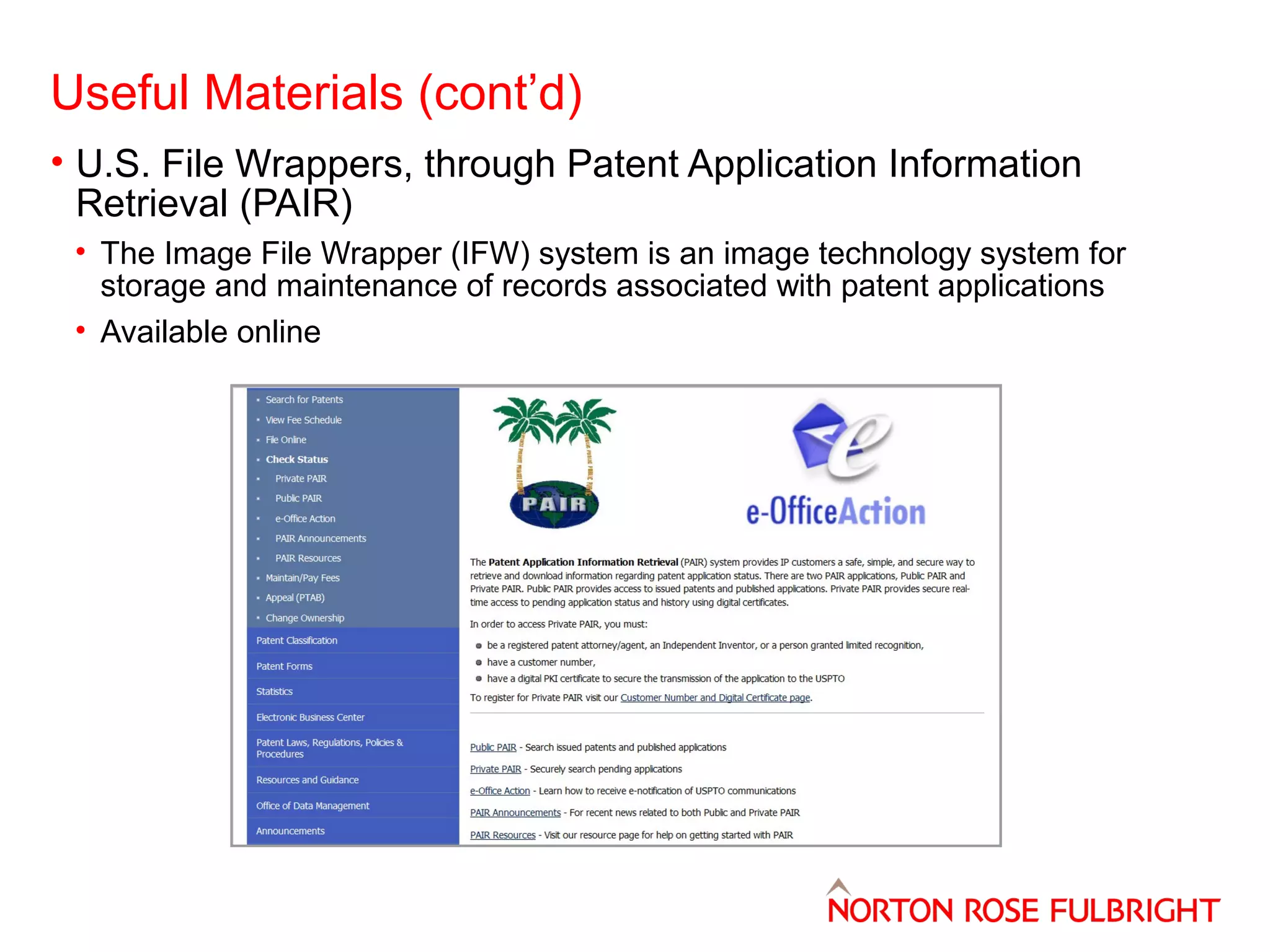
Useful Materials (cont’d)
• U.S. File Wrappers, through Patent Application Information
Retrieval (PAIR)
• The Image File Wrapper (IFW) system is an image technology system for
storage and maintenance of records associated with patent applications
• Available online
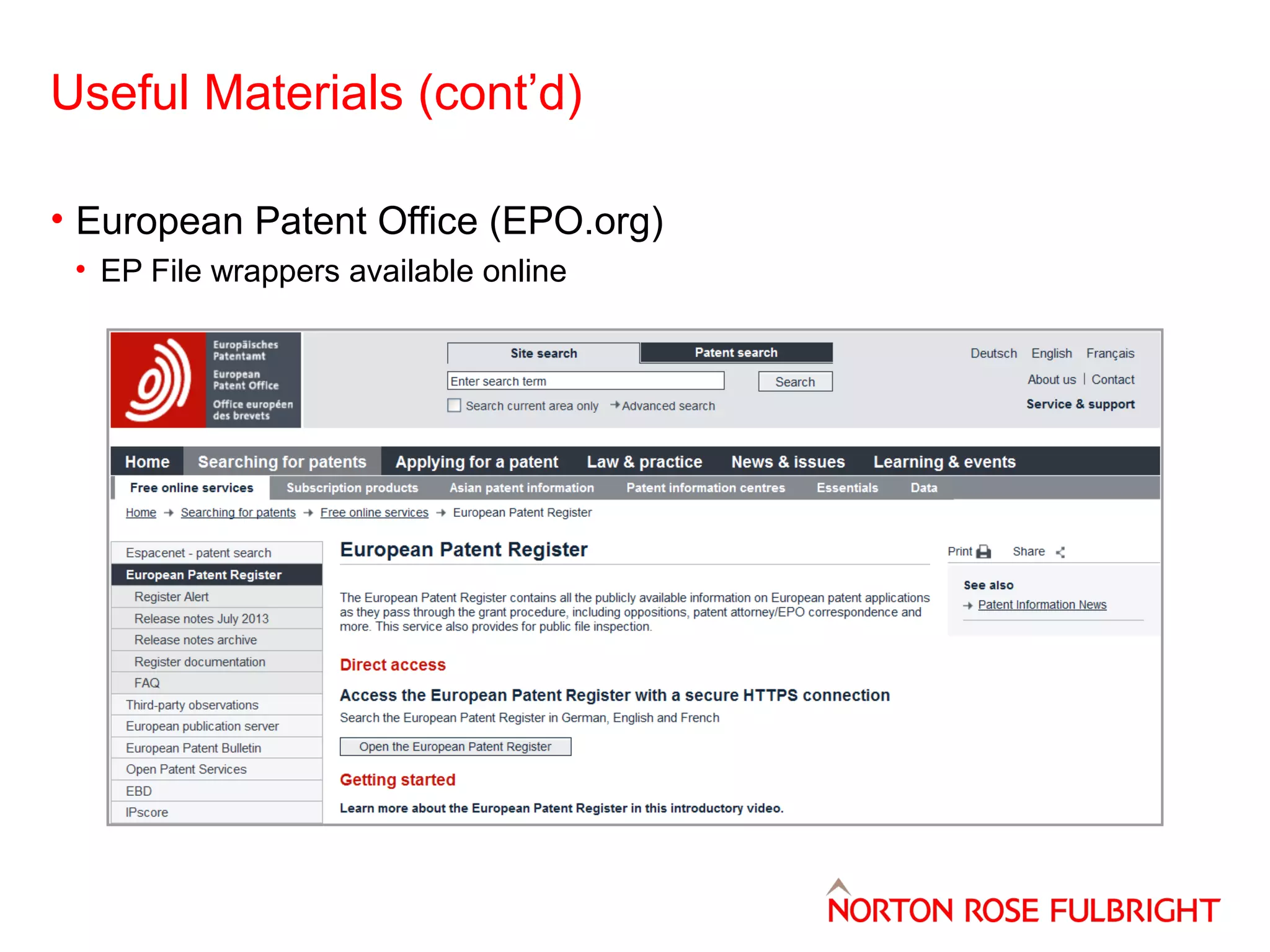
Useful Materials (cont’d)
• European Patent Office (EPO.org)
• EP File wrappers available online
Useful Materials (cont’d)
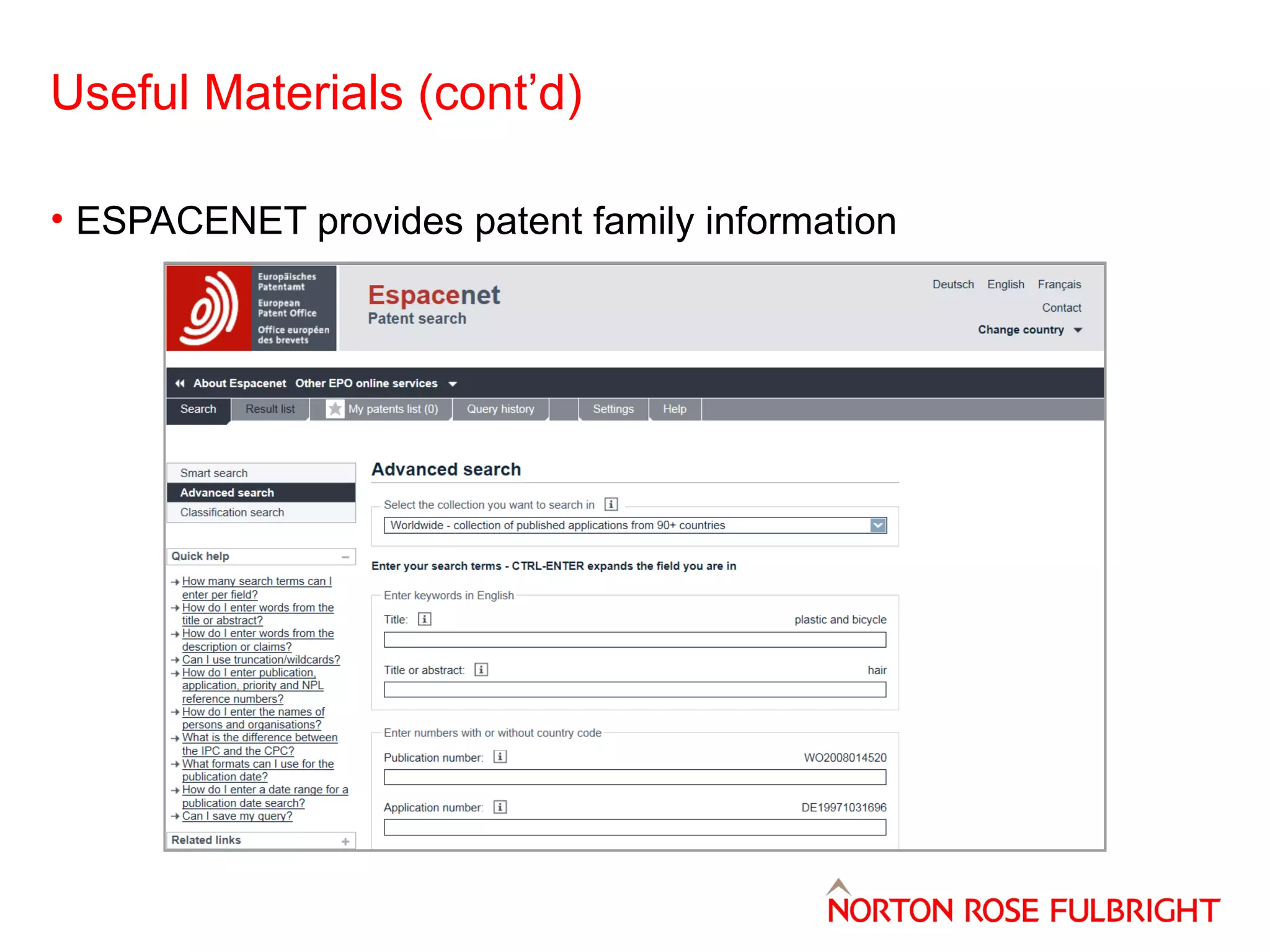
• ESPACENET provides patent family information
Useful Materials (cont’d)
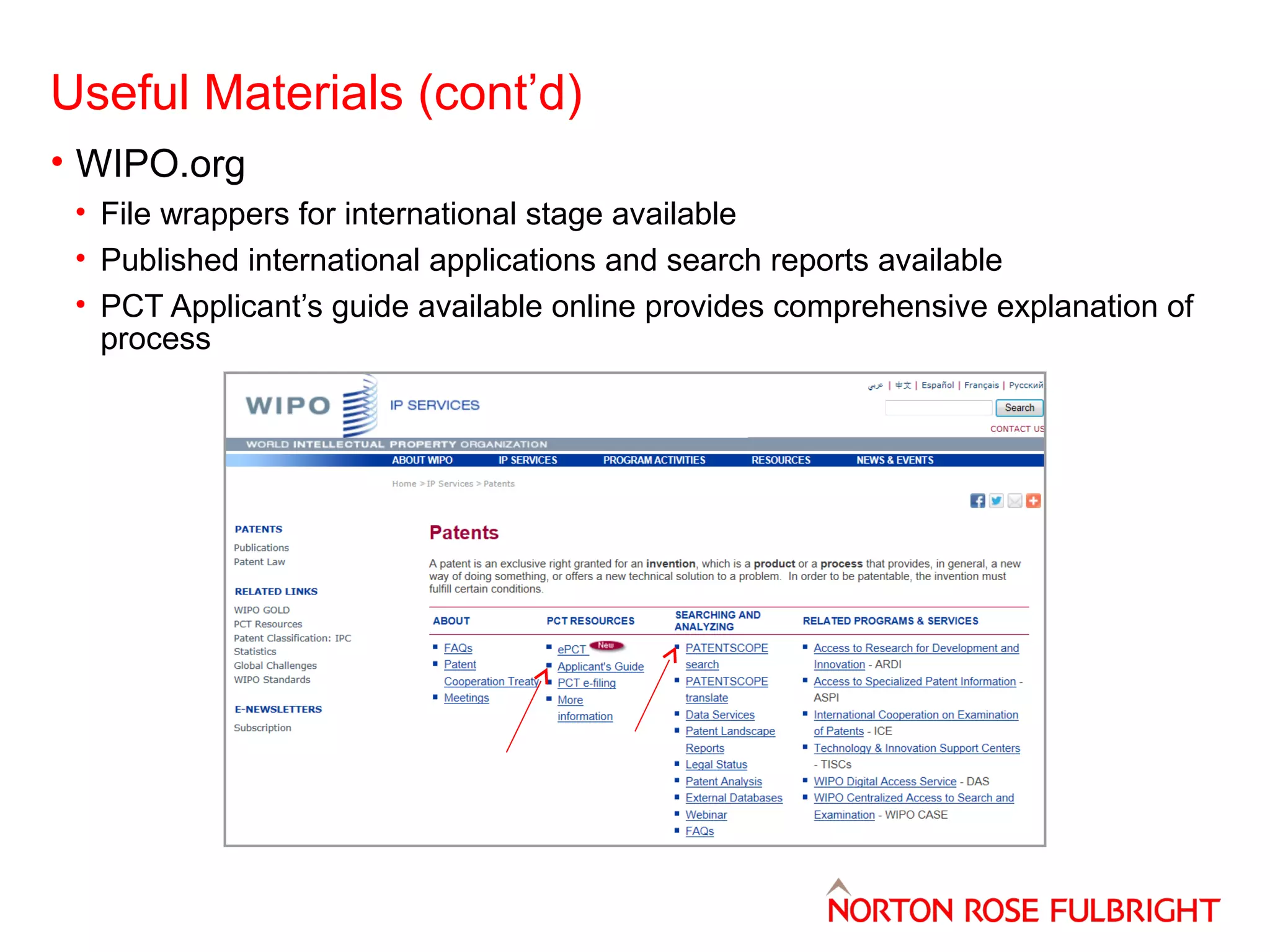
• WIPO.org
• File wrappers for international stage available
• Published international applications and search reports available
• PCT Applicant’s guide available online provides comprehensive explanation of
process
Useful Materials (cont’d)
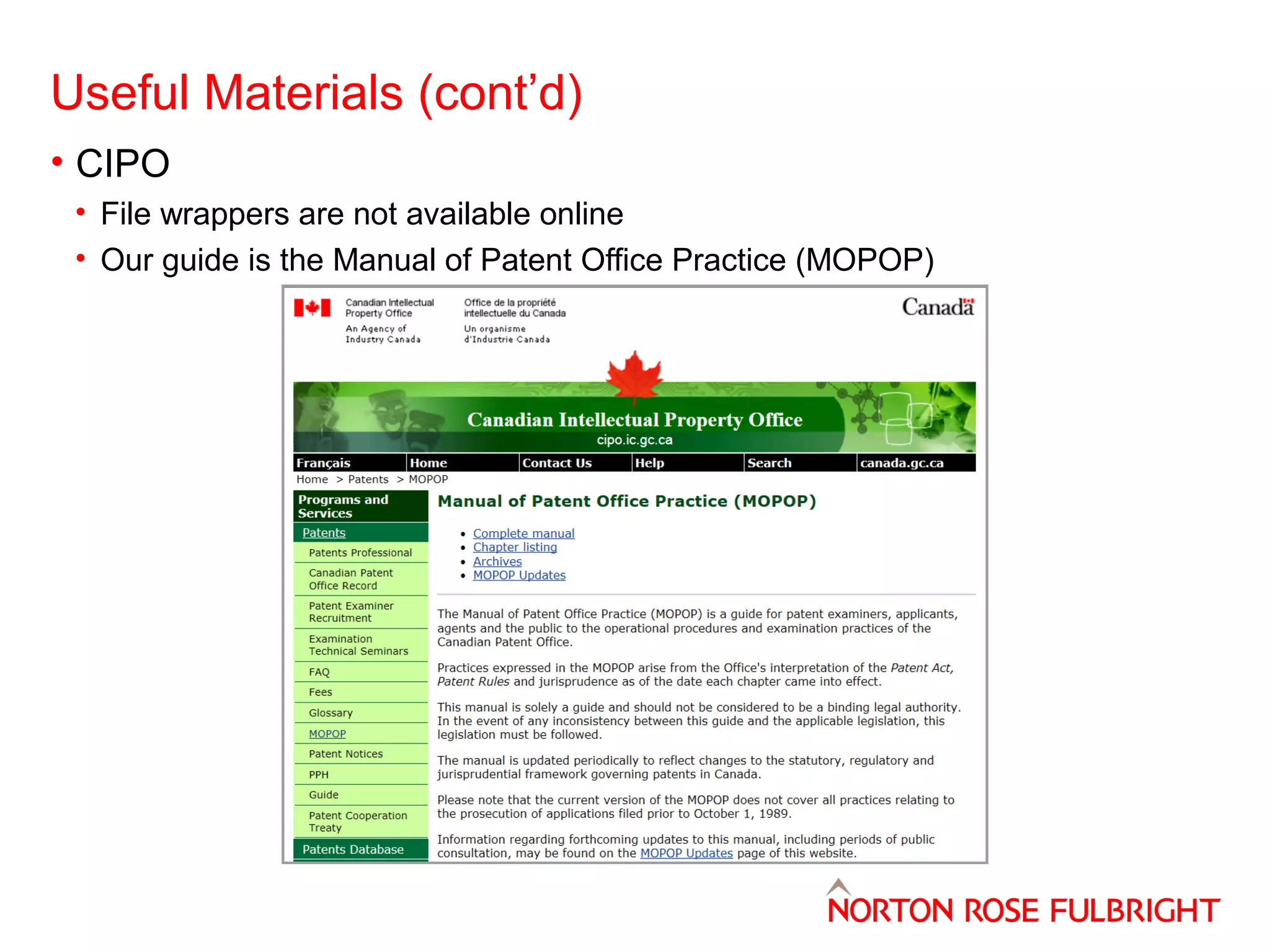
• CIPO
• File wrappers are not available online
• Our guide is the Manual of Patent Office Practice (MOPOP)
Why an IP strategy?
Not every technology company requires patents, certainly
But each tech company requires an IP strategy, which may include
an explanation as to why patents may not be necessary, or a
solid plan for future filings
Investors especially tend to demand at least a high level IP
strategy
An IP strategy is especially important for managing disclosures
(see more on this below)
And without being able to manage disclosures raising money and
collaborating with outside parties is difficult, if not impossible
More on IP strategy
An IP strategy helps identify the patent targets that can create the most value
Take a broad view as to what may be patentable, so that important targets are not
missed
An IP strategy identifies the full range of IP assets that can be used, including
trade-marks, design patents (covering for example user interface elements),
and copyright
Generally speaking, the emphasis is first on patents, but as a tech company
scales, the value and importance of trade-marks increases significantly
Picking a “strong brand” with good domain name coverage is important
–

usually a strong brand is a “suggestive” brand but not a “clearly
descriptive” brand
– be careful that famous marks in the US receive broad protection even
beyond their scope of use
– First “use” or sales establish entitlement to use a trade-mark, so
performing trade-mark searches closer to launch is important
More on IP strategy
An IP strategy may include trade secret elements, and may incorporate
defensive publication (especially once foundational IP is in place),
which involves strategic publication of information to block third parties
from patenting (used very effectively by IBM for example)
Tech companies often scale very quickly, so it is important to build a
strong IP foundation that can be used to build out a broader IP portfolio,
once the resources are available, and if there is a compelling business
case
IP strategy provides the insights necessary to minimize the risk of joint
development
IP strategy needs to be updated from time to time (business strategy and
technical roadmap should both be reflected)
Development of an IP Strategy
In many cases, we develop an IP strategy informally, by discussing the
technology road map, market opportunities, IP risks, and IP targets
Other times we conduct a more formal “IP audit” that involves
• Reviewing technologies
• Technology/IP evaluation processes used by tech company
• Agreements and processes affecting handling of proprietary
information
• Relationships with outside parties
• Current IP portfolio
• IP activities of competitors, patent landscaping
• IP SWOT analysis
• Usually a formal IP strategy document that distils key IP priorities and
process/agreement improvements for reducing risk and maximizing
value
IP and value creation
The right patents can boost your valuation
One strong patent that maps to the key market differentiators of a
company can be more valuable than a portfolio of “feature”
patents
Acquirers will not base decisions solely on strength of IP
(typically), but will prioritize targets based on IP, and consider IP
in developing a valuation
An IP strategy helps make the tech company more attractive to
acquirers and can unlock additional revenue (usually through
licensing)
IP and traction
Especially “early mover” IP puts a stake in the ground that can be
critical in protecting market position down the road
Strong, strategic, foundational patents create a “chilling effect”, long
enough to raise money and/or build traction
IP is not being ignored, even tech majors understand the dangers of
foundational IP, even in the hands of start-ups
Large patent infringement awards and settlements have made tech major
cautious – IP could be bought by a competitor, litigation is often financed by
a competitor
Many Patent infringement cases are now fought on contingency (where law
firm is paid mainly based on a percentage of aware or settlement)
Established companies are very interested in early mover IP, because they can
build on it
Managing disclosures
IP strategy helps the tech company understand their patent targets,
which they can then shield from disclosure
It is important to keep the objective of the disclosure in mind, and
disclose the appropriate level of detail in view of those objectives
A good NDA is important, and not all templates are created alike
Investors generally do not sign an NDA, but they also do not require
technical details
A key reason why IP is filed is to facilitate disclosure of the
technology, in situations where an NDA is not practical
Despite patent filings, it is still better to hold back “secret sauce”
elements in part to underline the innovativeness of the tech
company
Disclosure should be based in part on estimation of trustworthiness
of the recipient of information
Non-Disclosure Agreements
• What is an NDA?
• Agreement between 2 parties to keep information confidential for a set
period of time
• Can be mutual or unilateral

• Typical terms of an NDA
• Identify confidential information and its permitted uses/users
• Define the excluded information and special treatment for any critical
information
• Specify how the confidential information must be treated and returned
• Outline a time period for confidentiality obligations
• Importance of feedback clauses
Non-Disclosure Agreements (cont’d)
• Consequences of breaking an NDA
• Remedy is based in contract against the person who signed the NDA
• May include monetary damages, an injunction preventing the use of
information, or even a “constructive trust” to reverse any profits of the
misuse

• Practical advice
• Sharing confidential information requires a high degree of trust
• A written agreement improves legal certainty and is a serious reminder
of obligations
• Make records of what was disclosed at meetings, try to mark
documents appropriately, and generally keep good records
• There is no “one size fits all” solution; every NDA will be unique to the
circumstances
Other considerations for building valuable patents
A key issue is engaging on a patent at the right time
There is tremendous pressure to file early mover patents,
particularly with US moving recently to first-to-file
However, for patents to be approved, implementation detail is
required
What ends up being patentable is somewhere between high level
distillation of the essential aspects of the technology, and technical
implementation details
Driving this “in between” level of abstraction is critical
The key is sometime to “envision” key implementations
IP Culture
A technology company can further enhance its valuation by
adopting an “IP Culture”
This means integrating commitment to IP into day to day activities
This does not have to be time consuming
Usually it involves
• Informing the team at a high level about IP activities, in part to
solicit contributions
• Tasking a key resource who manages IP related activities
• Typically, we help train them to drive value into IP activities
• Contributions to IP activities (such as providing strong patent
disclosures) should be rewarded and recognized (even if
value is nominal)
• Organizations with IP culture produce better IP relative to
investment
Foundational and compelling patents
Focus needs to be on “foundational patents”
– Early mover patents that are the first to occupy an important
domain
– Patents that convey what the platform will be 2 years and 5
million development dollars later
– “Platform” patents rather than feature patents in that the
patent covers the value that the core components provide to
other platforms (patent what it would mean to Google to
have access to the technology)
Focus needs to be on “compelling patents”
– Intelligent features, answers to technical challenges,
important user insights
– Answer in the specification the question of “why is this not
obvious”?
Drafting Foundational Patents
Usually the starting point is a strong provisional patent application that provides a strong
priority date, and usually gathers together multiple inventions and inventive concepts, or
what we often call an omnibus patent application
The omnibus patent application usually ends up as the foundation for sometimes several
other patent applications down the road
The starting point is a good technical disclosure, which includes:
– An explanation of the pain being addressed
– Summary of similar technologies, or at least solutions being used currently to
address the same problem
– First a high level explanation of the technology, with high level, platform view
diagrams
– Explain in greater, and greater detail, referencing diagrams, and including the
“environment” for implementing and extending the technology
– Highlight which aspects are future state, and which ones exist currently
– Highlight key innovative aspects, and why they are not obvious
– Include use cases that highlight the advantages, and the “technical effect” of the
invention
– Explain the advantages, providing comparative data to prior art solutions, is
possible
Avoiding problems
Important IP issues technology companies run into:
– Ownership of IP is not covered strongly enough in
employment agreements, founder agreements
– Continued cooperation in prosecution patents, and
processing assignments is not provided
– Founders leave, and IP assignments and releases are not
strong enough
– Problematic agreements affecting IP such as service
agreements (where client has an argument that they own
some aspect of IP), or joint development agreement where
ownership of IP is unclear
Disclaimer
Norton Rose Fulbright LLP, Norton Rose Fulbright Australia, Norton Rose Fulbright Canada LLP, Norton Rose Fulbright South Africa (incorporated as Deneys Reitz Inc) and Fulbright & Jaworski LLP, each of which is a separate legal
entity, are members (“the Norton Rose Fulbright members”) of Norton Rose Fulbright Verein, a Swiss Verein. Norton Rose Fulbright Verein helps coordinate the activities of the Norton Rose Fulbright members but does not itself
provide legal services to clients.

–

References to “Norton Rose Fulbright”, “the law firm”, and “legal practice” are to one or more of the
Norton Rose Fulbright members or to one of their respective affiliates (together “Norton Rose Fulbright
entity/entities”). No individual who is a member, partner, shareholder, director, employee or consultant of,
in or to any Norton Rose Fulbright entity (whether or not such individual is described as a “partner”)
accepts or assumes responsibility, or has any liability, to any person in respect of this communication.
Any reference to a partner or director is to a member, employee or consultant with equivalent standing
and qualifications of the relevant Norton Rose Fulbright entity.

–

The purpose of this communication is to provide information as to developments in the law. It does not
contain a full analysis of the law nor does it constitute an opinion of any Norton Rose Fulbright entity on
the points of law discussed. You must take specific legal advice on any particular matter which concerns
you. If you require any advice or further information, please speak to your usual contact at Norton Rose
Fulbright.

Entrepreneurship 101 - Intellectual Property

  • 1.
    Introduction to IntellectualProperty NORCAT – November 20th, 2013
  • 2.
    Introduction • Forms ofintellectual property – Using an example that people can relate to • Useful resources • IP strategy primer • Questions
  • 3.
    Forms of IntellectualProperty Protection • Patents • Trade-marks • Industrial Designs • Copyrights • Plant Breeder’s Rights • Integrated Circuit Topographies • Trade Secrets
  • 4.
    What is aPatent? • Exclusive Right • Territorial • Granted by government authority • Limited exclusive privilege that the law allows a patentee in his own invention • Ownership • Natural right arises from production • You cannot obtain a valid patent application on the invention of another • Term • Limited period of time, usually 20 years from filing
  • 5.
    Nature of PatentRight • Bargain with the state • Inventor gives full disclosure of invention in exchange for limited period of exclusivity • Upon expiration of patent, the invention can be exploited by anyone • Before expiration others have access to information • Patent excludes others from making, using or selling your invention • Your patent may not allow you to practice the invention – No guarantee of “Freedom to Operate”
  • 6.
    Form of PatentApplication • A patent application has: • An Abstract • A Description, comprised of the following elements: • Title for identification purposes • Field of the Invention, which describes the area(s) to which the invention relates • Background of the Invention, which describes the related prior art and the problem that is solved by the invention • Summary of the Invention, which is comprised of one or more general statements of the invention and usually provides the precise language for the claim(s)
  • 7.
    Form of PatentApplication Cont’d • Brief Description of the Drawings, where applicable, including specific embodiments, examples, detailed description of figures, and the like • Claims, which distinctly claim the part, improvement or combination of the invention which the applicant regards to be patentable • Claims are drafted as a single sentence • Broadest claim is independent and doesn’t refer to any other claims • Drafted as “inverted pyramid” getting narrower in scope • Drawings are included where the description lends itself to them • A Sequence Listing is required where the invention relates to genes or fragments thereof • Deposit of Biological Material may be required to satisfy the description requirements
  • 8.
  • 9.
  • 10.
  • 11.
  • 12.
    Patentable Invention • Requirements • • • • New Useful Patentablesubject matter Unobvious • The first three you often get a sense of in an initial interview • Can further investigate new and unobvious through a patentability search
  • 13.
    Patentability Search andAssessment • • • • • • Invaluable to avoid re-patenting the wheel To establish scope of invention Language of the patent art Reveal the patent landscape in a particular area Reveal activities of competitors Useful information to consider when choosing countries or regions where protection should be sought if at all
  • 14.
    Filing a PatentApplication • Must be filed in a timely manner • Before publication or disclosure to the public, or • Within grace periods, or • In keeping with International Treaty requirements But, • To provide a proper priority basis, the subject matter of a later claim must be taught in the priority filing
  • 15.
    Disclosure of InventionBefore Filing • US: one-year grace period • Canada: one year grace period from Canadian filing date • EP: public disclosure prior to priority filing precludes the grant of valid patent rights • Confidential disclosures may not be damaging, but are relying on receiving party to maintain confidentiality • Disclosures that take place after filing can cause problems where an inadequate priority patent application is filed and claims lose entitlement to the priority date
  • 16.
    Patent Application Processin Context • Patent application process fits within a larger cycle of events in a plan for commercializing technology
  • 17.
    Whether/How to File… •There are many factors that may play a role • Why? Because the costs associated with patent protection and enforcement are significant and patents are territorial
  • 18.
    Whether/How to File…(cont’d) •Factors to consider when deciding whether to file include: • • • • • • • • • • • • Potential commercial life of invention Scope of likely patent protection Public or private exploitation of invention Simple or complex technology – market lead time Ability to keep secret – free flow of technical information Capability to police patent State of development of technology Competitive posture of innovator • How does proposed patent fit in a portfolio or strategy Importance of invention Financing/Leasing? • A patent may be necessary to attract $ Defensive Reasons Are other forms of IP protection more appropriate? In particular, trade secret, industrial design or copyright?
  • 19.
    Patent Application Process TypicalTimeline PARIS CONVENTION National Filings Priority Application and National Entries of PCT Filing PCT Filing Deadline to Request Examination in Canada Months 0 12 18 30 72 (5 Years from Filing) Publication
  • 20.
    Enablement • Ensures thatpublic receives its “quid pro quo” for patent grant • Description must enable person skilled in the art to practice the invention without undue experimentation • Factors to consider: • • • • • • • • Quantity of experimentation necessary Amount of direction and guidance provided Presence of working examples Nature of invention State of prior art Relative skill of those in the art Predictability of art Breadth of claims
  • 21.
    Example of interplaybetween different forms of intellectual property Vital Alert -Patents on base technology (underground communications, censor monitoring) -Patents covering different applications (safer detonation) -Trade-marks (CANARY™) -Possible registered circuit topographies -Shape of unit, possible industrial design and/or trade-mark (distinguishing guise) -Copyright protects computer code, and marketing materials -Trade secrets used to protect certain aspects of technology, and source code
  • 22.
    Useful Materials • USPTOWebsite • Manual of Patent Examining Procedure (MPEP)
  • 23.
    Useful Materials (cont’d) •U.S. File Wrappers, through Patent Application Information Retrieval (PAIR) • The Image File Wrapper (IFW) system is an image technology system for storage and maintenance of records associated with patent applications • Available online
  • 24.
    Useful Materials (cont’d) •European Patent Office (EPO.org) • EP File wrappers available online
  • 25.
    Useful Materials (cont’d) •ESPACENET provides patent family information
  • 26.
    Useful Materials (cont’d) •WIPO.org • File wrappers for international stage available • Published international applications and search reports available • PCT Applicant’s guide available online provides comprehensive explanation of process
  • 27.
    Useful Materials (cont’d) •CIPO • File wrappers are not available online • Our guide is the Manual of Patent Office Practice (MOPOP)
  • 28.
    Why an IPstrategy? Not every technology company requires patents, certainly But each tech company requires an IP strategy, which may include an explanation as to why patents may not be necessary, or a solid plan for future filings Investors especially tend to demand at least a high level IP strategy An IP strategy is especially important for managing disclosures (see more on this below) And without being able to manage disclosures raising money and collaborating with outside parties is difficult, if not impossible
  • 29.
    More on IPstrategy An IP strategy helps identify the patent targets that can create the most value Take a broad view as to what may be patentable, so that important targets are not missed An IP strategy identifies the full range of IP assets that can be used, including trade-marks, design patents (covering for example user interface elements), and copyright Generally speaking, the emphasis is first on patents, but as a tech company scales, the value and importance of trade-marks increases significantly Picking a “strong brand” with good domain name coverage is important – usually a strong brand is a “suggestive” brand but not a “clearly descriptive” brand – be careful that famous marks in the US receive broad protection even beyond their scope of use – First “use” or sales establish entitlement to use a trade-mark, so performing trade-mark searches closer to launch is important
  • 30.
    More on IPstrategy An IP strategy may include trade secret elements, and may incorporate defensive publication (especially once foundational IP is in place), which involves strategic publication of information to block third parties from patenting (used very effectively by IBM for example) Tech companies often scale very quickly, so it is important to build a strong IP foundation that can be used to build out a broader IP portfolio, once the resources are available, and if there is a compelling business case IP strategy provides the insights necessary to minimize the risk of joint development IP strategy needs to be updated from time to time (business strategy and technical roadmap should both be reflected)
  • 31.
    Development of anIP Strategy In many cases, we develop an IP strategy informally, by discussing the technology road map, market opportunities, IP risks, and IP targets Other times we conduct a more formal “IP audit” that involves • Reviewing technologies • Technology/IP evaluation processes used by tech company • Agreements and processes affecting handling of proprietary information • Relationships with outside parties • Current IP portfolio • IP activities of competitors, patent landscaping • IP SWOT analysis • Usually a formal IP strategy document that distils key IP priorities and process/agreement improvements for reducing risk and maximizing value
  • 32.
    IP and valuecreation The right patents can boost your valuation One strong patent that maps to the key market differentiators of a company can be more valuable than a portfolio of “feature” patents Acquirers will not base decisions solely on strength of IP (typically), but will prioritize targets based on IP, and consider IP in developing a valuation An IP strategy helps make the tech company more attractive to acquirers and can unlock additional revenue (usually through licensing)
  • 33.
    IP and traction Especially“early mover” IP puts a stake in the ground that can be critical in protecting market position down the road Strong, strategic, foundational patents create a “chilling effect”, long enough to raise money and/or build traction IP is not being ignored, even tech majors understand the dangers of foundational IP, even in the hands of start-ups Large patent infringement awards and settlements have made tech major cautious – IP could be bought by a competitor, litigation is often financed by a competitor Many Patent infringement cases are now fought on contingency (where law firm is paid mainly based on a percentage of aware or settlement) Established companies are very interested in early mover IP, because they can build on it
  • 34.
    Managing disclosures IP strategyhelps the tech company understand their patent targets, which they can then shield from disclosure It is important to keep the objective of the disclosure in mind, and disclose the appropriate level of detail in view of those objectives A good NDA is important, and not all templates are created alike Investors generally do not sign an NDA, but they also do not require technical details A key reason why IP is filed is to facilitate disclosure of the technology, in situations where an NDA is not practical Despite patent filings, it is still better to hold back “secret sauce” elements in part to underline the innovativeness of the tech company Disclosure should be based in part on estimation of trustworthiness of the recipient of information
  • 35.
    Non-Disclosure Agreements • Whatis an NDA? • Agreement between 2 parties to keep information confidential for a set period of time • Can be mutual or unilateral • Typical terms of an NDA • Identify confidential information and its permitted uses/users • Define the excluded information and special treatment for any critical information • Specify how the confidential information must be treated and returned • Outline a time period for confidentiality obligations • Importance of feedback clauses
  • 36.
    Non-Disclosure Agreements (cont’d) •Consequences of breaking an NDA • Remedy is based in contract against the person who signed the NDA • May include monetary damages, an injunction preventing the use of information, or even a “constructive trust” to reverse any profits of the misuse • Practical advice • Sharing confidential information requires a high degree of trust • A written agreement improves legal certainty and is a serious reminder of obligations • Make records of what was disclosed at meetings, try to mark documents appropriately, and generally keep good records • There is no “one size fits all” solution; every NDA will be unique to the circumstances
  • 37.
    Other considerations forbuilding valuable patents A key issue is engaging on a patent at the right time There is tremendous pressure to file early mover patents, particularly with US moving recently to first-to-file However, for patents to be approved, implementation detail is required What ends up being patentable is somewhere between high level distillation of the essential aspects of the technology, and technical implementation details Driving this “in between” level of abstraction is critical The key is sometime to “envision” key implementations
  • 38.
    IP Culture A technologycompany can further enhance its valuation by adopting an “IP Culture” This means integrating commitment to IP into day to day activities This does not have to be time consuming Usually it involves • Informing the team at a high level about IP activities, in part to solicit contributions • Tasking a key resource who manages IP related activities • Typically, we help train them to drive value into IP activities • Contributions to IP activities (such as providing strong patent disclosures) should be rewarded and recognized (even if value is nominal) • Organizations with IP culture produce better IP relative to investment
  • 39.
    Foundational and compellingpatents Focus needs to be on “foundational patents” – Early mover patents that are the first to occupy an important domain – Patents that convey what the platform will be 2 years and 5 million development dollars later – “Platform” patents rather than feature patents in that the patent covers the value that the core components provide to other platforms (patent what it would mean to Google to have access to the technology) Focus needs to be on “compelling patents” – Intelligent features, answers to technical challenges, important user insights – Answer in the specification the question of “why is this not obvious”?
  • 40.
    Drafting Foundational Patents Usuallythe starting point is a strong provisional patent application that provides a strong priority date, and usually gathers together multiple inventions and inventive concepts, or what we often call an omnibus patent application The omnibus patent application usually ends up as the foundation for sometimes several other patent applications down the road The starting point is a good technical disclosure, which includes: – An explanation of the pain being addressed – Summary of similar technologies, or at least solutions being used currently to address the same problem – First a high level explanation of the technology, with high level, platform view diagrams – Explain in greater, and greater detail, referencing diagrams, and including the “environment” for implementing and extending the technology – Highlight which aspects are future state, and which ones exist currently – Highlight key innovative aspects, and why they are not obvious – Include use cases that highlight the advantages, and the “technical effect” of the invention – Explain the advantages, providing comparative data to prior art solutions, is possible
  • 41.
    Avoiding problems Important IPissues technology companies run into: – Ownership of IP is not covered strongly enough in employment agreements, founder agreements – Continued cooperation in prosecution patents, and processing assignments is not provided – Founders leave, and IP assignments and releases are not strong enough – Problematic agreements affecting IP such as service agreements (where client has an argument that they own some aspect of IP), or joint development agreement where ownership of IP is unclear
  • 43.
    Disclaimer Norton Rose FulbrightLLP, Norton Rose Fulbright Australia, Norton Rose Fulbright Canada LLP, Norton Rose Fulbright South Africa (incorporated as Deneys Reitz Inc) and Fulbright & Jaworski LLP, each of which is a separate legal entity, are members (“the Norton Rose Fulbright members”) of Norton Rose Fulbright Verein, a Swiss Verein. Norton Rose Fulbright Verein helps coordinate the activities of the Norton Rose Fulbright members but does not itself provide legal services to clients. – References to “Norton Rose Fulbright”, “the law firm”, and “legal practice” are to one or more of the Norton Rose Fulbright members or to one of their respective affiliates (together “Norton Rose Fulbright entity/entities”). No individual who is a member, partner, shareholder, director, employee or consultant of, in or to any Norton Rose Fulbright entity (whether or not such individual is described as a “partner”) accepts or assumes responsibility, or has any liability, to any person in respect of this communication. Any reference to a partner or director is to a member, employee or consultant with equivalent standing and qualifications of the relevant Norton Rose Fulbright entity. – The purpose of this communication is to provide information as to developments in the law. It does not contain a full analysis of the law nor does it constitute an opinion of any Norton Rose Fulbright entity on the points of law discussed. You must take specific legal advice on any particular matter which concerns you. If you require any advice or further information, please speak to your usual contact at Norton Rose Fulbright.