Intellectual Property
and Patents
This resource was downloaded from Business Skills for
Chemists (https://rsc.li/3840bDs)
Learning Outcomes
 Introduce the concept of Intellectual Property (IP)
 Why protect an idea?
 Patents
 How to get value from your patent
What is Intellectual Property?
“Intellectual property (IP) refers to creations of the mind:
inventions, literary and artistic works, symbols, names,
images and designs used in commerce.”
IP comes in several forms:
 Patents – technical features of innovations
 Trade Marks – brand names and logos
 Registered Designs – appearance
 Copyright – graphical and literary material
Why Protect An Idea?
Legal protection of your new idea or invention ensures the
future position of your company/brand and enables you
to make money in a highly competitive market place
It stops others from copying your idea allowing you to
maximise the return you deserve for investing you time,
capital and resources in the invention of the idea
A Well Known Example
Registered Trademarks
 The name “Apple” and the logo above are examples of some of
the registered trademarks the company holds
 In total Apple holds approximately 8000 registered trademarks
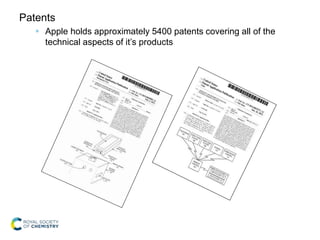
Patents
 Apple holds approximately 5400 patents covering all of the
technical aspects of it’s products
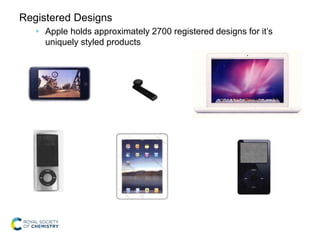
Registered Designs
 Apple holds approximately 2700 registered designs for it’s
uniquely styled products
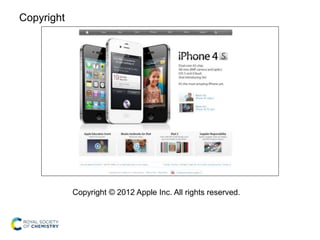
Copyright
Copyright © 2012 Apple Inc. All rights reserved.
Patents
Patents are the only mechanism for protecting technical ideas
Patents are property, they have value (£) and investors like to
see them
Patents are a negative right i.e. they detail what cannot be
done by others
The legal bit:
 a monopoly right lasting up to 20 years from filing
 disclosure of your idea to the public
 country-specific
The paper bit:
 a description of a (technical) idea
 a definition of what cannot be done by others (claims)
 the names of the inventor(s)
A social bargain…
The state grants a monopoly right, but you disclose your idea to the world
 Exclusivity in a defined technical area
 Chance to recoup your investment
 In return you pay some fees to the state
 Stimulates innovation
Patentability
Q. What can be patented?
A. Nearly anything “technical”
 Products (molecules, materials, new composition)
 Apparatus (for making, purifying, extracting)
 Methods (synthetic methodology, process steps, treatment)
 Uses (as a drug, a paint stripper, etc.)
Must be:
 New (“novel”)
 Non-obvious (involves an “inventive step”)
 Capable of industrial application
Novelty (& Disclosure)
Absolute worldwide novelty test
Anything made available (disclosed) to the public anywhere
 The “Prior Art”
 Published documents, posters, lectures
 In order to anticipate a “claim” all the features must be in a single
document/lecture/poster
Disclosure
 The invention must not have been made available to the public in
any way, at any time, anywhere – this is very important!
 This can be guarded against though imposing a CDA
Inventive Step
The invention must not be obvious to a person who is ‘skilled
in the art’
The ‘person skilled in the art’:
 Reads everything (speaks all languages)
 Makes routine selections
 Overcomes routine problems
 Doesn’t make inventive leaps
An invention may be inventive if:
 It has an unexpected or surprising result
 It was not obvious to try or non-routine
 It overcomes a technical problem
Exclusions from Patentability
Important Exclusions (UK, Europe)
 Methods of medical treatment/diagnosis
 Computer programs as such
 Mathematical models
 Presentation of information
 Methods of doing business
A patent attorney often avoids these
There are no restrictions in US
Inventorship & Ownership
The inventor(s) are the actual devisor(s) of the invention
Ownership may depend upon the relationship of the
inventor(s) and any other parties involved
 A business/company normally owns the IP generated by employees
 This is normally set-out in the employees contract
 This is also the case at a University
 Students however are not employees and a separate agreement will
need to be reached between the University and the student
The patent may be invalidated if the inventor(s) and/or owners
are not correctly indentified
Freedom-to-Operate
Your patent stops others from using your IP, but does not allow
you to use it yourself
To use your own patent you may need to use something which
is covered in the claims of someone else’s patent, e.g.
 Patent 1 – “the wheel”
 Patent 2 – “the push bike”
 The owner of patent 2 must ask permission to make his bike!
You therefore may have to license, buy or attack the other
patent to gain the full potential from your invention
Alternatively you could invent around the other patent
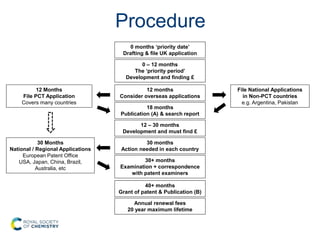
Procedure
0 months ‘priority date’
Drafting & file UK application
12 months
Consider overseas applications
18 months
Publication (A) & search report
30 months
Action needed in each country
30+ months
Examination + correspondence
with patent examiners
40+ months
Grant of patent & Publication (B)
Annual renewal fees
20 year maximum lifetime
0 – 12 months
The ‘priority period’
Development and finding £
12 – 30 months
Development and must find £
12 Months
File PCT Application
Covers many countries
File National Applications
in Non-PCT countries
e.g. Argentina, Pakistan
30 Months
National / Regional Applications
European Patent Office
USA, Japan, China, Brazil,
Australia, etc
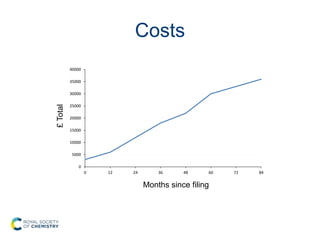
Costs
0
5000
10000
15000
20000
25000
30000
35000
40000
0 12 24 36 48 60 72 84
£
Total
Months since filing
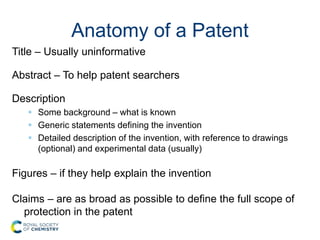
Anatomy of a Patent
Title – Usually uninformative
Abstract – To help patent searchers
Description
 Some background – what is known
 Generic statements defining the invention
 Detailed description of the invention, with reference to drawings
(optional) and experimental data (usually)
Figures – if they help explain the invention
Claims – are as broad as possible to define the full scope of
protection in the patent
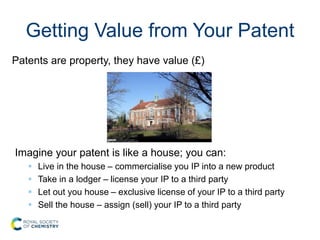
Getting Value from Your Patent
Patents are property, they have value (£)
Imagine your patent is like a house; you can:
 Live in the house – commercialise you IP into a new product
 Take in a lodger – license your IP to a third party
 Let out you house – exclusive license of your IP to a third party
 Sell the house – assign (sell) your IP to a third party
What Investors Look For
Effective patent protection
 Gives security against competition from third parties
 Gives reassurance that they will see a return on their investment
Freedom-to-operate
 Gives assurance that third parties will not be able to stop you
entering your market place
 Gives reassurance that they will see a return on their investment
Proper entitlement of inventorship
 Gives assurance that no-one else can claim the IP or invalidate the
patent
 Gives reassurance that they will see a return on their investment
Summary
 Introduced the concept of Intellectual Property (IP)
 Why you would want to protect an idea
 Patents
 Shown how to get the value from your patent
Further Reading
Mewburn Ellis LLP
 www.mewburn.com
Intellectual Property Office
 www.ipo.gov.uk
European Patent Office
 www.epo.org
Inside Careers – Career Opportunities in IP Law
 www.insidecareers.co.uk
Authors
Dr. Jeremy Webster, Dr. Rachel Oxley, Dr. Trevor Farren, Dr. Simon Mosey
& Dr. William Drewe
Organisations
School of Chemistry, University of Nottingham, U.K.
in association with Mewburn Ellis LLP
Supported by:

intellectualpropertypresentation_872607 (1).ppt

  • 1.
    Intellectual Property and Patents Thisresource was downloaded from Business Skills for Chemists (https://rsc.li/3840bDs)
  • 2.
    Learning Outcomes  Introducethe concept of Intellectual Property (IP)  Why protect an idea?  Patents  How to get value from your patent
  • 3.
    What is IntellectualProperty? “Intellectual property (IP) refers to creations of the mind: inventions, literary and artistic works, symbols, names, images and designs used in commerce.” IP comes in several forms:  Patents – technical features of innovations  Trade Marks – brand names and logos  Registered Designs – appearance  Copyright – graphical and literary material
  • 4.
    Why Protect AnIdea? Legal protection of your new idea or invention ensures the future position of your company/brand and enables you to make money in a highly competitive market place It stops others from copying your idea allowing you to maximise the return you deserve for investing you time, capital and resources in the invention of the idea
  • 5.
    A Well KnownExample Registered Trademarks  The name “Apple” and the logo above are examples of some of the registered trademarks the company holds  In total Apple holds approximately 8000 registered trademarks
  • 6.
    Patents  Apple holdsapproximately 5400 patents covering all of the technical aspects of it’s products
  • 7.
    Registered Designs  Appleholds approximately 2700 registered designs for it’s uniquely styled products
  • 8.
    Copyright Copyright © 2012Apple Inc. All rights reserved.
  • 9.
    Patents Patents are theonly mechanism for protecting technical ideas Patents are property, they have value (£) and investors like to see them Patents are a negative right i.e. they detail what cannot be done by others
  • 10.
    The legal bit: a monopoly right lasting up to 20 years from filing  disclosure of your idea to the public  country-specific The paper bit:  a description of a (technical) idea  a definition of what cannot be done by others (claims)  the names of the inventor(s) A social bargain… The state grants a monopoly right, but you disclose your idea to the world  Exclusivity in a defined technical area  Chance to recoup your investment  In return you pay some fees to the state  Stimulates innovation
  • 11.
    Patentability Q. What canbe patented? A. Nearly anything “technical”  Products (molecules, materials, new composition)  Apparatus (for making, purifying, extracting)  Methods (synthetic methodology, process steps, treatment)  Uses (as a drug, a paint stripper, etc.) Must be:  New (“novel”)  Non-obvious (involves an “inventive step”)  Capable of industrial application
  • 12.
    Novelty (& Disclosure) Absoluteworldwide novelty test Anything made available (disclosed) to the public anywhere  The “Prior Art”  Published documents, posters, lectures  In order to anticipate a “claim” all the features must be in a single document/lecture/poster Disclosure  The invention must not have been made available to the public in any way, at any time, anywhere – this is very important!  This can be guarded against though imposing a CDA
  • 13.
    Inventive Step The inventionmust not be obvious to a person who is ‘skilled in the art’ The ‘person skilled in the art’:  Reads everything (speaks all languages)  Makes routine selections  Overcomes routine problems  Doesn’t make inventive leaps An invention may be inventive if:  It has an unexpected or surprising result  It was not obvious to try or non-routine  It overcomes a technical problem
  • 14.
    Exclusions from Patentability ImportantExclusions (UK, Europe)  Methods of medical treatment/diagnosis  Computer programs as such  Mathematical models  Presentation of information  Methods of doing business A patent attorney often avoids these There are no restrictions in US
  • 15.
    Inventorship & Ownership Theinventor(s) are the actual devisor(s) of the invention Ownership may depend upon the relationship of the inventor(s) and any other parties involved  A business/company normally owns the IP generated by employees  This is normally set-out in the employees contract  This is also the case at a University  Students however are not employees and a separate agreement will need to be reached between the University and the student The patent may be invalidated if the inventor(s) and/or owners are not correctly indentified
  • 16.
    Freedom-to-Operate Your patent stopsothers from using your IP, but does not allow you to use it yourself To use your own patent you may need to use something which is covered in the claims of someone else’s patent, e.g.  Patent 1 – “the wheel”  Patent 2 – “the push bike”  The owner of patent 2 must ask permission to make his bike! You therefore may have to license, buy or attack the other patent to gain the full potential from your invention Alternatively you could invent around the other patent
  • 17.
    Procedure 0 months ‘prioritydate’ Drafting & file UK application 12 months Consider overseas applications 18 months Publication (A) & search report 30 months Action needed in each country 30+ months Examination + correspondence with patent examiners 40+ months Grant of patent & Publication (B) Annual renewal fees 20 year maximum lifetime 0 – 12 months The ‘priority period’ Development and finding £ 12 – 30 months Development and must find £ 12 Months File PCT Application Covers many countries File National Applications in Non-PCT countries e.g. Argentina, Pakistan 30 Months National / Regional Applications European Patent Office USA, Japan, China, Brazil, Australia, etc
  • 18.
    Costs 0 5000 10000 15000 20000 25000 30000 35000 40000 0 12 2436 48 60 72 84 £ Total Months since filing
  • 19.
    Anatomy of aPatent Title – Usually uninformative Abstract – To help patent searchers Description  Some background – what is known  Generic statements defining the invention  Detailed description of the invention, with reference to drawings (optional) and experimental data (usually) Figures – if they help explain the invention Claims – are as broad as possible to define the full scope of protection in the patent
  • 20.
    Getting Value fromYour Patent Patents are property, they have value (£) Imagine your patent is like a house; you can:  Live in the house – commercialise you IP into a new product  Take in a lodger – license your IP to a third party  Let out you house – exclusive license of your IP to a third party  Sell the house – assign (sell) your IP to a third party
  • 21.
    What Investors LookFor Effective patent protection  Gives security against competition from third parties  Gives reassurance that they will see a return on their investment Freedom-to-operate  Gives assurance that third parties will not be able to stop you entering your market place  Gives reassurance that they will see a return on their investment Proper entitlement of inventorship  Gives assurance that no-one else can claim the IP or invalidate the patent  Gives reassurance that they will see a return on their investment
  • 22.
    Summary  Introduced theconcept of Intellectual Property (IP)  Why you would want to protect an idea  Patents  Shown how to get the value from your patent
  • 23.
    Further Reading Mewburn EllisLLP  www.mewburn.com Intellectual Property Office  www.ipo.gov.uk European Patent Office  www.epo.org Inside Careers – Career Opportunities in IP Law  www.insidecareers.co.uk
  • 24.
    Authors Dr. Jeremy Webster,Dr. Rachel Oxley, Dr. Trevor Farren, Dr. Simon Mosey & Dr. William Drewe Organisations School of Chemistry, University of Nottingham, U.K. in association with Mewburn Ellis LLP Supported by: