Sachidananda Benegal
N S Raghavan Center for Entrepreneurial Learning
4/24/2014 1(c) Sachidananda Benegal
• A few questions:
– In context of firms
– Equilibrium
• Where do new firms
come in!
– Is there a role for
entrepreneurship?
– What role does an
entrepreneur play?
We all know!
4/24/2014 2(c) Sachidananda Benegal
Who is an entrepreneur?
4/24/2014 3(c) Sachidananda Benegal
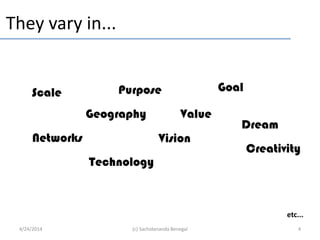
They vary in...
PurposeScale
Geography Value
Creativity
Goal
Vision
Dream
Networks
Technology
etc...
4/24/2014 4(c) Sachidananda Benegal
HOW DOES AND ENTREPRENEUR
THINK?
4/24/2014 5(c) Sachidananda Benegal
Causal Logic is predictive
Control of outcomes achieved through
accurate predictions,
clear goals,
and avoiding or protecting oneself against the unexpected
To the extent you can predict the future, you can control it
Conventional Wisdom: Causal Logic
4/24/2014 6(c) Sachidananda Benegal
The Problem Space
Ref: Presentation of Prof Saras
4/24/2014 7(c) Sachidananda Benegal
Classic Causation Model from Marketing Textbooks
Process of Effectuation Used by Expert Entrepreneurs
SINGLE CUSTOMER
Segment Definition
Market Definition
Segmentation
Targeting
Positioning
Understand
Customer
Adding Segments/Partners
Def of one of many possible markets
Marketing Process Inversion
4/24/2014 8(c) Sachidananda Benegal
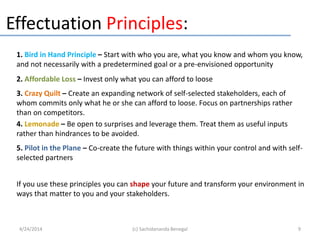
Effectuation Principles:
1. Bird in Hand Principle – Start with who you are, what you know and whom you know,
and not necessarily with a predetermined goal or a pre-envisioned opportunity
2. Affordable Loss – Invest only what you can afford to loose
3. Crazy Quilt – Create an expanding network of self-selected stakeholders, each of
whom commits only what he or she can afford to loose. Focus on partnerships rather
than on competitors.
4. Lemonade – Be open to surprises and leverage them. Treat them as useful inputs
rather than hindrances to be avoided.
5. Pilot in the Plane – Co-create the future with things within your control and with self-
selected partners
If you use these principles you can shape your future and transform your environment in
ways that matter to you and your stakeholders.
4/24/2014 9(c) Sachidananda Benegal
Who I am?
What I know?
Whom I know?
What Can I Do?
Interaction with
others
Effectual
Stakeholder
Commitments
Who we are?
What we know?
Whom we
know?
New
means
Expanding cycle of resources
What can we
do?
(Affordable loss)
New
Goals
Actual course of
action possible
Converging cycle of constraints
New Markets
and New Firms
The process!
4/24/2014 10(c) Sachidananda Benegal
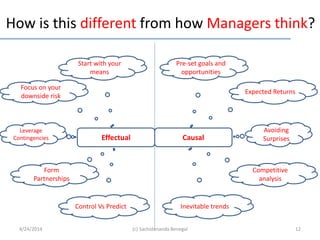
How is this different from how Managers think?
4/24/2014 11(c) Sachidananda Benegal
How is this different from how Managers think?
Effectual Causal
Start with your
means
Focus on your
downside risk
Leverage
Contingencies
Form
Partnerships
Control Vs Predict
Pre-set goals and
opportunities
Expected Returns
Avoiding
Surprises
Competitive
analysis
Inevitable trends
4/24/2014 12(c) Sachidananda Benegal
CAN WE THEN SAY WE DON’T NEED
MANAGERS?
4/24/2014 13(c) Sachidananda Benegal
Firm Life-Cycle and Entrepreneur’s Career
Causal
Tethered to goals
and predictive
Effectual
Tethered to means
and non-predictive Time
Expert
entrepreneurs
do not always
manage to
bridge this gap
Expert
Entrepreneur
Startup
Firm
Large
Firm
NoviceEntrepreneur
R
e
s
o
u
r
c
e
s
Low
High
4/24/2014 14(c) Sachidananda Benegal
LEAN STARTUP
4/24/2014 15(c) Sachidananda Benegal
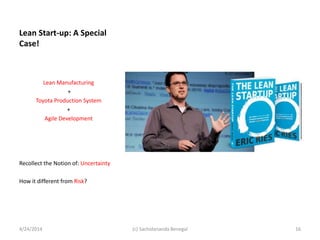
Lean Start-up: A Special
Case!
Lean Manufacturing
+
Toyota Production System
+
Agile Development
Recollect the Notion of: Uncertainty
How it different from Risk?
4/24/2014 16(c) Sachidananda Benegal
Traditional Product Development
Unit of Progress: Advance to Next Stage
Waterfall
Requirements
Specification
Design
Implementation
Verification
Maintenance
Problem: known
Solution: known
4/24/2014 17(c) Sachidananda Benegal
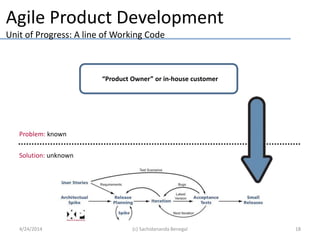
Agile Product Development
Unit of Progress: A line of Working Code
Problem: known
Solution: unknown
“Product Owner” or in-house customer
4/24/2014 18(c) Sachidananda Benegal
Product Development at Lean Startup
Unit of Progress: Validated Learning About Customers ($$$)
Problem: unknown
Solution: unknown
Customer Development
Hypotheses,
Experiments,
Insights
Data,
Feedback,
Insights
4/24/2014 19(c) Sachidananda Benegal
Minimize TOTAL time through the loop
LEARN BUILD
MEASURE
IDEAS
CODE
DATA
4/24/2014 20(c) Sachidananda Benegal
And much more...
4/24/2014 21(c) Sachidananda Benegal
4/24/2014 22(c) Sachidananda Benegal
I own right over none of the images used here – copyright is still with the owners
Reference:
• effectuation.org
• Presentations by:
– Prof Saras Saraswathy
– Eric Ries
4/24/2014 23(c) Sachidananda Benegal

Entrepreneruship- Effectuation & Lean Start up

  • 1.
    Sachidananda Benegal N SRaghavan Center for Entrepreneurial Learning 4/24/2014 1(c) Sachidananda Benegal
  • 2.
    • A fewquestions: – In context of firms – Equilibrium • Where do new firms come in! – Is there a role for entrepreneurship? – What role does an entrepreneur play? We all know! 4/24/2014 2(c) Sachidananda Benegal
  • 3.
    Who is anentrepreneur? 4/24/2014 3(c) Sachidananda Benegal
  • 4.
    They vary in... PurposeScale GeographyValue Creativity Goal Vision Dream Networks Technology etc... 4/24/2014 4(c) Sachidananda Benegal
  • 5.
    HOW DOES ANDENTREPRENEUR THINK? 4/24/2014 5(c) Sachidananda Benegal
  • 6.
    Causal Logic ispredictive Control of outcomes achieved through accurate predictions, clear goals, and avoiding or protecting oneself against the unexpected To the extent you can predict the future, you can control it Conventional Wisdom: Causal Logic 4/24/2014 6(c) Sachidananda Benegal
  • 7.
    The Problem Space Ref:Presentation of Prof Saras 4/24/2014 7(c) Sachidananda Benegal
  • 8.
    Classic Causation Modelfrom Marketing Textbooks Process of Effectuation Used by Expert Entrepreneurs SINGLE CUSTOMER Segment Definition Market Definition Segmentation Targeting Positioning Understand Customer Adding Segments/Partners Def of one of many possible markets Marketing Process Inversion 4/24/2014 8(c) Sachidananda Benegal
  • 9.
    Effectuation Principles: 1. Birdin Hand Principle – Start with who you are, what you know and whom you know, and not necessarily with a predetermined goal or a pre-envisioned opportunity 2. Affordable Loss – Invest only what you can afford to loose 3. Crazy Quilt – Create an expanding network of self-selected stakeholders, each of whom commits only what he or she can afford to loose. Focus on partnerships rather than on competitors. 4. Lemonade – Be open to surprises and leverage them. Treat them as useful inputs rather than hindrances to be avoided. 5. Pilot in the Plane – Co-create the future with things within your control and with self- selected partners If you use these principles you can shape your future and transform your environment in ways that matter to you and your stakeholders. 4/24/2014 9(c) Sachidananda Benegal
  • 10.
    Who I am? WhatI know? Whom I know? What Can I Do? Interaction with others Effectual Stakeholder Commitments Who we are? What we know? Whom we know? New means Expanding cycle of resources What can we do? (Affordable loss) New Goals Actual course of action possible Converging cycle of constraints New Markets and New Firms The process! 4/24/2014 10(c) Sachidananda Benegal
  • 11.
    How is thisdifferent from how Managers think? 4/24/2014 11(c) Sachidananda Benegal
  • 12.
    How is thisdifferent from how Managers think? Effectual Causal Start with your means Focus on your downside risk Leverage Contingencies Form Partnerships Control Vs Predict Pre-set goals and opportunities Expected Returns Avoiding Surprises Competitive analysis Inevitable trends 4/24/2014 12(c) Sachidananda Benegal
  • 13.
    CAN WE THENSAY WE DON’T NEED MANAGERS? 4/24/2014 13(c) Sachidananda Benegal
  • 14.
    Firm Life-Cycle andEntrepreneur’s Career Causal Tethered to goals and predictive Effectual Tethered to means and non-predictive Time Expert entrepreneurs do not always manage to bridge this gap Expert Entrepreneur Startup Firm Large Firm NoviceEntrepreneur R e s o u r c e s Low High 4/24/2014 14(c) Sachidananda Benegal
  • 15.
    LEAN STARTUP 4/24/2014 15(c)Sachidananda Benegal
  • 16.
    Lean Start-up: ASpecial Case! Lean Manufacturing + Toyota Production System + Agile Development Recollect the Notion of: Uncertainty How it different from Risk? 4/24/2014 16(c) Sachidananda Benegal
  • 17.
    Traditional Product Development Unitof Progress: Advance to Next Stage Waterfall Requirements Specification Design Implementation Verification Maintenance Problem: known Solution: known 4/24/2014 17(c) Sachidananda Benegal
  • 18.
    Agile Product Development Unitof Progress: A line of Working Code Problem: known Solution: unknown “Product Owner” or in-house customer 4/24/2014 18(c) Sachidananda Benegal
  • 19.
    Product Development atLean Startup Unit of Progress: Validated Learning About Customers ($$$) Problem: unknown Solution: unknown Customer Development Hypotheses, Experiments, Insights Data, Feedback, Insights 4/24/2014 19(c) Sachidananda Benegal
  • 20.
    Minimize TOTAL timethrough the loop LEARN BUILD MEASURE IDEAS CODE DATA 4/24/2014 20(c) Sachidananda Benegal
  • 21.
    And much more... 4/24/201421(c) Sachidananda Benegal
  • 22.
    4/24/2014 22(c) SachidanandaBenegal I own right over none of the images used here – copyright is still with the owners
  • 23.
    Reference: • effectuation.org • Presentationsby: – Prof Saras Saraswathy – Eric Ries 4/24/2014 23(c) Sachidananda Benegal