
Business Plan Essentials
Sachidananda B S
N S Raghavan Center for Entrepreneurial Learning
(s) Sachidananda Benegal
DISCLAIMERS UPFRONT
Note:
•No Business Plan Template – it’s the elements of a B-Plan
•Plan for business, monetization shall follow execution
• Attempt to keep it as practical as possible
(s) Sachidananda Benegal
WHAT?
What is a business plan?
(s) Sachidananda Benegal
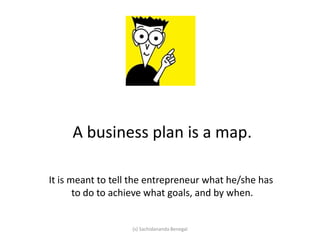
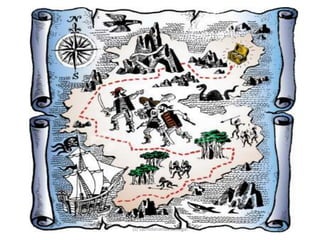
A business plan is a map.
It is meant to tell the entrepreneur what he/she has
to do to achieve what goals, and by when.
(s) Sachidananda Benegal
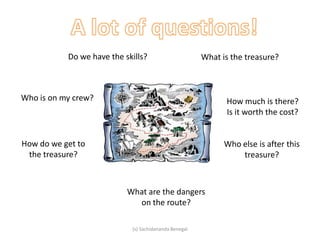
What is the treasure?
How do we get to
the treasure?
Who else is after this
treasure?
How much is there?
Is it worth the cost?
Who is on my crew?
What are the dangers
on the route?
Do we have the skills?
(s) Sachidananda Benegal
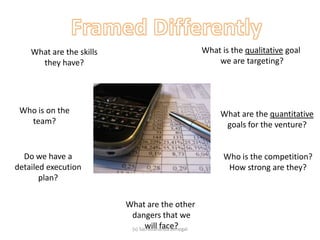
What is the qualitative goal
we are targeting?
Do we have a
detailed execution
plan?
Who is the competition?
How strong are they?
What are the quantitative
goals for the venture?
Who is on the
team?
What are the other
dangers that we
will face?
What are the skills
they have?
(s) Sachidananda Benegal
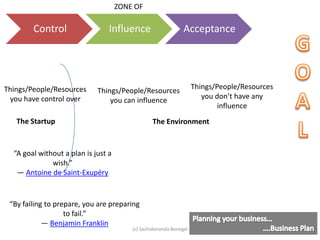
The Startup The Environment
Things/People/Resources
you have control over
Things/People/Resources
you can influence
Things/People/Resources
you don’t have any
influence
“A goal without a plan is just a
wish.”
― Antoine de Saint-Exupéry
“By failing to prepare, you are preparing
to fail.”
― Benjamin Franklin
Control Influence Acceptance
ZONE OF
(s) Sachidananda Benegal
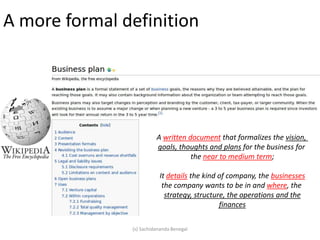
A more formal definition
A written document that formalizes the vision,
goals, thoughts and plans for the business for
the near to medium term;
It details the kind of company, the businesses
the company wants to be in and where, the
strategy, structure, the operations and the
finances
(s) Sachidananda Benegal
WHOM & WHO?
For whom is the B-Plan written? Who writes it?
(s) Sachidananda Benegal
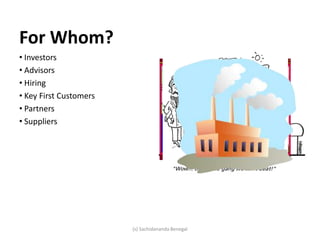
For Whom?
• Investors
• Advisors
• Hiring
• Key First Customers
• Partners
• Suppliers
(s) Sachidananda Benegal
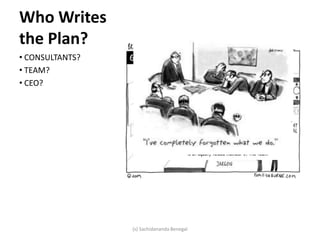
Who Writes
the Plan?
• CONSULTANTS?
• TEAM?
• CEO?
(s) Sachidananda Benegal
Keep these
in mind
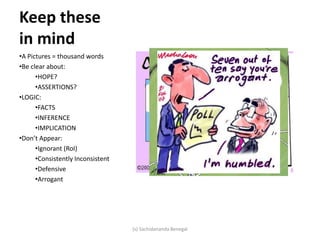
•A Pictures = thousand words
•Be clear about:
•HOPE?
•ASSERTIONS?
•LOGIC:
•FACTS
•INFERENCE
•IMPLICATION
•Don’t Appear:
•Ignorant (RoI)
•Consistently Inconsistent
•Defensive
•Arrogant
(s) Sachidananda Benegal
BUSINESS PLAN
Preparation, Elements and Components of a B-Plan
(s) Sachidananda Benegal
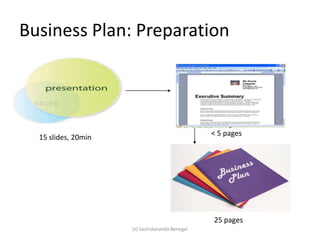
Business Plan: Preparation
15 slides, 20min
< 5 pages
25 pages
(s) Sachidananda Benegal
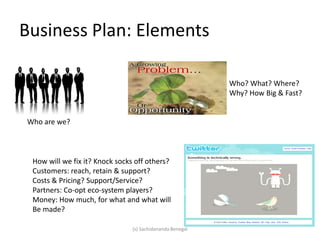
Business Plan: Elements
Who are we?
Who? What? Where?
Why? How Big & Fast?
How will we fix it? Knock socks off others?
Customers: reach, retain & support?
Costs & Pricing? Support/Service?
Partners: Co-opt eco-system players?
Money: How much, for what and what will
Be made?
(s) Sachidananda Benegal
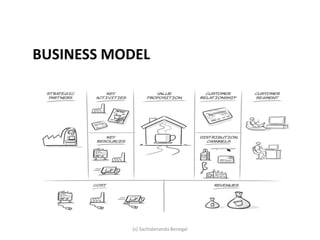
BUSINESS MODEL
(s) Sachidananda Benegal
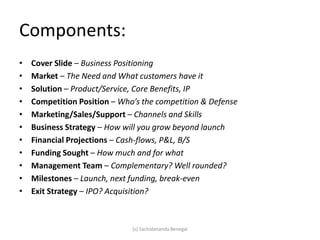
Components:
• Cover Slide – Business Positioning
• Market – The Need and What customers have it
• Solution – Product/Service, Core Benefits, IP
• Competition Position – Who’s the competition & Defense
• Marketing/Sales/Support – Channels and Skills
• Business Strategy – How will you grow beyond launch
• Financial Projections – Cash-flows, P&L, B/S
• Funding Sought – How much and for what
• Management Team – Complementary? Well rounded?
• Milestones – Launch, next funding, break-even
• Exit Strategy – IPO? Acquisition?
(s) Sachidananda Benegal
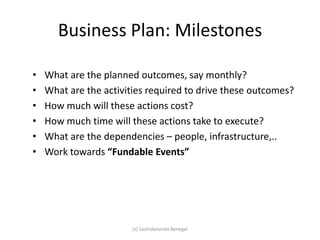
Business Plan: Milestones
• What are the planned outcomes, say monthly?
• What are the activities required to drive these outcomes?
• How much will these actions cost?
• How much time will these actions take to execute?
• What are the dependencies – people, infrastructure,..
• Work towards “Fundable Events”
(s) Sachidananda Benegal
MOST IMPORTANTLY
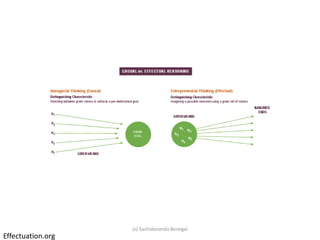
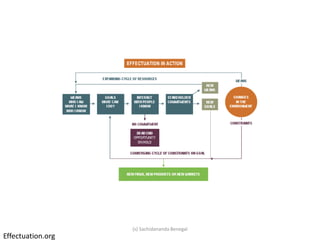
How does one decide in an entrepreneurial set up?
(s) Sachidananda Benegal
Effectuation.org
(s) Sachidananda Benegal
Effectuation.org
(s) Sachidananda Benegal
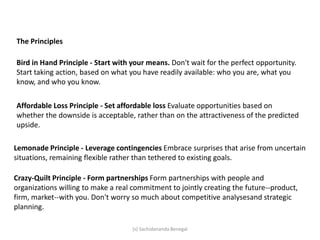
The Principles
Bird in Hand Principle - Start with your means. Don't wait for the perfect opportunity.
Start taking action, based on what you have readily available: who you are, what you
know, and who you know.
Affordable Loss Principle - Set affordable loss Evaluate opportunities based on
whether the downside is acceptable, rather than on the attractiveness of the predicted
upside.
Lemonade Principle - Leverage contingencies Embrace surprises that arise from uncertain
situations, remaining flexible rather than tethered to existing goals.
Crazy-Quilt Principle - Form partnerships Form partnerships with people and
organizations willing to make a real commitment to jointly creating the future--product,
firm, market--with you. Don't worry so much about competitive analysesand strategic
planning.
(s) Sachidananda Benegal
THANK YOU
(s) Sachidananda Benegal

Essentials of B-Plan

  • 1.
    Business Plan Essentials SachidanandaB S N S Raghavan Center for Entrepreneurial Learning (s) Sachidananda Benegal
  • 2.
    DISCLAIMERS UPFRONT Note: •No BusinessPlan Template – it’s the elements of a B-Plan •Plan for business, monetization shall follow execution • Attempt to keep it as practical as possible (s) Sachidananda Benegal
  • 3.
    WHAT? What is abusiness plan? (s) Sachidananda Benegal
  • 4.
    A business planis a map. It is meant to tell the entrepreneur what he/she has to do to achieve what goals, and by when. (s) Sachidananda Benegal
  • 5.
  • 6.
    What is thetreasure? How do we get to the treasure? Who else is after this treasure? How much is there? Is it worth the cost? Who is on my crew? What are the dangers on the route? Do we have the skills? (s) Sachidananda Benegal
  • 7.
    What is thequalitative goal we are targeting? Do we have a detailed execution plan? Who is the competition? How strong are they? What are the quantitative goals for the venture? Who is on the team? What are the other dangers that we will face? What are the skills they have? (s) Sachidananda Benegal
  • 8.
    The Startup TheEnvironment Things/People/Resources you have control over Things/People/Resources you can influence Things/People/Resources you don’t have any influence “A goal without a plan is just a wish.” ― Antoine de Saint-Exupéry “By failing to prepare, you are preparing to fail.” ― Benjamin Franklin Control Influence Acceptance ZONE OF (s) Sachidananda Benegal
  • 9.
    A more formaldefinition A written document that formalizes the vision, goals, thoughts and plans for the business for the near to medium term; It details the kind of company, the businesses the company wants to be in and where, the strategy, structure, the operations and the finances (s) Sachidananda Benegal
  • 10.
    WHOM & WHO? Forwhom is the B-Plan written? Who writes it? (s) Sachidananda Benegal
  • 11.
    For Whom? • Investors •Advisors • Hiring • Key First Customers • Partners • Suppliers (s) Sachidananda Benegal
  • 12.
    Who Writes the Plan? •CONSULTANTS? • TEAM? • CEO? (s) Sachidananda Benegal
  • 13.
    Keep these in mind •APictures = thousand words •Be clear about: •HOPE? •ASSERTIONS? •LOGIC: •FACTS •INFERENCE •IMPLICATION •Don’t Appear: •Ignorant (RoI) •Consistently Inconsistent •Defensive •Arrogant (s) Sachidananda Benegal
  • 14.
    BUSINESS PLAN Preparation, Elementsand Components of a B-Plan (s) Sachidananda Benegal
  • 15.
    Business Plan: Preparation 15slides, 20min < 5 pages 25 pages (s) Sachidananda Benegal
  • 16.
    Business Plan: Elements Whoare we? Who? What? Where? Why? How Big & Fast? How will we fix it? Knock socks off others? Customers: reach, retain & support? Costs & Pricing? Support/Service? Partners: Co-opt eco-system players? Money: How much, for what and what will Be made? (s) Sachidananda Benegal
  • 17.
  • 18.
    Components: • Cover Slide– Business Positioning • Market – The Need and What customers have it • Solution – Product/Service, Core Benefits, IP • Competition Position – Who’s the competition & Defense • Marketing/Sales/Support – Channels and Skills • Business Strategy – How will you grow beyond launch • Financial Projections – Cash-flows, P&L, B/S • Funding Sought – How much and for what • Management Team – Complementary? Well rounded? • Milestones – Launch, next funding, break-even • Exit Strategy – IPO? Acquisition? (s) Sachidananda Benegal
  • 19.
    Business Plan: Milestones •What are the planned outcomes, say monthly? • What are the activities required to drive these outcomes? • How much will these actions cost? • How much time will these actions take to execute? • What are the dependencies – people, infrastructure,.. • Work towards “Fundable Events” (s) Sachidananda Benegal
  • 20.
    MOST IMPORTANTLY How doesone decide in an entrepreneurial set up? (s) Sachidananda Benegal
  • 21.
  • 22.
  • 23.
    The Principles Bird inHand Principle - Start with your means. Don't wait for the perfect opportunity. Start taking action, based on what you have readily available: who you are, what you know, and who you know. Affordable Loss Principle - Set affordable loss Evaluate opportunities based on whether the downside is acceptable, rather than on the attractiveness of the predicted upside. Lemonade Principle - Leverage contingencies Embrace surprises that arise from uncertain situations, remaining flexible rather than tethered to existing goals. Crazy-Quilt Principle - Form partnerships Form partnerships with people and organizations willing to make a real commitment to jointly creating the future--product, firm, market--with you. Don't worry so much about competitive analysesand strategic planning. (s) Sachidananda Benegal
  • 24.