Effectuation
Sachidananda B S
Presentation for Launchpadders
NSRCEL-IIMB
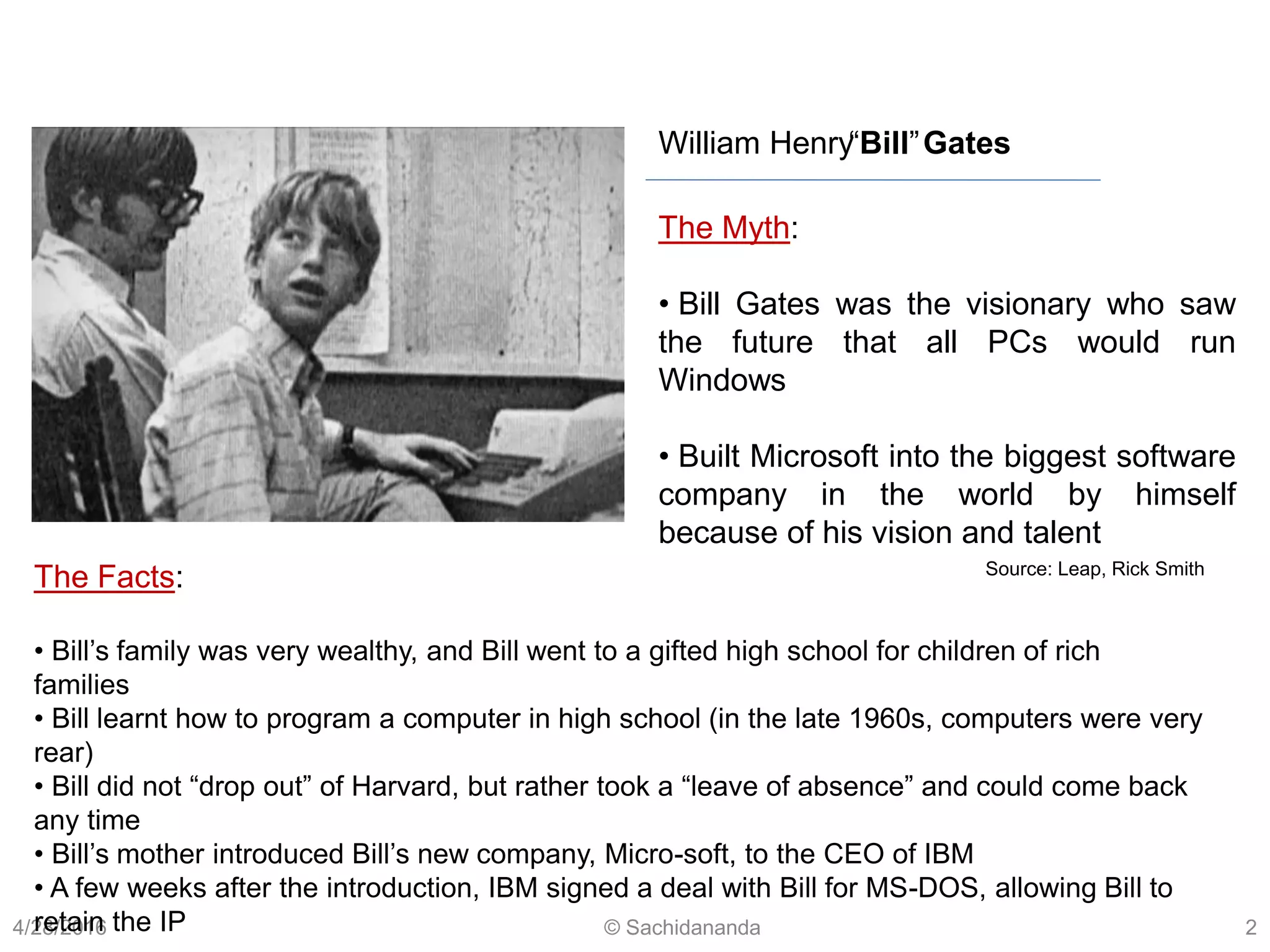
William Henry Gates
4/28/2016 © Sachidananda 2
“Bill”
The Myth:
• Bill Gates was the visionary who saw
the future that all PCs would run
Windows
• Built Microsoft into the biggest software
company in the world by himself
because of his vision and talent
The Facts:
• Bill’s family was very wealthy, and Bill went to a gifted high school for children of rich
families
• Bill learnt how to program a computer in high school (in the late 1960s, computers were very
rear)
• Bill did not “drop out” of Harvard, but rather took a “leave of absence” and could come back
any time
• Bill’s mother introduced Bill’s new company, Micro-soft, to the CEO of IBM
• A few weeks after the introduction, IBM signed a deal with Bill for MS-DOS, allowing Bill to
retain the IP
Source: Leap, Rick Smith
Ellio
t
ZuckerbergMark
4/28/2016 © Sachidananda 3
The Myth:
•Mark was a visionary who saw online social networks as
the future of online media
• Mark built facebook by himself from the beginning based
on his vision and talent
•Through his strong vision and character, was able to raise
millions of dollars easily for facebook
The Facts:
• Learned how to write computer programs since he was 10 years old
• Worked on many “projects” including Facemash and The Facebook, many of which failed
early, but he learned from them
• Started The Facebook with just $2000
• Had a strong core team who helped him grow facebook before getting external funding
• Met Sean Parker who helped him raise money to grown business
Source: The Facebook Effect, David Kirkpatrick
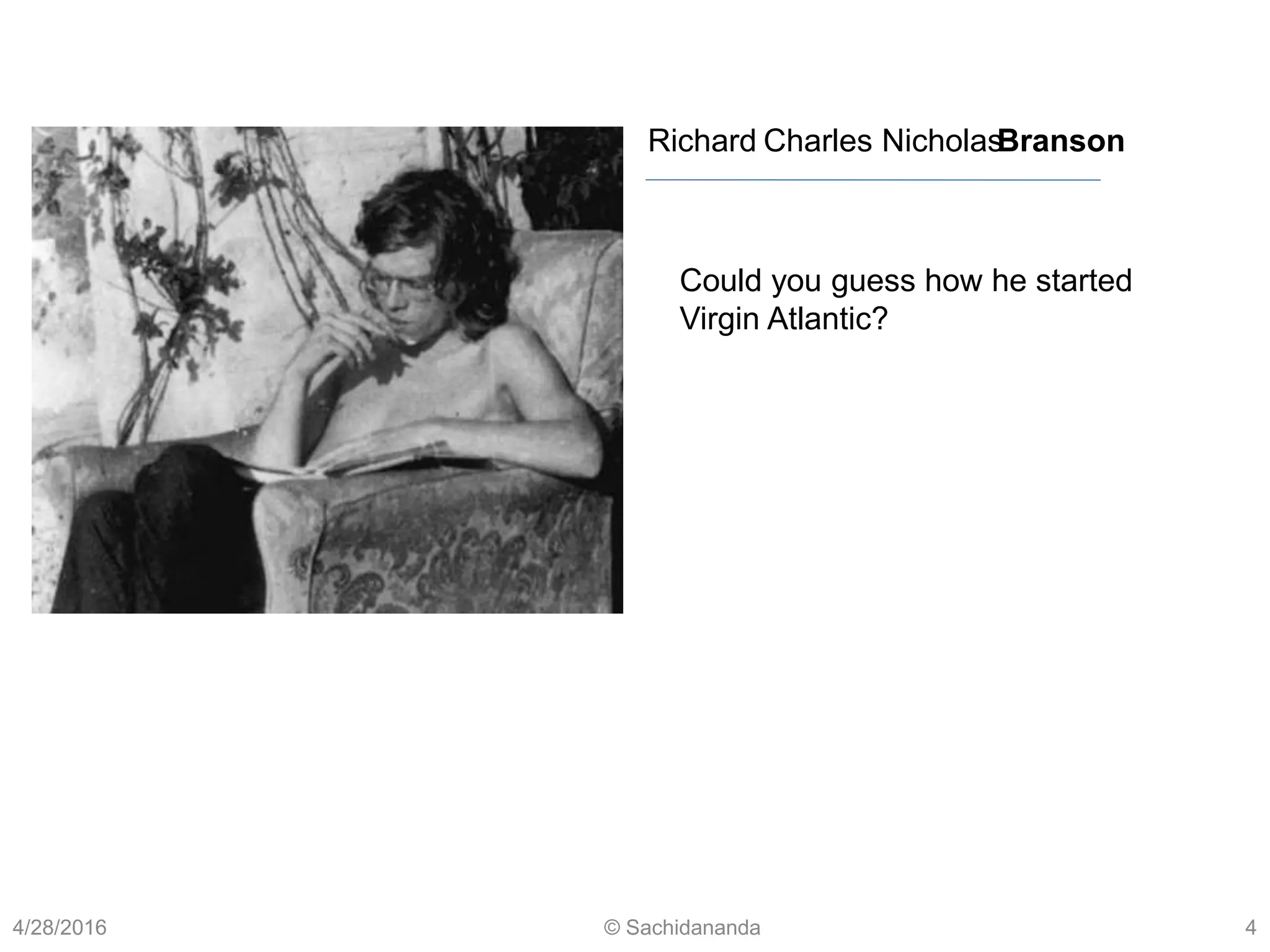
Charles NicholasBransonRichard
4/28/2016 © Sachidananda 4
Could you guess how he started
Virgin Atlantic?
HOW DOES AN
ENTREPRENEUR THINK?
4/28/2016 © Sachidananda 5
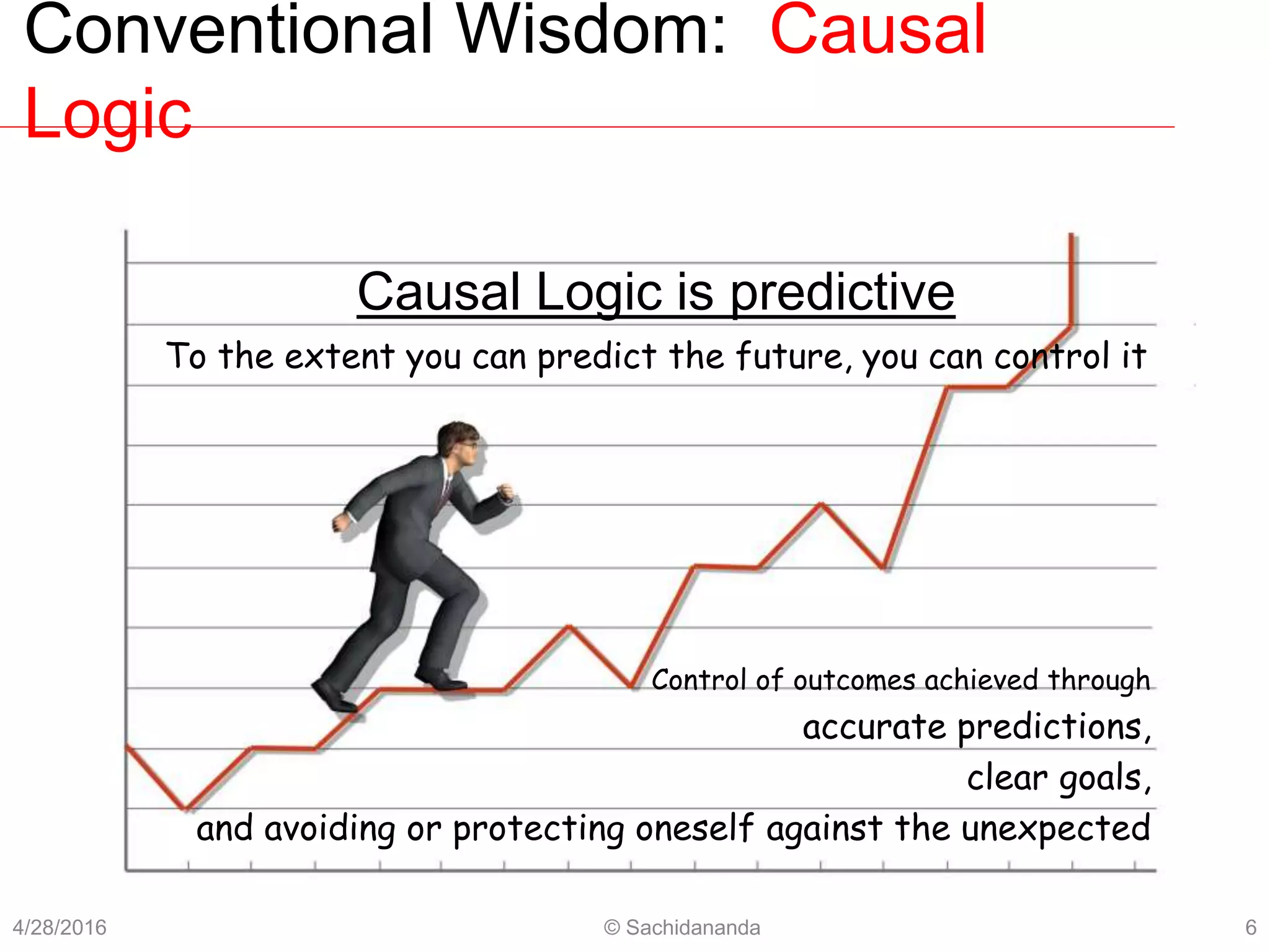
Causal Logic is predictive
Control of outcomes achieved through
accurate predictions,
clear goals,
and avoiding or protecting oneself against the unexpected
To the extent you can predict the future, you can control it
Conventional Wisdom: Causal
Logic
4/28/2016 © Sachidananda 6
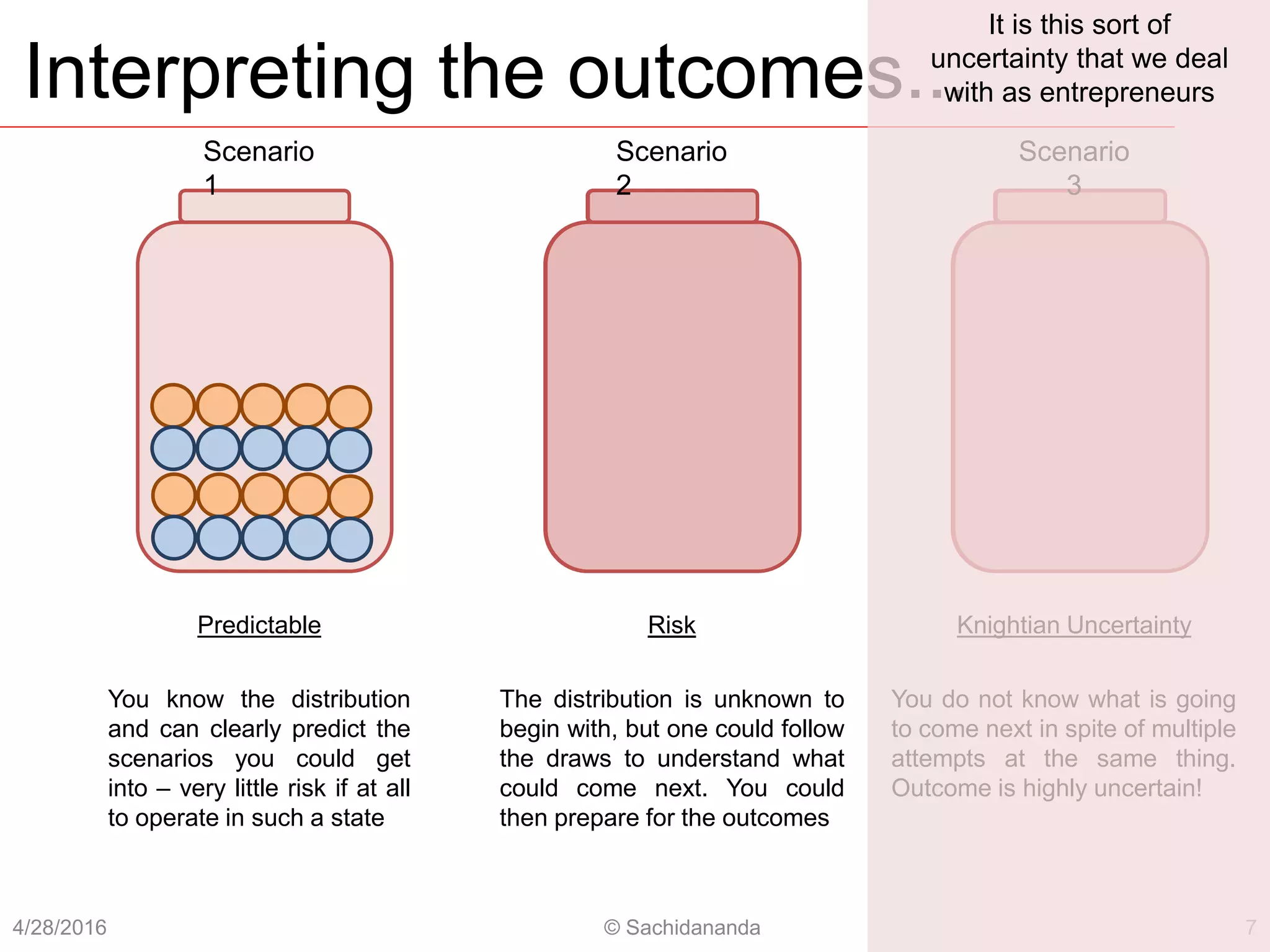
Interpreting the outcomes...
4/28/2016 © Sachidananda 7
Scenario
1
Scenario
2
Scenario
3
Knightian UncertaintyRiskPredictable
You know the distribution
and can clearly predict the
scenarios you could get
into – very little risk if at all
to operate in such a state
The distribution is unknown to
begin with, but one could follow
the draws to understand what
could come next. You could
then prepare for the outcomes
You do not know what is going
to come next in spite of multiple
attempts at the same thing.
Outcome is highly uncertain!
It is this sort of
uncertainty that we deal
with as entrepreneurs
Through the study of several such
Entrepreneurs….
…Some patterns
emerge
The Effectual
Principles
4/28/2016 © Sachidananda 8
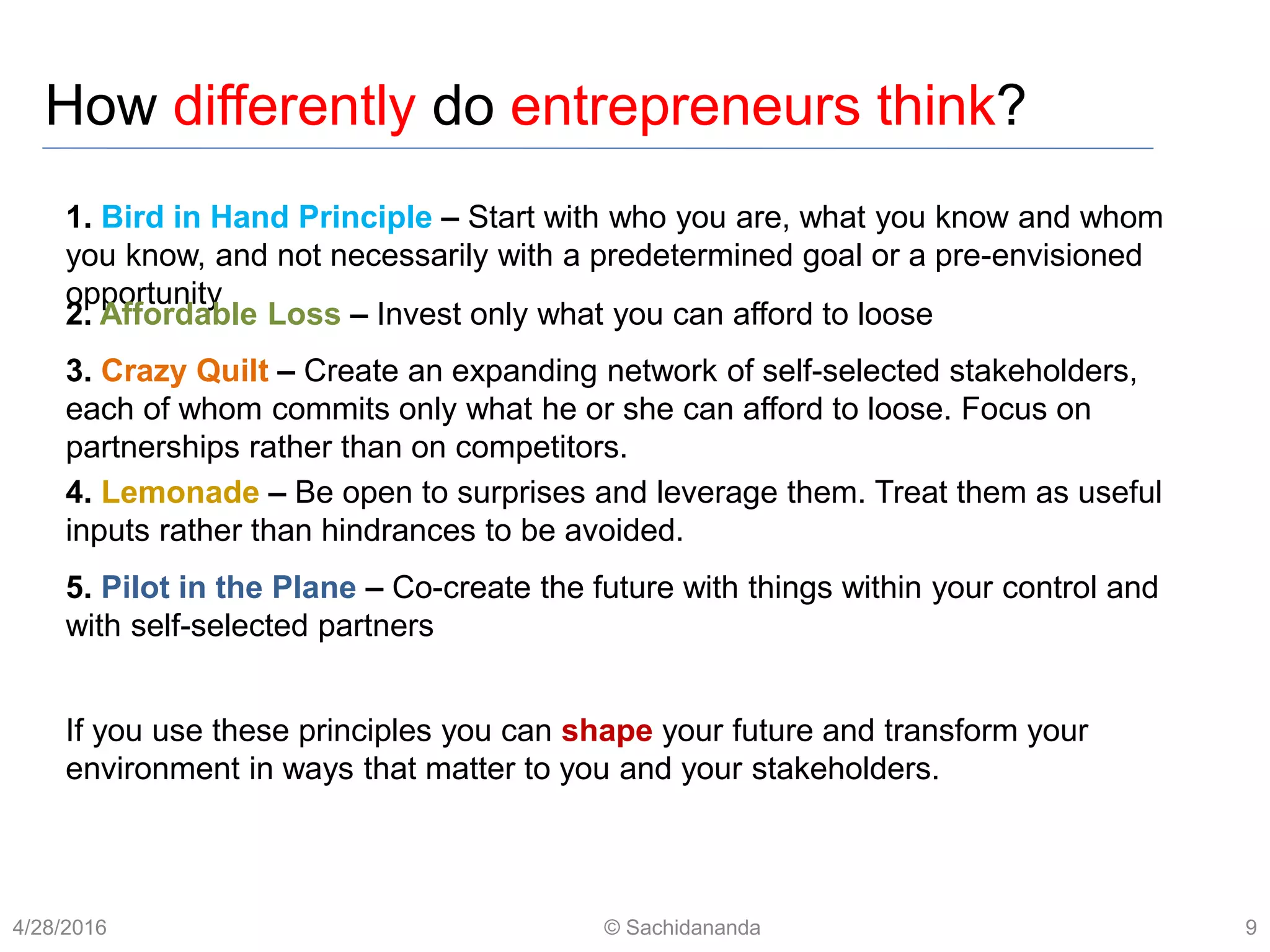
How differently do entrepreneurs think?
1. Bird in Hand Principle – Start with who you are, what you know and whom
you know, and not necessarily with a predetermined goal or a pre-envisioned
opportunity
2. Affordable Loss – Invest only what you can afford to loose
3. Crazy Quilt – Create an expanding network of self-selected stakeholders,
each of whom commits only what he or she can afford to loose. Focus on
partnerships rather than on competitors.
4. Lemonade – Be open to surprises and leverage them. Treat them as useful
inputs rather than hindrances to be avoided.
5. Pilot in the Plane – Co-create the future with things within your control and
with self-selected partners
If you use these principles you can shape your future and transform your
environment in ways that matter to you and your stakeholders.
4/28/2016 © Sachidananda 9
How is this different from how Managers
think?
Effectual Causal
Start with your
means
Focus on your
downside risk
Leverage
Contingencie
s
Form
Partnerships
Control Vs
Predict
Pre-set goals
and
opportunities
Expected
Returns
Avoiding
Surprises
Competitive
analysis
Inevitable trends
4/28/2016 © Sachidananda 10
Classic Causation Model from Marketing Textbooks
Process of Effectuation Used by Expert Entrepreneurs
SINGLE CUSTOMER
Segment Definition
Market Definition
Segmentation
Targeting
Positioning
Understand
Customer
Adding Segments/Partners
Def of one of many possible markets
Marketing Process Inversion
4/28/2016 © Sachidananda 11
Who I am?
What I know?
Whom I know?
What Can I
Do?
Interaction
with others
Effectual
Stakeholder
Commitments
Who we are?
What we
know?
Whom we
know?
New
mean
s
Expanding cycle of resources
What can we
do?
(Affordable
loss)
New
Goals
Actual course
of action
possible
Converging cycle of constraints
New Markets
and New
Firms
The process!
4/28/2016 © Sachidananda 12
How is this different from how Managers
think?
4/28/2016 © Sachidananda 13
Having said that:
Effectuation
 is Not an invention or thought of a great mind
 is not a Recipe guaranteeing success
 does offer Control in an unpredictable Business Environment
 does offer Insights how expert entrepreneurs cope with uncertainty
4/28/2016 © Sachidananda 14
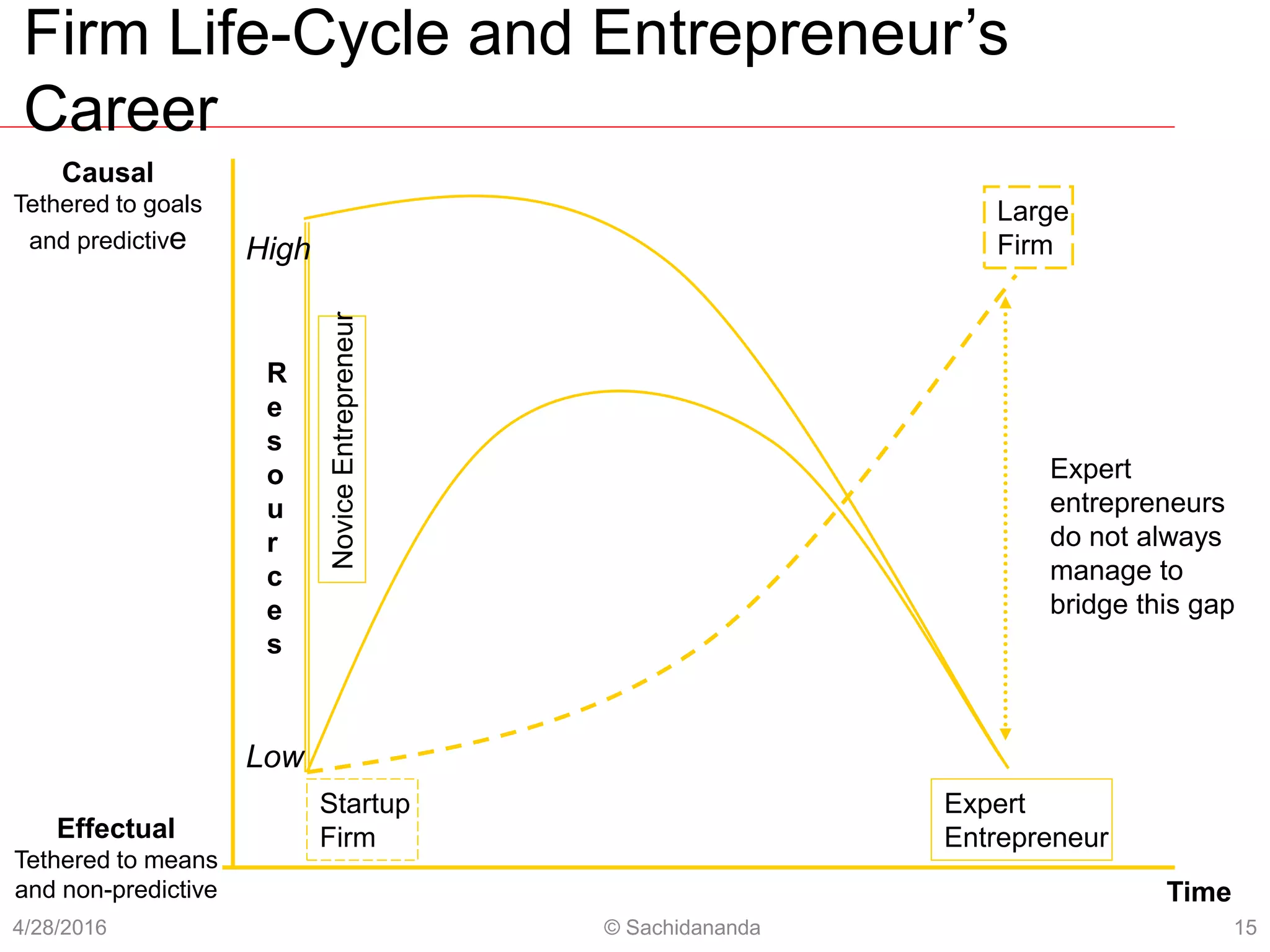
Firm Life-Cycle and Entrepreneur’s
Career
4/28/2016 © Sachidananda 15
Causal
Tethered to goals
and predictive
Effectual
Tethered to means
and non-predictive Time
Expert
entrepreneurs
do not always
manage to
bridge this gap
Expert
Entrepreneur
Startup
Firm
Large
Firm
NoviceEntrepreneur
R
e
s
o
u
r
c
e
s
Low
High
4/28/2016 © Sachidananda 16
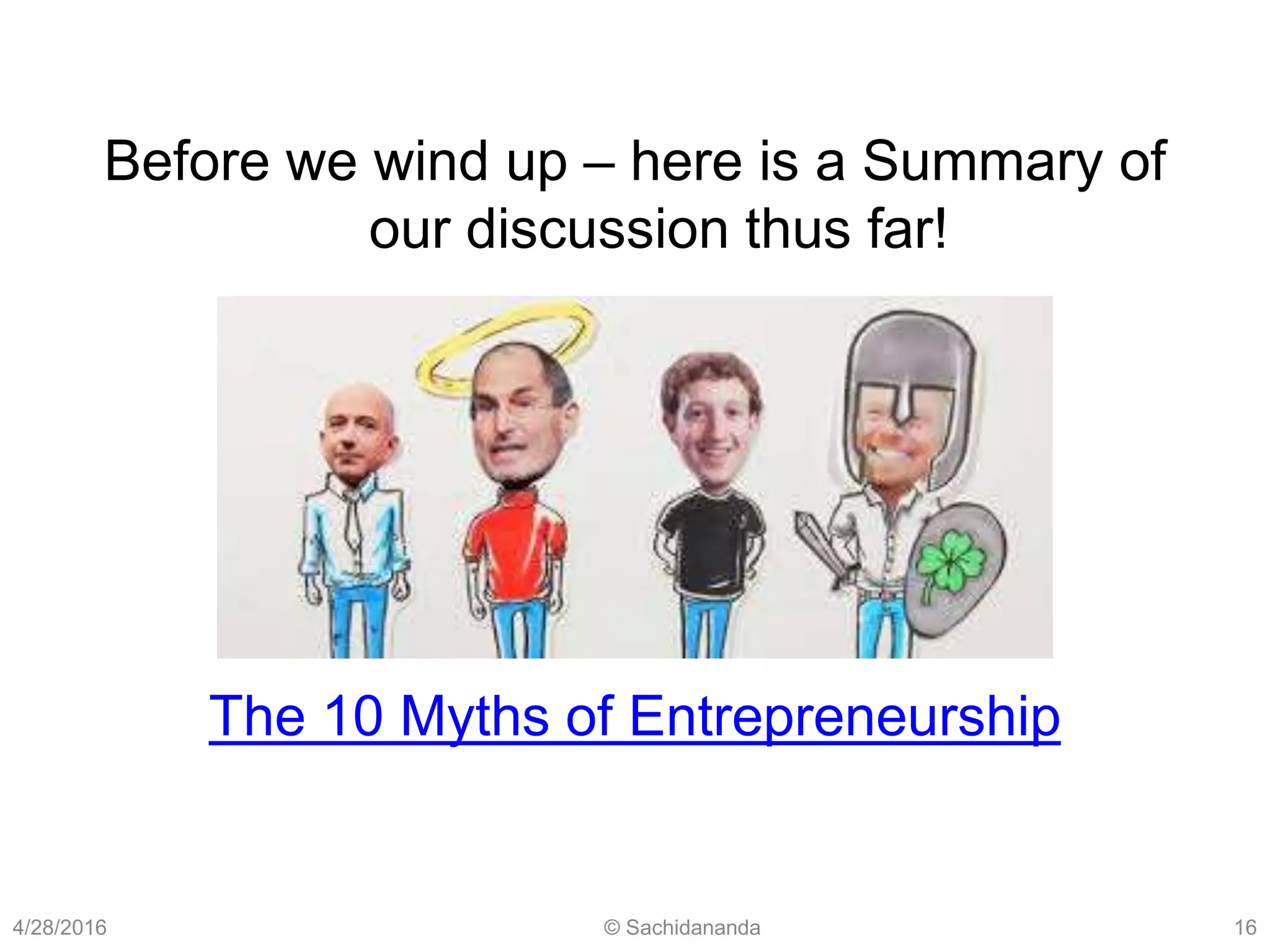
Before we wind up – here is a Summary of
our discussion thus far!
The 10 Myths of Entrepreneurship
QUESTIONS
4/28/2016 © Sachidananda 17
THANK YOU

Effectuation -NSRCEL Launchpad participants

  • 1.
    Effectuation Sachidananda B S Presentationfor Launchpadders NSRCEL-IIMB
  • 2.
    William Henry Gates 4/28/2016© Sachidananda 2 “Bill” The Myth: • Bill Gates was the visionary who saw the future that all PCs would run Windows • Built Microsoft into the biggest software company in the world by himself because of his vision and talent The Facts: • Bill’s family was very wealthy, and Bill went to a gifted high school for children of rich families • Bill learnt how to program a computer in high school (in the late 1960s, computers were very rear) • Bill did not “drop out” of Harvard, but rather took a “leave of absence” and could come back any time • Bill’s mother introduced Bill’s new company, Micro-soft, to the CEO of IBM • A few weeks after the introduction, IBM signed a deal with Bill for MS-DOS, allowing Bill to retain the IP Source: Leap, Rick Smith
  • 3.
    Ellio t ZuckerbergMark 4/28/2016 © Sachidananda3 The Myth: •Mark was a visionary who saw online social networks as the future of online media • Mark built facebook by himself from the beginning based on his vision and talent •Through his strong vision and character, was able to raise millions of dollars easily for facebook The Facts: • Learned how to write computer programs since he was 10 years old • Worked on many “projects” including Facemash and The Facebook, many of which failed early, but he learned from them • Started The Facebook with just $2000 • Had a strong core team who helped him grow facebook before getting external funding • Met Sean Parker who helped him raise money to grown business Source: The Facebook Effect, David Kirkpatrick
  • 4.
    Charles NicholasBransonRichard 4/28/2016 ©Sachidananda 4 Could you guess how he started Virgin Atlantic?
  • 5.
    HOW DOES AN ENTREPRENEURTHINK? 4/28/2016 © Sachidananda 5
  • 6.
    Causal Logic ispredictive Control of outcomes achieved through accurate predictions, clear goals, and avoiding or protecting oneself against the unexpected To the extent you can predict the future, you can control it Conventional Wisdom: Causal Logic 4/28/2016 © Sachidananda 6
  • 7.
    Interpreting the outcomes... 4/28/2016© Sachidananda 7 Scenario 1 Scenario 2 Scenario 3 Knightian UncertaintyRiskPredictable You know the distribution and can clearly predict the scenarios you could get into – very little risk if at all to operate in such a state The distribution is unknown to begin with, but one could follow the draws to understand what could come next. You could then prepare for the outcomes You do not know what is going to come next in spite of multiple attempts at the same thing. Outcome is highly uncertain! It is this sort of uncertainty that we deal with as entrepreneurs
  • 8.
    Through the studyof several such Entrepreneurs…. …Some patterns emerge The Effectual Principles 4/28/2016 © Sachidananda 8
  • 9.
    How differently doentrepreneurs think? 1. Bird in Hand Principle – Start with who you are, what you know and whom you know, and not necessarily with a predetermined goal or a pre-envisioned opportunity 2. Affordable Loss – Invest only what you can afford to loose 3. Crazy Quilt – Create an expanding network of self-selected stakeholders, each of whom commits only what he or she can afford to loose. Focus on partnerships rather than on competitors. 4. Lemonade – Be open to surprises and leverage them. Treat them as useful inputs rather than hindrances to be avoided. 5. Pilot in the Plane – Co-create the future with things within your control and with self-selected partners If you use these principles you can shape your future and transform your environment in ways that matter to you and your stakeholders. 4/28/2016 © Sachidananda 9
  • 10.
    How is thisdifferent from how Managers think? Effectual Causal Start with your means Focus on your downside risk Leverage Contingencie s Form Partnerships Control Vs Predict Pre-set goals and opportunities Expected Returns Avoiding Surprises Competitive analysis Inevitable trends 4/28/2016 © Sachidananda 10
  • 11.
    Classic Causation Modelfrom Marketing Textbooks Process of Effectuation Used by Expert Entrepreneurs SINGLE CUSTOMER Segment Definition Market Definition Segmentation Targeting Positioning Understand Customer Adding Segments/Partners Def of one of many possible markets Marketing Process Inversion 4/28/2016 © Sachidananda 11
  • 12.
    Who I am? WhatI know? Whom I know? What Can I Do? Interaction with others Effectual Stakeholder Commitments Who we are? What we know? Whom we know? New mean s Expanding cycle of resources What can we do? (Affordable loss) New Goals Actual course of action possible Converging cycle of constraints New Markets and New Firms The process! 4/28/2016 © Sachidananda 12
  • 13.
    How is thisdifferent from how Managers think? 4/28/2016 © Sachidananda 13
  • 14.
    Having said that: Effectuation is Not an invention or thought of a great mind  is not a Recipe guaranteeing success  does offer Control in an unpredictable Business Environment  does offer Insights how expert entrepreneurs cope with uncertainty 4/28/2016 © Sachidananda 14
  • 15.
    Firm Life-Cycle andEntrepreneur’s Career 4/28/2016 © Sachidananda 15 Causal Tethered to goals and predictive Effectual Tethered to means and non-predictive Time Expert entrepreneurs do not always manage to bridge this gap Expert Entrepreneur Startup Firm Large Firm NoviceEntrepreneur R e s o u r c e s Low High
  • 16.
    4/28/2016 © Sachidananda16 Before we wind up – here is a Summary of our discussion thus far! The 10 Myths of Entrepreneurship
  • 17.