
Table of Contents

Unit 1 - What is an Entrepreneur .................................................................................................... 1
   What is an entrepreneur.............................................................................................................. 2
   Role of an entrepreneur .............................................................................................................. 2
How enployees and entrepreneurs differ........................................................................................ 3


Unit 1 - What is an Entrepreneur


Objectives

Upon completion of this unit students should be able to:
   1. State who is an entrepreneur
   2. Identify the role of an entrepreneur
   3. Identify the characteristics of an entrepreneur
   4. Understand the risk of becoming an entrepreneur
   5. Recognize the benefits of being a successful business owner
   6. Differentiate between an opportunity and an idea
   7. Recognize investment capital is necessary for an idea to become an opportunity
   8. Asses the reason why you are thinking about starting a business


Before you begin what is your answer to these question

Have you ever dream of starting your own business?  Yes                                                            No

If Yes, what kind of business?

_____________________________________________________________

_____________________________________________________________

_____________________________________________________________

If No, why not

_____________________________________________________________

                                                                                                                                         1
_____________________________________________________________

_____________________________________________________________

What would be the best or worst thing about owning your own business?

_____________________________________________________________

_____________________________________________________________

_____________________________________________________________


What is an entrepreneur


An entrepreneur (on-tra-prih-NER) is someone that creates a new business.
This can carry a high risk because it requires money to set up a new business
without knowing if it will give a return on investment. A good understanding
of the market is needed and finding out what customers want and modify
their products in line with market requirements. Every entrepreneurship
business started with an idea of how to solve a particular problem or add
value to a present product. This is the first phase of any business. This is
where you test your idea for a business by doing research to find out if
anyone else has had the same idea.

The production and sale of new products and services are sparked by
entrepreneurial energy, creativity and motivation.


Role of an entrepreneur


Entrepreneurs seek disequilibrium – a gap between the wants and needs of
customers and the products and series that are currently available. The
entrepreneur then brings together the factors of production necessary to
produce, offer and sell desired products and services. They invest and risk
their money – and other people’s money- to produce a product or service
that can be sold at a profit.

                                                                              2
The role of an entrepreneur includes the following

      Innovators who create new products or process
      They are risk takers
      They people who take an idea and make it a success
      Combines the other three factors of production (land, labour, capital)
      to produce a good or service
      Takes the risk of losing investment if business fails


How employees and entrepreneurs differ


Employees work for someone else and entrepreneurs work for themselves,
entrepreneurs risk more than employees. Employees may risk losing a job if
they do not perform their work well but they are paid for their work.
Entrepreneurs risk not being able to pay their employees or themselves if
business is “slow.”


                              Class Discussion

Do you know any entrepreneurs? What do entrepreneurs do and how do
they differ from employees?


The rewards employees and entrepreneurs get from their work can also be
different. A reward can involve money, but it also might be personal
satisfaction or independence. As business owners, entrepreneurs are in
control of the money made by the business. They also have the final say in
all business decisions. As a result, entrepreneurs are ultimately responsible
for the success or failure of their businesses. (Mariotti 2010)


                                                                                3
Rewards of being an entrepreneur


Some of the rewards of being an entrepreneur:

1. Money
When you are someone's employee, the amount of money you earn is
limited by the labor market. You'll earn the going rate for your field and
typically not much more. When you are self employed, your earning
potential is only limited by your own brains and motivation to build a
successful business. The more effort and smart planning you put into your
business, the more you will directly benefit from your own work.

2. Opportunities
Many entrepreneurs say they launched their business in order to create
opportunities for themselves that they could not find in traditional jobs
within their local labor market. A parent with a young family may want
flexibility that is not available in traditional jobs, a new immigrant may want
responsibility and opportunities for professional growth that they may not
have found in their new country.

When you build your own business, you can build opportunities and
working conditions that are a good fit for your needs in ways that you may
not find in traditional employment.

3. Accomplishment
Building a successful business can provide you with a sense of pride that
you have created something yourself based on something you value. You get
to make the decisions; if you think a project is a great idea, you get to make
it happen. You get to build something from the ground up that is your own
and a reflection of your values, and any business success is always your
success.

4. Time
While you will invest a lot of time in building your business, depending
upon the type of business you launch, being an entrepreneur can provide you

                                                                              4
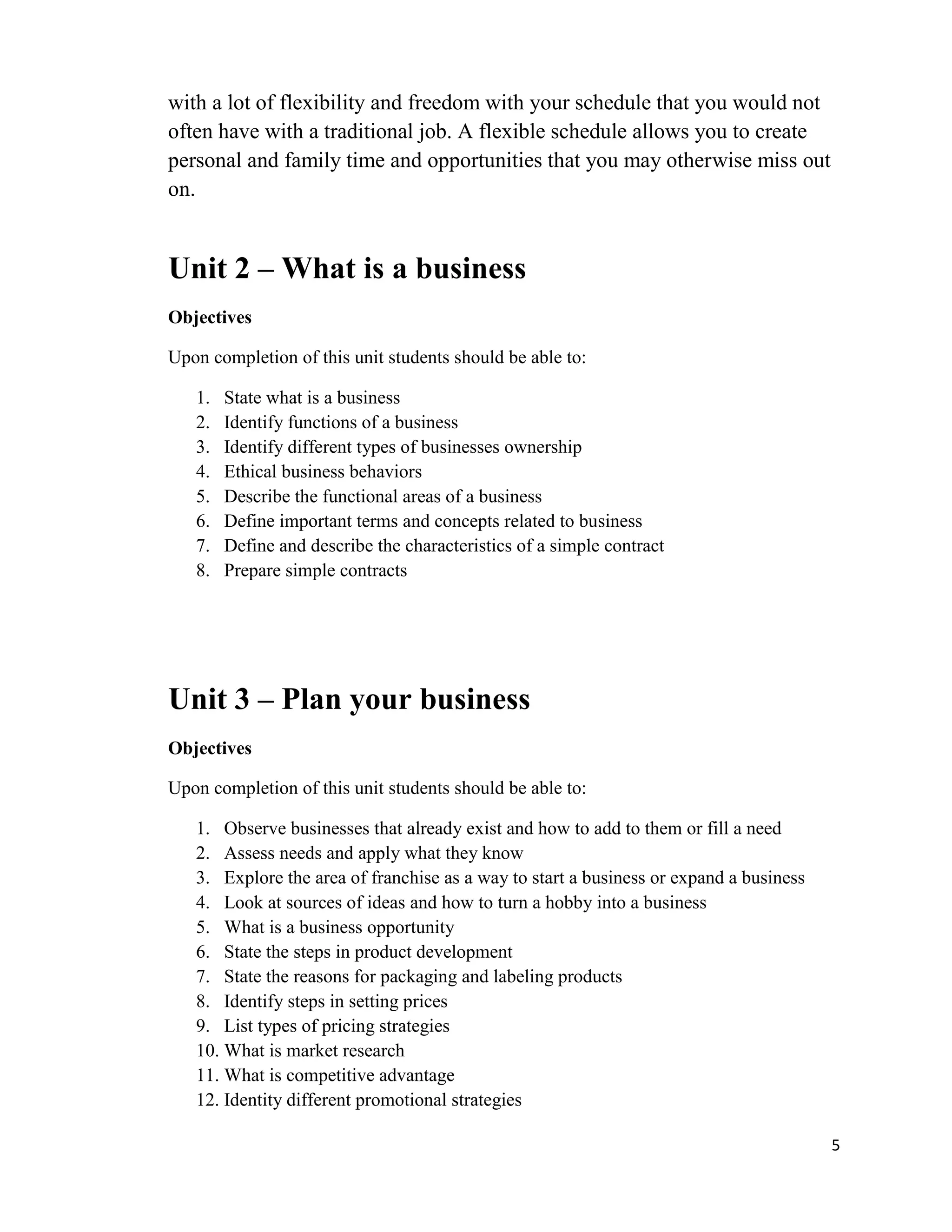
with a lot of flexibility and freedom with your schedule that you would not
often have with a traditional job. A flexible schedule allows you to create
personal and family time and opportunities that you may otherwise miss out
on.


Unit 2 – What is a business
Objectives

Upon completion of this unit students should be able to:

   1.   State what is a business
   2.   Identify functions of a business
   3.   Identify different types of businesses ownership
   4.   Ethical business behaviors
   5.   Describe the functional areas of a business
   6.   Define important terms and concepts related to business
   7.   Define and describe the characteristics of a simple contract
   8.   Prepare simple contracts


Unit 3 – Plan your business
Objectives

Upon completion of this unit students should be able to:

   1. Observe businesses that already exist and how to add to them or fill a need
   2. Assess needs and apply what they know
   3. Explore the area of franchise as a way to start a business or expand a business
   4. Look at sources of ideas and how to turn a hobby into a business
   5. What is a business opportunity
   6. State the steps in product development
   7. State the reasons for packaging and labeling products
   8. Identify steps in setting prices
   9. List types of pricing strategies
   10. What is market research
   11. What is competitive advantage
   12. Identity different promotional strategies

                                                                                        5
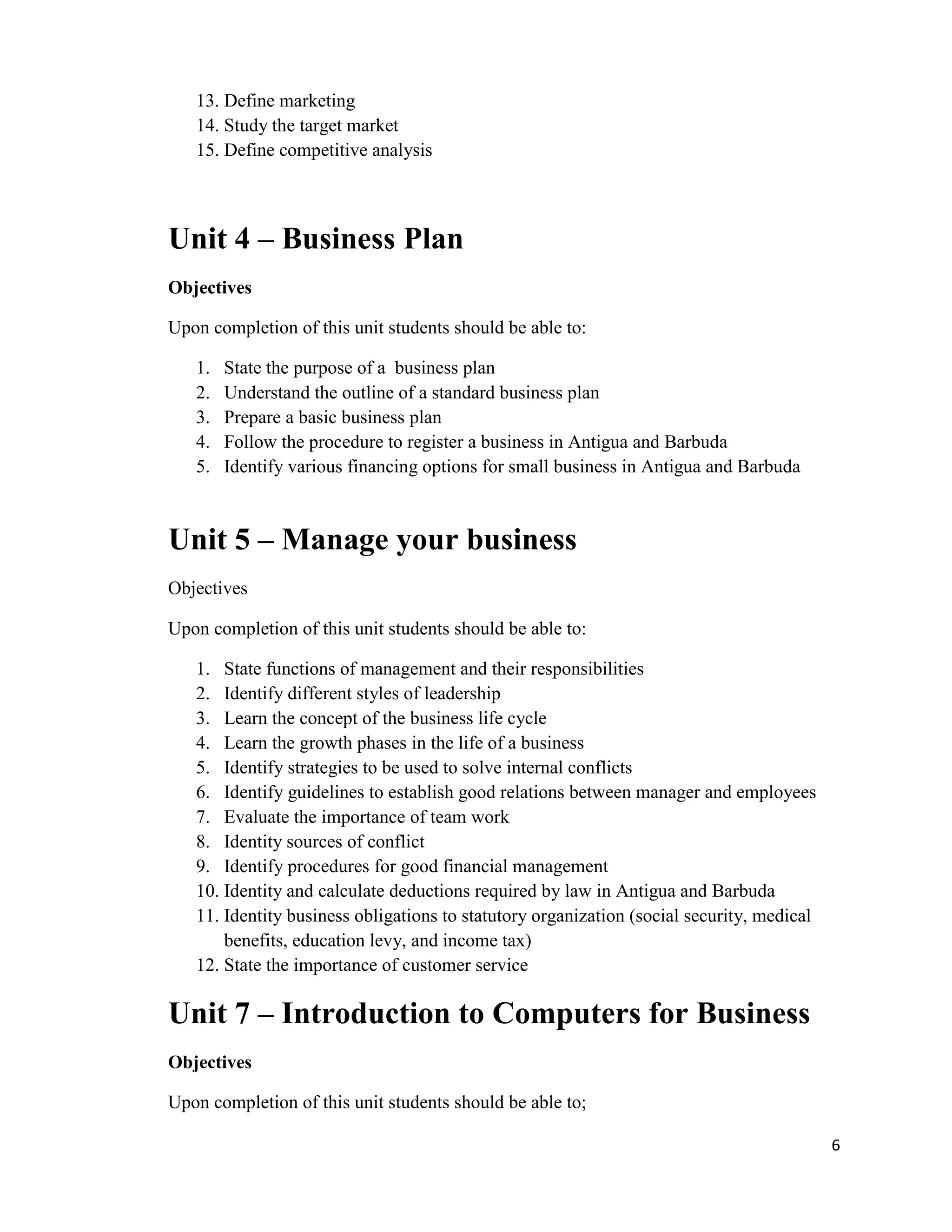
13. Define marketing
   14. Study the target market
   15. Define competitive analysis


Unit 4 – Business Plan
Objectives

Upon completion of this unit students should be able to:

   1.   State the purpose of a business plan
   2.   Understand the outline of a standard business plan
   3.   Prepare a basic business plan
   4.   Follow the procedure to register a business in Antigua and Barbuda
   5.   Identify various financing options for small business in Antigua and Barbuda


Unit 5 – Manage your business
Objectives

Upon completion of this unit students should be able to:

   1. State functions of management and their responsibilities
   2. Identify different styles of leadership
   3. Learn the concept of the business life cycle
   4. Learn the growth phases in the life of a business
   5. Identify strategies to be used to solve internal conflicts
   6. Identify guidelines to establish good relations between manager and employees
   7. Evaluate the importance of team work
   8. Identity sources of conflict
   9. Identify procedures for good financial management
   10. Identity and calculate deductions required by law in Antigua and Barbuda
   11. Identity business obligations to statutory organization (social security, medical
       benefits, education levy, and income tax)
   12. State the importance of customer service

Unit 7 – Introduction to Computers for Business
Objectives

Upon completion of this unit students should be able to;

                                                                                           6
1. Identify how the computer can assist in business operations
2. Identity different software packages that can enhance business operations
3. Use different software (Word, Excel, Power Point and Publishers) to enhance
   your business.


                                                                                 7

Entrepereneurship workbook

  • 1.
    Table of Contents Unit1 - What is an Entrepreneur .................................................................................................... 1 What is an entrepreneur.............................................................................................................. 2 Role of an entrepreneur .............................................................................................................. 2 How enployees and entrepreneurs differ........................................................................................ 3 Unit 1 - What is an Entrepreneur Objectives Upon completion of this unit students should be able to: 1. State who is an entrepreneur 2. Identify the role of an entrepreneur 3. Identify the characteristics of an entrepreneur 4. Understand the risk of becoming an entrepreneur 5. Recognize the benefits of being a successful business owner 6. Differentiate between an opportunity and an idea 7. Recognize investment capital is necessary for an idea to become an opportunity 8. Asses the reason why you are thinking about starting a business Before you begin what is your answer to these question Have you ever dream of starting your own business?  Yes  No If Yes, what kind of business? _____________________________________________________________ _____________________________________________________________ _____________________________________________________________ If No, why not _____________________________________________________________ 1
  • 2.
    _____________________________________________________________ _____________________________________________________________ What would bethe best or worst thing about owning your own business? _____________________________________________________________ _____________________________________________________________ _____________________________________________________________ What is an entrepreneur An entrepreneur (on-tra-prih-NER) is someone that creates a new business. This can carry a high risk because it requires money to set up a new business without knowing if it will give a return on investment. A good understanding of the market is needed and finding out what customers want and modify their products in line with market requirements. Every entrepreneurship business started with an idea of how to solve a particular problem or add value to a present product. This is the first phase of any business. This is where you test your idea for a business by doing research to find out if anyone else has had the same idea. The production and sale of new products and services are sparked by entrepreneurial energy, creativity and motivation. Role of an entrepreneur Entrepreneurs seek disequilibrium – a gap between the wants and needs of customers and the products and series that are currently available. The entrepreneur then brings together the factors of production necessary to produce, offer and sell desired products and services. They invest and risk their money – and other people’s money- to produce a product or service that can be sold at a profit. 2
  • 3.
    The role ofan entrepreneur includes the following Innovators who create new products or process They are risk takers They people who take an idea and make it a success Combines the other three factors of production (land, labour, capital) to produce a good or service Takes the risk of losing investment if business fails How employees and entrepreneurs differ Employees work for someone else and entrepreneurs work for themselves, entrepreneurs risk more than employees. Employees may risk losing a job if they do not perform their work well but they are paid for their work. Entrepreneurs risk not being able to pay their employees or themselves if business is “slow.” Class Discussion Do you know any entrepreneurs? What do entrepreneurs do and how do they differ from employees? The rewards employees and entrepreneurs get from their work can also be different. A reward can involve money, but it also might be personal satisfaction or independence. As business owners, entrepreneurs are in control of the money made by the business. They also have the final say in all business decisions. As a result, entrepreneurs are ultimately responsible for the success or failure of their businesses. (Mariotti 2010) 3
  • 4.
    Rewards of beingan entrepreneur Some of the rewards of being an entrepreneur: 1. Money When you are someone's employee, the amount of money you earn is limited by the labor market. You'll earn the going rate for your field and typically not much more. When you are self employed, your earning potential is only limited by your own brains and motivation to build a successful business. The more effort and smart planning you put into your business, the more you will directly benefit from your own work. 2. Opportunities Many entrepreneurs say they launched their business in order to create opportunities for themselves that they could not find in traditional jobs within their local labor market. A parent with a young family may want flexibility that is not available in traditional jobs, a new immigrant may want responsibility and opportunities for professional growth that they may not have found in their new country. When you build your own business, you can build opportunities and working conditions that are a good fit for your needs in ways that you may not find in traditional employment. 3. Accomplishment Building a successful business can provide you with a sense of pride that you have created something yourself based on something you value. You get to make the decisions; if you think a project is a great idea, you get to make it happen. You get to build something from the ground up that is your own and a reflection of your values, and any business success is always your success. 4. Time While you will invest a lot of time in building your business, depending upon the type of business you launch, being an entrepreneur can provide you 4
  • 5.
    with a lotof flexibility and freedom with your schedule that you would not often have with a traditional job. A flexible schedule allows you to create personal and family time and opportunities that you may otherwise miss out on. Unit 2 – What is a business Objectives Upon completion of this unit students should be able to: 1. State what is a business 2. Identify functions of a business 3. Identify different types of businesses ownership 4. Ethical business behaviors 5. Describe the functional areas of a business 6. Define important terms and concepts related to business 7. Define and describe the characteristics of a simple contract 8. Prepare simple contracts Unit 3 – Plan your business Objectives Upon completion of this unit students should be able to: 1. Observe businesses that already exist and how to add to them or fill a need 2. Assess needs and apply what they know 3. Explore the area of franchise as a way to start a business or expand a business 4. Look at sources of ideas and how to turn a hobby into a business 5. What is a business opportunity 6. State the steps in product development 7. State the reasons for packaging and labeling products 8. Identify steps in setting prices 9. List types of pricing strategies 10. What is market research 11. What is competitive advantage 12. Identity different promotional strategies 5
  • 6.
    13. Define marketing 14. Study the target market 15. Define competitive analysis Unit 4 – Business Plan Objectives Upon completion of this unit students should be able to: 1. State the purpose of a business plan 2. Understand the outline of a standard business plan 3. Prepare a basic business plan 4. Follow the procedure to register a business in Antigua and Barbuda 5. Identify various financing options for small business in Antigua and Barbuda Unit 5 – Manage your business Objectives Upon completion of this unit students should be able to: 1. State functions of management and their responsibilities 2. Identify different styles of leadership 3. Learn the concept of the business life cycle 4. Learn the growth phases in the life of a business 5. Identify strategies to be used to solve internal conflicts 6. Identify guidelines to establish good relations between manager and employees 7. Evaluate the importance of team work 8. Identity sources of conflict 9. Identify procedures for good financial management 10. Identity and calculate deductions required by law in Antigua and Barbuda 11. Identity business obligations to statutory organization (social security, medical benefits, education levy, and income tax) 12. State the importance of customer service Unit 7 – Introduction to Computers for Business Objectives Upon completion of this unit students should be able to; 6
  • 7.
    1. Identify howthe computer can assist in business operations 2. Identity different software packages that can enhance business operations 3. Use different software (Word, Excel, Power Point and Publishers) to enhance your business. 7