CHAPTER 2
ERP and
Implementation
6/29/2021 1
ERP SNEHAL KULKARNI
Contents…..
• ERP implementation and
strategy,
• Implementation Life cycle,
• Pre-implementation task,
• implementation methodology.
6/29/2021 2
ERP SNEHAL KULKARNI
ERP implementation and strategy
financial
H.R
logistic
Maintenan
ce mgmt
sales &
marketing
QM
Material
mgmt
Strategic &
operational
ERP
6/29/2021 3
ERP SNEHAL KULKARNI
6/29/2021 4
ERP SNEHAL KULKARNI
What is Strategy
It’s not just COPY and PASTE
6/29/2021 5
ERP SNEHAL KULKARNI
6/29/2021 6
ERP SNEHAL KULKARNI
Why ERP
• Simplification of business processes
• Enhance productivity , flexibility and Efficiency
• Enhance new business and growth strategy
• Reduces cost
• Continuous improvement
• Extend your business using internet
6/29/2021 7
ERP SNEHAL KULKARNI
ERP implementation Challenges
6/29/2021 8
ERP SNEHAL KULKARNI
•Hershey’s Implementation
Failure :
–Testing and Scheduling
6/29/2021 9
ERP SNEHAL KULKARNI
ERP implementation Challenges…..
• Inadequate definition of requirements
• Resistance to change
• Inadequate recourses
• Inadequate training and education
• Lack of top management support
• Unrealistic expectations of benefits and ROI
• Poor communications
• Poor projects design and management
6/29/2021 10
ERP SNEHAL KULKARNI
ERP implementation Challenges…..
• Inadequate definition of requirements 46.5 %
• Resistance to change 43.9%
• Inadequate recourses 43.1%
• Inadequate training and education 36.2%
• Lack of top management support 32.4%
• Unrealistic expectations of benefits and ROI 30%
• Poor communications 27.4%
• Poor projects design and management 16.8%
6/29/2021 11
ERP SNEHAL KULKARNI
ERP implementation and strategy,
• Implementing an ERP system is
among the most expensive,
time-consuming and complicated
tasks an IT department can take
on.
6/29/2021 12
ERP SNEHAL KULKARNI
ERP Implementation Mistake
•Poor planning:-For this internal audit should be
done
•Not properly vetting ERP vendors : check
background of vendor
•Underestimating the time and resources required.
•Not having the right people on the team from the
start
•Not investing in training and change
management.
•Taking the kitchen sink approach
•Not having an active load testing environment
• Ignoring third-party support alternatives
•Not having a maintenance strategy.
6/29/2021 13
ERP SNEHAL KULKARNI
kitchen sink approach
• Most common mistakes made during ERP
implementations is to assume that ERP can be
used to run a business end to end.
• To avoid this costly mistake, companies should
focus on implementing ERP to optimize value
chain and to trace costs. Everything else
should be a secondary goal.
6/29/2021 15
ERP SNEHAL KULKARNI
ERP implementation
• ERP implementation – installation of a software
package that integrates all data and processes
into a centralized, unified database.
• Cross functional and company wide
• Organizations rely on software for cohesiveness
• Can lead to cost savings, more efficient
processes
6/29/2021 16
ERP SNEHAL KULKARNI
ERP implementation
• Depends on several factors
– Size, industry, sales volume
• Common basic factors
– Physical Scope, Resource Allocation
6/29/2021 17
ERP SNEHAL KULKARNI
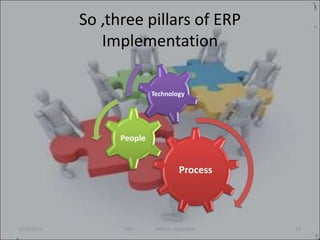
So ,three pillars of ERP
Implementation
Process
People
Technology
6/29/2021 18
ERP SNEHAL KULKARNI
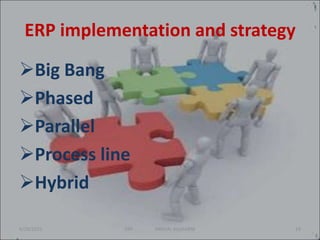
ERP implementation and strategy
Big Bang
Phased
Parallel
Process line
Hybrid
6/29/2021 19
ERP SNEHAL KULKARNI
Big Bang
•What is the “Big Bang” approach?
•“A straightforward ERP Implementation
approach. It means all ERP modules, such as
financials, manufacturing, and human
resources, etc, are implemented in all business
units at all geographic locations at the same
time.”
•It will push the entire organization to use the
new system at the same time.
•The old system will be entirely shut down.
6/29/2021 20
ERP SNEHAL KULKARNI
The Big Bang Advantages
 The entire organization reaps the benefits of the deployed
system as this enforces process change.
 Installing the ERP by Big bang approach may help the
company to get quicker return on the investment.
 Easier integration and reporting.
 No temporary interfaces required.
 Lower cost of running the systems as legacy systems are
retired simultaneously.
 Faster implementation timeline.
6/29/2021 21
ERP SNEHAL KULKARNI
Disadvantages
High capital and human resource investment.
 Any technical performance issue affects the
entire user population.
Requires training of the entire user population.
Complex deployment and testing.
there can be lot of pressure because the
deadline must be met.
6/29/2021 22
ERP SNEHAL KULKARNI
Implementation Processes
--- Converting the system.
Planning, convert data from old system, load data in new system, test
data in new system, execute off-line trials, and check to verify validity.
--- Releasing parts of the system.
Release converted database, release produced application, release
infrastructure.
--- Training the future users.
Create main buffer of experienced staff, training all users.
--- Releasing the whole system.
Turn down the old system and load the new system.
6/29/2021 23
ERP SNEHAL KULKARNI
Who should choose the “Big bang”?
The Big bang is difficult to manage for very
large organizations.
It is easier in organizations that are
centralized.
It is less risky with simple processes.
It is easier for small, simple organizations.
It can be used in the situation where an
immediate erp solution is needed
6/29/2021 25
ERP SNEHAL KULKARNI
Finance
Manufacturing
HR
Material Management
Quality Mgmt
Marketing ,Sales
Finance
Manufacturing
HR
Material Management
Quality Mgmt
Marketing ,Sales
Legacy System New ERP System
Go Live
Big Bang Transition
6/29/2021 26
ERP SNEHAL KULKARNI
Big Bang Variants
•Mini Big bang : It takes a single big bang approach and break it
into two or more sections
•Mega Big Bang :It refers to the large companies ,with multiple
sites , all going live at the same time using a big bang strategy
•Multi Big Bang : This uses multiple big bang sequenced in order
for different geographical facilities . This approach can be used
for large corporations that have multiple divisions served by
centralized IT group
6/29/2021 27
ERP SNEHAL KULKARNI
Phased Approach
•The alternative approach to Big Bang is to
adopt some level of phasing – whether by
region, country, site, line of business, functional
area or by business priority.
•For most small organizations a big bang
approach is feasible, while for larger and more
complex organizations some degree of phasing
is inevitable -
6/29/2021 28
ERP SNEHAL KULKARNI
6/29/2021 29
ERP SNEHAL KULKARNI
Phased Approach
• Changeover occurs in phases over an extended
period of time. Users move onto new system in a
series of steps.
• The phase approach is also goes by the name of the
modular , functional and sequential.
• The method of implementation goes after one ERP
module at a time.
• This approach suits to the company where they do
not share many common processes across
departments or business units.
• Implementation is done first and then the integration
is done
6/29/2021 30
ERP SNEHAL KULKARNI
Advantages & disadvantage of Phase
approach
• It allows the company to implement one
functional module at a time.
• Many companies prefer to take this stepping
stone approach.
• Recourses needed will be less.
• The overall cost and time needed for this
approach is more
6/29/2021 31
ERP SNEHAL KULKARNI
ERP Implementation at Nestle
•The business case for implementing an ERP system can be seen by examining any
one of three Nestle stories. Nestle SA is the parent company of the candy-making
giant and is headquartered in Switzerland (Konicki, pg 185). In 2000 Nestle SA decided
that it wanted to leverage its size and begin acting like the giant it is. To do so, it
signed a $200 million contract with SAP to roll out an ERP system to its 230,000
employees in 80 countries around the world (Olson, pg. 53). In addition to this sum,
Nestle SA also committed to an additional $80 million to be spent on consulting,
maintenance, and upgrades (Konicki, pg. 185). Executives at Nestle SA realized that
the company needed to standardize its business processes if it wanted to be
competitive. The rollout was scheduled to take three years for Nestle SA’s largest
sites with the others to follow. Included in the implementation were the mySAP.com
financials, accounts payable, accounts receivable, planning, production management,
procurement, direct procurement, supply-chain, demand planning, fulfillment, and
business-intelligence modules (Konicki, pg. 185).
6/29/2021 32
ERP SNEHAL KULKARNI
Parallel Approach
• This approach keeps both legacy system and
the new ERP system active simultaneously for
a length of a time.
• The advantage of this approach is that it has a
good recovery options in case something goes
wrong.
• This approach consumes more recourses than
other techniques in transition
6/29/2021 33
ERP SNEHAL KULKARNI
• in this method, the old system and new
system run at the same time, users learn
the new system while still working on the old
and when requirements for the new system is
met, the switch is made.
Parallel Approach
6/29/2021 34
ERP SNEHAL KULKARNI
• Pro:
• Least risky
• Users learn the new system while working on the
old
• Slower pace than the big bang but faster than a
phased roll-out
• Con:
• Most expensive
• Employees have to enter data in both systems- this
can be inefficient and breed data-entry problems
Parallel Approach
6/29/2021 35
ERP SNEHAL KULKARNI
Process line
• This approach is commonly used on product lines or
process flows and related assets.
• The first product line is first transitioned from the
legacy to the new ERP system and its success
monitored.
• Upon a successful implementation, the second product
line is similarly moved to the new system and its
success measured.
• This approach is useful when you need to build
industrial faith on a new system with the goal of
increasing its overall success prospects.
• Usually, the more complicated and challenging process
lines are transitioned last after successes with the
other lines.
6/29/2021 36
ERP SNEHAL KULKARNI
Hybrid
• This is a combination of the above-mentioned
implementation strategies.
• The decision on what method to use tends to be based on
the study of the ERP team members and other necessary
information.
• The size and type of business or corporation also
contributes to the simplicity or complexity of a hybrid
strategy.
• Large conglomerates will no doubt have complex hybrid
systems compared to small single-site businesses.
• Hybrids are most preferred where flexibility in adapting to
specific needs is needed. They also allow for exclusive
adjustments based on industry needs.
6/29/2021 37
ERP SNEHAL KULKARNI
So what now? How do you
choose?
•Many companies don’t choose, they use a combination
of the above ERP implementation strategies; this is
another viable method. It is important to choose the
strategy that will provide a low cost, low risk situation,
but is different for each company. Conditions such as
number of plants/offices, number of support employees,
number of divisions, if you are international, complexity
of your requirements, etc. all play a role in which
strategy will be best for you.
6/29/2021 38
ERP SNEHAL KULKARNI
Survey Results – Updated April 1st
• Author[1] recently hosted a survey to find out which
ERP implementation strategies are the most popular
and most successful. With the help of Twitter and our
favorite industry bloggers, he received 85 responses
from organizations that have been involved in an
implementation. His survey was brief and informal with
just four simple questions:
– Which implementation strategy did your organization
choose? Big bang, phased rollout, parallel adoption,
combo of big bang and phased rollout, or other.
– If you selected other, please describe the strategy you
chose.
– Was the implementation a success?
– If you selected no, please explain why.
6/29/2021 39
ERP SNEHAL KULKARNI
which ERP implementation strategies are used ??
6/29/2021 40
ERP SNEHAL KULKARNI
6/29/2021 41
ERP SNEHAL KULKARNI
6/29/2021 42
ERP SNEHAL KULKARNI
Implementation Life cycle
6/29/2021 43
ERP SNEHAL KULKARNI
• ERP implementation lifecycle focus on the ERP
project which is carried out to make ERP up
and running.
• ERP project is likely to go through different
phases like any other project.
• Most often these phases do not necessarily
depend on one another in a sequence, i.e. one
phase might start before previous phase has
finished.
ERP Implementation Life Cycle
6/29/2021 44
ERP SNEHAL KULKARNI
ERP Implementation……..
• Also all phases that will be discussed may not
be applicable in all cases.
• The different phases of ERP implementation
are:-
6/29/2021 45
ERP SNEHAL KULKARNI
Pre-
evaluation
Screening
Package
Evaluation
Project
Planning
Phase
Gap-
Analysis
Reenginee
ring Configurat
ion
Implementat
ion Team
Training
Testing
Going Live
End-user
training
Post –
implement
ation
6/29/2021 46
ERP SNEHAL KULKARNI
Pre-evaluation Screening
 When the company has agree to
implement ERP, they have to search for
the convenient & appropriate ERP
package.
6/29/2021 47
ERP SNEHAL KULKARNI
Package Evaluation
•The objective of this phase is to find the package
that is flexible enough to meet the company’s need
or in other words, a software that could be
customised to obtain a ‘good fit’.
•Once the packages to be evaluated are identified,
the company needs to develop a selection criteria
that will permit the evaluation of all the available
packages on the same scale
6/29/2021 48
ERP SNEHAL KULKARNI
Package Evaluation
• To choose the best system, the identification
of the system that meets the business needs,
and that matches the business profile.
• Some important points to be kept in mind
while evaluating ERP software include:
– Degree of integration between the various
components of the ERP system.
6/29/2021 49
ERP SNEHAL KULKARNI
Package Evaluation
– Flexibility and scalability
– Complexity
– User friendliness
• It is better to have a selection committee that
will do the evaluation process.
6/29/2021 50
ERP SNEHAL KULKARNI
Project Planning Phase
•This is the phase that designs the implementation process. Time
schedules, deadlines, etc. for the project are arrived at.
•The project plan is developed in this phase.
•In this phase the details of how to go about the implementation
are decided. The project plan is developed, roles are identified
and responsibilities are assigned.
6/29/2021 51
ERP SNEHAL KULKARNI
Project Planning Phase
• The organizational resources that will be used
for the implementation are decided and the
people who are supposed to head the
implementation are identified.
• The implementation team members are
selected and task allocation is done.
• The phase will decide when to begin the
project, how to do it and when the project is
supposed to be completed.
6/29/2021 52
ERP SNEHAL KULKARNI
Project Planning Phase
• The phase will also plan the ‘What to do’ in
case of contingencies; how to monitor the
progress of the implementation;
• The phase will plan what control measures
should be installed and what corrective
actions should be taken when things get out
of control.
• The project planning is usually done by a
committee constituted by the team leaders of
each implementation group headed by CIO.
6/29/2021 53
ERP SNEHAL KULKARNI
Gap Analysis
• This is the most crucial phase for the success
of the ERP implementation.
• Simply it is the process through which
companies create a complete model of where
they are now, and in which direction they
want to head in the future.
• The trick is to design a model which both
anticipates and covers any functional gaps.
6/29/2021 54
ERP SNEHAL KULKARNI
Gap Analysis……….
• Analyze the gaps in existing outcome and
desired outcome.
– Identify the existing process and the outcome(part
of req. analysis in proj planning)
– Identify the desired process and desired outcome
– Document the gap
– Develop the means to fill the gap
• Gap analysis can be done by
– prototype , questionnaire
6/29/2021 55
ERP SNEHAL KULKARNI
Reengineering
• This phase involves human factors.
• In ERP implementation settings, reengineering
has two connotations. The first connotation is
the controversial one, involving the use of ERP
to aid in downsizing efforts.
• In this case ERP is purchased with aim of
reducing the number of employees.
6/29/2021 56
ERP SNEHAL KULKARNI
Reengineering
• Every implementation will involve some
change in job responsibilities as processes
become more automated and efficient.
• However it is best to regard ERP as investment
and cost-cutting measure rather than a
downsizing tool.
• ERP should endanger business change but not
endanger the jobs of thousands of employee.
6/29/2021 57
ERP SNEHAL KULKARNI
“As-is to to be” process reengineering
Gap
document
Requirement
analysis
To be
process
Modify
process
Introduce
ERP
6/29/2021 58
ERP SNEHAL KULKARNI
Configuration
• In this case business process have to be
understood and mapped in such a way that
the incoming ERP solutions match up with the
overall goals of the company.
• It is not required to shut down company
operations while you do a mapping process.
6/29/2021 59
ERP SNEHAL KULKARNI
Configuration
• This is the main functional area of ERP
implementation.
• The Holy Grail (unwritten rule) of ERP
implementation is, synchronizing existing
company practices with the ERP package
rather than changing the source code and
customizing it to suit the company.
6/29/2021 60
ERP SNEHAL KULKARNI
Implementation Team Training
 This is the segment where the
company trains its employees to
implement and later run the system.
 For the company to be self-
sufficient in running the ERP
system, it should have a good in-
house team that can handle the
various solutions.
 Thus the company must realise the
importance of this phase and
selects right employees with good
attitude.
6/29/2021 61
ERP SNEHAL KULKARNI
Testing
 Testing segment is the the point where you are
testing a real case scenarios. This phase must be
designed to specifically to find the weak links in the
system and these bugs should be fixed before going
live.
6/29/2021 62
ERP SNEHAL KULKARNI
Going Live
• This is the phase where all technicalities are
over, and the system is officially declared
operational.
• In this phase all data conversion must have
been done, and databases are up and running;
and the prototype is fully configured and
tested.
6/29/2021 63
ERP SNEHAL KULKARNI
Going Live
• The implementation team must have tested
and run the system successfully for some
time.
• Once the system is ‘live’ the old system is
removed and the new system is used for doing
business.
6/29/2021 64
ERP SNEHAL KULKARNI
End-User Training
• This is the phase where the actual users of the system will be
trained on how to use the system.
• The employees who are going to use the new system are identified
and their skills are noted.
• Based on their skill levels are divided into groups.
• It starts before the system goes live
• Training is must as resistance to change to the new system from old
fro employees.
6/29/2021 65
ERP SNEHAL KULKARNI
End-User Training
• Then each group is given training on the new
system.
• This training is very useful as the success of
the ERP system is in the hands of end-users.
• The end-user training is much more important
and much more difficult than implementation
team training since people are always
reluctant to change.
6/29/2021 66
ERP SNEHAL KULKARNI
End-User Training
• “You can have the best technology in the
world, but if you don’t have a community who
wants to use it and who are excited about it,
then it has no purpose.” Chris Hughes Co-
Founder of FaceBook.
6/29/2021 67
ERP SNEHAL KULKARNI
Post – Implementation (Maintenance
Mode)
• This is the very critical phase when the
implementation phase is over.
• There must be enough employees who are
trained to handle the problem that might
occurred when the system is running.
• There must be technical people in the
company who have the ability to enhance the
system when required.
6/29/2021 68
ERP SNEHAL KULKARNI
Post – Implementation (Maintenance
Mode)
• Living with ERP systems will be different from
installing them.
• Projects for implementing the ERP systems get
a lot of resources and attention.
• However an organization can only get the
maximum value of these inputs if it
successfully adopts and effectively uses the
system.
6/29/2021 69
ERP SNEHAL KULKARNI
6/29/2021 70
ERP SNEHAL KULKARNI
6/29/2021 71
ERP SNEHAL KULKARNI
Higher Education ERP system
• Human Resources/Payroll Module
• Financial System/Accounts Payable Module
• Financial System/Accounts Receivable
Module
• Customer Relationship Management Module
General/Overall Module
6/29/2021 72
ERP SNEHAL KULKARNI
Higher Education ERP system
1. Recruitment Module
2. Admissions Module
3. Student Maintenance Module
4. Student Registration Module
5. Student Curriculum Planning Module
6. Student Financial Aid Module
7. Student Accounts Receivable Module
8. Student Graduation Module
9. Alumni Module
10. University Administration Module
11. University Grants Module
12. University Faculty Module
??
6/29/2021 73
ERP SNEHAL KULKARNI
6/29/2021 74
ERP SNEHAL KULKARNI
Pre-implementation task
• How do u want to run your business?
• What problems need to be resolved?
• Do we know and understand our priorities?
• Do we fully understand our “as-is” condition
versus our “could be" process??
• What task will be accomplished and by what
date?
• Who will implement ERP and make it work.
6/29/2021 75
ERP SNEHAL KULKARNI
• So, ”Do it right at first time”
•As it requires a vast amount of recourses
like,money,personal,hardware,software,communica
tion network etc…and can result in huge loss if not
done properly.
•Planning process is important in pre
implementation task.
6/29/2021 76
ERP SNEHAL KULKARNI
Tasks in Project planning
Assembling
stakeholders
Feasibility study
Project vision , mission
statement
Determination of org.
structure
Determination of
modules to be
implemented
Creating the core team
Training
Establishing the data
migration strategy
Established interface
Time and cost
estimation
Identify Constraints
Establishing policies &
guidelines
6/29/2021 77
ERP SNEHAL KULKARNI
Business Processes
6/29/2021 78
ERP SNEHAL KULKARNI
What is Business Process ?
• A business process is collection of activities that
takes one or more kinds of inputs and creates an
output that is of value to the customer.
• A business process is a collection of linked tasks
which find their end in the delivery of a service or
product to a client. A business process has also
been defined as a set of activities and tasks that,
once completed, will accomplish an
organizational goal.
6/29/2021 79
ERP SNEHAL KULKARNI
6/29/2021 80
ERP SNEHAL KULKARNI
6/29/2021 81
ERP SNEHAL KULKARNI
Business processes are cross functional in nature
• For ex. Sales & warehouse , sales and accounts etc…
6/29/2021 82
ERP SNEHAL KULKARNI
Types of processes
• Procurement or purchasing process (buy)
• Production or Manufacturing process (make)
• Fulfillment process (sell)
• Financial management process
6/29/2021 84
ERP SNEHAL KULKARNI
Specific terms for this processes
• Product data management process(design): support the
design and development of the products for the initial product
idea stage through the discontinuation of the product.
• Product planning stage(plan) : it uses historical data and sales
forecasts to plan which material will be produced and in what
quantity and when.
• Inventory management process (store) : It is used both to
store and track both the raw materials and finished goods
• Customer service process : It is used to deliver after sales
customer service.
6/29/2021 85
ERP SNEHAL KULKARNI
Procurement
Send Payment to Supplier
Receive and Verify Invoice from Supplier
Update Inventory Database
Receive and Inspect Material form Supplier
Send PO to Supplier
Create Purchase order (PO)
Create Purchase requisition for Material not in Stock
Check Material Availability with respect to Bill Of Material
Create Bill Of Material
Create master production Schedule
Warehouse
6/29/2021 87
ERP SNEHAL KULKARNI
6/29/2021 88
ERP SNEHAL KULKARNI
Production Planning
• Input by the marketing department in the form of market
trends and sales forecasts.
• Quantity of different products sold in the previous years
• Orders in hand
• Stock in hand and recorder levels
• Production and inventory costs
• Time require for production and for purchase the material.
• Production capacity
6/29/2021 89
ERP SNEHAL KULKARNI
Production Planning
Create Bill Of Material
Create Master production Schedule(MPS)
Determine quantity of Products to be Produce
Analyze Sales forecast and market trends
Receive Bill Of Material Receive MPS
Production
6/29/2021 91
ERP SNEHAL KULKARNI
Production Process
Create master production schedule and Bill of Material
Receive Bill Of Material
Send Raw material and components as per BOM to Production
Receive MPS & BOM
Set up the layout & Make the preparation for production
Receive material from warehouse , verify with BOM and start production as per
MPS
Receive and Inspect and Store finished goods and Update Inventory
6/29/2021 93
ERP SNEHAL KULKARNI
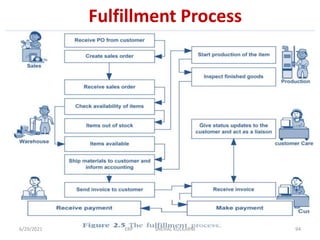
Fulfillment Process
6/29/2021 94
ERP SNEHAL KULKARNI
Inventory management process
6/29/2021 95
ERP SNEHAL KULKARNI
6/29/2021 96
ERP SNEHAL KULKARNI
Implementation Methodology
98
ERP SNEHAL
KULKARNI
Most critical phases of ERP life cycle
Adoption Decision
Acquisition
Implementation
Use and maintenance
Evolution
Retirement
99
ERP SNEHAL
KULKARNI
Adaption Decision
 Here managers must question the need of new ERP
system.
 Profile of the ERP vendors.
 It includes the definition of system requirement , its goal
and benefits and an analysis of the impact of adoption at
business and organization levels
100
ERP SNEHAL
KULKARNI
Critical phases of ERP lifecycle
 Acquisition: This phase involves, selecting the product that best fits to
the requirement of the organization to minimize the need of
customization.
 Implementation : This phase deals with the customization and
parameterization of adaption of ERP packages acquired to meet the
needs of organization
 Use and maintenance : This phase consist of use of the product in a
way that returns excepted benefits and minimize disruption .
 Evolution : in this additional capabilities are integrated into system to
obtain additional benefits
 Retirement : When the new technology appear to the ERP system or
becomes inadequate to the need of the business, managers decide if
substitute another information system approach that is more adequate
to the organizational need of the moment
101
ERP SNEHAL
KULKARNI
ERP Implementation
 The nature of ERP implementation is such that it is best handled
within project management context.
 The organization of project team that is best for managing the
implementation takes the following format :
The CEO leads the steering committee and sponsors the
project
The person who manages the implementation is the project
manager
He reports the steering committee, who reviews progress and
resolves any territorial ,resource policy disputes.
The PM has the implementation team reporting to him
102
ERP SNEHAL
KULKARNI
Implementation strategy should be
decided based on the following
Speed of implementation
Availability of people for carrying out the
implementation task
Availability of time for training all users
Cost
Confidence in the new system
Disruption to operations
Total timescale
103
ERP SNEHAL
KULKARNI
Implementation Plan
 Before implementation an ERP system in an organization or
project, it is very crucial that the implementation process be
planned.
 The implementation plan documents the
who,what,why,where,when and how of the project. It is the
outcome of discussion with affected people and involves
negotiations over resources, timescales and cost and their
agreement.
 The most basic plan will be identify all the activities, those doing
them and the time frame
 A project plan will enumerate the major task, the estimated
duration .Resources required and people who will doing the task.
 There are two types of plans,
 High level plan will give an overview of the project
 The project manager will develop a detailed project plan , where
the high level plan is broken down into lot more detail with the time
window being weeks or days rather than months
104
ERP SNEHAL
KULKARNI
Risk , Budget and Cost
Risk analysis is a must phase for the project as project plans can
go astray for events that could have been anticipated and
prevented
The aim of risk analysis is to anticipate possible problems ,
access their likelihood of appearance and their intensity of impact
and finally to established how they can be prevented.
Risk assessment should be carried out at the outset of the
project and should be regularly reviewed, revise and updated.
105
ERP SNEHAL
KULKARNI
Performance Measurement
It is carried our to measure the success of ERP
implementation and effectiveness of its operation.
The performance related measures are cost, time and
benefits
The project plan has detailed information of task , people
responsible for the task and time frame for the task. So the
project plan can be used to track the ERP implementation.
At every step, measure the deliverables which will give the
picture of ongoing process.
It is important to remember that the measurable provide a
means to access progress and attainment, they in themselves
do not determine success.
Performance measurements only provide reference for
further actions
106
ERP SNEHAL
KULKARNI
Problems and system issues
 It is desirables that there should be agreed procedure for
recording issues and their resolutions.
 The technical issues include installation and commissioning
of both hardware and software.
 Some of the technical issues are..
How does the system performance under heavy load?
How quickly the storage space will get consumed when the
system is live?
What is backup procedure ?
How the password managed?
What user menus need to be generated and how will be this
handled?
Whats is the disaster recovery procedure?
 The technical issues should be resolved as smallest issue
can be hurdle in the smooth working of system
107
ERP SNEHAL
KULKARNI
ERP implementation methodology by
vendors and consultants
A methodology is a roadmap to the implementation. The
purpose of this is deliver an implementation on time, according
to specification and in given budget.
Most vendors have their own methodology.
Some methodologies of ERP implementation are……
Accelerated SAP
The total solution by Ernst & Young LLP
Fast track work plan by Deloitte & touché
At last the experienced project ,manager should manage the
project so that the ERP system methodology will be best suited
for his organization.
108
ERP SNEHAL
KULKARNI
ERP implementation hidden cost
Some cost are more commonly overlooked or
underestimated than others
The hidden cost of ERP system are…..
Training
Customization
Integration and testing
Data conversion
Data analysis
Consultants
maintenance
109
ERP SNEHAL
KULKARNI

Chapter 2 erp implementation

  • 1.
  • 2.
    Contents….. • ERP implementationand strategy, • Implementation Life cycle, • Pre-implementation task, • implementation methodology. 6/29/2021 2 ERP SNEHAL KULKARNI
  • 3.
    ERP implementation andstrategy financial H.R logistic Maintenan ce mgmt sales & marketing QM Material mgmt Strategic & operational ERP 6/29/2021 3 ERP SNEHAL KULKARNI
  • 4.
  • 5.
    What is Strategy It’snot just COPY and PASTE 6/29/2021 5 ERP SNEHAL KULKARNI
  • 6.
  • 7.
    Why ERP • Simplificationof business processes • Enhance productivity , flexibility and Efficiency • Enhance new business and growth strategy • Reduces cost • Continuous improvement • Extend your business using internet 6/29/2021 7 ERP SNEHAL KULKARNI
  • 8.
  • 9.
    •Hershey’s Implementation Failure : –Testingand Scheduling 6/29/2021 9 ERP SNEHAL KULKARNI
  • 10.
    ERP implementation Challenges….. •Inadequate definition of requirements • Resistance to change • Inadequate recourses • Inadequate training and education • Lack of top management support • Unrealistic expectations of benefits and ROI • Poor communications • Poor projects design and management 6/29/2021 10 ERP SNEHAL KULKARNI
  • 11.
    ERP implementation Challenges….. •Inadequate definition of requirements 46.5 % • Resistance to change 43.9% • Inadequate recourses 43.1% • Inadequate training and education 36.2% • Lack of top management support 32.4% • Unrealistic expectations of benefits and ROI 30% • Poor communications 27.4% • Poor projects design and management 16.8% 6/29/2021 11 ERP SNEHAL KULKARNI
  • 12.
    ERP implementation andstrategy, • Implementing an ERP system is among the most expensive, time-consuming and complicated tasks an IT department can take on. 6/29/2021 12 ERP SNEHAL KULKARNI
  • 13.
    ERP Implementation Mistake •Poorplanning:-For this internal audit should be done •Not properly vetting ERP vendors : check background of vendor •Underestimating the time and resources required. •Not having the right people on the team from the start •Not investing in training and change management. •Taking the kitchen sink approach •Not having an active load testing environment • Ignoring third-party support alternatives •Not having a maintenance strategy. 6/29/2021 13 ERP SNEHAL KULKARNI
  • 14.
    kitchen sink approach •Most common mistakes made during ERP implementations is to assume that ERP can be used to run a business end to end. • To avoid this costly mistake, companies should focus on implementing ERP to optimize value chain and to trace costs. Everything else should be a secondary goal. 6/29/2021 15 ERP SNEHAL KULKARNI
  • 15.
    ERP implementation • ERPimplementation – installation of a software package that integrates all data and processes into a centralized, unified database. • Cross functional and company wide • Organizations rely on software for cohesiveness • Can lead to cost savings, more efficient processes 6/29/2021 16 ERP SNEHAL KULKARNI
  • 16.
    ERP implementation • Dependson several factors – Size, industry, sales volume • Common basic factors – Physical Scope, Resource Allocation 6/29/2021 17 ERP SNEHAL KULKARNI
  • 17.
    So ,three pillarsof ERP Implementation Process People Technology 6/29/2021 18 ERP SNEHAL KULKARNI
  • 18.
    ERP implementation andstrategy Big Bang Phased Parallel Process line Hybrid 6/29/2021 19 ERP SNEHAL KULKARNI
  • 19.
    Big Bang •What isthe “Big Bang” approach? •“A straightforward ERP Implementation approach. It means all ERP modules, such as financials, manufacturing, and human resources, etc, are implemented in all business units at all geographic locations at the same time.” •It will push the entire organization to use the new system at the same time. •The old system will be entirely shut down. 6/29/2021 20 ERP SNEHAL KULKARNI
  • 20.
    The Big BangAdvantages  The entire organization reaps the benefits of the deployed system as this enforces process change.  Installing the ERP by Big bang approach may help the company to get quicker return on the investment.  Easier integration and reporting.  No temporary interfaces required.  Lower cost of running the systems as legacy systems are retired simultaneously.  Faster implementation timeline. 6/29/2021 21 ERP SNEHAL KULKARNI
  • 21.
    Disadvantages High capital andhuman resource investment.  Any technical performance issue affects the entire user population. Requires training of the entire user population. Complex deployment and testing. there can be lot of pressure because the deadline must be met. 6/29/2021 22 ERP SNEHAL KULKARNI
  • 22.
    Implementation Processes --- Convertingthe system. Planning, convert data from old system, load data in new system, test data in new system, execute off-line trials, and check to verify validity. --- Releasing parts of the system. Release converted database, release produced application, release infrastructure. --- Training the future users. Create main buffer of experienced staff, training all users. --- Releasing the whole system. Turn down the old system and load the new system. 6/29/2021 23 ERP SNEHAL KULKARNI
  • 23.
    Who should choosethe “Big bang”? The Big bang is difficult to manage for very large organizations. It is easier in organizations that are centralized. It is less risky with simple processes. It is easier for small, simple organizations. It can be used in the situation where an immediate erp solution is needed 6/29/2021 25 ERP SNEHAL KULKARNI
  • 24.
    Finance Manufacturing HR Material Management Quality Mgmt Marketing,Sales Finance Manufacturing HR Material Management Quality Mgmt Marketing ,Sales Legacy System New ERP System Go Live Big Bang Transition 6/29/2021 26 ERP SNEHAL KULKARNI
  • 25.
    Big Bang Variants •MiniBig bang : It takes a single big bang approach and break it into two or more sections •Mega Big Bang :It refers to the large companies ,with multiple sites , all going live at the same time using a big bang strategy •Multi Big Bang : This uses multiple big bang sequenced in order for different geographical facilities . This approach can be used for large corporations that have multiple divisions served by centralized IT group 6/29/2021 27 ERP SNEHAL KULKARNI
  • 26.
    Phased Approach •The alternativeapproach to Big Bang is to adopt some level of phasing – whether by region, country, site, line of business, functional area or by business priority. •For most small organizations a big bang approach is feasible, while for larger and more complex organizations some degree of phasing is inevitable - 6/29/2021 28 ERP SNEHAL KULKARNI
  • 27.
  • 28.
    Phased Approach • Changeoveroccurs in phases over an extended period of time. Users move onto new system in a series of steps. • The phase approach is also goes by the name of the modular , functional and sequential. • The method of implementation goes after one ERP module at a time. • This approach suits to the company where they do not share many common processes across departments or business units. • Implementation is done first and then the integration is done 6/29/2021 30 ERP SNEHAL KULKARNI
  • 29.
    Advantages & disadvantageof Phase approach • It allows the company to implement one functional module at a time. • Many companies prefer to take this stepping stone approach. • Recourses needed will be less. • The overall cost and time needed for this approach is more 6/29/2021 31 ERP SNEHAL KULKARNI
  • 30.
    ERP Implementation atNestle •The business case for implementing an ERP system can be seen by examining any one of three Nestle stories. Nestle SA is the parent company of the candy-making giant and is headquartered in Switzerland (Konicki, pg 185). In 2000 Nestle SA decided that it wanted to leverage its size and begin acting like the giant it is. To do so, it signed a $200 million contract with SAP to roll out an ERP system to its 230,000 employees in 80 countries around the world (Olson, pg. 53). In addition to this sum, Nestle SA also committed to an additional $80 million to be spent on consulting, maintenance, and upgrades (Konicki, pg. 185). Executives at Nestle SA realized that the company needed to standardize its business processes if it wanted to be competitive. The rollout was scheduled to take three years for Nestle SA’s largest sites with the others to follow. Included in the implementation were the mySAP.com financials, accounts payable, accounts receivable, planning, production management, procurement, direct procurement, supply-chain, demand planning, fulfillment, and business-intelligence modules (Konicki, pg. 185). 6/29/2021 32 ERP SNEHAL KULKARNI
  • 31.
    Parallel Approach • Thisapproach keeps both legacy system and the new ERP system active simultaneously for a length of a time. • The advantage of this approach is that it has a good recovery options in case something goes wrong. • This approach consumes more recourses than other techniques in transition 6/29/2021 33 ERP SNEHAL KULKARNI
  • 32.
    • in thismethod, the old system and new system run at the same time, users learn the new system while still working on the old and when requirements for the new system is met, the switch is made. Parallel Approach 6/29/2021 34 ERP SNEHAL KULKARNI
  • 33.
    • Pro: • Leastrisky • Users learn the new system while working on the old • Slower pace than the big bang but faster than a phased roll-out • Con: • Most expensive • Employees have to enter data in both systems- this can be inefficient and breed data-entry problems Parallel Approach 6/29/2021 35 ERP SNEHAL KULKARNI
  • 34.
    Process line • Thisapproach is commonly used on product lines or process flows and related assets. • The first product line is first transitioned from the legacy to the new ERP system and its success monitored. • Upon a successful implementation, the second product line is similarly moved to the new system and its success measured. • This approach is useful when you need to build industrial faith on a new system with the goal of increasing its overall success prospects. • Usually, the more complicated and challenging process lines are transitioned last after successes with the other lines. 6/29/2021 36 ERP SNEHAL KULKARNI
  • 35.
    Hybrid • This isa combination of the above-mentioned implementation strategies. • The decision on what method to use tends to be based on the study of the ERP team members and other necessary information. • The size and type of business or corporation also contributes to the simplicity or complexity of a hybrid strategy. • Large conglomerates will no doubt have complex hybrid systems compared to small single-site businesses. • Hybrids are most preferred where flexibility in adapting to specific needs is needed. They also allow for exclusive adjustments based on industry needs. 6/29/2021 37 ERP SNEHAL KULKARNI
  • 36.
    So what now?How do you choose? •Many companies don’t choose, they use a combination of the above ERP implementation strategies; this is another viable method. It is important to choose the strategy that will provide a low cost, low risk situation, but is different for each company. Conditions such as number of plants/offices, number of support employees, number of divisions, if you are international, complexity of your requirements, etc. all play a role in which strategy will be best for you. 6/29/2021 38 ERP SNEHAL KULKARNI
  • 37.
    Survey Results –Updated April 1st • Author[1] recently hosted a survey to find out which ERP implementation strategies are the most popular and most successful. With the help of Twitter and our favorite industry bloggers, he received 85 responses from organizations that have been involved in an implementation. His survey was brief and informal with just four simple questions: – Which implementation strategy did your organization choose? Big bang, phased rollout, parallel adoption, combo of big bang and phased rollout, or other. – If you selected other, please describe the strategy you chose. – Was the implementation a success? – If you selected no, please explain why. 6/29/2021 39 ERP SNEHAL KULKARNI
  • 38.
    which ERP implementationstrategies are used ?? 6/29/2021 40 ERP SNEHAL KULKARNI
  • 39.
  • 40.
  • 41.
  • 42.
    • ERP implementationlifecycle focus on the ERP project which is carried out to make ERP up and running. • ERP project is likely to go through different phases like any other project. • Most often these phases do not necessarily depend on one another in a sequence, i.e. one phase might start before previous phase has finished. ERP Implementation Life Cycle 6/29/2021 44 ERP SNEHAL KULKARNI
  • 43.
    ERP Implementation…….. • Alsoall phases that will be discussed may not be applicable in all cases. • The different phases of ERP implementation are:- 6/29/2021 45 ERP SNEHAL KULKARNI
  • 44.
  • 45.
    Pre-evaluation Screening  Whenthe company has agree to implement ERP, they have to search for the convenient & appropriate ERP package. 6/29/2021 47 ERP SNEHAL KULKARNI
  • 46.
    Package Evaluation •The objectiveof this phase is to find the package that is flexible enough to meet the company’s need or in other words, a software that could be customised to obtain a ‘good fit’. •Once the packages to be evaluated are identified, the company needs to develop a selection criteria that will permit the evaluation of all the available packages on the same scale 6/29/2021 48 ERP SNEHAL KULKARNI
  • 47.
    Package Evaluation • Tochoose the best system, the identification of the system that meets the business needs, and that matches the business profile. • Some important points to be kept in mind while evaluating ERP software include: – Degree of integration between the various components of the ERP system. 6/29/2021 49 ERP SNEHAL KULKARNI
  • 48.
    Package Evaluation – Flexibilityand scalability – Complexity – User friendliness • It is better to have a selection committee that will do the evaluation process. 6/29/2021 50 ERP SNEHAL KULKARNI
  • 49.
    Project Planning Phase •Thisis the phase that designs the implementation process. Time schedules, deadlines, etc. for the project are arrived at. •The project plan is developed in this phase. •In this phase the details of how to go about the implementation are decided. The project plan is developed, roles are identified and responsibilities are assigned. 6/29/2021 51 ERP SNEHAL KULKARNI
  • 50.
    Project Planning Phase •The organizational resources that will be used for the implementation are decided and the people who are supposed to head the implementation are identified. • The implementation team members are selected and task allocation is done. • The phase will decide when to begin the project, how to do it and when the project is supposed to be completed. 6/29/2021 52 ERP SNEHAL KULKARNI
  • 51.
    Project Planning Phase •The phase will also plan the ‘What to do’ in case of contingencies; how to monitor the progress of the implementation; • The phase will plan what control measures should be installed and what corrective actions should be taken when things get out of control. • The project planning is usually done by a committee constituted by the team leaders of each implementation group headed by CIO. 6/29/2021 53 ERP SNEHAL KULKARNI
  • 52.
    Gap Analysis • Thisis the most crucial phase for the success of the ERP implementation. • Simply it is the process through which companies create a complete model of where they are now, and in which direction they want to head in the future. • The trick is to design a model which both anticipates and covers any functional gaps. 6/29/2021 54 ERP SNEHAL KULKARNI
  • 53.
    Gap Analysis………. • Analyzethe gaps in existing outcome and desired outcome. – Identify the existing process and the outcome(part of req. analysis in proj planning) – Identify the desired process and desired outcome – Document the gap – Develop the means to fill the gap • Gap analysis can be done by – prototype , questionnaire 6/29/2021 55 ERP SNEHAL KULKARNI
  • 54.
    Reengineering • This phaseinvolves human factors. • In ERP implementation settings, reengineering has two connotations. The first connotation is the controversial one, involving the use of ERP to aid in downsizing efforts. • In this case ERP is purchased with aim of reducing the number of employees. 6/29/2021 56 ERP SNEHAL KULKARNI
  • 55.
    Reengineering • Every implementationwill involve some change in job responsibilities as processes become more automated and efficient. • However it is best to regard ERP as investment and cost-cutting measure rather than a downsizing tool. • ERP should endanger business change but not endanger the jobs of thousands of employee. 6/29/2021 57 ERP SNEHAL KULKARNI
  • 56.
    “As-is to tobe” process reengineering Gap document Requirement analysis To be process Modify process Introduce ERP 6/29/2021 58 ERP SNEHAL KULKARNI
  • 57.
    Configuration • In thiscase business process have to be understood and mapped in such a way that the incoming ERP solutions match up with the overall goals of the company. • It is not required to shut down company operations while you do a mapping process. 6/29/2021 59 ERP SNEHAL KULKARNI
  • 58.
    Configuration • This isthe main functional area of ERP implementation. • The Holy Grail (unwritten rule) of ERP implementation is, synchronizing existing company practices with the ERP package rather than changing the source code and customizing it to suit the company. 6/29/2021 60 ERP SNEHAL KULKARNI
  • 59.
    Implementation Team Training This is the segment where the company trains its employees to implement and later run the system.  For the company to be self- sufficient in running the ERP system, it should have a good in- house team that can handle the various solutions.  Thus the company must realise the importance of this phase and selects right employees with good attitude. 6/29/2021 61 ERP SNEHAL KULKARNI
  • 60.
    Testing  Testing segmentis the the point where you are testing a real case scenarios. This phase must be designed to specifically to find the weak links in the system and these bugs should be fixed before going live. 6/29/2021 62 ERP SNEHAL KULKARNI
  • 61.
    Going Live • Thisis the phase where all technicalities are over, and the system is officially declared operational. • In this phase all data conversion must have been done, and databases are up and running; and the prototype is fully configured and tested. 6/29/2021 63 ERP SNEHAL KULKARNI
  • 62.
    Going Live • Theimplementation team must have tested and run the system successfully for some time. • Once the system is ‘live’ the old system is removed and the new system is used for doing business. 6/29/2021 64 ERP SNEHAL KULKARNI
  • 63.
    End-User Training • Thisis the phase where the actual users of the system will be trained on how to use the system. • The employees who are going to use the new system are identified and their skills are noted. • Based on their skill levels are divided into groups. • It starts before the system goes live • Training is must as resistance to change to the new system from old fro employees. 6/29/2021 65 ERP SNEHAL KULKARNI
  • 64.
    End-User Training • Theneach group is given training on the new system. • This training is very useful as the success of the ERP system is in the hands of end-users. • The end-user training is much more important and much more difficult than implementation team training since people are always reluctant to change. 6/29/2021 66 ERP SNEHAL KULKARNI
  • 65.
    End-User Training • “Youcan have the best technology in the world, but if you don’t have a community who wants to use it and who are excited about it, then it has no purpose.” Chris Hughes Co- Founder of FaceBook. 6/29/2021 67 ERP SNEHAL KULKARNI
  • 66.
    Post – Implementation(Maintenance Mode) • This is the very critical phase when the implementation phase is over. • There must be enough employees who are trained to handle the problem that might occurred when the system is running. • There must be technical people in the company who have the ability to enhance the system when required. 6/29/2021 68 ERP SNEHAL KULKARNI
  • 67.
    Post – Implementation(Maintenance Mode) • Living with ERP systems will be different from installing them. • Projects for implementing the ERP systems get a lot of resources and attention. • However an organization can only get the maximum value of these inputs if it successfully adopts and effectively uses the system. 6/29/2021 69 ERP SNEHAL KULKARNI
  • 68.
  • 69.
  • 70.
    Higher Education ERPsystem • Human Resources/Payroll Module • Financial System/Accounts Payable Module • Financial System/Accounts Receivable Module • Customer Relationship Management Module General/Overall Module 6/29/2021 72 ERP SNEHAL KULKARNI
  • 71.
    Higher Education ERPsystem 1. Recruitment Module 2. Admissions Module 3. Student Maintenance Module 4. Student Registration Module 5. Student Curriculum Planning Module 6. Student Financial Aid Module 7. Student Accounts Receivable Module 8. Student Graduation Module 9. Alumni Module 10. University Administration Module 11. University Grants Module 12. University Faculty Module ?? 6/29/2021 73 ERP SNEHAL KULKARNI
  • 72.
  • 73.
    Pre-implementation task • Howdo u want to run your business? • What problems need to be resolved? • Do we know and understand our priorities? • Do we fully understand our “as-is” condition versus our “could be" process?? • What task will be accomplished and by what date? • Who will implement ERP and make it work. 6/29/2021 75 ERP SNEHAL KULKARNI
  • 74.
    • So, ”Doit right at first time” •As it requires a vast amount of recourses like,money,personal,hardware,software,communica tion network etc…and can result in huge loss if not done properly. •Planning process is important in pre implementation task. 6/29/2021 76 ERP SNEHAL KULKARNI
  • 75.
    Tasks in Projectplanning Assembling stakeholders Feasibility study Project vision , mission statement Determination of org. structure Determination of modules to be implemented Creating the core team Training Establishing the data migration strategy Established interface Time and cost estimation Identify Constraints Establishing policies & guidelines 6/29/2021 77 ERP SNEHAL KULKARNI
  • 76.
  • 77.
    What is BusinessProcess ? • A business process is collection of activities that takes one or more kinds of inputs and creates an output that is of value to the customer. • A business process is a collection of linked tasks which find their end in the delivery of a service or product to a client. A business process has also been defined as a set of activities and tasks that, once completed, will accomplish an organizational goal. 6/29/2021 79 ERP SNEHAL KULKARNI
  • 78.
  • 79.
  • 80.
    Business processes arecross functional in nature • For ex. Sales & warehouse , sales and accounts etc… 6/29/2021 82 ERP SNEHAL KULKARNI
  • 81.
    Types of processes •Procurement or purchasing process (buy) • Production or Manufacturing process (make) • Fulfillment process (sell) • Financial management process 6/29/2021 84 ERP SNEHAL KULKARNI
  • 82.
    Specific terms forthis processes • Product data management process(design): support the design and development of the products for the initial product idea stage through the discontinuation of the product. • Product planning stage(plan) : it uses historical data and sales forecasts to plan which material will be produced and in what quantity and when. • Inventory management process (store) : It is used both to store and track both the raw materials and finished goods • Customer service process : It is used to deliver after sales customer service. 6/29/2021 85 ERP SNEHAL KULKARNI
  • 83.
    Procurement Send Payment toSupplier Receive and Verify Invoice from Supplier Update Inventory Database Receive and Inspect Material form Supplier Send PO to Supplier Create Purchase order (PO) Create Purchase requisition for Material not in Stock Check Material Availability with respect to Bill Of Material Create Bill Of Material Create master production Schedule Warehouse 6/29/2021 87 ERP SNEHAL KULKARNI
  • 84.
  • 85.
    Production Planning • Inputby the marketing department in the form of market trends and sales forecasts. • Quantity of different products sold in the previous years • Orders in hand • Stock in hand and recorder levels • Production and inventory costs • Time require for production and for purchase the material. • Production capacity 6/29/2021 89 ERP SNEHAL KULKARNI
  • 86.
    Production Planning Create BillOf Material Create Master production Schedule(MPS) Determine quantity of Products to be Produce Analyze Sales forecast and market trends Receive Bill Of Material Receive MPS Production 6/29/2021 91 ERP SNEHAL KULKARNI
  • 87.
    Production Process Create masterproduction schedule and Bill of Material Receive Bill Of Material Send Raw material and components as per BOM to Production Receive MPS & BOM Set up the layout & Make the preparation for production Receive material from warehouse , verify with BOM and start production as per MPS Receive and Inspect and Store finished goods and Update Inventory 6/29/2021 93 ERP SNEHAL KULKARNI
  • 88.
  • 89.
  • 90.
  • 91.
  • 92.
    Most critical phasesof ERP life cycle Adoption Decision Acquisition Implementation Use and maintenance Evolution Retirement 99 ERP SNEHAL KULKARNI
  • 93.
    Adaption Decision  Heremanagers must question the need of new ERP system.  Profile of the ERP vendors.  It includes the definition of system requirement , its goal and benefits and an analysis of the impact of adoption at business and organization levels 100 ERP SNEHAL KULKARNI
  • 94.
    Critical phases ofERP lifecycle  Acquisition: This phase involves, selecting the product that best fits to the requirement of the organization to minimize the need of customization.  Implementation : This phase deals with the customization and parameterization of adaption of ERP packages acquired to meet the needs of organization  Use and maintenance : This phase consist of use of the product in a way that returns excepted benefits and minimize disruption .  Evolution : in this additional capabilities are integrated into system to obtain additional benefits  Retirement : When the new technology appear to the ERP system or becomes inadequate to the need of the business, managers decide if substitute another information system approach that is more adequate to the organizational need of the moment 101 ERP SNEHAL KULKARNI
  • 95.
    ERP Implementation  Thenature of ERP implementation is such that it is best handled within project management context.  The organization of project team that is best for managing the implementation takes the following format : The CEO leads the steering committee and sponsors the project The person who manages the implementation is the project manager He reports the steering committee, who reviews progress and resolves any territorial ,resource policy disputes. The PM has the implementation team reporting to him 102 ERP SNEHAL KULKARNI
  • 96.
    Implementation strategy shouldbe decided based on the following Speed of implementation Availability of people for carrying out the implementation task Availability of time for training all users Cost Confidence in the new system Disruption to operations Total timescale 103 ERP SNEHAL KULKARNI
  • 97.
    Implementation Plan  Beforeimplementation an ERP system in an organization or project, it is very crucial that the implementation process be planned.  The implementation plan documents the who,what,why,where,when and how of the project. It is the outcome of discussion with affected people and involves negotiations over resources, timescales and cost and their agreement.  The most basic plan will be identify all the activities, those doing them and the time frame  A project plan will enumerate the major task, the estimated duration .Resources required and people who will doing the task.  There are two types of plans,  High level plan will give an overview of the project  The project manager will develop a detailed project plan , where the high level plan is broken down into lot more detail with the time window being weeks or days rather than months 104 ERP SNEHAL KULKARNI
  • 98.
    Risk , Budgetand Cost Risk analysis is a must phase for the project as project plans can go astray for events that could have been anticipated and prevented The aim of risk analysis is to anticipate possible problems , access their likelihood of appearance and their intensity of impact and finally to established how they can be prevented. Risk assessment should be carried out at the outset of the project and should be regularly reviewed, revise and updated. 105 ERP SNEHAL KULKARNI
  • 99.
    Performance Measurement It iscarried our to measure the success of ERP implementation and effectiveness of its operation. The performance related measures are cost, time and benefits The project plan has detailed information of task , people responsible for the task and time frame for the task. So the project plan can be used to track the ERP implementation. At every step, measure the deliverables which will give the picture of ongoing process. It is important to remember that the measurable provide a means to access progress and attainment, they in themselves do not determine success. Performance measurements only provide reference for further actions 106 ERP SNEHAL KULKARNI
  • 100.
    Problems and systemissues  It is desirables that there should be agreed procedure for recording issues and their resolutions.  The technical issues include installation and commissioning of both hardware and software.  Some of the technical issues are.. How does the system performance under heavy load? How quickly the storage space will get consumed when the system is live? What is backup procedure ? How the password managed? What user menus need to be generated and how will be this handled? Whats is the disaster recovery procedure?  The technical issues should be resolved as smallest issue can be hurdle in the smooth working of system 107 ERP SNEHAL KULKARNI
  • 101.
    ERP implementation methodologyby vendors and consultants A methodology is a roadmap to the implementation. The purpose of this is deliver an implementation on time, according to specification and in given budget. Most vendors have their own methodology. Some methodologies of ERP implementation are…… Accelerated SAP The total solution by Ernst & Young LLP Fast track work plan by Deloitte & touché At last the experienced project ,manager should manage the project so that the ERP system methodology will be best suited for his organization. 108 ERP SNEHAL KULKARNI
  • 102.
    ERP implementation hiddencost Some cost are more commonly overlooked or underestimated than others The hidden cost of ERP system are….. Training Customization Integration and testing Data conversion Data analysis Consultants maintenance 109 ERP SNEHAL KULKARNI