©2013 LHST sarl
MT114
Bringing business into
context
Enterprise
Mobile Apps
Prof. Lee SCHLENKER schlenker@em-lyon.com
©2013 LHST sarl
Agenda
Intro Application MetricsImpact
©2013 LHST sarl
Mobile Commerce
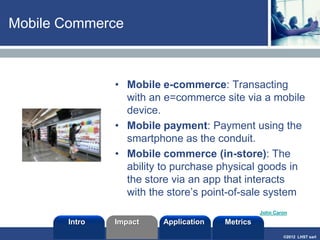
• Mobile e-commerce: Transacting
with an e=commerce site via a mobile
device.
• Mobile payment: Payment using the
smartphone as the conduit.
• Mobile commerce (in-store): The
ability to purchase physical goods in
the store via an app that interacts
with the store’s point-of-sale system
John Caron
Intro Application MetricsImpact
©2013 LHST sarl
4
Mobile Applications
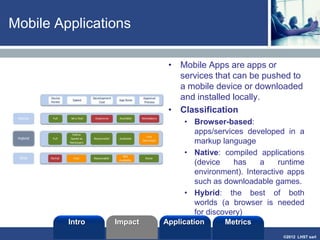
• Mobile Apps are apps or
services that can be pushed to
a mobile device or downloaded
and installed locally.
• Classification
• Browser-based:
apps/services developed in a
markup language
• Native: compiled applications
(device has a runtime
environment). Interactive apps
such as downloadable games.
• Hybrid: the best of both
worlds (a browser is needed
for discovery)
Intro Application MetricsImpact
©2013 LHST sarl
Web app or native?
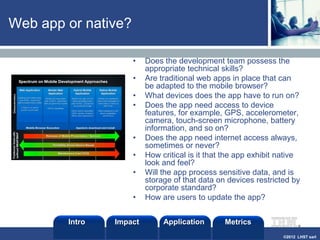
• Does the development team possess the
appropriate technical skills?
• Are traditional web apps in place that can
be adapted to the mobile browser?
• What devices does the app have to run on?
• Does the app need access to device
features, for example, GPS, accelerometer,
camera, touch-screen microphone, battery
information, and so on?
• Does the app need internet access always,
sometimes or never?
• How critical is it that the app exhibit native
look and feel?
• Will the app process sensitive data, and is
storage of that data on devices restricted by
corporate standard?
• How are users to update the app?
Intro Application MetricsImpact
©2013 LHST sarl
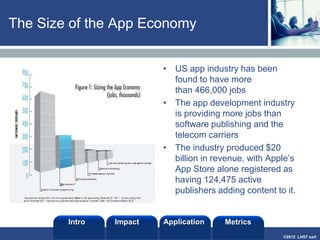
The Size of the App Economy
• US app industry has been
found to have more
than 466,000 jobs
• The app development industry
is providing more jobs than
software publishing and the
telecom carriers
• The industry produced $20
billion in revenue, with Apple’s
App Store alone registered as
having 124,475 active
publishers adding content to it.
Intro Application MetricsImpact
©2013 LHST sarl
Mobile Apps and the Job Market
Intro Application MetricsImpact
©2013 LHST sarl
Mobile Project Manager
• http://www.lafrenchmobile.com/emploi-chef-de-
projet-developpement-applications-mobile-
iphone-ipad-,23.html
• http://www.metiers.internet.gouv.fr/metier/chef-
de-projet-web-mobile
• http://mobs.fr/archives/job-tag/chef-de-projet-
mobile/
Intro Application MetricsImpact
©2013 LHST sarl
What’s changed?
©2013 LHST sarl
Context over Process
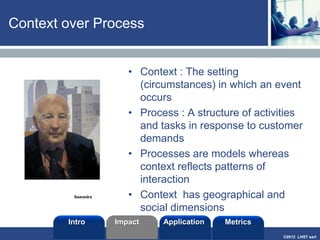
• Context : The setting
(circumstances) in which an event
occurs
• Process : A structure of activities
and tasks in response to customer
demands
• Processes are models whereas
context reflects patterns of
interaction
• Context has geographical and
social dimensions
Saavedra
Intro Application MetricsImpact
©2013 LHST sarl
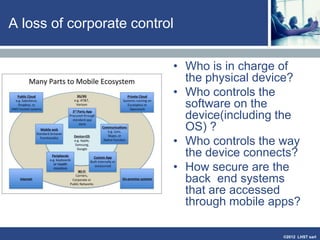
A loss of corporate control
• Who is in charge of
the physical device?
• Who controls the
software on the
device(including the
OS) ?
• Who controls the way
the device connects?
• How secure are the
back end systems
that are accessed
through mobile apps?
©2013 LHST sarl
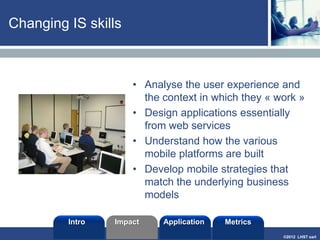
Changing IS skills
• Analyse the user experience and
the context in which they « work »
• Design applications essentially
from web services
• Understand how the various
mobile platforms are built
• Develop mobile strategies that
match the underlying business
models
Intro Application MetricsImpact
©2013 LHST sarl
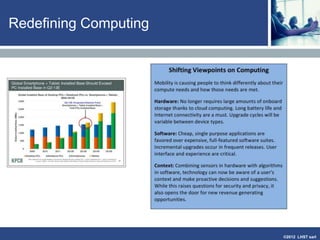
Redefining Computing
©2013 LHST sarl
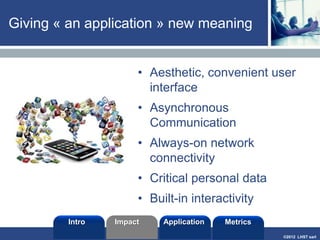
Giving « an application » new meaning
• Aesthetic, convenient user
interface
• Asynchronous
Communication
• Always-on network
connectivity
• Critical personal data
• Built-in interactivity
Intro Application MetricsImpact
©2013 LHST sarl
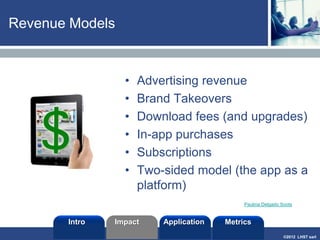
Revenue Models
• Advertising revenue
• Brand Takeovers
• Download fees (and upgrades)
• In-app purchases
• Subscriptions
• Two-sided model (the app as a
platform)
Paulina Delgado Soots
Intro Application MetricsImpact
©2013 LHST sarl
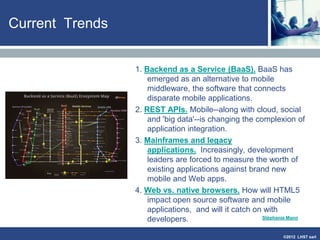
Current Trends
1. Backend as a Service (BaaS). BaaS has
emerged as an alternative to mobile
middleware, the software that connects
disparate mobile applications.
2. REST APIs. Mobile--along with cloud, social
and 'big data'--is changing the complexion of
application integration.
3. Mainframes and legacy
applications. Increasingly, development
leaders are forced to measure the worth of
existing applications against brand new
mobile and Web apps.
4. Web vs. native browsers. How will HTML5
impact open source software and mobile
applications, and will it catch on with
developers. Stéphanie Mann
©2013 LHST sarl
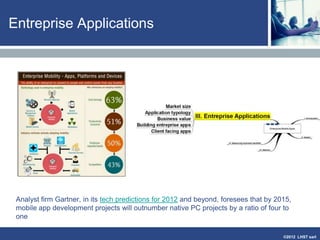
Entreprise Applications
Analyst firm Gartner, in its tech predictions for 2012 and beyond, foresees that by 2015,
mobile app development projects will outnumber native PC projects by a ratio of four to
one
©2013 LHST sarl
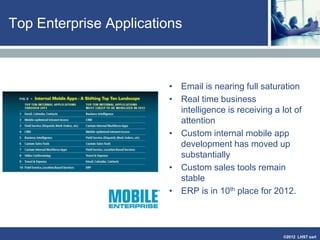
Top Enterprise Applications
• Email is nearing full saturation
• Real time business
intelligence is receiving a lot of
attention
• Custom internal mobile app
development has moved up
substantially
• Custom sales tools remain
stable
• ERP is ranked 10th in 2012.
©2013 LHST sarl
Business Value
Intro Application MetricsImpact
©2013 LHST sarl
Building Enterprise Applications
• Custom internal mobile app
development has moved up
substantially
• First step in moving from
mobile apps to a mobile
strategy
• Recognition of the importance
of corporate context and
culture
• The notion of mobile first :
designing applications around
mobility scenarios
• ERP is in 10th place for 2012.
©2013 LHST sarl
Client facing applications
• The dominance of B2C and
social networking applications
is of little surprise
• The presence of of B2B
applications is important tool in
supporting corporate
ecosystems
• Location based services need
to be invented.
• Why is consumer BI so far
down the list?
©2013 LHST sarl
Business Benefits
Intro Application MetricsImpact
©2013 LHST sarl
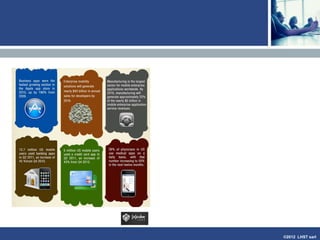
Enterprise Mobile Apps
• Entreprise mobile
solutions will generate $40
billion in sales
• Manufacturing is the
largest vertical market
• Mobile payments is a
major market
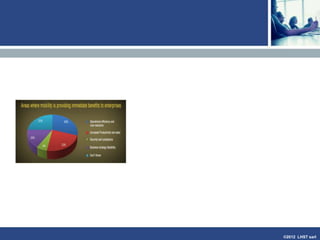
• Perceived benefits include
operational efficiency,
sales, compliance and
security
©2013 LHST sarl
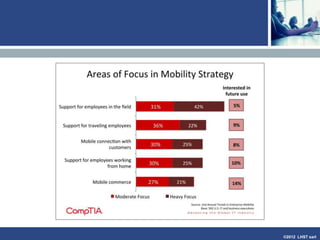
Demand, supply or metrics ?
Tata Consulting, 2013
©2013 LHST sarl
Corporate focus
• Enterprise mobile
solutions will generate
$40 billion in sales
• Manufacturing is the
largest vertical market
• Mobile payments is a
major market
• Perceived benefits
include operational
efficiency, sales,
compliance and
security
©2013 LHST sarl
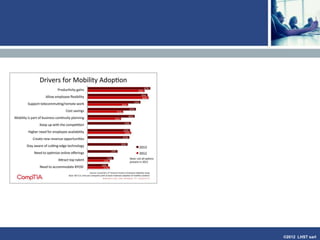
Corporate objectives
• The major objectives for
mobile development
today are productivity
gains, supporting the
mobile workforce.
• Cost savings, and market
pressures are often cited
as secondary drivers
• The need to cater to
employee demands isn’t
yet a priority
©2013 LHST sarl
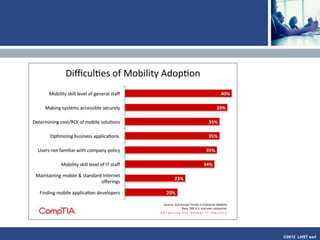
Organizational challenges
• The biggest obstacle
appears to be internal
knowledge and skills
• The ability to project the
ROI of a solution is a
major challenge
• Security and
maintenance are other
notable concerns
• « Mobile first » isn’t yet
clearly defined
©2013 LHST sarl
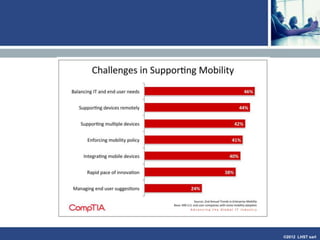
Technical Challenges
• Technical challenges include
finding the right balance
between IT and operational
objectives
• Developing and enforcing a
mobile policy is equally
challenging
• Understanding and then
integrating innovation is also
often cited.
©2013 LHST sarl
Who initiates and who decides?
• According to SAP,
initiatives are often
undertaken at the CXO
level
• IT staff itself is rarely at
the origin of a project
• Why are the views of
customers and partners
so far down this list?

Enterprise Mobile Apps

  • 1.
    ©2013 LHST sarl MT114 Bringingbusiness into context Enterprise Mobile Apps Prof. Lee SCHLENKER schlenker@em-lyon.com
  • 2.
    ©2013 LHST sarl Agenda IntroApplication MetricsImpact
  • 3.
    ©2013 LHST sarl MobileCommerce • Mobile e-commerce: Transacting with an e=commerce site via a mobile device. • Mobile payment: Payment using the smartphone as the conduit. • Mobile commerce (in-store): The ability to purchase physical goods in the store via an app that interacts with the store’s point-of-sale system John Caron Intro Application MetricsImpact
  • 4.
    ©2013 LHST sarl 4 MobileApplications • Mobile Apps are apps or services that can be pushed to a mobile device or downloaded and installed locally. • Classification • Browser-based: apps/services developed in a markup language • Native: compiled applications (device has a runtime environment). Interactive apps such as downloadable games. • Hybrid: the best of both worlds (a browser is needed for discovery) Intro Application MetricsImpact
  • 5.
    ©2013 LHST sarl Webapp or native? • Does the development team possess the appropriate technical skills? • Are traditional web apps in place that can be adapted to the mobile browser? • What devices does the app have to run on? • Does the app need access to device features, for example, GPS, accelerometer, camera, touch-screen microphone, battery information, and so on? • Does the app need internet access always, sometimes or never? • How critical is it that the app exhibit native look and feel? • Will the app process sensitive data, and is storage of that data on devices restricted by corporate standard? • How are users to update the app? Intro Application MetricsImpact
  • 6.
    ©2013 LHST sarl TheSize of the App Economy • US app industry has been found to have more than 466,000 jobs • The app development industry is providing more jobs than software publishing and the telecom carriers • The industry produced $20 billion in revenue, with Apple’s App Store alone registered as having 124,475 active publishers adding content to it. Intro Application MetricsImpact
  • 7.
    ©2013 LHST sarl MobileApps and the Job Market Intro Application MetricsImpact
  • 8.
    ©2013 LHST sarl MobileProject Manager • http://www.lafrenchmobile.com/emploi-chef-de- projet-developpement-applications-mobile- iphone-ipad-,23.html • http://www.metiers.internet.gouv.fr/metier/chef- de-projet-web-mobile • http://mobs.fr/archives/job-tag/chef-de-projet- mobile/ Intro Application MetricsImpact
  • 9.
  • 10.
    ©2013 LHST sarl Contextover Process • Context : The setting (circumstances) in which an event occurs • Process : A structure of activities and tasks in response to customer demands • Processes are models whereas context reflects patterns of interaction • Context has geographical and social dimensions Saavedra Intro Application MetricsImpact
  • 11.
    ©2013 LHST sarl Aloss of corporate control • Who is in charge of the physical device? • Who controls the software on the device(including the OS) ? • Who controls the way the device connects? • How secure are the back end systems that are accessed through mobile apps?
  • 12.
    ©2013 LHST sarl ChangingIS skills • Analyse the user experience and the context in which they « work » • Design applications essentially from web services • Understand how the various mobile platforms are built • Develop mobile strategies that match the underlying business models Intro Application MetricsImpact
  • 13.
  • 14.
    ©2013 LHST sarl Giving« an application » new meaning • Aesthetic, convenient user interface • Asynchronous Communication • Always-on network connectivity • Critical personal data • Built-in interactivity Intro Application MetricsImpact
  • 15.
    ©2013 LHST sarl RevenueModels • Advertising revenue • Brand Takeovers • Download fees (and upgrades) • In-app purchases • Subscriptions • Two-sided model (the app as a platform) Paulina Delgado Soots Intro Application MetricsImpact
  • 16.
    ©2013 LHST sarl CurrentTrends 1. Backend as a Service (BaaS). BaaS has emerged as an alternative to mobile middleware, the software that connects disparate mobile applications. 2. REST APIs. Mobile--along with cloud, social and 'big data'--is changing the complexion of application integration. 3. Mainframes and legacy applications. Increasingly, development leaders are forced to measure the worth of existing applications against brand new mobile and Web apps. 4. Web vs. native browsers. How will HTML5 impact open source software and mobile applications, and will it catch on with developers. Stéphanie Mann
  • 17.
    ©2013 LHST sarl EntrepriseApplications Analyst firm Gartner, in its tech predictions for 2012 and beyond, foresees that by 2015, mobile app development projects will outnumber native PC projects by a ratio of four to one
  • 18.
    ©2013 LHST sarl TopEnterprise Applications • Email is nearing full saturation • Real time business intelligence is receiving a lot of attention • Custom internal mobile app development has moved up substantially • Custom sales tools remain stable • ERP is ranked 10th in 2012.
  • 19.
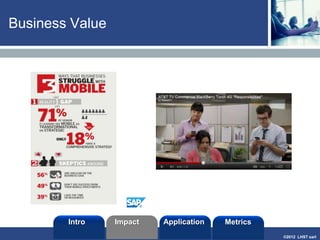
    ©2013 LHST sarl BusinessValue Intro Application MetricsImpact
  • 20.
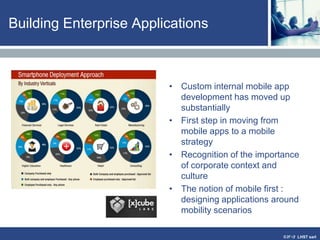
    ©2013 LHST sarl BuildingEnterprise Applications • Custom internal mobile app development has moved up substantially • First step in moving from mobile apps to a mobile strategy • Recognition of the importance of corporate context and culture • The notion of mobile first : designing applications around mobility scenarios • ERP is in 10th place for 2012.
  • 21.
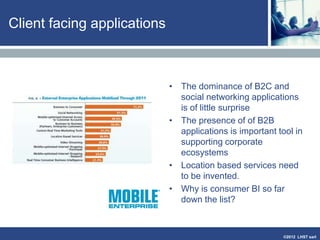
    ©2013 LHST sarl Clientfacing applications • The dominance of B2C and social networking applications is of little surprise • The presence of of B2B applications is important tool in supporting corporate ecosystems • Location based services need to be invented. • Why is consumer BI so far down the list?
  • 22.
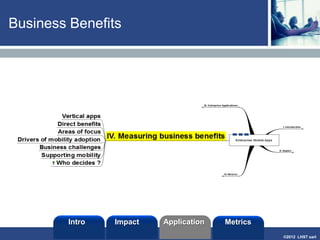
    ©2013 LHST sarl BusinessBenefits Intro Application MetricsImpact
  • 23.
    ©2013 LHST sarl EnterpriseMobile Apps • Entreprise mobile solutions will generate $40 billion in sales • Manufacturing is the largest vertical market • Mobile payments is a major market • Perceived benefits include operational efficiency, sales, compliance and security
  • 24.
    ©2013 LHST sarl Demand,supply or metrics ? Tata Consulting, 2013
  • 25.
    ©2013 LHST sarl Corporatefocus • Enterprise mobile solutions will generate $40 billion in sales • Manufacturing is the largest vertical market • Mobile payments is a major market • Perceived benefits include operational efficiency, sales, compliance and security
  • 26.
    ©2013 LHST sarl Corporateobjectives • The major objectives for mobile development today are productivity gains, supporting the mobile workforce. • Cost savings, and market pressures are often cited as secondary drivers • The need to cater to employee demands isn’t yet a priority
  • 27.
    ©2013 LHST sarl Organizationalchallenges • The biggest obstacle appears to be internal knowledge and skills • The ability to project the ROI of a solution is a major challenge • Security and maintenance are other notable concerns • « Mobile first » isn’t yet clearly defined
  • 28.
    ©2013 LHST sarl TechnicalChallenges • Technical challenges include finding the right balance between IT and operational objectives • Developing and enforcing a mobile policy is equally challenging • Understanding and then integrating innovation is also often cited.
  • 29.
    ©2013 LHST sarl Whoinitiates and who decides? • According to SAP, initiatives are often undertaken at the CXO level • IT staff itself is rarely at the origin of a project • Why are the views of customers and partners so far down this list?

Editor's Notes

  • #4 Mobile e-commerce: Transacting with an e=commerce site via a mobile device. Examples include: eBay mobile, Amazon mobile, the Tesco app in Korea, and the majority of mobile commerce “apps.”Mobile payment: Payment using the smartphone as the conduit. Examples include: Google Wallet, PayPal, and LevelUp.Mobile commerce (in-store): The ability to purchase physical goods in the store via an app that interacts with the store’s point-of-sale system (and bypass the checkout process). Examples include SCAN IT! Mobile from Stop & Shop, Starbucks Card Mobile app, and Chipotle Mobile Ordering App.
  • #6 ProgrammabilityPotential for creating more responsive applications (combats bad perception left by WAP)Critical personal dataEvery application will access personal user profile in some formCustomizations, preferences, authentication information, personal information (contacts, tasks, appointments, etc.)Mobile payments (credit cards, account information, e-tickets)Asynchronous CommunicationMost applications are best described as event-based―core of the application logic is to react to some external events.Aesthetic, convenient user interfaceApplications need pleasing, simple and responsive user interfacesAlways-on network connectivityAlmost all applications heavily rely on network connectivity. Integration of data from the desktop (office, enterprise, school) to mobile device. Access anytime, anywhere is what increases utility of the mobile applications.