The API Economy
January 2019
Grady Kidder & Todd Clapp
2
0
5
10
15
20
2010 2011 2012 2013 2014 2015 2016 2017
Number of Paid SaaS Subscriptions perCompany
SaaS Has Eaten the World…
Data Source: Blissfully.
▪ SaaS is now nearly ubiquitous throughout the
economy
▪ ~800% growth in number of paid SaaS
applications from 2010-2017 (~9x increase)
▪ The average company now pays for ~20
applications
▪ >$200K in average SaaS spend
▪ Each business group within an organization is
now a buyer – no longer being purchased by
select few
SaaS adoption has proliferated across every industry vertical and business function
August 2011
“Software
is eating
the world”
Est. 2010-2017
CAGR: ~37%
3
0
4,000
8,000
12,000
16,000
20,000
0
4
8
12
16
20
2010 2011 2012 2013 2014 2015 2016 2017 2018
TotalPublicWebAPICount
NumberofPaidSaaSSubscriptionsperCompany
Number of Paid SaaS Subscriptions per Company Total Public Web API Count
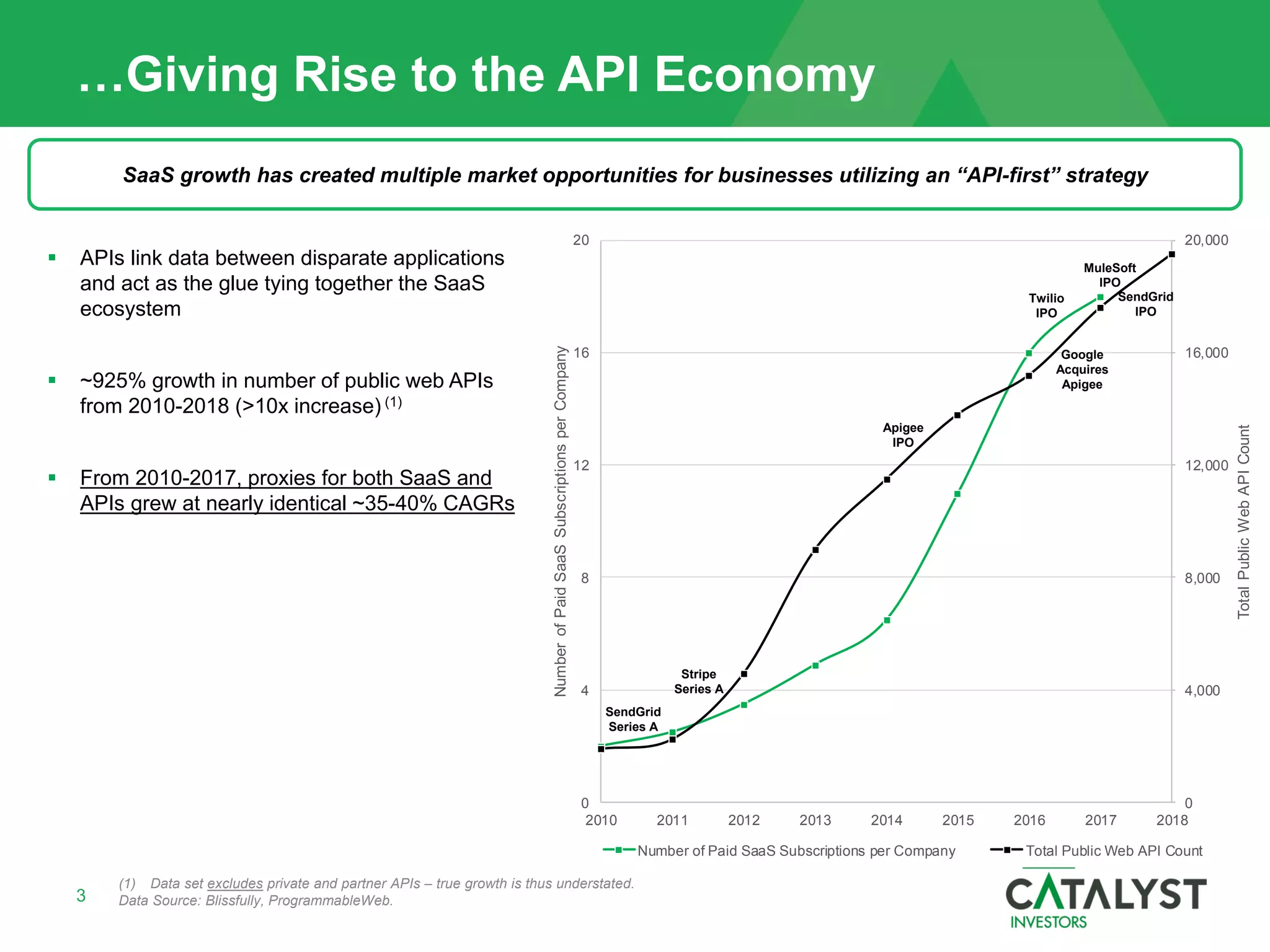
…Giving Rise to the API Economy
(1) Data set excludes private and partner APIs – true growth is thus understated.
Data Source: Blissfully, ProgrammableWeb.
Twilio
IPO
SendGrid
Series A
SendGrid
IPO
MuleSoft
IPO
Apigee
IPO
Google
Acquires
Apigee
Stripe
Series A
▪ APIs link data between disparate applications
and act as the glue tying together the SaaS
ecosystem
▪ ~925% growth in number of public web APIs
from 2010-2018 (>10x increase) (1)
▪ From 2010-2017, proxies for both SaaS and
APIs grew at nearly identical ~35-40% CAGRs
SaaS growth has created multiple market opportunities for businesses utilizing an “API-first” strategy
4
Communication
Products,
Platforms &
Data
Aggregators
Horizontal Focus Vertical Focus
Payments Digital
Features &
Functionality
Prospect &
Customer
Data
Governance,
Risk &
Compliance
Financial
Services
Healthcare Commerce Other
Horizontal
Integrators
API
Management
Marketplaces Development & Monitoring
Note: this landscape is intended to be a representative sampling and is not an exhaustive list.
Please direct inquiries to grady@catalyst.com
API Integrators
IPaaS
The API Economy Landscape
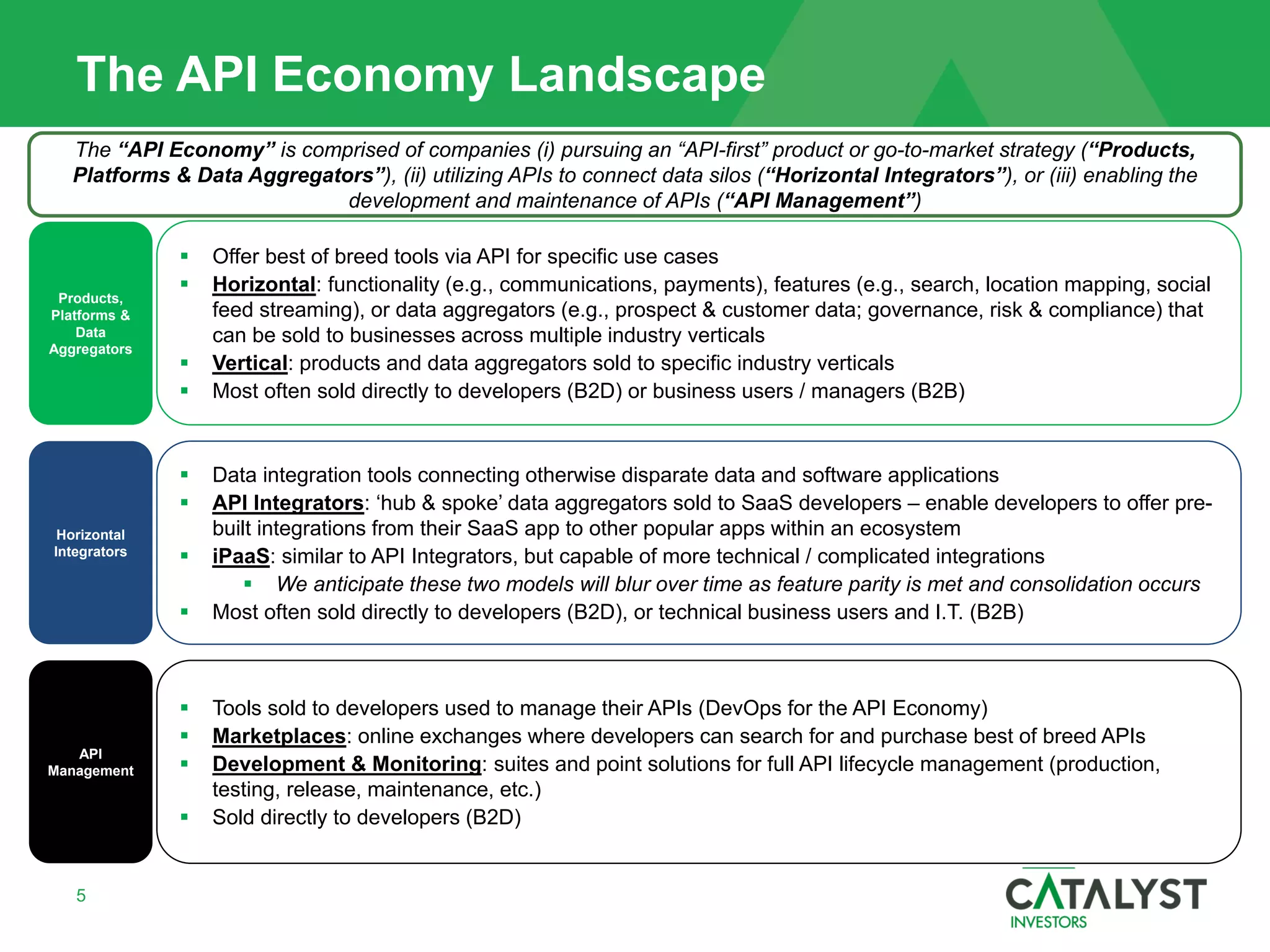
The “API Economy” is comprised of companies (i) pursuing an “API-first” product or go-to-market strategy (“Products,
Platforms & Data Aggregators”), (ii) utilizing APIs to connect data silos (“Horizontal Integrators”), or (iii) enabling the
development and maintenance of APIs (“API Management”)
5
API
Management
▪ Data integration tools connecting otherwise disparate data and software applications
▪ API Integrators: ‘hub & spoke’ data aggregators sold to SaaS developers – enable developers to offer pre-
built integrations from their SaaS app to other popular apps within an ecosystem
▪ iPaaS: similar to API Integrators, but capable of more technical / complicated integrations
▪ We anticipate these two models will blur over time as feature parity is met and consolidation occurs
▪ Most often sold directly to developers (B2D), or technical business users and I.T. (B2B)
▪ Offer best of breed tools via API for specific use cases
▪ Horizontal: functionality (e.g., communications, payments), features (e.g., search, location mapping, social
feed streaming), or data aggregators (e.g., prospect & customer data; governance, risk & compliance) that
can be sold to businesses across multiple industry verticals
▪ Vertical: products and data aggregators sold to specific industry verticals
▪ Most often sold directly to developers (B2D) or business users / managers (B2B)
▪ Tools sold to developers used to manage their APIs (DevOps for the API Economy)
▪ Marketplaces: online exchanges where developers can search for and purchase best of breed APIs
▪ Development & Monitoring: suites and point solutions for full API lifecycle management (production,
testing, release, maintenance, etc.)
▪ Sold directly to developers (B2D)
The API Economy Landscape
Products,
Platforms &
Data
Aggregators
Horizontal
Integrators
The “API Economy” is comprised of companies (i) pursuing an “API-first” product or go-to-market strategy (“Products,
Platforms & Data Aggregators”), (ii) utilizing APIs to connect data silos (“Horizontal Integrators”), or (iii) enabling the
development and maintenance of APIs (“API Management”)
6
▪ Building direct API connections or connecting into an API marketplace / portal increases TAM
➢ New customer acquisition channels
➢ Access to new markets
➢ Additional products / revenue streams
API Economy Dynamics & Themes
Growth
Opportunities
Outsource Non-
core Skills
Data
Democratization
▪ Licensing best-of-breed products and functionality via API allows developers to spend more
time building their own product / service instead of building everything from scratch
➢ Faster go-to-market
➢ Better end-user experience
➢ Requires fewer internal development resources
➢ Easier to maintain
▪ Follows DevOps trend of modular, microservices development and other BPO trends Catalyst
has previously identified
▪ Data aggregators break silos and connect
disparate SaaS applications, unlocking
value from “trapped” data
▪ Decreases amount of time, energy, and
resources spent gathering and processing
data from different sources
API
There are multiple tailwinds fueling the growth of APIs and accompanying services
Please send any inquiries to grady@catalyst.com

The API Economy

  • 1.
    The API Economy January2019 Grady Kidder & Todd Clapp
  • 2.
    2 0 5 10 15 20 2010 2011 20122013 2014 2015 2016 2017 Number of Paid SaaS Subscriptions perCompany SaaS Has Eaten the World… Data Source: Blissfully. ▪ SaaS is now nearly ubiquitous throughout the economy ▪ ~800% growth in number of paid SaaS applications from 2010-2017 (~9x increase) ▪ The average company now pays for ~20 applications ▪ >$200K in average SaaS spend ▪ Each business group within an organization is now a buyer – no longer being purchased by select few SaaS adoption has proliferated across every industry vertical and business function August 2011 “Software is eating the world” Est. 2010-2017 CAGR: ~37%
  • 3.
    3 0 4,000 8,000 12,000 16,000 20,000 0 4 8 12 16 20 2010 2011 20122013 2014 2015 2016 2017 2018 TotalPublicWebAPICount NumberofPaidSaaSSubscriptionsperCompany Number of Paid SaaS Subscriptions per Company Total Public Web API Count …Giving Rise to the API Economy (1) Data set excludes private and partner APIs – true growth is thus understated. Data Source: Blissfully, ProgrammableWeb. Twilio IPO SendGrid Series A SendGrid IPO MuleSoft IPO Apigee IPO Google Acquires Apigee Stripe Series A ▪ APIs link data between disparate applications and act as the glue tying together the SaaS ecosystem ▪ ~925% growth in number of public web APIs from 2010-2018 (>10x increase) (1) ▪ From 2010-2017, proxies for both SaaS and APIs grew at nearly identical ~35-40% CAGRs SaaS growth has created multiple market opportunities for businesses utilizing an “API-first” strategy
  • 4.
    4 Communication Products, Platforms & Data Aggregators Horizontal FocusVertical Focus Payments Digital Features & Functionality Prospect & Customer Data Governance, Risk & Compliance Financial Services Healthcare Commerce Other Horizontal Integrators API Management Marketplaces Development & Monitoring Note: this landscape is intended to be a representative sampling and is not an exhaustive list. Please direct inquiries to grady@catalyst.com API Integrators IPaaS The API Economy Landscape The “API Economy” is comprised of companies (i) pursuing an “API-first” product or go-to-market strategy (“Products, Platforms & Data Aggregators”), (ii) utilizing APIs to connect data silos (“Horizontal Integrators”), or (iii) enabling the development and maintenance of APIs (“API Management”)
  • 5.
    5 API Management ▪ Data integrationtools connecting otherwise disparate data and software applications ▪ API Integrators: ‘hub & spoke’ data aggregators sold to SaaS developers – enable developers to offer pre- built integrations from their SaaS app to other popular apps within an ecosystem ▪ iPaaS: similar to API Integrators, but capable of more technical / complicated integrations ▪ We anticipate these two models will blur over time as feature parity is met and consolidation occurs ▪ Most often sold directly to developers (B2D), or technical business users and I.T. (B2B) ▪ Offer best of breed tools via API for specific use cases ▪ Horizontal: functionality (e.g., communications, payments), features (e.g., search, location mapping, social feed streaming), or data aggregators (e.g., prospect & customer data; governance, risk & compliance) that can be sold to businesses across multiple industry verticals ▪ Vertical: products and data aggregators sold to specific industry verticals ▪ Most often sold directly to developers (B2D) or business users / managers (B2B) ▪ Tools sold to developers used to manage their APIs (DevOps for the API Economy) ▪ Marketplaces: online exchanges where developers can search for and purchase best of breed APIs ▪ Development & Monitoring: suites and point solutions for full API lifecycle management (production, testing, release, maintenance, etc.) ▪ Sold directly to developers (B2D) The API Economy Landscape Products, Platforms & Data Aggregators Horizontal Integrators The “API Economy” is comprised of companies (i) pursuing an “API-first” product or go-to-market strategy (“Products, Platforms & Data Aggregators”), (ii) utilizing APIs to connect data silos (“Horizontal Integrators”), or (iii) enabling the development and maintenance of APIs (“API Management”)
  • 6.
    6 ▪ Building directAPI connections or connecting into an API marketplace / portal increases TAM ➢ New customer acquisition channels ➢ Access to new markets ➢ Additional products / revenue streams API Economy Dynamics & Themes Growth Opportunities Outsource Non- core Skills Data Democratization ▪ Licensing best-of-breed products and functionality via API allows developers to spend more time building their own product / service instead of building everything from scratch ➢ Faster go-to-market ➢ Better end-user experience ➢ Requires fewer internal development resources ➢ Easier to maintain ▪ Follows DevOps trend of modular, microservices development and other BPO trends Catalyst has previously identified ▪ Data aggregators break silos and connect disparate SaaS applications, unlocking value from “trapped” data ▪ Decreases amount of time, energy, and resources spent gathering and processing data from different sources API There are multiple tailwinds fueling the growth of APIs and accompanying services
  • 7.
    Please send anyinquiries to grady@catalyst.com