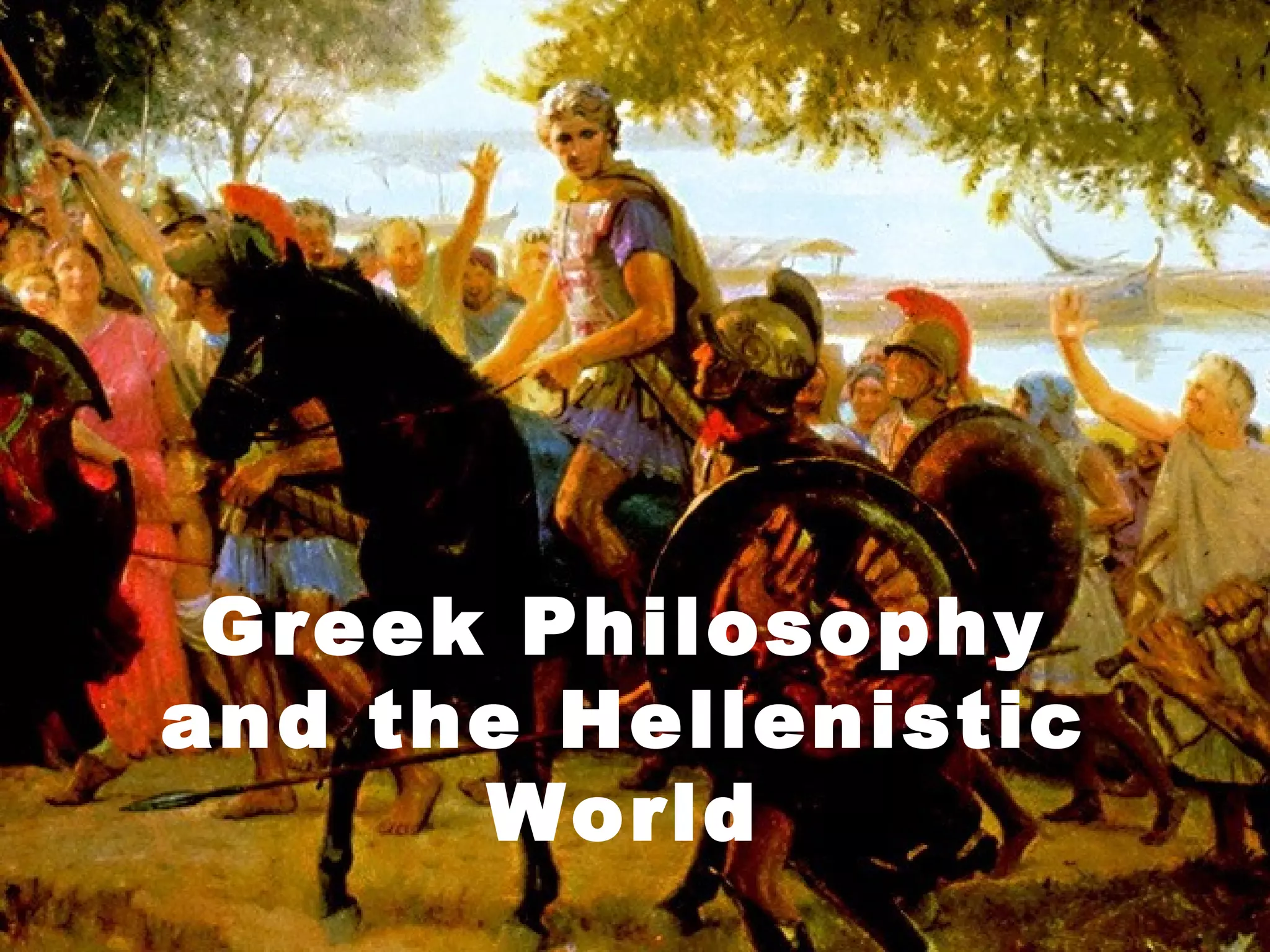
Greek Philosophy and the Hellenistic World
Philosophical v. Mythological Perspectives Mythological: Particular Ad hoc Deification of nature Philosophical: General Consistent Reification of supernature Philosophy is the intellectual project of questioning accepted ideas and requiring that reason and evidence be the criteria for belief. The Greeks are largely responsible for its forms.
Xenophanes on the Gods “ The Ethiops say that their gods are flat-nosed and black,while the Thracians say that theirs have blue eyes and red hair. Yet if cattle or horses or lions had hands and could draw, and could sculpture like men, then the horses would draw their gods like horses, and cattle like cattle; and each they would shape bodies of gods in the likeness, each kind, of their own.”
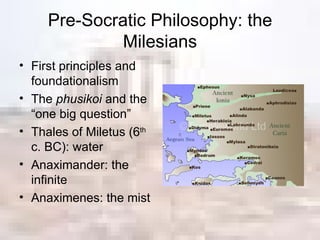
Pre-Socratic Philosophy: the Milesians First principles and foundationalism The  phusikoi  and the “one big question” Thales of Miletus (6 th  c. BC): water Anaximander: the infinite Anaximenes: the mist
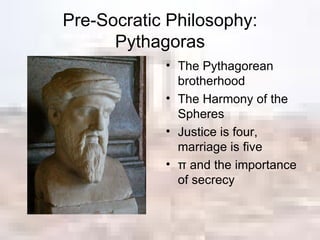
Pre-Socratic Philosophy: Pythagoras The Pythagorean brotherhood The Harmony of the Spheres Justice is four, marriage is five π  and the importance of secrecy
Pre-Socratic Philosophy: Change and Continuity Heraclitus and the world of flux The Eleatics: Parmenides Zeno’s paradox of motion Atomism: Empedocles and Democritus
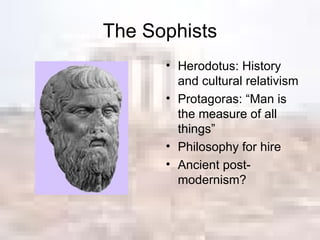
The Sophists Herodotus: History and cultural relativism Protagoras: “Man is the measure of all things” Philosophy for hire Ancient post-modernism?
The Sophists v. Socrates Sophists: Believed in paid teaching Taught Rhetoric Sought to mold opinion Favored democracy Socrates: Believed in free instruction Taught dialectic Sought knowledge Suspicious of democracy (preferred aristocracy)
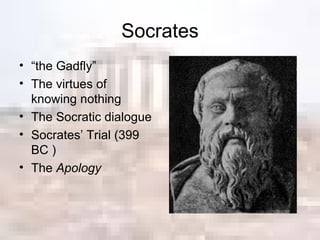
Socrates “ the Gadfly” The virtues of knowing nothing The Socratic dialogue Socrates’ Trial (399 BC ) The  Apology
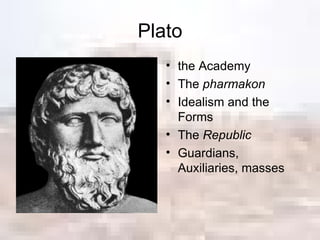
Plato the Academy The  pharmakon Idealism and the Forms The  Republic Guardians, Auxiliaries, masses
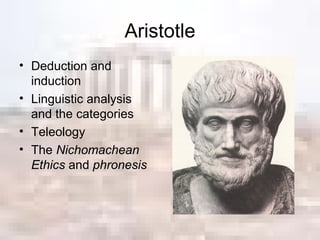
Aristotle Deduction and induction Linguistic analysis and the categories Teleology The  Nichomachean Ethics  and  phronesis
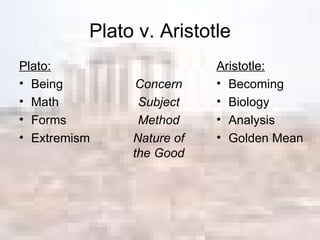
Plato v. Aristotle Plato: Being Math Forms Extremism Aristotle: Becoming Biology Analysis Golden Mean Concern Subject Method Nature of the Good
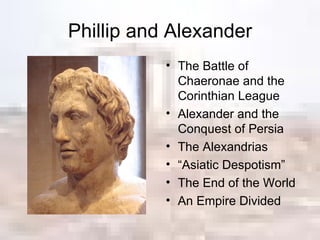
Phillip and Alexander The Battle of Chaeronae and the Corinthian League Alexander and the Conquest of Persia The Alexandrias “ Asiatic Despotism” The End of the World An Empire Divided
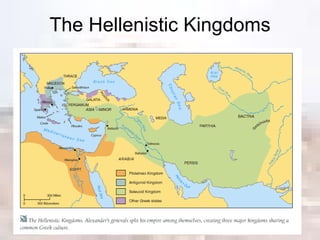
The Hellenistic Kingdoms
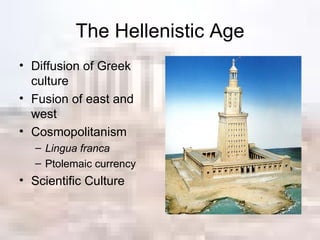
The Hellenistic Age Diffusion of Greek culture Fusion of east and west Cosmopolitanism Lingua franca Ptolemaic currency Scientific Culture
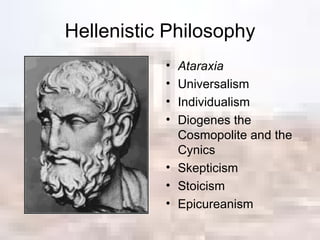
Hellenistic Philosophy Ataraxia Universalism Individualism Diogenes the Cosmopolite and the Cynics Skepticism Stoicism Epicureanism
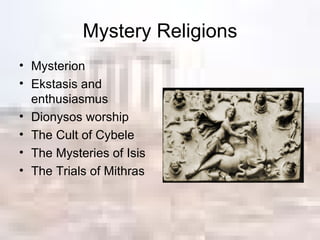
Mystery Religions Mysterion Ekstasis and enthusiasmus Dionysos worship The Cult of Cybele The Mysteries of Isis The Trials of Mithras
Summary The Hellenic and Hellenistic eras were times of great intellectual ferment. Philosophy attempted to provide knowledge and perspective on the nature of humanity and the universe, though it often produced as many questions as it answered. The replacement of a highly localized, communal form of life associated with the classical polis with a cosmopolitan despotism prompted a shift in philosophical ideals towards a higher degree of individualism and disengagement. These cultural forms would be imported by the next emerging Mediterranean power, Rome.

Greek Philosophy and the Hellenistic World

  • 1.
    Greek Philosophy andthe Hellenistic World
  • 2.
    Philosophical v. MythologicalPerspectives Mythological: Particular Ad hoc Deification of nature Philosophical: General Consistent Reification of supernature Philosophy is the intellectual project of questioning accepted ideas and requiring that reason and evidence be the criteria for belief. The Greeks are largely responsible for its forms.
  • 3.
    Xenophanes on theGods “ The Ethiops say that their gods are flat-nosed and black,while the Thracians say that theirs have blue eyes and red hair. Yet if cattle or horses or lions had hands and could draw, and could sculpture like men, then the horses would draw their gods like horses, and cattle like cattle; and each they would shape bodies of gods in the likeness, each kind, of their own.”
  • 4.
    Pre-Socratic Philosophy: theMilesians First principles and foundationalism The phusikoi and the “one big question” Thales of Miletus (6 th c. BC): water Anaximander: the infinite Anaximenes: the mist
  • 5.
    Pre-Socratic Philosophy: PythagorasThe Pythagorean brotherhood The Harmony of the Spheres Justice is four, marriage is five π and the importance of secrecy
  • 6.
    Pre-Socratic Philosophy: Changeand Continuity Heraclitus and the world of flux The Eleatics: Parmenides Zeno’s paradox of motion Atomism: Empedocles and Democritus
  • 7.
    The Sophists Herodotus:History and cultural relativism Protagoras: “Man is the measure of all things” Philosophy for hire Ancient post-modernism?
  • 8.
    The Sophists v.Socrates Sophists: Believed in paid teaching Taught Rhetoric Sought to mold opinion Favored democracy Socrates: Believed in free instruction Taught dialectic Sought knowledge Suspicious of democracy (preferred aristocracy)
  • 9.
    Socrates “ theGadfly” The virtues of knowing nothing The Socratic dialogue Socrates’ Trial (399 BC ) The Apology
  • 10.
    Plato the AcademyThe pharmakon Idealism and the Forms The Republic Guardians, Auxiliaries, masses
  • 11.
    Aristotle Deduction andinduction Linguistic analysis and the categories Teleology The Nichomachean Ethics and phronesis
  • 12.
    Plato v. AristotlePlato: Being Math Forms Extremism Aristotle: Becoming Biology Analysis Golden Mean Concern Subject Method Nature of the Good
  • 13.
    Phillip and AlexanderThe Battle of Chaeronae and the Corinthian League Alexander and the Conquest of Persia The Alexandrias “ Asiatic Despotism” The End of the World An Empire Divided
  • 14.
  • 15.
    The Hellenistic AgeDiffusion of Greek culture Fusion of east and west Cosmopolitanism Lingua franca Ptolemaic currency Scientific Culture
  • 16.
    Hellenistic Philosophy AtaraxiaUniversalism Individualism Diogenes the Cosmopolite and the Cynics Skepticism Stoicism Epicureanism
  • 17.
    Mystery Religions MysterionEkstasis and enthusiasmus Dionysos worship The Cult of Cybele The Mysteries of Isis The Trials of Mithras
  • 18.
    Summary The Hellenicand Hellenistic eras were times of great intellectual ferment. Philosophy attempted to provide knowledge and perspective on the nature of humanity and the universe, though it often produced as many questions as it answered. The replacement of a highly localized, communal form of life associated with the classical polis with a cosmopolitan despotism prompted a shift in philosophical ideals towards a higher degree of individualism and disengagement. These cultural forms would be imported by the next emerging Mediterranean power, Rome.