

English in the classroom
Applied Linguistics for Language Teachers
Lecture 10, WS2016-2017
Dr. Achilleas Kostoulas
KARL-FRANZENS-UNIVERSITÄT GRAZ
UNIVERSITY OF GRAZ
Lecture Outline
1. The global dominance of English
2. Dealing with diversity in language
education
3. The Native English Speaker Teacher
debate
THE GLOBAL DOMINANCE
OF ENGLISH
1. What is a lingua franca?
2. Advantages of having a global language
3. Effects on language ecologies
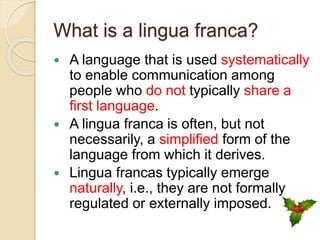
What is a lingua franca?
 A language that is used systematically
to enable communication among
people who do not typically share a
first language.
 A lingua franca is often, but not
necessarily, a simplified form of the
language from which it derives.
 Lingua francas typically emerge
naturally, i.e., they are not formally
regulated or externally imposed.
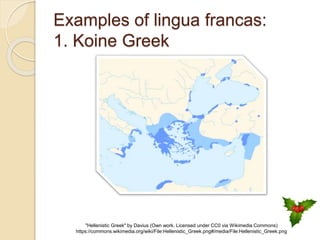
Examples of lingua francas:
1. Koine Greek
"Hellenistic Greek" by Davius (Own work. Licensed under CC0 via Wikimedia Commons)
https://commons.wikimedia.org/wiki/File:Hellenistic_Greek.png#/media/File:Hellenistic_Greek.png
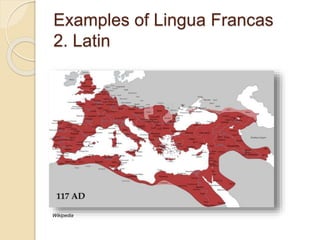
Examples of Lingua Francas
2. Latin
Wikipedia
Examples of Lingua Francas
2. Latin
Wikipedia
Duncan Hall @ Flickr [CC-BY]
Examples of Lingua Francas
3. Sabir / Mediterranean Lingua Franca
Wikipedia
Examples of Lingua Francas
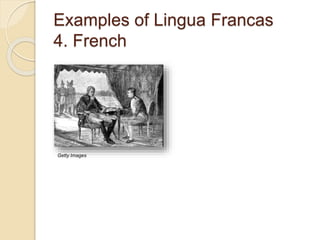
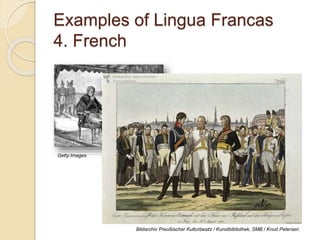
4. French
Getty Images
Examples of Lingua Francas
4. French
Getty Images
Bildarchiv Preußischer Kulturbesitz / Kunstbibliothek, SMB / Knud Petersen
Examples of Lingua Francas
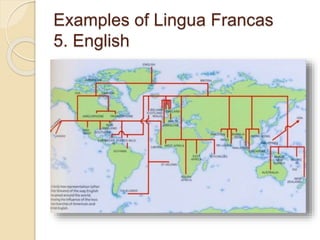
5. English
Examples of lingua francas
 Koine Greek
 Latin
 Lingua Franca (Sabir)
 French
 English
What do you think?
Is there something
these languages all
have in common?
Language and Power
 A global language comes into being
when one linguistic community has
disproportionate power (military,
political, religious, economical, etc.)
 A global language also perpetuates
this power imbalance.
Language teaching and foreign
policy
“The [British] Council’s aim is to create in
a country overseas a basis of friendly
knowledge and understanding of the
people of this country, of their philosophy
and way of life, which will lead to a
sympathetic appreciation of British
foreign policy, whatever for the moment
that policy may be and from whatever
political conviction it may spring”.
http://www.britishcouncil.org/organisation/history (Emphasis added)
The English Effect
“English gives the UK a competitive
edge. For the UK today, it provides a
strong competitive advantage in culture,
diplomacy, commerce, media, academia
and IT, and in the use and practice of soft
power.”
15
www.britishcouncil.org
Economic importance of ELT
 Students coming to UK to learn English
contribute £2 billion per year approx. to UK
economy
 Importance of English for global business
expansion
 British Council sponsored provision of UK
exams and qualifications worth £60 million in
export earnings for UK exam boards.
 Textbook industry
16
www.britishcouncil.org
Reflect and Discuss
 What are some advantages for us as
users of a language that is globally
understood?
 In what ways might any negative
impact of English be addressed?
DEALING WITH DIVERSITY
IN LANGUAGE EDUCATION
1. The Standard Language Ideology
2. World Englishes
3. English as a Lingua Franca in education?
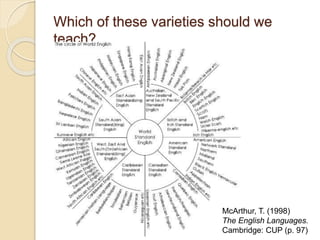
Which of these varieties should we
teach?
McArthur, T. (1998)
The English Languages.
Cambridge: CUP (p. 97)
The Standard Language
Ideology
The Standard Language ideology
acknowledges linguistic diversity, but
holds that it is pedagogically desirable
to teach to a clearly defined and socially
acceptable standard.
“the real English, Anglais real, Royal English,
Queen’s English, or (for those unsympathetic to the
monarchy) Oxford English, the vintage language”
(Widdowson 2003: 35)
The ‘Quirk concern’
“It is neither liberal nor liberating to
permit learners to settle for lower
standards than the best, and it’s a
travesty of liberalism to tolerate low
standards which lock the least fortunate
into the least rewarding careers” (Quirk
1990: 9)What do you think?
If we encourage students to
use non-standard forms,
what will the impact on their
future lives be?
World Englishes
 The Standard Language ideology
assumes that ‘non-standard’ equals ‘sub-
standard’. Sociolinguistics has
challenged this position.
 Some regional varieties of English have
become institutionalised. These are
more appropriate for international
communication in those regions.
 The World Englishes perspective is that
regional varieties (e.g. Singaporean
English, Indian English) are legitimate
target varieties.
Reflect and discuss
Randolph Quirk had argued that we need
to learn the standard language, because
the goal of language instruction is to
facilitate communication with native
speakers.
“This, of course, is only partially true. The
reality is that in its localized varieties, English
has become the main vehicle for interaction
among its non-native users, with distinct
linguistic and cultural backgrounds – Indians
interacting with Nigerians, Japanese, Sri
Lankans, Germans with Singaporeans, and so
on”. (Kachru 1991: 10).
Is English as a Native Language still useful
in communication among non-native
English as a lingua franca
English as a Lingua Franca (ELF) or
English as an International Language
(EIL) is “any use of English among
speakers of different first languages, for
whom English is the communicative
medium of choice, and often the only
option” (Seidlhofer 2011: 7)
ELF pedagogical recommendations
ELF linguistic research has made few
concrete pedagogical
recommendations. Some include:
 Focus pronunciation teaching on core
features that impact intelligibility
 Emphasise the teaching of
communication strategies from which
language emerges, rather than
language forms
Reflect & Discuss
 Some ELF researchers have noted
that the third person marker is
redundant, i.e. it does not contribute to
intelligibility. For them, “Thomas play
tennis” is a legitimate ELF
construction.
 How do you feel about a teaching
paradigm that does not correct such
constructions?
THE NATIVE ENGLISH
SPEAKER TEACHER
DEBATE
1. The persistence of native-speaker models
2. Defining the native speaker
3. Native-speakerism
Warm-up tasks
1. In an Austrian school, where there
are two English language teachers,
one from Austria and one from
England, who is ‘native’?
2. What is a ‘native speaker’? Write a
two-three sentence definition.
Defining the native speaker
(1)
1. The native speaker acquires the L1 of
which s/he is a native speaker in
childhood.
2. The native speaker has intuitions (in
terms of acceptability and
productiveness) about his/her idiolectal
grammar.
3. The native speaker has intuitions about
those features of the Standard
Language grammar which are distinct
from his/her idiolectal grammar.Davies (1991/2003)
Defining the native speaker
(2)
4. The native speaker has a unique
capacity to produce fluent
spontaneous discourse, which
exhibits pauses mainly at clause
boundaries […] and which is
facilitated by a huge memory stock of
completed lexical items[…] In both
production and comprehension the
native speaker exhibits a wide range
of communicative competence.Davies (1991/2003)
Defining the native speaker
(3)
5. The native speaker
has a unique
capacity to write
creatively […]
6. The native speaker
has a unique
capacity to
interpret and
translate into the
L1 of which he/she
is a native speaker.
[…]
Davies (1991/2003)
Reflection task
 List three reasons why you wanted to
learn English. Tick those that relate to
communication exclusively with native
speakers of English.
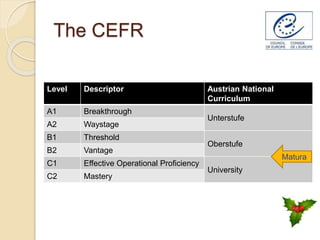
The CEFR
Level Descriptor Austrian National
Curriculum
A1 Breakthrough
Unterstufe
A2 Waystage
B1 Threshold
Oberstufe
B2 Vantage
C1 Effective Operational Proficiency
University
C2 Mastery
Matura
Example CEFR descriptors
(1)
Independent User (B2)
Can understand the main ideas of
complex text on both concrete and
abstract topics, including technical
discussions in his/her field of
specialisation. Can interact with a
degree of fluency and spontaneity that
makes regular interaction with native
speakers quite possible without strain
for either party. (p.24)
Example CEFR descriptors
(2)
Independent User (Informal discussion
with friends)
Can with some effort catch much of
what is said around him/her in
discussion, but may find it difficult to
participate effectively in discussion with
several native speakers who do not
modify their language in any way. (p. 77)
Native speakers as teachers
(1)
052 A2 Englisch Grundstufe 4
ENGLISH CONVERSATION! An
opportunity to overcome your
shyness to speak English.
Conversation with a native
speaker on fun everyday themes.
(VHS Graz Umgebung 2013-14)
Native speakers as teachers
(2)
053 A1 Französisch Grundstufe 1
Bienvenue! Willkommen an alle, die mit
einem Native Speaker die französische
Sprache und Kultur kennenlernen wollen.
Spiele, Musik und Spaß ergänzen den
Unterricht. Ein Kurs für
FranzösischliebhaberInnen ohne oder
mit geringen Vorkenntnissen.
(VHS Graz Umgebung 2013-14)
Native Speakers as teachers
(3)
Essential qualifications:
• A first degree from a Department
of French Language and
Literature
• A Masters degree in French
Language Teaching or
Translation, or a PhD focussing
on French Language Teaching
• Linguistic proficiency at a native-
speaker level
• Proven professional experience in
creating learning materials for
teaching and learning English,
and/or assessing linguistic
proficiency (in print and/or in
electronic media)
Essential qualifications:
• A humanities degree
• Native speaker of English
• Proven professional experience in
creating learning materials for
teaching and learning English,
and/or assessing linguistic
proficiency (in print and/or in
electronic media)
Task
 List three advantages of having a
native speaker as a teacher
 List three areas in which native
speakers might be less effective as
teachers
A false dichotomy
 The distinction between native and non-
native speakers as teachers is, in many
ways a false dichotomy.
 Individual teachers have different
strengths; some connect to linguistic
background; many do not.
 Discussing individual strengths through
the lens of group membership is as
counterproductive as discussing the
relative strengths of male and female
teachers.
 The reason why we are having this
debate is the ideology of native-
speakerism.
Native-speakerism
“Native-speakerism is a
pervasive ideology
within ELT,
characterized by the
belief that ‘native-
speaker’ teachers
represents a ‘Western
culture’ from which
spring the ideals both of
the English language
and of English language
teaching methodology.”
(Holliday 2006: 385)
Native-speakerism (definition)
Native-speakerism is an ideology that
unreflectively combines the following
beliefs:
(a) a language is embodied, in an ‘ideal’
form, in users who have acquired it as
children
(b) all ‘native speakers’ use the same
variety of the language
(c) the variety used by native speakers is
superior to all other varieties
(d) native speakers, therefore, are
preferable language teachers
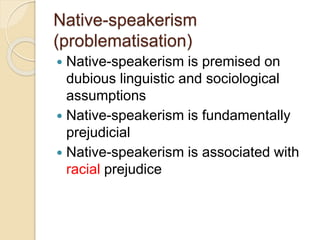
Native-speakerism
(problematisation)
 Native-speakerism is premised on
dubious linguistic and sociological
assumptions
 Native-speakerism is fundamentally
prejudicial
 Native-speakerism is associated with
racial prejudice
English in the world 2

English in the world 2

  • 1.
    English in theclassroom Applied Linguistics for Language Teachers Lecture 10, WS2016-2017 Dr. Achilleas Kostoulas KARL-FRANZENS-UNIVERSITÄT GRAZ UNIVERSITY OF GRAZ
  • 2.
    Lecture Outline 1. Theglobal dominance of English 2. Dealing with diversity in language education 3. The Native English Speaker Teacher debate
  • 3.
    THE GLOBAL DOMINANCE OFENGLISH 1. What is a lingua franca? 2. Advantages of having a global language 3. Effects on language ecologies
  • 4.
    What is alingua franca?  A language that is used systematically to enable communication among people who do not typically share a first language.  A lingua franca is often, but not necessarily, a simplified form of the language from which it derives.  Lingua francas typically emerge naturally, i.e., they are not formally regulated or externally imposed.
  • 5.
    Examples of linguafrancas: 1. Koine Greek "Hellenistic Greek" by Davius (Own work. Licensed under CC0 via Wikimedia Commons) https://commons.wikimedia.org/wiki/File:Hellenistic_Greek.png#/media/File:Hellenistic_Greek.png
  • 6.
    Examples of LinguaFrancas 2. Latin Wikipedia
  • 7.
    Examples of LinguaFrancas 2. Latin Wikipedia Duncan Hall @ Flickr [CC-BY]
  • 8.
    Examples of LinguaFrancas 3. Sabir / Mediterranean Lingua Franca Wikipedia
  • 9.
    Examples of LinguaFrancas 4. French Getty Images
  • 10.
    Examples of LinguaFrancas 4. French Getty Images Bildarchiv Preußischer Kulturbesitz / Kunstbibliothek, SMB / Knud Petersen
  • 11.
    Examples of LinguaFrancas 5. English
  • 12.
    Examples of linguafrancas  Koine Greek  Latin  Lingua Franca (Sabir)  French  English What do you think? Is there something these languages all have in common?
  • 13.
    Language and Power A global language comes into being when one linguistic community has disproportionate power (military, political, religious, economical, etc.)  A global language also perpetuates this power imbalance.
  • 14.
    Language teaching andforeign policy “The [British] Council’s aim is to create in a country overseas a basis of friendly knowledge and understanding of the people of this country, of their philosophy and way of life, which will lead to a sympathetic appreciation of British foreign policy, whatever for the moment that policy may be and from whatever political conviction it may spring”. http://www.britishcouncil.org/organisation/history (Emphasis added)
  • 15.
    The English Effect “Englishgives the UK a competitive edge. For the UK today, it provides a strong competitive advantage in culture, diplomacy, commerce, media, academia and IT, and in the use and practice of soft power.” 15 www.britishcouncil.org
  • 16.
    Economic importance ofELT  Students coming to UK to learn English contribute £2 billion per year approx. to UK economy  Importance of English for global business expansion  British Council sponsored provision of UK exams and qualifications worth £60 million in export earnings for UK exam boards.  Textbook industry 16 www.britishcouncil.org
  • 17.
    Reflect and Discuss What are some advantages for us as users of a language that is globally understood?  In what ways might any negative impact of English be addressed?
  • 18.
    DEALING WITH DIVERSITY INLANGUAGE EDUCATION 1. The Standard Language Ideology 2. World Englishes 3. English as a Lingua Franca in education?
  • 19.
    Which of thesevarieties should we teach? McArthur, T. (1998) The English Languages. Cambridge: CUP (p. 97)
  • 20.
    The Standard Language Ideology TheStandard Language ideology acknowledges linguistic diversity, but holds that it is pedagogically desirable to teach to a clearly defined and socially acceptable standard. “the real English, Anglais real, Royal English, Queen’s English, or (for those unsympathetic to the monarchy) Oxford English, the vintage language” (Widdowson 2003: 35)
  • 21.
    The ‘Quirk concern’ “Itis neither liberal nor liberating to permit learners to settle for lower standards than the best, and it’s a travesty of liberalism to tolerate low standards which lock the least fortunate into the least rewarding careers” (Quirk 1990: 9)What do you think? If we encourage students to use non-standard forms, what will the impact on their future lives be?
  • 22.
    World Englishes  TheStandard Language ideology assumes that ‘non-standard’ equals ‘sub- standard’. Sociolinguistics has challenged this position.  Some regional varieties of English have become institutionalised. These are more appropriate for international communication in those regions.  The World Englishes perspective is that regional varieties (e.g. Singaporean English, Indian English) are legitimate target varieties.
  • 23.
    Reflect and discuss RandolphQuirk had argued that we need to learn the standard language, because the goal of language instruction is to facilitate communication with native speakers. “This, of course, is only partially true. The reality is that in its localized varieties, English has become the main vehicle for interaction among its non-native users, with distinct linguistic and cultural backgrounds – Indians interacting with Nigerians, Japanese, Sri Lankans, Germans with Singaporeans, and so on”. (Kachru 1991: 10). Is English as a Native Language still useful in communication among non-native
  • 24.
    English as alingua franca English as a Lingua Franca (ELF) or English as an International Language (EIL) is “any use of English among speakers of different first languages, for whom English is the communicative medium of choice, and often the only option” (Seidlhofer 2011: 7)
  • 25.
    ELF pedagogical recommendations ELFlinguistic research has made few concrete pedagogical recommendations. Some include:  Focus pronunciation teaching on core features that impact intelligibility  Emphasise the teaching of communication strategies from which language emerges, rather than language forms
  • 26.
    Reflect & Discuss Some ELF researchers have noted that the third person marker is redundant, i.e. it does not contribute to intelligibility. For them, “Thomas play tennis” is a legitimate ELF construction.  How do you feel about a teaching paradigm that does not correct such constructions?
  • 27.
    THE NATIVE ENGLISH SPEAKERTEACHER DEBATE 1. The persistence of native-speaker models 2. Defining the native speaker 3. Native-speakerism
  • 28.
    Warm-up tasks 1. Inan Austrian school, where there are two English language teachers, one from Austria and one from England, who is ‘native’? 2. What is a ‘native speaker’? Write a two-three sentence definition.
  • 29.
    Defining the nativespeaker (1) 1. The native speaker acquires the L1 of which s/he is a native speaker in childhood. 2. The native speaker has intuitions (in terms of acceptability and productiveness) about his/her idiolectal grammar. 3. The native speaker has intuitions about those features of the Standard Language grammar which are distinct from his/her idiolectal grammar.Davies (1991/2003)
  • 30.
    Defining the nativespeaker (2) 4. The native speaker has a unique capacity to produce fluent spontaneous discourse, which exhibits pauses mainly at clause boundaries […] and which is facilitated by a huge memory stock of completed lexical items[…] In both production and comprehension the native speaker exhibits a wide range of communicative competence.Davies (1991/2003)
  • 31.
    Defining the nativespeaker (3) 5. The native speaker has a unique capacity to write creatively […] 6. The native speaker has a unique capacity to interpret and translate into the L1 of which he/she is a native speaker. […] Davies (1991/2003)
  • 32.
    Reflection task  Listthree reasons why you wanted to learn English. Tick those that relate to communication exclusively with native speakers of English.
  • 33.
    The CEFR Level DescriptorAustrian National Curriculum A1 Breakthrough Unterstufe A2 Waystage B1 Threshold Oberstufe B2 Vantage C1 Effective Operational Proficiency University C2 Mastery Matura
  • 34.
    Example CEFR descriptors (1) IndependentUser (B2) Can understand the main ideas of complex text on both concrete and abstract topics, including technical discussions in his/her field of specialisation. Can interact with a degree of fluency and spontaneity that makes regular interaction with native speakers quite possible without strain for either party. (p.24)
  • 35.
    Example CEFR descriptors (2) IndependentUser (Informal discussion with friends) Can with some effort catch much of what is said around him/her in discussion, but may find it difficult to participate effectively in discussion with several native speakers who do not modify their language in any way. (p. 77)
  • 36.
    Native speakers asteachers (1) 052 A2 Englisch Grundstufe 4 ENGLISH CONVERSATION! An opportunity to overcome your shyness to speak English. Conversation with a native speaker on fun everyday themes. (VHS Graz Umgebung 2013-14)
  • 37.
    Native speakers asteachers (2) 053 A1 Französisch Grundstufe 1 Bienvenue! Willkommen an alle, die mit einem Native Speaker die französische Sprache und Kultur kennenlernen wollen. Spiele, Musik und Spaß ergänzen den Unterricht. Ein Kurs für FranzösischliebhaberInnen ohne oder mit geringen Vorkenntnissen. (VHS Graz Umgebung 2013-14)
  • 38.
    Native Speakers asteachers (3) Essential qualifications: • A first degree from a Department of French Language and Literature • A Masters degree in French Language Teaching or Translation, or a PhD focussing on French Language Teaching • Linguistic proficiency at a native- speaker level • Proven professional experience in creating learning materials for teaching and learning English, and/or assessing linguistic proficiency (in print and/or in electronic media) Essential qualifications: • A humanities degree • Native speaker of English • Proven professional experience in creating learning materials for teaching and learning English, and/or assessing linguistic proficiency (in print and/or in electronic media)
  • 39.
    Task  List threeadvantages of having a native speaker as a teacher  List three areas in which native speakers might be less effective as teachers
  • 40.
    A false dichotomy The distinction between native and non- native speakers as teachers is, in many ways a false dichotomy.  Individual teachers have different strengths; some connect to linguistic background; many do not.  Discussing individual strengths through the lens of group membership is as counterproductive as discussing the relative strengths of male and female teachers.  The reason why we are having this debate is the ideology of native- speakerism.
  • 41.
    Native-speakerism “Native-speakerism is a pervasiveideology within ELT, characterized by the belief that ‘native- speaker’ teachers represents a ‘Western culture’ from which spring the ideals both of the English language and of English language teaching methodology.” (Holliday 2006: 385)
  • 42.
    Native-speakerism (definition) Native-speakerism isan ideology that unreflectively combines the following beliefs: (a) a language is embodied, in an ‘ideal’ form, in users who have acquired it as children (b) all ‘native speakers’ use the same variety of the language (c) the variety used by native speakers is superior to all other varieties (d) native speakers, therefore, are preferable language teachers
  • 43.
    Native-speakerism (problematisation)  Native-speakerism ispremised on dubious linguistic and sociological assumptions  Native-speakerism is fundamentally prejudicial  Native-speakerism is associated with racial prejudice