The Alchemy of
                            English
                            by Braj B. Kachru


                      A Presentation by Christy Tatum
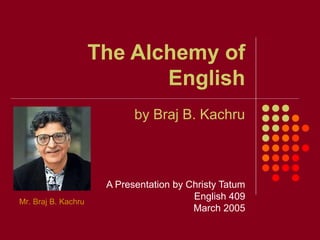
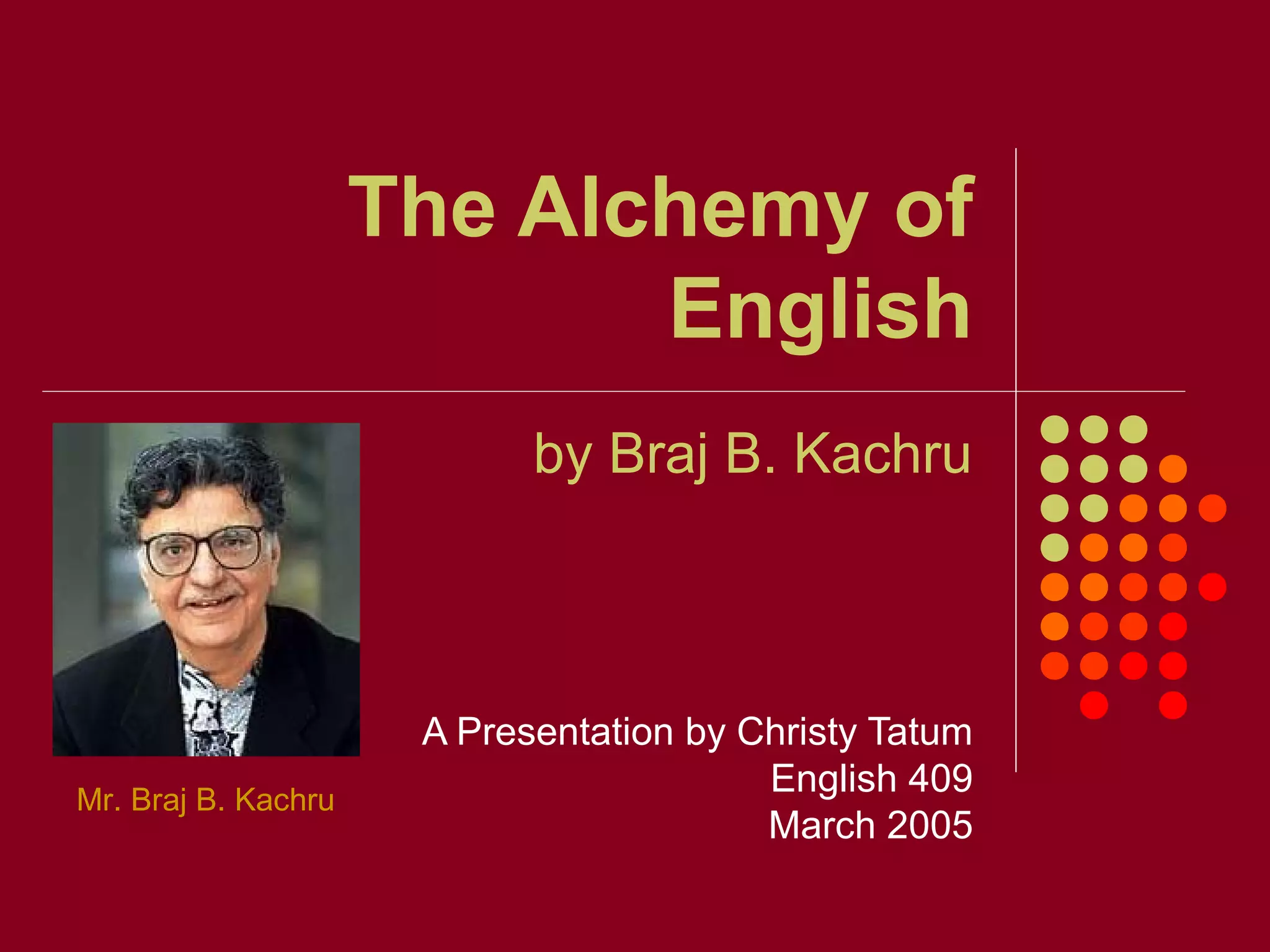
Mr. Braj B. Kachru
                                         English 409
                                         March 2005
The Life of Braj B. Kachru
   Professor Braj B. Kachru is the Director of the Centre for Advanced Study at the
    University of Illinois. He is said to be the world's leading scholar in the field of world
    Englishes; he has pioneered, shaped, and defined the linguistic, socio-cultural and
    pedagogical dimensions of cross-cultural diffusion of English.
   Professor Kachru has more than 25 authored and edited volumes and more than 100
    research papers, review articles, and reviews. He wrote a book from which our essay is
    excperted called The Alchemy of English: The Spread, Functions and Models of Non-
    Native Englishes, associate editor of the acclaimed The Oxford Companion to the
    English Language and Contributor to the Cambridge History of the English Language.
    Kachru sits on the editorial boards of 8 scholarly journals, and is founder and co-editor
    of the journal World Englishes. He has chaired many national and international
    committees and led several organizations, including the American Association for
    Applied Linguistics. Among his many awards is the Duke of Edinburgh Award (1987) for
    The Alchemy of English.
   He holds joint appointments with the College of Education, Program in Comparative
    and World Literature, and Division of English as an International Language. He headed
    the Department of Linguistics (1968-79), directed the Division of English as an
    International Language (1985-91), and was director of the Center for Advanced Study
    (June 1996-January 2000). He was director of the Linguistic Institute of the Linguistic
    Society of America (1978), president of American Association of Applied Linguistics
    (1984), and president of the International Association for World Englishes (1997-99).
    He was named Jubilee Professor of Liberal Arts and Sciences at UIUC in 1992; Sir
    Edward Youde Memorial Fund Visiting Professor at Hong Kong University in 1998; and
    honorary fellow of the Central Institute of English and Foreign Languages, Hyderabad,
    India, in 2001.
   In October 2002 UIUC hosted the International Association for World Englishes annual
    conference, which included a one-day symposium titled "World Englishes: Perspective
    on the 21st-Century" dedicated to Professor Kachru. In 2003 he was selected a
    member of the editorial boards of Journal of Multilingual and Multicultural Development
    and Linguistics and the Human Sciences. His recently authored and coedited volumes
    include Asian Englishes: Beyond the Canon (2004), World Englishes: Critical Concepts
English as a language of
power
   The power of english is of a worldly nature which is termed
    the “vehicular load” of a language. English is considered as
    the “primary medium for 20th century science and technology.”
   Important Markers of English power: demographic distribution,
    native & non-native users across all cultures, use in world
    forums, and it’s rich literary tradition.
   Power resides in: its uses, the roles users can play, its
    percieved importance in that English exceeds other
    languages on all counts.
   The spread of English was not forseen as shown through the
    poetry Kachru includes by Samual Daniel.
   The Elizabethan period was the glory of the English period
    due to William Shakespeare and Ben Jonson.
English as a language of
power (continued)
   In the beginning there was a lot of cynicism towards the
    spread of the English language, however, it was short lived
    and the visions Samual Daniel addressed in his poems have
    been seen.
   The English language is a tool of power, dominance,
    communication and elitist identity across the world.
   Due to Imperialism English has become an integral part of a
    complex sociolinguistic setting.
   Colonial Englishes became non-native second languages and
    have the same status today.
   The non-nativeness of the varieties is signifcant attitudinally,
    linguistically, and socio-linguistically.
English as a colonial language
   Due to the political power of the British in the India and the
    Americans in the Philippines and Puerto Rico, the colonists had
    to adopt a pose fitting their new status. English became a
    marker of power.
   “India likes gods. And Englishmen like posing as gods.”
   Because English was clearly a powerful language the Natives
    tried to adopt the language and pose the same status as the
    colonists. This made the colonists uncomfortable.
   Thus the term “non-native” English is coined. It is the
    transplanted varieties of English that are acquired as a second
    language.
   English is used as a tool of power to connect those with similar
    cultures and norms as the politically elite.
   At almost the same time America, another English-speaking
    nation, was doing it’s best to Americanize Puerto Rico.
English as a colonial language
(continued)
   In 1898 America’s power spread to the Philippines and
    President McKinley considered it the American’s duty to
    educate, civilize, and Christianize the Filipinos so that they
    would be fitting of citizenship.
   Throughout South Asia the same was true, many English
    speakers were trying to Christianize and change the “natives.”
   English has become a tool of civilization and light. Use of
    said tool is considered to the colonists contribution and duty.
   English also became the medium for understanding
    technology and scientific developments.
   In India, the installed language had socially and
    administratively dominant roles and thus the national media,
    legal and other important professions were conducted in
    English.
English as a colonial language
(continued)
   Eventually the Indians (as well as Filipinos or Africans) who did
    become skilled in professional roles were called “Westernized” or
    to be more neutral “modernized.”
   English acquired a strong non-native base and local languages
    lost their prestige and power.
   In time the elite language was used against the Englishmen and
    their roles and intentions; it became the language of a resurging
    nationalism and political awakening.
   The linguistic and cultural pluralism in Africa and South Asia
    aided with the spread of English and thus fostered staying power
    for the language.
   By the 1920’s English had become the language of politics,
    intranational administration, law, and was associated with liberal
    thinking. Even after the colonial period ended English maintained
    its power over local language.
Acquiring Domains of Power
   Acquiring power is not necessarily linked to the number of people
    speaking the language. The power is acquired through the prestige of
    the professions those who speak the language posses. Thus others
    seek emulation.
   English serves at least two purposes for Governments: it provides a
    linguistic tool for administrative cohesiveness of a country and it
    provides a language of wider communication on a global scale.
   Enthusiasm for English is not unanimous or widespread. One
    disadvantage is very obvious in that due to use of an external
    language the culture suffers.
   English does have one clear advantage in that attitundinally and
    linguistically it is neutral. It does not have implications of “caste” like
    the native languages of India does. English is not associated with any
    religious or ethnic faction like the other languages of India are either.
   Although English does have some limitations it has been seen as the
    language of power and opportunity.
Attitudinal neutrality and
power
   In early studies it was shown that in code-mixing English is used
    to neutralize identities that one is reluctant to express through
    native languages or dialects. “Code-mixing refers to the use of
    lexical items or phrases from one code in the stream of discourse
    of another.”
   Neutralization is a linguistic strategy used to “unload” a linguistic
    item from it’s traditional, cultural, and emotional meanings by
    avoiding its use and choosing something from another code.
    The borrowed code has no cultural connotations.
   The power of neutralization is associated with English in two
    ways: first, it provides an additional code that doesn’t have a
    cultural tone or connotation and second, its use develops new
    code-mixing varieties of language.
Post-colonial period
   Even after independence the controversy over English exists
    but in new forms. Now, people question whether or not
    English is truly a non-native or “alien” language for India,
    Africa, and South East Asia
   The new power bases have been accepted in Africa and Asia.
     The new varieties have their own linguistic and cultural
    ecologies as well as sociocultural contexts, thus, due to the
    adaptation of these new ecologies non-native Englishes have
    new identities.
   Unfortunately, for India, despite warnings that perpetuating
    English as part of Indian culture was diminishing the Indian
    languages in the 1960’s this became reality in the 1980’s.
Post-colonial period
(continued)
   The implications from the change in the ecology of world
    Englishes is very significant. The new varieties have
    developed localized norms and standards. To purists this is a
    big problem but others reject a “monomodel” of English saying
    it isn’t applicable or realistic.
   The spread of English and it’s alchemy (ability to change) has
    raised serious theoretical questions which don’t lie in the
    “power” of English but in language analysis and description.
    The idea of the monolingual native speaker is being
    questioned and new perspectives are being explored.
   English does not just have one defining context but many
    spread across the world through many cultures. The same is
    true within literature, perhaps it is time that “literature in
    English” be incorporated as a category with the already
    existing “American Literature” and “English Literature.”
Implications
   The alchemy of English does not only provide social status, but also
    gives access to attitudinally and materially desirable domains of
    power and knowledge. English is a powerful linguistic tool for
    manipulation and control.
   In addition, the alchemy of English has left a deep impression on the
    languages and literature of the Non-Western world. It has caused a
    transformation of languages equipping them for new societal,
    scientific, and technological demands.
   Never has so much control lied in the power of one language. The
    power of English is so dominant that it has developed across all
    cultures and languages.
   For now English doesn’t appear to be losing any power and only
    seems to be getting deeper roots in different cultures.
   The view of English as a truly international language is tarnished by
    the misuse of English to prevent economic, sociopolitical, and cultural
    advancement for those who don’t possess the ability to speak
    English.
Implications (continued)
   In many countries, including India, English is viewed as the
    language of oppression. It is considered another way to
    exclude large populations and has been called a “language
    bar”. In regions in which people are already trying to fight
    against a “caste bar” or “tribal bar” this can be oppressive.
   It seems as though there is a sort of linguistic schizophrenia in
    that people are fighting against English but at the same time
    fighting for their loved ones ability to use the language. Thus
    a policy has risen in which those who are anti-English have
    different expectations for home and outside.
   In conclusion, the fact remains that the power of English is in
    its “vehicular load,” in the attitude toward the language, and in
    the increasing belief in its power of linguistic alchemy in which
    it transmutes an individual and a speech community.

Kachru

  • 1.
    The Alchemy of English by Braj B. Kachru A Presentation by Christy Tatum Mr. Braj B. Kachru English 409 March 2005
  • 2.
    The Life ofBraj B. Kachru  Professor Braj B. Kachru is the Director of the Centre for Advanced Study at the University of Illinois. He is said to be the world's leading scholar in the field of world Englishes; he has pioneered, shaped, and defined the linguistic, socio-cultural and pedagogical dimensions of cross-cultural diffusion of English.  Professor Kachru has more than 25 authored and edited volumes and more than 100 research papers, review articles, and reviews. He wrote a book from which our essay is excperted called The Alchemy of English: The Spread, Functions and Models of Non- Native Englishes, associate editor of the acclaimed The Oxford Companion to the English Language and Contributor to the Cambridge History of the English Language. Kachru sits on the editorial boards of 8 scholarly journals, and is founder and co-editor of the journal World Englishes. He has chaired many national and international committees and led several organizations, including the American Association for Applied Linguistics. Among his many awards is the Duke of Edinburgh Award (1987) for The Alchemy of English.  He holds joint appointments with the College of Education, Program in Comparative and World Literature, and Division of English as an International Language. He headed the Department of Linguistics (1968-79), directed the Division of English as an International Language (1985-91), and was director of the Center for Advanced Study (June 1996-January 2000). He was director of the Linguistic Institute of the Linguistic Society of America (1978), president of American Association of Applied Linguistics (1984), and president of the International Association for World Englishes (1997-99). He was named Jubilee Professor of Liberal Arts and Sciences at UIUC in 1992; Sir Edward Youde Memorial Fund Visiting Professor at Hong Kong University in 1998; and honorary fellow of the Central Institute of English and Foreign Languages, Hyderabad, India, in 2001.  In October 2002 UIUC hosted the International Association for World Englishes annual conference, which included a one-day symposium titled "World Englishes: Perspective on the 21st-Century" dedicated to Professor Kachru. In 2003 he was selected a member of the editorial boards of Journal of Multilingual and Multicultural Development and Linguistics and the Human Sciences. His recently authored and coedited volumes include Asian Englishes: Beyond the Canon (2004), World Englishes: Critical Concepts
  • 3.
    English as alanguage of power  The power of english is of a worldly nature which is termed the “vehicular load” of a language. English is considered as the “primary medium for 20th century science and technology.”  Important Markers of English power: demographic distribution, native & non-native users across all cultures, use in world forums, and it’s rich literary tradition.  Power resides in: its uses, the roles users can play, its percieved importance in that English exceeds other languages on all counts.  The spread of English was not forseen as shown through the poetry Kachru includes by Samual Daniel.  The Elizabethan period was the glory of the English period due to William Shakespeare and Ben Jonson.
  • 4.
    English as alanguage of power (continued)  In the beginning there was a lot of cynicism towards the spread of the English language, however, it was short lived and the visions Samual Daniel addressed in his poems have been seen.  The English language is a tool of power, dominance, communication and elitist identity across the world.  Due to Imperialism English has become an integral part of a complex sociolinguistic setting.  Colonial Englishes became non-native second languages and have the same status today.  The non-nativeness of the varieties is signifcant attitudinally, linguistically, and socio-linguistically.
  • 5.
    English as acolonial language  Due to the political power of the British in the India and the Americans in the Philippines and Puerto Rico, the colonists had to adopt a pose fitting their new status. English became a marker of power.  “India likes gods. And Englishmen like posing as gods.”  Because English was clearly a powerful language the Natives tried to adopt the language and pose the same status as the colonists. This made the colonists uncomfortable.  Thus the term “non-native” English is coined. It is the transplanted varieties of English that are acquired as a second language.  English is used as a tool of power to connect those with similar cultures and norms as the politically elite.  At almost the same time America, another English-speaking nation, was doing it’s best to Americanize Puerto Rico.
  • 6.
    English as acolonial language (continued)  In 1898 America’s power spread to the Philippines and President McKinley considered it the American’s duty to educate, civilize, and Christianize the Filipinos so that they would be fitting of citizenship.  Throughout South Asia the same was true, many English speakers were trying to Christianize and change the “natives.”  English has become a tool of civilization and light. Use of said tool is considered to the colonists contribution and duty.  English also became the medium for understanding technology and scientific developments.  In India, the installed language had socially and administratively dominant roles and thus the national media, legal and other important professions were conducted in English.
  • 7.
    English as acolonial language (continued)  Eventually the Indians (as well as Filipinos or Africans) who did become skilled in professional roles were called “Westernized” or to be more neutral “modernized.”  English acquired a strong non-native base and local languages lost their prestige and power.  In time the elite language was used against the Englishmen and their roles and intentions; it became the language of a resurging nationalism and political awakening.  The linguistic and cultural pluralism in Africa and South Asia aided with the spread of English and thus fostered staying power for the language.  By the 1920’s English had become the language of politics, intranational administration, law, and was associated with liberal thinking. Even after the colonial period ended English maintained its power over local language.
  • 8.
    Acquiring Domains ofPower  Acquiring power is not necessarily linked to the number of people speaking the language. The power is acquired through the prestige of the professions those who speak the language posses. Thus others seek emulation.  English serves at least two purposes for Governments: it provides a linguistic tool for administrative cohesiveness of a country and it provides a language of wider communication on a global scale.  Enthusiasm for English is not unanimous or widespread. One disadvantage is very obvious in that due to use of an external language the culture suffers.  English does have one clear advantage in that attitundinally and linguistically it is neutral. It does not have implications of “caste” like the native languages of India does. English is not associated with any religious or ethnic faction like the other languages of India are either.  Although English does have some limitations it has been seen as the language of power and opportunity.
  • 9.
    Attitudinal neutrality and power  In early studies it was shown that in code-mixing English is used to neutralize identities that one is reluctant to express through native languages or dialects. “Code-mixing refers to the use of lexical items or phrases from one code in the stream of discourse of another.”  Neutralization is a linguistic strategy used to “unload” a linguistic item from it’s traditional, cultural, and emotional meanings by avoiding its use and choosing something from another code. The borrowed code has no cultural connotations.  The power of neutralization is associated with English in two ways: first, it provides an additional code that doesn’t have a cultural tone or connotation and second, its use develops new code-mixing varieties of language.
  • 10.
    Post-colonial period  Even after independence the controversy over English exists but in new forms. Now, people question whether or not English is truly a non-native or “alien” language for India, Africa, and South East Asia  The new power bases have been accepted in Africa and Asia. The new varieties have their own linguistic and cultural ecologies as well as sociocultural contexts, thus, due to the adaptation of these new ecologies non-native Englishes have new identities.  Unfortunately, for India, despite warnings that perpetuating English as part of Indian culture was diminishing the Indian languages in the 1960’s this became reality in the 1980’s.
  • 11.
    Post-colonial period (continued)  The implications from the change in the ecology of world Englishes is very significant. The new varieties have developed localized norms and standards. To purists this is a big problem but others reject a “monomodel” of English saying it isn’t applicable or realistic.  The spread of English and it’s alchemy (ability to change) has raised serious theoretical questions which don’t lie in the “power” of English but in language analysis and description. The idea of the monolingual native speaker is being questioned and new perspectives are being explored.  English does not just have one defining context but many spread across the world through many cultures. The same is true within literature, perhaps it is time that “literature in English” be incorporated as a category with the already existing “American Literature” and “English Literature.”
  • 12.
    Implications  The alchemy of English does not only provide social status, but also gives access to attitudinally and materially desirable domains of power and knowledge. English is a powerful linguistic tool for manipulation and control.  In addition, the alchemy of English has left a deep impression on the languages and literature of the Non-Western world. It has caused a transformation of languages equipping them for new societal, scientific, and technological demands.  Never has so much control lied in the power of one language. The power of English is so dominant that it has developed across all cultures and languages.  For now English doesn’t appear to be losing any power and only seems to be getting deeper roots in different cultures.  The view of English as a truly international language is tarnished by the misuse of English to prevent economic, sociopolitical, and cultural advancement for those who don’t possess the ability to speak English.
  • 13.
    Implications (continued)  In many countries, including India, English is viewed as the language of oppression. It is considered another way to exclude large populations and has been called a “language bar”. In regions in which people are already trying to fight against a “caste bar” or “tribal bar” this can be oppressive.  It seems as though there is a sort of linguistic schizophrenia in that people are fighting against English but at the same time fighting for their loved ones ability to use the language. Thus a policy has risen in which those who are anti-English have different expectations for home and outside.  In conclusion, the fact remains that the power of English is in its “vehicular load,” in the attitude toward the language, and in the increasing belief in its power of linguistic alchemy in which it transmutes an individual and a speech community.