Expository vs. Argumentative Writing
What is Expository Writing?
Purely informational, objective writing
Written to inform, explain, or describe
Author assumes the reader has no prior knowledge of
the topic
Unlike argumentative/persuasive writing, the primary
goal of expository writing is to deliver information
about the topic, not to persuade the reader
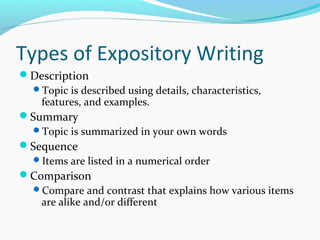
Types of Expository Writing
Description
Topic is described using details, characteristics,
features, and examples.
Summary
Topic is summarized in your own words
Sequence
Items are listed in a numerical order
Comparison
Compare and contrast that explains how various items
are alike and/or different
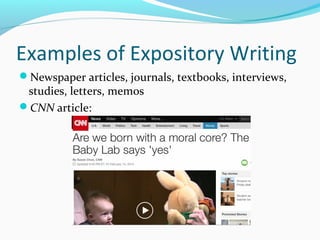
Examples of Expository Writing
Newspaper articles, journals, textbooks, interviews,
studies, letters, memos
CNN article:
What is Argumentative Writing?
Written to persuade the reader to adopt your
position, beliefs, or behavior
Purpose is to convince the reader that your opinion
is correct
Author assumes the reader already has prior
knowledge of the topic
Therefore, do not devote large sections of the essay to
simply summarizing the topic, texts, or material.
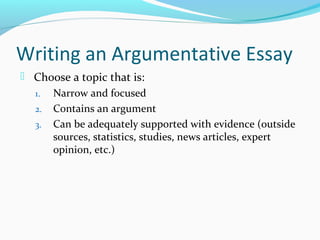
Writing an Argumentative Essay
 Choose a topic that is:
1. Narrow and focused
2. Contains an argument
3. Can be adequately supported with evidence (outside
sources, statistics, studies, news articles, expert
opinion, etc.)
Narrow and Focused
Make sure your thesis statement isn’t too broad and
unfocused.
Zero in on a particular aspect of the media or text to discuss in-
depth
Better to focus on one aspect in-depth than to try to cover a wide
range of issues superficially
Example:
“Fantasy literature uses a good vs. evil plot.”
 Too general.
“Much of fantasy literature, such as Harry Potter and The Lord of the
Rings, features an over-simplistic binary of good versus evil, which
reduces its characters to one-dimensional didactic devices.”
 Focused on particular books and how a good vs. evil plot has
impacted characterization.
Contains an Argument
Make sure your thesis statement takes a clear
stand
Avoid indecisiveness
Example:
“Fantasy literature uses a good vs. evil plot, which can be good
or bad.”
 Vague and indecisive. What is the position? Which side is
supported?
“Much of fantasy literature, such as Harry Potter and The Lord of
the Rings, features an over-simplistic binary of good versus
evil, which reduces its characters to one-dimensional didactic
devices.”
 A clear position is stated (against the good vs. evil plot).
Contains an Argument
Make sure your thesis statement takes a clear
stand
Avoid expository writing
Example:
“Sam Harris says that there can be a moral truth that
science can provide.”
 Merely expository/factual writing that gives the reader
information about Harris’ speech
 Facts cannot be arguments
“Contrary to Harris’ assertions, morality cannot be an
objective truth. Morality is relative to a person’s
viewpoint.”
 Takes a clear position of disagreement with Harris’ claim
Contains an Argument
• Make sure your thesis statement contains your own ideas.
• Example:
– Thesis: “Sam Harris is correct that morality is objective and
all his claims are true.”
• Paper then goes on to summarize Harris’ speech, inserting quotations from
Harris
– A weak thesis statement that demonstrates little insight or individual
thought, and an overall essay that is highly expository in merely
summarizing what Harris has already said.
– Thesis: “As Sam Harris says, science is indeed capable of
providing a universal moral truth that is based on the goal of
decreasing human suffering, an idea that is supported by
scientific findings and contrary to the claims of moral
relativists.”
• Paper then goes on to explain why Harris is correct, using scientific studies as
evidence that humans share a universal morality and that moral relativism is
incorrect.
– A strong thesis statement that clearly agrees with Harris, addressing the
counterargument of moral relativism. Overall essay supports the thesis
statement using concrete evidence from external sources.
– Does not simply repeat Harris’ claims, since Harris never examines specific
scientific studies or moral relativism in-depth.
Evidence
Make sure your thesis statement can be adequately
supported with evidence (outside sources, statistics,
studies, news articles, expert opinion, etc.)
Avoid stating personal feelings
Example:
“I feel that Harry Potter is a boring book to read.”
 Personal feelings cannot be supported with empirical evidence
“Although Harry Potter may be a bestseller, it lacks substance
due to flat characterization.”
 Can be substantiated using examples from the books and
quotations from literary critics
Court Room
Argue like a lawyer presenting a case in a court
room
A lawyer would:
 Take a clear position
 Ex. Either guilty or not guilty
 Present concrete evidence
 Ex. DNA samples, studies, witnesses, interviews, etc.
A lawyer would NOT:
 Make an indecisive claim
 “Maybe he’s guilty, maybe he’s not… I’m not sure… There’s no point in
arguing…”
 Build a case entirely on hypothetical scenarios or use
examples from his/her personal life as evidence
 “The dog must not have bitten the plaintiff, because when I was a child,
I had a dog who was so friendly…”
Purpose
• Expository
– Used to inform, describe, explain, compare, or
summarize in a neutral and objective way
• Argumentative
– Used to persuade the reader that your opinion is
correct
– Opinion is clearly stated, rather than appearing
neutral
• Expository = Facts
Argumentative = Opinion
Focus• Expository
– Focused on information
– Main point: To tell the reader of the facts
– Consider:
• What does the reader need to know about the topic?
• How can I clearly summarize the topic?
• Argumentative
– Focused on an opinion, a debatable claim
– Main point: Convince the reader of the validity of your opinion
using concrete evidence (studies, news articles, expert opinion,
statistics, etc.)
– Consider:
• What real-world examples can I use to support my thesis statement?
• What experts in the field might agree with me?
• How can I address and refute the opposition’s claims?
Structure• Expository
– Introduction: Introduces the reader to the topic
– Body: Describes, explains, informs, classifies, summarizes, and/or
compares various issues regarding the topic
– Conclusion: Reminds the reader of main points and gives sense of
closure
• Argumentative
– Introduction: Leads the reader to your opinion on the topic, which
is clearly stated in a thesis statement of 1-3 sentences
– Body: Discusses the ways in which external sources (ex. studies,
news articles, journals, interviews, etc.) are evidence that support
your thesis statement. Refutes opposing arguments, saying why
counterarguments are incorrect.
– Conclusion: Restates overall argument and gives sense of closure.
(Do not introduce a new argument.)
Using Expository Writing
Where to use exposition in an argumentative paper
Introduction:
J. K. Rowling’s Harry Potter series and J. R. R. Tolkien’s
The Lord of the Rings trilogy are among the bestselling
works of fantasy literature. Both series have had wide
appeal and been adapted into profitable films.
However, much of fantasy literature, such as Harry
Potter and The Lord of the Rings, features an over-
simplistic binary of good versus evil, which reduces
its characters to one-dimensional didactic devices.
 Expository writing is used to introduce the reader to
background information about the topic
Using Expository Writing
Where to use exposition in an argumentative paper
As supporting evidence in the body of your essay:
For instance, little insight is given into the internal lives
of Tolkien’s evil characters, and they become an
essentially homogeneous group defined simply by their
label as ‘evil.’ As Hourihan says, “Nor is Sauron himself
more than a cipher. He has no discernible motivation
[…] Neither Sauron nor his servants the Orcs provide
any insights into the nature of institutionalized or
individual evil […] The Lord of the Rings simply
reasserts the traditional dualisms” (34).
 Expository writing is used to inform the reader of a
critic’s comments
Using Expository Writing
Make sure that your argumentative essay is not
actually an expository essay
Expository writing should be embedded within an
overall argumentative framework
Ask yourself:
 Is my entire essay a compare and contrast?
 Does the majority of my essay merely summarize the topic?
 Does my essay only describe the events?
 If the answer to any of the above is ‘yes,’ then you have
written an expository essay, not an argumentative essay
Writing an Argumentative Essay
 Overall steps
1. Choose a topic
2. Consider both sides of the topic and take a position
3. Find evidence to support your position
4. Plan your essay
○ Consider making an outline to gain a clear picture of how
you will structure your essay and how you will
incorporate the evidence
1. Write your essay
Template
 Introduction
 Thesis statement (clearly stated in 1-3 sentences at the end of the introductory
paragraph)
 Body
 My thesis statement is correct because of [cited quotation/paraphrase from
Example #1]. Example #1 supports my thesis statement in the following ways: x,
y, z…
 My thesis statement is correct because of [cited quotation/paraphrase from
Example #2]. Example #2 supports my thesis statement in the following ways: x,
y, z…
 Counterarguments: Some people do not agree with my thesis statement. For
example, [opponent] claims that [cited quotation/paraphrase from opponent].
However, [cited quotation/paraphrase from opponent] is incorrect in the following
ways: x, y, z…
 Conclusion
 Re-establishes the main points of your argument
 Brings essay to a feeling of closure
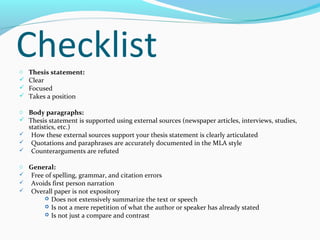
Checklisto Thesis statement:
 Clear
 Focused
 Takes a position
o Body paragraphs:
 Thesis statement is supported using external sources (newspaper articles, interviews, studies,
statistics, etc.)
 How these external sources support your thesis statement is clearly articulated
 Quotations and paraphrases are accurately documented in the MLA style
 Counterarguments are refuted
o General:
 Free of spelling, grammar, and citation errors
 Avoids first person narration
 Overall paper is not expository
 Does not extensively summarize the text or speech
 Is not a mere repetition of what the author or speaker has already stated
 Is not just a compare and contrast
Remember
It is not enough to simply state whether you
agree/disagree with the author or speaker.
Instead, you must clearly articulate why you
agree/disagree.
Always provide evidence from valid external
sources (newspaper articles, studies, interviews,
statistics, expert opinion, etc.) to support your
thesis.
Works Cited
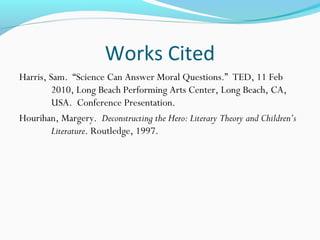
Harris, Sam. “Science Can Answer Moral Questions.” TED, 11 Feb
2010, Long Beach Performing Arts Center, Long Beach, CA,
USA. Conference Presentation.
Hourihan, Margery. Deconstructing the Hero: Literary Theory and Children’s
Literature. Routledge, 1997.

English: Expository vs. Argumentative

  • 1.
  • 2.
    What is ExpositoryWriting? Purely informational, objective writing Written to inform, explain, or describe Author assumes the reader has no prior knowledge of the topic Unlike argumentative/persuasive writing, the primary goal of expository writing is to deliver information about the topic, not to persuade the reader
  • 3.
    Types of ExpositoryWriting Description Topic is described using details, characteristics, features, and examples. Summary Topic is summarized in your own words Sequence Items are listed in a numerical order Comparison Compare and contrast that explains how various items are alike and/or different
  • 4.
    Examples of ExpositoryWriting Newspaper articles, journals, textbooks, interviews, studies, letters, memos CNN article:
  • 5.
    What is ArgumentativeWriting? Written to persuade the reader to adopt your position, beliefs, or behavior Purpose is to convince the reader that your opinion is correct Author assumes the reader already has prior knowledge of the topic Therefore, do not devote large sections of the essay to simply summarizing the topic, texts, or material.
  • 6.
    Writing an ArgumentativeEssay  Choose a topic that is: 1. Narrow and focused 2. Contains an argument 3. Can be adequately supported with evidence (outside sources, statistics, studies, news articles, expert opinion, etc.)
  • 7.
    Narrow and Focused Makesure your thesis statement isn’t too broad and unfocused. Zero in on a particular aspect of the media or text to discuss in- depth Better to focus on one aspect in-depth than to try to cover a wide range of issues superficially Example: “Fantasy literature uses a good vs. evil plot.”  Too general. “Much of fantasy literature, such as Harry Potter and The Lord of the Rings, features an over-simplistic binary of good versus evil, which reduces its characters to one-dimensional didactic devices.”  Focused on particular books and how a good vs. evil plot has impacted characterization.
  • 8.
    Contains an Argument Makesure your thesis statement takes a clear stand Avoid indecisiveness Example: “Fantasy literature uses a good vs. evil plot, which can be good or bad.”  Vague and indecisive. What is the position? Which side is supported? “Much of fantasy literature, such as Harry Potter and The Lord of the Rings, features an over-simplistic binary of good versus evil, which reduces its characters to one-dimensional didactic devices.”  A clear position is stated (against the good vs. evil plot).
  • 9.
    Contains an Argument Makesure your thesis statement takes a clear stand Avoid expository writing Example: “Sam Harris says that there can be a moral truth that science can provide.”  Merely expository/factual writing that gives the reader information about Harris’ speech  Facts cannot be arguments “Contrary to Harris’ assertions, morality cannot be an objective truth. Morality is relative to a person’s viewpoint.”  Takes a clear position of disagreement with Harris’ claim
  • 10.
    Contains an Argument •Make sure your thesis statement contains your own ideas. • Example: – Thesis: “Sam Harris is correct that morality is objective and all his claims are true.” • Paper then goes on to summarize Harris’ speech, inserting quotations from Harris – A weak thesis statement that demonstrates little insight or individual thought, and an overall essay that is highly expository in merely summarizing what Harris has already said. – Thesis: “As Sam Harris says, science is indeed capable of providing a universal moral truth that is based on the goal of decreasing human suffering, an idea that is supported by scientific findings and contrary to the claims of moral relativists.” • Paper then goes on to explain why Harris is correct, using scientific studies as evidence that humans share a universal morality and that moral relativism is incorrect. – A strong thesis statement that clearly agrees with Harris, addressing the counterargument of moral relativism. Overall essay supports the thesis statement using concrete evidence from external sources. – Does not simply repeat Harris’ claims, since Harris never examines specific scientific studies or moral relativism in-depth.
  • 11.
    Evidence Make sure yourthesis statement can be adequately supported with evidence (outside sources, statistics, studies, news articles, expert opinion, etc.) Avoid stating personal feelings Example: “I feel that Harry Potter is a boring book to read.”  Personal feelings cannot be supported with empirical evidence “Although Harry Potter may be a bestseller, it lacks substance due to flat characterization.”  Can be substantiated using examples from the books and quotations from literary critics
  • 12.
    Court Room Argue likea lawyer presenting a case in a court room A lawyer would:  Take a clear position  Ex. Either guilty or not guilty  Present concrete evidence  Ex. DNA samples, studies, witnesses, interviews, etc. A lawyer would NOT:  Make an indecisive claim  “Maybe he’s guilty, maybe he’s not… I’m not sure… There’s no point in arguing…”  Build a case entirely on hypothetical scenarios or use examples from his/her personal life as evidence  “The dog must not have bitten the plaintiff, because when I was a child, I had a dog who was so friendly…”
  • 13.
    Purpose • Expository – Usedto inform, describe, explain, compare, or summarize in a neutral and objective way • Argumentative – Used to persuade the reader that your opinion is correct – Opinion is clearly stated, rather than appearing neutral • Expository = Facts Argumentative = Opinion
  • 14.
    Focus• Expository – Focusedon information – Main point: To tell the reader of the facts – Consider: • What does the reader need to know about the topic? • How can I clearly summarize the topic? • Argumentative – Focused on an opinion, a debatable claim – Main point: Convince the reader of the validity of your opinion using concrete evidence (studies, news articles, expert opinion, statistics, etc.) – Consider: • What real-world examples can I use to support my thesis statement? • What experts in the field might agree with me? • How can I address and refute the opposition’s claims?
  • 15.
    Structure• Expository – Introduction:Introduces the reader to the topic – Body: Describes, explains, informs, classifies, summarizes, and/or compares various issues regarding the topic – Conclusion: Reminds the reader of main points and gives sense of closure • Argumentative – Introduction: Leads the reader to your opinion on the topic, which is clearly stated in a thesis statement of 1-3 sentences – Body: Discusses the ways in which external sources (ex. studies, news articles, journals, interviews, etc.) are evidence that support your thesis statement. Refutes opposing arguments, saying why counterarguments are incorrect. – Conclusion: Restates overall argument and gives sense of closure. (Do not introduce a new argument.)
  • 16.
    Using Expository Writing Whereto use exposition in an argumentative paper Introduction: J. K. Rowling’s Harry Potter series and J. R. R. Tolkien’s The Lord of the Rings trilogy are among the bestselling works of fantasy literature. Both series have had wide appeal and been adapted into profitable films. However, much of fantasy literature, such as Harry Potter and The Lord of the Rings, features an over- simplistic binary of good versus evil, which reduces its characters to one-dimensional didactic devices.  Expository writing is used to introduce the reader to background information about the topic
  • 17.
    Using Expository Writing Whereto use exposition in an argumentative paper As supporting evidence in the body of your essay: For instance, little insight is given into the internal lives of Tolkien’s evil characters, and they become an essentially homogeneous group defined simply by their label as ‘evil.’ As Hourihan says, “Nor is Sauron himself more than a cipher. He has no discernible motivation […] Neither Sauron nor his servants the Orcs provide any insights into the nature of institutionalized or individual evil […] The Lord of the Rings simply reasserts the traditional dualisms” (34).  Expository writing is used to inform the reader of a critic’s comments
  • 18.
    Using Expository Writing Makesure that your argumentative essay is not actually an expository essay Expository writing should be embedded within an overall argumentative framework Ask yourself:  Is my entire essay a compare and contrast?  Does the majority of my essay merely summarize the topic?  Does my essay only describe the events?  If the answer to any of the above is ‘yes,’ then you have written an expository essay, not an argumentative essay
  • 19.
    Writing an ArgumentativeEssay  Overall steps 1. Choose a topic 2. Consider both sides of the topic and take a position 3. Find evidence to support your position 4. Plan your essay ○ Consider making an outline to gain a clear picture of how you will structure your essay and how you will incorporate the evidence 1. Write your essay
  • 20.
    Template  Introduction  Thesisstatement (clearly stated in 1-3 sentences at the end of the introductory paragraph)  Body  My thesis statement is correct because of [cited quotation/paraphrase from Example #1]. Example #1 supports my thesis statement in the following ways: x, y, z…  My thesis statement is correct because of [cited quotation/paraphrase from Example #2]. Example #2 supports my thesis statement in the following ways: x, y, z…  Counterarguments: Some people do not agree with my thesis statement. For example, [opponent] claims that [cited quotation/paraphrase from opponent]. However, [cited quotation/paraphrase from opponent] is incorrect in the following ways: x, y, z…  Conclusion  Re-establishes the main points of your argument  Brings essay to a feeling of closure
  • 21.
    Checklisto Thesis statement: Clear  Focused  Takes a position o Body paragraphs:  Thesis statement is supported using external sources (newspaper articles, interviews, studies, statistics, etc.)  How these external sources support your thesis statement is clearly articulated  Quotations and paraphrases are accurately documented in the MLA style  Counterarguments are refuted o General:  Free of spelling, grammar, and citation errors  Avoids first person narration  Overall paper is not expository  Does not extensively summarize the text or speech  Is not a mere repetition of what the author or speaker has already stated  Is not just a compare and contrast
  • 22.
    Remember It is notenough to simply state whether you agree/disagree with the author or speaker. Instead, you must clearly articulate why you agree/disagree. Always provide evidence from valid external sources (newspaper articles, studies, interviews, statistics, expert opinion, etc.) to support your thesis.
  • 23.
    Works Cited Harris, Sam.“Science Can Answer Moral Questions.” TED, 11 Feb 2010, Long Beach Performing Arts Center, Long Beach, CA, USA. Conference Presentation. Hourihan, Margery. Deconstructing the Hero: Literary Theory and Children’s Literature. Routledge, 1997.