MUHAMMAD AYAZ
MTP 78
LECTURER IN ENGLISH
GDC THANA MALAKAND
TOPIC:
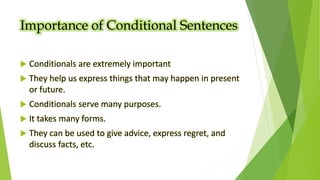
Importance of Conditional Sentences
 Conditionals are extremely important
 They help us express things that may happen in present
or future.
 Conditionals serve many purposes.
 It takes many forms.
 They can be used to give advice, express regret, and
discuss facts, etc.
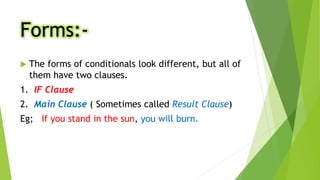
Forms:-
 The forms of conditionals look different, but all of
them have two clauses.
1. IF Clause
2. Main Clause ( Sometimes called Result Clause)
Eg; If you stand in the sun, you will burn.
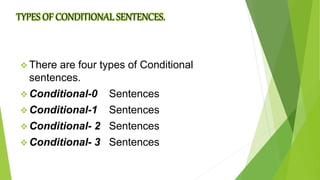
TYPES OF CONDITIONAL SENTENCES.
 There are four types of Conditional
sentences.
 Conditional-0 Sentences
 Conditional-1 Sentences
 Conditional- 2 Sentences
 Conditional- 3 Sentences
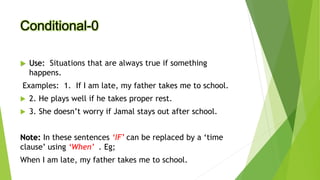
Conditional-0
 Use: Situations that are always true if something
happens.
Examples: 1. If I am late, my father takes me to school.
 2. He plays well if he takes proper rest.
 3. She doesn’t worry if Jamal stays out after school.
Note: In these sentences ‘IF’ can be replaced by a ‘time
clause’ using ‘When’ . Eg;
When I am late, my father takes me to school.
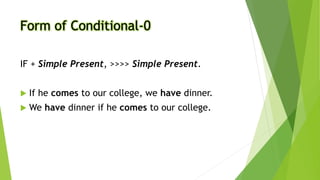
Form of Conditional-0
IF + Simple Present, >>>> Simple Present.
 If he comes to our college, we have dinner.
 We have dinner if he comes to our college.
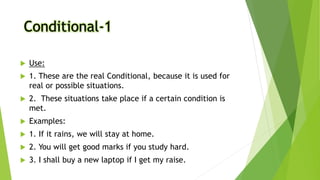
Conditional-1
 Use:
 1. These are the real Conditional, because it is used for
real or possible situations.
 2. These situations take place if a certain condition is
met.
 Examples:
 1. If it rains, we will stay at home.
 2. You will get good marks if you study hard.
 3. I shall buy a new laptop if I get my raise.
Note:
we often use UNLESS with means ‘ if ….. Not’
Eg;
If he doesn’t hurry up, he will miss the party.
Unless he hurries up, he will miss the party.
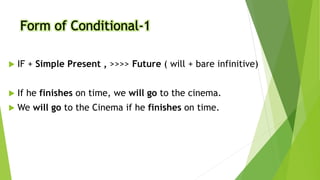
Form of Conditional-1
 IF + Simple Present , >>>> Future ( will + bare infinitive)
 If he finishes on time, we will go to the cinema.
 We will go to the Cinema if he finishes on time.
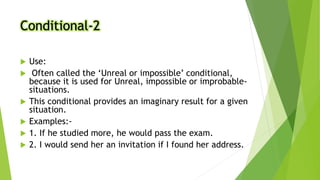
Conditional-2
 Use:
 Often called the ‘Unreal or impossible’ conditional,
because it is used for Unreal, impossible or improbable-
situations.
 This conditional provides an imaginary result for a given
situation.
 Examples:-
 1. If he studied more, he would pass the exam.
 2. I would send her an invitation if I found her address.
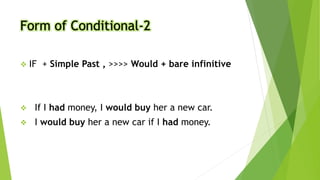
Form of Conditional-2
 IF + Simple Past , >>>> Would + bare infinitive
 If I had money, I would buy her a new car.
 I would buy her a new car if I had money.
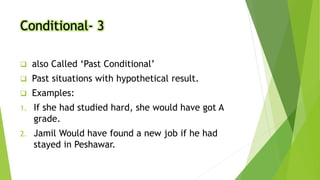
Conditional- 3
 also Called ‘Past Conditional’
 Past situations with hypothetical result.
 Examples:
1. If she had studied hard, she would have got A
grade.
2. Jamil Would have found a new job if he had
stayed in Peshawar.
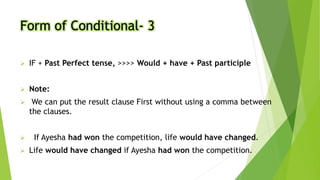
Form of Conditional- 3
 IF + Past Perfect tense, >>>> Would + have + Past participle
 Note:
 We can put the result clause First without using a comma between
the clauses.
 If Ayesha had won the competition, life would have changed.
 Life would have changed if Ayesha had won the competition.
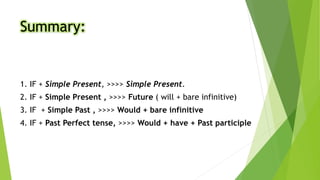
Summary:
1. IF + Simple Present, >>>> Simple Present.
2. IF + Simple Present , >>>> Future ( will + bare infinitive)
3. IF + Simple Past , >>>> Would + bare infinitive
4. IF + Past Perfect tense, >>>> Would + have + Past participle
THANK YOU.

English conditional Sentences

  • 2.
    MUHAMMAD AYAZ MTP 78 LECTURERIN ENGLISH GDC THANA MALAKAND
  • 3.
  • 4.
    Importance of ConditionalSentences  Conditionals are extremely important  They help us express things that may happen in present or future.  Conditionals serve many purposes.  It takes many forms.  They can be used to give advice, express regret, and discuss facts, etc.
  • 5.
    Forms:-  The formsof conditionals look different, but all of them have two clauses. 1. IF Clause 2. Main Clause ( Sometimes called Result Clause) Eg; If you stand in the sun, you will burn.
  • 6.
    TYPES OF CONDITIONALSENTENCES.  There are four types of Conditional sentences.  Conditional-0 Sentences  Conditional-1 Sentences  Conditional- 2 Sentences  Conditional- 3 Sentences
  • 7.
    Conditional-0  Use: Situationsthat are always true if something happens. Examples: 1. If I am late, my father takes me to school.  2. He plays well if he takes proper rest.  3. She doesn’t worry if Jamal stays out after school. Note: In these sentences ‘IF’ can be replaced by a ‘time clause’ using ‘When’ . Eg; When I am late, my father takes me to school.
  • 8.
    Form of Conditional-0 IF+ Simple Present, >>>> Simple Present.  If he comes to our college, we have dinner.  We have dinner if he comes to our college.
  • 9.
    Conditional-1  Use:  1.These are the real Conditional, because it is used for real or possible situations.  2. These situations take place if a certain condition is met.  Examples:  1. If it rains, we will stay at home.  2. You will get good marks if you study hard.  3. I shall buy a new laptop if I get my raise.
  • 10.
    Note: we often useUNLESS with means ‘ if ….. Not’ Eg; If he doesn’t hurry up, he will miss the party. Unless he hurries up, he will miss the party.
  • 11.
    Form of Conditional-1 IF + Simple Present , >>>> Future ( will + bare infinitive)  If he finishes on time, we will go to the cinema.  We will go to the Cinema if he finishes on time.
  • 12.
    Conditional-2  Use:  Oftencalled the ‘Unreal or impossible’ conditional, because it is used for Unreal, impossible or improbable- situations.  This conditional provides an imaginary result for a given situation.  Examples:-  1. If he studied more, he would pass the exam.  2. I would send her an invitation if I found her address.
  • 13.
    Form of Conditional-2 IF + Simple Past , >>>> Would + bare infinitive  If I had money, I would buy her a new car.  I would buy her a new car if I had money.
  • 14.
    Conditional- 3  alsoCalled ‘Past Conditional’  Past situations with hypothetical result.  Examples: 1. If she had studied hard, she would have got A grade. 2. Jamil Would have found a new job if he had stayed in Peshawar.
  • 15.
    Form of Conditional-3  IF + Past Perfect tense, >>>> Would + have + Past participle  Note:  We can put the result clause First without using a comma between the clauses.  If Ayesha had won the competition, life would have changed.  Life would have changed if Ayesha had won the competition.
  • 16.
    Summary: 1. IF +Simple Present, >>>> Simple Present. 2. IF + Simple Present , >>>> Future ( will + bare infinitive) 3. IF + Simple Past , >>>> Would + bare infinitive 4. IF + Past Perfect tense, >>>> Would + have + Past participle
  • 17.