WELCOME TO
WELCOME TO
OUR ENGLISH
OUR ENGLISH
PROJECT ON
PROJECT ON
MYSTERIES OF
MYSTERIES OF
ANCIENT
ANCIENT
EGYPT
EGYPT
CIVILISATIONS
CIVILISATIONS
Project by:
PRANSHU KUMAR ANAND
HARSHIT
SHUBHAM
JUNAID
ATUL MAHESWARI
SESSION:2023-2024
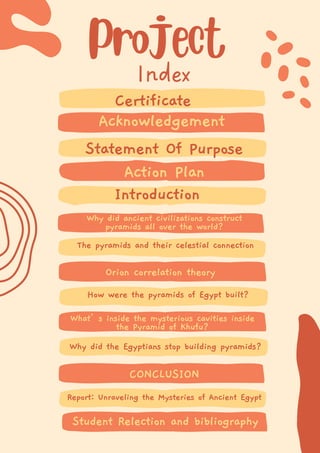
Index
Project
Action Plan
Introduction
Statement Of Purpose
Certificate
Acknowledgement
The pyramids and their celestial connection
Why did ancient civilizations construct
pyramids all over the world?
Orion correlation theory
How were the pyramids of Egypt built?
What’s inside the mysterious cavities inside
the Pyramid of Khufu?
Why did the Egyptians stop building pyramids?
CONCLUSION
Report: Unraveling the Mysteries of Ancient Egypt
Student Relection and bibliography
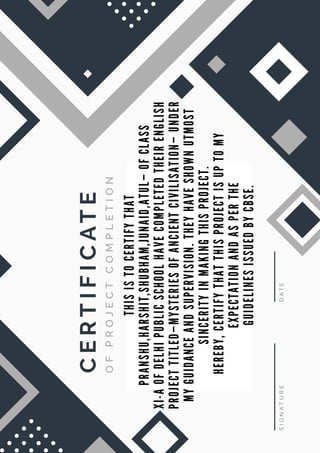
THIS
IS
TO
CERTIFY
THAT
PRANSHU,HARSHIT,SHUBHAM,JUNAID,ATUL—
OF
CLASS
XI-A
OF
DELHI
PUBLIC
SCHOOL
HAVE
COMPLETED
THEIR
ENGLISH
PROJECT
TITLED—MYSTERIES
OF
ANCIENT
CIVILISATION—
UNDER
MY
GUIDANCE
AND
SUPERVISION.
THEY
HAVE
SHOWN
UTMOST
SINCERITY
IN
MAKING
THIS
PROJECT.
HEREBY,
CERTIFY
THAT
THIS
PROJECT
IS
UP
TO
MY
EXPECTATION
AND
AS
PER
THE
GUIDELINES
ISSUED
BY
CBSE.
Acknowledgement
W E A R E U S I N G T H I S O P P O R T U N I T Y
T O E X P R E S S O U R G R A T I T U D E
T O W A R D S T E A C H E R M S P R I Y A N K A
W H O G A V E U S T H I S G O L D E N
O P P O R T U N I T Y T O D O S U C H A G O O D
P R O J E C T O N T H E T O P I C
" M Y S T E R I E S O F A N C I E N T
C I V I L I S A T I O N " . W E A R E T H A N K F U L
T O E V E R Y O N E W H O S U P P O R T E D U S
F O R T H E C O M P L E T I O N O F T H I S
P R O J E C T A N D G A V E U S T H E I R
A S P I R I N G G U I D A N C E , F R I E N D L Y
A D V I C E A N D I N V A L U A B L E
F E E D B A C K D U R I N G T H E P R O J E C T .
W E A R E S I N C E R E L Y G R A T E F U L T O
A L L O F O U R F R I E N D S , C O -
P A R T N E R S , F A M I L Y A N D G U I D E
W H O S H A R E D T H E I R T R U T H F U L
A N D I L L U M I N A T I N G V I E W S O N A
N U M B E R O F I S S U R E S R E L A T E D T O
T H E P R O J E C T B Y D E V O T I N G T H E I R
P R E C I O U S T I M E . T H A N K Y O U
STATEMENT OF
PURPOSE
To find about theories and stories of
deep hidden mysteries like the story of
king tut
we have done project on this topic because-
To know about the mystical structures,
technology of ancient civisilization
To appreciate the culture and beliefs
of ancient people
To develop and fulfill curiosity of
learning about interesting mysteries
and thrillers about ancient history
wonders
ACTION
PLAN
Our action plan was as follows:
First we all chose this topic
“mysteries of ancient civilizations”
Next we discussed the topics to be
included in the project in a clean
way.
After a lot of research and
watching a ton of videos we formed
the majority of the content
Next we started finding acticles and
paper about the following topics on
the internet websites
Lastly we added the other required
pages with suitable images
The Ancient Egyptian civilization can only be
defined as a twilight zone where the mind and
the soul are trapped in a work of sci-fi or an
enchanting fairytale filled with immortal
puzzles and heavenly wonders. Under the
mythological sands of Egypt lies some of
history's most unsolved mysteries that keep
challenging the concepts of reason & reality
till our current day. Egypt is one of the most
researched ancient cultures as for the last two
centuries it has been the obsession of countless
historians and archaeologists. Their culture
and technology is a gift that keeps on giving
as a lot of mysteries remain unsolved, every
time an archaeological discovery is made in
the magical destination of Egypt like Luxor &
Aswan, an infinite number of unanswered
questions keep popping up. For the last 1000
years, researchers have explored this 4
millennia-year-old civilization across vast
deserts to uncover the secret of their
immortality using Modern science and some
artifacts like the Rosetta stone which were
able to give explanations and answers but
some mysteries remain unsolved.
INTRO
INTRODUCTION
DUCTION
•One of the common aspects which most surprises
people is the construction of pyramids in the
ancient world. These majestic monuments can be
found in all the corners of the world, from terraced
pyramids circular pyramids, and the classics.
Almost all the ancient cultures of the world
constructed incredible pyramids which challenge
our current understanding of some of the most
incredible civilizations on Earth.
1.
•The inhabitants of ancient Egypt, ancient China,
the Pre-Incas, Incas, Aztecs, Mayas and many other
ancient cultures raised pyramids which still exist
today.
2.
•No one has been able to understand what the true
purpose of the pyramids was. Destined to be used
as tombs? As monuments to honor the gods? Or is
it possible that, as many believe today, the
pyramids were constructed in order to make use of
the natural energy of the planet and the universe?
3.
•The mystery around the pyramids gets deeper
when you realize that some of them, like the
pyramids of the Giza plateau are aligned
astronomically. The truth is that, although we have
dealt a great deal with understanding the
fundamental principles of the pyramids which
ancient cultures constructed, we still have no idea
how they were capable of raising these majestic
buildings and what their true purpose was?
4.
Why did ancient civilizations construct
pyramids all over the world?
•There is a certain celestial connection existent among the Giza
Pyramids. Does it reveal an interaction with “beings come from
heaven”? The same pattern can also be found in the pyramids of
Xian. Without doubt, it is more than a simple coincidence.
1.
•The fact that the cultures and civilizations of the world would
construct monuments is something fascinating and the fact that
nearly all of them share architectural similarities is simply
amazing, but we cannot forget the celestial connection that the
majority of them also share.
2.
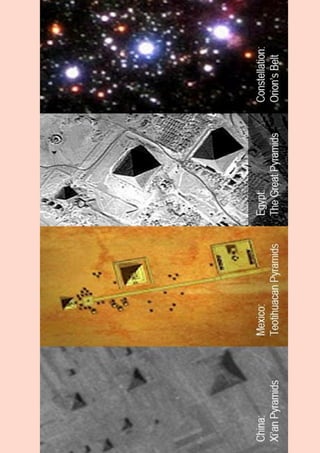
•If we focus on the pyramids of the Giza plateau, the pyramids of
Teotihuacan and even the Chinese pyramids, we will discover
that all of them seem to be aligned particularly to the
constellations. In this case we are speaking of the constellation of
Orion, which apparently was of highest importance not only for
the ancient Egyptians, but also for the ancient Aztecs and their
predecessors, ancient China, and other civilizations of the world.
How they were able to position these monuments with such
precision in order to imitate the cosmos is something that no one
has been able to comprehend, and it remains as one of the great
enigmas of history.
3.
The pyramids and their celestial connection
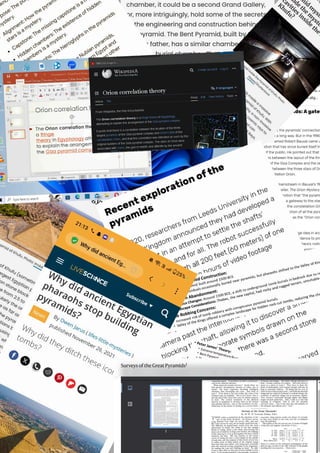
•The Orion correlation theory is a fringe theory in Egyptology
attempting to explain the arrangement of the Giza pyramid
complex.
1.
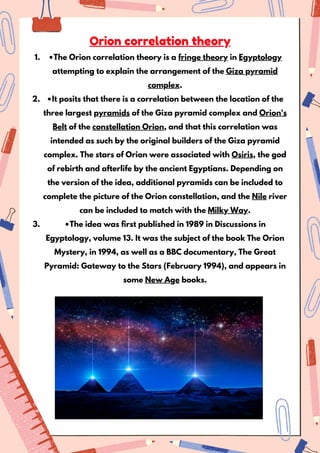
•It posits that there is a correlation between the location of the
three largest pyramids of the Giza pyramid complex and Orion's
Belt of the constellation Orion, and that this correlation was
intended as such by the original builders of the Giza pyramid
complex. The stars of Orion were associated with Osiris, the god
of rebirth and afterlife by the ancient Egyptians. Depending on
the version of the idea, additional pyramids can be included to
complete the picture of the Orion constellation, and the Nile river
can be included to match with the Milky Way.
2.
•The idea was first published in 1989 in Discussions in
Egyptology, volume 13. It was the subject of the book The Orion
Mystery, in 1994, as well as a BBC documentary, The Great
Pyramid: Gateway to the Stars (February 1994), and appears in
some New Age books.
3.
Orion correlation theory
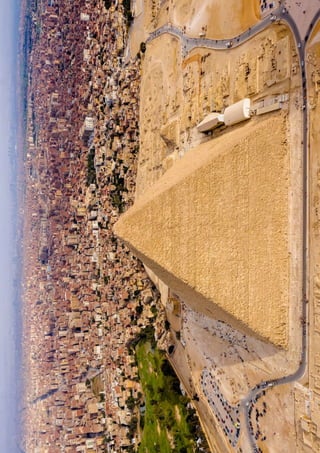
•The Pyramid of Khufu (sometimes called Cheops), the largest Egyptian
pyramid, is made of 2.3 million stone blocks, each weighing anywhere
from 2.5 to 16 tons. Some of the blocks, particularly the ones used in
the inner chambers, came as far as Aswan, 500 miles from Giza where
the pyramid stands. But how did ancient Egyptians build such massive
pyramids without using simple machines such as the wheel, which,
while used by Egyptians for pottery making, was not used for carts or
chariots until 1500 BCE, likely because wheels weren’t much use in the
thick sand that covered the country? It’s an age-old mystery and one
that continues to be an enigma for ancient monumental complexes
across the world. While there are numerous theories, there is a lack of
hard, archaeological evidence to fully support any one of them.
•One theory about how the blocks were moved involves sleds and wet
sand. A painting in the tomb of Djehutihotep shows men dragging a
colossal statue on a sled. In front of them, a person pours water onto
the sand. While initially thought to be a ceremonial gesture, physicist
Daniel Bonn recently discovered that the right amount of water, about
two to five percent of the volume of sand, increased the stiffness of the
sand and reduced the friction between the object being dragged and
the ground, making the object much easier to move. The same
technique may have been used to drag stone blocks to pyramid
construction sites.
•Once the blocks were at the pyramid’s construction site, however,
how were they lifted into place without the use of mechanical
advantage? A ramp found in a quarry dating to the construction of the
Pyramid of Khufu indicates that ancient Egyptians were able to pull
stone blocks out of the quarry on a steep upward slope. It’s possible
that similar ramps were used to haul stones up the pyramid’s sides to
be placed. However, the exact system is unknown. The ramps could
have been on the outside of the pyramid, spiraling up like a mountain
road, or straight and long, or built within the pyramid. How a 16-ton
block could have been moved up a ramp is also unknown, with theories
ranging from sleds to wooden rollers to wooden posts tied to each side
of a block, changing the shape from square to polygon and allowing
them to be rolled like a keg of beer.
How were the pyramids of Egypt built?
What’s inside the mysterious cavities inside
the Pyramid of Khufu?
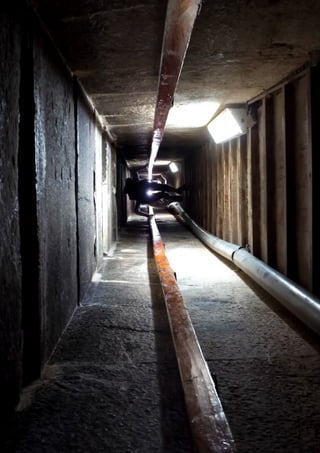
•In 2017, Scan Pyramids made a massive discovery inside the Pyramid
of Khufu. With the aid of muon-tomography, a non-invasive scanning
technique that uses cosmic rays to produce 3D images of spaces and
can penetrate much more deeply than X Rays, researchers discovered
two previously unknown voids inside the pyramid, the first new spaces
found inside the pyramid since the 19th century.
•A small void was detected on the pyramid’s north face,
approximately 15 feet long. Horizontal and sloping upwards, this could
be a passageway. More significantly, a 100-foot-long void was found
above the Grand Gallery, itself a magnificent passageway that
provides access to the burial chambers towards the center of the
pyramid.
Not much is known about this larger chamber. It could be either
horizontal or at a slope and may actually be made up of several
smaller rooms. While it is unlikely to be a burial chamber, it could be a
second Grand Gallery, or, more intriguingly, hold some of the secrets to
the engineering and construction behind the pyramid. The Bent
Pyramid, built by Snefru, Khufu’s father, has a similar chamber above
the main burial chamber. The space is believed to help reduce the
weight of masonry pressing down from above.
•Scan Pyramids has plans to scan more pyramids, including the
Pyramid of Khafre, Egypt’s second largest. What other secrets could
muon-tomography reveal about ancient Egypt’s monuments? Time will
tell.
Why did the Egyptians stop building
pyramids?
•The last royal pyramid was built around 1500 BCE. Afterward, while
wealthy individuals were occasionally buried in or near pyramids,
pharaohs were buried in the Valley of Kings, near Thebes (modern-day
Luxor), the new capital of ancient Egypt. What exactly caused the
rulers of Egypt to abandon the practice of pyramid burials is unknown,
though many theories exist.
•One theory is that religious changes around 1500 BCE began
emphasizing building tombs underground, in the bedrock, rather than
interring bodies in pyramids. Thebes, unlike the previous Egyptian
capital, Memphis, had far less open space and what little there was
rocky and rugged, hardly the ideal landscape to build massive
monuments.
•Tomb robbing was also an issue, and there was far less chance that
burials would be looted if they weren’t placed in such conspicuous
settings as horizon-dominating pyramids. The Valley of the Kings is a
cliffy, complex landscape that was easy to hide royal burials and rock-
cut tombs in. Tuthmosis, the first pharaoh to be buried in the Valley of
Kings, hired a man named Ineni to inspect the excavation of his tomb.
In his autobiography, Tuthmosis wrote, “I inspected the excavation of
the cliff tomb of his Majesty alone, no one seeing, no one hearing.”
Entrances were kept secret and necropolis guards patrolled the area
for looters.
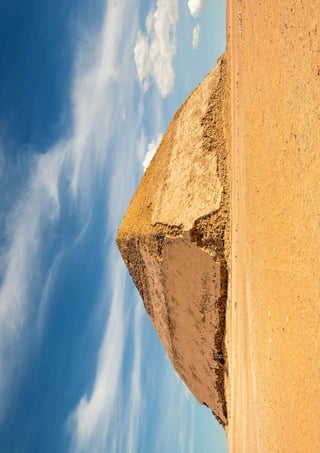
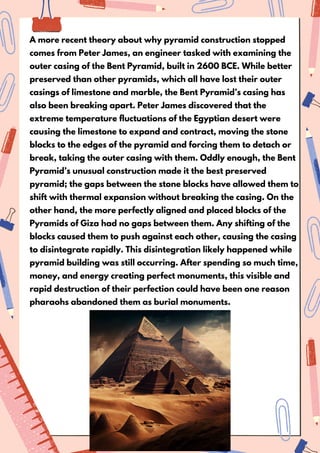
A more recent theory about why pyramid construction stopped
comes from Peter James, an engineer tasked with examining the
outer casing of the Bent Pyramid, built in 2600 BCE. While better
preserved than other pyramids, which all have lost their outer
casings of limestone and marble, the Bent Pyramid’s casing has
also been breaking apart. Peter James discovered that the
extreme temperature fluctuations of the Egyptian desert were
causing the limestone to expand and contract, moving the stone
blocks to the edges of the pyramid and forcing them to detach or
break, taking the outer casing with them. Oddly enough, the Bent
Pyramid’s unusual construction made it the best preserved
pyramid; the gaps between the stone blocks have allowed them to
shift with thermal expansion without breaking the casing. On the
other hand, the more perfectly aligned and placed blocks of the
Pyramids of Giza had no gaps between them. Any shifting of the
blocks caused them to push against each other, causing the casing
to disintegrate rapidly. This disintegration likely happened while
pyramid building was still occurring. After spending so much time,
money, and energy creating perfect monuments, this visible and
rapid destruction of their perfection could have been one reason
pharaohs abandoned them as burial monuments.
CONCLUSION
The Mysteries of Ancient Egypt continue to captivate and perplex
us. These enigmatic puzzles remind us that, despite our advances
in technology and research, there is still much to learn about the
ancient world. As we continue to uncover new evidence and
reevaluate old theories, the secrets of this remarkable civilization
may one day be revealed.
Report: Unraveling the Mysteries
of Ancient Egypt
Introduction: The allure of ancient Egypt lies in its twilight zone,
where immortal puzzles and heavenly wonders captivate the mind
and soul. Over the last two centuries, this civilization has been an
obsession for countless historians and archaeologists, providing a
continuous stream of unsolved mysteries. The focus of this report
is to delve into the heart of these mysteries, particularly those
surrounding pyramid construction, celestial connections, and the
intriguing reasons behind the abandonment of this monumental
burial practice.
Pyramid Construction: Ancient civilizations worldwide, including
Egypt, China, and the Americas, constructed pyramids that challenge
our understanding of their technological capabilities. The purpose of
these structures remains elusive, leading to speculations about
tombs, religious monuments, or energy harnessing devices. The
alignment of pyramids with celestial bodies, particularly Orion's Belt,
adds a layer of complexity to the mystery. The Orion correlation
theory suggests a deliberate connection between the layout of the
Giza pyramid complex and the stars in Orion's Belt, emphasizing the
celestial significance embedded in these architectural wonders.
Celestial Connections: The celestial connection among the Giza
Pyramids, Teotihuacan, and Chinese pyramids raises questions about
an interaction with beings from heaven. The alignment with the
constellation of Orion spans across different cultures, emphasizing
its importance for ancient Egyptians, Aztecs, and other civilizations.
The precision with which these monuments mirror the cosmos remains
a profound enigma, challenging our understanding of ancient
knowledge and technology.
Pyramid of Khufu's Mysteries: Recent technological advancements,
such as muon-tomography, have revealed previously unknown
voids within the Pyramid of Khufu. These discoveries, made by Scan
Pyramids in 2017, include a small passageway on the pyramid's
north face and a significant 100-foot-long void above the Grand
Gallery. While the purpose of these cavities is not fully understood,
they fuel speculation about additional chambers or insights into the
pyramid's engineering and construction. The continuous
exploration of these mysteries through cutting-edge technology
keeps the narrative of ancient Egypt alive.
Reasons for Pyramid Abandonment: The report explores various
theories regarding why the Egyptians ceased building pyramids
around 1500 BCE. Shifts in religious practices favoring underground
tombs, the practicality of the Valley of Kings, and the challenge of
tomb robbery are considered potential factors. Additionally, the
environmental impact, particularly the extreme temperature
fluctuations causing the disintegration of limestone casing, is
proposed as a reason for the abandonment of the pyramid-building
tradition.
Conclusion: The mysteries of ancient Egypt persist, challenging our
understanding of history, technology, and the cosmos. From the
celestial alignments of pyramids to the technological marvels
hidden within, each discovery opens new avenues of inquiry. As we
unravel the enigma of ancient Egypt, the journey continues, fueled
by the fascination and curiosity that this twilight zone of history
evokes.
In our personal viewpoint on ancient Egyptian pyramids embraces the
complexity and richness of their narrative. These structures stand as
a testament to human ingenuity, spiritual significance, and an
enduring enigma that continues to captivate generations. As we
unravel the layers of history, my appreciation for the twilight zone of
ancient Egypt grows, fueled by the perpetual allure of the pyramids
and the mysteries they hold.
Student
Student
Student
Reflection
Reflection
Reflection
Undertaking the pyramid mysteries project broadened our
understanding of ancient civilizations and their architectural
marvels. We learned about diverse theories on the purpose of
pyramids and the interconnectedness of global civilizations in
adopting similar structures.
Learnings:
Appreciation for ancient engineering.
1.
Exploration of various pyramid theories.
2.
Understanding the interconnectedness of civilizations.
3.
Hone research and presentation skills.
4.
Strengths:
Curiosity and eagerness to learn.
1.
Adaptability in navigating diverse sources.
2.
Attention to detail in deciphering hieroglyphs and nuances.
3.
Weaknesses:
Time management balancing school commitments.
1.
Overreliance on specific sources.
2.
Difficulty in balancing depth and brevity in presentation.
3.
In summary, the project was a rewarding exploration of pyramid
mysteries, highlighting strengths like curiosity and adaptability, but
also areas for improvement in time management and source
diversity. This experience enhances our commitment to
understanding historical phenomena deeply.
Conclusion
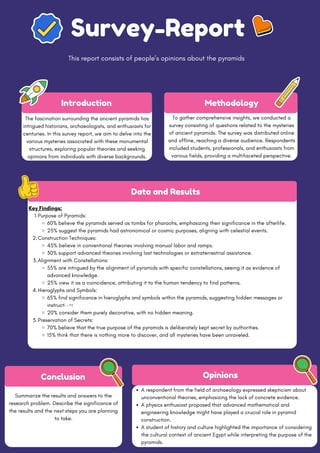
Introduction
The fascination surrounding the ancient pyramids has
intrigued historians, archaeologists, and enthusiasts for
centuries. In this survey report, we aim to delve into the
various mysteries associated with these monumental
structures, exploring popular theories and seeking
opinions from individuals with diverse backgrounds.
Methodology
To gather comprehensive insights, we conducted a
survey consisting of questions related to the mysteries
of ancient pyramids. The survey was distributed online
and offline, reaching a diverse audience. Respondents
included students, professionals, and enthusiasts from
various fields, providing a multifaceted perspective.
Data and Results
Key Findings:
Purpose of Pyramids:
1.
60% believe the pyramids served as tombs for pharaohs, emphasizing their significance in the afterlife.
25% suggest the pyramids had astronomical or cosmic purposes, aligning with celestial events.
Construction Techniques:
2.
45% believe in conventional theories involving manual labor and ramps.
30% support advanced theories involving lost technologies or extraterrestrial assistance.
Alignment with Constellations:
3.
55% are intrigued by the alignment of pyramids with specific constellations, seeing it as evidence of
advanced knowledge.
25% view it as a coincidence, attributing it to the human tendency to find patterns.
Hieroglyphs and Symbols:
4.
65% find significance in hieroglyphs and symbols within the pyramids, suggesting hidden messages or
instructions.
20% consider them purely decorative, with no hidden meaning.
Preservation of Secrets:
5.
70% believe that the true purpose of the pyramids is deliberately kept secret by authorities.
15% think that there is nothing more to discover, and all mysteries have been unraveled.
Survey-Report
This report consists of people’s opinions about the pyramids
Summarize the results and answers to the
research problem. Describe the significance of
the results and the next steps you are planning
to take.
References
A respondent from the field of archaeology expressed skepticism about
unconventional theories, emphasizing the lack of concrete evidence.
A physics enthusiast proposed that advanced mathematical and
engineering knowledge might have played a crucial role in pyramid
construction.
A student of history and culture highlighted the importance of considering
the cultural context of ancient Egypt while interpreting the purpose of the
pyramids.
Opinions
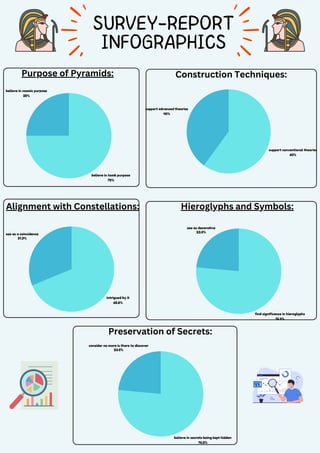
believe in tomb purpose
75%
believe in cosmic purpose
25%
support conventional theories
60%
support advanced theories
40%
intrigued by it
68.8%
see as a coincidence
31.3%
find significance in hieroglyphs
76.5%
see as decorative
23.5%
believe in secrets being kept hidden
76.5%
consider no more is there to discover
23.5%
SURVEY-REPORT
INFOGRAPHICS
Purpose of Pyramids:
Preservation of Secrets:
Hieroglyphs and Symbols:
Alignment with Constellations:
Construction Techniques:
Biblio
Biblio graphy
graphy
https://matadornetwork.com/read
/pyramid-mysteries/
https://chat.openai.com/
https://www.egypttoursportal.com
https://www.youtube.com
https://en.wikipedia.org/wiki/Orion
_correlation_theory
https://en.wikipedia.org/wiki/Orion
_correlation_theory
https://www.history.com/

English art integrated project class 11 CBSE

  • 1.
    WELCOME TO WELCOME TO OURENGLISH OUR ENGLISH PROJECT ON PROJECT ON MYSTERIES OF MYSTERIES OF ANCIENT ANCIENT EGYPT EGYPT CIVILISATIONS CIVILISATIONS Project by: PRANSHU KUMAR ANAND HARSHIT SHUBHAM JUNAID ATUL MAHESWARI SESSION:2023-2024
  • 2.
    Index Project Action Plan Introduction Statement OfPurpose Certificate Acknowledgement The pyramids and their celestial connection Why did ancient civilizations construct pyramids all over the world? Orion correlation theory How were the pyramids of Egypt built? What’s inside the mysterious cavities inside the Pyramid of Khufu? Why did the Egyptians stop building pyramids? CONCLUSION Report: Unraveling the Mysteries of Ancient Egypt Student Relection and bibliography
  • 3.
  • 4.
    Acknowledgement W E AR E U S I N G T H I S O P P O R T U N I T Y T O E X P R E S S O U R G R A T I T U D E T O W A R D S T E A C H E R M S P R I Y A N K A W H O G A V E U S T H I S G O L D E N O P P O R T U N I T Y T O D O S U C H A G O O D P R O J E C T O N T H E T O P I C " M Y S T E R I E S O F A N C I E N T C I V I L I S A T I O N " . W E A R E T H A N K F U L T O E V E R Y O N E W H O S U P P O R T E D U S F O R T H E C O M P L E T I O N O F T H I S P R O J E C T A N D G A V E U S T H E I R A S P I R I N G G U I D A N C E , F R I E N D L Y A D V I C E A N D I N V A L U A B L E F E E D B A C K D U R I N G T H E P R O J E C T . W E A R E S I N C E R E L Y G R A T E F U L T O A L L O F O U R F R I E N D S , C O - P A R T N E R S , F A M I L Y A N D G U I D E W H O S H A R E D T H E I R T R U T H F U L A N D I L L U M I N A T I N G V I E W S O N A N U M B E R O F I S S U R E S R E L A T E D T O T H E P R O J E C T B Y D E V O T I N G T H E I R P R E C I O U S T I M E . T H A N K Y O U
  • 5.
    STATEMENT OF PURPOSE To findabout theories and stories of deep hidden mysteries like the story of king tut we have done project on this topic because- To know about the mystical structures, technology of ancient civisilization To appreciate the culture and beliefs of ancient people To develop and fulfill curiosity of learning about interesting mysteries and thrillers about ancient history wonders
  • 6.
    ACTION PLAN Our action planwas as follows: First we all chose this topic “mysteries of ancient civilizations” Next we discussed the topics to be included in the project in a clean way. After a lot of research and watching a ton of videos we formed the majority of the content Next we started finding acticles and paper about the following topics on the internet websites Lastly we added the other required pages with suitable images
  • 8.
    The Ancient Egyptiancivilization can only be defined as a twilight zone where the mind and the soul are trapped in a work of sci-fi or an enchanting fairytale filled with immortal puzzles and heavenly wonders. Under the mythological sands of Egypt lies some of history's most unsolved mysteries that keep challenging the concepts of reason & reality till our current day. Egypt is one of the most researched ancient cultures as for the last two centuries it has been the obsession of countless historians and archaeologists. Their culture and technology is a gift that keeps on giving as a lot of mysteries remain unsolved, every time an archaeological discovery is made in the magical destination of Egypt like Luxor & Aswan, an infinite number of unanswered questions keep popping up. For the last 1000 years, researchers have explored this 4 millennia-year-old civilization across vast deserts to uncover the secret of their immortality using Modern science and some artifacts like the Rosetta stone which were able to give explanations and answers but some mysteries remain unsolved. INTRO INTRODUCTION DUCTION
  • 10.
    •One of thecommon aspects which most surprises people is the construction of pyramids in the ancient world. These majestic monuments can be found in all the corners of the world, from terraced pyramids circular pyramids, and the classics. Almost all the ancient cultures of the world constructed incredible pyramids which challenge our current understanding of some of the most incredible civilizations on Earth. 1. •The inhabitants of ancient Egypt, ancient China, the Pre-Incas, Incas, Aztecs, Mayas and many other ancient cultures raised pyramids which still exist today. 2. •No one has been able to understand what the true purpose of the pyramids was. Destined to be used as tombs? As monuments to honor the gods? Or is it possible that, as many believe today, the pyramids were constructed in order to make use of the natural energy of the planet and the universe? 3. •The mystery around the pyramids gets deeper when you realize that some of them, like the pyramids of the Giza plateau are aligned astronomically. The truth is that, although we have dealt a great deal with understanding the fundamental principles of the pyramids which ancient cultures constructed, we still have no idea how they were capable of raising these majestic buildings and what their true purpose was? 4. Why did ancient civilizations construct pyramids all over the world?
  • 12.
    •There is acertain celestial connection existent among the Giza Pyramids. Does it reveal an interaction with “beings come from heaven”? The same pattern can also be found in the pyramids of Xian. Without doubt, it is more than a simple coincidence. 1. •The fact that the cultures and civilizations of the world would construct monuments is something fascinating and the fact that nearly all of them share architectural similarities is simply amazing, but we cannot forget the celestial connection that the majority of them also share. 2. •If we focus on the pyramids of the Giza plateau, the pyramids of Teotihuacan and even the Chinese pyramids, we will discover that all of them seem to be aligned particularly to the constellations. In this case we are speaking of the constellation of Orion, which apparently was of highest importance not only for the ancient Egyptians, but also for the ancient Aztecs and their predecessors, ancient China, and other civilizations of the world. How they were able to position these monuments with such precision in order to imitate the cosmos is something that no one has been able to comprehend, and it remains as one of the great enigmas of history. 3. The pyramids and their celestial connection
  • 14.
    •The Orion correlationtheory is a fringe theory in Egyptology attempting to explain the arrangement of the Giza pyramid complex. 1. •It posits that there is a correlation between the location of the three largest pyramids of the Giza pyramid complex and Orion's Belt of the constellation Orion, and that this correlation was intended as such by the original builders of the Giza pyramid complex. The stars of Orion were associated with Osiris, the god of rebirth and afterlife by the ancient Egyptians. Depending on the version of the idea, additional pyramids can be included to complete the picture of the Orion constellation, and the Nile river can be included to match with the Milky Way. 2. •The idea was first published in 1989 in Discussions in Egyptology, volume 13. It was the subject of the book The Orion Mystery, in 1994, as well as a BBC documentary, The Great Pyramid: Gateway to the Stars (February 1994), and appears in some New Age books. 3. Orion correlation theory
  • 16.
    •The Pyramid ofKhufu (sometimes called Cheops), the largest Egyptian pyramid, is made of 2.3 million stone blocks, each weighing anywhere from 2.5 to 16 tons. Some of the blocks, particularly the ones used in the inner chambers, came as far as Aswan, 500 miles from Giza where the pyramid stands. But how did ancient Egyptians build such massive pyramids without using simple machines such as the wheel, which, while used by Egyptians for pottery making, was not used for carts or chariots until 1500 BCE, likely because wheels weren’t much use in the thick sand that covered the country? It’s an age-old mystery and one that continues to be an enigma for ancient monumental complexes across the world. While there are numerous theories, there is a lack of hard, archaeological evidence to fully support any one of them. •One theory about how the blocks were moved involves sleds and wet sand. A painting in the tomb of Djehutihotep shows men dragging a colossal statue on a sled. In front of them, a person pours water onto the sand. While initially thought to be a ceremonial gesture, physicist Daniel Bonn recently discovered that the right amount of water, about two to five percent of the volume of sand, increased the stiffness of the sand and reduced the friction between the object being dragged and the ground, making the object much easier to move. The same technique may have been used to drag stone blocks to pyramid construction sites. •Once the blocks were at the pyramid’s construction site, however, how were they lifted into place without the use of mechanical advantage? A ramp found in a quarry dating to the construction of the Pyramid of Khufu indicates that ancient Egyptians were able to pull stone blocks out of the quarry on a steep upward slope. It’s possible that similar ramps were used to haul stones up the pyramid’s sides to be placed. However, the exact system is unknown. The ramps could have been on the outside of the pyramid, spiraling up like a mountain road, or straight and long, or built within the pyramid. How a 16-ton block could have been moved up a ramp is also unknown, with theories ranging from sleds to wooden rollers to wooden posts tied to each side of a block, changing the shape from square to polygon and allowing them to be rolled like a keg of beer. How were the pyramids of Egypt built?
  • 18.
    What’s inside themysterious cavities inside the Pyramid of Khufu? •In 2017, Scan Pyramids made a massive discovery inside the Pyramid of Khufu. With the aid of muon-tomography, a non-invasive scanning technique that uses cosmic rays to produce 3D images of spaces and can penetrate much more deeply than X Rays, researchers discovered two previously unknown voids inside the pyramid, the first new spaces found inside the pyramid since the 19th century. •A small void was detected on the pyramid’s north face, approximately 15 feet long. Horizontal and sloping upwards, this could be a passageway. More significantly, a 100-foot-long void was found above the Grand Gallery, itself a magnificent passageway that provides access to the burial chambers towards the center of the pyramid. Not much is known about this larger chamber. It could be either horizontal or at a slope and may actually be made up of several smaller rooms. While it is unlikely to be a burial chamber, it could be a second Grand Gallery, or, more intriguingly, hold some of the secrets to the engineering and construction behind the pyramid. The Bent Pyramid, built by Snefru, Khufu’s father, has a similar chamber above the main burial chamber. The space is believed to help reduce the weight of masonry pressing down from above. •Scan Pyramids has plans to scan more pyramids, including the Pyramid of Khafre, Egypt’s second largest. What other secrets could muon-tomography reveal about ancient Egypt’s monuments? Time will tell.
  • 20.
    Why did theEgyptians stop building pyramids? •The last royal pyramid was built around 1500 BCE. Afterward, while wealthy individuals were occasionally buried in or near pyramids, pharaohs were buried in the Valley of Kings, near Thebes (modern-day Luxor), the new capital of ancient Egypt. What exactly caused the rulers of Egypt to abandon the practice of pyramid burials is unknown, though many theories exist. •One theory is that religious changes around 1500 BCE began emphasizing building tombs underground, in the bedrock, rather than interring bodies in pyramids. Thebes, unlike the previous Egyptian capital, Memphis, had far less open space and what little there was rocky and rugged, hardly the ideal landscape to build massive monuments. •Tomb robbing was also an issue, and there was far less chance that burials would be looted if they weren’t placed in such conspicuous settings as horizon-dominating pyramids. The Valley of the Kings is a cliffy, complex landscape that was easy to hide royal burials and rock- cut tombs in. Tuthmosis, the first pharaoh to be buried in the Valley of Kings, hired a man named Ineni to inspect the excavation of his tomb. In his autobiography, Tuthmosis wrote, “I inspected the excavation of the cliff tomb of his Majesty alone, no one seeing, no one hearing.” Entrances were kept secret and necropolis guards patrolled the area for looters.
  • 21.
    A more recenttheory about why pyramid construction stopped comes from Peter James, an engineer tasked with examining the outer casing of the Bent Pyramid, built in 2600 BCE. While better preserved than other pyramids, which all have lost their outer casings of limestone and marble, the Bent Pyramid’s casing has also been breaking apart. Peter James discovered that the extreme temperature fluctuations of the Egyptian desert were causing the limestone to expand and contract, moving the stone blocks to the edges of the pyramid and forcing them to detach or break, taking the outer casing with them. Oddly enough, the Bent Pyramid’s unusual construction made it the best preserved pyramid; the gaps between the stone blocks have allowed them to shift with thermal expansion without breaking the casing. On the other hand, the more perfectly aligned and placed blocks of the Pyramids of Giza had no gaps between them. Any shifting of the blocks caused them to push against each other, causing the casing to disintegrate rapidly. This disintegration likely happened while pyramid building was still occurring. After spending so much time, money, and energy creating perfect monuments, this visible and rapid destruction of their perfection could have been one reason pharaohs abandoned them as burial monuments.
  • 22.
    CONCLUSION The Mysteries ofAncient Egypt continue to captivate and perplex us. These enigmatic puzzles remind us that, despite our advances in technology and research, there is still much to learn about the ancient world. As we continue to uncover new evidence and reevaluate old theories, the secrets of this remarkable civilization may one day be revealed.
  • 23.
    Report: Unraveling theMysteries of Ancient Egypt Introduction: The allure of ancient Egypt lies in its twilight zone, where immortal puzzles and heavenly wonders captivate the mind and soul. Over the last two centuries, this civilization has been an obsession for countless historians and archaeologists, providing a continuous stream of unsolved mysteries. The focus of this report is to delve into the heart of these mysteries, particularly those surrounding pyramid construction, celestial connections, and the intriguing reasons behind the abandonment of this monumental burial practice. Pyramid Construction: Ancient civilizations worldwide, including Egypt, China, and the Americas, constructed pyramids that challenge our understanding of their technological capabilities. The purpose of these structures remains elusive, leading to speculations about tombs, religious monuments, or energy harnessing devices. The alignment of pyramids with celestial bodies, particularly Orion's Belt, adds a layer of complexity to the mystery. The Orion correlation theory suggests a deliberate connection between the layout of the Giza pyramid complex and the stars in Orion's Belt, emphasizing the celestial significance embedded in these architectural wonders. Celestial Connections: The celestial connection among the Giza Pyramids, Teotihuacan, and Chinese pyramids raises questions about an interaction with beings from heaven. The alignment with the constellation of Orion spans across different cultures, emphasizing its importance for ancient Egyptians, Aztecs, and other civilizations. The precision with which these monuments mirror the cosmos remains a profound enigma, challenging our understanding of ancient knowledge and technology.
  • 24.
    Pyramid of Khufu'sMysteries: Recent technological advancements, such as muon-tomography, have revealed previously unknown voids within the Pyramid of Khufu. These discoveries, made by Scan Pyramids in 2017, include a small passageway on the pyramid's north face and a significant 100-foot-long void above the Grand Gallery. While the purpose of these cavities is not fully understood, they fuel speculation about additional chambers or insights into the pyramid's engineering and construction. The continuous exploration of these mysteries through cutting-edge technology keeps the narrative of ancient Egypt alive. Reasons for Pyramid Abandonment: The report explores various theories regarding why the Egyptians ceased building pyramids around 1500 BCE. Shifts in religious practices favoring underground tombs, the practicality of the Valley of Kings, and the challenge of tomb robbery are considered potential factors. Additionally, the environmental impact, particularly the extreme temperature fluctuations causing the disintegration of limestone casing, is proposed as a reason for the abandonment of the pyramid-building tradition. Conclusion: The mysteries of ancient Egypt persist, challenging our understanding of history, technology, and the cosmos. From the celestial alignments of pyramids to the technological marvels hidden within, each discovery opens new avenues of inquiry. As we unravel the enigma of ancient Egypt, the journey continues, fueled by the fascination and curiosity that this twilight zone of history evokes. In our personal viewpoint on ancient Egyptian pyramids embraces the complexity and richness of their narrative. These structures stand as a testament to human ingenuity, spiritual significance, and an enduring enigma that continues to captivate generations. As we unravel the layers of history, my appreciation for the twilight zone of ancient Egypt grows, fueled by the perpetual allure of the pyramids and the mysteries they hold.
  • 25.
    Student Student Student Reflection Reflection Reflection Undertaking the pyramidmysteries project broadened our understanding of ancient civilizations and their architectural marvels. We learned about diverse theories on the purpose of pyramids and the interconnectedness of global civilizations in adopting similar structures. Learnings: Appreciation for ancient engineering. 1. Exploration of various pyramid theories. 2. Understanding the interconnectedness of civilizations. 3. Hone research and presentation skills. 4. Strengths: Curiosity and eagerness to learn. 1. Adaptability in navigating diverse sources. 2. Attention to detail in deciphering hieroglyphs and nuances. 3. Weaknesses: Time management balancing school commitments. 1. Overreliance on specific sources. 2. Difficulty in balancing depth and brevity in presentation. 3. In summary, the project was a rewarding exploration of pyramid mysteries, highlighting strengths like curiosity and adaptability, but also areas for improvement in time management and source diversity. This experience enhances our commitment to understanding historical phenomena deeply.
  • 28.
    Conclusion Introduction The fascination surroundingthe ancient pyramids has intrigued historians, archaeologists, and enthusiasts for centuries. In this survey report, we aim to delve into the various mysteries associated with these monumental structures, exploring popular theories and seeking opinions from individuals with diverse backgrounds. Methodology To gather comprehensive insights, we conducted a survey consisting of questions related to the mysteries of ancient pyramids. The survey was distributed online and offline, reaching a diverse audience. Respondents included students, professionals, and enthusiasts from various fields, providing a multifaceted perspective. Data and Results Key Findings: Purpose of Pyramids: 1. 60% believe the pyramids served as tombs for pharaohs, emphasizing their significance in the afterlife. 25% suggest the pyramids had astronomical or cosmic purposes, aligning with celestial events. Construction Techniques: 2. 45% believe in conventional theories involving manual labor and ramps. 30% support advanced theories involving lost technologies or extraterrestrial assistance. Alignment with Constellations: 3. 55% are intrigued by the alignment of pyramids with specific constellations, seeing it as evidence of advanced knowledge. 25% view it as a coincidence, attributing it to the human tendency to find patterns. Hieroglyphs and Symbols: 4. 65% find significance in hieroglyphs and symbols within the pyramids, suggesting hidden messages or instructions. 20% consider them purely decorative, with no hidden meaning. Preservation of Secrets: 5. 70% believe that the true purpose of the pyramids is deliberately kept secret by authorities. 15% think that there is nothing more to discover, and all mysteries have been unraveled. Survey-Report This report consists of people’s opinions about the pyramids Summarize the results and answers to the research problem. Describe the significance of the results and the next steps you are planning to take. References A respondent from the field of archaeology expressed skepticism about unconventional theories, emphasizing the lack of concrete evidence. A physics enthusiast proposed that advanced mathematical and engineering knowledge might have played a crucial role in pyramid construction. A student of history and culture highlighted the importance of considering the cultural context of ancient Egypt while interpreting the purpose of the pyramids. Opinions
  • 29.
    believe in tombpurpose 75% believe in cosmic purpose 25% support conventional theories 60% support advanced theories 40% intrigued by it 68.8% see as a coincidence 31.3% find significance in hieroglyphs 76.5% see as decorative 23.5% believe in secrets being kept hidden 76.5% consider no more is there to discover 23.5% SURVEY-REPORT INFOGRAPHICS Purpose of Pyramids: Preservation of Secrets: Hieroglyphs and Symbols: Alignment with Constellations: Construction Techniques:
  • 30.